
Sales Development
SDR vs BDR: What's the Difference and Which Does Your Team Need?
An SDR qualifies leads; a BDR generates them. That is the standard answer, and it is only half the picture: the industry uses these titles in two different ways. ConnectLoop works alongside both, covering the inbound qualification layer around the clock.

Published
Table of contents
- What is the actual difference between an SDR and a BDR?
- Why do two credible sources give opposite definitions?
- How do you tell which job a listing is actually describing?
- What does each role do day to day?
- What do SDRs and BDRs have in common?
- Which role should you take?
- Which role should you hire first?
- What has changed at the top of the funnel?
- How does ConnectLoop fit alongside an SDR or BDR team?
- Where the human roles stay essential
- Key takeaways
- Frequently asked questions
What is the actual difference between an SDR and a BDR?
In the most widely used version: a BDR generates new pipeline through outbound prospecting, and an SDR qualifies inbound leads that marketing produced. BDR sits at the very top of the funnel. SDR sits just behind it, deciding which leads deserve an Account Executive's time.
That is the definition most sales teams operate on.
It is also not the only one in circulation, which is where most of the confusion in this topic comes from.
Both roles are early-career sales development positions. Neither closes deals. Both hand qualified opportunities to Account Executives, and both are measured on activity and meetings booked rather than revenue signed.
The overlap is significant enough that people move between the two titles routinely, often without changing what they do all day.
Why do two credible sources give opposite definitions?
Because the titles are not standardised, and the two highest-ranking articles on this subject define them in opposite ways. This is not a subtlety: it is a direct contradiction that neither article acknowledges.
Set them side by side.
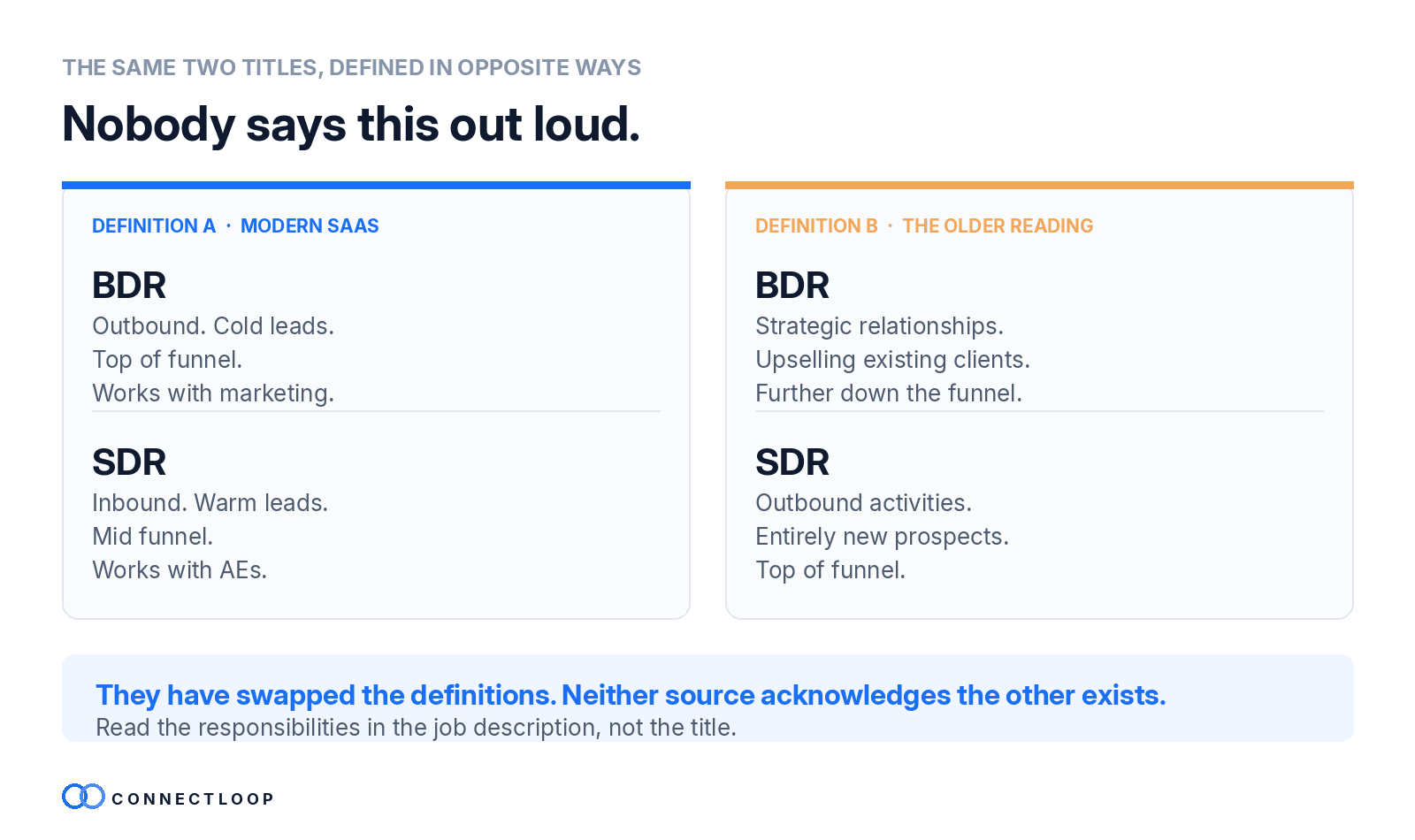
Amplemarket defines a BDR as focused on outbound prospecting, targeting cold leads at the top of the funnel, working closely with marketing. Their SDR handles inbound and warm leads, working closely with Account Executives, positioned mid-funnel.
memoryBlue defines it the other way round. Their SDR “generally engages in outbound activities,” reaching entirely new prospects at the top of the funnel. Their BDR focuses on “strategic relationship-building,” works with existing clients on upselling and cross-selling, and operates “further down the funnel.”
Definition A: BDR is outbound, SDR is inbound
The version used by most modern SaaS organisations, and the one Amplemarket describes.
- BDR: cold outreach, cold calling, social selling, generating net-new pipeline
- SDR: responding to inbound enquiries, qualifying marketing-generated leads, booking meetings for AEs
Definition B: SDR is outbound, BDR is business development
The older and more literal reading, and the one memoryBlue uses.
- SDR: all prospecting and qualification, inbound and outbound
- BDR: partnerships, new markets, account expansion, upselling into existing customers
Neither is wrong. They come from different eras and different company types. Definition B reads “business development” literally, as the function it originally described: partnerships and market expansion. Definition A treats BDR as a prospecting title, which is how most software companies now use it.
The practical consequence: the title on a job advert tells you very little on its own. What matters is what the responsibilities section says.
How do you tell which job a listing is actually describing?
Read the activities, not the title. A job description reveals which definition a company is using within about four lines, and those four lines matter far more than whether the role is called SDR or BDR.
Here is how to read one.
- Find where the leads come from. “Respond to inbound enquiries” and “follow up on marketing-qualified leads” means inbound qualification. “Build target account lists” and “cold outreach” means outbound prospecting. This single distinction decides most of what the job feels like.
- Check who they hand off to. Handing off to Account Executives means this is a sales development role in the modern sense. Handing off to a partnerships or business development manager means it is Definition B.
- Look at the metrics. Meetings booked and qualified opportunities means prospecting or qualification. Partnerships signed, accounts expanded, or revenue influenced means genuine business development.
- Note whether existing customers appear. Upselling and cross-selling to current accounts is a strong signal of Definition B. If the role never touches existing customers, it is top-of-funnel work.
- Find the volume expectation. A daily activity target of 60 to 100 touches is prospecting. A target measured in accounts rather than activities is strategic.
- Check the reporting line. Reporting into marketing or demand generation suggests inbound qualification. Reporting into a sales manager suggests outbound.
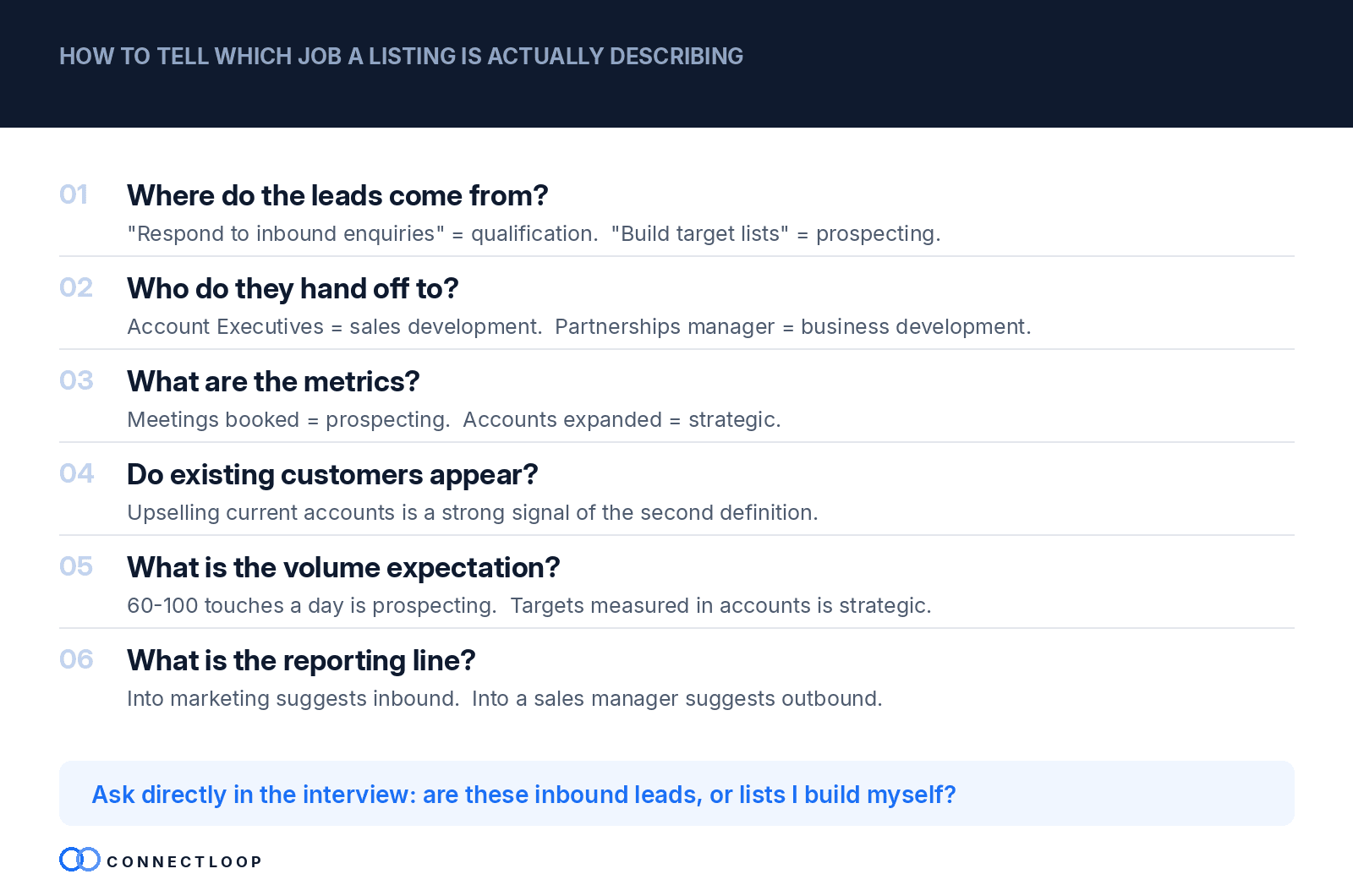
Ask directly in the interview. “Are these inbound leads or lists I build myself?” is a fair question, and the answer tells you more than the title ever will.
What does each role do day to day?
The daily work diverges more than the definitions suggest. One role spends its day starting conversations that nobody asked for; the other spends it responding to conversations someone already started.
Using Definition A, the version most software companies operate on:
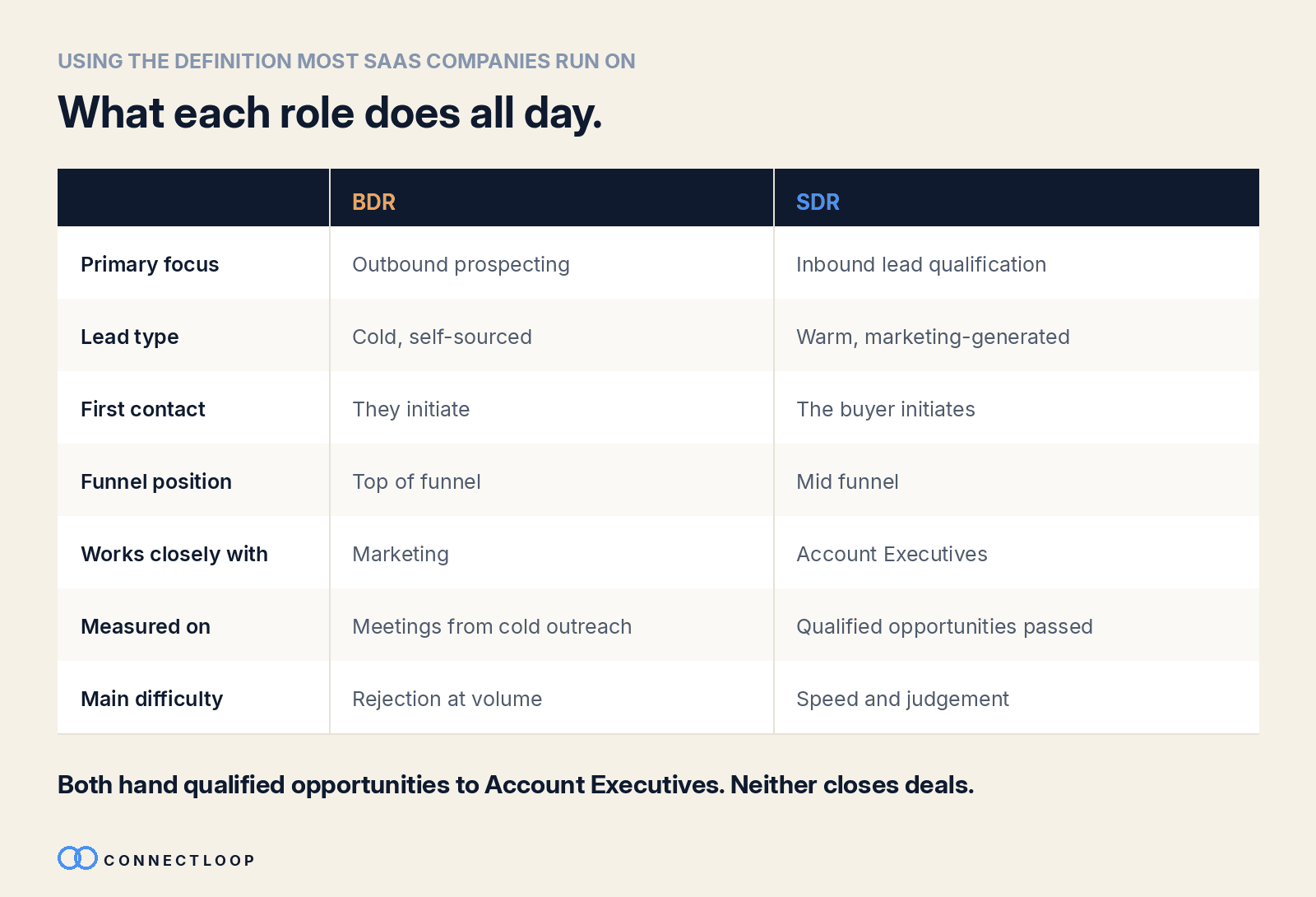
The emotional shape of the two jobs is different, and this matters more than most career advice admits.
A BDR is interrupting people. Most of those people did not want to be interrupted, and the rejection rate reflects that. The skill is resilience and finding the small percentage who are receptive.
An SDR is responding to people who raised their hand. The pressure is different: the lead is warm, the opportunity is real, and losing it is a visible failure rather than an expected outcome.
What do SDRs and BDRs have in common?
More than the comparison table suggests. Both are early-career sales roles with overlapping skill sets, similar career paths, and the same fundamental job: producing qualified conversations for someone else to close.
Skills that transfer directly between the two:
- Lead qualification: identifying which prospects are worth advancing
- Objection handling: responding to resistance without becoming defensive
- Effective communication: conveying a value proposition quickly
- Relationship building: creating enough trust for a next conversation
- Strategic planning: identifying which accounts or segments to prioritise
- Collaboration with marketing: aligning on what qualified actually means
- Resilience: both roles involve substantial rejection
- Organisation: managing pipeline, follow-up and CRM hygiene at volume
The career paths converge too. Both commonly lead to Account Executive, and from there to sales management. Both also transfer well into customer success, account management and demand generation.
Time in role is often quoted at one to two years before promotion, though the sources making that claim do not provide evidence for it. Treat it as convention rather than a benchmark.
Which role should you take?
If you are choosing between two offers, ignore the titles and choose based on the lead source. That single variable determines what your day looks like more than anything else in the job description.
Take the outbound role if:
- You want to build something from nothing and can tolerate a high rejection rate
- You are interested in the strategic side: segmentation, messaging, list building
- You want the skill that transfers most widely, because prospecting is valuable everywhere
- You would rather control your own pipeline than depend on marketing's output
Take the inbound role if:
- You want conversations with people who are already interested
- You are strong at thinking on your feet under time pressure
- You want to develop qualification judgement early, which is what AEs are actually hired for
- You would rather have fewer, deeper conversations than many shallow ones
One caution worth having. An inbound role at a company with weak inbound is worse than an outbound role at a company with a good motion. Ask how many inbound leads the team gets per rep per month before you accept anything.
Which role should you hire first?
It depends on whether you have demand or need to create it. Hiring an inbound qualifier when nothing is coming in produces an expensive person with nothing to do. Hiring an outbound prospector when your inbound is already unmanaged means you are buying volume you cannot service.
Hire outbound first if:
- Your inbound is thin and you need pipeline now
- You are entering a new market or segment with no awareness
- Your ICP is narrow and identifiable, so target lists are buildable
- Deal sizes justify the cost of prospecting into named accounts
Hire inbound qualification first if:
- Enquiries are arriving and going unanswered or under-qualified
- Your Account Executives are spending time on unqualified calls
- Marketing is producing volume and nobody is filtering it
- Response times are measured in days rather than minutes
Check the unanswered enquiries before deciding. Filter your shared inbox to last month, and count the messages that received no reply at all. Most teams have never run this and the number is consistently higher than expected. If it is large, you have a coverage problem, and another person may not be the fastest fix.
What has changed at the top of the funnel?
The part of both jobs that involves answering the same questions repeatedly is no longer necessarily human work. That is a genuine shift, and the existing writing on this topic largely predates it.
Neither of the two most-cited articles on SDR versus BDR mentions AI, automation or software at any point.
Three things have moved.
First response no longer has to wait for a working day. A meaningful share of inbound arrives outside office hours, and until recently the only options were a rota or accepting the delay.
Initial qualification can happen in conversation. Frameworks like SPIN and MEDDIC are structured sets of questions. Asking them consistently is a discipline problem, not a judgement problem, and discipline is what software is good at.
The repetitive layer is separable from the skilled layer. The same eight questions asked in forty different ways is work that has to happen but does not require a person to happen well.
What has not changed: reading a room, hearing the thing behind an objection, and knowing when to push and when to leave it. That is what you hire an SDR or BDR to learn, and it is not what software does well.
How does ConnectLoop fit alongside an SDR or BDR team?
ConnectLoop AI sales agents cover the inbound qualification layer: answering questions, qualifying with SPIN and MEDDIC, and booking meetings, so that the people you hire spend their time on conversations where judgement matters.
It is not a replacement for either role.
Where ConnectLoop sits in the funnel:
- A visitor arrives and asks something. Lia answers from your approved knowledge base, product pages, documentation and playbooks, rather than from generic AI output. When the answer is not there, she says so and flags the gap.
- Qualification happens in the conversation. Lia runs SPIN and MEDDIC as natural questions rather than a form, capturing needs, pain, budget, authority and timing.
- Every conversation is scored. Hot, warm or cold, based on what was said and done rather than what someone typed into a field.
- Meetings are booked in the thread. Against real Google Calendar or Outlook availability, with no link to click and no email back-and-forth.
- The rep inherits context. Transcript, qualification answers and intent score, so the first human conversation starts from something rather than nothing.
- Follow-up is drafted, a person approves it. Proactive Outreach writes the follow-up based on what was actually discussed, and a human reviews, edits and sends it. That approval step is deliberate: it protects sender reputation, which takes months to build and about a week to damage.
- Everything syncs. Conversations, contacts and meetings go to HubSpot, Salesforce, Pipedrive or Zoho automatically.
ConnectLoop works across website chat, WhatsApp and email, with one shared conversation memory. ConnectLoop is Google CASA Tier 2 verified and an official Meta Business Partner.
Where it fits: the inbound qualification layer, which is the SDR job under Definition A. ConnectLoop is built for conversations a buyer started, which is why teams run it alongside outbound rather than instead of it.
Where the human roles stay essential
Software handles the repetitive layer well. Judgement, demand creation and hiring decisions stay firmly human, and knowing where that line sits is what makes the combination work.
Four things worth being clear about.
- Outbound stays a human job. If your challenge is that nobody knows you exist yet, that is BDR territory and worth hiring for directly.
- Targeting comes first. Faster qualification multiplies whatever is arriving, so getting the right people to the site is the step that pays for everything after it.
- Reading a room stays human. The pause before an objection, the thing someone left unsaid, the moment to stop selling: that is exactly why these roles exist and why they are worth developing.
- Your content sets the ceiling. Lia answers from your approved material, and flags every question it could not cover, which turns a blind spot into a list your team can actually work through.
Key takeaways
- The two titles are not standardised, and the two most-cited articles on this subject define them in opposite ways without acknowledging the disagreement.
- Definition A, used by most SaaS companies: BDR is outbound and cold, SDR is inbound and warm.
- Definition B, the older reading: SDR covers all prospecting, BDR covers partnerships and account expansion.
- Read the activities, not the title. Where the leads come from and who you hand off to describe the job better than the acronym.
- Both roles share most of their skills, qualification, objection handling, communication, resilience, and people move between them routinely.
- Hire outbound when you need pipeline. Hire inbound qualification when enquiries are already going unanswered. Count the unanswered messages first.
- The repetitive layer at the top of the funnel is now separable from the skilled layer, which is the thing existing writing on this subject predates.
- Software works alongside both roles. It takes the part that never needed a person, so the people you hire spend their time on the conversations that do.

About the author
ConnectLoop Staff
Written by the ConnectLoop team. ConnectLoop is an AI sales agent for inbound revenue teams, based in Cambridge, Massachusetts.
About ConnectLoop →Frequently asked questions
In the most common definition, a BDR generates new pipeline through outbound prospecting and an SDR qualifies inbound leads for Account Executives. However, some organisations reverse this, using SDR for all prospecting and BDR for partnerships and account expansion. The responsibilities in the job description are more reliable than the title.
Because the titles are not standardised. Amplemarket defines BDR as outbound and SDR as inbound. memoryBlue defines SDR as outbound and BDR as strategic account development. Both are in current use: Definition A comes from modern SaaS practice, Definition B from the original meaning of business development.
Neither is inherently more senior. Both are early-career sales development roles that typically report into sales or demand generation and hand qualified opportunities to Account Executives. Seniority depends on the company, not the acronym.
Yes, and it happens frequently. The two roles share qualification, objection handling, communication and pipeline management skills. The main adjustment is moving between responding to interest and creating it, which is more of a mindset change than a skills gap.
Hire outbound if your inbound is thin and you need pipeline. Hire inbound qualification if enquiries are already arriving and going unanswered or under-qualified. Count the unanswered messages in your shared inbox from last month before deciding; that number usually settles the question.
No. Software handles the repetitive layer: answering common questions, running qualification frameworks consistently, booking meetings around the clock. Judgement, objection reading and knowing when to stop selling stay human, which is what these roles exist to develop.
ConnectLoop is built for inbound revenue teams: it answers, qualifies and books meetings from conversations a buyer started. Teams running outbound typically pair it with a BDR function, so each side does what it is best at.
One to two years is the figure commonly quoted before promotion to Account Executive. The widely cited sources for this do not provide evidence, so treat it as convention rather than a benchmark.
SPIN and MEDDIC are the most common in inbound qualification, with BANT still widely used. ConnectLoop runs SPIN and MEDDIC inside the conversation, capturing needs, pain, budget, authority and timing as natural questions rather than a form.
Ask where the leads come from, how many arrive per rep per month, who you hand off to, and what you are measured on. Those four answers describe the job more accurately than any title.
See what your inbound actually looks like
ConnectLoop answers inbound questions, qualifies with SPIN and MEDDIC, and books meetings inside the conversation, so the reps you hire start from context rather than a name and an email address.