
AI Sales Agents
What Is an AI SDR? The Complete Guide
Someone is on your pricing page right now. It is late at night where they live. They have one final question before they book a demo, but nobody is available to answer it. By the next morning, they have already moved on to a competitor.

Published
This happens every day in B2B sales. Research consistently shows that responding to a new lead within five minutes dramatically increases the chances of turning that prospect into a qualified sales opportunity.
Yet many businesses still rely on manual follow-ups, limited business hours, and overloaded sales teams, causing valuable opportunities to slip away.
This is where AI SDRs (Artificial Intelligence Sales Development Representatives) are changing the way modern sales teams operate.
Instead of waiting for a human to respond, an AI SDR engages prospects instantly, qualifies leads through natural conversations, answers common questions, personalizes outreach, and schedules meetings automatically 24/7 and across multiple channels.
In this guide, you'll learn what an AI SDR is, how it works, its key benefits, common challenges, pricing considerations, and best practices for implementing one successfully in your sales process.
Along the way, we'll show where a tool like ConnectLoop fits in, so no late-night visitor on your pricing page ever goes unanswered again.
Never Miss Another High-Intent Lead
Every minute a prospect waits for a reply reduces your chances of converting them. ConnectLoop's AI Sales Agent responds instantly across your website, WhatsApp, and email, qualifies leads, answers questions using your own knowledge base, and books meetings automatically.
Try Live DemoTable of contents
- Key takeaways
- Why this matters right now
- What is an AI SDR?
- What does an AI SDR do?
- How does an AI SDR work?
- AI SDR vs human SDR: what is the difference?
- AI SDR vs AI BDR vs AI sales agent
- How do teams use AI SDRs?
- What are the main benefits of an AI SDR?
- How much does an AI SDR cost?
- Why do AI SDRs fail?
- Where AI SDRs are headed
- Getting started
- Frequently asked questions
Key takeaways
- An AI SDR automates the first stage of sales prospecting, qualifying leads, outreach, follow-up, and booking meetings.
- The biggest win is speed AI replies in under a minute, at any hour.
- AI SDRs do not replace human sellers they remove repetitive work so people can focus on real conversations.
- Many deployments fail they quietly stop being used within the first few months, almost always because of bad data, poor email setup, or no human oversight.
- Email is no longer enough WhatsApp and website chat now get far more replies, especially in Latin America, South Asia, and the Middle East.
Why this matters right now

Most sales development reps are missing quota. Quota attainment has been falling across B2B sales teams for years, not because reps got worse, but because the first-response part of the job (finding, qualifying, and following up with leads) eats most of their day before real selling even starts.
AI SDRs are the reason that's starting to change.
What is an AI SDR?
An AI SDR is software that does the job of a sales development representative. It uses AI to find leads, research them, talk to them in natural language, qualify them, and book meetings. Unlike older sales tools, it does not just follow a fixed script. It reads each reply, understands the meaning, and decides what to do next.
A sales development representative, or SDR, is usually the first person a buyer talks to. Their job is to filter leads so that account executives only spend time on serious buyers.
The work is repetitive. Most of an SDR's day goes to building lists, sending follow-ups, and updating the CRM rather than selling.
An AI SDR takes over that repetitive part.
Here is the difference in practice. An old automation tool sends the same message on a fixed schedule.
An AI SDR reads a reply like “We already use another tool, but our contract ends in March,” understands this is interest rather than rejection, updates the lead, writes a suitable answer, and schedules a follow-up for February. Nobody has to tell it to do that.
You may also see the same product called: AI BDR, virtual SDR, AI sales agent, AI sales rep, or autonomous SDR.
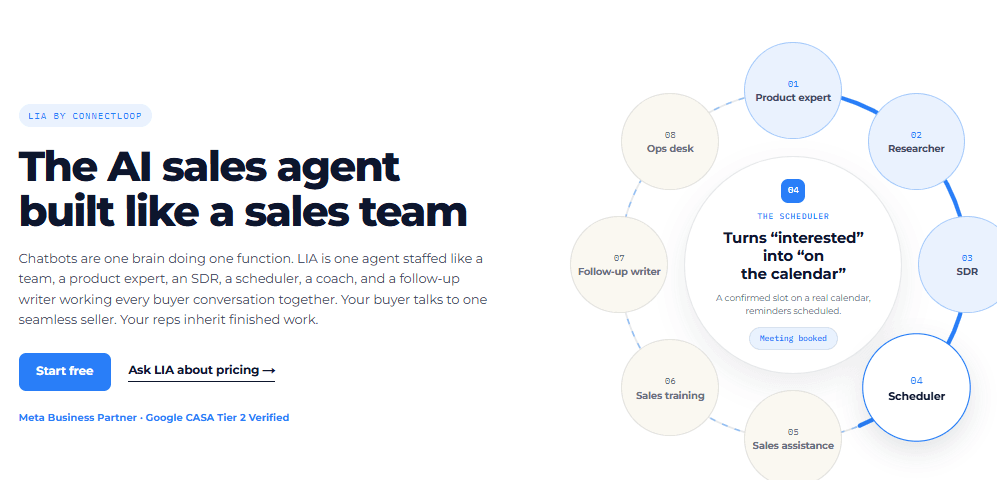
ConnectLoop's AI sales agent, LIA, is built around exactly this idea. It doesn't just fire off scripted messages, it reads the intent behind a reply and decides the next best action on its own.
What does an AI SDR do?
An AI SDR does six main jobs: it finds prospects, researches them, qualifies them, sends personalized messages, handles replies, and books meetings. It also logs everything in your CRM and passes strong leads to a human.
| Task | What the AI SDR does |
|---|---|
| Find prospects | Searches contact databases for companies that match your ideal customer profile, and removes people already in your CRM |
| Research | Collects company news, funding, hiring activity, and website behavior into a short profile for each lead |
| Qualify | Asks natural questions about role, need, budget, and timing, then scores the lead |
| Reach out | Writes and sends personalized messages by email, WhatsApp, website chat, or SMS |
| Handle replies | Answers product questions, deals with common objections, and spots buying interest |
| Book meetings | Checks your calendar, offers times, books the meeting, and sends reminders |
| Update the CRM | Saves every conversation, score, and contact detail automatically |
| Hand off | Passes the lead to the right person when the conversation needs a human |
That last row matters most. An AI SDR that does not know its own limits will damage more deals than it creates.
How does an AI SDR work?
An AI SDR works in four steps: it collects data about the lead, checks your product information so its answers are accurate, decides what action to take, then writes and sends the message through the right channel.
- It collects data The AI gathers three types of information: company details (size, industry, location), behavior (pages visited, emails opened), and buying signals (funding news, new hires, repeat visits to your pricing page).
- It checks your real content Good AI SDRs do not answer from memory. Before writing anything, the system searches your actual product pages, pricing, and help documents, then answers only from what it finds.
- It decides what to do The system checks: Does this lead match our customer profile? What happened last time? Which channel do they prefer? Should a human take over now?
- It writes and sends The AI writes the message in your brand voice, adjusts it for the channel (a WhatsApp message is much shorter than an email), sends it, and saves the result in your CRM.
The method in step two is called retrieval-augmented generation, or RAG. It is the main reason some AI agents give accurate answers and others invent things. This is exactly how ConnectLoop's LIA works: every answer is pulled from your real product content, not guessed.
AI SDR vs human SDR: what is the difference?
AI SDRs are better at speed, volume, consistency, and cost. Human SDRs are better at emotional understanding, cultural nuance, difficult objections, and building trust. The best teams use both: AI handles the first contact and qualification, humans take over when there is real interest.
| AI SDR | Human SDR | |
|---|---|---|
| Reply time | Under 1 minute | 42 hours on average |
| Working hours | 24/7, every time zone | About 8 hours, one time zone |
| Conversations at once | Unlimited | One |
| Time to get started | Hours or days | 3–4 months |
| Cost | $500–$5,000 per month | A full salary plus overhead |
| Follow-up | Never forgets | Often stops after 1–2 tries |
| Emotional understanding | Weak | Strong |
| Cultural nuance | Basic | Strong |
| Difficult negotiation | Not suitable | Essential |
| Building relationships | Cannot | The main human strength |
The simple rule. Give AI the work where being fast and consistent matters most. Keep humans for work where judgment and trust matter most.
Answering a form at 2 a.m. is a speed problem. Saving a deal after a bad demo is a judgment problem.
There is one more point people rarely mention. Human SDRs are paid based on qualified opportunities, so they naturally focus on the easiest leads.
Anything unclear gets less attention. An AI SDR treats every lead the same way. In practice, a good share of AI-generated pipeline comes from leads a human would have skipped.
This is the gap ConnectLoop is built to close. It picks up the leads that would otherwise sit unanswered, so your human reps can spend their time where judgment actually matters.
See an AI SDR in Action
See how ConnectLoop's AI Sales Agent, LIA, instantly engages visitors, qualifies leads, answers product questions, and books meetings automatically 24/7 across your website, WhatsApp, and email.
Try Live DemoAI SDR vs AI BDR vs AI sales agent
These terms overlap, and vendors use them differently. In general, an AI SDR handles inbound leads, an AI BDR handles cold outbound prospecting, an AI sales agent is the general term for both, and a sales copilot only helps a human instead of acting alone.
| Term | Main job | Does it act alone? |
|---|---|---|
| AI SDR | Qualifies and replies to inbound leads | Yes |
| AI BDR | Reaches out to cold accounts | Yes |
| AI sales agent | General term for both | Usually |
| Sales copilot | Drafts and suggests; a human sends | No |
| Chatbot | Answers basic FAQs on your website | No |
The question that matters when you buy is simple: does the tool act, or does it only suggest?
How do teams use AI SDRs?
For inbound leads
This is where AI SDRs work best and carry the least risk. The buyer contacted you first, so there is no spam risk and no consent problem. The only way to fail is to answer slowly or badly.
The flow looks like this:
- A visitor makes contact They open a chat, fill a form, or send a WhatsApp message.
- The AI identifies the company where possible and starts with a relevant message, not a generic greeting.
- It asks a few natural questions to understand the need.
- It answers product and pricing questions using your real documentation.
- It books a meeting or saves the contact and hands off to a human.
- Everything is logged in the CRM.
This is the exact flow ConnectLoop's LIA runs on your website and WhatsApp: a visitor gets a relevant, real-time answer instead of a “someone will get back to you” form.
For outbound prospecting
Outbound is harder. Every weak message uses up two things you cannot easily replace: your email reputation and your buyer's patience.
What works in 2026:
- Reach out because something happened (new funding, a relevant job posting, a return visit to your pricing page), not just because you have someone's email address.
- Send fewer, better messages to a narrow list.
- Let AI write the first message, but have a human approve batches before sending.
- Use more than one channel.
What does not work: high-volume, fully automatic cold email to a list nobody checked. This is the most common setup in demos, and the most common reason projects fail.
What are the main benefits of an AI SDR?
- Speed to lead A lead contacted within five minutes is about 21 times more likely to qualify. No human team can do this at 11 p.m. on a Sunday. An AI SDR does it every time. This is the exact problem ConnectLoop was built to solve.
- Full coverage Most buyers research outside office hours. Without AI, those hours are simply lost.
- Handles busy periods Lead volume jumps after a launch, a webinar, or a conference. Human teams respond by getting slower. AI capacity does not change.
- Lower cost per conversation A US SDR costs $80,000–$120,000 per year in total. AI SDR platforms cost roughly $500–$5,000 per month. They do different jobs, but the cost of extra coverage is very different.
- Better work for your team Reps consistently say relationships and problem-solving are the best parts of the job. AI gives that time back.
Where an AI SDR fits on your team. The right role depends on where your team is today:
- Solo founder or two-person team let it run the whole first conversation and fill your calendar, since there's no dedicated SDR to hand off to yet.
- Understaffed pipelines use it to fill the top of the funnel with qualified conversations while your reps focus on the accounts most likely to close.
- A fully staffed team treat it as an always-on assistant that catches everything reps don't have hours in the day for: instant replies, follow-ups, and CRM upkeep.
How much does an AI SDR cost?
Most AI SDR platforms cost between $500 and $5,000 per month in 2026. Entry tiers start around $300–$600 per month, and several vendors, including ConnectLoop, offer a free plan to test with real traffic. Mid-market platforms run $1,000–$3,000. Enterprise setups with custom work cost $3,000 or more. You should also budget for data, sending infrastructure, and setup.
| Pricing model | How it works | Typical range |
|---|---|---|
| Per agent | Flat monthly fee per AI agent | $500–$2,500 per month |
| Usage-based | You pay per message or conversation | $0.05–$1.50 per interaction |
| Per result | You pay per qualified lead or booked meeting | $30–$300 per meeting |
| Platform + usage | Base fee plus usage charges | $1,000–$5,000 base |
Costs that are not on the pricing page
- Contact data $0.10–$1.00 per enriched contact
- Email infrastructure $100–$500 per month for extra domains and warm-up tools
- WhatsApp fees charged per 24-hour conversation, and the rate changes by country
- Setup and onboarding $2,000–$25,000 one time for anything beyond self-service
- Your own team's time usually 5–10 hours per week. Planning for zero here is the most common budgeting mistake.
Compare the right number. Do not compare monthly prices, compare cost per qualified opportunity: (platform + data + infrastructure + your team's hours) ÷ qualified opportunities created. Then compare that to what your current process costs. It is the only comparison that answers the real question.
What does ConnectLoop cost?
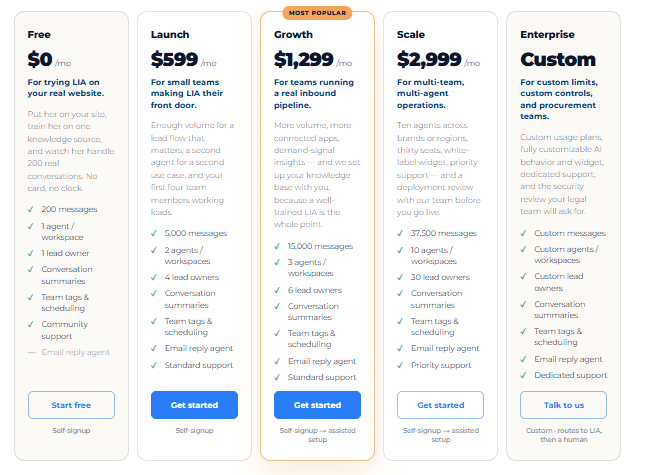
ConnectLoop is priced by conversation volume, not by seat, so cost scales with how much of your pipeline the agent is actually handling, not with headcount. Every plan includes the core AI features; higher tiers add more agents, more team seats, and deeper customization. All plans, including Free, come with conversation summaries, team tags and scheduling, and the email reply agent.
ConnectLoop never cuts off a conversation mid-month. Once you pass your plan's included message limit, the agent keeps running and overage is billed at your plan's rate, with alerts at 75% and 90% of your limit so there are no surprises. If you know a busy month is coming, discounted add-on packs can be bought from the portal at any time and are used before any overage billing starts.
Moving up a tier buys more than volume. Growth and above unlock Advanced RAG (more accurate answers pulled from more of your knowledge base), deeper AI customization (custom prompts and behavior controls instead of defaults), and richer insight reporting (demand signals and blockers, not just topics). Scale adds a voice channel, an agent avatar, and the option to remove ConnectLoop branding from the widget. Enterprise opens all of it up to custom limits and dedicated support.
The Free plan is enough to see how LIA handles real conversations on your site. Most teams outgrow it within the first month or two simply on volume, and move to Launch or Growth once they know an AI SDR is a fit. Current plan limits and pack rates are on the ConnectLoop pricing page.
Why do AI SDRs fail?
Most failures have nothing to do with AI quality. They come from bad data, poor email setup, weak personalization, no human review, and an unclear handoff. Around 50–70% of teams stop using their AI SDR within three months, and Gartner expects more than 40% of agentic AI projects to be cancelled by the end of 2027.
Most guides skip this section. That is exactly why so many projects die in month four.
1. Bad data
Automation copies your existing process. If your customer profile is out of date and a third of your target accounts have closed or been acquired, the AI will contact the wrong people very efficiently.
Fix: clean your list and update your ideal customer profile before you start. Remove existing customers and open deals.
2. Email problems
This is the most expensive failure, and almost nobody explains it before you buy. Google requires a spam complaint rate below 0.10%. At 0.30% (three complaints per thousand emails), Gmail can block your domain completely. Microsoft applies similar rules. Cold outbound often runs at 0.5–1% without careful list cleaning.
The damage is not limited to one campaign. It affects the domain your whole company uses, including your reps' normal emails.
Fix:
- Use a separate domain for outbound, never your main one.
- Warm up new domains slowly over several weeks.
- Set up SPF, DKIM, and DMARC correctly.
- Spread volume across several mailboxes.
- Check Google Postmaster Tools weekly and keep complaints under 0.08%.
- Move some volume to channels with no domain risk, such as chat and WhatsApp.
3. Personalization that looks automated
Buyers now recognize AI messages immediately. The fake-specific opening line. The compliment that could apply to any company. Reply rates for this style have collapsed.
Fix: mention something real and recent. If the AI has nothing genuine to say, it should not send anything.
4. No human review
Fully automatic outbound removes the one thing that makes outbound work: a person who cares what goes out.
Fix: for the first 60–90 days, let AI write and a human approve in batches. Review groups of messages, not single ones, so you keep the speed advantage. Inbound replies can be automatic much sooner, because the buyer contacted you.
ConnectLoop is built with this staged rollout in mind. You can keep a human in the loop early and hand over more control as trust builds.
5. No clear handoff
The AI books a meeting. Nobody agreed what “qualified” means. An account executive takes a bad call, loses trust, and stops accepting AI-booked meetings. After three of those, the project is finished.
Fix: write down the qualification rules and the handoff process before launch, with your sales team in the room.
Where AI SDRs are headed
Trust in AI-driven sales conversations has moved fast. Buyers increasingly accept an AI agent handling their first questions, provided the answers are accurate and there is a clear route to a human: which is exactly why grounding answers in real content, rather than a model's memory, has become the baseline expectation instead of a nice-to-have.
The next wave of capability is less about replying faster and more about acting earlier: agents that flag buying signals before a lead ever fills out a form, join and summarize discovery calls, and hand a rep a ready-made meeting agenda instead of a blank calendar invite.
The direction is the same one this guide has pointed at throughout: fewer fragmented tools, one agent that carries a lead from first message to booked meeting.
Getting started
An AI SDR is not a replacement for your sales team, and it is not a magic pipeline machine. It is a way to make sure every buyer gets a fast, accurate, helpful answer at any hour, on the channel they already use.
The teams that succeed all do the same things. They clean their data before they automate. They start with inbound. They keep a human involved where judgment matters. And they meet buyers on conversational channels instead of fighting for space in a crowded inbox.
This is exactly what ConnectLoop's AI sales agent, LIA, is built to do. It handles inbound qualification and proactive outreach on your website and WhatsApp, answers from your real product content, and connects to your CRM from day one, so the next visitor on your pricing page gets an answer, no matter what time it is where they live.

About the author
ConnectLoop Staff
Written by the ConnectLoop team. ConnectLoop is an AI sales agent for inbound revenue teams, based in Cambridge, Massachusetts.
About ConnectLoop →Frequently asked questions
No. AI SDRs replace tasks, not people. They handle first replies, qualification, follow-up and scheduling. Humans are still needed for complex objections, negotiation and building trust. Most teams use both together.
Yes, when set up properly. Inbound qualification gives the most reliable results. Fully automatic cold outbound fails most often. Success depends far more on your data and email setup than on which vendor you choose.
Most platforms cost $500 to $5,000 per month. Add contact data, email infrastructure, setup fees, and roughly 5 to 10 hours per week of your team's time. Compare cost per qualified opportunity rather than monthly price.
A basic inbound setup can go live in a few hours. A proper rollout takes about 90 days: 30 days to prepare data, 30 days for a small pilot, and 30 days to expand.
An AI SDR usually handles inbound leads who have already shown interest. An AI BDR usually handles cold outbound to new accounts. Many platforms do both, and the terms are often used interchangeably.
Yes. It connects to Google Calendar or Outlook, checks real availability, books the meeting and sends reminders. ConnectLoop's LIA does this natively as part of the same conversation.
Yes. Most platforms connect to HubSpot, Pipedrive, Zoho and others. Check that the integration saves the full conversation, not just a timestamp. ConnectLoop syncs the full conversation, lead score and contact details automatically.
Yes, through the WhatsApp Business API. This matters in Latin America, South Asia and the Middle East, where WhatsApp is the main business channel. Opt-in and approved message templates are required. ConnectLoop runs on WhatsApp alongside your website chat, so both channels stay in sync.
Often more than for a large one. A founder or two-person sales team has the biggest coverage gap. Start with inbound only, which is the lowest-risk and fastest way to see results.
Treating it as something you switch on and forget. Teams that succeed clean their data first, start with inbound, keep a human reviewing outbound, and read real conversations every week.
Ready to Automate Your Sales Pipeline?
Whether you're a startup or an enterprise team, ConnectLoop helps you capture more qualified leads, reduce response time, and let your sales reps focus on closing deals instead of chasing prospects.