
Sales Automation
AI Appointment Booking: How Meetings Get Booked Inside the Conversation
AI appointment booking lets a buyer schedule a meeting during the conversation they are already having, checked against real calendar availability, without a booking link or a form. ConnectLoop's agent, Lia, does this on your website, on WhatsApp and by email.

Published
Table of contents
- What does AI appointment booking actually do?
- Booking link, phone call, or inside the conversation?
- How does an agent check real availability?
- What breaks when a bot books a meeting?
- How do you handle reschedules and cancellations?
- Do AI-booked meetings get no-showed more often?
- How does booking work on WhatsApp?
- When should a human book instead?
- How does ConnectLoop book meetings?
- What AI appointment booking cannot fix
- Key takeaways
- Frequently asked questions
What does AI appointment booking actually do?
It closes the gap between someone deciding they want a meeting and that meeting existing. The AI reads intent from the conversation, checks live calendar availability, proposes times, confirms one, and writes it to both calendars.
That sounds like a small job. In most funnels it is where the largest single drop happens.
The category is growing quickly. Fortune Business Insights projects the appointment scheduling software market to grow from $635.6 million in 2026 to over $1.9 billion by 2034, a compound annual rate of 14.70%.
The AI part is newer than the scheduling part. Gartner predicts that 40% of enterprise applications will include task-specific AI agents by 2026, up from under 5% in 2025, and scheduling is one of the most commonly cited first use cases.
Three things separate booking from scheduling.
Scheduling shows availability. A calendar widget displays open slots and waits.
Booking completes the transaction. Something has to read intent, pick a time, and write the record.
AI booking does it in the conversation. No link, no form, no callback promise.
Booking link, phone call, or inside the conversation?
Three approaches, and most buyers only know about two of them. Booking links put the work on the buyer. Voice AI calls them. Conversational booking happens in the thread they already opened.
| Booking link | Voice AI | In-conversation | |
|---|---|---|---|
| Who starts it | Buyer clicks a link | AI calls the buyer | Buyer is already talking |
| Typical tools | Booking link platforms | Voice agent platforms | Chat and messaging agents |
| Buyer effort | Open link, pick slot, fill form | Answer a phone call | None — keep typing |
| Context carried | None — form starts fresh | Whatever the script holds | The whole conversation |
| Works at 11pm | Yes | No, calling is intrusive | Yes |
| Works on mobile | Poorly — forms on phones | Yes | Yes |
| Best for | Known contacts, warm intros | Cold outbound at volume | Inbound enquiries |
| Main failure | Buyer never clicks | Buyer never answers | Agent misreads intent |
The middle column is what most people picture when they hear “AI appointment setter.” That term has been claimed by voice platforms that phone cold lists.
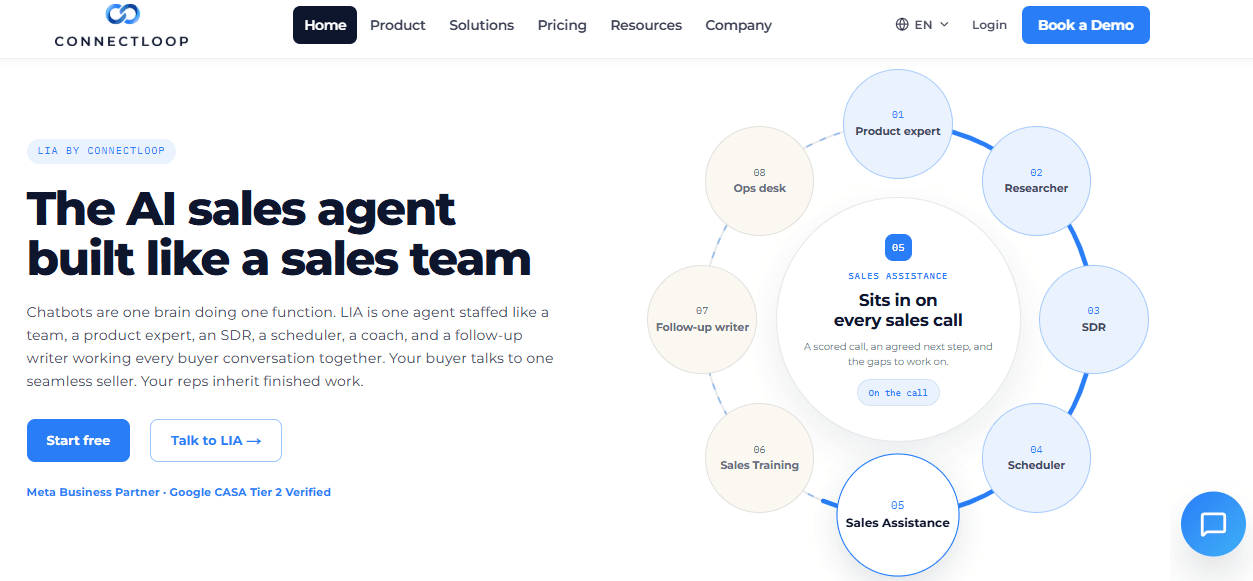
Lia books inside conversations a buyer started, on the channel they choose, no cold calls, no link to click.
The distinction matters commercially. A cold call needs permission it does not have. Someone who has just asked about pricing has already given it.
How does an agent check real availability?
By connecting to the calendar itself, not to a copy of it. Live Google Calendar or Outlook availability means a slot offered at 11:04 is still free at 11:05, because the agent is reading the source rather than a cached snapshot.
This is where implementations differ, and where most of the failures come from.
Four things a booking agent needs to read correctly:
- Actual free time, including events created seconds ago by someone else.
- Working hours, which are not the same as the hours a calendar is empty. A gap at 7am is not available.
- Buffers, so back-to-back meetings do not get booked with no gap between them.
- Minimum notice, so nobody books a meeting for eleven minutes from now.
Most articles about scheduling software say “syncs with your calendar” and stop there. The settings above are what decide whether it works in practice, and they are worth asking any vendor about specifically.
What breaks when a bot books a meeting?
Double-bookings, timezone errors, and meetings booked with the wrong person. These are the failure modes every vendor page avoids, and they are the questions a buyer actually has before deploying anything.
Worth naming them plainly.
The race condition. Two people are offered the same slot within seconds of each other. Both accept. Without a lock on the calendar write, both get confirmed.
Timezone assumptions. A visitor in São Paulo is offered “3pm” without a timezone attached. They read it as their 3pm. The rep expects them at 3pm Eastern. Nobody is wrong and the meeting does not happen.
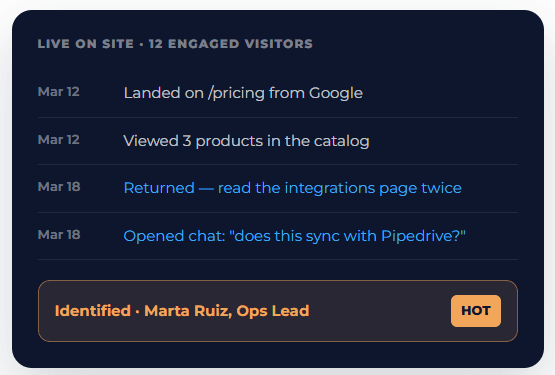
Wrong rep. A large enterprise enquiry lands on a junior AE's calendar because the agent had no routing logic beyond next available.
Booking a lead who should not have one. An agent that books anyone who asks fills your calendar with meetings your team then has to cancel, which is worse than not booking at all.
Reading a question as a request. “How do demos work?” is not “book me a demo.” An over-eager agent turns curiosity into a calendar invite the person did not want.
What to ask a vendor: what happens when two people accept the same slot, how timezones are detected and confirmed, and what routing rules decide whose calendar gets the meeting.
Book a meeting the way your buyers actually want to
ConnectLoop's agent answers the question, then books the meeting in the same conversation against real Google Calendar or Outlook availability.
Start Free at ConnectLoopHow do you handle reschedules and cancellations?
In the same conversation, without a link. A buyer who needs to move a meeting should be able to say so and have it moved, rather than digging through their inbox for a confirmation email with a reschedule button in it.
Reschedules are a bigger share of scheduling work than most teams measure.
Three things a booking agent should handle without human involvement:
- Moving a confirmed meeting to a new time, checked against the same live availability as the original.
- Cancelling cleanly, releasing the slot back so someone else can take it.
- Recognising a reschedule request phrased as anything other than the word “reschedule”: “can we do Thursday instead,” “something's come up,” “I need to move our call.”
The third is where most implementations fail. A system that only responds to a specific command is a form with extra steps.
What should escalate: repeated reschedules, cancellations close to the meeting, and anything with an explanation attached. Those are signals about the deal, not scheduling admin.
Do AI-booked meetings get no-showed more often?
Nobody in this category publishes an answer, which is itself worth noticing. Every scheduling vendor claims reminders reduce no-shows. None compares no-show rates on meetings booked by an agent against meetings booked by a human.
The question deserves a real answer rather than a claim.
The argument that AI-booked meetings should no-show more: a meeting booked in thirty seconds with no human contact carries less social obligation than one agreed with a person. Low friction to book means low friction to forget.
The argument they should no-show less: the meeting was booked at the moment of peak intent, not three days later when someone finally replied. Intent decays fast, and speed captures it.
ConnectLoop does not have published data comparing the two. Stating that is more useful than asserting a number nobody has measured.
What any team can measure: tag meetings by how they were booked, then compare show rates over a quarter. It takes one CRM field and it answers the question for your funnel specifically, which is the only answer that matters.
How does booking work on WhatsApp?
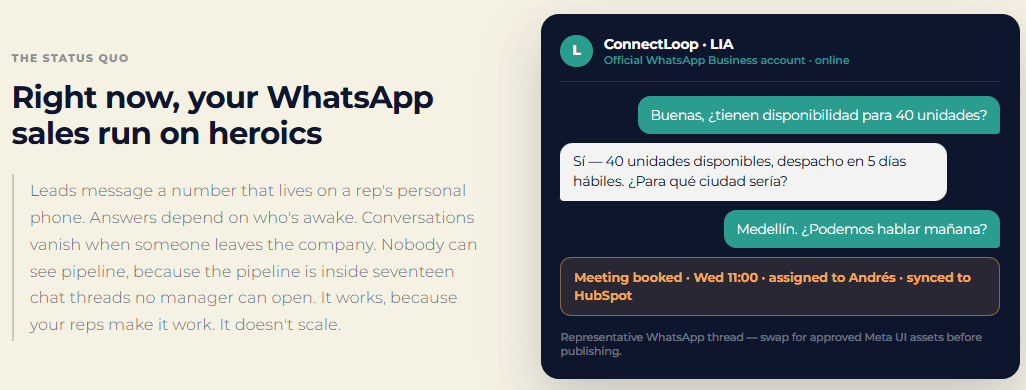
The same way, in shorter messages. WhatsApp expectations are set by how people use it personally, which is instantly and briefly. A four-paragraph reply with three time options reads as spam on the channel most of the world books things through.
Three differences that matter.
- Message length. Offer two or three times, not a wall of availability.
- Speed. A two-hour reply on WhatsApp reads as no reply at all. The window is much tighter than email.
- Persistence. A web chat ends when the tab closes. A WhatsApp thread is still there next week, which means a reschedule three days later lands in the same conversation.
ConnectLoop runs on the official WhatsApp Business API as a verified Meta Business Partner with Embedded Signup. Unofficial integrations get numbers banned, usually at the point volume becomes worth having.
When should a human book instead?
When the meeting matters more than the convenience of booking it quickly. Complex multi-stakeholder scheduling, high-value deals, and anything with emotional weight are better handled by a person, and treating automation as always-correct produces a worse outcome.
Four cases where ConnectLoop escalates rather than books.
- Multiple attendees on the buyer's side. Coordinating four calendars across two organisations is a negotiation, not a lookup.
- Executive or enterprise conversations. A large deal deserves a person, and the buyer usually expects one.
- Anything with emotional context. A complaint, an escalation, a churn conversation. Booking it efficiently is the wrong instinct.
- When the buyer asks for a person. This should never require a workaround.
The judgement is whether the booking is the valuable part or whether the conversation around it is.
How does ConnectLoop book meetings?
ConnectLoop books inside the conversation, against live calendar availability, without handing the buyer a link. Lia answers the question first, recognises when the person is ready, offers real times, and writes the meeting to both calendars.
Here is the flow.
- Lia answers first. Every response is grounded in your approved content: product pages, documentation, policies. She does not invent prices or promises, and says so when the answer is not there.
- Qualification happens in the conversation. Lia runs SPIN or MEDDIC as natural questions rather than a form, so the meeting arrives with context rather than a name and an email.
- Intent is scored. Every conversation produces a temperature — hot, warm or cold — based on what was actually said and done.
- Availability is checked live. ConnectLoop reads real Google Calendar or Outlook availability at the moment of booking, not a synced copy.
- The meeting is booked in the thread. No link, no form, no callback promise. The buyer confirms and it exists.
- Reschedules are handled without your reps. A buyer who needs to move it says so, in the same conversation.
- Everything syncs. The meeting, the conversation and the contact go to HubSpot, Salesforce, Pipedrive or Zoho automatically.
ConnectLoop works across website chat, WhatsApp and email with one shared conversation memory, so a buyer who asks about pricing on your site and books on WhatsApp two days later is one record.
ConnectLoop is Google CASA Tier 2 verified and an official Meta Business Partner.
What AI appointment booking cannot fix
It cannot create demand, it cannot fix a badly targeted lead flow, and it cannot make a meeting valuable that should never have been booked. Faster booking multiplies what you already have, including the problems.
Four honest limits.
- It will not improve a bad-fit lead flow. If your inbound is dominated by people outside your ICP, booking them faster fills your calendar with meetings your team then cancels.
- It cannot answer what your content does not contain. ConnectLoop's agent retrieves from your approved material. A question your documentation does not cover will not be answered by any agent.
- A booked meeting is not a qualified meeting. Booking rate and show rate are different numbers, and a system optimised for the first can quietly damage the second.
- Some conversations should not end in a booking at all. Support questions from existing customers, early-stage researchers, and single factual queries are better answered than scheduled.
ConnectLoop does not solve the first. Teams whose real constraint is lead quality should address that before adding faster booking on top.
Key takeaways
- AI appointment booking happens inside the conversation. No link, no form, no callback promise — the buyer never leaves the thread they opened.
- “AI appointment setter” usually means voice. The term has been claimed by platforms that phone cold lists. Different product, different buyer.
- Live availability is the whole game. A cached calendar produces double-bookings. Ask any vendor whether they read the source or a copy.
- Buffers, working hours and minimum notice decide whether it works. “Syncs with your calendar” tells you nothing useful.
- The failure modes are predictable. Double-booking, timezone errors, wrong rep, and reading a question as a request. Ask about all four.
- Nobody publishes no-show data by booking method. Tag it in your CRM and measure it yourself. It is one field.
- Reschedules should work in plain language. A system that only responds to the word “reschedule” is a form with extra steps.
- Faster booking multiplies what you have. It will not fix a bad-fit lead flow; it will fill your calendar with meetings you then cancel.

About the author
ConnectLoop Staff
Written by the ConnectLoop team. ConnectLoop is an AI sales agent for inbound revenue teams, based in Cambridge, Massachusetts.
About ConnectLoop →Frequently asked questions
Software that schedules a meeting during a conversation, using AI to read intent, check live calendar availability, propose times and confirm one. It differs from a booking link because the buyer never leaves the conversation, and from voice AI because nobody is phoned.
In practice the terms have split. “AI appointment setter” now mostly refers to voice platforms that phone cold lists and book meetings by call. AI appointment booking covers scheduling inside chat, messaging or email conversations. ConnectLoop does the second.
Yes. ConnectLoop checks live availability at the moment of booking rather than a synced copy, so a slot offered is a slot that is genuinely free.
Reading live availability rather than a cached snapshot, and writing to the calendar as a single operation. Worth asking any vendor specifically what happens when two people accept the same slot seconds apart.
By detecting the buyer's timezone and confirming the meeting in it. Timezone errors are one of the most common failure modes in automated booking, and any vendor should be able to explain exactly how theirs are handled.
Yes. Reschedules and cancellations are handled in the same conversation, and the released slot goes back into availability. Repeated reschedules escalate to a person, because those are usually a signal about the deal rather than the diary.
Nobody in this category publishes a comparison, and ConnectLoop does not have one either. The honest answer is that it depends on your funnel. Tag meetings by booking method in your CRM and compare show rates over a quarter — one field, and it answers the question for you specifically.
Yes, through the official [WhatsApp Business API](/blog/whatsapp-ai-agent-how-it-works). Message length and [response speed differ from web chat](/blog/speed-to-lead), but the booking mechanics are the same. ConnectLoop is a verified Meta Business Partner with Embedded Signup.
Multi-stakeholder scheduling, enterprise conversations, anything with emotional weight, and any time the buyer asks for a person. Automation is not always the better outcome, and treating it as such produces meetings nobody wanted.
ConnectLoop's agent trains on your website content in about 60 seconds. Calendar connection and routing rules take longer, depending on how much you want configured before going live.
Stop losing meetings to a booking link
ConnectLoop's agent, Lia, answers the question, qualifies with SPIN and MEDDIC, and books the meeting in the same conversation on your website, on WhatsApp and by email. Reschedules handled without your reps.