
Lead Qualification
Inbound Lead Qualification: The Questions That Actually Qualify
Inbound lead qualification is the process of deciding whether someone who contacted you is worth a salesperson's time by establishing fit, problem, authority and timing. ConnectLoop's agent, Lia, does this conversationally on your website, on WhatsApp and by email, asking the questions a form cannot.

Published
Table of contents
- What can a form actually capture?
- What questions qualify an inbound lead?
- What order should you ask them in?
- How is inbound qualification different from cold outbound?
- What if the lead won't answer?
- When should you skip qualification entirely?
- How do you qualify leads outside working hours?
- How does ConnectLoop qualify inbound leads?
- What can inbound lead qualification not fix?
- Key takeaways
- Frequently asked questions
What can a form actually capture?
A form captures what someone is willing to type before they know whether you are worth talking to. That is name, email, company, and whatever else you risk asking. It cannot capture the problem they are trying to solve, who else is involved, or how urgent it is.
This is the constraint every qualification framework runs into.
BANT asks about budget, authority, need and timeline. MEDDIC asks about metrics, the economic buyer, decision criteria, decision process, identified pain and a champion. CHAMP leads with challenges.
Not one of those is a form field. They are all conversations.
So most teams do the next best thing: they collect firmographic data, enrich it, score it, and infer the rest. That produces a lead record with a company size and a job title, and no idea what the person actually wants.
There is a second problem, and it is the one that costs more.
Every additional form field reduces completion. That is well established, and it creates a trade-off most teams never resolve: ask less and you convert more visitors but learn less about them; ask more and you learn more about the fewer people who bother.
ConnectLoop takes the other route: ask almost nothing on the form, and find out the rest by asking.
What questions qualify an inbound lead?
Four things need establishing: whether they fit your customer profile, what problem brought them, who decides, and when. The questions below are the ones that surface those without sounding like an interrogation. Most guides name the frameworks and stop there.
Which questions establish fit?
Fit is the cheapest thing to check and the one most worth checking first. If they are not a fit, nothing else matters.
- What are you using for this today? Tells you whether they have a budget line already, and who you are replacing.
- How many people would be using this? Firmographic data by another route, and more accurate than enrichment.
- What made you look now? The single most useful question in inbound. The answer is usually a trigger event.
- Is this for you or for a team? Separates an individual evaluator from an organisational buyer.
Which questions surface the problem?
This is where SPIN selling earns its place. Situation, Problem, Implication, Need-payoff: asked in that order, in a conversation, not read from a checklist.
- What is happening now that made you start looking?
- What does that cost you: time, money, or something else?
- What have you already tried?
- What happens if you do nothing?
That last one is uncomfortable to ask and it is the most diagnostic. A prospect who cannot answer it does not have a problem urgent enough to buy for.
Which questions establish authority and timing?
Ask these late. Asked early, they read as a credit check.
- Who else would need to be involved in a decision like this? Better than “are you the decision maker,” which invites a defensive yes.
- Is there a date this needs to be working by? Better than “what is your timeline,” which invites “no rush.”
- What would need to be true for this to go ahead? Surfaces decision criteria without naming them.
Which questions should you not ask?
- “What is your budget?” on a first inbound conversation. Almost nobody answers honestly, and asking signals you are pricing them rather than helping them.
- Anything already answerable from enrichment. Asking a prospect their company size when you can look it up wastes the one thing you have limited amounts of: their patience.
- More than four or five questions in a row. Qualification is a conversation, not a survey.
What order should you ask them in?
Answer their question first, then establish fit, then problem, then authority and timing. Reversing that order is the most common mistake in inbound qualification, because it treats a person who came to you as though you had interrupted them.
Someone who arrives on your pricing page and opens a chat has a question. If the first thing they meet is “what is your company size,” you have taken something and given nothing.
The sequence that works:
- Answer what they asked Immediately, accurately, from your own content.
- Ask one fit question Framed as relevance rather than screening: “so I point you at the right thing, is this for a team or just you?”
- Ask what prompted the search This is where the real qualification happens.
- Follow the problem, not your script If they mention a cost, ask about the cost.
- Establish who else is involved Only once there is genuine interest.
- Ask about timing last And only if the rest has gone well.
Steps 5 and 6 are where most conversations should stop if they are going to stop. A lead who will not name anyone else involved and will not name a date is not ready, and pushing produces a polite no rather than a useful one.
How is inbound qualification different from cold outbound?
Permission. Someone who contacted you first has already told you they have a problem, and has implicitly agreed to a conversation. Cold outbound has neither. Almost every published guide on qualification assumes the outbound situation and applies it to inbound, where it does not fit.
| Cold outbound | Inbound | |
|---|---|---|
| Who started it | You did | They did |
| Permission | None. You are interrupting | High. They asked |
| What you know first | Firmographics from a list | Behaviour, and their actual question |
| First move | Earn attention | Answer the question |
| What silence means | Normal. Most cold outreach is ignored. | Something changed, or they got busy |
| Qualification style | Screen before investing time | Help first, qualify inside the help |
| Speed pressure | Low | High, interest decays quickly |
| Biggest risk | Being marked as spam | Sounding like a form with a personality |
The practical consequence: an inbound conversation that opens with qualification questions wastes the strongest asset you have, which is that this person already told you what they wanted.
What if the lead won't answer?
Take the deflection as data and move on. A prospect who will not name a timeline usually does not have one, and a prospect who will not name other stakeholders usually is not the one who decides. Neither is a reason to push, both are answers.
Nobody writes about this, and it happens constantly.
“I'm just looking around at the moment.” Genuine, and common. The right response is to keep helping and stop qualifying. Someone in research mode who has a good experience comes back; someone who gets pushed does not.
“I'd need to check with a few people.” That is the authority answer, given indirectly. Follow it: “Happy to put something together you could share with them, what would they want to know?”
“We're not looking to spend anything right now.” Sometimes true, often a reflex. Worth one clarifying pass: “Fair enough. Is that a this-quarter thing or a not-this-year thing?”, and then accept whichever answer comes back.
Silence after a qualification question is itself a signal. A conversation that was flowing and stops the moment you ask about budget has told you something about where the person sits in their organisation.
When should you skip qualification entirely?
When the enquiry is small, when the person is clearly early, and when answering is cheaper than qualifying. Not every inbound conversation is a sales opportunity, and treating every one as though it is produces a worse experience than simply being useful.
Three cases where ConnectLoop's agent answers and does not qualify:
- Support questions from existing customers. Someone asking how to change a setting does not need a discovery conversation.
- Genuinely early research. A student, a competitor, an analyst. Qualification wastes their time and yours.
- Single, factual questions. “Do you integrate with Pipedrive?” has a yes-or-no answer. Answer it. If they want more, they will ask.
The judgement is whether qualification serves the person or only serves you. A question that makes the next answer better is worth asking. A question that only sorts them into a bucket is not.
How do you qualify leads outside working hours?
Either you staff those hours or something automated covers them. Most inbound arrives when buyers have a spare moment, which is disproportionately evenings and weekends, and most B2B teams have no coverage then at all.
The gap is rarely 9am to 5pm. It is the sixteen hours a day and two days a week that nobody is watching.
This is where qualification quietly fails. Not because the questions are wrong, but because nobody is there to ask them. An enquiry that arrives at 9pm on a Thursday sits until Friday morning, by which point the person has usually looked elsewhere.
Three ways teams cover the gap:
- Extend coverage with people Effective and expensive. Only justifiable at volume.
- Auto-reply and queue Better than silence, but a “someone will get back to you” message qualifies nobody.
- Automate the conversation An agent that answers, qualifies and books during those hours removes the queue entirely.
ConnectLoop's agent, Lia, runs the same qualification sequence at 3am that it runs at 3pm: answering from your content, establishing fit and problem, and booking against real calendar availability.
Worth measuring before you decide anything. Export the timestamps on last quarter's inbound enquiries and split them by hour. It takes ten minutes, and the distribution is usually not what people expect. If most of your volume genuinely does arrive between nine and five, this section does not apply to you.
How does ConnectLoop qualify inbound leads?
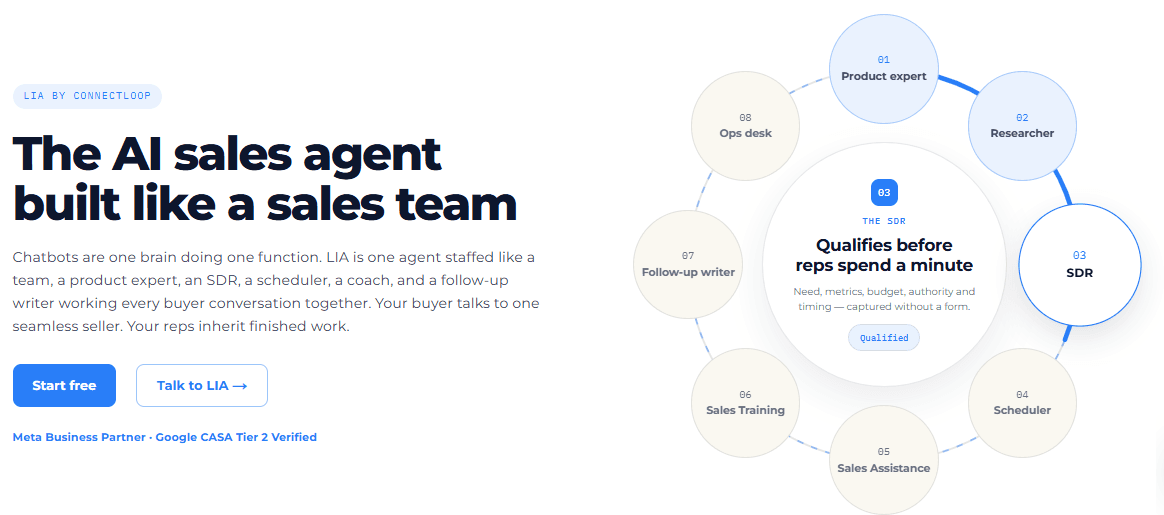
ConnectLoop runs qualification inside the conversation rather than after it. Lia answers the visitor's question from your approved content, asks qualifying questions in sequence, scores the lead, and books the meeting, all before a rep is involved.
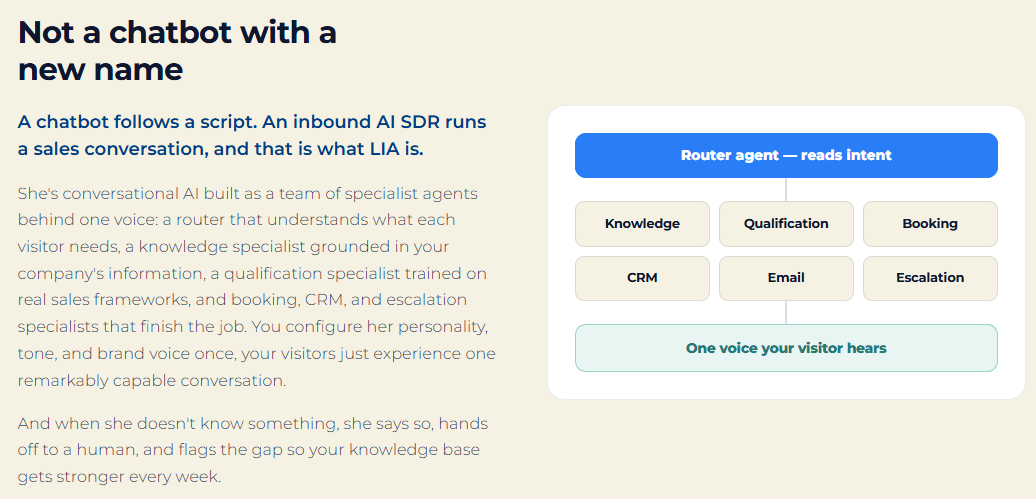
Here is the flow.
- Lia answers first Every response is grounded in your own documents, product pages and FAQs, so she does not invent prices or policies. When she cannot answer something, she says so, offers a person, and logs the question rather than guessing.
- Visitor Intelligence supplies context ConnectLoop identifies the company behind anonymous website traffic and surfaces which pages were read, so the conversation starts with firmographic context rather than asking for it.
- Qualification runs conversationally Lia works through SPIN or MEDDIC as a sequence of natural questions, adapting to what the person actually says rather than following a fixed decision tree.
- The lead is scored Every conversation produces a temperature: hot, warm or cold: based on what was said, not only on what was filled in.
- Booking happens in the same conversation Lia checks real Google Calendar or Outlook availability and books the meeting there and then, rather than promising a callback.
- Everything syncs The full conversation, the score and the contact details go to HubSpot, Salesforce or Pipedrive automatically.
- Follow-up is drafted, not sent When a conversation goes quiet, Proactive Outreach drafts a follow-up from what was actually discussed. A person reviews, edits, and sends or dismisses it. ConnectLoop does not send outbound autonomously; that is a deliberate constraint, because automated sending at volume without review damages sender reputation and is slow to repair.
ConnectLoop works across website chat, WhatsApp and email, with one shared conversation memory. A buyer who asks about pricing on your site and returns three days later on WhatsApp is one record, not two enquiries.
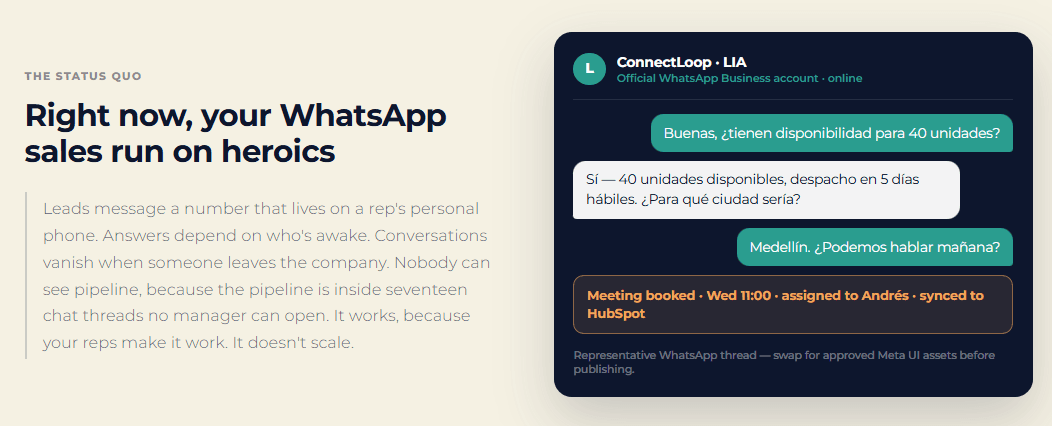
ConnectLoop is Google CASA Tier 2 verified and an official Meta Business Partner with verified Embedded Signup.
What can inbound lead qualification not fix?
It cannot create demand that was never there, it cannot fix bad targeting, and it cannot substitute for content that does not exist. Qualification multiplies what you already have, including the problems.
Four honest limits.
- It will not rescue a bad-fit lead flow. If your inbound is dominated by people outside your ICP, qualifying faster sorts more of the wrong people, more efficiently. Fix targeting first.
- It cannot answer what your content does not cover. ConnectLoop's agent retrieves from your approved material. If your documentation does not explain your refund policy, no agent will. Retrieval finds what exists; it does not create it.
- A qualification score is a prediction, not a fact. Lead scoring ranks likelihood. It gets things wrong in both directions, and a hot score is not a commitment.
- Some leads should not be qualified at all. As above: support questions, early researchers, single factual questions. Treating every conversation as a sales opportunity produces a worse experience than being useful.
ConnectLoop does not solve the first two. Teams whose real constraint is lead quality or content coverage should address those before adding qualification on top.
Key takeaways
- A form captures what someone will type before they trust you. It cannot capture problems, authority or urgency. Those are conversations.
- Answer their question before you qualify. Someone who contacted you first has given you permission and told you what they want. Leading with screening questions wastes both.
- “What made you look now?” is the highest-value question in inbound. The answer is almost always a trigger event.
- Ask about authority and timing last. Asked early, they read as a credit check and produce defensive answers.
- Deflection is data. A prospect who will not name a date usually does not have one. That is an answer, not an obstacle.
- Not every enquiry should be qualified. Support questions, early researchers and single factual questions are better simply answered.
- Match response speed to the strength of the signal. Under five minutes for demo and pricing requests; content downloads and newsletter signups tolerate a longer window.
- Qualification multiplies what you already have. It will not fix bad targeting. It will get you to the same outcome faster.

About the author
ConnectLoop Staff
Written by the ConnectLoop team. ConnectLoop is an AI sales agent for inbound revenue teams, based in Cambridge, Massachusetts.
About ConnectLoop →Frequently asked questions
The process of deciding whether someone who contacted you is worth a salesperson's time, by establishing fit with your ideal customer profile, the problem they are trying to solve, who else is involved in the decision, and when they need it working. It differs from cold outbound qualification because the buyer initiated contact.
Lead scoring is the information-gathering process, assigning values to firmographic and behavioural signals. Lead qualification is the decision that follows. Scoring informs qualification; it does not replace it.
SPIN suits inbound better than BANT, because it starts from the buyer's situation rather than your screening criteria. MEDDIC suits complex, multi-stakeholder deals. BANT is faster but asks about budget too early for most inbound conversations. ConnectLoop supports SPIN and MEDDIC as conversational sequences.
Most B2B organisations have SDRs qualify so AEs can focus on discovery and closing. The practical requirement is that both agree in writing what qualified means before any handoff, otherwise AEs take bad calls, lose trust, and stop accepting the meetings.
Under five minutes for high-intent enquiries such as demo and pricing requests, because interest decays fastest in the first hour. Lower-intent enquiries such as content downloads and newsletter signups tolerate a longer window. Matching response speed to the strength of the signal works better than applying one SLA to everything.
It can run the questions, score the answers and book the meeting. It cannot read hesitation, handle a sensitive objection, or build the trust that closes a complex deal. The realistic division is that AI handles the repetitive majority and escalates cleanly.
Four or five, spread through a conversation rather than asked in sequence. More than that reads as a survey. Agree with your AEs which data points make a first meeting productive, and capture only those.
Route it to nurture with a reason recorded, or tell them honestly that you are not a fit and point them somewhere that is. Recording the reason matters, because disposition data is what lets marketing fix the targeting that produced the bad-fit lead.
Yes, for people who prefer them. The point is not to remove the form but to stop it being the only route in. ConnectLoop captures details inside the conversation for the majority of visitors who would never fill one in.
The same way, with shorter messages. WhatsApp expectations are set by the channel, so a two-hour reply reads as no reply. ConnectLoop runs on the WhatsApp Business API as an official Meta Business Partner, with the conversation shared across channels.
Qualify inbound leads inside the conversation
ConnectLoop's agent, Lia, answers questions from your own content, qualifies with SPIN and MEDDIC, and books meetings against real calendar availability: on your website, on WhatsApp and by email. Visitor Intelligence identifies the companies behind anonymous traffic before a conversation begins.