
Sales Communication
How to Write a Follow-Up Email After No Response (With Templates)
Wait three to five business days, keep the follow-up shorter than your first email, add one new piece of value rather than repeating yourself, and end with a question they can answer in a single line. ConnectLoop drafts these follow-ups automatically from the actual conversation, a person reviews and sends.

Published · Updated
Table of contents
- Why didn't they reply to your first email?
- How long should you wait before following up?
- How many follow-up emails should you send?
- What should a follow-up email actually say?
- What follow-up email templates can you copy after no response?
- What should a second follow-up email after no response say?
- What are polite follow-up email examples that don't sound pushy?
- What subject lines work for a follow-up email after no response?
- Does the same advice apply to cold and inbound follow-up?
- How do you follow up when they contacted you first?
- How do you follow up on a job application or interview?
- What are the most common follow-up mistakes?
- Why does the follow-up never actually get written?
- How does ConnectLoop handle follow-up?
- What can a follow-up email not fix?
- Key takeaways
- Frequently asked questions
Why didn't they reply to your first email?
Usually because they were busy, not because they weren't interested. An unanswered email is more often an inbox problem or a timing problem than a rejection. People skim on mobile, intend to reply later, and lose the thread.
That distinction matters because it changes your tone. Silence can also mean the deal stalled at an earlier point in the stages of the sales process, which a follow-up alone will not move.
If you assume the recipient is deliberately ignoring you, the follow-up comes out defensive. If you assume they meant to reply and forgot, it comes out short and easy to answer, which is the version that works.
There is also a scale problem behind the silence. Many companies take hours or even days to answer an inbound enquiry, and some never reply at all.
Those are the companies receiving enquiries, not sending them. But the point holds in both directions: most inboxes are not being worked well, and slow or absent replies are the norm rather than the exception.
How long should you wait before following up?
Three to five business days for a first follow-up. Same-day or next-day reads as anxious. Waiting more than a week means the context of your original email has gone, and you are effectively starting over.
Adjust for the recipient's time zone rather than your own.
A workable cadence looks like this:
- Day 0: initial email Send the first email with one clear point and one specific ask.
- Day 3: first follow-up Send a short, friendly reminder. Don't rewrite the original email. Simply mention why it's relevant and ask an easy question.
- Day 7: second follow-up Add something new, such as an insight, example, or relevant resource. Avoid repeating the same message.
- Day 14: final follow-up Close the conversation politely and let them know you won't follow up again.
How many follow-up emails should you send?
Two to three, plus a final close. Beyond four total touches you are adding inbox volume without adding value, and the risk of being marked as spam rises faster than the chance of a reply.
| Day | What to send | Goal |
|---|---|---|
| Day 0 | Original email or reply to the enquiry | Answer the question or make the ask |
| Day 3 | First follow-up | Reference the specific thing and add one detail |
| Day 7 | Second follow-up | Add something new and useful |
| Day 14 | Final close | Offer to close the loop and leave the door open |
The sequence matters more than the number.
Four emails that each say something different will outperform six that say the same thing in slightly different words. If your second and third messages are near-identical, the recipient reasonably assumes the fourth will be too, and stops opening them.
When to stop: once you have made your offer, tried a second angle, and sent a courteous final note, you are done. Continuing past that point damages the relationship you were trying to build.
What should a follow-up email actually say?
Shorter than the original, more specific, and easier to answer. A good follow-up references the exact thing you discussed, adds one new piece of information, and asks a question the recipient can answer in a single line from a phone.
What makes a good subject line?
Keep the original thread where possible. Replying to your own email preserves the context, and a Re: line reads as a continuation rather than a new pitch.
If you start a fresh thread, name the topic directly:
- Following up on [specific thing]
- One more thought on [topic]
- Should I close the loop on this?
Avoid manufactured urgency. Subject lines engineered to look important get opened once and remembered as a trick.
How should you open it?
Give context and lower the resistance. The recipient should not have to scroll to work out who you are or what this concerns.
Openings that work:
- “Following up on the note below in case it got buried.”
- “Circling back on the pricing question you asked last week.”
- “One additional thought on this.”
What should the call to action be?
Low-friction CTAs generally outperform specific meeting requests, because answering costs the recipient almost nothing.
Low-friction CTAs that work:
- Would it help if I sent a short summary instead?
- Is this something you'd want to look at, or is the timing wrong?
- Are you the right person for this, or should I speak to someone else?
The last one is particularly effective because answering it costs the recipient almost nothing, and a redirect is a useful outcome.
What follow-up email templates can you copy after no response?
The templates below cover the most common situations: a general polite follow-up, a cold sales email, a proposal or quote, a meeting request and an existing client. Each one references something specific, adds one new thing and ends with an easy question. Replace the brackets and reply in the original thread. ConnectLoop teams use the same structure.
Polite follow-up email after no response (general)
Subject: Re: [original subject]
Hi [Name],
I wanted to follow up on my note about [specific thing]. I know things get busy, so here is the short version: [one-sentence summary of what you need or offered].
Would [specific day] work for a quick answer, or is someone else better placed to help?
Thanks, [Your name]
Sample follow-up email after no response for sales
Subject: Re: [original subject]
Hi [Name],
Following up on my last email about [problem you mentioned]. Since then, I noticed [one relevant, specific detail about their company or role].
Teams in [their industry] usually start by [one small, concrete first step]. Is this something on your list for [this quarter / this month]?
Best, [Your name]
Follow-up email after sending a proposal or quote
If the silence is about price rather than fit, the follow-up is the start of a negotiation; how to negotiate in sales covers what to trade instead of discounting.
Subject: Re: Proposal for [company name]
Hi [Name],
I wanted to check whether the proposal I sent on [date] answered your questions. One point I'd add: [a detail that addresses a likely concern, such as start date, payment terms or scope].
Is anything missing that would help you or your team decide? Happy to adjust the scope if needed.
Best, [Your name]
Follow-up email after a meeting request with no reply
Subject: 20 minutes on [topic]?
Hi [Name],
I reached out last week about a short call on [topic]. If a call is hard to fit in, I can send a two-paragraph summary instead.
Would [day] at [time] or [day] at [time] work, or would you prefer the written version?
Thanks, [Your name]
Follow-up email to a client after no response
Subject: Re: [project or account name]
Hi [Name],
Following up on [the open item: approval, feedback, renewal question]. To keep [project or start date] on track, we need [specific thing] by [date].
If it's easier, reply with a quick yes or no and I'll handle the rest.
Thanks, [Your name]
What should a second follow-up email after no response say?
A second follow-up email should be shorter than the first and add something new: a useful resource, a relevant detail or a simpler question. Send it about seven days after the first email. Don't repeat the original message or point out that they haven't replied. ConnectLoop recommends one clear question per email, so replying takes seconds.
Second follow-up email template
Subject: Re: [original subject]
Hi [Name],
One more thought on [topic]: [one new, useful thing, such as a short example, a checklist or an answer to a question they are likely to have].
Does this change anything on your side, or should I check back in [month]?
Best, [Your name]
Third follow-up email template (before the final close)
Subject: Re: [original subject]
Hi [Name],
I don't want to fill your inbox, so here is the simplest version: is [problem or goal] still a priority for [this quarter]?
A one-word reply is perfect: "yes", "later" or "no".
Thanks, [Your name]
If there is still no reply, send the final close template from earlier in this guide.
What are polite follow-up email examples that don't sound pushy?
A polite follow-up assumes the reader is busy, not ignoring you. It names the specific thing you are following up on, offers an easy way to reply and avoids phrases that make the reader explain their silence. ConnectLoop's guidance is simple: swap pressure for help, and make the next step smaller.
| Instead of | Write |
|---|---|
| "Just checking in" | "Following up on [specific thing]" |
| "As per my last email" | "In case my note on [topic] got buried" |
| "I haven't heard back from you" | "I know things get busy" |
| "Did you get a chance to read my email?" | "Here is the short version" |
| "This is my last attempt" | "Should I close the loop on this for now?" |
Two short polite nudges:
Subject: Re: [original subject] — Hi [Name], a quick nudge on [specific thing]. Is [day] still realistic on your side?
Subject: Re: [original subject] — Hi [Name], in case this got buried: would it help if I sent [the summary / the price / the next step] in one line?
What subject lines work for a follow-up email after no response?
The best subject line for a follow-up is usually the original one with "Re:", because it keeps the thread together. When you start a new thread, name the specific topic, keep it under about six words and skip fake urgency. The examples below match the situations ConnectLoop customers see most. For more, see the guide to sales email subject lines.
| Situation | Subject line examples |
|---|---|
| General follow-up | Following up on [topic] / One more thought on [topic] |
| After a website enquiry | Re: your question about [topic] |
| After a demo or call | Next steps for [company name] / Your question on [feature] |
| After a proposal or quote | Re: Proposal for [company name] / Quick question on the proposal |
| Meeting request | 20 minutes on [topic]? / Two times that might work |
| Final follow-up | Should I close the loop on this? / Closing the file on [topic] |
Does the same advice apply to cold and inbound follow-up?
No, and this is where most published advice falls down. Nearly every guide on this topic assumes you emailed a stranger who owes you nothing. Following up with someone who contacted you first is a different situation with different permission.
| Cold outbound follow-up | Inbound follow-up | |
|---|---|---|
| Who started it | You did | They did |
| Permission level | None, you're interrupting | High. They asked a question |
| What silence means | Normal. Most people ignore cold emails. | Something changed, or they got busy |
| Right tone | Apologetic about the interruption | Helpful continuation of a conversation |
| Timing | 3–5 business days | Often sooner, interest decays fast |
| What to reference | Your original pitch | What they actually asked about |
| Number of touches | 3–4 before stopping | 2–3 is usually enough |
| Biggest risk | Being marked as spam | Sounding like you forgot the conversation |
The practical consequence: an inbound follow-up that opens with “I'm just checking in” wastes the strongest asset you have, which is that this person already told you what they wanted.
How do you follow up when they contacted you first?
Reference the specific thing they asked about, not the fact that time has passed. Someone who asked a question and went quiet does not need reminding that you exist. They need the conversation picked up where it stopped.
Template, after a website chat or enquiry
Subject: Re: your question about [specific thing]
Hi [Name],
You asked about [specific thing] on [day]. I wanted to add one detail I didn't cover: [the extra information].
Does that answer it, or is there something else you need before deciding?
[Your name]
Template, after a demo or call
If the silence followed a concern raised on the call, answer that concern in the follow-up; objection handling covers the usual ones.
Subject: The [specific thing] you asked about
Hi [Name],
You mentioned [specific concern] on our call. I've since [done the thing / checked with the team / put together the example]: [one-line answer].
Worth a short call to go through it, or would a written summary be more useful?
[Your name]
Template, the final close
Subject: Should I close the loop?
Hi [Name],
I haven't heard back, so I'll assume the timing isn't right. No problem at all.
If it changes, just reply here and I'll pick it up.
[Your name]
That last one produces more replies than it looks like it should. Giving someone permission to say no often gets you an honest answer either way.
How do you follow up on a job application or interview?
Wait one week after applying and two to three business days after an interview. A follow-up letter after a job application should be short, restate one specific reason you fit the role, and ask about the timeline rather than the decision.
The structure differs from sales follow-up in one important way: you are asking about a process, not proposing one.
Template, after a job application with no response
Subject: Following up on my application for [role]
Dear [Name],
I applied for the [role] position on [date] and wanted to check whether the team has a timeline for next steps.
I remain very interested, particularly [one specific, genuine reason].
Happy to send anything further that would help.
Kind regards, [Your name]
Template, after an interview with no response
Subject: Thank you, and a quick question on timing
Dear [Name],
Thank you again for the conversation on [date]. I've been thinking about [specific thing discussed] since.
Is there an expected timeline for a decision? I'm keen either way.
Kind regards, [Your name]
What are the most common follow-up mistakes?
Sounding annoyed, repeating yourself, and asking for too much. Most weak follow-ups fail on tone rather than content. The message is fine; it just reads as though the sender is frustrated.
The mistakes that cost the most:
- Passive-aggressive phrasing. “As per my last email” and “I'm still waiting to hear” read as blame regardless of intent.
- Identical phrasing. Resending the same message with a new date on it adds volume, not value.
- Writing for the desktop. Three long paragraphs look manageable on a laptop and exhausting on a phone.
- Vague CTAs. “Let me know your thoughts” is polite and weak. It asks the recipient to decide what to do.
- Over-personalising badly. Referencing details clearly scraped from a profile reads as invasive rather than thoughtful.
- Following up too fast. Next-day follow-up signals anxiety, not diligence.
- Never stopping. Persistence past the fourth touch damages the relationship and risks a spam complaint.
A check before sending: is this shorter than the original, does it add something new, and could someone reply from a phone in one line?
Why does the follow-up never actually get written?
Because it depends on somebody remembering. This is the part almost no guide addresses. The problem is rarely that teams write bad follow-ups, it's that the follow-up doesn't happen at all.
Follow-up lives in reps' heads, snoozed emails, and CRM tasks quietly marked overdue.
The lead who asked a good question three weeks ago is gone, and nobody can point to the moment it was lost. There was no decision, no rejection, no bad email. Just an intention that expired.
That is a systems problem, not a writing problem. Better templates do not fix it. The only things that do are a reminder that fires reliably, or a system that drafts the message so the remaining work is a review rather than a blank page.
How does ConnectLoop handle follow-up?
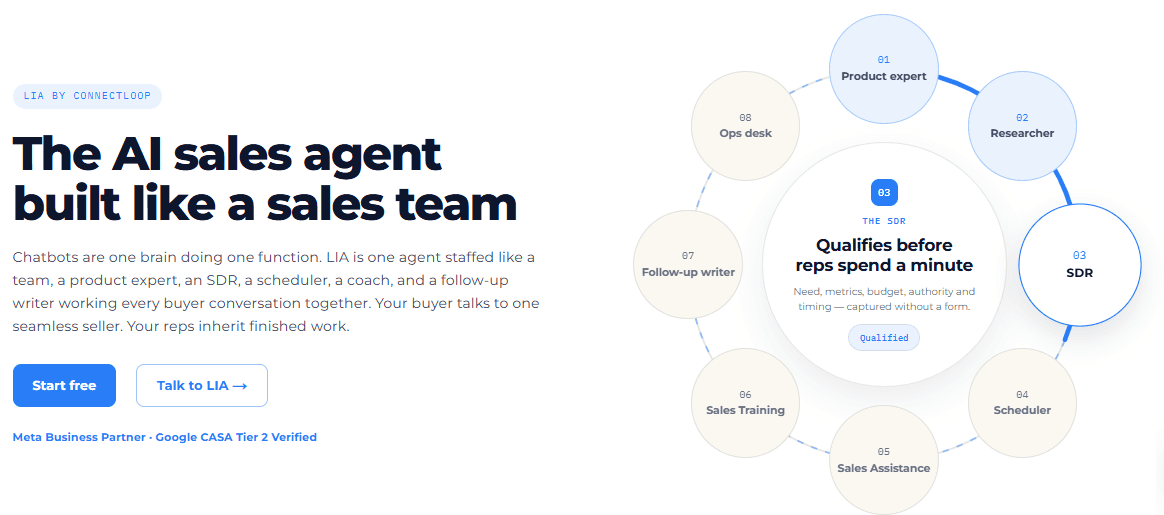
ConnectLoop drafts the follow-up from the actual conversation, then waits for a human to approve it. Because Lia handled the original exchange, the draft references what the person genuinely asked about rather than a generic “just checking in.”
Three things make this different from a sequencer.
It has the conversation. Lia answers questions on website chat, by email and on WhatsApp, so when a lead goes quiet, the follow-up is built from a real exchange: the specific question, the objection raised, the pages they read before asking. Visitor Intelligence adds the behavioural context: which pages they viewed, how often they returned.
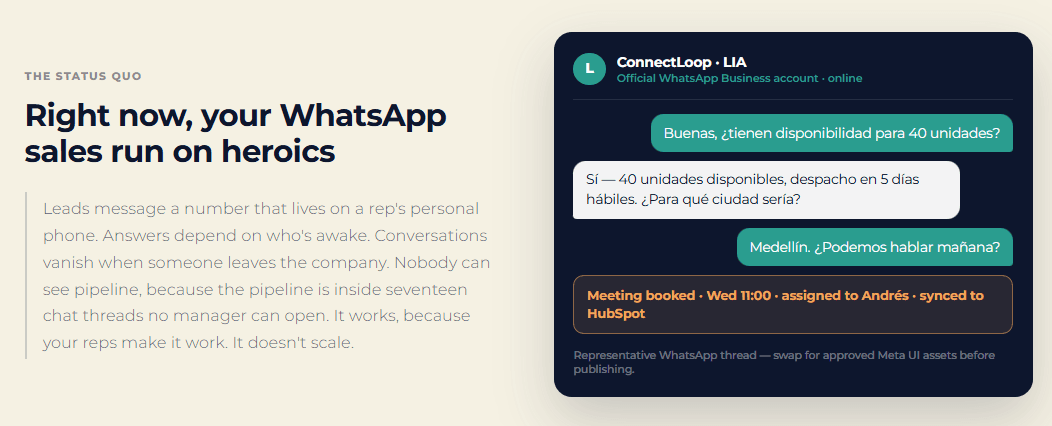
Nothing sends autonomously. A person on your team reviews every draft and sends it from their own inbox. Automated sending at volume, without review, is how sender reputation gets damaged, and it is slow to repair.
It doesn't rely on anyone remembering. ConnectLoop's Proactive Outreach drafts an email when a known lead comes back to your website, and Sales Assistance drafts a follow-up after a Google Meet or Zoom call, so the follow-up gets written while the context is fresh. That removes the failure mode described in the section above.
Every conversation is tracked from the first message to the booked call.
What can a follow-up email not fix?
It cannot create interest that was never there, and it cannot rescue a badly targeted list. A perfectly written follow-up to someone who was never a fit produces a faster, more polite rejection. Better discovery call questions catch that mismatch before it reaches the inbox.
Three honest limits worth stating.
- Follow-up multiplies what you already have. If your original email reached the wrong person with the wrong offer, more touches will not change the outcome. They will simply get you to the same result sooner.
- Volume makes it worse, not better. Sending more follow-ups to more people at higher frequency is the fastest route to spam complaints and deliverability damage.
- Some silence is a real answer. Not every non-reply is a busy inbox. Some people have decided and would rather not say so. The final “close the loop” email exists to give those people an easy exit, and when they take it, that is the system working.
ConnectLoop does not solve the first two. Teams whose constraint is lead quality rather than follow-up consistency should fix that first.
Key takeaways
- Wait three to five business days before the first follow-up. Sooner reads as anxious; much later loses the context.
- Two to three follow-ups plus a final close is the practical limit. Beyond four touches you're adding volume, not value.
- Every follow-up must add something new. Identical messages teach the recipient to stop opening them.
- Inbound follow-up is not cold outbound. Someone who contacted you first has given you permission and told you what they want, reference it.
- Low-friction CTAs outperform meeting requests. A question answerable in one line from a phone gets more replies than a calendar ask.
- The most common failure is absence, not wording. The follow-up that never gets written costs more than the one that's slightly clumsy.
- Never make the recipient defend their silence. “As per my last email” undoes an otherwise good message.
- Follow-up multiplies what you have. It won't fix bad targeting. It will just get you to the same outcome faster.

About the author
ConnectLoop Staff
Written by the ConnectLoop team. ConnectLoop is an AI sales agent for inbound revenue teams, based in Cambridge, Massachusetts.
About ConnectLoop →Frequently asked questions
Three to five business days for a first follow-up. Same-day or next-day follow-up reads as impatient and can reduce reply rates. Wait longer than a week and the context of your original message has faded, which means you are effectively starting again.
Two to three follow-ups plus a final closing-the-loop message is the practical ceiling for most outreach. Beyond four total touches you add inbox volume without meaningfully improving reply rates, and the risk of a spam complaint rises.
Keep the original thread and reply to it. A Re: line preserves context and reads as a continuation. If you start a new thread, name the topic directly, for example Following up on the pricing question. Avoid manufactured urgency, which gets opened once and remembered badly.
No, as long as the tone is right. What reads as rude is implying the recipient owes you a reply. Following up in case this got buried is fine. I still have not heard from you is not, even when the difference is unintentional.
Give context, add one new piece of information, and ask a question that takes ten seconds to answer. Keep it shorter than your first email. The tone test: would this read as helpful if the recipient genuinely had been too busy to reply?
Say you will stop, and mean it. I have not heard back, so I will assume the timing is not right. If that changes, just reply here. Giving someone a clean exit often produces an honest answer, and it protects the relationship for later.
Yes. The follow-up should be the shortest message in the thread. The recipient already has the context from your first email, so repeating it wastes the space you need for the new information that justifies the message.
Permission. Someone who contacted you first has already told you what they want, so referencing their actual question works far better than a generic check-in. Timing is usually tighter too, because interest decays quickly after an enquiry.
The drafting can. The sending is a different question. ConnectLoop drafts follow-ups from the real conversation and holds them for human review, because automated sending at volume without review damages sender reputation. Automate the remembering, not the judgement.
The final message in a follow-up sequence, sent when previous attempts have gone unanswered. It closes the loop politely, states that you will stop contacting them, and leaves the door open. It frequently produces replies from people who intended to respond and did not.
Stop relying on anyone remembering
ConnectLoop's agent, Lia, handles inbound conversations on your website, by email and on WhatsApp: answering questions, qualifying leads, and booking meetings. When a conversation goes quiet, ConnectLoop drafts the follow-up from what was actually discussed, and your team reviews and sends it.