
Sales Process
Stages of the Sales Process: 7 Stages, One Output Each
The stages of the sales process are prospecting, qualification, discovery, presentation, proposal, negotiation and close, followed by post-sale work that turns a customer into a referral. Each stage should produce a piece of evidence before the next begins. In inbound sales, the first three stages happen in a conversation the rep may never see, which is where ConnectLoop's agent works.

Published
Table of contents
- What are the stages of the sales process?
- What are the benefits of an effective sales process?
- Why do guides disagree on 5, 6 or 7 stages?
- What is the difference between a sales process, a sales cycle, a pipeline and a funnel?
- What happens at each stage, and what should it produce?
- How does the sales process change when the buyer comes to you?
- Which stages happen before a rep is involved?
- What should travel across each hand-off?
- Which sales methodology fits which stage?
- How do you measure the sales process?
- What are the most common mistakes at each stage?
- How do you improve your sales process?
- How do you build a repeatable sales process?
- How does the process change for mid-market and education buyers?
- Key takeaways
- Frequently asked questions
What are the stages of the sales process?
A sales process is the repeatable process a team follows to turn a prospect into a customer, broken into sales stages. Most versions have seven, and some call the whole sequence the sales lifecycle or sales workflow. What matters more than the count is that each stage has a clear goal, produces something checkable, and has an owner. Below is the version ConnectLoop uses, with the evidence each stage should leave behind.
| # | Stage | Goal | What it produces | Who owns it in an inbound team |
|---|---|---|---|---|
| 1 | Prospecting and awareness | Find people who fit the ideal customer profile and get their attention | A list of leads, or a visitor on your site | Marketing, or the buyer themselves |
| 2 | Qualification | Confirm fit, need, authority and timing | A qualified lead with a stated reason for reaching out | AI agent or SDR |
| 3 | Discovery | Understand the pain, the goal and the decision process | A discovery summary in the buyer's own words | Agent for the first pass, rep for depth |
| 4 | Presentation and demo | Show how the solution fits the pain uncovered | A demo tailored to the discovery notes | Rep |
| 5 | Proposal | Put the business case, price and scope in writing | A proposal or quote with ROI | Rep |
| 6 | Objections and negotiation | Resolve concerns and agree terms | Agreed terms, trades recorded | Rep |
| 7 | Close | Get the signature and hand to onboarding | A signed agreement and an onboarding plan | Rep, then customer success |
| + | Post-sale | Retain, expand, earn referrals | Renewal, upsell, cross-sell, referral | Customer success and account management |
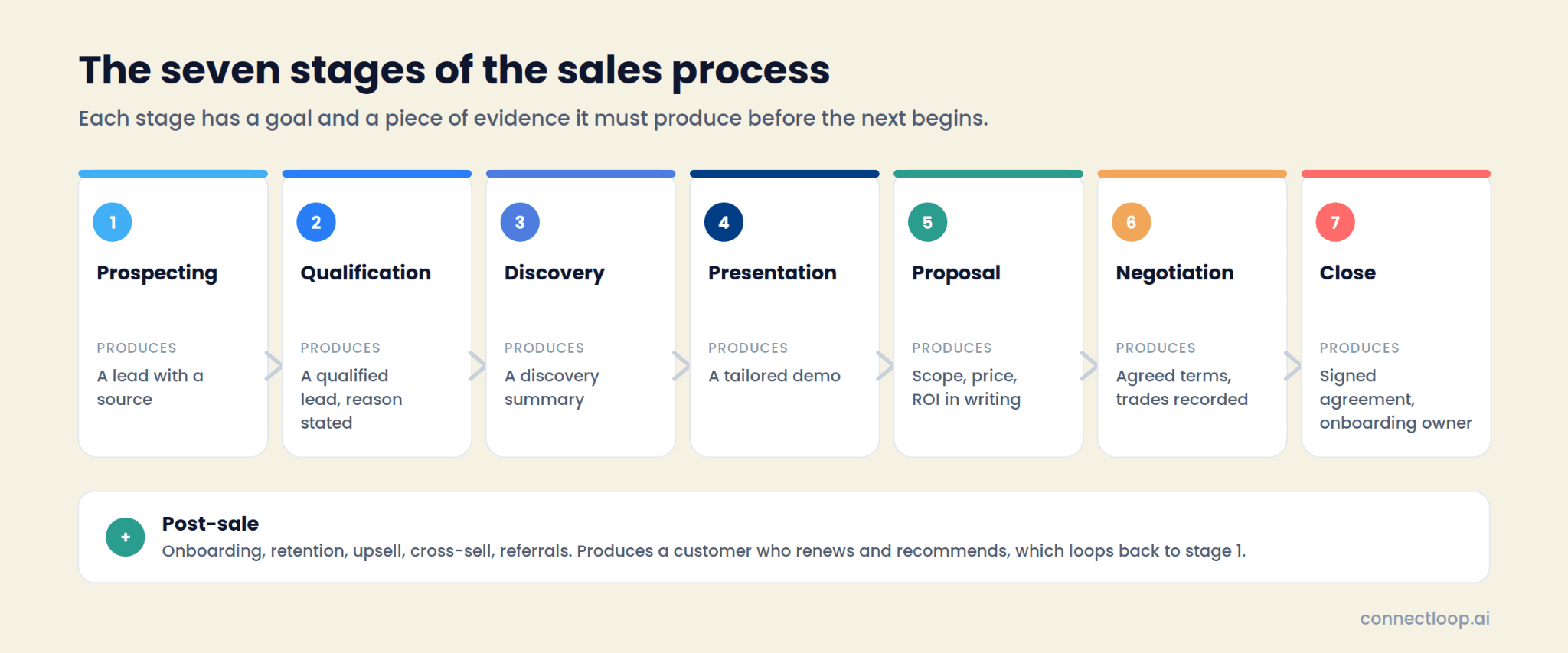
The table is the spine of the article. Every section below either explains a stage, explains what moves between stages, or explains what changes when the buyer starts the process rather than the seller.
What are the benefits of an effective sales process?
An effective sales process makes selling more efficient, onboarding faster, results more consistent and performance trackable at every stage. Reps know the next step, managers know where each deal sits, and forecasts rest on stage data rather than gut feel. It also gives an AI sales agent a clear place to work, because a stage with a defined output can be handed to whoever produces it best. It also removes the silos that form when each stage lives in a different tool or a different person's head.
- More efficient selling. One process, one set of tools, no duplicate follow-ups from two reps to the same buyer.
- Faster onboarding of new reps. A written process with clear outputs is something a new hire can follow in week one.
- Consistency. Every buyer gets the same quality of experience, whoever they speak to.
- Quantifiable and trackable. Stage-by-stage conversion shows where deals stall, so coaching goes where it is needed.
- Fewer silos. When qualification, discovery and closing share the same record, context stops getting lost at hand-offs.
- Happier reps. A process that works removes guesswork, and reps who know what to do next stay longer.
Why do guides disagree on 5, 6 or 7 stages?
Because they merge or split the same activities. Some fold research into prospecting, some treat objections as part of negotiation, some drop post-sale entirely. The underlying work is the same. Pick the number that matches how your team hands work between people, and use it consistently in the CRM.
Seven stages suit teams where different people own qualification, discovery and closing. Five suit small teams where one rep runs the whole sales cycle. Fewer than five usually means qualification and discovery are being skipped, which shows up later as a low win rate. The exception is transactional selling, where an AI agent for e-commerce runs the whole exchange from question to checkout and three stages are plenty.
A useful test: if two adjacent stages are always done by the same person in the same meeting, merge them. If a stage has no output you could point to in the CRM, it is not a stage yet.
What is the difference between a sales process, a sales cycle, a pipeline and a funnel?
A sales process is the sequence of stages and the actions inside them. A sales cycle is that sequence measured in time, from first contact to close. A sales pipeline is every open deal, shown by stage. A sales funnel is the same pipeline shown as conversion rates, with the numbers shrinking at each step.
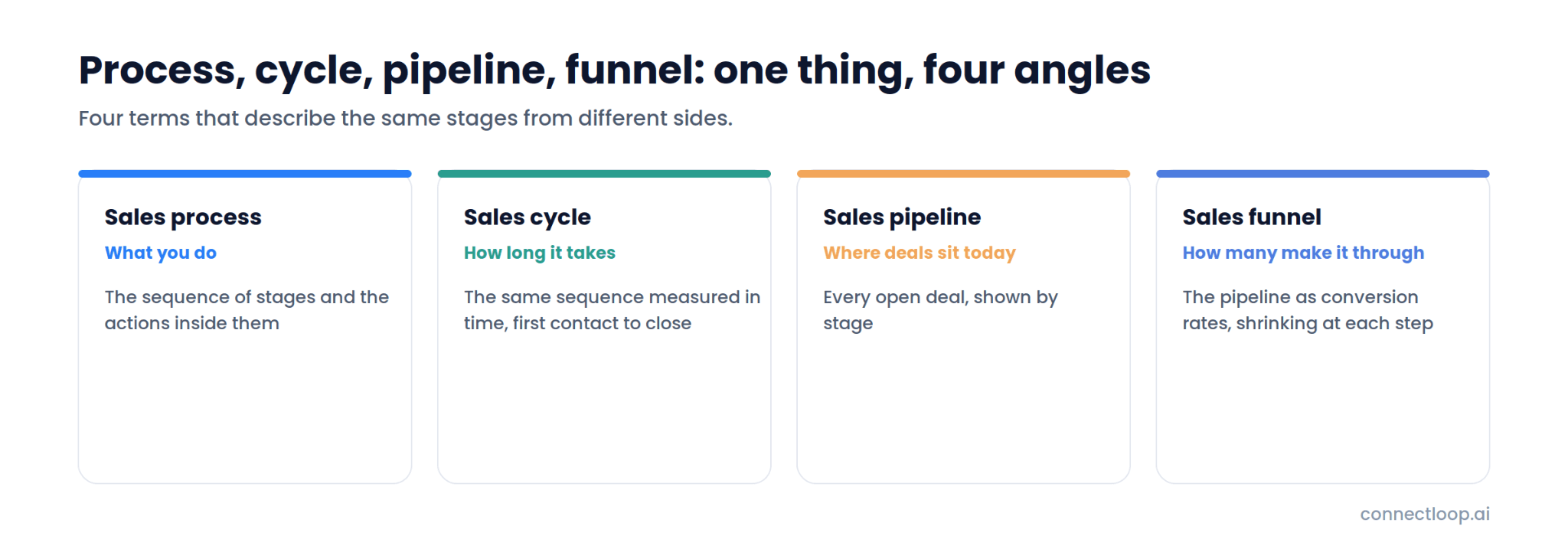
The four terms describe one thing from four angles. The process is what you do. The cycle is how long it takes. The pipeline is where each deal sits today. The funnel is how many make it from one stage to the next.
A sales methodology is different again: it is the approach applied inside the stages, whether consultative selling, SPIN, MEDDIC or Challenger. ConnectLoop's BANT vs MEDDIC comparison covers how to choose one.
What happens at each stage, and what should it produce?
Each stage below has a goal, the work that gets it there, and the evidence it should leave in the CRM. Treat the evidence as the exit condition. A deal with no discovery summary has not finished discovery, whatever the pipeline says.
What happens in the prospecting stage?
Prospecting finds people who match the buyer persona and starts a conversation. In outbound sales it means customer research, lists, cold email and calls. In inbound sales the buyer prospects themselves: they search, read, and arrive on your website, WhatsApp or email with a question already formed.
The output is a lead with a source. Where they came from matters, because a visitor who arrived from a comparison search behaves differently from one who arrived from a referral. ConnectLoop's B2B SaaS lead generation strategies guide covers the channels that feed this stage.
What happens in the qualification stage?
Qualification confirms the lead is worth a rep's time: they have a need you solve, a rough budget, some authority or access to it, and a timeline. The output is a qualified lead with the reason they reached out recorded in their words, not a checkbox.
Frameworks help here. BANT for short cycles, MEDDIC for complex ones, GPCT for goal-led conversations. Buying signals, a return visit, a pricing page viewed twice, a competitor named, count as evidence alongside the answers. The mistake is treating the framework as a form. The best qualification happens inside a natural conversation, which is what ConnectLoop's inbound lead qualification guide walks through.
Lead scoring belongs in this stage too. A score built from behaviour, pages viewed, return visits and stated intent, ranks the queue so the rep calls the right person first.
What happens in the discovery stage?
Needs discovery goes beneath the stated need to the pain points underneath it, the cost of leaving it unsolved, and how the decision will be made. The output is a discovery summary: pain, impact, decision-maker, other stakeholders, timeline, and what else they are evaluating.
SPIN is the classic questioning method for this stage: situation, problem, implication, need-payoff. In a discovery call it turns "we need a chatbot" into "we lose enrolments overnight because nobody answers," which is a problem worth paying to solve.
Multi-threading starts here. If the person you are talking to is not the decision-maker, discovery includes finding out who is and asking for the introduction.
What happens in the presentation and demo stage?
The presentation, whether a sales pitch or a product demo, shows the solution against the specific pain from discovery, in the buyer's language, using their examples. The output is a demo the buyer recognises as built for them, and a written follow-up that restates the value proposition in their terms.
A demo that shows every feature is a demo that skipped discovery. Show the three things that address the pain, back each with a result, and leave time for questions. The ConnectLoop AI appointment booking guide covers getting the demo booked without the back-and-forth.
What happens in the proposal stage?
The proposal puts scope, price and the business case in writing for every stakeholder, including the ones who were not in the demo. The output is a document that answers three questions: why change, why now, and what is the financial impact.
Include the cost of delay. A proposal that shows what each month of waiting costs creates urgency without pressure. Show ROI in the buyer's own metrics, not generic percentages, and keep the impact case short enough to forward.
What happens in the objections and negotiation stage?
Objections are questions in disguise: a price objection, a timing objection, a risk, or a competitor. Objection handling finds the question; negotiation is the trade that resolves it. The output is agreed terms, with every concession paired to something received. ConnectLoop's guide to how to negotiate in sales covers this stage in full.
The three most common objections are price ("it's more than we expected"), timing ("we're not ready") and lack of urgency ("what we have works"). Each has a question behind it, and the question is what to answer.
What happens in the close?
The close is where you close the deal: the signature and the hand-off to onboarding. If discovery, presentation and proposal were done properly, it is the quietest stage in the process. The output is a signed agreement, a start date, and a named person on each side responsible for the first thirty days.
Closing techniques exist, the assumptive close, the urgency close, but they are a sign that an earlier stage was skipped. A buyer who understands the value and trusts the seller does not need a technique.
What happens after the sale?
Post-sale is where retention, upsell, cross-sell and referrals come from, and it is the stage most teams leave undefined. The output is a customer who renews, expands and recommends. Onboarding, a check-in cadence, lead nurturing for the contacts who said not yet, and account development or key account management belong here, owned by customer success.
The sales process loops. A well-handled customer becomes a referral, which is the cheapest form of prospecting there is. Tools that watch for a customer's return visit and draft the next touch, or that carry open promises from one call into the next, are what keep this stage from being forgotten.
How does the sales process change when the buyer comes to you?
In inbound sales the buyer starts the process, often outside working hours, and the first three stages happen in a conversation before a rep is involved. The order holds; the owner changes. Prospecting is done by the buyer, qualification and first-pass discovery are done by whoever answers, and speed decides whether the rep ever gets stage four.
| Stage | Outbound version | Inbound version |
|---|---|---|
| Prospecting | Rep researches, lists, reaches out | Buyer searches, reads, arrives with a question |
| Qualification | Rep asks on a first call, days later | Answered in the first conversation, minutes after arrival |
| Discovery | A scheduled discovery call | First pass in the chat; depth on the rep's call |
| Presentation | Rep books and runs it | Booked in the conversation; rep runs it |
| Proposal onward | Rep | Rep |
| Time to first response | Rep's calendar | Whoever is available at 9pm |
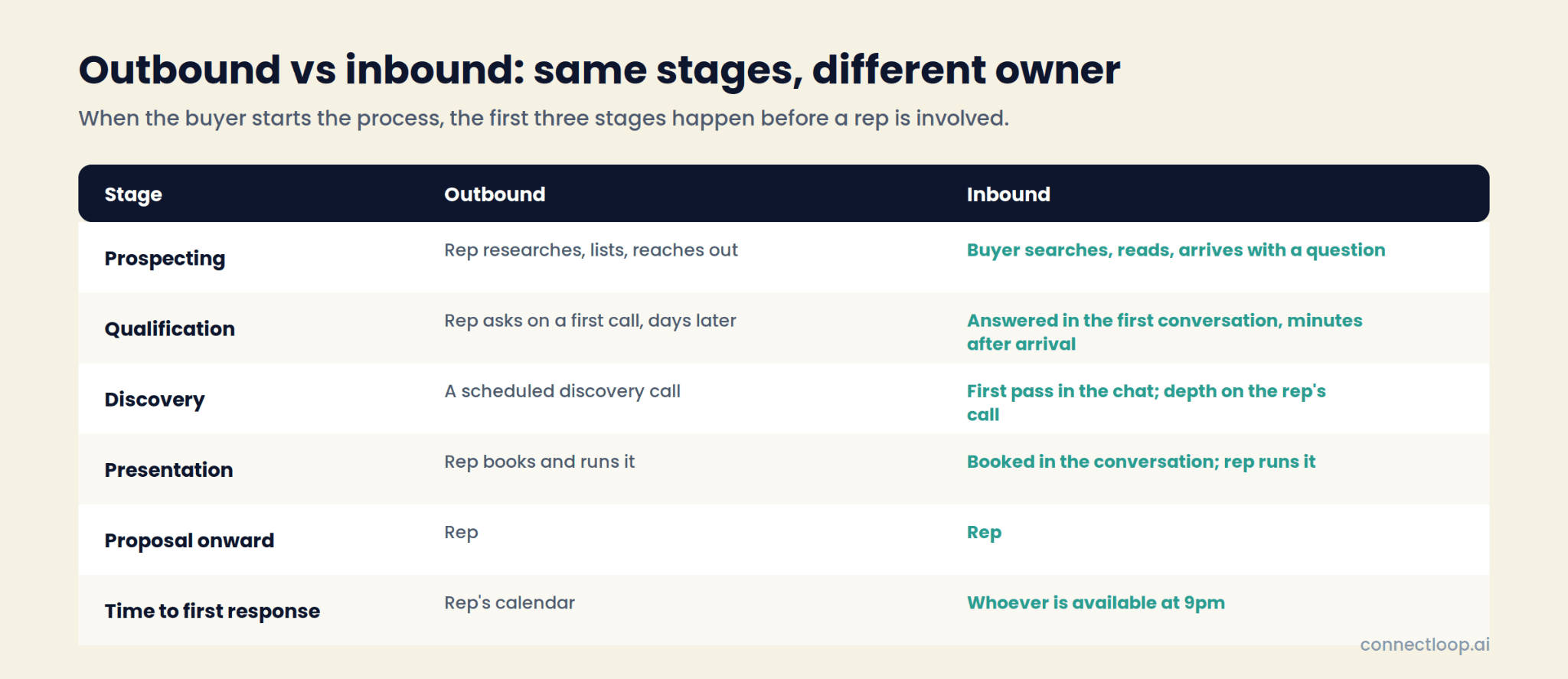
Two things follow. First, time to respond to an inquiry becomes the most important early metric, because the buyer is comparing you against whoever answered first. ConnectLoop's speed to lead guide covers why. Second, the rep's first call is no longer stage one; it is stage four, and it should start from what the buyer already said.
Which stages happen before a rep is involved?
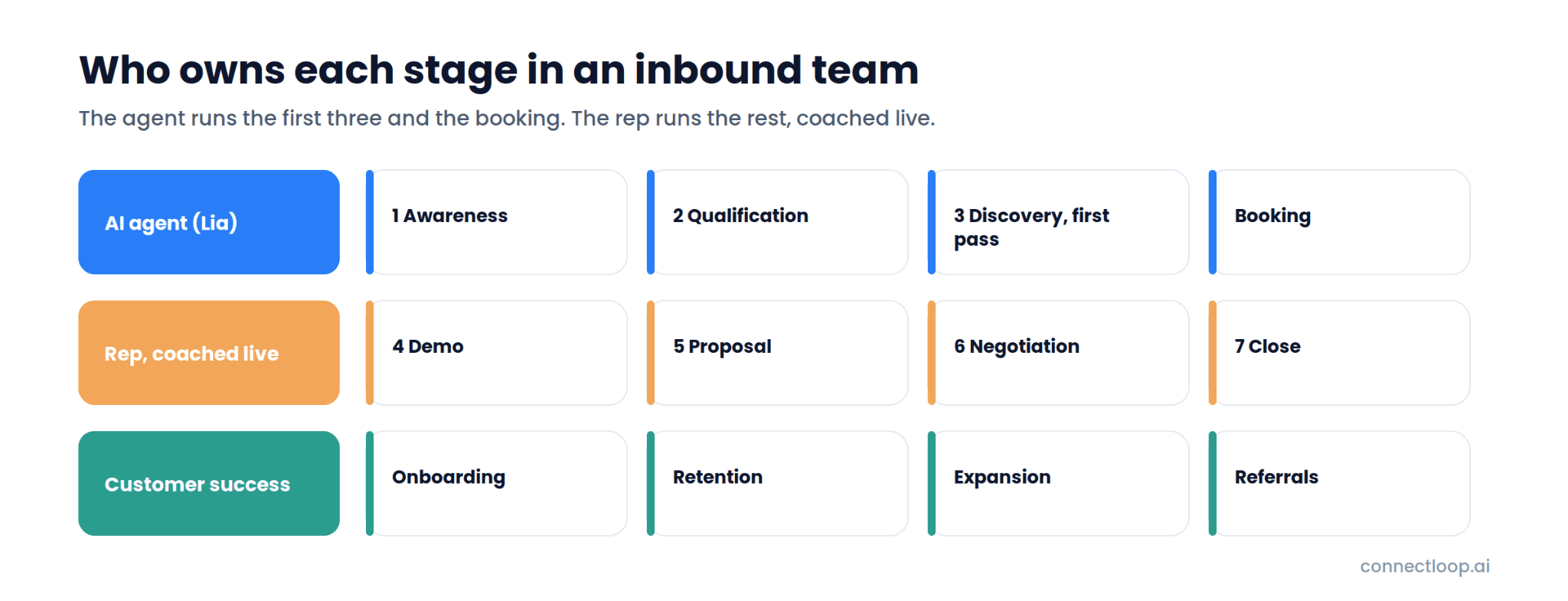
Stages one to three, and the booking of stage four. Prospecting is the buyer's own research. Qualification and first-pass discovery can happen in the conversation that starts when they arrive. Booking the demo can happen in the same exchange. Everything from the demo onward needs a person, and the best tools for those stages sit beside the rep rather than in front of the buyer.
This is how ConnectLoop covers the whole process. Its agent, Lia, works on website chat, WhatsApp and email, trained on the company's own site in about sixty seconds. For the later stages, ConnectLoop's Sales Assistance coaches the rep live on the call. Between the two, every conversation is tracked from first message to booked meeting and beyond.
| Stage | What ConnectLoop does | Who acts |
|---|---|---|
| 1. Prospecting and awareness | Visitor Intelligence tracks every anonymous visit, writes a summary of what the visitor is after, and labels intent High, Medium or Low. Lead Capture popups turn readers who never chat into known contacts. | The buyer, then the system |
| 2. Qualification | Lia answers the first question from approved content, then asks BANT, SPIN and MEDDICC questions one at a time inside the chat. Answers land on a lead scorecard, each marked Inferred or Confirmed. Lead temperature is scored automatically. | Lia |
| 3. Discovery, first pass | The pain, the alternatives named and the timeline are captured in the buyer's words. Conversational Intelligence reads every conversation and surfaces competitors, trends, sentiment and friction. | Lia, then the sales leader |
| 4. Booking and hand-off | Lia books against real calendar availability, sends the invite, routes the lead to the right team member by tag, and syncs the transcript, intent score and pages viewed to the CRM. | Lia, then the rep |
| 4 to 7. Demo, proposal, negotiation, close | Sales Assistance listens to the live call in the browser, tracks the framework step by step, surfaces cue cards for objections, pricing and product questions, then scores the call and drafts the follow-up. | The rep, coached live |
| Post-sale | Proactive Outreach drafts a follow-up when a known lead returns to the site. The customer dossier carries open promises and framework coverage into the next call. | Customer success and the rep |
What happens before the rep, step by step?
- Awareness. A visitor arrives at 9pm from a search. Visitor Intelligence tracks the pages they read and how many times they have come back, and writes a summary with an intent label. If they never open the chat, a Lead Capture popup offers something worth an email address.
- Inquiry. They ask a pricing or feature question. Lia answers from approved content, the same answer every time. If the answer is missing, the question is logged in Knowledge Gaps so the team can add it.
- Qualification. In the same exchange, Lia weaves in one discovery question at a time: what prompted the visit, what else they are evaluating, when they need it. With Sales Methodology on, those answers fill a SPIN and MEDDICC scorecard on the lead. If the visitor declines a question, Lia stops asking and carries on as a normal assistant.
- First-pass discovery. The pain and its context are captured. Conversational Intelligence then shows which competitors were named, what is trending, where sentiment turned, and which questions went unanswered.
- Booking. If the visitor is ready, Lia books the meeting against the team member's working hours and calendar, sends the invite, and routes the lead by tag. If not, the conversation is tracked from first message onward, and if they return later, Proactive Outreach drafts a follow-up for a person to send.
- Hand-off. The rep opens the record with the transcript, the summary, the scorecard, the intent score and the pages viewed already synced to the CRM, and a follow-up reminder if the lead sits unattended. They start at stage four.
How does ConnectLoop support the rep from the demo to the close?
Stages four to seven depend on judgment about the account and the relationship, and ConnectLoop keeps them with a person. What it adds is a coach in the room. Sales Assistance captures the meeting audio in the browser, with no bot joining the call, and works the framework the team chose: SPIN, MEDDICC, BANT, Challenger, or a custom sequence built in the workspace.
During the call the rep sees a tracker marking each framework step covered, pending or skipped, cue cards for objections, pricing and product questions with suggested wording, and what earlier calls with the same customer already settled, so nothing is re-asked. Talk ratio, pace and buyer sentiment run alongside.
After the call, ConnectLoop scores framework coverage step by step with the evidence for each, lists the action items agreed, writes a coaching note on where the call could have gone better, and drafts the follow-up email for the rep to review and send. The customer dossier keeps open promises and what is still uncovered, and carries both into the next call.
How do you optimise sales cycle management with ConnectLoop?
ConnectLoop makes every stage measurable and every hand-off complete. Conversational Intelligence groups inbound conversations by what drove them, pricing, features, integrations, setup or billing, and shows how well the agent resolved each. Sales Assistance reports calls assisted, cues accepted, average framework coverage and open action items. Knowledge Gaps and Friction Points list exactly what to add to the knowledge base.
A sales leader can see, for any 7, 30 or 90-day period, how much of stages one to three happened before anyone on the team was involved, which topics the agent resolved, where the mood turned, and how thoroughly reps covered the framework on the calls that followed. Sales cycle management starts with knowing where the cycle actually begins, and for inbound teams it begins in that first conversation.
What should travel across each hand-off?
Every hand-off between stages, and especially the one from agent to rep, should carry the evidence the previous stage produced. Lost context at hand-offs is the most common reason buyers repeat themselves, and a buyer who repeats themselves has been told the process is not working.
- Qualification to discovery: the stated reason for reaching out, the source, the pages viewed, the intent score, the competitor named if any.
- Discovery to presentation: the pain in the buyer's words, the cost of inaction, the decision-maker, other stakeholders, the timeline.
- Presentation to proposal: what resonated in the demo, the questions asked, the objections raised.
- Proposal to negotiation: the pricing floor, the trades available, the walk-away point.
- Close to onboarding: the promises made, the start date, the success criteria the buyer stated.
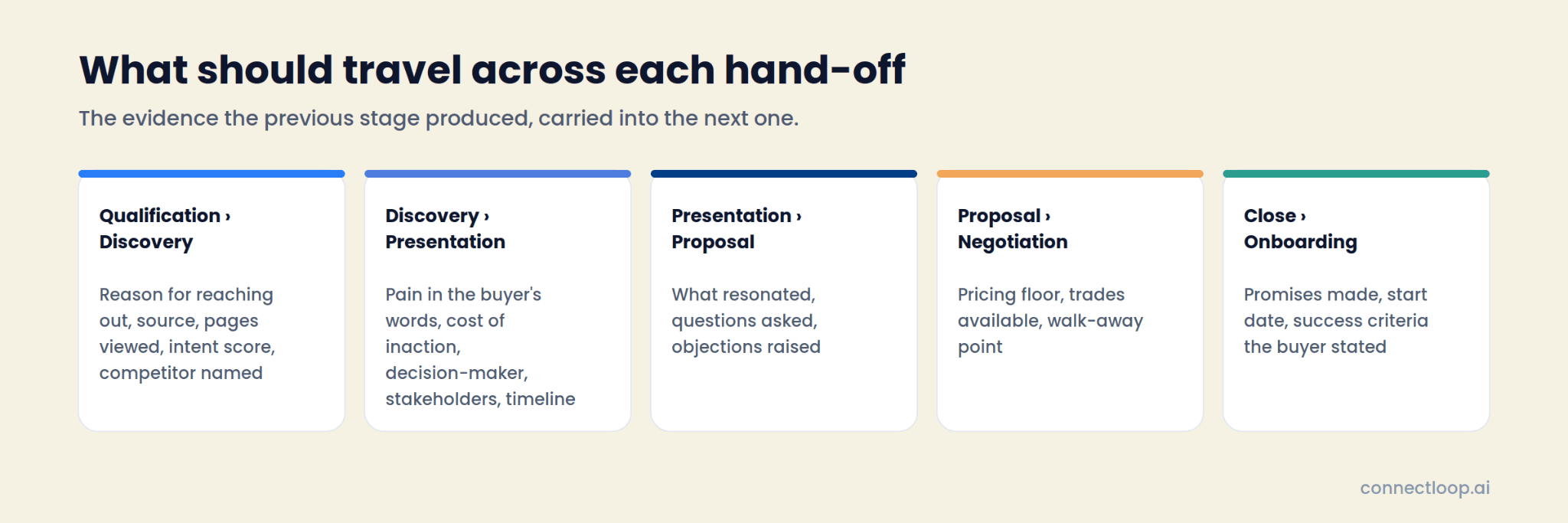
If the CRM can hold these as fields rather than notes, the handoff becomes auditable, and sales automation can move the record between stages without a rep retyping it. If an AI SDR or agent did the first stages, the sync to the CRM should carry the transcript so nothing is retyped.
Which sales methodology fits which stage?
Methodologies are tools for specific stages, not replacements for the process. BANT and GPCT fit qualification. SPIN fits discovery. MEDDIC fits the deal review that runs across stages three to seven. Challenger and insight selling fit presentation, where the seller reframes the problem. Value-based selling fits the proposal.
| Methodology | Best stage | What it adds |
|---|---|---|
| BANT | Qualification | Budget, authority, need, timeline in four questions |
| GPCT | Qualification | Goals, plans, challenges, timeline; goal-led version of BANT |
| SPIN | Discovery | Situation, problem, implication, need-payoff questioning |
| MEDDIC / MEDDPICC | Deal review, stages 3 to 7 | Eight checkpoints that predict whether a deal is real |
| Challenger Sale | Presentation | Teach the buyer something, then tailor and take control |
| Insight selling | Presentation | Bring ideas the buyer has not considered |
| Solution Selling | Discovery to proposal | Diagnose before prescribing; solution crafting with the buyer |
| Value-based selling | Proposal | Price against the outcome, not the feature list |
Most teams combine three: a qualification framework early, SPIN in discovery, MEDDIC for the review. ConnectLoop's MEDDPICC sales methodology guide explains the review framework in detail.
How do you measure the sales process?
Measure conversion rate between each pair of stages, average sales cycle length, time to close, win rate, and time to respond to an inquiry. These are the KPIs that matter. Track lead and lag measures together: lead measures are activities that predict outcomes, lag measures are the outcomes. A sales manager who watches stage-by-stage conversion can find the bottleneck before the quarter ends.
The formulas:
- Stage conversion rate = deals that reached the later stage ÷ deals that entered the earlier stage
- Average sales cycle length = total days to close all won deals ÷ number of won deals
- Win rate = deals won ÷ deals that reached proposal
- Time to respond = minutes from first inbound message to first reply, by hour of day
The last one is the number most teams have never seen, and it is usually the biggest surprise. Which numbers matter most also depends on who owns the early stages; the SDR vs BDR split decides whether qualification accuracy or outbound volume is the lead measure. Salesforce's State of Sales research found sellers spend most of their week on tasks other than selling, which is one reason the first reply takes so long. Pipeline value and quota attainment are the lag measures that follow from the four above.
According to RAIN Group's research into B2B sales challenges, a rising share of sales leaders report more opportunities lost to no decision. No-decision losses are a process metric: they show up where discovery was thin and the cost of inaction was never made real.
What are the most common mistakes at each stage?
Most process failures are the same seven mistakes, one per stage. Each has a fix that costs less than the deal it saves.
- Prospecting: chasing anyone. Fix: write the ICP down, including who is not a fit, and qualify against it. For inbound teams, start by learning to identify anonymous website visitors who already match it.
- Qualification: treating the framework as a form. Fix: ask the questions in conversation, record the answers in the buyer's words.
- Discovery: pitching before understanding. Fix: no demo until there is a discovery summary with a pain, a cost and a decision-maker.
- Presentation: showing every feature. Fix: three features, each tied to a stated pain, each backed by a result.
- Proposal: sending price without a business case. Fix: why change, why now, what it costs to wait.
- Negotiation: discounting at the first objection. Fix: ask what is behind the objection; trade, never concede.
- Close: treating the signature as the end. Fix: a named onboarding owner, a thirty-day check-in before the contract is filed, and a plan for the follow-up email after no response when a lost deal goes quiet instead of closing.
The inbound version adds one more: leaving the first reply to the morning. The fix is whoever, or whatever, is available when the buyer arrives.
How do you improve your sales process?
Improve an existing sales process by measuring it stage by stage, finding the stage where deals stall, and fixing that one stage before touching anything else. Most processes fail in one or two places, not everywhere. Digital transformation helps when it connects the stages, not when it adds another tool to a disconnected stack.
- Analyse the current process. Pull stage conversion rates for the last two quarters. Identify the stage with the lowest conversion or the longest dwell time.
- Read the evidence from that stage. Transcripts, call recordings, CRM notes. The cause is usually visible within ten conversations, and AI sales coaching that scores calls against the framework finds it faster than reading.
- Outline the buyer's journey against it. Where does the buyer expect something the stage is not giving them?
- Remove the roadblock. A missing document, an unanswered question, a slow first reply, a hand-off that drops context.
- Connect the systems. Digital transformation in sales means the chat, the CRM, the calendar and the follow-up share one record, so nothing is retyped and nothing is lost between stages. ConnectLoop replaces the separate live chat tool, scheduling app, follow-up sequencer and support inbox with one system, connected to the CRM, calendar and email the team already uses.
- Re-measure next period. One change at a time, so you know what worked.
How do you build a repeatable sales process?
A repeatable sales process is written down, reflected in the CRM, measured at every stage, and coached against weekly. The eight steps below are a proven blueprint most teams can run in a quarter. It takes a quarter to establish and never stops being refined. Consistency is the goal: a new rep should be able to follow it in their first week, and a sales manager should be able to see where any deal is without asking.
- Map the buyer's journey first. Where do buyers actually start, what do they read, what do they ask, and when? For inbound teams, start with the conversations, not the CRM.
- Define each stage by its output. Write the exit condition: "qualified lead with stated reason," "discovery summary," "proposal sent." No output, no stage.
- Assign an owner per stage. Agent, SDR, rep, customer success. A stage with two owners has none.
- Build the CRM to match. One pipeline stage per process stage, with required fields for the outputs above. Sync anything captured earlier so it is not retyped.
- Pick the methodology per stage. BANT or GPCT at qualification, SPIN at discovery, MEDDIC for deal review. Put it in the sales playbook.
- Set the metrics. Stage conversion, cycle length, win rate, time to respond. Review weekly.
- Coach the pattern. If most deals stall at the same stage, that is a sales training gap, not a rep problem. Sales coaching on transcripts and scored calls finds it fastest; a live-call assistant that tracks framework coverage tells you which step reps skip.
- Revisit quarterly. Buyers change channels, products change, the process follows.
Standardization is what makes onboarding new reps fast and forecasting honest, and it is the foundation any sales enablement effort sits on. It is not rigidity: the stages are fixed, the conversation inside them is not.
How does the process change for mid-market and education buyers?
For a $2,000 to $50,000 deal there is usually no procurement stage, no formal RFP and no legal review. The buyer, often a founder, a director or an enrolment lead, runs the process personally and has probably seen your pricing before speaking to anyone. Stages four to seven compress into one or two conversations, and speed at stages one to three decides who gets them.
Three adjustments. Merge presentation and proposal where the buyer wants a price on the call. Keep the discovery summary even when the call is short; it is what makes the follow-up relevant. And treat the after-hours inquiry as the norm, since education buyers, in particular, research in the evening. ConnectLoop's WhatsApp AI agent guide covers the channel most of them use.
The B2B vs B2C distinction matters less here than the deal-size one. A $5,000 certification sale to a working professional looks more like a considered consumer purchase than an enterprise deal, and the process should match.
Key takeaways
- The sales process has seven stages, prospecting through close, plus post-sale. Guides that count five or six merge the same work; pick the count that matches your hand-offs.
- Define each stage by what it produces: a qualified lead, a discovery summary, a proposal, a signed agreement. No output, no stage.
- Process is what you do, cycle is how long it takes, pipeline is where deals sit, funnel is the conversion between stages.
- In inbound sales the buyer starts the process, and stages one to three happen in the first conversation, often after hours.
- ConnectLoop's Lia handles awareness, inquiry, qualification, first-pass discovery and booking, then hands the transcript, scorecard and intent score to the rep. Sales Assistance coaches the rep live from the demo to the close, and Proactive Outreach keeps the follow-up going.
- Every hand-off should carry the previous stage's evidence, so the buyer never repeats themselves.
- Match the methodology to the stage: BANT or GPCT to qualify, SPIN to discover, MEDDIC to review, Challenger to present.
- Measure stage conversion, cycle length, win rate and time to respond, and coach whichever stage the numbers point to.

About the author
ConnectLoop Staff
Written by the ConnectLoop team. ConnectLoop is an AI sales agent for inbound revenue teams, based in Cambridge, Massachusetts.
About ConnectLoop →Frequently asked questions
Prospecting, qualification, discovery, presentation, proposal, negotiation and close. Most teams add post-sale as an eighth, covering onboarding, retention, upsell and referrals. Each stage should produce a piece of evidence before the next begins.
Discovery, because every later stage depends on it. A demo without a discovery summary shows the wrong features, a proposal without one has no business case, and a negotiation without one has nothing to trade against. In inbound sales, qualification runs a close second, because it decides which conversations reach a rep.
It depends on deal size and stakeholders. Transactional and small B2B deals close in days or weeks; mid-market in weeks to a couple of months; enterprise in months. Measure your own average sales cycle length rather than the industry's, and track it by stage to see where time is lost.
The stages are the same; the owners and the timing change. In inbound, the buyer does the prospecting, qualification happens in the first conversation, and the rep enters at the presentation stage. Time to first response replaces outreach volume as the early metric.
Yes: awareness, inquiry, qualification, first-pass discovery and booking. ConnectLoop's Lia does those on website chat, WhatsApp and email and hands the transcript, scorecard and intent score to the rep. Discovery depth, the demo, the proposal, negotiation and the close stay with a person, and ConnectLoop's Sales Assistance coaches the rep live through them.
The process is the sequence of stages your team follows. A methodology is the approach used inside a stage: SPIN for discovery questions, MEDDIC for deal review, Challenger for presentations. One process, several methodologies.
The stage's output: a qualified lead with a stated reason, a discovery summary, a tailored demo with follow-up notes, a proposal with ROI, agreed terms with trades listed, a signed agreement with an onboarding owner. If it is not recorded, the stage is not finished.
Calculate the conversion rate between each pair of stages and compare it with your own history. The pair with the lowest conversion, or the one that fell furthest, is the bottleneck. Read the transcripts or call recordings from that stage before changing anything.
Yes. A renewal runs the same stages in compressed form: the customer success manager qualifies the need, rediscovers the pain, presents the value delivered, proposes terms and negotiates. Account development is a sales process with a shorter cycle.
Stage-by-stage conversion, average cycle length, win rate, time to respond to an inquiry, and pipeline value against quota. Pair them with a deal review on the two or three deals that moved least.
A good sales process is a set of stages with clear outputs and clear owners
If your buyers start the process on your website at 9pm, ConnectLoop is built to run the first three stages well and hand the rest to your team with nothing lost. Train Lia on your site in about sixty seconds on the free plan and read the first qualified conversation it produces.