
Sales Enablement
Benefits of Sales Coaching: Quota Attainment, Ramp Time and Why Coaching Stalls
Sales coaching improves quota attainment by changing what reps do on real deals, not what they know in theory. Recent Gartner research links coaching to faster ramp time and better seller performance. The catch is capacity: most managers can't coach every rep every week. ConnectLoop's Sales Assistance coaches reps during live calls to close that gap.

Published · Updated
This guide answers the question first, then covers why coaching matters, what the latest figures say, why it so often doesn't happen, and how to make it part of the week rather than an extra.
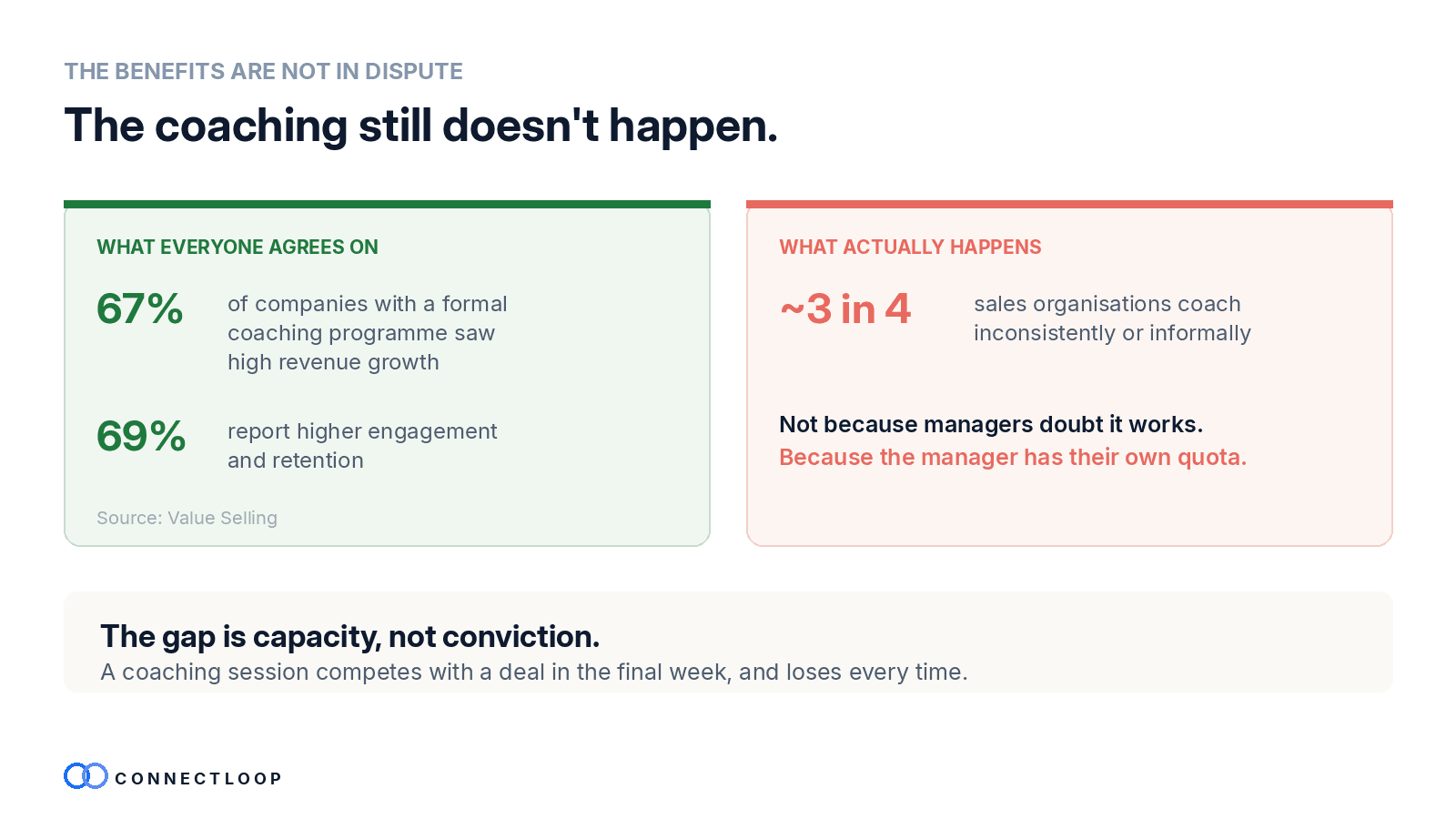
Table of contents
- Does sales coaching improve quota attainment?
- What is sales coaching?
- Why is sales coaching important?
- What do the sales coaching statistics say?
- What is the difference between sales coaching and sales training?
- Why isn't sales coaching happening in your organisation?
- Can pipeline meetings be a coaching opportunity?
- How does remote sales coaching work?
- How do you measure sales coaching effectiveness?
- How do you start a coaching rhythm, step by step?
- How does ConnectLoop support sales coaching?
- Key takeaways
- Frequently asked questions
Does sales coaching improve quota attainment?
Yes, when it's consistent and tied to real deals. Coaching improves the behaviours that drive quota: better discovery, earlier objection handling and clearer next steps. Gartner reports AI-supported coaching linked to a 21% improvement in seller performance. ConnectLoop's view is that coaching only lifts quota when it happens weekly, not quarterly.
The honest answer has two parts. Coaching changes behaviour quickly, often within a few weeks. Quota attainment follows more slowly, because deals take a full sales cycle to close.
That's why teams that judge coaching on one quarter's numbers often give up too early. The first proof is in leading indicators, such as framework coverage and stage progression, before it shows up in closed revenue.
Which reps gain the most from coaching?
Usually the middle of the team. Top performers already do most things well, and the lowest performers may have a fit or motivation problem coaching won't fix. ConnectLoop recommends starting with reps who are close to quota, because small improvements in their discovery and qualification move the team number most.
Check the cause before you coach. A rep who misses quota because of poor territory or weak leads needs a different conversation from a rep who skips discovery questions.
What is sales coaching?
Sales coaching is regular, one-to-one help that improves how a rep sells, using evidence from their own calls and deals. It focuses on behaviour, such as questions asked, objections handled and next steps agreed. ConnectLoop treats coaching as continuous: before the call, during it, and after it.
Coaching is different from managing. A pipeline review asks "Will this deal close?" A coaching conversation asks "What will you do differently on the next call, and why?"
Good coaching has three parts: a clear standard (your sales methodology), evidence (calls, emails and deal history), and one specific change the rep agrees to try.
Why is sales coaching important?
Because training alone fades, buyers are harder to win, and every rep sells a little differently. Coaching turns a shared playbook into daily habits. The importance of sales coaching grows as buyers rely more on self-service and expect more from the rep when they do talk. ConnectLoop builds coaching into the conversation itself for that reason.
Buyers now arrive better informed. Gartner's 20 May 2026 survey of 645 B2B buyers found 69% turn to sales reps to validate AI-generated insights.
When a buyer does reach a rep, the rep has to add something the buyer couldn't find alone. That depends on skill, and skill depends on coaching.
The impact of coaching on sales performance shows up in four places:
- Ramp time: new reps reach productivity faster with feedback on real calls.
- Consistency: every rep follows the same core process, so forecasts become more reliable.
- Win rate: better discovery and qualification mean fewer deals lost late.
- Retention: reps who feel supported are more likely to stay.
What do the sales coaching statistics say?
Recent research points the same way: structured coaching and better use of rep time are linked to stronger performance. Gartner's 2025–2026 findings connect AI-supported coaching with faster ramp and higher seller performance. Direct, recent quota-attainment studies are scarcer, so ConnectLoop treats these as strong signals rather than guarantees.
The sales coaching statistics worth citing in 2026:
| Finding | Source | Date |
|---|---|---|
| AI-supported sales coaching linked to a 55% reduction in onboarding ramp time, a 21% improvement in seller performance and 14% stronger opportunity progression | Gartner CSO & Sales Leader Conference | Conference highlights, May |
| AI saves sellers an average of 4.8 hours a week, but 72% of sales organisations report low reinvestment of that time into high-impact activities | Gartner survey of 210 sales leaders | 19 May 2026 |
| Organisations that reinvest AI time savings into high-value activities are 2.2x more likely to exceed customer growth goals | Same Gartner survey | 19 May 2026 |
| Sales organisations that prioritise seller AI upskilling are 2.4x more likely to achieve strong revenue growth | Gartner survey of 227 CSOs | 20 May 2026 |
Read together, the message is practical. AI frees up rep time, but most teams don't spend it on anything better. Coaching is one of the clearest high-value uses of that time.
Be careful with older figures. Many coaching statistics still in circulation come from studies several years old, often published by companies that sell coaching programmes. Check the date and the source before you quote one.
What is the difference between sales coaching and sales training?
Training teaches a skill to a group; coaching helps one rep apply it on real deals. Training happens in sessions, while coaching happens continuously, using the rep's own calls as evidence. Both matter, but only coaching makes the skill stick. ConnectLoop supports both: practice before calls, and live coaching during them.
| Sales training | Sales coaching | |
|---|---|---|
| Who | A group or the whole team | One rep at a time |
| When | Onboarding, kickoffs, new launches | Every week, around live deals |
| Content | Standard material: product, process, methodology | The rep's own calls, emails and deals |
| Goal | Know what good looks like | Do it consistently under pressure |
| Measured by | Completion and assessment scores | Behaviour change and deal outcomes |
Training without coaching fades because reps go back to old habits under pressure. Coaching without training has nothing to anchor to, because there is no shared standard.
AI sales coaching vs traditional sales training compares the two approaches in depth. Sales role play covers the practice side.
Why isn't sales coaching happening in your organisation?
Usually because managers don't have the time, not because reps don't want it. Most sales managers carry their own targets, run pipeline reviews and handle escalations, so coaching is the first thing to slip. ConnectLoop's approach is to make coaching happen inside the work rather than as an extra meeting.
The common reasons coaching stalls:
- No time. A manager with eight reps needs several hours a week to prepare and coach properly. That time rarely exists.
- No evidence. Without recorded calls or notes, coaching becomes opinion. Reps push back on feedback they can't see.
- No standard. If the team hasn't agreed a methodology, there is nothing clear to coach against.
- No measurement. Coaching that isn't tracked is the first thing cut when the quarter gets busy.
- It feels like inspection. If every coaching session follows a lost deal, reps learn to avoid it.
Each of these has a fix. Agree one framework. Use real conversations as evidence. Put coaching on the calendar and protect it. Separate coaching from performance management.
The sales playbook is where the agreed standard should live, so coaching has a reference point.
Who coaches when there's no dedicated sales manager?
Founders, senior reps or the reps themselves, with a shared framework and evidence from real calls. Peer review and self-review work well when everyone scores against the same standard. ConnectLoop's Sales Assistance scores calls against your chosen framework, so reps get consistent feedback even without a full-time manager.
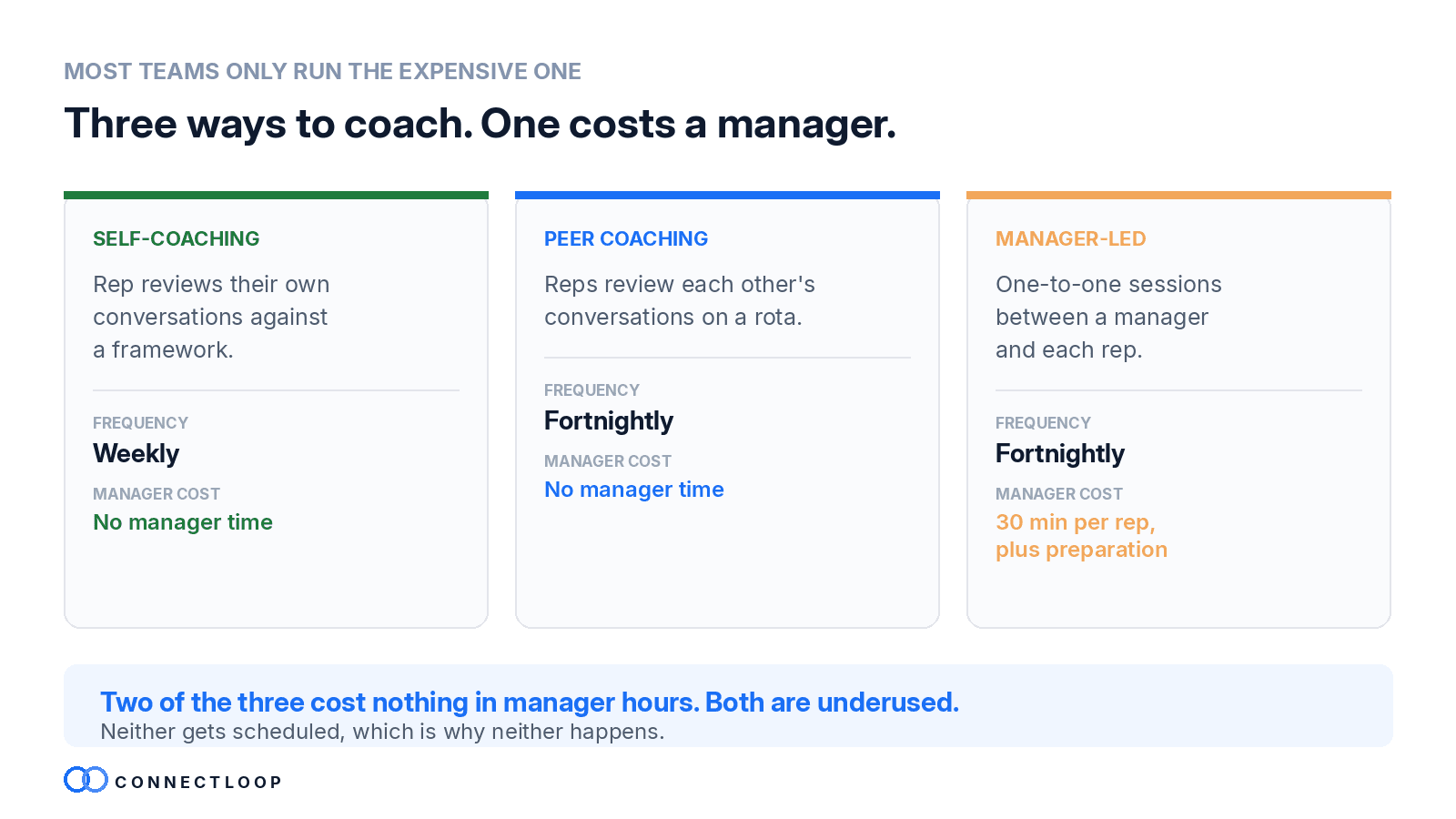
Small teams can run a simple rhythm: each rep reviews one of their own calls a week, and two reps swap one call every other week. A founder or senior rep joins once a month.
Can pipeline meetings be a coaching opportunity?
Yes. Pipeline meetings already discuss real deals, so they're a natural place for deal coaching. The change is in the questions: instead of asking only "When will it close?", ask "What do we still not know, and how will you find out?" ConnectLoop's framework coverage shows which steps each deal is missing.
Deal coaching turns a forecast review into skill building. Three questions work for almost any deal:
- What's missing? Which qualification steps, such as decision process or economic buyer, are still unknown?
- What's the evidence? What did the buyer actually say or do that supports the stage?
- What's the next move? What will the rep ask or send next, and why?
Keep one or two deals per rep for deeper coaching, rather than skimming every deal. Use your methodology as the checklist; MEDDPICC and BANT vs MEDDIC show common options.
Deals stall at predictable points. Matching coaching to the stages of the sales process helps managers spot where each rep tends to get stuck.
How does remote sales coaching work?
Remote sales coaching uses recorded or live calls, shared notes and short one-to-ones over video instead of sitting in on meetings. It can be more consistent than in-person coaching, because every call can be reviewed. ConnectLoop's Sales Assistance coaches reps on Google Meet and Zoom calls without a bot joining the meeting.
Remote coaching works best with a few habits:
- Review real calls, not memories. A short clip of the actual moment beats a summary from the rep.
- Keep sessions short and frequent. Twenty minutes every week beats an hour once a month.
- Give one change at a time. Too much feedback at once means none of it sticks.
- Use live prompts carefully. In-call cues help with objections and pricing, but too many distract the rep.
Remote teams also need written standards. When people don't share an office, the playbook and framework replace the informal learning that happens by overhearing colleagues.
How do you measure sales coaching effectiveness?
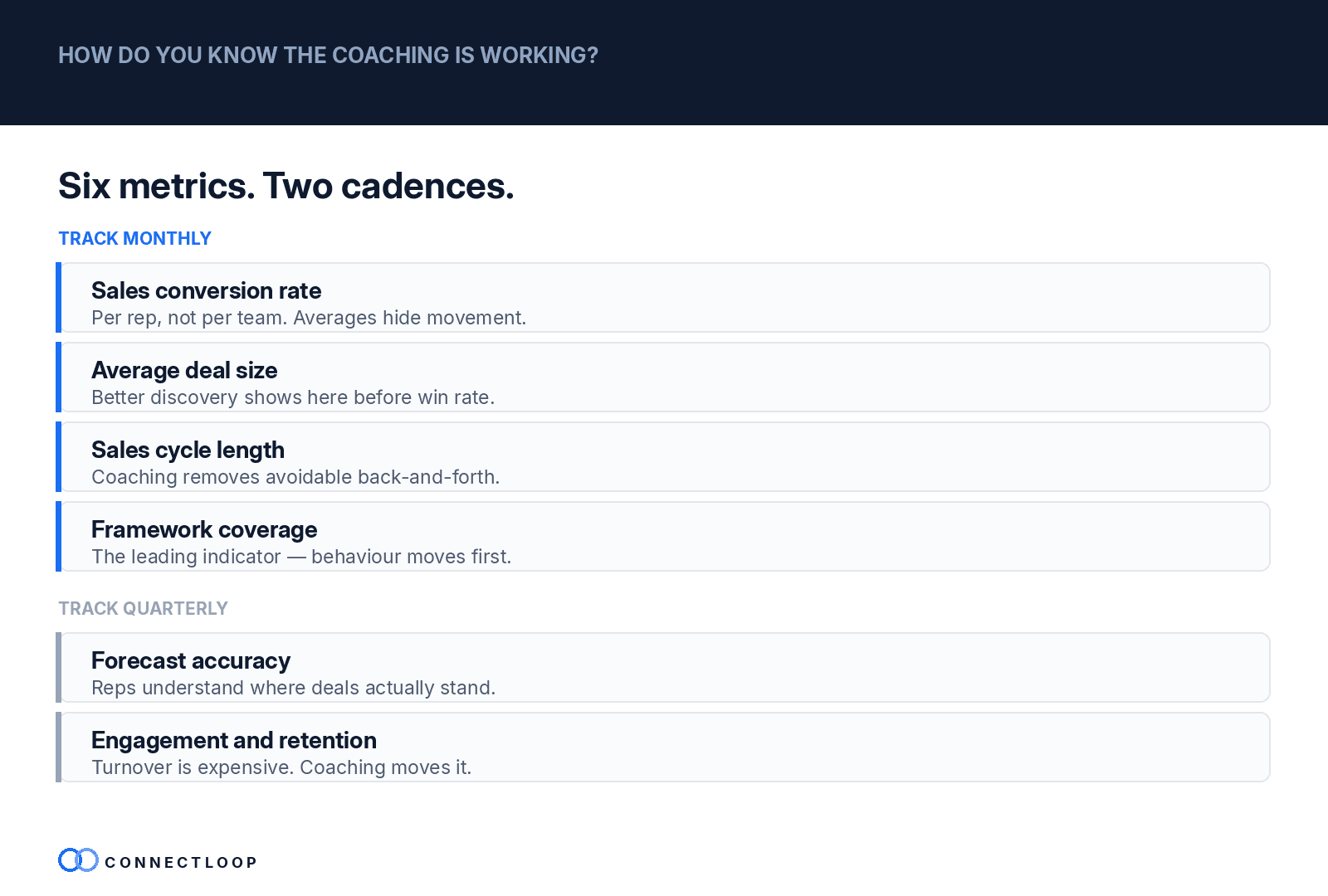
Track leading indicators, which move first, and lagging indicators, which show the business result. Behaviour, such as framework coverage and talk ratio, moves within weeks; win rate and quota attainment take a sales cycle or more. ConnectLoop's Assist Dashboard reports calls assisted, cues accepted and average framework coverage.
| Metric | Type | What it tells you |
|---|---|---|
| Framework coverage | Leading | Whether reps are asking the questions your methodology requires |
| Stage progression | Leading | Whether deals move forward after coaching |
| Ramp time | Lagging | How quickly new reps reach productivity |
| Win rate per rep | Lagging | Whether better behaviour turns into closed deals |
| Quota attainment | Lagging | The overall result, measured over at least a full sales cycle |
| Rep retention | Lagging | Whether reps feel supported enough to stay |
Measure per rep, not just as a team average. A team average can hide one rep improving sharply and another going backwards.
These sit alongside your wider inbound sales metrics.
How do you start a coaching rhythm, step by step?
Start small, use one framework, and protect the time. A 30-day rhythm with a few reps shows more than a big launch. ConnectLoop recommends beginning with the reps closest to quota and one clear behaviour to improve.
- Agree one framework. Pick the methodology your team already uses and define what "covered" means for each step.
- Pick three reps. Start with reps near quota, where small changes matter most.
- Choose one behaviour each. For example, asking about the decision process, or handling the first price objection.
- Use real evidence. Review one recorded or assisted call per rep each week.
- Book short one-to-ones. Twenty to thirty minutes per rep, every week, protected on the calendar.
- Turn pipeline meetings into deal coaching. Ask what's missing, what the evidence is, and what the next move is.
- Track leading indicators. Watch framework coverage and stage progression weekly.
- Review after 30 days. Keep what worked, then expand to the rest of the team.
How does ConnectLoop support sales coaching?
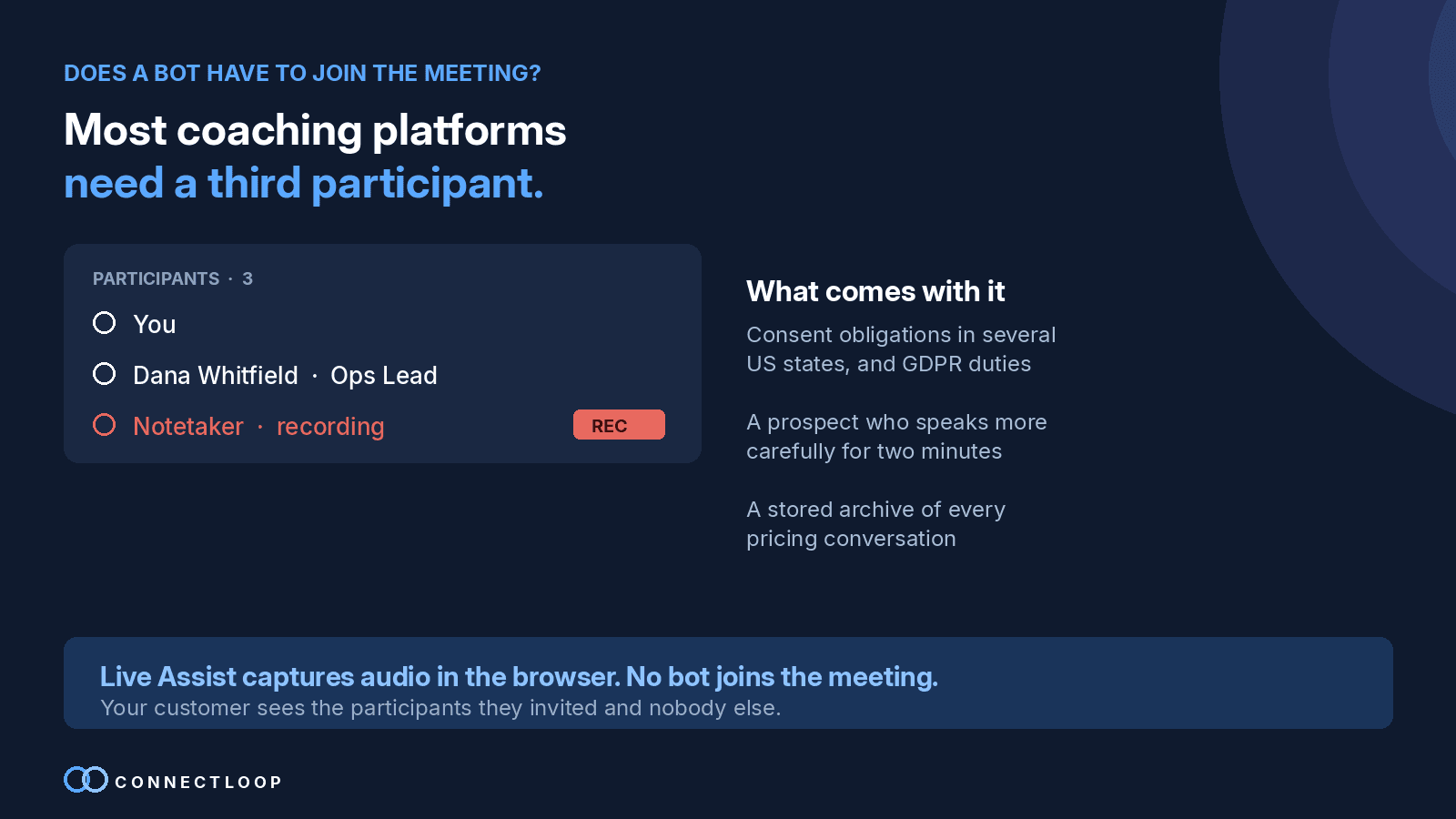
ConnectLoop's Sales Assistance coaches reps during live calls. It captures the call in the browser with no bot joining the meeting, shows cues as the conversation happens, tracks framework coverage and scores the call afterwards. Managers see patterns across the team instead of listening to every call.
ConnectLoop is an AI sales agent platform for inbound revenue teams. Its agent, Lia, handles the first conversation on website chat, WhatsApp and email, qualifies the buyer and books the meeting. Sales Assistance then supports the rep on the call that follows.
What it does:
- No bot in the meeting. Audio is captured from the browser tab during Google Meet and Zoom calls in Chrome or Edge, so only invited people appear in the meeting.
- Live cues. Seven cue types appear during the call: memory, discovery questions, pricing, objections, battlecards, product knowledge and action items.
- Framework tracking. Reps can run ConnectLoop's YES Framework, SPIN, MEDDICC, BANT, Challenger, or a custom methodology of up to 12 steps.
- Customer dossier. Open promises, stakeholders and framework coverage carry from one call to the next.
- Manager view. The Assist Dashboard shows calls assisted, cues accepted, average framework coverage and open action items over 7, 30 or 90 days.
- Follow-up drafts. After the call, a follow-up draft is ready for the rep to review and send from their own inbox.
Because Lia handles the first inbound conversation, the rep starts the call knowing what the buyer already asked. What AI sales coaching actually does explains the live coaching approach in more detail.
What does coaching software leave to people?
The judgment. Software can show that a rep skipped the decision-process question; it can't tell whether the deal was ever a good fit, or what's affecting the rep's confidence. ConnectLoop is built to give managers better evidence, so their coaching time goes where it matters.
Software also can't create a coaching culture. If nobody protects coaching time, a dashboard won't change that. Start with the habit, then add tools that make it easier to keep.
Key takeaways
- Sales coaching improves quota attainment by changing behaviour on real deals, but results show in leading indicators first and in quota over a full sales cycle.
- Coach the middle of the team first. Reps close to quota usually gain the most from small improvements.
- Recent Gartner research links AI-supported coaching to a 55% reduction in ramp time and a 21% improvement in seller performance.
- Most coaching fails because of manager capacity, not rep resistance. Fix the time, the evidence and the standard.
- Training teaches the skill; coaching makes it stick. Teams need both.
- Pipeline meetings can double as deal coaching if the questions change from "when" to "what's missing".
- Measure per rep, using framework coverage and stage progression before win rate and quota.
- ConnectLoop's Sales Assistance coaches reps during live calls, with no bot joining the meeting.

About the author
ConnectLoop Staff
Written by the ConnectLoop team. ConnectLoop is an AI sales agent for inbound revenue teams, based in Cambridge, Massachusetts.
About ConnectLoop →Frequently asked questions
Behaviour changes, such as asking better discovery questions, often show within a few weeks. Win rate and quota attainment take at least one full sales cycle. Give coaching a quarter before judging it on revenue.
Weekly is best for reps you're actively developing. Short, regular sessions of 20 to 30 minutes work better than long monthly reviews, because feedback stays close to the calls it's about.
Deal coaching focuses on one live opportunity: what's known, what's missing and what the rep should do next. It builds skill using real deals, and it often fits inside existing pipeline meetings.
Yes. Small teams can use self-review and peer review against a shared framework, with a founder or senior rep coaching once a month. Coaching software can fill the gap where no full-time manager exists.
Not always. Many tools add a bot to the meeting, but ConnectLoop's Sales Assistance captures audio from the browser tab, so no extra participant joins. Follow local consent rules for recording and analysing calls either way.
One call, one behaviour and one agreed change. Start with what the rep did well, review the key moment, agree what to try next time, and check it on the next call.
Yes, but the focus changes. Experienced reps benefit more from deal strategy, negotiation and complex stakeholder situations than from basic discovery. See how to negotiate in sales for one common focus area.
No. AI can review every call, track framework coverage and give live prompts. Managers still own deal strategy, career development and judgment on the account. AI gives them better evidence and more time.
Coaching that happens every week, not every quarter
The benefits of sales coaching aren't in doubt. The problem is making it happen consistently when managers are stretched. ConnectLoop helps by coaching reps during live calls, tracking framework coverage and showing managers where to focus. See how Sales Assistance works.