
Sales Qualification
BANT vs MEDDIC: Which One Your Sales Team Actually Needs
BANT asks four questions to decide whether a deal is worth pursuing. MEDDICC asks seven to work out how to win it. Both were designed for a rep on a scheduled call. ConnectLoop runs them inside inbound conversations instead, where the rules change.

Published
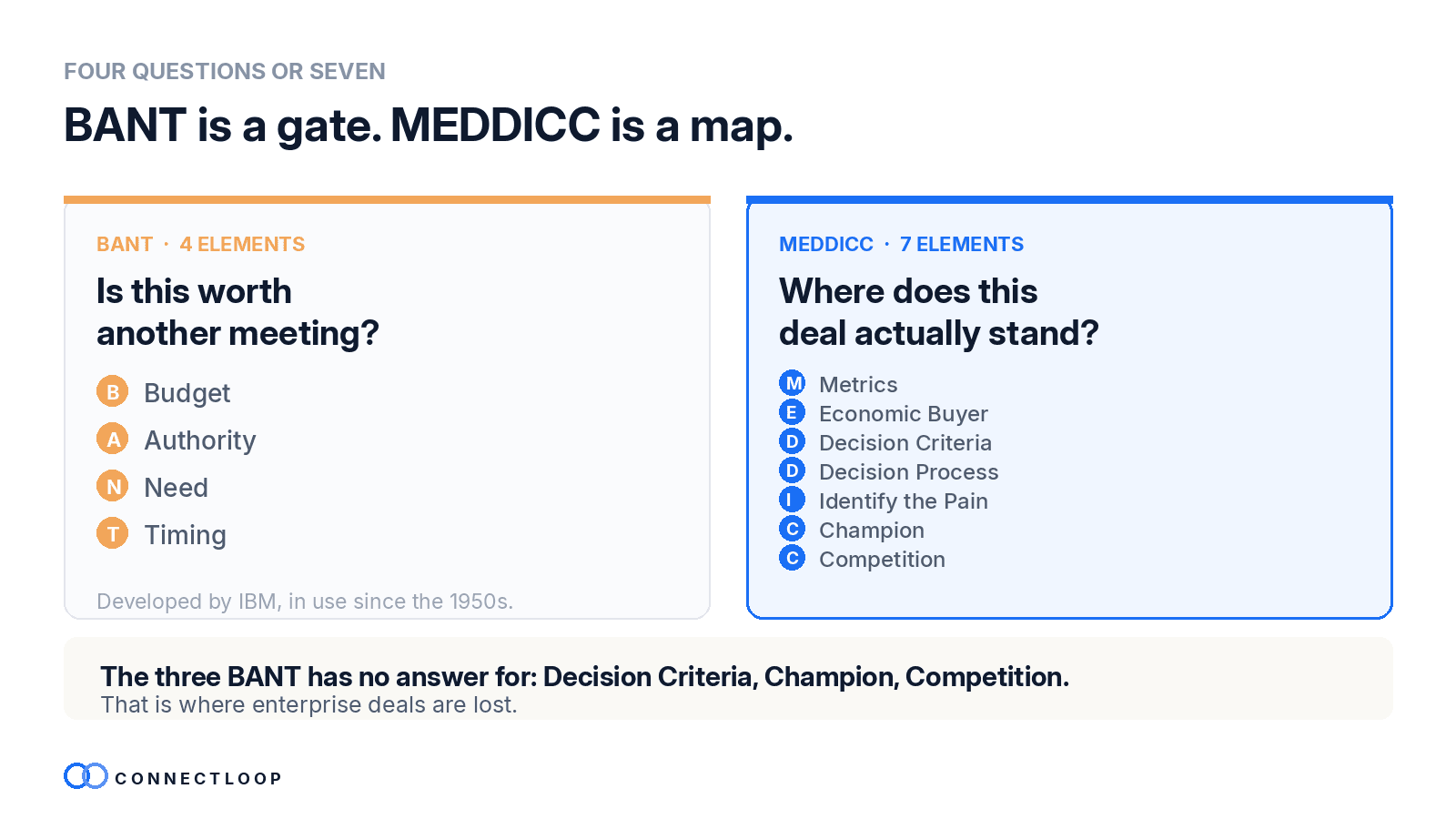
Table of contents
- What is BANT?
- What is MEDDIC?
- MEDDIC, MEDDICC or MEDDPICC: which one do people mean?
- How do the two frameworks map to each other?
- Which framework fits which sales motion?
- What are the pros and cons of BANT?
- What are the pros and cons of MEDDICC?
- How do you choose between them?
- What changes when qualification happens in a chat window?
- What do you do with a partially qualified lead?
- How do you run a framework without turning it into a script?
- How does ConnectLoop run these frameworks?
- Where qualification frameworks stop helping
- Key takeaways
- Frequently asked questions
What is BANT?
A four-part qualification checklist developed by IBM and in use since the 1950s, designed to decide quickly whether a prospect is worth pursuing past a first conversation. It asks about Budget, Authority, Need and Timing, and it is built for speed rather than depth.
The four elements are straightforward.
- Budget: can they afford it?
- Authority: are you talking to someone who can decide?
- Need: do they have a problem you solve?
- Timing: when are they looking to buy?
BANT answers one question: is this worth another meeting?
For high-volume prospecting and short transactional cycles, that is a legitimate thing to know, and BANT tells you fast.
The criticism of BANT is not that it is wrong. It is that it stops where enterprise deals get complicated, and it treats a buying committee as a single checkbox called Authority.
What is MEDDIC?
A six-part qualification methodology built for complex B2B sales. Where BANT decides whether to enter a deal, MEDDIC is designed to tell you where you stand inside one: what is known, what is missing, and what to do next.
The six elements:
- Metrics: the quantified value your solution delivers
- Economic Buyer: the person with overall buying authority
- Decision Criteria: how your solution will be evaluated
- Decision Process: the steps the buyer takes to reach a decision
- Identify the Pain: the business problem being solved
- Champion: the internal advocate who will sell on your behalf
MEDDICC adds a seventh:
- Competition: any alternative the buyer is weighing, including rival vendors, an internal build, and doing nothing
The difference in intent matters more than the difference in length. BANT is a gate. MEDDICC is a map.
MEDDIC, MEDDICC or MEDDPICC: which one do people mean?
Three names for the same lineage, each adding an element. Most confusion in this topic comes from people using them interchangeably when they are not.
| Name | Elements | What it adds |
|---|---|---|
| MEDDIC | 6 | The original: Metrics, Economic Buyer, Decision Criteria, Decision Process, Identify the Pain, Champion |
| MEDDICC | 7 | Adds Competition, including the status quo and doing nothing |
| MEDDPICC | 8 | Adds Paper Process, the steps from decision to signature |
MEDDICC, the organisation that owns and certifies the methodology, now writes primarily about MEDDPICC and describes it as their preferred variation.
Practical guidance: if a job advert or a vendor says MEDDIC, ask how many elements they run. The extra two matter most in long enterprise cycles with procurement involved.
ConnectLoop runs MEDDICC, the seven-element version including Competition, inside conversations. Competition matters in inbound specifically, because a buyer researching at 9pm is almost always comparing you against something.
How do the two frameworks map to each other?
More closely than the acronyms suggest. Every BANT element has a MEDDIC equivalent, but MEDDIC breaks each one into something more specific and adds three things BANT has no answer for.
| BANT | MEDDIC equivalent | What changes |
|---|---|---|
| Budget | Metrics | Moves from "can they pay" to "what is this worth to them," quantified |
| Authority | Economic Buyer + Champion | Separates the person who signs from the person who advocates internally |
| Need | Identify the Pain | Treats pain as something to develop and quantify, not just confirm |
| Timing | Decision Process | Breaks a date into the actual steps the buyer must take |
| — | Decision Criteria | No BANT equivalent. How you are evaluated is invisible in BANT |
| — | Champion | No BANT equivalent. Nobody is prompted to find an internal advocate |
| — | Competition | No BANT equivalent. Rival vendors, internal builds and the status quo are all invisible |
The three gaps at the bottom are where enterprise deals are lost.
A deal with confirmed budget, authority, need and timing still dies if you never learn how the buyer evaluates vendors, if nobody inside the account argues for you when you are not in the room, or if they quietly decide to do nothing.
BANT does not prompt any of those questions. That is the whole case for MEDDICC.
Which framework fits which sales motion?
BANT suits speed and volume. MEDDIC suits complexity and value. The decision is less about company size than about how many people have to agree before anyone can sign.
| BANT | MEDDIC | |
|---|---|---|
| Deal size | Small to mid | Mid to enterprise |
| Cycle length | Days to weeks | Months to quarters |
| Stakeholders | One or two | A buying committee |
| Best used by | SDRs, inside sales, inbound qualification | Account Executives running complex deals |
| Time to complete | Minutes | Across several conversations |
| What it tells you | Whether to proceed | Where the deal actually stands |
| Main weakness | No view of evaluation or advocacy | Too heavy for early or transactional qualification |
They are not mutually exclusive, and the strongest sales organisations use both.
A common structure: BANT at the top of the funnel to decide who gets a meeting, MEDDIC from discovery onward to run the deal.
The mistake is asking BANT to do MEDDIC's job. A team running six-figure deals on four checkboxes has a forecast built on very little.
What are the pros and cons of BANT?
BANT's strength is speed and its weakness is depth. It gets a rep to a decision in minutes, and it does that by ignoring most of what determines whether a complex deal actually closes.
Where BANT works
- Simplicity. Four criteria any rep can apply consistently on their first week. A framework nobody misunderstands is a framework that gets used, and consistency across a team matters more than sophistication on paper.
- Fast disqualification. BANT is as useful for ruling deals out as ruling them in. A rep who establishes in two minutes that there is no budget and no timeline can move on, which is the whole point on high-volume inbound.
- Purchase readiness. It finds people who can buy now. For short cycles and transactional sales, that is precisely the question worth asking.
- Sales and marketing alignment. Four clear criteria are easy for a marketing team to design lead capture around. A complex framework is harder to align on, and misalignment there is expensive.
Where BANT falls short
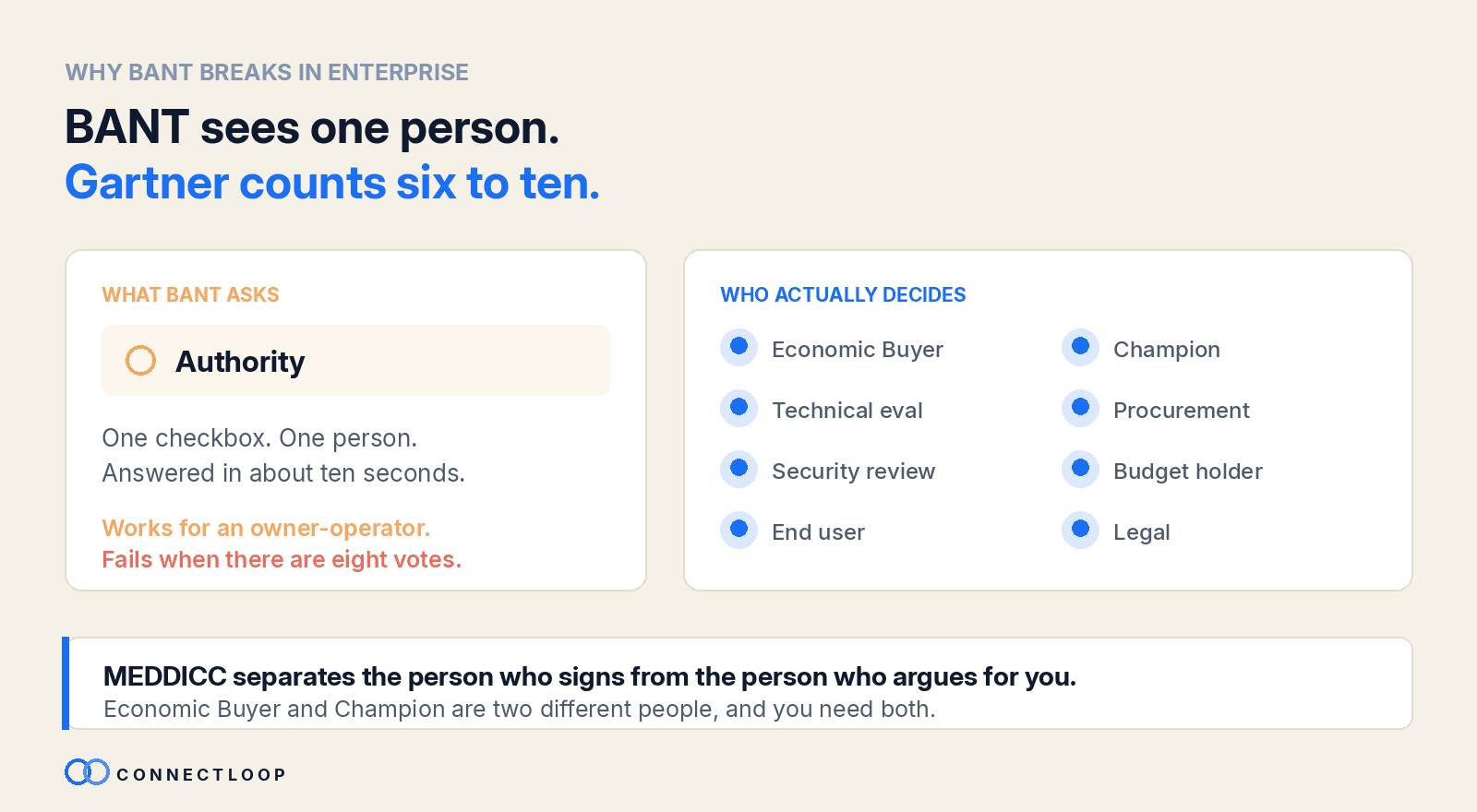
- It ignores the buying committee. Gartner reports that the average B2B purchase decision involves six to ten stakeholders. BANT reduces all of them to a single checkbox called Authority. That works when you are selling to an owner-operator. It fails when the person you qualified has one vote out of eight, and the other seven appear in month three.
- It has no view of how the decision gets made. Two deals with identical budget, authority, need and timing can end differently depending entirely on decision criteria and process. BANT captures neither.
- It disqualifies good leads. A prospect without an articulated need fails BANT immediately. A rep who dug into their situation might have found a problem forming that becomes urgent in two quarters. That lead is now gone rather than nurtured.
- It skips the human part. Trust is what separates a won deal from a lost one, and BANT does not prompt a rep to build any. It qualifies the transaction, not the relationship.
What are the pros and cons of MEDDICC?
MEDDICC's strength is completeness and its weakness is cost. It gives you a genuine picture of a deal, and it takes time, training and a system to maintain that picture across a pipeline.
Where MEDDICC works
- Comprehensiveness. Metrics and pain reveal what the buyer is actually trying to achieve. Decision criteria and process reveal what has to happen for them to buy. That is a materially different level of information from four checkboxes.
- It qualifies people, not just deals. Economic Buyer and Champion identify who matters and who will argue for you internally. Those two elements alone explain most enterprise deals that stall without warning.
- Continuous qualification. BANT's usefulness ends after the first call. MEDDICC keeps working: a rep can revisit the elements at any stage, see what is still blank, and act on it.
- Fewer surprises. The deal that disappears in the final week usually had a missing element nobody checked. MEDDICC's real value is not qualification; it is forecast reliability.
Where MEDDICC falls short
- Complexity. Seven elements are harder to apply consistently than four. A new rep will run MEDDICC unevenly for months, and getting consistency across a team requires real training investment.
- It is slower. On high-volume inbound with a handful of SDRs, a methodical rep is a slow rep. Being thorough with lead forty means leads forty-one through sixty went cold.
- It can lengthen cycles. Building relationships and mapping decision processes takes time. If the company's priority this quarter is pipeline velocity, that is a genuine conflict.
- It needs tooling. This is the constraint most teams underestimate. Seven elements per deal across a pipeline is not a spreadsheet job. Without a system that captures the elements as part of normal work, MEDDICC becomes a form reps fill in retrospectively, which produces complete scorecards and no additional insight.
How do you choose between them?
Work through five questions about your team and your sale. The answers point clearly one way or the other, and for most organisations the honest answer is both, used at different stages.
- How experienced is your team? Experienced reps who know the product adapt to MEDDICC quickly. A team of new hires will apply it inconsistently, and an inconsistently applied complex framework is worse than a consistently applied simple one.
- What is your response time? If leads already sit unanswered for a day, adding a longer qualification process makes that worse. Fix speed before adding depth.
- Who do you sell to? Small and mid-sized businesses with one or two decision-makers suit BANT, as does ecommerce, where the buyer is often a single person deciding in one session. Enterprise deals with a buying committee need the extra context.
- How complex is the product? If what you sell is easy to understand and has one obvious use case, BANT is enough. If it solves several problems for several roles, MEDDICC earns its overhead.
- What can your systems actually track? A CRM that cannot hold seven elements per deal means MEDDICC lives in reps' heads, which means it does not exist.
Most teams end up running both. BANT decides who gets a meeting. MEDDICC runs the deal from discovery to close. Neither framework is a rule: both are templates you adapt.
What changes when qualification happens in a chat window?
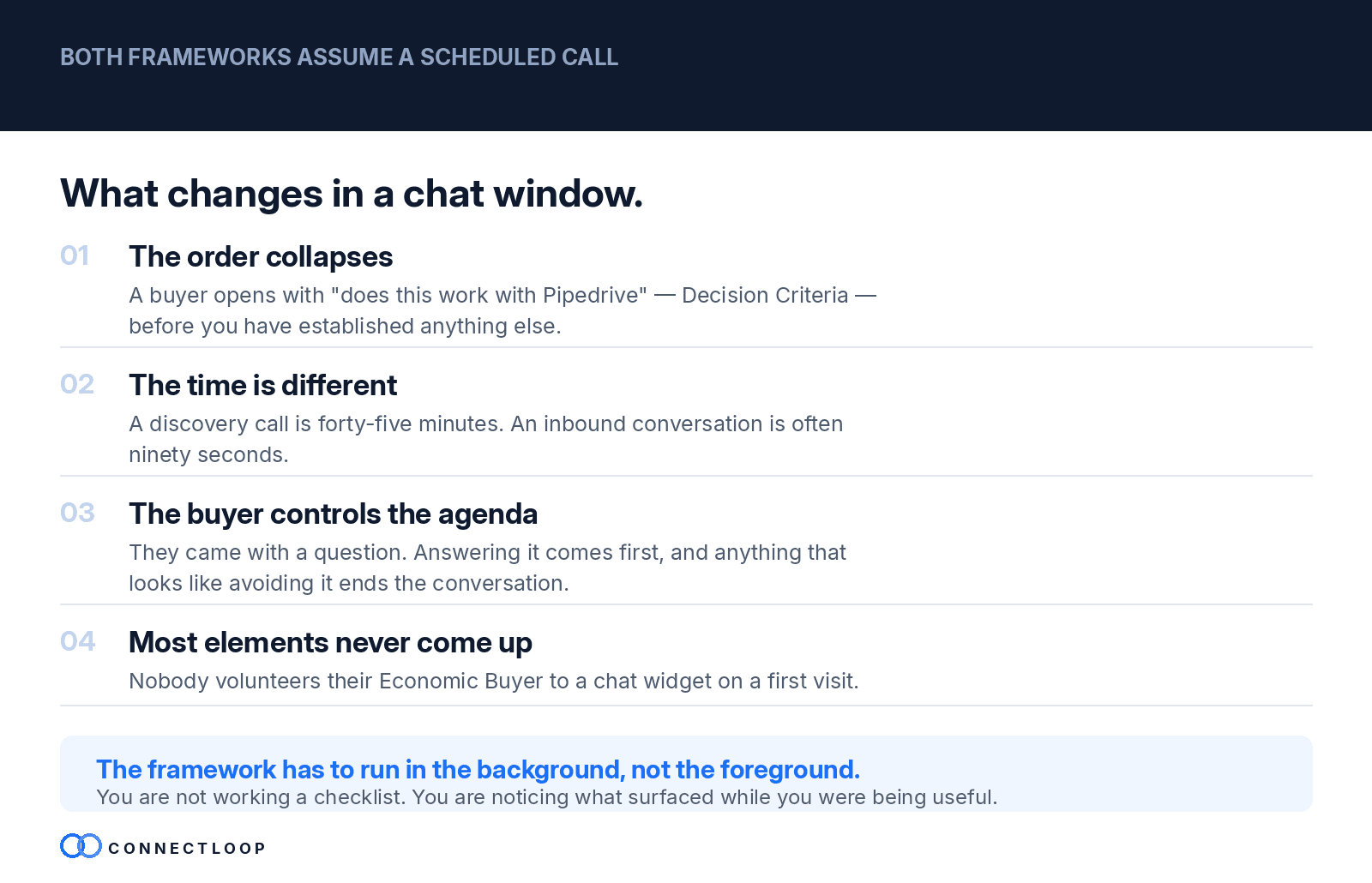
Almost everything about how the framework runs, and nothing about what it is trying to learn. Both BANT and MEDDIC were designed for a rep with a notebook and a scheduled call. Inbound conversations give you none of that.
Four things break.
- The order collapses. In a call you can work through elements in sequence. A buyer in chat opens with "does this work with Pipedrive," which is Decision Criteria, before you have established anything else.
- The time is different. A discovery call is forty-five minutes. An inbound conversation is often ninety seconds, and asking six qualification questions in that window makes you an interrogation rather than a help.
- The buyer controls the agenda. They came with a question. Answering it comes first, and anything that looks like avoiding it ends the conversation.
- Most elements never come up at all. Nobody volunteers their Economic Buyer to a chat widget on a first visit.
Which means the framework has to run in the background rather than the foreground. You are not working a checklist; you are noticing which elements happened to surface while you were being useful.
That is a genuinely different skill, and no article on this subject covers it, because both frameworks predate the channel.
What do you do with a partially qualified lead?
Route it rather than reject it. MEDDICC has seven elements and a real inbound conversation might surface two or three. A lead is not disqualified because five of seven are blank: it is simply early.
Almost every guide to these frameworks assumes you complete them. In inbound, you rarely do.
A workable way to handle it:
- Score what you have, not what is missing. Three elements confirmed is information; treating it as a failure throws away a real lead.
- Note which elements are absent. A missing Economic Buyer is a different problem from a missing Metric, and they need different next steps.
- Weight Pain and Champion highest. A buyer with clear pain and an internal advocate progresses without the other five. The reverse rarely holds.
- Pass the gaps to the rep. The value of running a framework in a chat is not a completed scorecard: it is the rep knowing exactly what to ask first.
- Do not ask for the rest in the same conversation. Budget and Authority questions asked in the first ninety seconds read as pushy and cost more than they gather. The missing elements belong in a follow-up email after no response, or in the first call, not in the chat that was meant to answer their question.
The most useful output of inbound qualification is not a qualified lead. It is a briefed rep.
How do you run a framework without turning it into a script?
By treating the elements as things to notice rather than questions to ask. A rep working visibly through a checklist is obvious to the buyer, and it produces worse answers than a conversation would.
Six practical rules:
- Answer their question first. Every time. Qualification that delays the answer costs you the conversation.
- Ask one thing at a time, and make it follow from what they just said rather than from your list.
- Take what is volunteered. "We're replacing something that can't handle WhatsApp" gives you Pain, Decision Criteria and Competition without a single question.
- Never ask Budget in the first exchange. It is the fastest way to sound like a form.
- Ask about people, not authority. "Who else would need to see this?" gathers Economic Buyer and Champion without using either word.
- Stop when the conversation has run its course. A partially qualified lead in a good mood beats a fully qualified lead who found the process tiresome.
The test is whether the buyer would describe the conversation as helpful. If they would describe it as being screened, the framework is running in the foreground and it is costing you deals.
How does ConnectLoop run these frameworks?
In two places, for two different jobs. Lia, ConnectLoop's AI sales agent, runs qualification inside inbound conversations. Live Assist runs a framework alongside a rep during a live call, prompting in real time.
Five frameworks are supported, and a workspace can set a default or switch per session.
| Framework | Elements | Typical use |
|---|---|---|
| ConnectLoop YES Framework™ | Staged, starting with Discover | ConnectLoop's own method, the workspace default |
| MEDDICC | 7 | Complex deals with a buying committee |
| SPIN Selling | 4 question types | Discovery, drawing out implication and need-payoff |
| BANT | 4 | Fast qualification on high-volume inbound |
| Challenger | Teach, tailor, take control | Deals where the buyer needs reframing rather than qualifying |
Being able to switch framework per conversation matters because the right one depends on the deal, not on what the company standardised on two years ago.
How qualification runs on inbound
- Lia answers the question first. Every response comes from your approved content: product pages, documentation, playbooks. When the answer is not there, she says so, offers a person, and logs the gap.
- Qualification runs alongside the answer. SPIN and MEDDICC elements surface as part of the conversation, not as a form the buyer has to complete.
- What the buyer volunteers is captured. Needs, pain, budget signals, who else is involved, rough timing, and what they are comparing you against.
- Intent is scored hot, warm or cold from what was said and done. That includes activity from before the conversation started, because anonymous website visitors are tracked from their first visit and the history attaches once they identify themselves.
- The meeting is booked in the same thread, against live Google Calendar or Outlook availability, with no link to click.
- The rep inherits the transcript and the gaps, so the first human conversation starts from something.
How Live Assist runs on calls
Real-time coaching during a live customer call, with the chosen framework running alongside the rep.
No bot joins the meeting. Audio is captured in the browser, the meeting tab plus the rep's microphone, rather than by adding a third participant to the call.
That matters more than it sounds. Every conversation intelligence platform requires a recording bot with the vendor's name on it to appear in your customer's meeting. ConnectLoop does not.
The session tracks:
- Framework coverage: which elements have been surfaced and which are still missing
- Cues accepted: how often the rep used a suggested question
- Action items captured as the call runs
- Calls assisted across the team, for managers
Pre-call context and an optional script can be added before a session, if the rep wants the assistant following a specific structure.
Everything syncs to HubSpot, Salesforce, Pipedrive or Zoho automatically. ConnectLoop works across website chat, WhatsApp and email with one shared conversation history, and is Google CASA Tier 2 verified and an official Meta Business Partner.
ConnectLoop is built for inbound conversations a buyer started, and the calls that follow. Teams running outbound typically pair it with a BDR function, so each side does what it is best at.
Where qualification frameworks stop helping
They organise what you learn. They do not create demand, they do not tell you whether the buyer was honest, and they cannot rescue a deal that was never real.
Four limits worth naming.
- They measure the seller, not the buyer. A completed MEDDIC scorecard tells you the rep asked the questions. It does not tell you the answers were true.
- They can become the goal. Teams scored on framework completion produce complete scorecards and no additional revenue. The framework is a tool for thinking, not a target.
- Neither framework was built for inbound. Both assume a scheduled conversation with an agenda you control. Inbound gives you neither, which is why running them in a chat requires adapting the method rather than the checklist.
- Targeting comes first. Qualifying the wrong companies more rigorously sorts the wrong companies more efficiently. If your inbound is dominated by people outside your ICP, that is the problem to fix before the framework is.
Key takeaways
- BANT is a gate; MEDDIC is a map. BANT decides whether to enter a deal. MEDDIC tells you where you stand inside one.
- BANT was developed by IBM and has four elements: Budget, Authority, Need, Timing.
- MEDDIC has six, MEDDICC seven, MEDDPICC eight: three names for the same lineage, and the source of most confusion on this topic. ConnectLoop runs MEDDICC.
- Gartner reports the average B2B purchase decision involves six to ten stakeholders. BANT reduces all of them to one checkbox called Authority.
- The three gaps BANT cannot cover are Decision Criteria, Champion and Competition, and those are where enterprise deals are most often lost.
- MEDDICC needs a system, not a spreadsheet. Seven elements per deal across a pipeline is the constraint most teams underestimate.
- Use both. BANT at the top of the funnel, MEDDICC from discovery onward. They were built for different jobs.
- Neither framework was designed for a chat window. In inbound, the order collapses, the time is shorter, and the buyer controls the agenda, so the framework has to run in the background.
- A partially qualified lead is early, not disqualified. Weight Pain and Champion highest and route the rest to a rep with the gaps named.
- Frameworks organise what you learn. They do not create demand, verify honesty, or fix a targeting problem.

About the author
ConnectLoop Staff
Written by the ConnectLoop team. ConnectLoop is an AI sales agent for inbound revenue teams, based in Cambridge, Massachusetts.
About ConnectLoop →Frequently asked questions
BANT is a four-element checklist covering Budget, Authority, Need and Timing, designed to decide quickly whether a deal is worth pursuing. MEDDIC is a six-element methodology designed to tell you where you stand inside a complex deal. BANT is a gate; MEDDIC is a map.
Neither is better in general. BANT suits high-volume, short-cycle and transactional sales where speed matters. MEDDIC suits complex deals with multiple stakeholders and long cycles. Many organisations use BANT at the top of the funnel and MEDDIC from discovery onward.
MEDDIC has six elements. MEDDICC adds Competition, which includes the status quo as an alternative. MEDDPICC adds Paper Process, the steps between a decision and a signature. MEDDICC, the organisation that owns the methodology, now writes primarily about MEDDPICC.
For inbound qualification and transactional sales, yes. Its four questions are the fastest way to decide whether a lead deserves a meeting. For enterprise deals it is insufficient, because it has no concept of how the buyer evaluates vendors or who advocates internally.
Yes, and it is a common structure. BANT decides who gets a meeting. MEDDIC runs the deal from discovery to close. The frameworks are not competing methodologies so much as tools built for different stages.
BANT fits inbound better because it is short enough to run in a conversation. MEDDICC elements can be captured too, but rarely all seven in one exchange: an inbound conversation typically surfaces two or three, and the rest come later.
Route the lead rather than reject it. Score what was confirmed, note what is missing, and weight Pain and Champion most heavily. A partially qualified lead with clear pain progresses; a fully scored lead without it usually does not.
Five: the ConnectLoop YES Framework™, MEDDICC, SPIN Selling, BANT and Challenger. A workspace sets a default and a rep can switch per session. Lia runs qualification inside inbound conversations; Live Assist runs the chosen framework alongside a rep on a live call.
Answer the buyer's question first, ask one thing at a time, and let each question follow from what they just said. Take what is volunteered rather than working through a list, and never open with Budget.
Gartner reports six to ten. That single figure is the strongest argument for MEDDICC over BANT in complex sales, because BANT treats the entire buying committee as one checkbox called Authority.
A system that can capture seven elements per deal as part of normal work. Without it, reps fill the framework in retrospectively, which produces complete scorecards and no real insight. That tooling requirement is the most commonly underestimated part of adopting MEDDICC.
The principles do. Any sale with more than one decision-maker benefits from separating who signs from who advocates, and from understanding how the buyer evaluates options. The specific elements matter less than the habit of asking.
Qualify without the form
ConnectLoop's agent runs SPIN and MEDDICC as natural questions inside the conversation, so a lead reaches your rep with context rather than a name and an email address.