
Ecommerce
AI Agent for Ecommerce: The One That Sells, Not the One That Supports
An AI agent for ecommerce answers shopper questions, resolves the doubt holding up a decision, and moves people toward a purchase in conversation, before they leave. ConnectLoop's agent, Lia, does this on your store, on WhatsApp and by email, grounded in your own approved content.

Published
Table of contents
- What does an AI agent for ecommerce actually do?
- Is this just a chatbot with better marketing?
- Why is most ecommerce AI pointed at support instead of sales?
- What do shoppers actually ask before they buy?
- How does an agent answer product questions without inventing things?
- Can an AI agent sell on WhatsApp?
- How does this work on WooCommerce?
- How does ConnectLoop handle ecommerce conversations?
- What can an AI agent for ecommerce not fix?
- Key takeaways
- Frequently asked questions
What does an AI agent for ecommerce actually do?
It answers the question standing between a shopper and a purchase. Will this fit, is it in stock, does it work with what I already own, when will it arrive, can I return it. Then it either resolves the doubt or hands over to a person.
That sounds narrow. It isn't.
Shopify's own data on Shopify Inbox found that 70% of chat conversations are with customers making a purchasing decision, not with people who have a problem after the fact.
And those conversations convert. Shopify reported that 17% of pre-purchase Inbox conversations turned into sales in November 2023, and that adding product cards to live chat lifted conversion from 21% to 23.5%.
Read that again, because most ecommerce AI is built as though the opposite were true.
The majority of people who open a chat window on a store are not stuck. They are deciding. They have one unanswered question and a full cart, or an empty one.
An agent that treats every conversation as a support ticket will handle those correctly and sell nothing.
Is this just a chatbot with better marketing?
Sometimes. The distinction that matters is whether the thing can take an action that changes something outside the chat window. A chatbot answers. An agent answers and then does something: adds to a cart, checks live stock, books a call, creates a record.
The test is simple. After the conversation ends, is anything different in a system other than the transcript?
| Chatbot | AI agent | |
|---|---|---|
| How it responds | Scripted flows, decision trees | Interprets the question, adapts |
| Where answers come from | A fixed FAQ list | Live catalog, stock, policy documents |
| When it doesn't know | Falls through to “contact us” | Says so, escalates, logs the gap |
| Can it act | No | Yes: cart, booking, record creation |
| Out-of-stock item | “That item is unavailable” | Suggests alternatives from the catalog |
| Across channels | Separate per channel | One conversation, shared memory |
| Failure mode | Frustrating loops | Wrong action taken confidently |
Note the last row. It is not a marketing point.
A chatbot that gives a vague answer is annoying. An agent that adds the wrong variant to a cart or quotes a price that no longer exists creates work someone has to undo.
Acting means being wrong in public. That is exactly why grounding matters more for agents than for chatbots, and why ConnectLoop treats it as a hard constraint rather than a feature.
Why is most ecommerce AI pointed at support instead of sales?
Because support volume is easier to measure and easier to justify. Tickets have a cost per resolution. Sales conversations that never happened have no line in any spreadsheet, so nobody defends the budget for them.
Look at how the category talks about itself.
The dominant metrics are automation rate, cost per resolution, ticket deflection and first-contact resolution. Salesforce's 2025 State of Service report found that 30% of service cases are currently handled by AI, and projects 50% by 2027.
All of that is real. None of it is about revenue.
The result is an odd gap. There is enormous coverage of what happens after someone buys: where is my order, how do I return this, can I change the address. There is growing coverage of product discovery, search and recommendations.
Almost nothing addresses the moment in between: someone on a product page with one unresolved doubt and a decision to make.
That moment is where the money is, and it is the least served part of the journey.
Two things follow from this.
Support metrics will make a sales agent look bad. Deflection rate is the wrong measure for a conversation whose success is a purchase.
And a support-trained agent will answer a pre-purchase question correctly while missing the sale entirely, because answering was the whole objective it was given.
What do shoppers actually ask before they buy?
Fit, compatibility, availability, delivery and returns. Five categories cover most pre-purchase hesitation, and each one has a different failure mode when the answer is missing.
Which questions stop a sale outright?
- Fit and sizing. “Will this fit a 34-inch waist?” Unanswered, this becomes either an abandoned cart or a return.
- Compatibility. “Does this work with a 2021 model?” Buyers will not risk it. They leave and check a competitor who says clearly.
- Stock and lead time. “Do you have this in navy?” A generic “check the product page” answer sends someone back to where they already were.
- Delivery. “Will this arrive before Friday?” The most time-sensitive question in ecommerce, and the one most likely to be asked at 9pm.
- Returns. “What if it's wrong?” This is a risk question, not a logistics one. The answer removes the last objection.
Which questions are worth asking back?
An agent that only answers is leaving information on the table. The same logic applies to qualifying questions in any inbound conversation.
- “What are you using it with?” Surfaces compatibility issues before they become returns.
- “Is this for you or a gift?” Changes what matters: sizing, packaging, delivery date.
- “Have you looked at anything else?” Reveals what they are comparing you against.
These have to feel like help, not qualification. A shopper who senses they are being processed will close the window.
How does an agent answer product questions without inventing things?
By retrieving from your live catalog and your own policy documents rather than generating from a language model's general knowledge. If the answer is not in your data, a well-built agent says so instead of guessing.
This is the single largest risk in the category and it gets the least attention.
A hallucinated price is a customer service incident. A hallucinated stock level is a cancelled order. A hallucinated returns policy may be one you are now expected to honour.
Three things have to be connected for grounding to work:
- The product catalog, including variants, attributes and current prices. Not a copy from last month — the live data.
- Stock levels, so that “yes, in navy” is true at the moment it is said.
- Policy content: returns, shipping, warranty as written, not paraphrased.
What happens when it doesn't know?
It should say so. That sounds obvious, and it is the behaviour most systems get wrong, because saying nothing useful feels like failure.
ConnectLoop treats a gap as information. When Lia cannot answer from approved content, she says so, offers a person, and logs the question.
Those logged questions are worth more than most analytics. They are a list, in your customers' own words, of what your product pages do not explain.
Most stores discover their content gaps through returns. This is the cheaper way to find them.
Can an AI agent sell on WhatsApp?
Yes, and for a large part of the world it is the primary channel rather than a secondary one. The mechanics differ from web chat in ways that matter: shorter messages, faster expected replies, and a conversation that persists between sessions.
Most writing about ecommerce AI assumes the web store is the only surface. That assumption does not travel.
In Latin America, India, Southeast Asia and much of the Middle East, a serious share of commerce happens in WhatsApp. Not support: sales. Quotes, questions, negotiation, closing.
Three things change when the channel does.
- Message length. A four-paragraph answer that reads as thorough in web chat reads as spam on WhatsApp. Answers have to be shorter and land in one message.
- Response expectation. WhatsApp expectations are set by how people use it personally, which is instantly. Two hours reads as no reply, and the same response time pressure applies across every inbound channel.
- Persistence. A web chat ends when the tab closes. A WhatsApp thread is still there next week, which means the agent needs memory that survives the session.
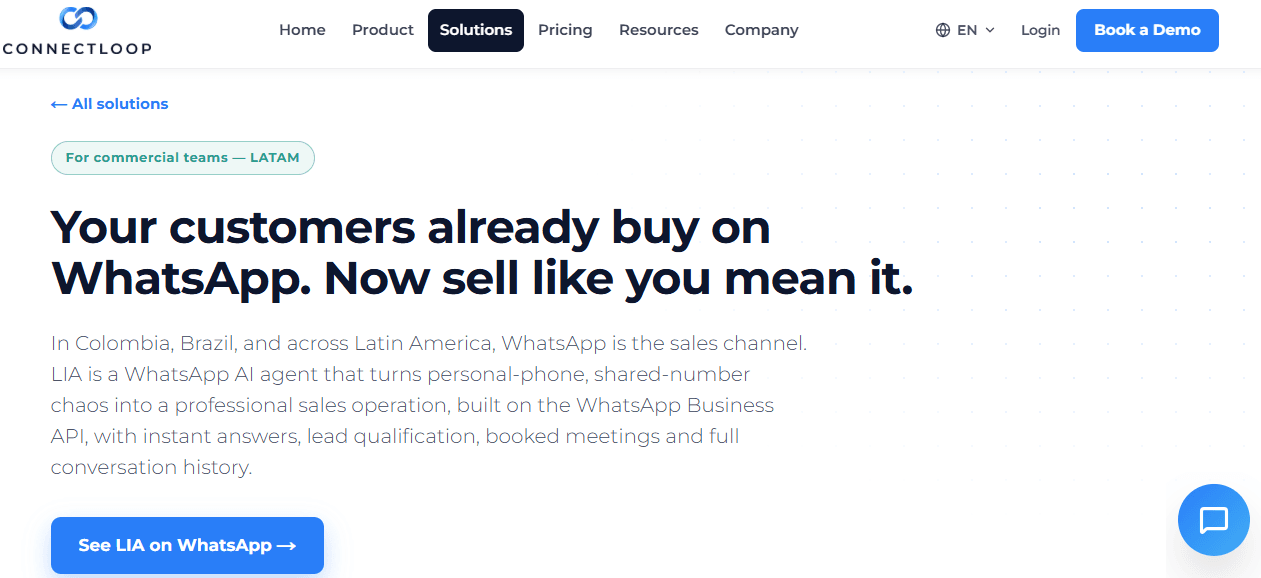
ConnectLoop runs on the official WhatsApp Business API as a verified Meta Business Partner with Embedded Signup, and selling on WhatsApp works the same way it does on your store. The unofficial route — scraped integrations and unofficial libraries — gets numbers banned, usually at exactly the moment volume becomes worth having.
How does this work on WooCommerce?
The requirements are the same as any store: the agent needs access to your content, a clear escalation path, and a way onto the page. What differs is how much of that is a plugin and how much is a build. See ecommerce solutions for how ConnectLoop fits.
WooCommerce is worth addressing directly because the category largely ignores it.
Read the major articles on ecommerce AI and you will find Shopify mentioned constantly, BigCommerce promoting itself, and WooCommerce appearing once or twice in passing, despite powering a very large share of the world's online stores.
The practical steps:
- Check what the agent can read. Ask any vendor whether it works from page content, from product data, or both — and whether stock levels are live or cached. The answers differ more than the marketing suggests.
- Add your policy content. Shipping, returns and warranty pages become part of what Lia can answer from. She retrieves from them rather than summarising them loosely.
- Decide what stays on the page. Anything price-sensitive or stock-dependent is safer confirmed at checkout than asserted in a conversation.
- Set the boundaries. Decide what the agent handles alone and what escalates. Order modifications and refunds are common escalation points.
- Add the widget. One script tag. ConnectLoop's agent trains on your site content in about 60 seconds.
- Connect WhatsApp if you sell there. ConnectLoop uses Meta's Embedded Signup, which removes most of the manual onboarding steps.
- Watch the gap log for the first fortnight. The questions Lia could not answer tell you which product pages need rewriting.
Step 7 is the one people skip, and it is the one that improves results fastest.
How does ConnectLoop handle ecommerce conversations?
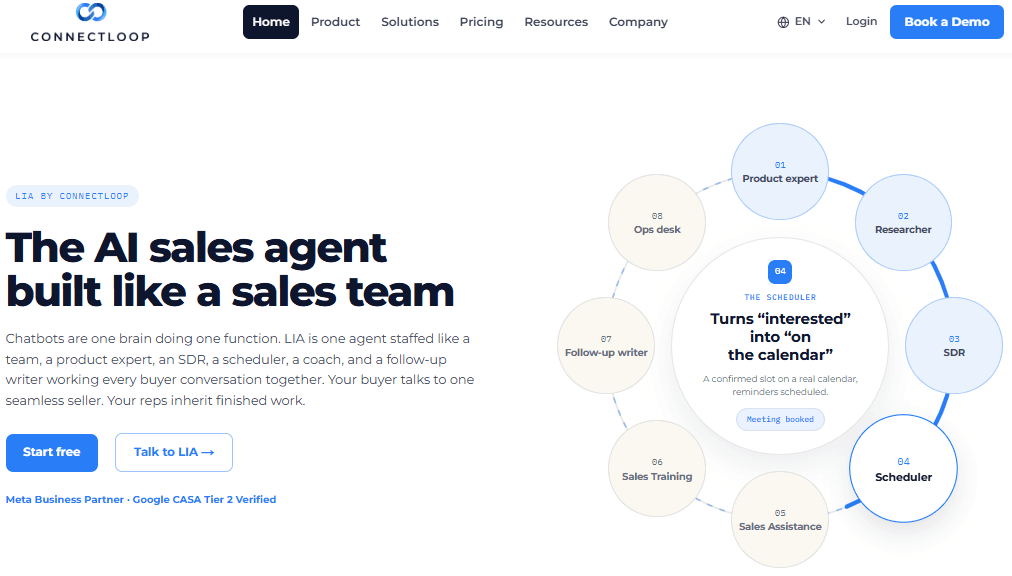
ConnectLoop treats a shopper conversation as a sales conversation rather than a support ticket. Lia answers from your approved content, keeps context across channels, and either closes the doubt or hands to a person with the whole exchange recorded.
What that looks like in practice.
Grounded answers. Every response comes from your approved content: product data, documentation, policy pages. Lia does not improvise prices or promises. When the answer is not there, she says so.
One conversation across channels. Someone who asks about sizing on your store and follows up on WhatsApp two days later is one person with one history, not two enquiries. ConnectLoop keeps that thread continuous.
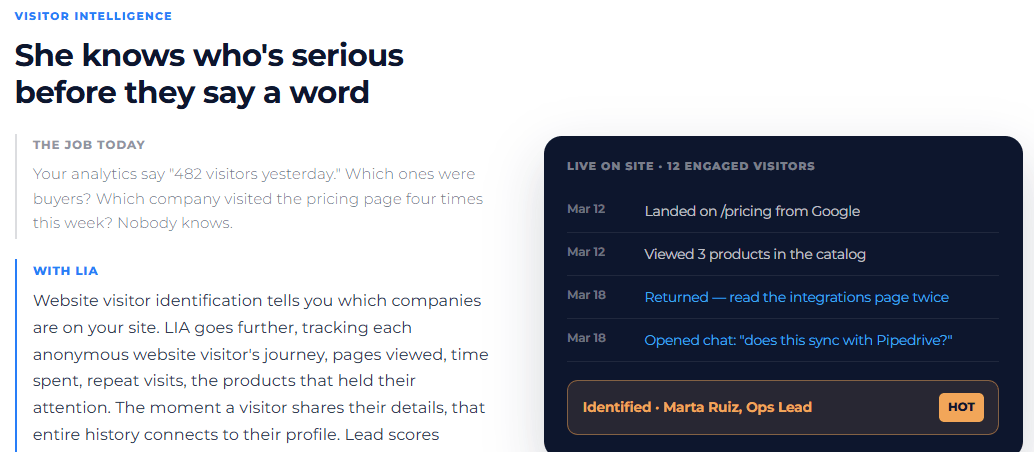
Visitor context. Visitor Intelligence identifies the companies behind anonymous traffic and surfaces which pages someone read before asking. For B2B and wholesale orders this changes the conversation entirely.
Escalation that works. When something needs a person — a complaint, anything with emotional weight — Lia hands over with the full context attached rather than making the customer start again.
Follow-up drafted, not sent. When a conversation goes quiet, ConnectLoop drafts a follow-up from what was actually discussed. A human reviews, edits, and sends or dismisses it.
That last constraint is deliberate. ConnectLoop does not send outbound autonomously, because automated sending at volume without review damages sender reputation, and sender reputation is slow to repair.
ConnectLoop is Google CASA Tier 2 verified and an official Meta Business Partner.
What can an AI agent for ecommerce not fix?
It cannot make a bad product page good, it cannot create demand, and it cannot replace judgement on the conversations that carry emotional weight. An agent multiplies what your store already has, including its problems.
Five honest limits.
- It cannot answer what your content does not contain. ConnectLoop's agent retrieves from your approved material. If your sizing guide does not mention the measurement someone asks about, no agent will produce it. Retrieval finds what exists; it does not invent.
- It will not fix a traffic quality problem. If the wrong people are arriving on your store, a conversation with them ends the same way, faster.
- Complaints should go to people. An unhappy customer wants to be heard, not processed. Escalation is not a fallback here: it is the correct first response.
- Automation rate is the wrong metric for sales. A conversation that ends in a human closing a large order is a success, even though the agent “failed” to handle it alone.
- Cart abandonment is mostly not a conversation problem. Baymard Institute's research puts documented cart abandonment at close to 70%, and the leading causes are unexpected costs, forced account creation and checkout friction. An agent addresses the share caused by unanswered questions. It does nothing about shipping costs revealed at step four.
ConnectLoop does not solve the second or the last. Stores whose real constraint is checkout friction or traffic quality should fix those first.
Key takeaways
- Most store chat is pre-purchase, not post-purchase. Shopify found 70% of Inbox conversations are with customers making a purchasing decision, and reported 17% of those pre-purchase conversations converting into sales in November 2023.
- The category is built for support anyway, because ticket costs are measurable and lost sales are not.
- The chatbot-versus-agent test is action. After the conversation, is anything different in a system other than the transcript?
- Grounding matters more for agents than chatbots. An agent that can act can be wrong in ways that create real work.
- Ask what happens when it does not know. That answer reveals how a system is built better than any feature list.
- WooCommerce and WhatsApp are underserved. The major coverage assumes Shopify and a web-only storefront.
- Deflection rate is the wrong metric for selling. Measure assisted conversion and order value instead.
- An agent multiplies what your store already has. It will not fix checkout friction, unexpected shipping costs, or the wrong traffic.

About the author
ConnectLoop Staff
Written by the ConnectLoop team. ConnectLoop is an AI sales agent for inbound revenue teams, based in Cambridge, Massachusetts.
About ConnectLoop →Frequently asked questions
Software that holds a conversation with a shopper and takes action on the outcome — answering product questions, checking stock, recommending alternatives, and either completing a step or handing to a person. The distinction from a chatbot is action, not fluency.
A chatbot follows scripted flows and returns answers from a fixed list. An agent interprets the question, retrieves from live data, and can take an action that changes something outside the chat. The practical test: after the conversation, is anything different in another system?
Some can, when connected to an order management system. Whether they should is a separate question. These decisions carry commercial and emotional weight, and handing them to a person is usually the better default. Ask any vendor how their escalation rules are configured before you rely on them.
It can, if it is generating rather than retrieving. A grounded agent answers only from your catalog and approved documents, and says so when the answer is not there. Ask any vendor what happens when the agent does not know — the answer tells you how it is built.
Most agents can be added to a WooCommerce store, though what they can read varies. Some work from page content, others connect to product data directly. Most coverage of this category assumes Shopify, so ask specifically about WooCommerce rather than assuming parity.
Yes, through the official WhatsApp Business API. This matters most in markets where WhatsApp is a primary commerce channel rather than a support one. ConnectLoop is a verified Meta Business Partner with Embedded Signup.
ConnectLoop's agent trains on your website content in about 60 seconds. Any further configuration — policy content, escalation rules, channel connections — depends on how much of it you want to tune before going live.
For a sales agent, conversion of assisted conversations, average order value on assisted sessions, and the reduction in pre-purchase abandonment. Not deflection rate — that measures a support objective and will make a sales agent look like a failure.
No, and treating that as the goal produces a worse result. It removes the repetitive pre-purchase questions so people handle the complaints, the complex orders and the conversations where being heard matters more than being answered.
They are answered. This is most of the value for smaller merchants, because evenings and weekends are when a large share of consumer shopping happens and when almost nobody is staffed. Worth exporting your own enquiry timestamps and checking the distribution.
Answer the question that stops the sale
ConnectLoop's agent, Lia, answers shopper questions from your own approved content, keeps one conversation across your store, WhatsApp and email, and hands to a person when it should. Visitor Intelligence shows which companies are reading before anyone asks.