
Lead Generation
15 B2B SaaS Lead Generation Strategies That Actually Work
Most lead generation advice stops at the form fill. These fifteen strategies cover both halves: eleven ways to generate leads, and four ways to stop losing the ones you already have, which is where ConnectLoop's AI sales agent works.

Published
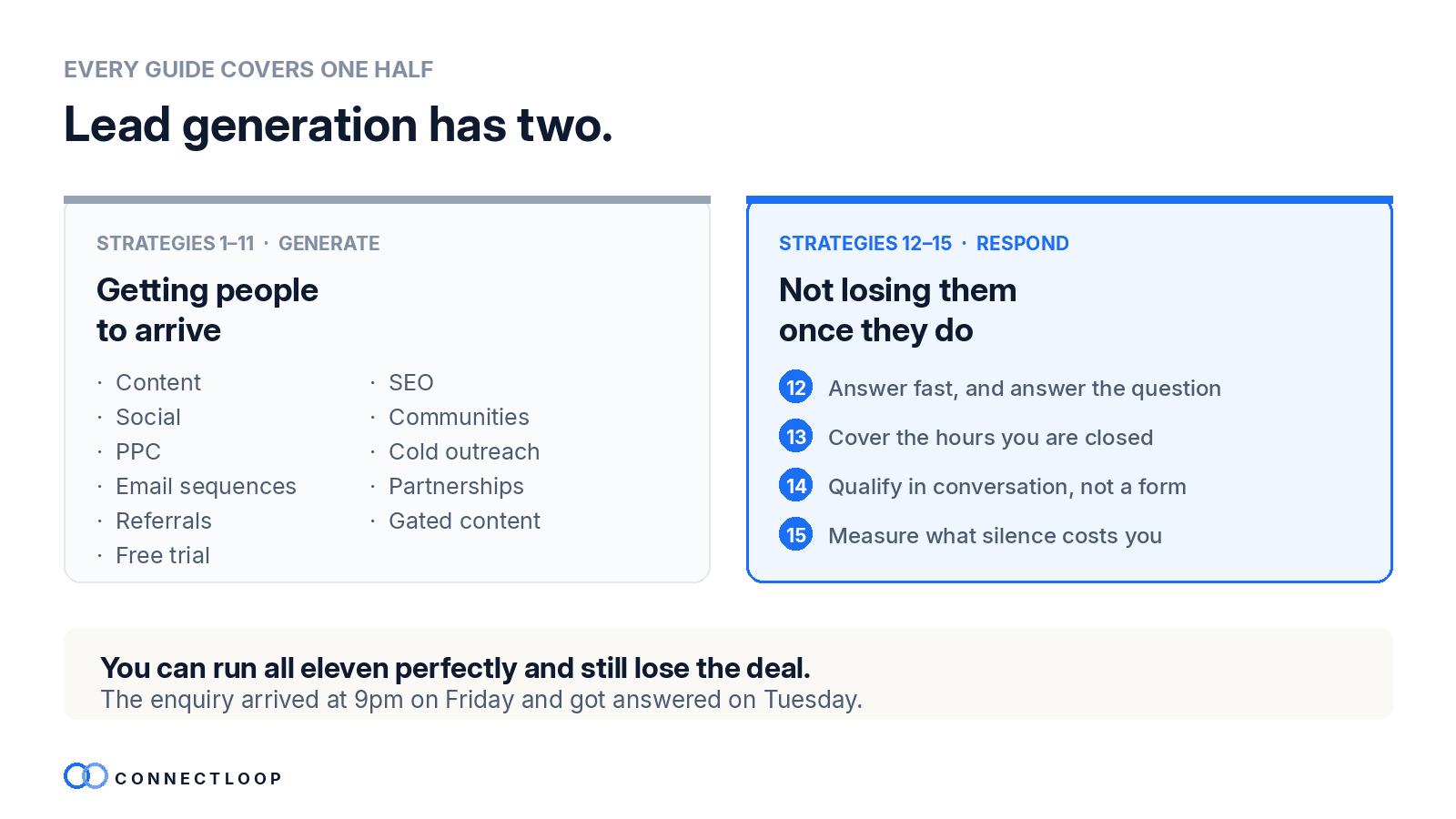
That split matters more than the strategies themselves. Every guide on this subject is a list of acquisition channels, and every one assumes the hard part ends when someone fills in a form.
It doesn't. A team can run content, SEO, paid and outbound perfectly and still lose the deal, because the enquiry arrived at 9pm on a Friday and got answered on Tuesday. That is not a lead generation problem, and it is why lead generation budgets underperform.
What follows is both halves. Strategies 1 to 11 are the channels that bring people to you, with what each actually costs in time and effort. Strategies 12 to 15 are what happens after they arrive, and they are the ones almost nobody writes about.
Table of contents
- What is B2B SaaS lead generation?
- Which strategies suit your stage?
- Strategies 1–5: how do buyers find you?
- Strategies 6–9: how do you reach them directly?
- Strategies 10–11: how do you turn interest into contact?
- Strategies 12–15: how do you stop losing the leads you generated?
- How does ConnectLoop fit into a lead generation programme?
- What lead generation cannot fix
- Key takeaways
- Frequently asked questions
What is B2B SaaS lead generation?
The process of getting the right businesses interested enough to start a conversation, then turning that conversation into a qualified opportunity. It splits into two halves that most guides treat as one: generating interest, and responding to it.
The first half gets almost all the attention.
Research from Ruler Analytics found that 91% of B2B marketers rank lead generation as their top priority. That focus is understandable, and it explains why nearly every guide on this subject is a list of acquisition channels.
Three things make B2B SaaS different from B2C.
- Multiple stakeholders. A buying committee rather than one person, each with different concerns.
- A narrower market. Fewer possible customers, so each one matters more.
- A longer sales cycle. Months rather than minutes, with interest decaying across the gap.
That third characteristic is why the second half matters. A lead you generated in March and answered in April is not the same lead.
Which strategies suit your stage?
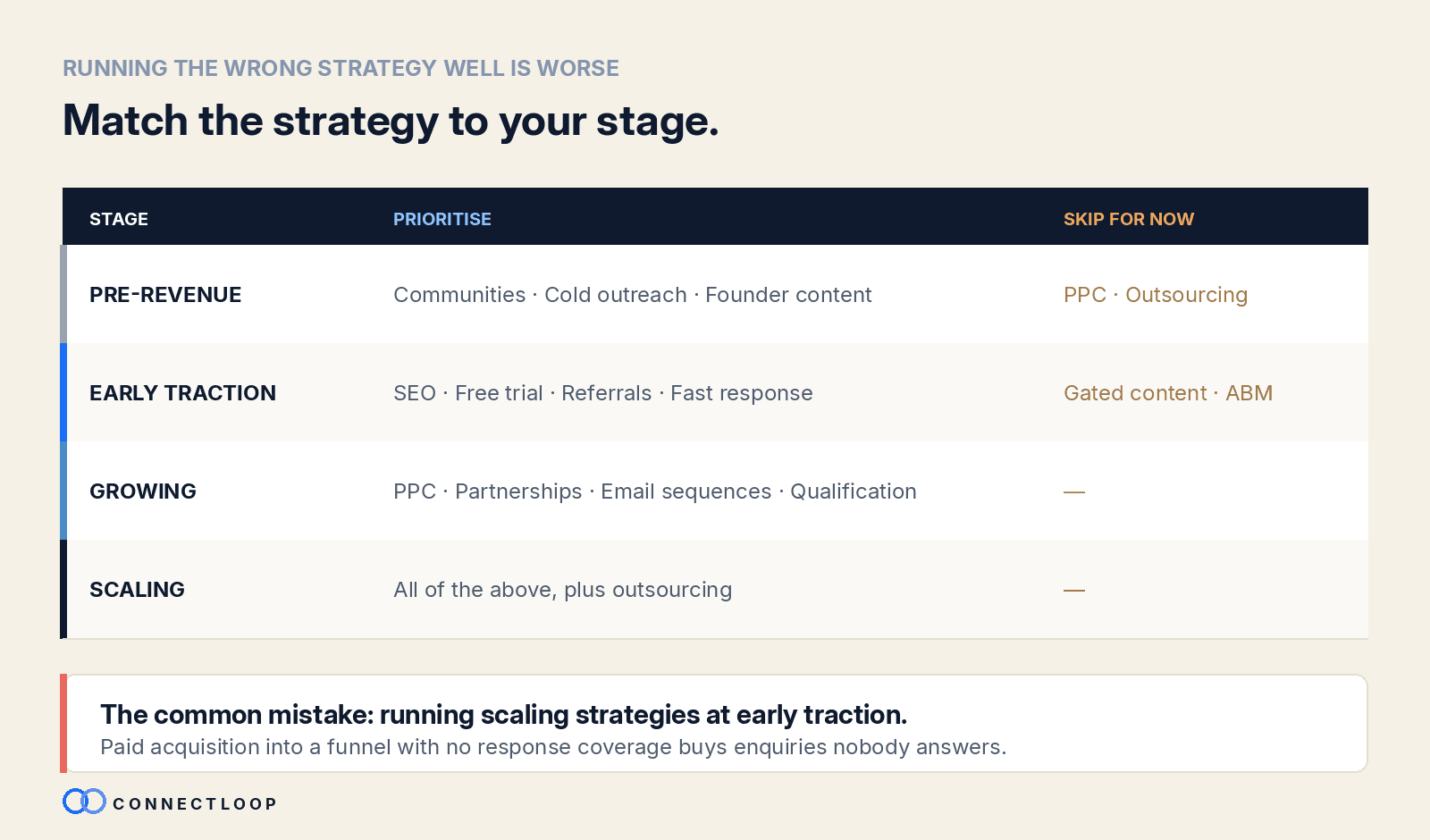
Not all fifteen apply to you. A pre-revenue founder and a Series B team have different constraints, and running the wrong strategy well is worse than running the right one badly.
| Stage | Prioritise | Skip for now | Why |
|---|---|---|---|
| Pre-revenue | Communities, cold outreach, founder content | PPC, outsourcing | You need conversations, not scale. Paid spend before product-market fit burns cash. |
| Early traction | SEO, free trial, referrals, fast response | Gated content, ABM | Compounding channels and removing friction. Gating slows what little flow you have. |
| Growing | PPC, partnerships, email sequences, qualification | — | Volume is arriving. The constraint shifts from getting leads to sorting them. |
| Scaling | All of the above, plus outsourcing | — | Specialisation pays. Multiple channels running in parallel. |
The common mistake is running scaling strategies at early traction. Paid acquisition into a funnel with no response coverage means paying for enquiries nobody answers.
Strategies 1–5: how do buyers find you?
Inbound discovery: content, search, social, communities and paid. These bring people to you rather than the other way round, and they compound over time rather than stopping when you stop paying.
1. Publish content that answers real questions
Not volume. Answers to things buyers actually ask, written by someone who knows the subject.
According to HubSpot, companies with regularly updated blogs generate 67% more leads per month than those without.
The difficulty is that most B2B SaaS content is written to exist rather than to be read. It paraphrases three articles that already rank, adds nothing, and gets published because a calendar said so.
What separates content that generates leads:
- Written by a practitioner. Someone who does the work produces detail a content team cannot fake, and that detail is what makes a reader trust the rest of the site.
- Contains something only you have. Original data, a specific customer situation, or a mistake you made. Everything else is available elsewhere.
- Answers the question directly. A reader who has to scroll past four hundred words of context to reach the answer has already left.
- States what does not work. Conceding limitations is what separates a useful piece from a brochure, and buyers can tell within two paragraphs.
- Refreshed quarterly. Rankings decay, and AI systems weight recency heavily when deciding what to cite.
The realistic timeline is eight to twelve weeks before a new article ranks for anything meaningful. Teams that abandon content at week six were never going to see results from it.
2. Treat SEO as distribution, not decoration
Content nobody finds is a diary entry. SEO is what turns it into a channel.
The 2023 B2B Marketing Mix Report found that SEO generates 34% of leads on average for B2B marketers.
Four things that matter more than the rest:
- Long-tail keywords with achievable difficulty. A new domain chasing a head term with high competition will not rank, however good the article. Start where you can win and work upward as authority builds.
- Search intent over keyword matching. Someone searching "AI sales assistant" wants a comparison. Someone searching "what is an AI sales assistant" wants a definition. Serving the wrong one loses the ranking even with the keyword present.
- Internal linking with real anchor text. Authority flows through links. A pillar page with eight articles pointing at it outranks the same page in isolation.
- Quarterly refreshes. Pages that go stale lose position, and AI systems in particular discount content that has not been updated recently.
The trap is chasing volume. A keyword with 15,000 searches and a difficulty score you cannot reach is worth less than five keywords at 200 each that you can rank for this quarter.
3. Pick one social channel and do it properly
Spreading across five platforms produces five weak presences.
HubSpot reports that 40% of marketers consider LinkedIn the most effective platform for lead generation.
Founder posts outperform company pages consistently. People engage with people, and a personal byline gets distribution a brand account does not. A company page posting the same content typically sees a fraction of the reach.
What works on LinkedIn specifically:
- Observations rather than announcements. "Here is something I noticed" outperforms "we are excited to announce" by a wide margin.
- Admitting a mistake. Posts about something that went wrong reliably outperform posts about something that went right.
- Ending on a question. A post that invites disagreement gets comments, and comments drive distribution far more than reactions.
- No external links in the post body. LinkedIn suppresses reach on posts that send people off-platform. Put the link in the first comment.
Consistency beats brilliance here. Three ordinary posts a week outperform one excellent post a month, because the algorithm rewards frequency.
4. Be genuinely useful in communities
Reddit, Slack groups, Discord, LinkedIn groups. Buyers consult these for unbiased recommendations, which is exactly why promotional posting fails there.
The mechanism is indirect and slow. You answer questions well enough that people check your profile, and some fraction of those people become aware of what you do.
Three rules that decide whether this works:
- Answer questions where your product is not the answer. Credibility comes from being useful when there is nothing in it for you.
- Disclose the conflict when there is one. "We build something in this space, so take this with that in mind" earns more trust than pretending to be neutral.
- Expect months, not weeks. Community presence compounds like content does. Nothing happens for a long time, and then people start arriving having already read your comments.
The failure mode is obvious and common: dropping a product link into a thread that was not asking for one. That gets you removed and remembered for the wrong reason.
5. Use paid to test, then to scale what works
PPC has the clearest measurement of any channel: you can attribute a click to a cost to a conversion. Ranktracker reports that 84% of brands see good results from PPC advertising.
Where paid earns its place:
- Testing messaging before committing to content. A week of ad spend tells you which value proposition resonates faster than three months of SEO.
- Covering terms you cannot rank for organically. High-difficulty commercial keywords are often cheaper to buy than to earn.
- Retargeting people who already visited. Consistently the highest-converting paid segment, because intent is already established.
Paid acquisition amplifies whatever your funnel already does, including the losing part. If enquiries go unanswered overnight, paid spend buys more unanswered enquiries at a known cost per click.
Fix the response half before scaling the acquisition half. That sequencing is the single most expensive mistake in this list.
Strategies 6–9: how do you reach them directly?
Outbound and relationship channels. These work when you know exactly who you want and cannot wait for them to find you.
6. Run cold outreach, carefully
Cold email still works. Backlinko's outreach study found that 8.5% of cold emails receive a response.
The five-step version:
- Define the ICP precisely: role, company size, industry, trigger event.
- Build a list that matches it, rather than buying a large one and filtering later.
- Personalise on something real, not a merge field with their company name in it.
- Track response and meetings booked, not opens.
- Cut what does not work after a fair sample, not after four sends.
The caveat nobody includes: cold email at volume damages domain reputation, and reputation takes months to repair while taking about a week to destroy. Warm up new domains properly, send from a subdomain rather than your primary, and stay well below platform limits.
The number that matters is meetings booked, not opens. Open tracking is unreliable since Apple Mail Privacy Protection, and a 40% open rate on a campaign that produced no meetings is not a result.
7. Build email sequences for people who already know you
Different from cold outreach and far more effective. FirstPageSage puts B2B email marketing conversion at around 2.4%.
Sequences worth having, in order of return:
- Post-demo follow-up. The highest-intent moment in your funnel, and the one most often left to a rep's memory.
- Re-engagement for quiet subscribers. People who opted in and went silent are cheaper to reactivate than to replace.
- Welcome sequence. Sets expectations and gets the first useful outcome faster.
- Churn reactivation. Former customers know the product, and circumstances change.
The failure mode is sending a sequence that ignores what the person actually did. A follow-up referencing the specific question someone asked converts several times better than "just checking in," and that requires the conversation history to be attached to the record.
8. Partner with complementary businesses
A non-competing company selling to the same market. You promote each other, integrate, or co-publish.
Three forms, in ascending order of value:
- Content swaps. Each publishes the other. Cheapest to arrange, weakest result, and easy to overdo until it looks like a link scheme.
- Co-marketing. A joint webinar, report or comparison. More work, and it reaches an audience that has already opted into the topic.
- Integration partnerships. The strongest version by some distance. If your product connects to theirs, their app directory becomes a durable source of qualified traffic from people who already use a tool you work with.
Integration directories are underrated as a channel. Someone browsing a CRM's app marketplace is further along than someone reading a blog post, and the listing works indefinitely without maintenance.
9. Make referrals easy rather than incentivised
Referral leads arrive with trust already attached and move faster through the funnel than any other source, because somebody the buyer knows has already done the evaluation.
Most referral programmes fail because they are complicated. A shareable link in the product dashboard outperforms a structured programme with tiers, terms and a landing page that nobody remembers exists.
What actually moves referral volume:
- Ask at the right moment. Immediately after a customer says something positive, not in a quarterly email campaign.
- Make the share one click. Every additional step removes a referrer.
- Give the recipient something too. Two-sided incentives convert better, because the referrer is offering rather than asking.
Referral programmes cannot fix a mediocre product. They amplify satisfaction that already exists, which is why they work well for some companies and produce nothing for others.
Strategies 10–11: how do you turn interest into contact?
Conversion mechanics. Someone is interested: these determine whether that interest becomes a record you can act on.
10. Use gated content selectively
Webinars, research reports, templates and case studies exchanged for an email address.
Gating works at the top of the funnel and hurts at the bottom. Someone in early research will trade an email for a genuinely useful report. Someone actively comparing vendors who hits a form instead of an answer goes to whoever did not gate.
A workable rule:
- Gate assets that took real effort: original research, a detailed template, a recorded session.
- Never gate anything that answers a buying question. Pricing detail, integration specifics and comparison content should be open.
- Ask for less than you want. Every additional field reduces completion, and job title rarely changes what you do next.
The stronger alternative is qualifying in conversation instead, which is strategy 14 and resolves the contradiction between this strategy and the next one.
11. Offer a free trial without a credit card
Userpilot reports that opt-in free trials, those not requiring card details, convert at nearly 20%.
Four things that make a trial convert:
- Clear duration and full feature access. A crippled trial demonstrates a crippled product. Buyers evaluating on a limited version conclude the limited version is what they would be buying.
- Sign-up in under a minute. Every field between interest and first use costs conversions, and card details cost the most.
- Onboarding that reaches value quickly. The measure is time to first useful outcome, not time to complete setup. Somebody who signs up and sees nothing work in ten minutes does not come back.
- Support that responds during the trial. This is where trials most often fail quietly. A question on day two that goes unanswered until day five means three of fourteen trial days wasted, and the buyer has already formed a view about your responsiveness.
Strategies 12–15: how do you stop losing the leads you generated?
This is the half of lead generation almost nobody writes about. Strategies 1 to 11 produce enquiries. These four determine how many survive long enough to become opportunities.
You can execute the first eleven perfectly and still lose the deal, because the enquiry arrived at 9pm on a Friday and got answered on Tuesday.
12. Answer fast, and answer the actual question
Speed matters, but not the way it is usually quoted.
The widely cited five-minute rule comes from research by Dr James Oldroyd, conducted at MIT and later published in Harvard Business Review. It found that contacting a lead within five minutes makes qualification dramatically more likely than waiting thirty.
What that study measured was contact, not conversion. It has been flattened into "reply fast or lose the deal," which is not what it says.
The distinction that matters: a reply in ninety seconds saying "when is a good time to talk?" has responded fast and answered nothing. The buyer asked whether it integrates with their CRM. They got a scheduling request.
Measure time to answered question, not time to first response.
Two numbers worth tracking separately:
- Time to first response: what most teams already measure, and what looks good on a dashboard.
- Time to answered question: how long until the buyer got the information they actually asked for.
The gap between those two numbers is where deals go. A team can average ninety seconds on the first and three days on the second, and the reporting will look excellent throughout.
13. Cover the hours you are closed
A share of B2B enquiries arrives outside working hours, because the person researching a purchase often does it when they have time rather than when you are open.
Three options, and only three:
- Accept the delay and lose a proportion of what you paid to acquire. Defensible if the proportion is small, and most teams have never checked whether it is.
- Staff a rota. Few teams under fifty people can justify it, and it is the first thing cut when headcount tightens.
- Have something that answers. An AI sales agent covers the hours nobody is working, which is what it is for.
ConnectLoop's agent, Lia, answers from a company's own approved content at any hour, on website chat, WhatsApp or email. When she cannot answer something, she says so, offers a person, and logs the question so the gap becomes a list rather than a lost enquiry.
This matters more for international markets. A team in one timezone selling into three is closed for most of the buyer's working day, and no amount of process fixes arithmetic.
14. Qualify in the conversation, not at a form
Strategy 10 says gate content to capture details. Strategy 11 says remove friction. Those contradict each other, and most guides never resolve it.
The resolution is asking qualification questions inside the conversation rather than in a form field.
What this looks like in practice: rather than a five-field form, the agent asks about needs, timing and who else is involved as part of answering the buyer's actual question.
Why it converts better than a form:
- The buyer is already talking. Answering three questions inside a conversation costs less effort than filling five fields before one.
- The answers are richer. "We are replacing a tool that cannot handle WhatsApp" tells a rep more than a dropdown selection ever will.
- Nobody lies to be polite. Form fields get inflated job titles and rounded team sizes. Conversations get closer to the truth.
ConnectLoop runs SPIN and MEDDIC this way, capturing needs, pain, budget, authority and timing, so a lead reaches a rep with context rather than a name and an email address.
15. Measure what an unanswered enquiry costs you
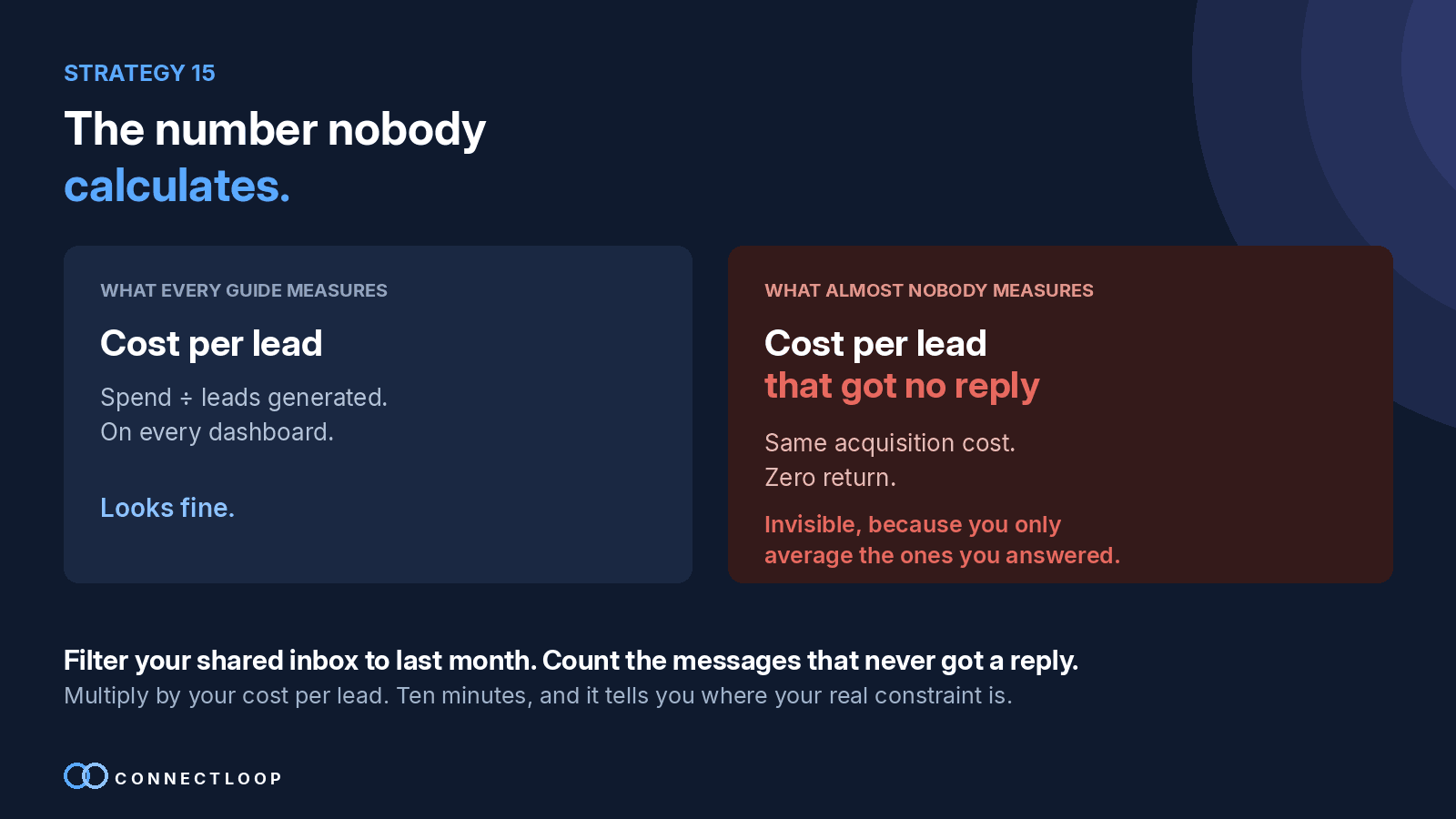
Every guide calculates cost per lead. Almost nobody calculates cost per lead that never got a reply.
It is the same acquisition cost with zero return, and it is invisible because unanswered enquiries drop out of average response time calculations.
How to run it in ten minutes:
- Open your shared inbox and filter to last month.
- Search for messages received that never got a reply. Not slow replies: no reply at all.
- Count them.
- Multiply by your blended cost per lead. That is what you spent to acquire people you then ignored.
- Split by time of day if your inbox allows it. The pattern usually explains the number.
Most teams have never run this, and the number is consistently higher than expected. It stays hidden because unanswered enquiries drop out of average response time calculations: you only average the ones you answered.
This is the single most useful ten minutes in this article. It tells you whether your constraint is generating leads or keeping them, and those need completely different budgets.
How does ConnectLoop fit into a lead generation programme?
It handles strategies 12 to 15, the response half. ConnectLoop makes sure the leads your other channels produce get answered, qualified and booked before intent decays.
Where it sits in the funnel:
- A visitor arrives from any of strategies 1 to 11 and asks something.
- Lia answers from approved content: product pages, documentation, playbooks. When the answer is not there, she says so, offers a person, and logs the gap.
- Qualification happens in conversation. SPIN and MEDDICC as natural questions rather than a form, capturing needs, pain, budget, authority and timing.
- Intent is scored hot, warm or cold from what was said and done.
- The meeting is booked in the thread, against live Google Calendar or Outlook availability. No link, no back-and-forth.
- Follow-up is drafted, a person approves it. Proactive Outreach writes it from the actual conversation, and a human reviews, edits and sends. That approval step is deliberate: it protects sender reputation, which takes months to build.
- Everything syncs to HubSpot, Salesforce, Pipedrive or Zoho automatically.
ConnectLoop works across website chat, WhatsApp and email with one shared conversation history, and is Google CASA Tier 2 verified and an official Meta Business Partner.
Visitor Intelligence tracks each visitor from their first anonymous visit, so when someone finally asks a question, the pages they read beforehand are already attached to the record.
What lead generation cannot fix
It cannot make a bad-fit market want your product, it cannot compensate for a weak offer, and it cannot rescue a funnel where nobody responds. More leads multiply what you already have.
Four honest limits.
- Volume without response coverage makes things worse. Doubling enquiries into a funnel that answers half of them doubles the number you lose.
- Targeting comes before optimisation. If the wrong companies are arriving, faster qualification sorts more of the wrong companies more efficiently.
- Your content sets the ceiling on what any agent can answer. Lia answers from your approved material and flags what she could not cover, which turns a blind spot into a list, but the list still needs writing.
- Outbound stays a human job. ConnectLoop is built for conversations a buyer started. Cold list building and prospecting sequences sit with a BDR function, and teams typically run both.
Key takeaways
- Lead generation has two halves. Eleven strategies generate enquiries; four determine how many survive. Almost every guide covers only the first.
- Ruler Analytics found 91% of B2B marketers rank lead generation as their top priority, which makes it odd how little attention the response half receives.
- Match strategies to stage. Pre-revenue needs conversations; scaling needs channels. Running scaling tactics early burns budget on enquiries nobody answers.
- Speed matters, but measure the right thing. Time to answered question, not time to first response. An acknowledgement is not an answer.
- Gating and friction-removal contradict each other. Gate top-of-funnel assets; never gate the content someone reads while comparing vendors.
- Cost per unanswered enquiry is the number nobody calculates. Same acquisition cost, zero return, and invisible in average response time.
- Paid acquisition amplifies whatever your funnel already does, including the losing part.
- More leads will not fix a targeting problem. Faster qualification of the wrong companies just sorts them more efficiently.

About the author
ConnectLoop Staff
Written by the ConnectLoop team. ConnectLoop is an AI sales agent for inbound revenue teams, based in Cambridge, Massachusetts.
About ConnectLoop →Frequently asked questions
It depends on stage. Pre-revenue teams get the most from communities, founder content and targeted cold outreach. Teams with traction should prioritise SEO, free trials, referrals and fast response. Paid acquisition works best once the response half of the funnel is already covered.
Two or three, properly. Running eight badly produces less than running two well, and most teams underestimate how long each takes to show results. SEO compounds over months; cold outreach shows signal in weeks.
Usually because the gap between enquiry and reply is longer than the buyer's attention. Research by Dr James Oldroyd at MIT, published in Harvard Business Review, found contact within five minutes makes qualification dramatically more likely than waiting thirty. Most inbound is answered in hours or days.
Gate top-of-funnel assets like research reports and webinars. Do not gate content someone reads while actively comparing vendors: a buyer who hits a form instead of an answer goes to whoever did not gate.
By asking qualification questions inside the conversation. ConnectLoop runs SPIN and MEDDIC as natural questions while answering the buyer's own question, capturing needs, pain, budget, authority and timing without a form field in sight.
No. ConnectLoop handles what happens after a lead arrives: answering, qualifying, booking and follow-up drafting. Lead generation itself comes from your content, SEO, paid, outbound and referral channels. The two halves work together.
Cost per lead, obviously. Then two most teams skip: time to answered question rather than time to first response, and the number of enquiries that never received a reply at all. The second is usually the most expensive number in the funnel.
Yes, with care. Backlinko's outreach study found 8.5% of cold emails receive a response, and the cost is close to zero. The risk is domain reputation: send at volume without warmup and you damage deliverability for months.
Cold outreach and paid show signal in weeks. SEO and content compound over months, typically eight to twelve weeks before an article ranks. Referrals and partnerships depend on existing customer volume. Plan for different curves rather than one timeline.
No. Software handles the repetitive layer: answering common questions, running qualification consistently, booking meetings around the clock. Judgement, objection reading and knowing when to stop selling stay human, which is what those roles exist to develop.
Answer the leads you already paid for
ConnectLoop's agent answers inbound questions, qualifies with SPIN and MEDDIC, and books meetings inside the conversation, on your website, on WhatsApp and by email, at any hour.