
Sales Enablement
AI Sales Coaching: What an AI Sales Coach Does and How It Works
AI sales coaching uses software to help sales reps improve their conversations: by practising before a call, getting prompts during it, and receiving scored feedback after it. The best tools coach from live audio or call recordings without a bot joining the meeting. ConnectLoop's Sales Assistance coaches reps during live calls, with the manager still in the loop.

Published · Updated
Table of contents
- What does an AI sales coach actually do?
- Before, during or after the call: which kind of AI sales coach do you need?
- How does AI sales coaching work from call recordings?
- How does real-time sales coaching work during a live call?
- Are there call coaching bots, and do you need one?
- What does automated call scoring get wrong?
- What does an AI sales coach do that a manager doesn't?
- AI sales coaching vs traditional sales training: what changes?
- How do you choose an AI sales coaching platform?
- Does AI sales coaching work for a small team?
- How does ConnectLoop coach sales reps?
- Key takeaways
- Frequently asked questions
What does an AI sales coach actually do?
An AI sales coach shortens the gap between a rep making a mistake and finding out about it. Instead of a manager reviewing a call days later, the AI gives feedback within minutes, or during the call itself. ConnectLoop's AI sales coach works while the conversation is still happening, so the rep can change the outcome of the call in front of them.
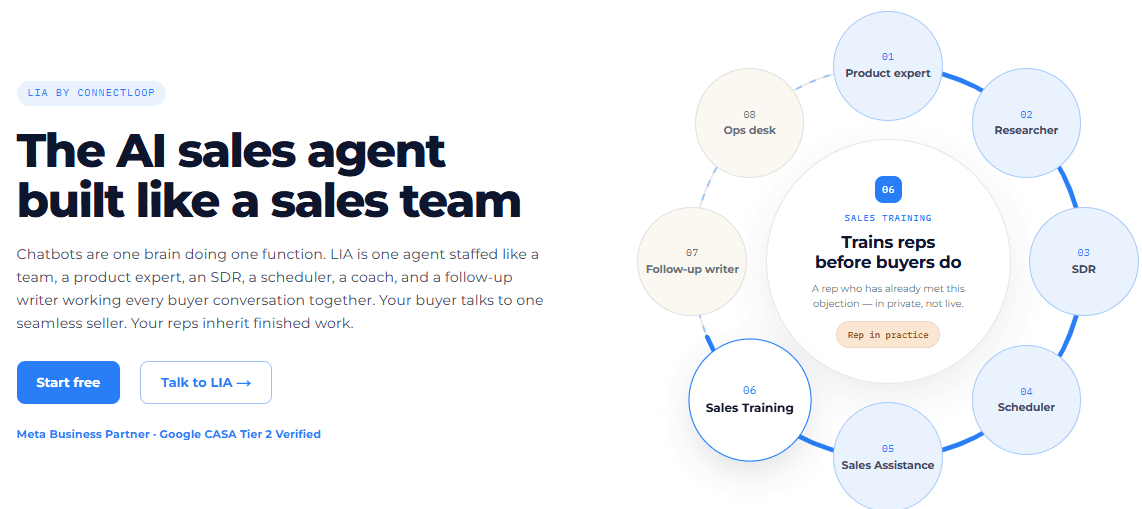
Traditional sales call coaching depends on a manager finding time to listen. In most teams, that means a handful of calls a month per rep, chosen almost at random.
AI coaching for sales reps changes the coverage. Every call can be reviewed, every rep gets feedback, and the manager sees patterns across the team instead of guessing from a few samples.
The result is coaching that keeps pace with the calls. New reps learn from every conversation instead of waiting for a review slot, and experienced reps get specific notes on the moments that moved a deal forward or stalled it.
Before, during or after the call: which kind of AI sales coach do you need?
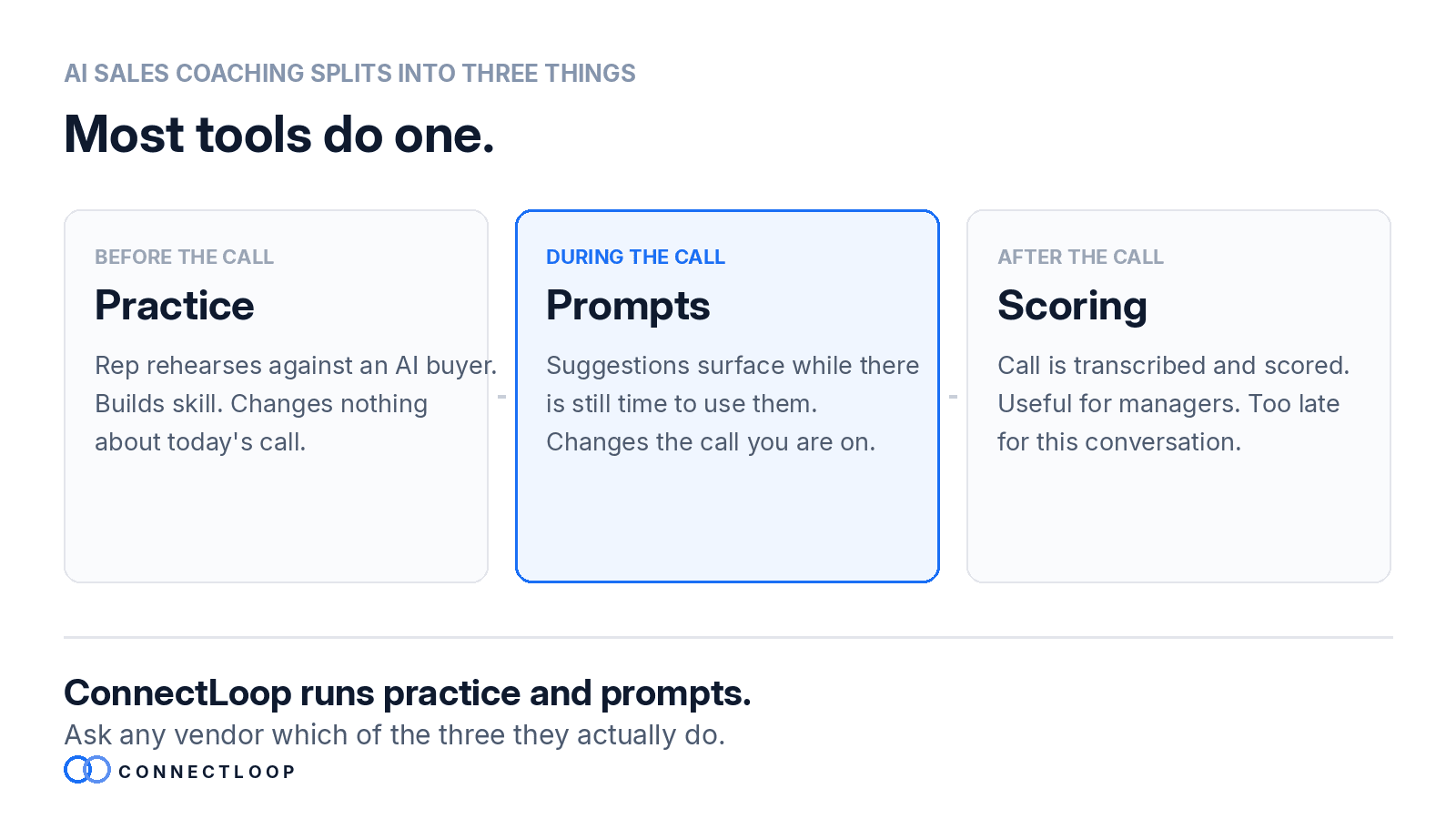
There are three types of AI sales coach: practice before the call, prompts during it, and scoring after it. Each helps a different call. Practice helps the next call, live prompts help the current call, and scoring helps future calls. ConnectLoop covers practice and live prompting, with scoring after the call.
| Type | When it works | Which call it helps | Best for |
|---|---|---|---|
| Practice (AI role-play) | Before the call | The next one | Onboarding, new pitches, hard objections |
| Live prompts | During the call | The current one | Objection handling, pricing, discovery gaps |
| Scoring and review | After the call | Future ones | Manager visibility, trends across the team |
Most tools on the market focus on scoring after the call. It's the easiest to build, because it only needs a recording. Live prompting is harder, which is why fewer tools offer it.
For practice, sales role play explains how rehearsing with an AI buyer works. For a wider view of tools, see AI sales training tools.
How does AI sales coaching work from call recordings?
The AI transcribes the recorded call, matches what was said against your sales framework, and flags missed questions, objections and next steps. The manager or rep then reviews the highlights instead of the full recording. ConnectLoop offers call recording as an option, and coaching works whether a call is recorded or not.
Coaching from recordings usually follows four steps:
- Capture. The call is recorded or captured as it happens.
- Transcribe. Speech becomes text, with each speaker identified.
- Analyse. The AI checks the conversation against your framework, such as SPIN, MEDDICC or BANT, and spots objections, pricing questions and commitments.
- Summarise. The rep and manager get a summary, the steps that were missed, and action items.
The advantage is coverage: every recorded call can be reviewed. The limitation is timing. By the time the feedback arrives, the call is over, so the lesson only helps the next one.
How does real-time sales coaching work during a live call?
Real-time sales coaching listens to the conversation as it happens and shows short prompts on the rep's screen: a missing discovery question, a suggested answer to an objection, or a pricing point. The rep can use it while there's still time to act. ConnectLoop's Sales Assistance shows these cues during Google Meet and Zoom calls.
Good live prompts are short and timely. A prompt that arrives too late, or a screen full of suggestions, distracts the rep instead of helping.
What a live AI conversational coach typically shows:
- The next question to ask, based on what the buyer has and hasn't said yet
- Objection responses from your own playbook, not generic scripts
- Pricing and product facts when the buyer asks for them
- Framework progress, showing which steps are covered and which are still open
- Action items captured as they're agreed
After the call, the same session produces a summary and a score, so live coaching and post-call review work together.
Are there call coaching bots, and do you need one?
Yes, many AI call coaching tools add a bot to the meeting to record it. You don't need one. Browser-based capture records the audio from the meeting tab on the rep's computer, so no extra participant joins the call. ConnectLoop's Sales Assistance works this way, with no meeting bots.
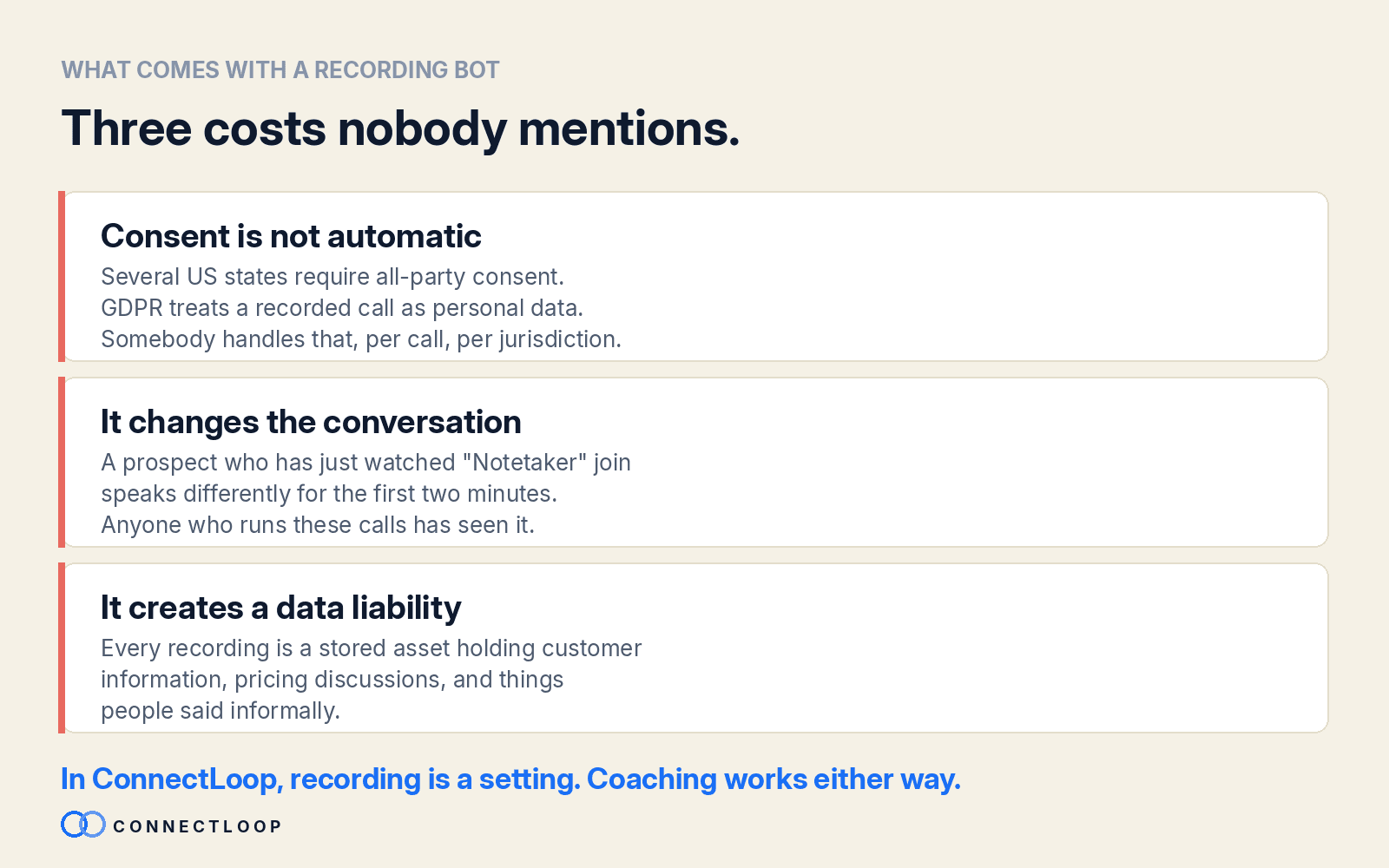
A bot in the meeting creates three problems:
- Consent isn't automatic. Some jurisdictions require every participant to agree to recording, and privacy rules apply to the stored data.
- It changes the conversation. Buyers often speak more carefully when they see a recorder join.
- It creates a data liability. Stored recordings hold pricing, plans and personal details that need protecting.
With browser-based capture, the buyer sees only the people they invited. Whatever the tool, follow your local consent rules and tell buyers when calls are recorded or analysed.
What does automated call scoring get wrong?
Automated scoring measures what's easy to count, not always what matters. It can reward reps for asking every framework question while missing that a short call ended in a booked meeting. ConnectLoop treats scores as evidence for a coaching conversation, not as a verdict on the rep.
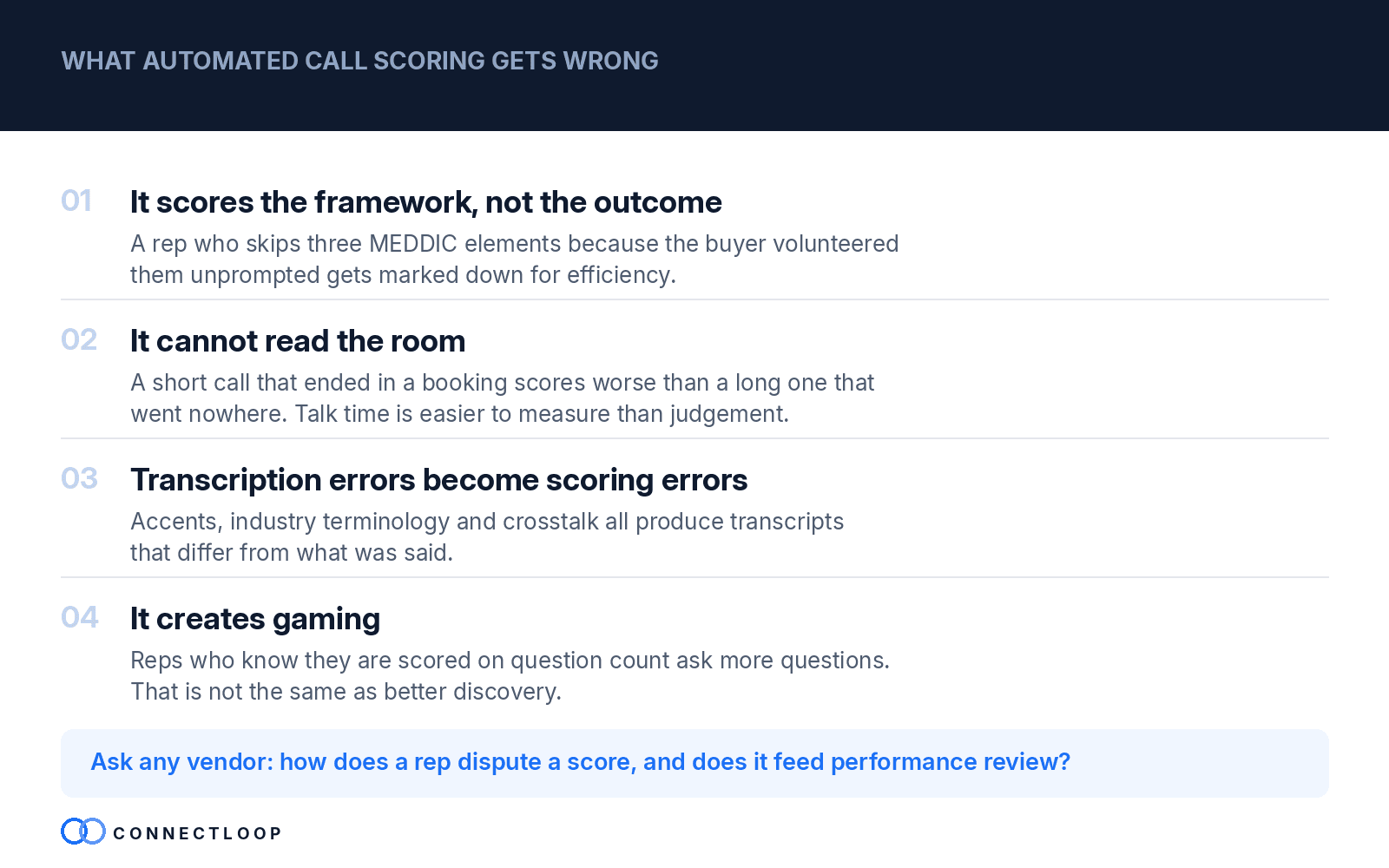
Four common problems:
- Process over outcome. A rep can tick every box and still lose the deal, or skip steps and win it.
- No judgment. Scoring can't tell whether a short call was efficient or rushed.
- Transcription errors. Accents, product names and people talking over each other can become scoring errors.
- Gaming. Reps learn to ask questions for the score rather than for the buyer.
The fix is human in the loop. Use scores to choose which calls a manager reviews, then let the manager judge what happened.
What does an AI sales coach do that a manager doesn't?
It covers every call, gives feedback instantly, and stays consistent across the team. A manager can listen to a few calls a week; an AI sales coach can review all of them and prompt reps in the moment. ConnectLoop's view is that AI handles coverage and speed, while the manager handles judgment and development.
| AI sales coach | Sales manager | |
|---|---|---|
| Coverage | Every call | A few calls a week |
| Speed | During or minutes after the call | Days later, if at all |
| Consistency | Same standard for every rep | Varies with time and focus |
| Judgment | Limited to what can be measured | Reads context, people and deal politics |
| Development | Points to skill gaps | Builds confidence and careers |
The two work best together. The AI shows the manager where to look; the manager decides what to do about it. The benefits of sales coaching covers why coaching so often stalls when it relies on manager time alone.
AI sales coaching vs traditional sales training: what changes?
Traditional training teaches skills in sessions, then relies on reps remembering them. AI sales coaching reinforces those skills on real calls, every week, with evidence. Training sets the standard; AI coaching keeps it alive. ConnectLoop supports both: practice before calls and live coaching during them.
The biggest changes:
- From events to habits. Coaching happens around every call, not once a quarter.
- From opinion to evidence. Feedback points to the exact moment in the call.
- From samples to coverage. Every rep gets coached, not just the ones a manager has time for.
For a full side-by-side comparison, read AI sales coaching vs traditional sales training.
How do you choose an AI sales coaching platform?
Start with the job you need done: practice, live prompts or post-call scoring. Then check how it captures calls, which frameworks it supports, and how pricing scales. ConnectLoop recommends testing any platform on your own real calls for 30 days before deciding.
Questions to ask:
- Which of the three jobs does it do? Many tools only score after the call.
- Does a bot join the meeting? Browser-based capture avoids it.
- Which meeting platforms does it support? Check Google Meet, Zoom or whatever your team uses.
- Can it coach against your framework? Look for SPIN, MEDDICC, BANT or a custom methodology. BANT vs MEDDIC helps you choose one.
- Does it use your own content? Prompts should come from your pricing, objections and playbook.
- What does the manager see? Look for team-level trends, not just individual scores.
- Does it connect to your CRM? Call outcomes and next steps should sit with the deal.
- How is it priced? Per-seat pricing gets expensive as the team grows; check what's included.
Does AI sales coaching work for a small team?
Yes, and small teams often benefit most, because they rarely have a full-time manager or enablement team. AI coaching gives every rep consistent feedback without adding headcount. ConnectLoop is built for inbound revenue teams of any size, with plans priced on conversation volume rather than per seat.
For small teams, the most useful setup is simple:
- One framework everyone uses.
- Live prompts on the calls that matter most, such as pricing and demo calls.
- A weekly 20-minute review using the AI's highlights, with a founder or senior rep.
Small inbound teams also win by answering faster. The rep's coaching starts before the call if the buyer's first questions were answered instantly, as covered in speed to lead. Those first answers often come through chat, WhatsApp or email, which is where conversational messaging turns a question into a booked call.
How does ConnectLoop coach sales reps?
ConnectLoop's Sales Assistance coaches reps during live Google Meet and Zoom calls, captured in the browser with no bot joining. It shows cues as the conversation happens, tracks framework coverage, and scores the call afterwards. Because ConnectLoop's agent, Lia, handles the first inbound conversation, the rep starts the call already knowing what the buyer asked. The AI-to-human handoff passes the full conversation to the rep, so nothing has to be asked twice.
ConnectLoop is an AI sales agent platform for inbound revenue teams. Lia answers buyers on website chat, WhatsApp and email, qualifies them and books the meeting. Sales Assistance then supports the rep on the call.
What it includes:
- No meeting bots. Audio is captured from the browser tab in Chrome or Edge, so only invited people appear in the meeting.
- Seven cue types. Memory, discovery questions, pricing, objections, battlecards, product knowledge and action items.
- Framework tracking. ConnectLoop's YES Framework, SPIN, MEDDICC, BANT, Challenger, or a custom methodology of up to 12 steps.
- Three views. Cockpit, Focus and Overlay, so reps choose how much they see during the call.
- Customer dossier. Open promises, stakeholders and framework coverage carry from one call to the next.
- Manager dashboard. Calls assisted, cues accepted, average framework coverage and open action items over 7, 30 or 90 days.
- Follow-up drafts. After the call, a draft is ready for the rep to review and send from their own inbox.
Everything syncs to Salesforce, HubSpot or Zoho, so the coaching record sits with the deal. ConnectLoop is CASA Verified by Google and an official Meta Business Partner.
What does ConnectLoop leave to the manager?
The judgment calls. ConnectLoop shows which framework steps a rep missed and which objections came up; the manager decides whether the deal was a good fit and how to develop the rep. Human in the loop is part of the design, not an afterthought.
Coaching software also works best where a coaching habit already exists. Protect a short weekly review, and let the software make that time more useful.
Key takeaways
- AI sales coaching is three jobs: practice before the call, live prompts during it, and scoring after it.
- Coaching from recordings helps future calls; real-time coaching helps the current one. The strongest setups use both.
- You don't need a meeting bot. Browser-based capture records the meeting tab with no extra participant.
- Automated scores are evidence, not verdicts. Keep a human in the loop.
- An AI sales coach adds coverage, speed and consistency; the manager adds judgment and development.
- Choose a platform by the job it does, how it captures calls, the frameworks it supports and how it's priced.
- ConnectLoop's Sales Assistance coaches reps during live calls, with seven cue types, framework tracking and no bot joining.

About the author
ConnectLoop Staff
Written by the ConnectLoop team. ConnectLoop is an AI sales agent for inbound revenue teams, based in Cambridge, Massachusetts.
About ConnectLoop →Frequently asked questions
An AI sales coach is software that helps a rep improve sales conversations, by rehearsing beforehand, prompting during a call, or scoring it afterwards. It gives every rep consistent feedback on every call, instead of relying only on the few calls a manager has time to review.
The AI transcribes the recording, checks the conversation against your sales framework, and highlights missed questions, objections and next steps. The rep and manager review the summary instead of the full call. It helps future calls, because the feedback arrives after the conversation has ended.
No. Some tools add a recording bot to the meeting, but browser-based capture records the meeting tab on the rep's computer instead. ConnectLoop's Sales Assistance works this way, so buyers only see the people they invited. Always follow local rules on recording consent.
Real-time sales coaching shows short prompts during a live call, such as a missing discovery question or a suggested answer to an objection. The rep can act on it while the buyer is still on the call, instead of learning the lesson afterwards.
ConnectLoop's Sales Assistance works on Google Meet and Zoom calls in the Chrome or Edge browser. Audio is captured from the meeting tab, so there's no separate app or bot for the buyer to see.
Most platforms support common frameworks such as SPIN, MEDDICC, BANT and Challenger. ConnectLoop supports all four, plus its own YES Framework and custom methodologies of up to 12 steps, so you can coach against the process your team already uses.
No. An AI sales coach covers every call and gives instant feedback, but it can't judge deal strategy, read account politics or develop a rep's career. Managers use the AI's evidence to focus their coaching time where it matters most.
Yes. Small teams often benefit most, because they rarely have a full-time manager or enablement team. AI coaching gives every rep consistent feedback, and plans priced on conversation volume rather than per seat keep costs predictable as the team grows.
Pick one framework, choose the calls that matter most, and use an AI sales coach to cover the rest. Keep a short weekly review so the manager stays in the loop and the feedback turns into habits.
Coach the conversation, not the recording
ConnectLoop's Sales Assistance coaches reps during live calls, with no bot joining the meeting. See how Sales Assistance works.