
Sales Enablement
AI Sales Coaching vs Traditional Sales Training: Before, During and After the Call
Traditional sales training teaches skills in workshops, away from real buyers. AI sales coaching gives feedback on actual conversations, often while they happen. Training builds the foundation; AI coaching makes it stick on every call. ConnectLoop's Sales Assistance adds the missing middle: coaching during the live call, with no bot joining.

Published
Table of contents
- What is the difference between AI sales coaching and traditional sales training?
- Why does traditional sales training struggle to change rep behaviour?
- How does AI sales coaching work?
- What does AI coaching look like before, during and after a call?
- How does ConnectLoop coach reps during the live call?
- Does AI sales coaching replace the sales manager?
- What is the right mix of AI and human coaching?
- How do you roll out AI sales coaching, step by step?
- What should you measure to know AI coaching is working?
- How much does AI sales coaching cost compared with traditional training?
- Key takeaways
- Frequently asked questions
What is the difference between AI sales coaching and traditional sales training?
Traditional sales training is scheduled, group-based and separate from selling: workshops, a sales kickoff, modules in a learning management system (LMS). AI sales coaching is continuous and individual, as ConnectLoop's explainer on what AI sales coaching actually does shows. It works from the rep's own calls, scores them against a playbook, and gives feedback in minutes, not weeks. ConnectLoop treats the two as layers, not rivals.
The simplest way to see the gap is to ask when the learning happens.
Training happens before the rep meets a buyer. Coaching happens around real conversations. A manager can only coach the calls they have time to hear, while AI can review every one.
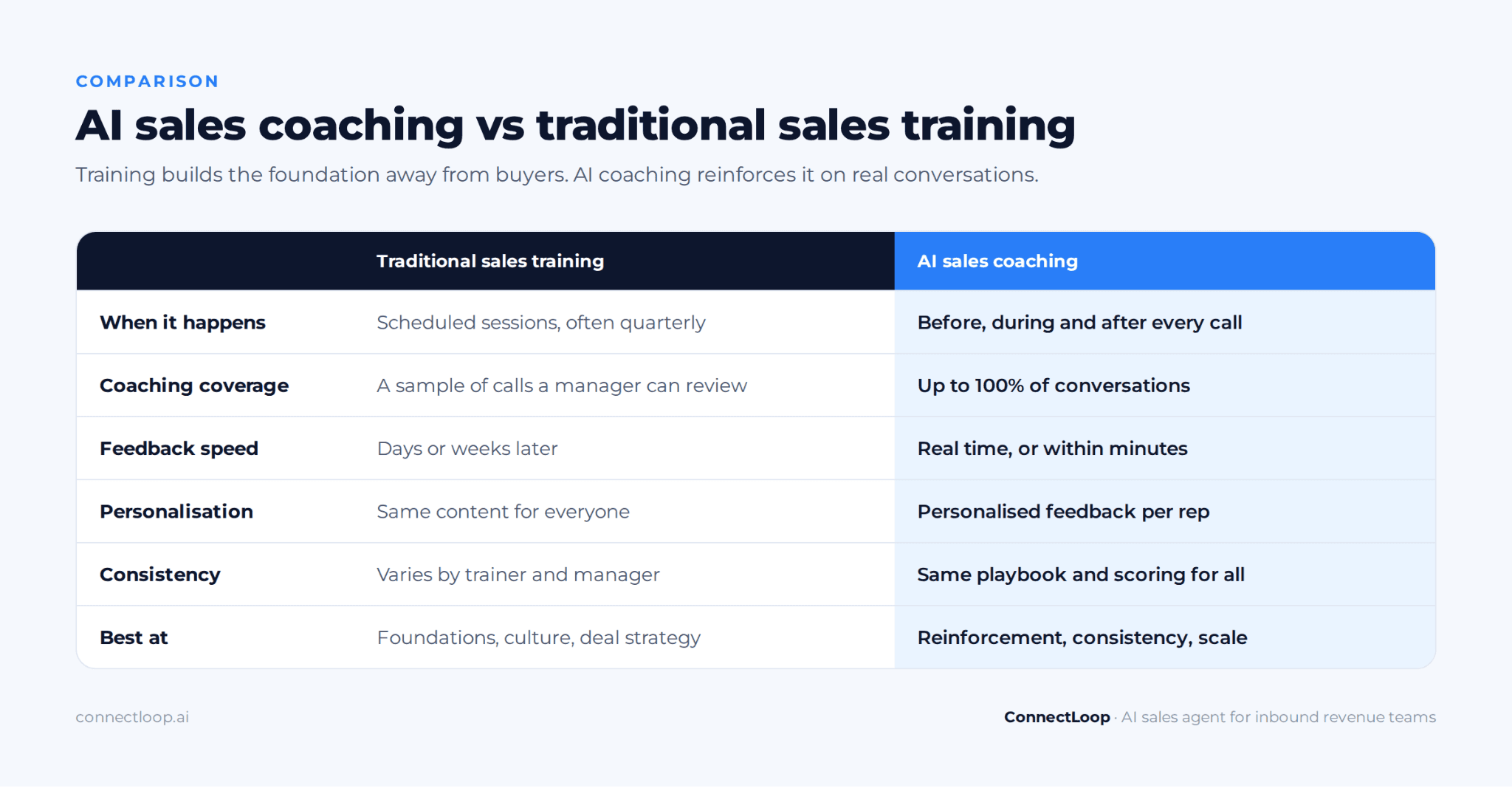
| Traditional sales training | AI sales coaching | |
|---|---|---|
| When it happens | Scheduled sessions, often quarterly | Before, during and after each call |
| Format | Workshops, sales kickoff, LMS modules | Feedback on the rep's own calls |
| Coaching coverage | A sample of calls a manager can review | Up to 100% of conversations |
| Feedback speed | Days or weeks later | Real-time feedback during the call, or instant feedback within minutes |
| Personalisation | Same content for the whole team | Personalised feedback per rep |
| Consistency | Varies by trainer and manager | Same playbook, same scoring for everyone |
| Best at | Foundations, culture, deal strategy | Reinforcement, consistency, scale |
| Main limit | Skill fade after the session | Needs good content and clear frameworks |
Neither column wins outright. Workshops build shared language and confidence. AI coaching keeps that language alive on the calls that follow.
Why does traditional sales training struggle to change rep behaviour?
Traditional training struggles because learning fades without use, and managers rarely have time to reinforce it. A rep leaves a workshop with new objection-handling skills, then meets real buyers weeks later with no one listening. ConnectLoop's view: training is a strong start that needs reinforcement at the point of application.
Three problems repeat across most sales teams.
What is the forgetting curve, and why does it matter for sales?
The forgetting curve comes from Hermann Ebbinghaus's 19th-century memory research. It shows that people lose much of what they learn within days unless it is reinforced. For sales, it means a two-day workshop without follow-up turns into skill fade by the end of the quarter, and retention of new techniques drops fastest for the skills reps use least. ConnectLoop's answer is reinforcement on live calls.
Repetition at the moment of use is what moves a skill from memory to habit. A cue card that appears when a buyer raises a pricing objection does more than a slide from last month's kickoff.
Why is manager time the biggest constraint?
Most sales managers carry their own targets, forecasts and hiring. Coaching gets whatever time is left, so it reaches the calls managers happen to join, not the ones that matter most. Coaching capacity, not willingness, is the limit: a classic manager bottleneck. ConnectLoop's Assist Dashboard shows framework coverage and open action items by rep, so managers can see where their time is needed.
The result is uneven coaching coverage. Strong reps get little attention, struggling reps get some, and nobody's feedback arrives while the call is still fresh.
Why does consistency break down at scale?
Every manager coaches differently. One focuses on discovery calls, another on closing, a third on tone. As teams grow, reps hear different advice, and the sales playbook drifts. AI coaching applies the same scorecards to every call, so ConnectLoop gives every team one standard across offices and time zones.
How does AI sales coaching work?
AI sales coaching captures a conversation, turns it into a transcript, and compares it with a playbook or sales methodology. It then gives the rep feedback: what was covered, what was missed and what to try next. Some tools coach after the call, some during it. ConnectLoop's Sales Assistance does both.
Most AI coaching tools combine four parts:
- Call analysis. Large language models (LLMs) read call transcripts to find questions asked, objections raised and commitments made.
- Scoring. Each call is scored against a framework such as SPIN, MEDDICC, BANT or Challenger, or against custom skill competency scores.
- Feedback. The rep receives actionable insights: the step skipped, the better question, the follow-up owed.
- Reporting. Managers see patterns across reps, such as skill gaps, coaching needs and readiness data, often mapped to the team's competency frameworks.
How is a purpose-built AI coach different from a general chatbot?
A general-purpose chatbot can review a transcript if you paste it in and write the right prompt. A purpose-built platform already knows your playbook, frameworks and products, captures the call itself, and scores every call the same way. ConnectLoop's Sales Assistance needs no prompt engineering from the rep.
Company-specific context is the difference. A coach that knows your pricing, objections and competitors gives advice the rep can use on the next call, not generic tips. The same principle applies to building a knowledge base for AI agents: the answers are only as good as the content behind them.
What does AI coaching look like before, during and after a call?
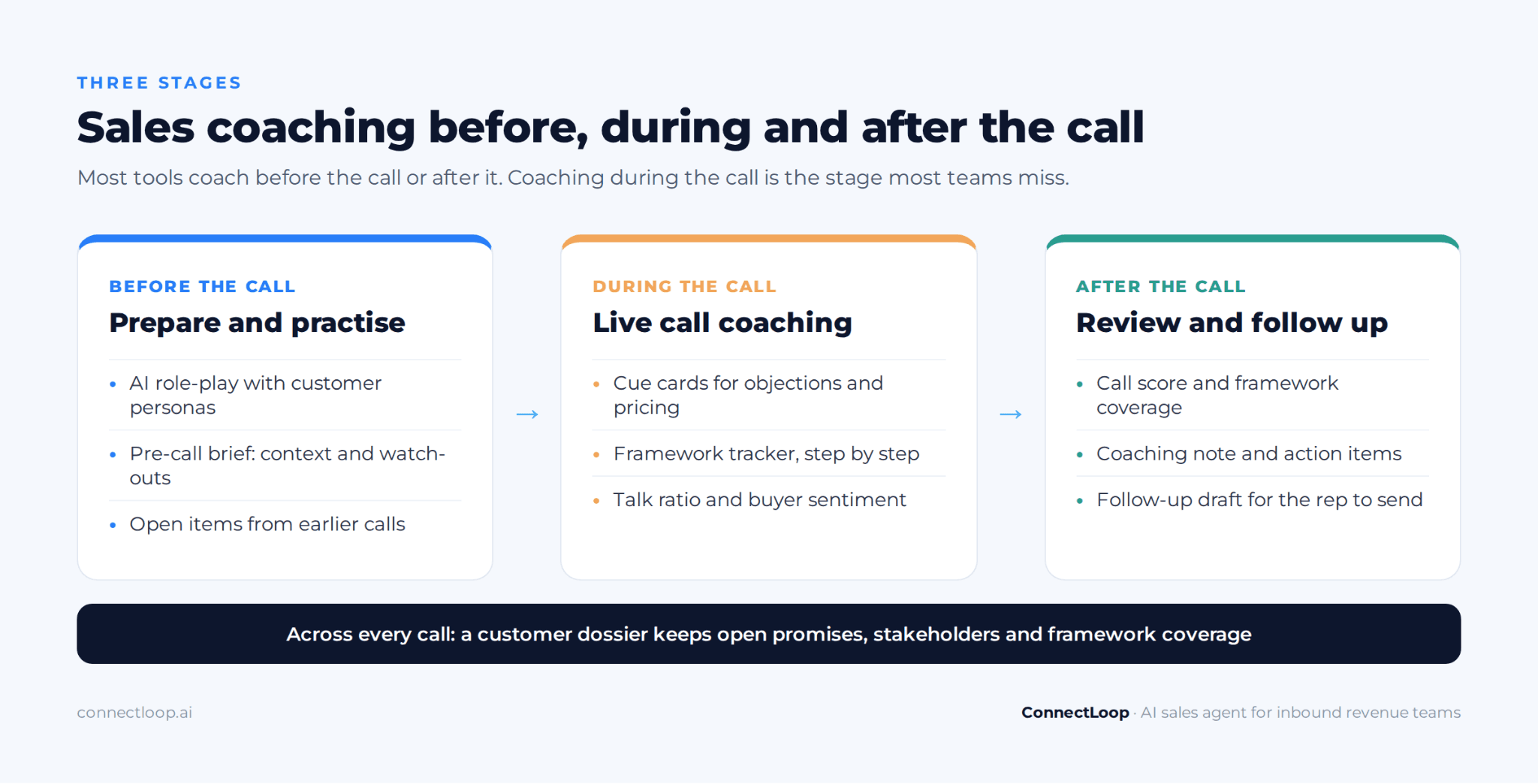
AI coaching works at three points. Before the call, reps practise or prepare. During the call, they get live guidance. After the call, they get a review. Most tools cover only one stage. ConnectLoop's Sales Assistance covers preparation, live coaching and review in one flow.
| Stage | Traditional approach | AI approach | What the rep gets |
|---|---|---|---|
| Before the call | Workshop notes, manager prep chat | Role-play with an AI buyer, or a pre-call brief | Practice and context |
| During the call | Nothing until the call ends | Live call coaching with cue cards and a framework tracker | Help at the moment it matters |
| After the call | Manager reviews a sample, days later | Automatic call review, scoring and coaching note | Fast, specific feedback |
| Across calls | Manager memory and CRM notes | A customer dossier with open promises | Continuity for every account |
What does AI coaching do before the call?
Before the call, AI helps reps rehearse and prepare. Role-play tools simulate an AI buyer with customer personas and voice realism, giving zero-stakes practice 24/7. A pre-call brief shows context, objectives and watch-outs. ConnectLoop focuses on the brief: what the buyer already said and what is still open.
AI role-play is a useful simulation for onboarding new hires and for rehearsing objection handling before a big meeting, which can shorten time to productivity. ConnectLoop's guide to sales role play covers scenarios and scoring in detail.
What does AI coaching do during the call?
During the call, AI listens and gives in-moment reinforcement: a reminder of the discovery question still missing, suggested wording for a pricing objection, a nudge when the rep talks too much. This is coaching during the call, the stage most tools skip. ConnectLoop built Sales Assistance around it.
Live coaching is where training meets reality. The rep doesn't need to remember the workshop; the right prompt appears when the buyer says the words that need it.
What does AI coaching do after the call?
After the call, AI produces a call review: a score, the buyer's sentiment, key moments, action items and how much of the framework was covered. A coaching note points to one or two things to improve. ConnectLoop also drafts the follow-up email for the rep to review and send.
The speed matters. A coaching debrief that lands within minutes is still connected to the conversation the rep remembers.
How does ConnectLoop coach reps during the live call?
ConnectLoop's Sales Assistance listens in the browser tab during Google Meet or Zoom calls, with no bot joining the call. It shows the rep cue cards for objections, pricing and product questions, tracks framework coverage step by step, and keeps a dossier for every customer. Managers see the results on the Assist Dashboard.
Here is what ConnectLoop provides at each point.
Before the call
- Customer context, objectives and watch-outs
- Items still open from earlier calls, so settled questions aren't asked again
During the call
- Browser-based capture. Audio comes from the meeting tab plus the rep's microphone in Chrome or Edge. No meeting bot appears in the participant list.
- Seven cue types. Memory, discovery questions, pricing, objections, battlecards, product knowledge and action items, each with suggested wording and response branches.
- Framework tracker. Shows which steps of the chosen methodology are covered as the call goes on.
- Live transcript and script references in the same assist feed.
- Three views. Cockpit for the full picture, Focus for the single most important cue, and Overlay for a compact layout.
After the call
- Call score and buyer sentiment
- Narrative summary and key moments linked to the transcript
- Action items captured from the conversation
- Framework coverage, with supporting quotes as evidence
- A post-call coaching note
- A follow-up draft to copy into the rep's inbox, review and send, useful for any follow-up email after no response too
Across calls
- Customer dossier. Open promises with overdue flags, framework coverage over time, stakeholders and call history.
- Assist Dashboard. Calls assisted, cues accepted, average framework coverage and open action items, by rep, over 7, 30 or 90 days.
Which sales methodologies can ConnectLoop coach against?
ConnectLoop ships its own YES Framework, with five stages: Discover, Define, Connect, Validate and Commit. SPIN, MEDDICC, BANT and Challenger are included as standard frameworks. Teams can also build a custom sales methodology of up to twelve steps, so coaching matches the way the team already sells.
Framework coverage gives coaching a clear metric. Instead of "be more consultative", the rep sees that Implicate the Pain was never covered, with the quote that proves it. ConnectLoop's guides to SPIN selling questions and MEDDPICC explain those frameworks step by step.
How does coaching connect to the first inbound conversation?
For inbound teams, the buyer often talks to ConnectLoop's AI agent, Lia, before any call. Lia answers on website chat, WhatsApp, email and voice, qualifies the lead and books the meeting. The rep starts the call knowing what the buyer already asked, so coaching builds on the first conversation instead of repeating it.
This is inbound sales coaching: the AI agent plus rep model, with coaching from real buyer questions. Chat and WhatsApp transcripts show the rep, and the coach, exactly what the buyer cares about. This model changes what coaching covers. The rep doesn't spend the first ten minutes on questions the buyer already answered in chat. The coach can focus on what only a person can do: depth, judgment and the deal itself. ConnectLoop's guide to inbound lead qualification shows what the agent captures before the hand-off.
Does AI sales coaching replace the sales manager?
No. AI sales coaching replaces the repetitive parts of coaching: listening to every call, scoring it, spotting missed steps. It frees managers for the work only people do well. ConnectLoop gives managers the evidence; the manager still decides what to coach, how and when.
"Does AI replace managers?" comes up in almost every rollout, and the evidence says no. Gartner's May 2026 buyer research, based on 645 B2B buyers surveyed in 2025, found human sellers outperformed generative AI by 39 percentage points on understanding needs and 32 points on buyer confidence. Coaching people to do those things well remains a human job.
What stays with the manager?
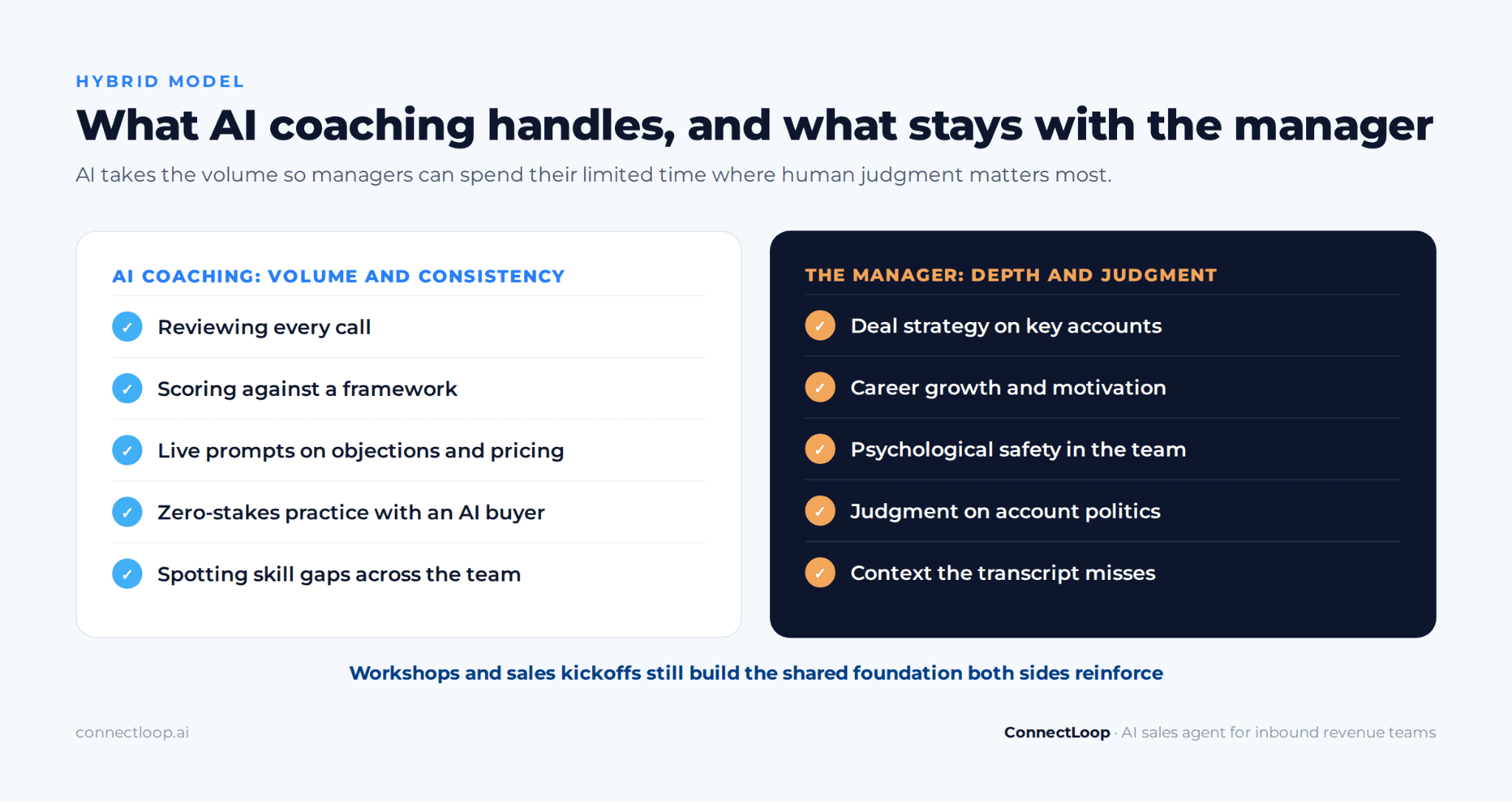
Managers keep the work that depends on judgment and relationships. AI handles volume; the manager handles meaning. ConnectLoop's Assist Dashboard is designed to point managers to the right calls, not to coach for them.
- Deal strategy. Deciding where to push, where to wait and when to walk away. ConnectLoop's guide to how to negotiate in sales covers that judgment.
- Career development. Goals, motivation and growth, often structured with a coaching model such as GROW.
- Psychological safety. Creating a team where reps admit mistakes and ask for help.
- Account judgment. Knowing the history, politics and people behind a deal.
- Context the transcript misses. Tone, body language in video calls, and what happened before the meeting.
What is the right mix of AI and human coaching?
A practical hybrid model uses AI for volume and humans for depth. Many teams follow an 80/20 rule: AI covers repetition, scoring and reinforcement on most calls; managers spend their limited time on strategy and the few calls that matter most. ConnectLoop's dashboard helps decide where those human hours go.
| Coaching task | Best handled by | Why |
|---|---|---|
| Reviewing every call | AI | Continuous coverage without manager time |
| Scoring against a framework | AI | Same scorecards for every rep |
| Live prompts on objections and pricing | AI | Only possible in real time |
| Practising hard conversations | AI role-play, then a manager | Zero-stakes practice first, human feedback second |
| Deal strategy on key accounts | Manager | Needs judgment and context |
| Motivation and career growth | Manager | Needs trust and relationship |
| New product launch or kickoff | Workshop | Shared understanding across the team |
Workshops still earn their place. A sales kickoff or product launch builds shared language, such as how to lead with value-based selling, that AI coaching then reinforces call by call. Sales enablement teams own both sides: the content and the reinforcement.
Can small sales teams use AI coaching?
Yes, and small sales teams often gain the most. With two or three reps, there is rarely a full-time manager to coach, so AI provides feedback that would otherwise not exist. ConnectLoop's Sales Assistance works for a single rep on Google Meet or Zoom in the browser, with nothing to install on the meeting.
Small teams also tend to sell inbound, where the first conversation happens on the website and speed to lead decides who gets the call. Pairing Lia for that first conversation with live coaching for the call gives a small team the coverage of a larger one.
How do you roll out AI sales coaching, step by step?
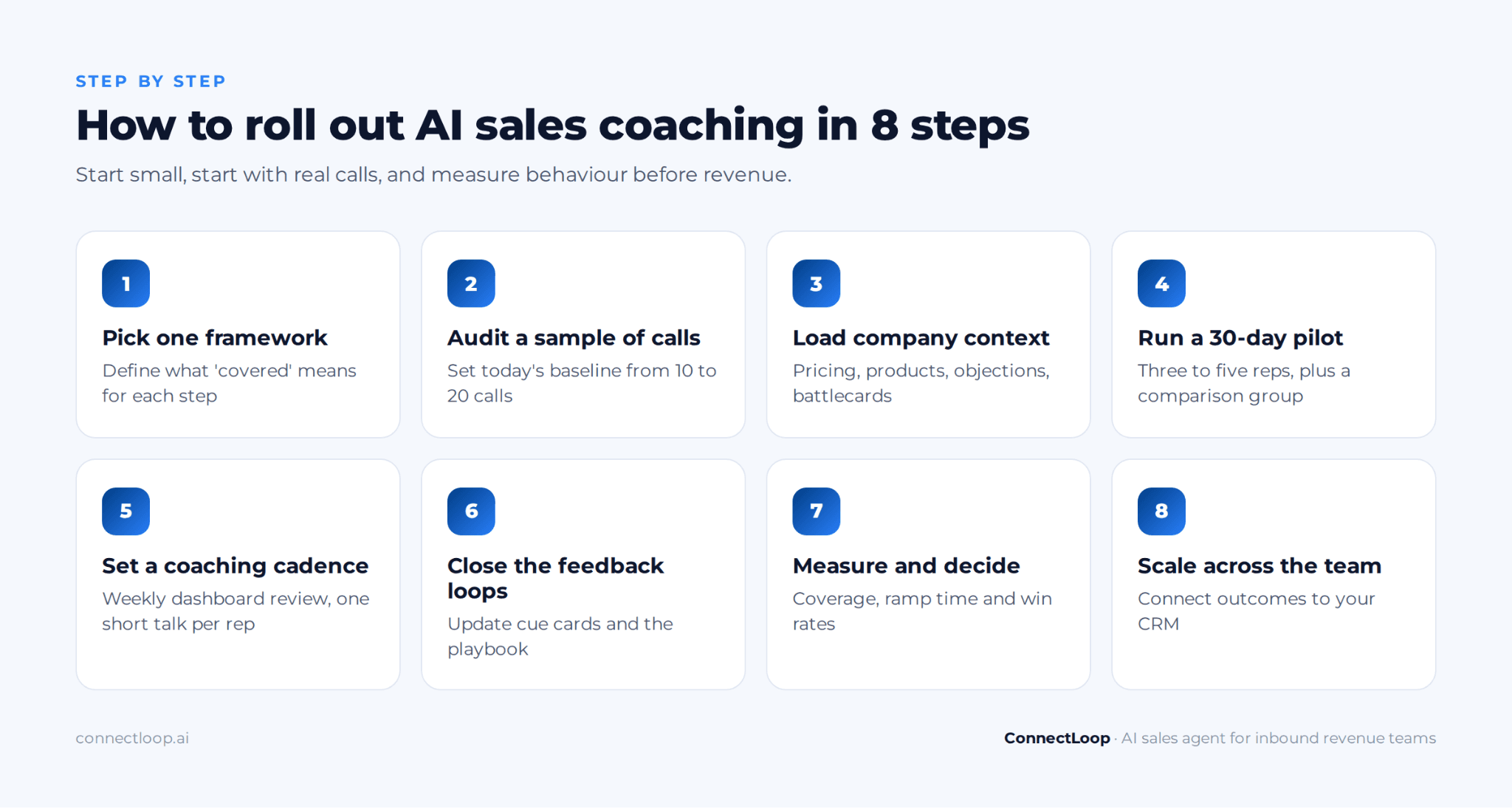
Start small, start with real calls, and measure before you scale. A 30-day pilot with a handful of reps tells you more than a long evaluation. ConnectLoop recommends starting with one framework and one team, then expanding once managers trust the scoring.
- Pick one framework. Choose the methodology your team already uses, such as SPIN, MEDDICC, BANT, Challenger or a custom sequence. Write down what "covered" means for each step.
- Audit a sample of calls. Call auditing on 10 to 20 recent calls shows today's baseline: which steps get skipped, how long reps talk, which objections cause trouble, and at which of the stages of the sales process deals stall.
- Load company-specific context. Add pricing, product details, objections and battlecards, so cue cards give your answers, not generic ones.
- Run a 30-day pilot. Use live call coaching with three to five reps. Keep the rest of the team as a comparison group.
- Set a coaching cadence. Managers review the dashboard weekly and hold one short coaching conversation per rep, using the call evidence.
- Close the feedback loops. Update cue cards when reps hit new objections, and update the playbook when patterns appear across reps.
- Measure and decide. Compare framework coverage, ramp time and win rates between the pilot group and the comparison group.
- Scale with CRM integration. Once the pilot works, make sure call outcomes and next steps reach your CRM, such as Salesforce or HubSpot, so they sit with the deal. ConnectLoop connects to both.
The biggest risk in rollout is adoption. Reps use coaching that helps them win the call in front of them, so make the first cue cards about the objections they struggle with most.
What should you measure to know AI coaching is working?
Measure behaviour first, then results such as revenue growth. Behaviour metrics such as framework coverage move within weeks. Results such as win rates and quota attainment take a quarter or more. ConnectLoop's Assist Dashboard reports the behaviour side: calls assisted, cues accepted, framework coverage and open action items.
| Metric | What it shows | When it moves |
|---|---|---|
| Framework coverage | Whether reps complete each step of the methodology | Weeks |
| Cues accepted | Whether reps find live guidance useful | Weeks |
| Talk ratio | Whether reps listen more than they speak | Weeks |
| Open action items | Whether promises to buyers are kept | Weeks |
| Ramp time | How fast new hires reach full productivity | One to two quarters |
| Win rates | Whether better calls produce more closed deals | A quarter or more |
| Quota attainment | Whether the team hits its numbers | A quarter or more |
| Training ROI | Revenue impact against coaching cost | Two quarters or more |
Track the same metrics for a comparison group during the pilot. Coaching also pays off beyond the numbers, as ConnectLoop's article on the benefits of sales coaching explains. Without one, it is hard to separate the effect of coaching from a strong quarter. ConnectLoop's guide to inbound sales metrics covers the numbers that sit before the CRM.
How long before AI sales coaching produces results?
Behaviour changes first, usually within the first few weeks of live coaching, because reps get feedback on every call instead of occasionally. Revenue results take longer, since deals have their own sales cycle. Whether the rep is an SDR or a BDR also changes which behaviours to measure first. ConnectLoop recommends judging a pilot on framework coverage after 30 days and on win rates after a full quarter.
How much does AI sales coaching cost compared with traditional training?
Traditional training costs are mostly upfront: trainers, travel, workshop days and time away from selling. AI coaching costs are ongoing: a subscription per rep or per team. The real comparison is cost per rep per coached conversation. ConnectLoop's Sales Assistance is a paid feature; current plans are on the pricing page.
The hidden cost of traditional training is the coaching that never happens afterwards. A workshop without reinforcement is paid for in full but only partly used.
When you compare options, include:
- Manager time. Hours spent reviewing calls manually, valued at the manager's cost.
- Ramp time. Every week a new hire takes to reach productivity has a revenue cost.
- Coverage. The share of calls that receive any feedback at all.
- Tool overlap. Whether one system replaces several, such as call review, note-taking and follow-up drafting.
The wider direction is clear. Gartner predicted in April 2026 that by 2029, sales organisations with AI-driven enablement will achieve 40% faster sales stage velocity than those using traditional enablement approaches. Treat that as a forecast, not a guarantee, and test it with your own pilot.
Which features matter when choosing an AI coaching platform?
Choose features that match where your team loses deals. If reps lose control in live calls, prioritise live coaching. If new hires lack confidence, prioritise role-play. ConnectLoop's strengths are live call coaching, framework coverage and the link to the first inbound conversation.
- Live guidance during calls, not only after them
- No bot joining the call, if buyers dislike meeting bots
- Framework flexibility, including your own custom sales methodology and the choice between lighter and heavier frameworks covered in BANT vs MEDDIC
- Evidence-based scoring, with quotes, not just numbers
- Continuity across calls, such as a customer dossier and open promises
- CRM integration with the systems your team already uses
- Security credentials you can verify. ConnectLoop is CASA Verified by Google and an official Meta Business Partner.
For a wider view of tool categories, ConnectLoop's guide to AI sales training tools compares simulators, call review and live coaching side by side.
Key takeaways
- Traditional sales training builds foundations; AI sales coaching reinforces them on real calls, at the point of application.
- The forgetting curve and limited manager time are why training alone rarely changes behaviour for long.
- AI coaching works at three stages: before the call (practice and preparation), during the call (live guidance) and after it (review and scoring).
- Coaching during the call is the stage most tools skip. ConnectLoop's Sales Assistance covers it with cue cards, a framework tracker and no bot joining the call.
- Framework coverage is a clearer coaching metric than generic skill scores, because each missed step comes with evidence from the transcript.
- AI does not replace the manager. It takes the volume so managers can focus on deal strategy, development and judgment.
- A hybrid model works best: AI for coverage and consistency, people for depth, workshops for shared foundations.
- Start with a 30-day pilot, measure behaviour first, then judge revenue impact over a full quarter.

About the author
ConnectLoop Staff
Written by the ConnectLoop team. ConnectLoop is an AI sales agent for inbound revenue teams, based in Cambridge, Massachusetts.
About ConnectLoop →Frequently asked questions
Neither is better on its own. Traditional training is strong for foundations, culture and shared language. AI sales coaching is stronger for reinforcement, consistency and coverage across every call. Most teams get the best results by combining both in a hybrid model.
Yes. Live call coaching tools listen to the conversation and show prompts in real time, such as suggested answers to objections or the discovery question still missing. ConnectLoop's Sales Assistance does this in the browser during Google Meet and Zoom calls, with no bot joining.
With a meeting bot, buyers see an extra participant. With browser-based capture, nothing joins the meeting. Whatever the tool, follow your local recording and consent rules, and tell buyers when calls are recorded or analysed.
Yes. Inbound teams benefit because the buyer's first questions are already captured before the call. With ConnectLoop, Lia handles the first conversation on chat, WhatsApp, email or voice, and the rep's coaching builds on what the buyer already said.
Most platforms support common frameworks such as SPIN, MEDDIC or MEDDICC, BANT and Challenger. ConnectLoop also ships its own YES Framework and lets teams build a custom methodology of up to twelve steps.
AI role-play is practice with a simulated buyer before real calls. AI coaching gives feedback on real calls, either live or afterwards. Role-play builds confidence; live coaching and call review show how skills hold up with real buyers. Many teams use both.
Some will at first. Adoption improves when reps see coaching as help for the call in front of them, not surveillance. Start with cue cards for the objections they find hardest, and share scores privately before using them in team reviews.
Changes in behaviour, such as better framework coverage, usually show within weeks. Revenue results, such as higher win rates, take at least a full sales cycle. A 30-day pilot followed by a quarter of measurement gives a fair picture.
Most purpose-built platforms connect to CRMs such as Salesforce and HubSpot, so call outcomes and next steps sit with the deal. Check which CRM and meeting platforms a tool supports before you start a pilot.
It doesn't set deal strategy, build trust with a struggling rep or read the politics of an account. Those stay with the manager. AI coaching makes the manager's time more effective by showing where it is needed.
Coach every call, not just the ones a manager can join
Training gives reps the playbook; coaching makes it show up on real calls. ConnectLoop's Sales Assistance coaches reps during the live call, scores every call against your framework, and keeps each customer's open promises in one place, with Lia handling the first conversation before the call. See how it works on the Sales Assistance page, or start with Lia on the free plan.