
AI Sales Agents
AI Knowledge Base: How to Build One for an AI Sales Agent
An AI knowledge base is the approved content an AI agent retrieves before it answers a buyer: pricing, product details, integrations, comparisons and policies. For a sales agent, it decides whether the first answer a buyer hears is accurate and consistent. ConnectLoop's agent, Lia, answers only from this content, so building it well is the first job.

Published
Table of contents
- What is an AI knowledge base for a sales agent?
- How does an AI knowledge base work?
- What should a sales knowledge base include?
- What should stay out of an AI sales knowledge base?
- How do you build an AI knowledge base, step by step?
- How does ConnectLoop build the knowledge base behind Lia?
- What happens when the answer isn't in the knowledge base?
- How do you measure whether your AI knowledge base is working?
- How do you keep an AI knowledge base current?
- How do you control access and protect sensitive data?
- Why do AI knowledge bases fail, and how do you avoid it?
- Which tools and technologies power an AI knowledge base?
- Key takeaways
- Frequently asked questions
What is an AI knowledge base for a sales agent?
An AI knowledge base is a collection of approved content that an AI agent searches to answer questions. In sales, that means the answers buyers ask for before they talk to a rep: what it costs, what it connects to, how it compares, and how to get started. ConnectLoop treats it as the agent's single source of truth.
Most guides on this topic are written for customer support or internal knowledge. A sales knowledge base has a different job. It has to answer pricing questions the same way every time, handle comparisons without overpromising, and move a qualified buyer toward a meeting.
Adoption is no longer the hard part. According to McKinsey's 2025 State of AI survey, 79% of organisations now use generative AI in at least one business function, yet only 7% say AI is fully scaled across the organisation. The knowledge base is often what separates a pilot from an agent a team trusts with real buyers.
How is an AI knowledge base different from a traditional knowledge base?
A traditional knowledge base is a library people search with keywords and read themselves. An AI knowledge base is read by the agent, which uses natural language processing to understand the question, retrieves the right passages, and writes an answer grounded in them. ConnectLoop's agent works this way on chat, WhatsApp and email.
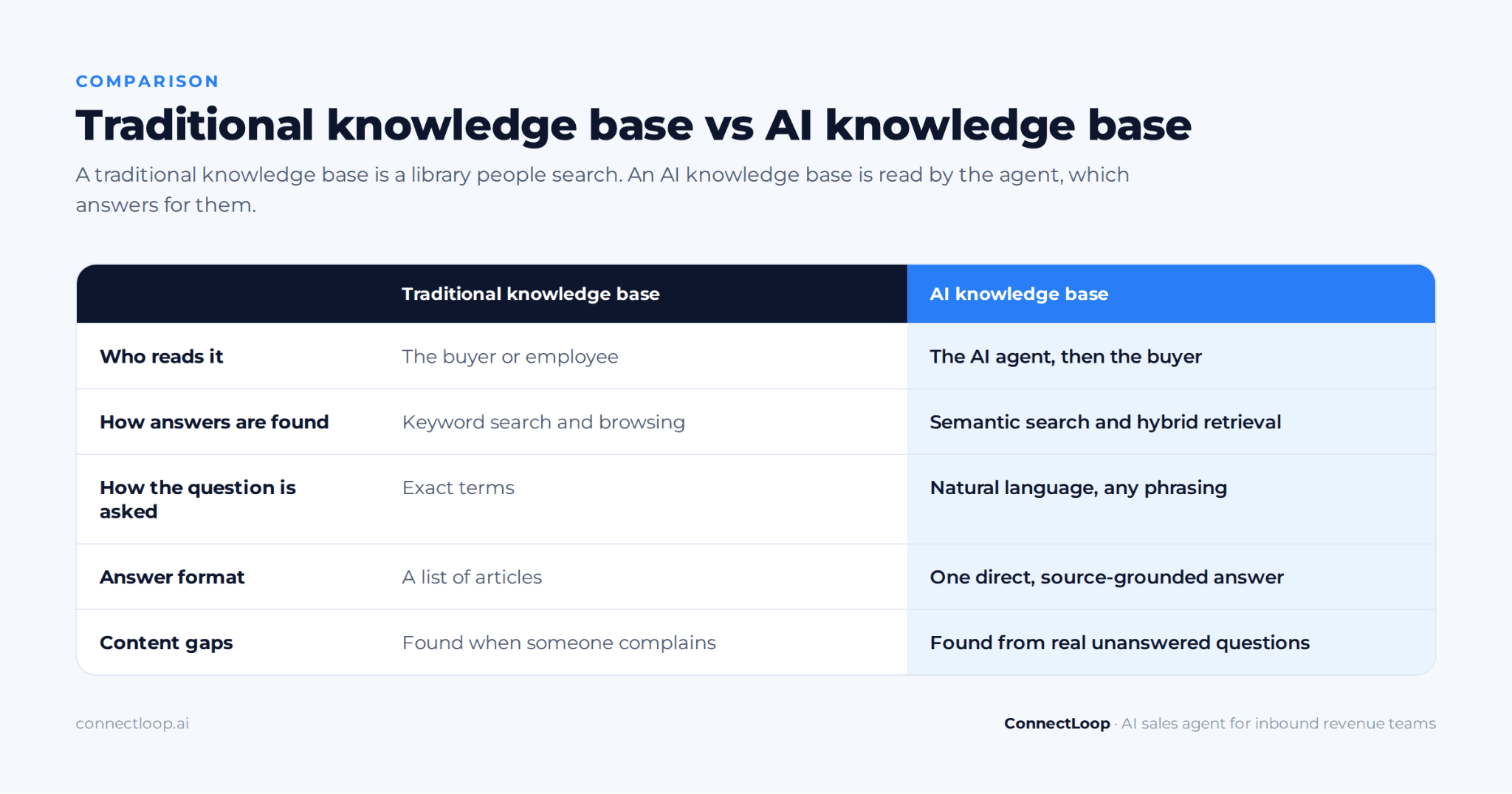
| Traditional knowledge base | AI knowledge base | |
|---|---|---|
| Who reads it | The buyer or employee | The AI agent, then the buyer |
| How answers are found | Keyword search and browsing | Semantic search and hybrid retrieval |
| How the question is asked | Exact terms | Natural language, any phrasing |
| Answer format | A list of articles | One direct answer, grounded in sources |
| Multi-source retrieval | One source at a time | Combines several sources in one answer |
| Content gaps | Found when someone complains | Found from real unanswered questions |
| Maintenance | Periodic manual review | Review cadence plus usage feedback |
What is the difference between a vector store and a knowledge base?
A vector store, or vector database, holds embeddings: numerical versions of your content that let the agent find passages by meaning. The knowledge base is the content itself, plus its structure, metadata, ownership and rules. ConnectLoop treats the vector store as the index and the knowledge base as what gets indexed.
How does an AI knowledge base work?
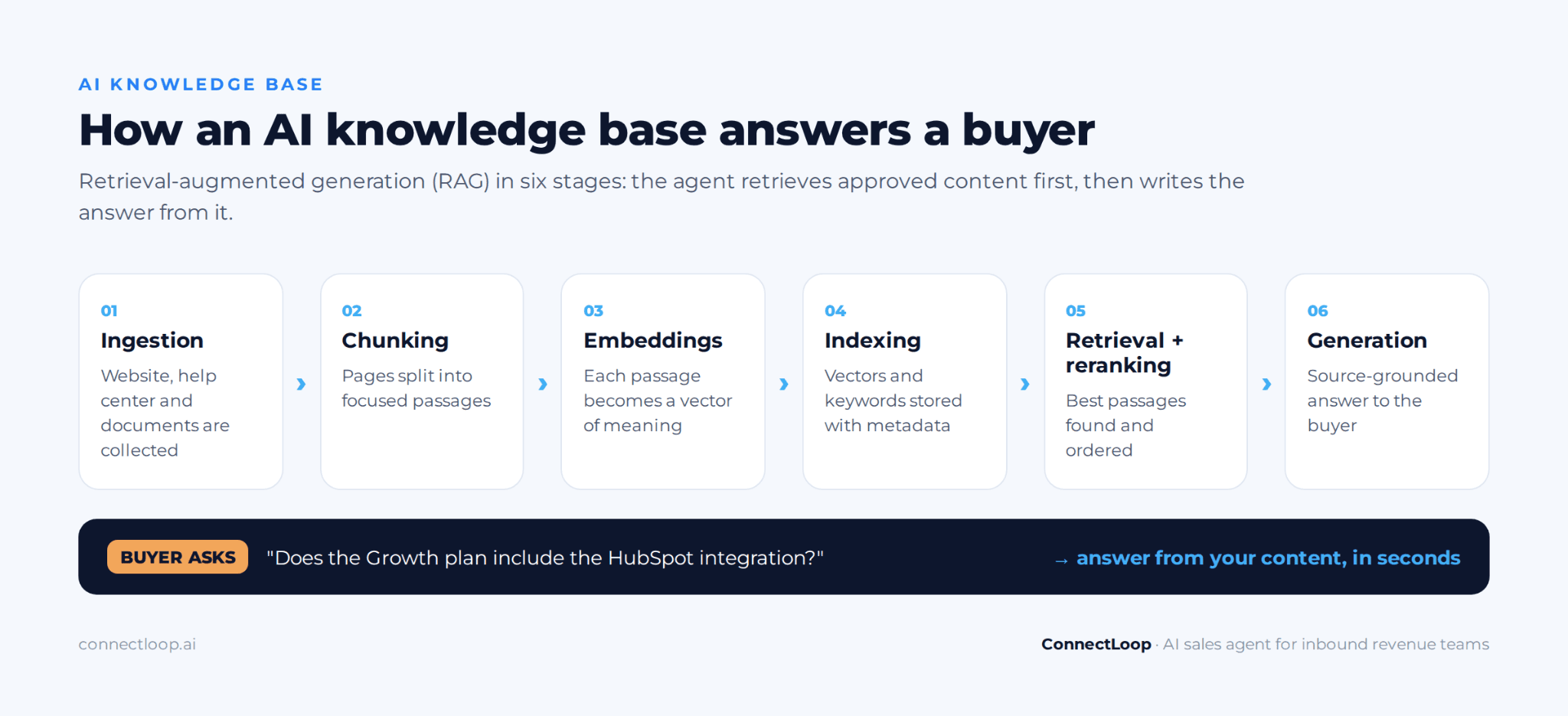
Most AI knowledge bases use retrieval-augmented generation (RAG). The agent first retrieves relevant passages from your content, then generates an answer using only those passages. RAG keeps answers source-grounded instead of relying on what a general model happens to remember. ConnectLoop's agent follows the same pattern for every buyer question, including the ones that arrive after hours, when speed to lead often decides who gets the meeting.
The process runs in six stages:
- Ingestion. Content is collected from your website, help center, product documentation and other sources through an ingestion pipeline.
- Chunking. Long pages are split into smaller passages. The chunking strategy decides where each passage starts and ends.
- Embeddings. An embedding model turns each passage into vector embeddings that capture its meaning.
- Indexing. The embeddings and their metadata are stored in a vector database, alongside a keyword index.
- Retrieval and reranking. When a question arrives, the system finds candidate passages and a reranker orders them by relevance.
- Generation. The model writes the answer from the top passages, inside its context window, and cites what it used.
Why does hybrid retrieval beat semantic search alone?
Semantic search finds passages with similar meaning, but it can miss exact terms like a plan name, an integration or a price. Hybrid search combines dense vector search with keyword search (sparse retrieval such as BM25), then merges the results, often with Reciprocal Rank Fusion and a cross-encoder reranker. For ConnectLoop's buyers, exact terms like plan names and prices are often the whole question, which is why retrieval quality matters so much in sales.
Some systems add a knowledge graph on top. Graph RAG links entities such as products, plans and integrations, so the agent can answer questions that depend on relationships, like "Which plan includes the HubSpot integration?"
What should a sales knowledge base include?
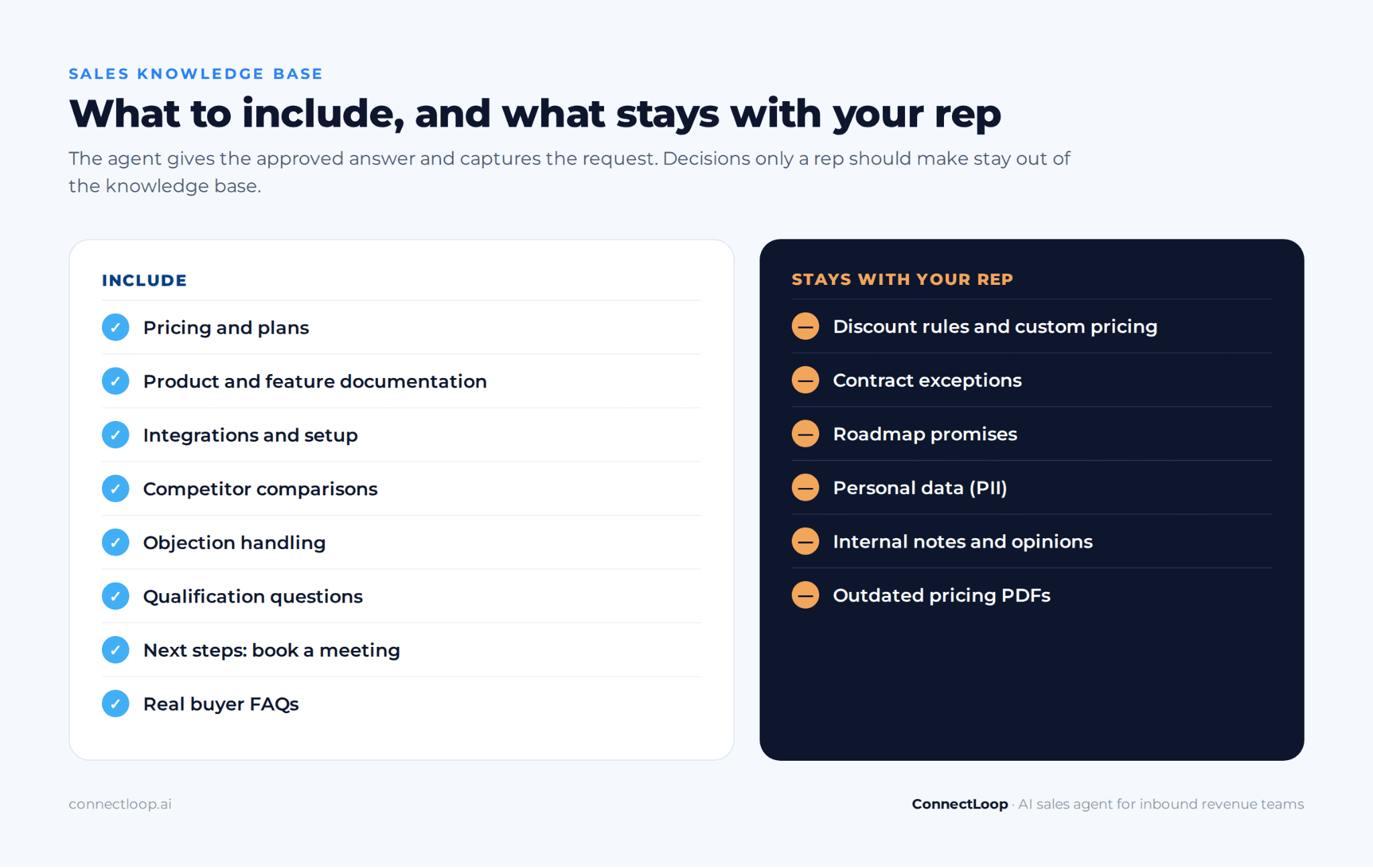
A sales knowledge base should cover every question a buyer asks before talking to a rep: pricing, plans, features, integrations, setup, comparisons, security and next steps. Write each answer the way your best rep would say it. ConnectLoop's Conversational Intelligence groups real conversations by these same drivers, which shows where to start.
- Pricing and plans. What each plan includes, how billing works, and what changes at each tier.
- Product and feature documentation. What the product does, in plain language, with one topic per article.
- Integrations. Which CRM, calendar and messaging tools connect, and what the setup involves.
- Competitor comparisons. Approved positioning on how you differ, written factually.
- Objection handling. Short, approved answers to the common concerns: price, timing, risk and switching effort.
- Qualification questions. The questions the agent should ask, drawn from your sales playbook.
- Next steps. How to book a meeting, start a trial or reach a person.
- FAQs and past conversations. Real buyer questions and the answers that worked.
Both structured content (tables, plan grids, FAQs) and unstructured content (articles, PDFs, transcripts) belong in the knowledge base. Structured content gives precise facts; unstructured content gives context and explanation. For an online store, structured content also means the product catalogue, which is how an AI agent for e-commerce answers stock and product questions.
What should stay out of an AI sales knowledge base?
Keep out anything only a rep should decide: discount rules, custom pricing, contract exceptions and promises about roadmap dates. Keep out personal data and internal-only notes too. The agent's job is to give the approved answer and capture the request; ConnectLoop keeps every negotiation decision with your team.
- Discount authority. The agent records a discount request and passes it to the rep. Trading price for term is covered in ConnectLoop's guide to how to negotiate in sales.
- Unapproved or outdated pricing. One old PDF can contradict your pricing page. Remove it before ingestion.
- Roadmap promises. "Coming soon" answers become commitments once a buyer reads them.
- Personal data (PII). Customer names, contracts and contact details have no place in content the agent can quote.
- Internal opinions. Sales notes about competitors or accounts should stay in the CRM.
How do you build an AI knowledge base, step by step?
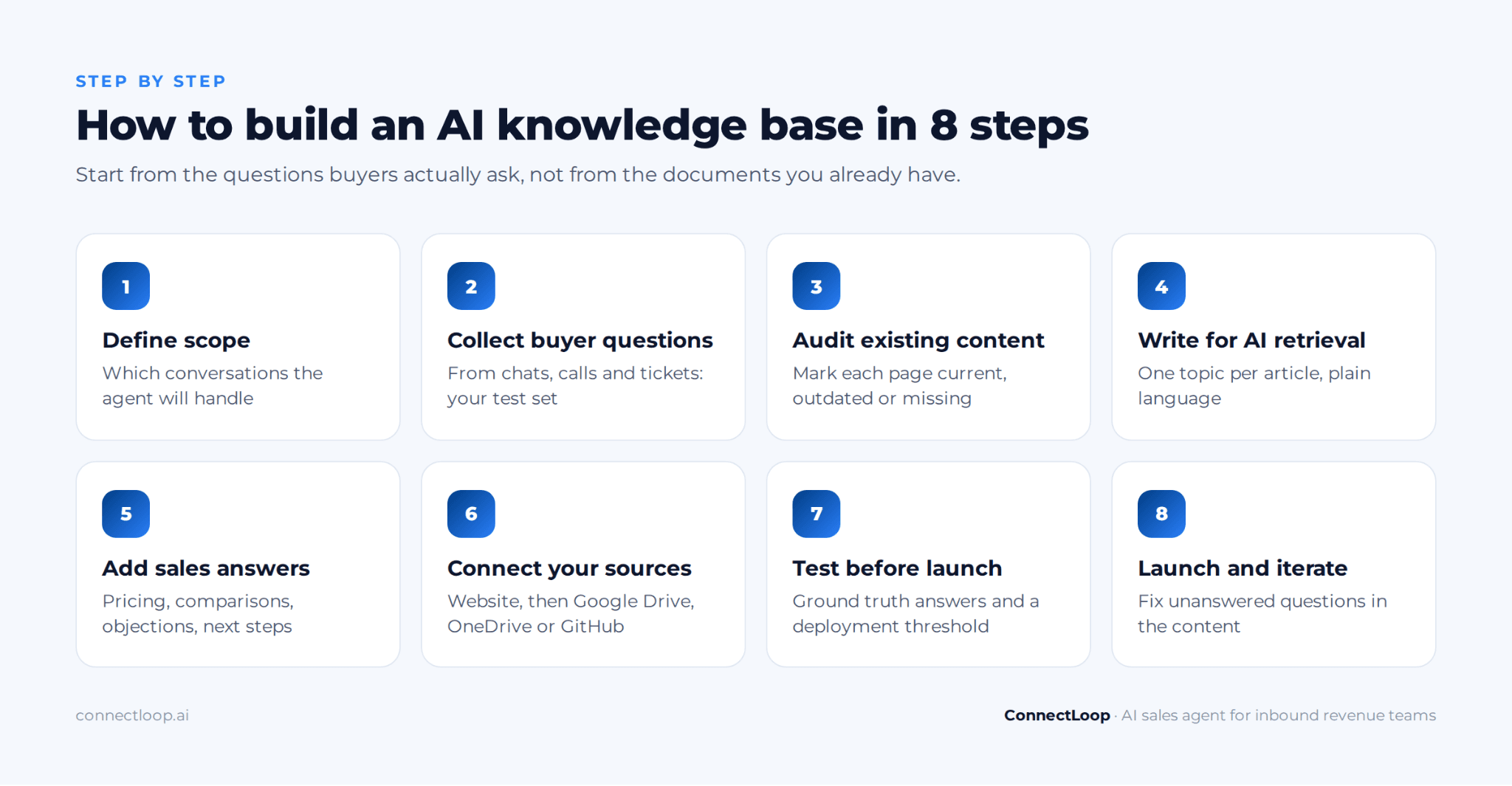
Start from the questions buyers actually ask, not from the documents you already have. Audit existing content, rewrite the answers for retrieval, connect your sources, then test against real questions before launch. ConnectLoop customers usually begin with their website, which the agent trains on in about sixty seconds.
- Define scope and audience. Decide which conversations the agent will handle: pre-sales questions, qualification, booking, or all three.
- Collect real buyer questions. Pull them from chat transcripts, sales calls, demo recordings and support tickets. These become your test set.
- Audit existing content. List every page, PDF and document. Mark each as current, outdated or missing.
- Write for AI retrieval. One topic per article, the question restated in the answer, clear headings and plain language. Add text alongside images and videos, because the agent reads text.
- Add sales-specific answers. Write the pricing, comparison, objection and next-step answers your website doesn't yet cover.
- Connect your sources. Start with your website and help center, then add your documents. In ConnectLoop, connecting Google Drive, Microsoft OneDrive or GitHub from the integrations page lets you import FAQ documents, pricing sheets and product guides straight into the knowledge base. If approved answers live in Confluence, Notion, SharePoint or Slack, export them into documents first. Add metadata such as product, plan and last-reviewed date.
- Test before launch. Run your buyer questions through the agent. Build a small ground truth dataset of correct answers and set a deployment threshold, for example 9 in 10 answered correctly.
- Launch, measure and iterate. Watch which questions go unanswered and fix the content, not the prompt.
How long does it take to set up an AI knowledge base?
A first version can be live in a day if your website is current. ConnectLoop trains Lia on your website in about sixty seconds, so the first answers come from content you already publish. The remaining work, adding sales-specific answers and closing gaps, usually takes a few weeks of steady iteration.
How does ConnectLoop build the knowledge base behind Lia?
ConnectLoop starts with your website. Lia trains on it in about sixty seconds and answers from that approved content on website chat, WhatsApp and email. From there, every real conversation shows what to add next, so the knowledge base grows from buyer questions rather than guesswork.
- One knowledge base, every channel. The same answers serve website chat, WhatsApp and email. ConnectLoop is an official Meta Business Partner, so the WhatsApp channel uses the same source of truth.
- Knowledge Gaps. When a buyer asks something the knowledge base can't answer, the question is logged in the Knowledge Gaps report so the team can add it. This is content gap detection driven by real buyers, not guesswork.
- Conversation drivers. Conversational Intelligence groups conversations by what drove them: pricing, features, integrations, setup or billing. It shows which topics deserve the most detailed answers.
- Qualification inside the conversation. Lia asks SPIN selling questions and MEDDICC questions one at a time, so the knowledge base and the qualification flow work together.
- CRM sync. The transcript, intent score and pages viewed sync to the CRM, so the rep sees what the buyer already asked.
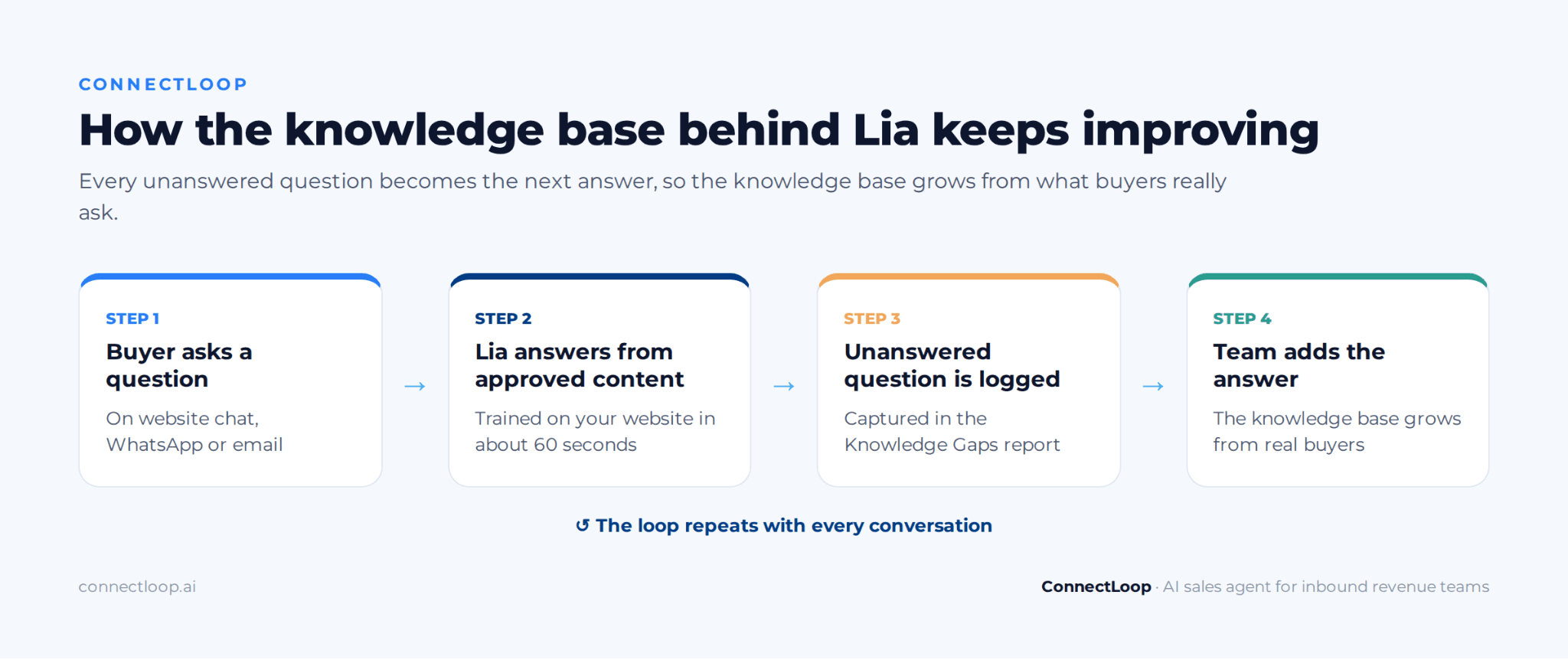
Your content sets the ceiling. Lia answers from what you publish, which is why the Knowledge Gaps report matters as much as the initial setup.
What happens when the answer isn't in the knowledge base?
The agent should say so, capture the question, and offer a person. Guessing is how hallucination happens. A well-built AI sales agent gives source-grounded responses or hands over. ConnectLoop's Lia logs the question in the Knowledge Gaps report and escalates to a person when the buyer asks for one or the conversation needs a human.
A good human handoff passes everything along: the question, the conversation so far and the buyer's details. The rep picks up where the agent stopped, and the unanswered question becomes a new knowledge base entry. If the buyer leaves before anyone replies, a follow-up email after no response brings the conversation back, with ConnectLoop drafting it for a person on your team to review and send. This is also what separates an agent from a basic bot, as ConnectLoop's comparison of a chatbot vs an AI agent explains.
How do you measure whether your AI knowledge base is working?
Measure two things: retrieval quality and business outcomes, alongside the wider inbound sales metrics your team already tracks. Retrieval quality tells you whether the agent finds the right content. Business outcomes tell you whether buyers move forward. For a sales agent, the second set matters more, and it is what ConnectLoop's Conversational Intelligence focuses on: what drove each conversation, how well it was resolved, and which questions went unanswered.
| Metric | What it measures | Type |
|---|---|---|
| Context precision | Share of retrieved passages that are relevant | Retrieval |
| Context recall | Share of the needed information that was retrieved | Retrieval |
| Faithfulness | Whether the answer sticks to the retrieved sources | Retrieval |
| Answer relevance | Whether the answer addresses the question asked | Retrieval |
| Mean Reciprocal Rank | How high the right passage ranks | Retrieval |
| Latency and cost per query | Speed and cost of each answer | Operations |
| Resolution rate | Share of questions answered without a person | Support |
| Answer consistency | Whether the same question gets the same answer | Sales |
| Knowledge gaps closed | Unanswered questions turned into content | Sales |
| Meetings booked | Conversations that end in a scheduled meeting | Sales |
| Qualified leads | Conversations that meet your qualification criteria | Sales |
Support teams focus on resolution rate and self-service. Sales teams should track meetings booked and qualified leads, then feed the results into lead scoring so reps call the right buyers first.
How do you keep an AI knowledge base current?
Give every topic an owner, set a review cadence, and tie updates to the events that change answers: a pricing change, a new integration, a product launch. Knowledge decay is quiet until a buyer quotes an old price back to your rep. ConnectLoop's Knowledge Gaps report adds a feedback loop from real conversations.
- Content ownership. One named owner per topic: pricing, integrations, security, product.
- Review cadence. Quarterly at minimum; monthly for pricing and features.
- Event triggers. Every pricing or product change includes a knowledge base update in its launch checklist.
- Versioning. Keep a record of what changed and when, so you can trace an answer back to its source.
- Freshness checks. Flag any page not reviewed in the last 90 days.
- Feedback loop. Use unanswered questions and rep feedback to decide what to write next.
- Rep practice. Train reps on the same approved answers the agent uses, for example through sales role play, so buyers hear one consistent story.
Governance for a large enterprise may add certification of approved content, lineage tracking and a semantic layer of business definitions that gives the agent business context. For most mid-market sales teams, clear ownership and a monthly review deliver most of the value.
How do you control access and protect sensitive data?
Decide what the agent may quote publicly, keep internal knowledge separate, and limit who can edit approved content. Role-based access control, row-level security and audit logging cover the enterprise needs. ConnectLoop is CASA Verified by Google, and the agent answers buyers only from content you approve.
- Separate public and internal content. Buyer-facing answers and internal sales enablement material should live in different collections.
- Role-based access control (RBAC). Only content owners can edit approved answers.
- Data minimisation. Ingest what the agent needs to answer buyers, nothing more.
- PII handling. Remove personal data before ingestion.
- Encryption and audit logging. Encrypt stored content and keep a log of who changed what.
Why do AI knowledge bases fail, and how do you avoid it?
The common pitfalls are content problems, not technical ones: outdated pages, conflicting answers, missing sales topics and no one responsible for updates. Insufficient chunking and ignored metadata make retrieval worse. ConnectLoop's Knowledge Gaps report is built on the same principle: the quality of the content decides the quality of the answer.
- Conflicting sources. Two pages give two prices. Fix: one approved page per fact.
- Support-only content. The knowledge base answers "how do I reset my password" but not "how do you compare". Fix: add sales answers for each of the stages of the sales process the agent touches.
- No owner. Content goes stale. Fix: named owners and a review cadence.
- Poor chunking. Answers are split mid-thought. Fix: chunk by section and keep headings with their text.
- Missing metadata. The agent can't tell a 2024 PDF from this month's pricing page. Fix: tag every source with a date and topic.
- No evaluation framework. Problems surface only when buyers complain. Fix: regular testing against real questions before and after every change, with performance measurement on the metrics above.
- Static systems. The knowledge base never learns from conversations. Fix: review unanswered questions weekly.
Which tools and technologies power an AI knowledge base?
An AI knowledge base needs four layers: a content store, an embedding model, a vector database and a language model, connected by an orchestration framework. Teams building their own choose each layer. Teams using an AI sales agent like ConnectLoop get the stack ready-made and focus on content.
- Vector databases: Pinecone, Weaviate, Qdrant, Chroma, Milvus and pgvector are common choices.
- Orchestration frameworks: LangChain and LlamaIndex connect retrieval, prompts and models.
- Language models: models such as GPT-4 and Claude generate the final answer.
- Connectors: teams building their own stack often use the Model Context Protocol (MCP) or native integrations to pull content from tools like Confluence, Notion and Google Drive.
- CRM integration: connects answers to customer context, so the agent and the rep share one record.
Two newer approaches are worth knowing. Agentic RAG lets the agent decide which sources to search and in what order, which supports agentic AI that takes actions such as booking a meeting. A multimodal knowledge base can also read images, diagrams and video transcripts.
For a sales team, the build-or-buy choice comes down to time. Building gives full control over every layer. Buying gets an agent answering buyers this week, with the team's effort going into the content that decides answer quality. ConnectLoop's guide to what an AI sales agent is covers the rest of that decision.
Key takeaways
- An AI knowledge base is the approved content an AI agent retrieves before it answers. For sales, it decides whether the first answer a buyer hears is right.
- Retrieval-augmented generation keeps answers source-grounded, and hybrid retrieval with reranking finds exact terms like plan names and prices.
- Sales knowledge bases need sales content: pricing, integrations, comparisons, objection handling, qualification questions and next steps.
- Keep discount authority, roadmap promises and personal data out. The agent captures the request; the rep decides.
- Build from real buyer questions, test against them before launch, and set a deployment threshold.
- Measure in sales terms: answer consistency, knowledge gaps closed, qualified leads and meetings booked.
- Keep it current with owners, a review cadence and event triggers tied to pricing and product changes.
- ConnectLoop's Lia trains on your website in about sixty seconds and grows its knowledge base from the Knowledge Gaps report across chat, WhatsApp and email.

About the author
ConnectLoop Staff
Written by the ConnectLoop team. ConnectLoop is an AI sales agent for inbound revenue teams, based in Cambridge, Massachusetts.
About ConnectLoop →Frequently asked questions
An AI knowledge base is a collection of approved content that an AI agent searches before answering a question. The agent retrieves the most relevant passages and writes an answer grounded in them, instead of relying on general model knowledge.
Retrieval-augmented generation (RAG) is the method an AI agent uses to answer from a knowledge base. It retrieves relevant passages first, then generates an answer from them. The knowledge base is the content; RAG is how the agent uses it.
Pricing and plans, product features, integrations, competitor comparisons, objection handling, qualification questions, next steps such as booking a meeting, and real buyer FAQs. Write each answer the way your best rep would.
Discount rules, custom pricing, contract exceptions, roadmap promises, personal data and internal notes. The agent should capture requests for these and pass them to a rep.
A first version can be live in a day if your website is current. ConnectLoop trains its agent on your website in about sixty seconds. Adding sales-specific answers and closing gaps usually takes a few weeks.
Review it at least quarterly, and monthly for pricing and features. Update it immediately whenever pricing, integrations or the product change, and add new answers weekly from unanswered questions.
Yes. A CRM integration lets the agent use customer context and sends the conversation, intent score and buyer details to the CRM, so the rep sees what the buyer already asked.
Track retrieval quality (context precision, recall, faithfulness) and sales outcomes (answer consistency, knowledge gaps closed, qualified leads and meetings booked). For a sales team, the outcomes matter most.
A well-built agent says so, captures the question and offers a person. The unanswered question then becomes new knowledge base content, so the same gap doesn't appear twice.
Your content sets the ceiling on what the agent can answer
Lia trains on your website in about sixty seconds and answers buyers on website chat, WhatsApp and email from the content you already publish. Every question it cannot answer is logged in the Knowledge Gaps report, which tells you what to write next. Train Lia on your site on the free plan and read the first conversation it produces.