
Sales Enablement
Sales Role Play: Scripts, Scenarios, and the Alternative That Coaches Real Calls
Sales role play is a rehearsed conversation where one person plays the buyer and a rep practises a specific moment: discovery, a price objection, a negotiation. It works because the rep gets feedback before the stakes are real. The limit is that practice ends when the real call starts, which is where ConnectLoop's Sales Assistance picks up: live cues, framework coverage and a coaching note on the actual conversation.

Published
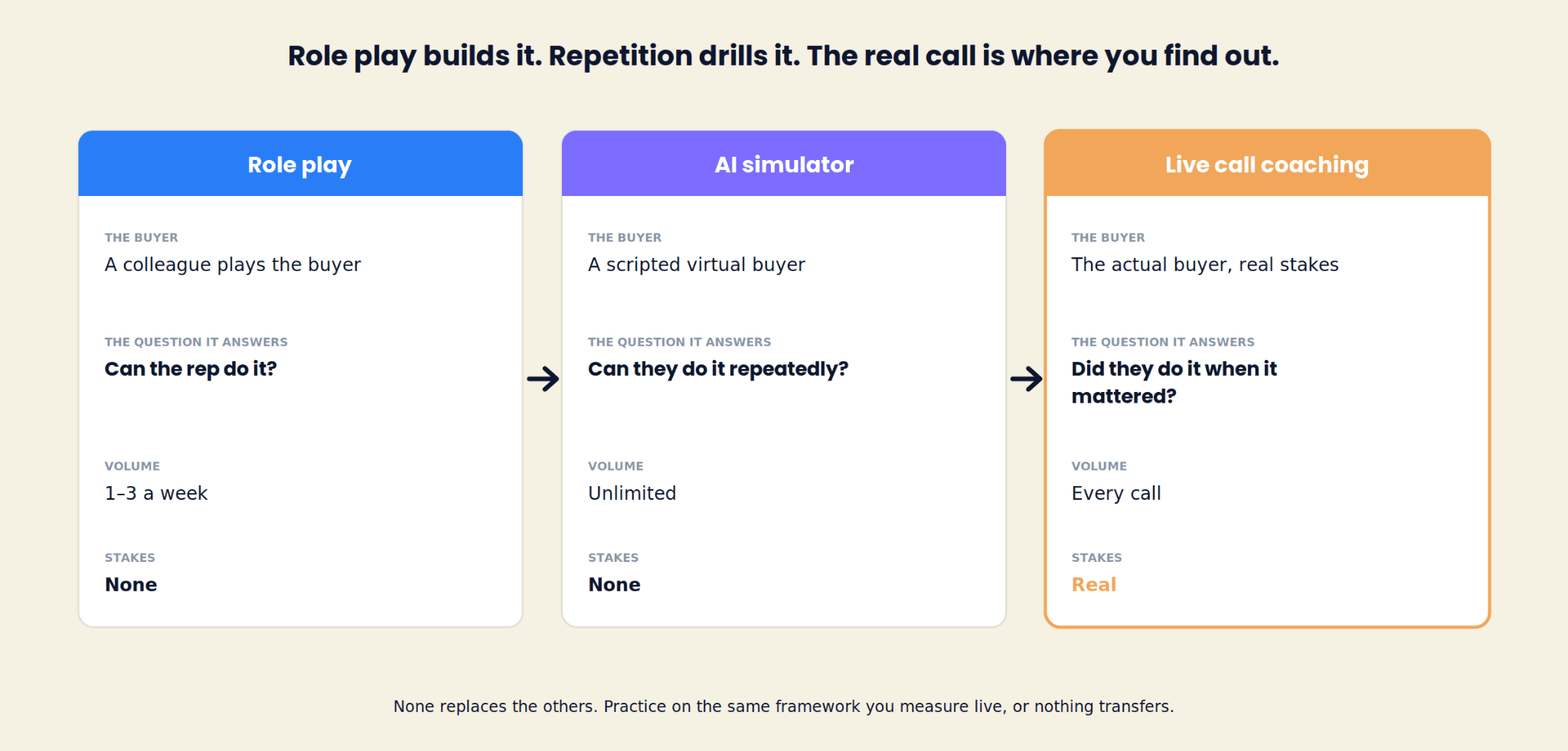
Table of contents
- What is sales role play and why does it work?
- How do you run a sales role play in five steps?
- What are the 10 sales role play scenarios worth running?
- How do you score a role play so it carries to the real call?
- How should role play differ for SDRs, AEs, CSMs and managers?
- Traditional vs AI role play vs live call coaching: what is the difference?
- What are the limits of AI role-play simulators?
- How does ConnectLoop coach the real call instead of a simulated one?
- How do you know if practice transferred to real calls?
- How much role play can a small team actually run?
- Key takeaways
- Frequently asked questions
What is sales role play and why does it work?
Sales role play is structured practice: a manager or peer plays a buyer persona, the rep runs a defined part of a sales conversation, and the group debriefs against a scorecard. It works because it builds muscle memory for moments that happen too fast on a real call to think through, and because feedback arrives minutes after the mistake rather than weeks.
Whether a team calls it role play, roleplay or role play exercises, three things make it useful rather than theatre. The buyer persona has a real objection and a real reason for it. The rep has a win condition, one thing they must achieve. And the debrief scores behaviour against a framework, not against how it felt.
The reason to invest in it is ramp time, the part of sales training that decides time-to-productivity for a new hire. A new SDR or account executive who has rehearsed the "too expensive" objection ten times handles it on call one instead of call thirty. That is the whole argument, and it is a good one as far as it goes.
Where it stops is the real call. A rehearsal builds instincts; it cannot tell a rep, mid-conversation, that they skipped the budget question. That is a separate job, covered in the live coaching section below.
How do you run a sales role play in five steps?
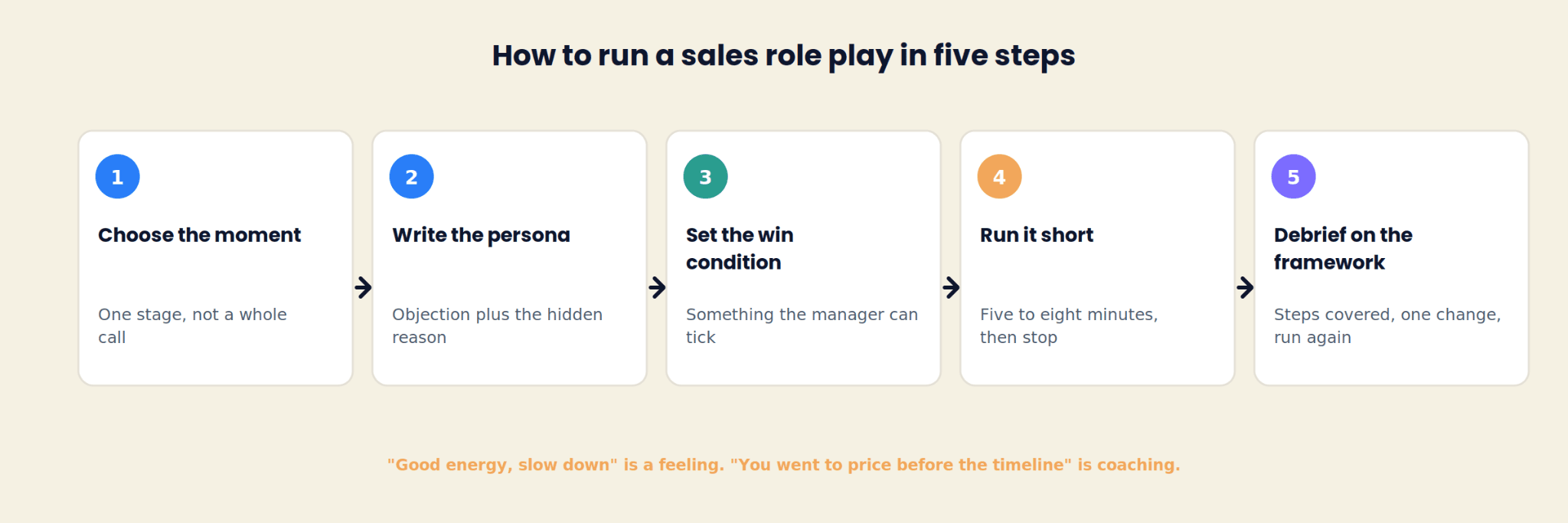
Pick one moment, not a whole call. Write the buyer persona with a stated objection and a hidden reason. Give the rep a win condition. Run it for five to eight minutes. Debrief against the same framework the rep will use on real calls, and record one thing to change next time.
- Choose the moment. One stage of the sales process: discovery, demo, objection, negotiation. A full-call role play teaches nothing because nothing is repeated. Role-play scripts work the same way: one moment, one page.
- Write the persona. Role, company size, what they said on the last call, the objection they will raise, and the reason behind it that the rep has to uncover. "Procurement lead, 40-person firm, says the price is high, actually worried about a two-year lock-in."
- Set the win condition. Not "handle the objection" but "get the buyer to name the real concern and agree a next step." A win condition the manager can tick yes or no.
- Run it short. Five to eight minutes. Stop the moment the win condition is met or clearly missed. Long role plays drift into improvisation.
- Debrief on the framework. Which steps were covered, which were skipped, what the buyer response was, what the next step is. One behaviour to change, written down. Then run it again.
The debrief is where most teams lose the value. "Good energy, maybe slow down" is a feeling. "You went to price before you confirmed the timeline; next time ask the Need-payoff question first" is coaching. The scorecard section below gives the format.
What are the 10 sales role play scenarios worth running?
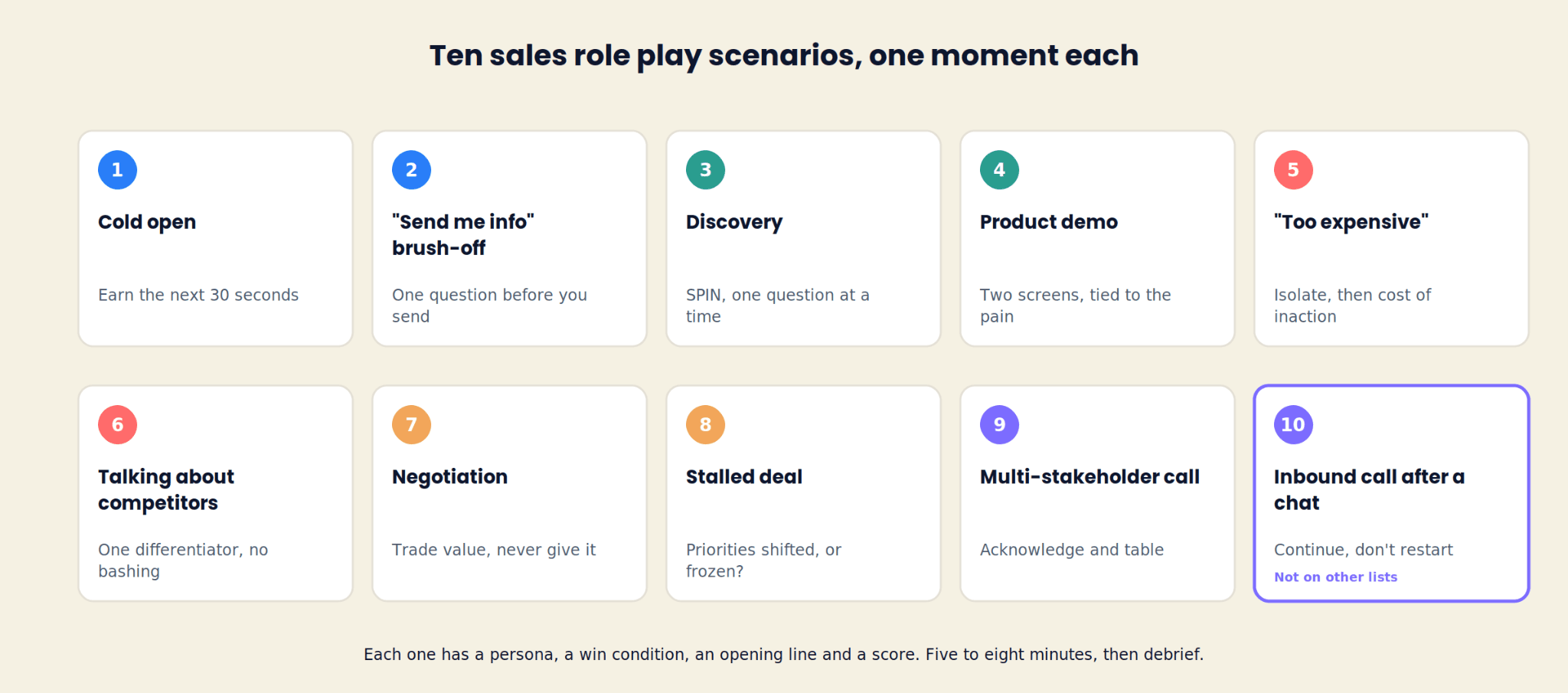
The ten below cover the moments that decide most deals: the first thirty seconds of cold outreach, discovery, the demo, the common objections, negotiation, a stalled deal, a multi-stakeholder call, and the inbound conversation that most lists leave out. Elevator pitch, customer success stories and letting a client go are worth adding once these ten are solid. Each has a persona, a win condition and a script line to open with.
1. The cold open
- Persona: Head of Operations, mid-call between meetings, expects a pitch.
- Win condition: earn the next thirty seconds without asking permission.
- Script: "I'll be quick. Three firms your size told us the same thing about after-hours enquiries last month. Is that a problem for you, or not really?"
- Score: pattern interrupt used, question asked within two sentences, tonality steady. Persona notes: a skeptical prospect who has heard the pitch before.
2. The "send me information" brush-off
- Persona: polite, wants the call to end, will not read what you send.
- Win condition: one clarifying question answered before anything is sent.
- Script: "Happy to. So I send the right thing, is it the pricing you want to see, or how the setup works?"
- Score: did the rep ask before agreeing; did they secure a reason to follow up. If they did not, the follow-up after no response is the next drill.
3. Discovery, one question at a time
- Persona: Head of Sales, ten reps, losing leads that come in after 6pm.
- Win condition: a Situation, Problem and Implication answer, each confirmed by the buyer, before any product is mentioned.
- Script (discovery questions): "How do enquiries reach the team today?" then "What happens to the ones that arrive after everyone has gone home?" then "What does that cost you in a month?"
- Score: questions in order, no pitch before the third answer. The SPIN question set is the reference.
4. The product demo that follows discovery
- Persona: the same Head of Sales, now on a demo, wants to see everything.
- Win condition: show only the two screens that answer the problem from discovery.
- Script: "You said the after-6pm enquiries are the problem. This is what one looks like from the buyer's side, and this is the record your rep sees the next morning."
- Score: Tell-Show-Tell used; every feature shown tied to a stated pain; no feature tour.
5. The "too expensive" objection
- Persona: likes the product, has a number in mind, uses price to test. Objection handling here means handling objections in order: isolate, then answer.
- Win condition: isolate the objection, then reframe against the cost of inaction.
- Script: "Aside from price, is there anything else that would stop you going ahead?" then "You said twelve lost enquiries a month. What is one of those worth?"
- Score: objection isolated before answered; cost of inaction stated in the buyer's own numbers; the rep stayed firm on price without going quiet.
6. Talking about competitors
- Persona: has a quote from another vendor open in a tab. Competitor questions come fast and the rep's first instinct is to defend.
- Win condition: one differentiator stated, no competitor criticised.
- Script: "They're a good option for some teams. The difference that matters for you is where the conversation ends: with us it ends in a booked call on your calendar. Want to see that?"
- Score: no negative comment about the other product; pivot to a differentiator tied to the buyer's problem.
7. Negotiation and trading value
- Persona: procurement, needs 15% off to sign this quarter.
- Win condition: any concession traded for something of equal value.
- Script: "I can look at the number if we can look at the term. Twelve months at that price, or the annual plan paid up front?"
- Score: no unilateral discount; the negotiation closed with a next step and a date.
8. The stalled deal
- Persona: was keen a month ago, has stopped replying. Stalled deals and gone-dark leads are the same scenario with different timing.
- Win condition: find out whether priorities shifted or the deal is frozen, and agree what happens next.
- Script: "Not chasing a decision. Has this dropped down the list, or has something changed on your side?"
- Score: de-escalation first; a real blocker uncovered; a mutual action plan or a clean close.
9. The multi-stakeholder call
- Persona: economic buyer, technical buyer and an end user on one call, with different priorities. Multi-threading a deal means each of them hears their own answer. An indecisive prospect in the room, or a decision-maker change since the last call, is the harder variant.
- Win condition: each stakeholder's concern acknowledged and one shared next step agreed.
- Script: "Three different questions there. Let me take security first for Sam, then the rollout for Priya, then come back to cost."
- Score: acknowledge and table used; nobody's question dropped; the decision-maker identified. A MEDDPICC checklist works well here.
10. The inbound conversation that becomes a call
- Persona: a buyer who spent ten minutes with the website AI sales agent last night, asked about pricing twice and booked a call through AI appointment booking.
- Win condition: continue the conversation rather than restart it.
- Script: "You asked Lia about the Growth plan and the WhatsApp setup last night. Want to start there, or has something changed since?"
- Score: did the rep read the transcript and the reason for reaching out before the call; did they skip questions already answered. Most scenario lists skip this one, and for an inbound team it is the most common call of the week; it is where inbound lead qualification either continues or restarts.
How do you score a role play so it carries to the real call?
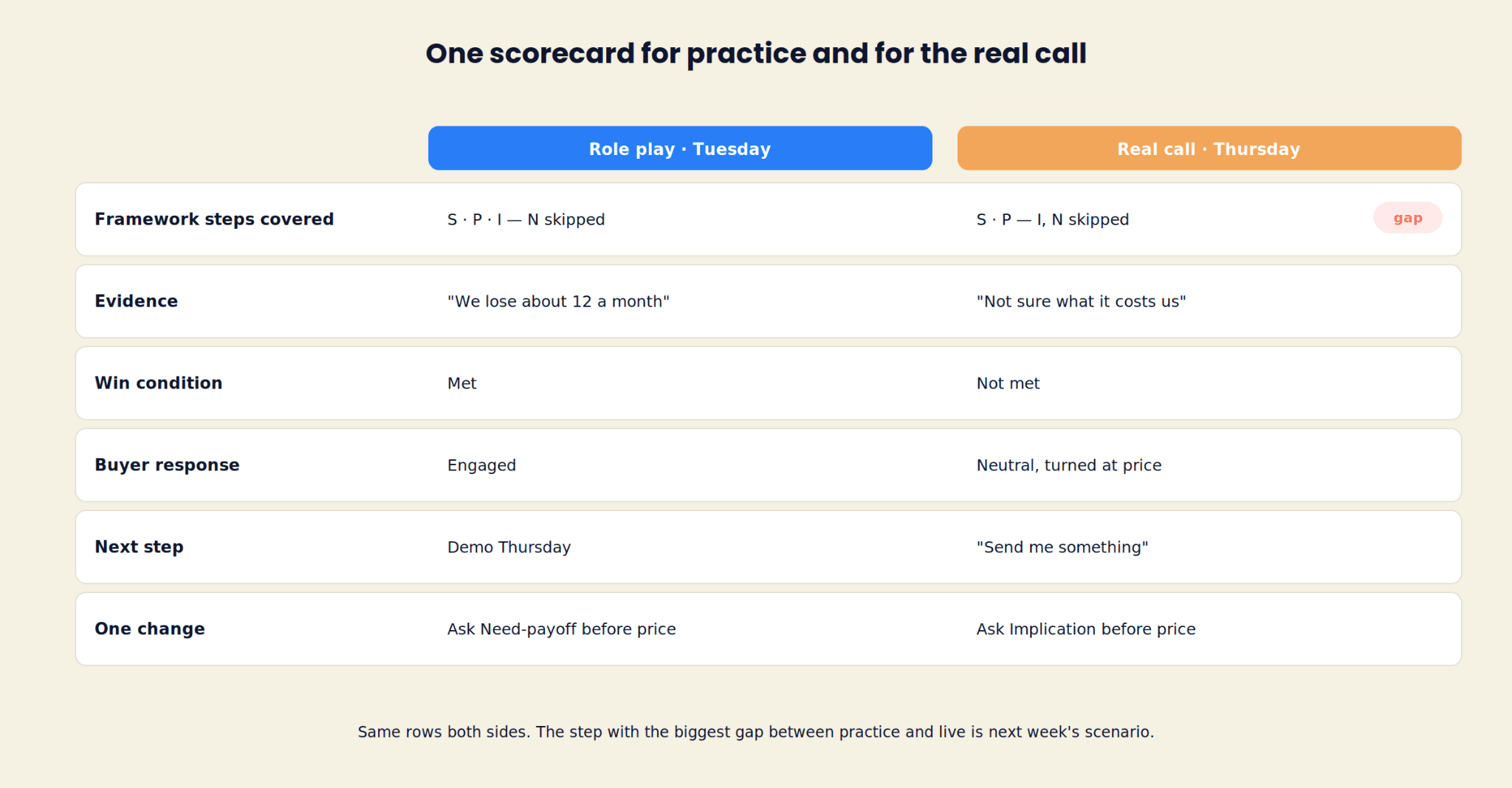
Score the practice against the same framework steps the rep will be measured on in real calls, and record evidence for each step rather than a feeling. If practice is scored on "confidence" and real calls on "did they ask the budget question", nothing transfers.
| Scorecard row | What the manager writes |
|---|---|
| Framework steps covered | Which SPIN, MEDDICC, BANT or custom steps were asked, in order |
| Evidence | The buyer's actual words that satisfy each step |
| Steps skipped | Which were missed, and whether the buyer declined or the rep forgot |
| Win condition | Met / not met |
| Buyer response | Engaged, neutral, resistant, and where it turned |
| Next step | Agreed, with a date, or not |
| One change | The single behaviour to practise next time |
This is the same shape as the coverage report ConnectLoop's Sales Assistance produces after a real call, which is the point. A rep who has seen the same seven rows in practice and in the coaching note after a live call knows exactly what is being measured. The same evidence feeds the lead score, so the buyer's answers count twice: once for the rep, once for the pipeline.
How should role play differ for SDRs, AEs, CSMs and managers?
SDRs and BDRs need short, repeated drills on the first sixty seconds. Account executives need multi-stage simulations where day three depends on what day one uncovered. Customer success managers need the mid-call pivot. Managers need to practise the debrief itself. Same method, different moment, and it holds whether the team has a sales enablement or revenue enablement function or the manager runs everything.
| Role | Scenarios to run | Format | Focus |
|---|---|---|---|
| SDR / BDR | Cold open, gatekeeper, brush-off, elevator pitch | Micro-drilling: 2–3 minutes, five repeats | Pacing, one question fast, no permission openers, pushback handled without arguing |
| Account executive | Discovery, demo, too expensive, negotiation, multi-stakeholder | Multi-stage: discovery Monday, demo Wednesday built on it | Framework coverage in order, trading value |
| Customer success manager | Renewal risk, cross-sell, upsell, account expansion, customer success stories told with the STAR method | Mid-call pivot: a curveball halfway through a routine check-in | Empathy first, mutual action plan |
| Sales manager | The debrief, the tough review | Coach the coach: a peer plays the defensive rep | Evidence-based feedback, one change |
The SDR vs BDR split matters here: an SDR working inbound leads should spend most of their drill time on scenario 10, not the cold open, and an AI SDR handling the first reply changes what the human SDR practises at all.
Traditional vs AI role play vs live call coaching: what is the difference?
Traditional role play needs a manager's time and gives human judgement. AI role play gives unlimited practice against a simulated buyer with consistent scoring. Live call coaching gives the rep cues during the real conversation and a coverage report afterwards. They answer different questions: can the rep do it, can they do it repeatedly, and did they do it when it counted.
| Traditional role play | AI role-play simulator | Live call coaching | |
|---|---|---|---|
| The buyer | A colleague in a practice conversation | A virtual buyer simulation, a simulated conversation with a scripted persona | The actual buyer |
| When | Scheduled, needs a manager | Any time, alone | During and after the real call |
| Feedback | Subjective, immediate | Consistent, immediate, on a scripted persona | Cues in the moment, coverage with evidence after |
| Stakes | None | None | Real |
| What it measures | Can the rep do it | Can the rep do it repeatedly | Did the rep do it when it mattered |
| Volume | 1–3 a week per rep, in practice | Unlimited | Every call |
| Cost | Manager hours | Per-seat licence for AI role-play tools | Per-seat licence |
None of the three replaces the others. Role play builds the behaviour; the simulator gives it repetitions; live coaching is where you find out whether it survived contact with a real objection.
What are the limits of AI role-play simulators?
A simulated buyer has no real stakes, so reps behave differently than they do with money on the line. Personas drift over a long session. Reps learn what the bot rewards and play to it. Scores measure performance against the script, not against a buyer who did not read it. Useful for repetitions; not proof of readiness.
This is not a reason to avoid simulators; the AI sales training tools comparison covers where they fit. It is a reason to treat their scores as practice scores. The question a sales manager needs answered is whether the rep asked the budget question on Tuesday's real call with the procurement lead, and no simulator can answer it.
How does ConnectLoop coach the real call instead of a simulated one?
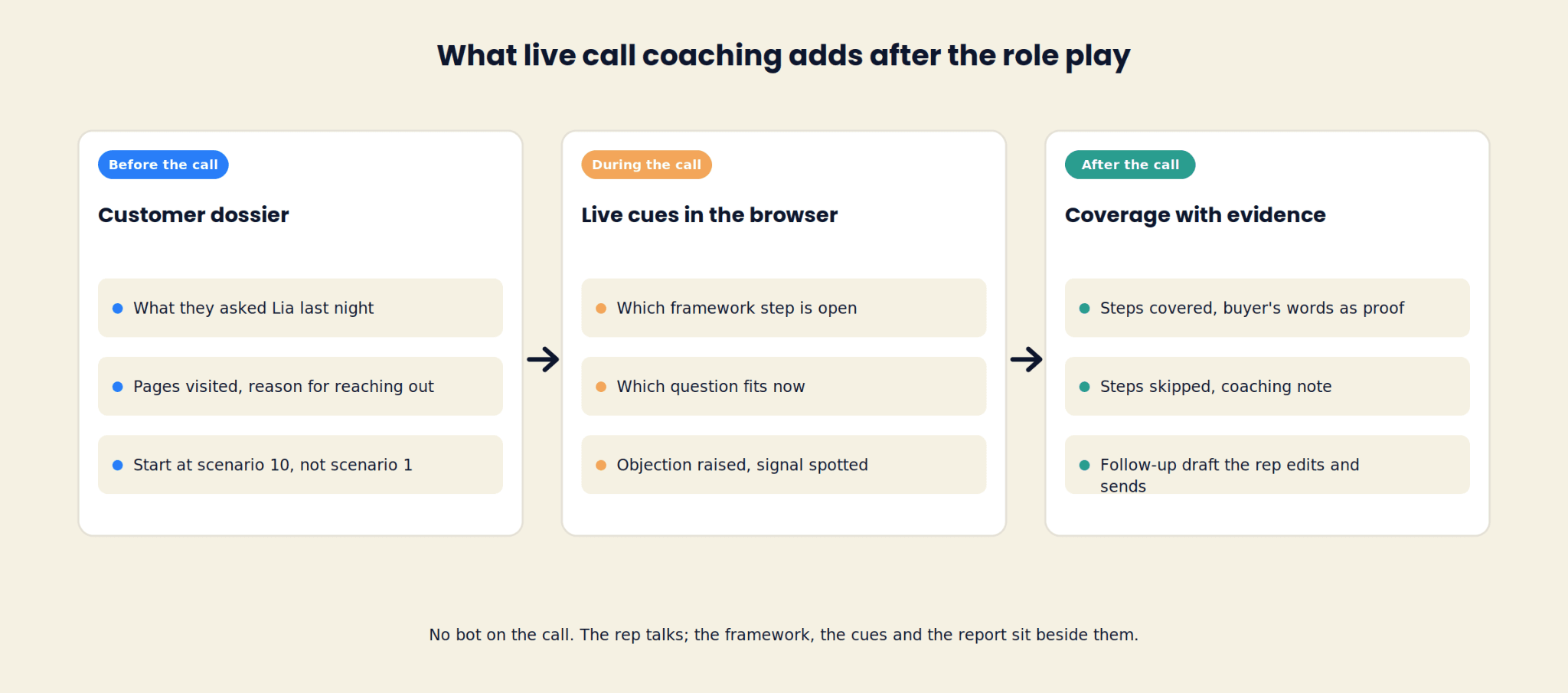
ConnectLoop's Sales Assistance listens to the rep's live call through the browser, tracks which steps of the chosen sales framework have been covered, and shows the rep cues in real time: a question to ask next, an objection to address, a buying signal to act on. After the call it produces a coverage report with evidence, a coaching note and a follow-up draft. There is no bot on the call.
ConnectLoop does not offer a role-play simulator; the coaching happens on real conversations. This is what that looks like in practice:
- Before the call: the customer dossier shows what the buyer asked Lia on the website or WhatsApp, the pages they visited before they identified themselves, and the reason they reached out, so the rep starts from scenario 10, not scenario 1.
- During the call: the rep chooses a view (Cockpit, Focus or Overlay) and a framework: SPIN, MEDDICC, BANT, Challenger, the ConnectLoop YES Framework™ with its 24 steps across Discover, Define, Connect, Validate and Commit, or a custom framework of up to twelve steps. Seven types of cue appear as the conversation moves: which step is open, which question fits now, which objection was just raised, and where a signal appeared.
- After the call: framework coverage with the buyer's words as evidence for each step, the steps skipped, a coaching note, action items, and a follow-up email draft the rep edits and sends.
- For the manager: the dashboard shows calls assisted, cues accepted, average framework coverage and open action items across the team. Those are the performance metrics the next section uses for transfer.
The Progress, Script, Context and Transcript tabs are the rep's own view. The manager's view is the pattern across a week of calls, which is where the next role play topic comes from. For what this is and is not, see what AI sales coaching actually does.
How do you know if practice transferred to real calls?
Compare the same framework steps across practice and real calls. If a rep covers the Implication question in nine of ten role plays and in two of ten live discovery calls, practice has not transferred and the coaching topic is obvious. Without the same scorecard on both sides, transfer is a guess.
The method has three parts:
- Same framework, both sides. Score role plays on the steps of the framework the team uses live. Not a practice rubric and a separate call rubric.
- Coverage per step, per rep, per week. From live calls: which steps were covered, with evidence, and which were skipped. From role plays: the same rows from the manager's scorecard.
- Practise the gap. The step with the biggest difference between practice and live becomes next week's scenario. The benefits of sales coaching show up here, in a number that moves.
Conversation Intelligence adds the buyer's side: sentiment across the call, the friction points, and whether the handover threshold was crossed. Put next to the inbound sales metrics the team already tracks, coverage per step becomes a leading indicator rather than a training score. A rep whose framework coverage is high but whose calls turn tense at the price step has a different problem from one who skips the step.
How much role play can a small team actually run?
A manager with eight reps can run about two role plays per rep per week if each takes ten minutes with debrief. A founder doing their own selling can run one a week with a co-founder. That is enough if each session targets one behaviour and the real calls are being measured in between.
| Team | Realistic volume | Who plays the buyer | Where live coaching fits |
|---|---|---|---|
| Founder-led, 1–2 sellers | 1 per week, 10 minutes | Co-founder or an advisor | Every real call, since there is no manager to listen in; speed to lead matters more than polish at this stage |
| 3–8 reps, one manager | 2 per rep per week | Manager or a paired rep | Picks the weekly scenario from the coverage gaps |
| 10+ reps, enablement team | Daily micro-drills for SDRs, weekly for AEs | Enablement, peers, simulator for repetitions | Transfer measurement across the team |
The small-team version most guides skip: if there is nobody to run the role play, put the sales plays from the sales playbook into the framework, coach the real calls, and use the coaching notes as the curriculum. The practice sessions come later, when there is someone to run them.
Key takeaways
- Sales role play is one moment of a call, run short, scored against a framework and repeated; a full mock call is a different exercise, and virtual or remote selling changes the medium, not the method.
- Ten scenarios cover most deals: cold open, brush-off, discovery, demo, too expensive, competitors, negotiation, stalled deal, multi-stakeholder, and the inbound call that continues a chat.
- Score practice on the same framework steps as real calls, with evidence, or nothing transfers.
- AI simulators give unlimited repetitions; their scores measure performance against a script, not readiness.
- Live call coaching is where you find out whether the practised behaviour showed up with a real buyer.
- ConnectLoop's Sales Assistance gives cues during the real call and a coverage report with evidence after it; there is no simulator mode.
- Transfer is measured by comparing coverage per step in practice and in live calls, then practising the gap.
- A founder-led team with nobody to run role plays can coach real calls first and build the practice curriculum from the coaching notes.

About the author
ConnectLoop Staff
Written by the ConnectLoop team. ConnectLoop is an AI sales agent for inbound revenue teams, based in Cambridge, Massachusetts.
About ConnectLoop →Frequently asked questions
A mock call is a full simulated call from open to close. A role play is one moment of a call, run short and repeated. Mock calls are useful for onboarding a new rep once; role plays are the weekly practice that changes behaviour.
Two short role plays a week per rep, each on one behaviour, beats one long session a month. SDRs benefit from daily two-minute drills on the cold open. The number matters less than whether the same behaviour is measured on real calls in between.
On what was said, yes: whether a question was asked, whether an objection was answered, whether the framework step was covered. On whether the buyer believed it, less so, because the buyer was a simulation. Treat simulator scores as practice scores and check them against real calls.
Sometimes. The only way to know is to score real calls on the same framework steps as the practice. ConnectLoop's Sales Assistance produces that coverage report for every live call, so the comparison is a number rather than an impression.
Practise the questions, not the lines. A discovery script written as five questions in a sensible order sounds natural because the rep has to listen to the answer before the next one. A script written as a paragraph gets recited.
Yes, for the debrief. Watching the moment where the buyer's response turned is more useful than remembering it. Keep recordings for the rep and the manager; they are practice, not performance reviews.
The one the team uses on live calls. SPIN for discovery-heavy sales, MEDDICC or MEDDPICC for complex multi-stakeholder deals, BANT for fast inbound qualification, Challenger or gap selling for teams that lead with insight. The persona should match the ICP, the ideal customer profile the team actually sells to. Practising on a framework the rep will not use live is wasted repetition; the same goes for coaching models such as GROW if the manager does not use them in the debrief. The BANT vs MEDDIC comparison helps choose.
No. ConnectLoop coaches real calls through Sales Assistance and handles inbound conversations through Lia. Teams that want simulated practice pair a simulator with it and use the live coverage report to check whether the practice transferred.
Which framework steps were covered with the buyer's words as evidence, which were skipped, whether the win condition was met, the next step agreed, and one behaviour to change. Seven rows, five minutes, written down.
ConnectLoop's Sales Assistance gives cues during the real call and a coverage report after it
There is no simulator mode; the coaching happens on real conversations. That coverage report is produced for every live call, so whether the practice transferred is a number rather than an impression.