
Sales Qualification
SPIN Selling Questions: 40+ Examples That Work on a Call and in a Chat
SPIN selling questions are the four types of question that lead a buyer to state their own need: Situation, Problem, Implication and Need-Payoff. Asked in that order in a sales conversation, they turn "we've been thinking about this" into "we need it fixed by March." ConnectLoop's agent, Lia, asks them one at a time inside a website, WhatsApp or email conversation, and your reps ask them on the call.

Published
Table of contents
- What are SPIN selling questions?
- Where does SPIN come from, and is it still effective?
- What is the difference between an implied need and an explicit need?
- What are Situation questions, with examples?
- What are Problem questions, with examples?
- What are Implication questions, with examples?
- What are Need-Payoff questions, with examples?
- How do SPIN questions work in a chat instead of a call?
- What happens when the buyer skips a question?
- Where do the answers go?
- How do you write your own SPIN questions?
- What are the most common SPIN mistakes?
- How does SPIN compare with MEDDIC and Challenger?
- Key takeaways
- Frequently asked questions
What are SPIN selling questions?
SPIN selling questions are a questioning technique for discovery: Situation questions collect facts, Problem questions probe for pain points, Implication questions explore consequences and the cost of not addressing them, and Need-Payoff questions get the buyer to articulate value in their own words. The sequence matters more than any single question.
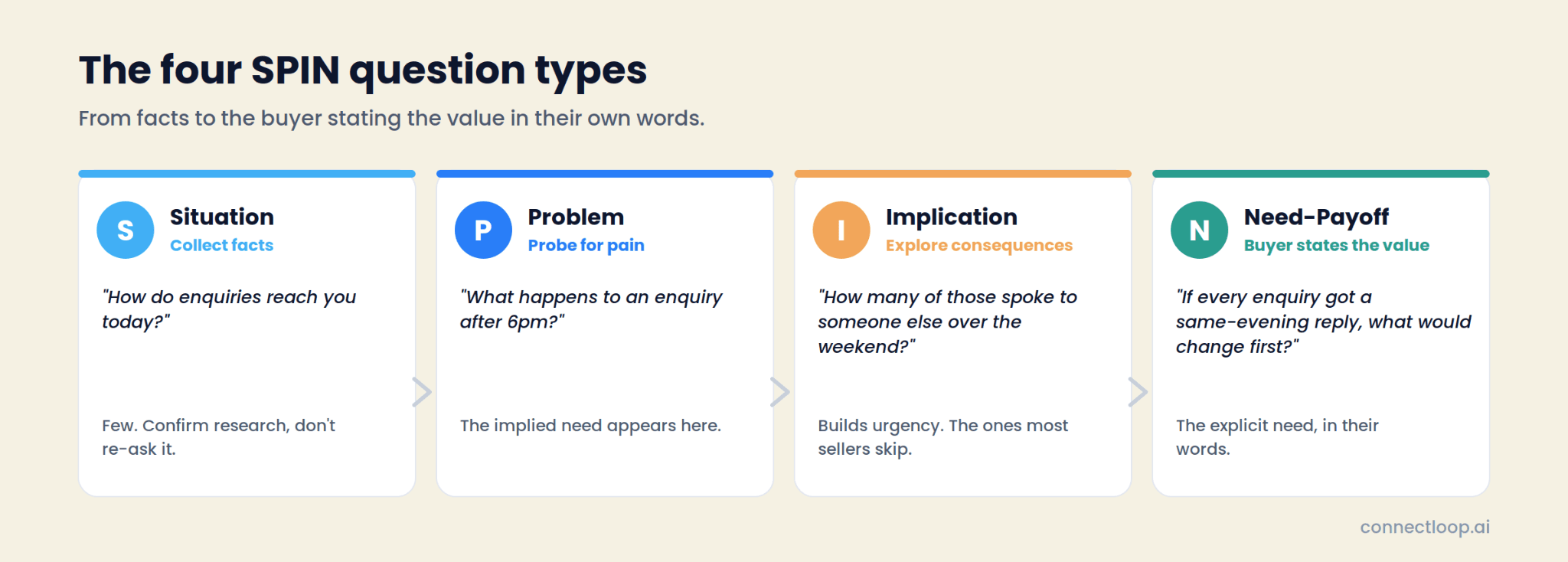
The point of the framework is that buyers act on needs they have stated themselves, not on needs a seller has described to them. That is why value-based selling depends on it: the buyer names the value before the price comes up. Situation and Problem questions uncover an implied need. Implication questions make it urgent. Need-Payoff questions convert it into an explicit need the buyer owns. A rep who asks the four types in order can guide the conversation without pitching, which is what earns the trusted advisor position: consultative rather than pushy.
SPIN is a conversation framework, which makes it different from a qualification framework like BANT or MEDDIC. ConnectLoop's BANT vs MEDDIC comparison covers the qualification side; this article is about the questions themselves.
Where does SPIN come from, and is it still effective?
SPIN comes from research led by Neil Rackham and published in the 1988 book SPIN Selling, based on analysis of more than 35,000 sales calls across more than 20 countries by Huthwaite. Rackham also described a sales call in four stages, Opening, Investigating, Demonstrating Capability and Obtaining Commitment, with SPIN questions living in the Investigating stage. The finding that still holds: in complex sales, sellers who asked more Implication and Need-Payoff questions won more, and sellers who asked more Situation questions won less. Limit Situation questions is the shortest summary of the whole book.
Nearly forty years later, the method is still used because the underlying behaviour hasn't changed. Buyers who are led to state a need act on it. Buyers who are told about a need resist it. What has changed is where the first conversation happens: for most inbound teams it is now a chat window, and the questions need to work there too.
SPIN suits complex B2B sales with multiple stakeholders and a real decision to make. For a transactional purchase with a two-day deal cycle, asking Implication questions is overkill; answer the question and take the order.
What is the difference between an implied need and an explicit need?
An implied need is a problem or dissatisfaction the buyer mentions without asking for a solution: "we lose enrolments over the weekend." An explicit need is a stated want for something that fixes it: "we need someone answering enquiries at 9pm." SPIN's job is to move the buyer from the first to the second, because explicit needs are what people buy against.
| Implied need | Explicit need | |
|---|---|---|
| What the buyer says | "Nobody replies until Monday." | "We need enquiries answered the same evening." |
| Which questions surface it | Situation and Problem | Implication and Need-Payoff |
| What the seller should do | Keep asking; don't pitch yet | Connect the solution to the stated want |
| How it lands on a scorecard | Problem step completed, need Inferred | Need-Payoff step completed, need Confirmed |
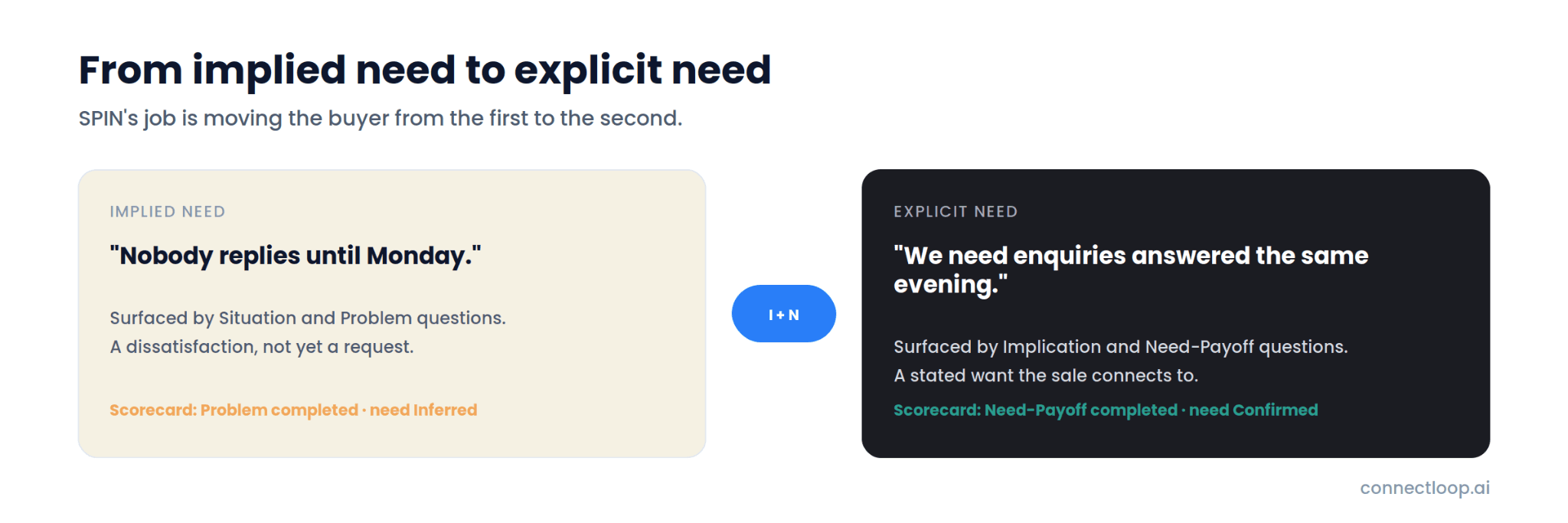
The trap is pitching at the implied stage. The buyer said Monday is too late; the seller starts describing a product; the buyer hadn't decided it was a problem worth solving yet. Two more questions would have let them decide.
What are Situation questions, with examples?
Situation questions collect facts about the buyer's current setup: how they handle something today, who is involved, what tools they use, how often it happens. They are necessary and should be few. Rackham's research found the more Situation questions a seller asked, the less likely the call was to succeed, because they cost the buyer patience and give them nothing back.
Three to five per conversation is plenty. Use them to build rapport and set the agenda, and confirm research rather than re-asking it: anything you can learn beforehand should be checked in a sentence, not asked in a question. "I saw you run cohorts in January and September, is that still the pattern?" is a Situation question that took ten seconds.
Examples, written for inbound buyers:
- How do enquiries reach you today: website form, phone, email, WhatsApp?
- Who picks them up, and what happens when that person is off?
- Roughly how many come in over a typical week?
- What hours does your team cover?
- Which tools sit between an enquiry and a booked meeting right now?
- How do you keep track of who's been followed up and who hasn't?
- When someone asks about pricing, who answers and how quickly?
- Is this for one location or several?
- How long has the current setup been in place?
- What made you look into this now?
The last one is a Situation question that often turns straight into a Problem answer. Let it.
What are Problem questions, with examples?
Problem questions probe for pain: difficulties, delays, dissatisfaction with the current way of working. They are where the implied need appears. Ask them about the specific areas your product improves, because a problem you can't solve is a problem you shouldn't dig into.
The best Problem questions are specific, not generic, and every one should have a purpose: to surface a pain your product improves. "What keeps you up at night?" invites a shrug. "What happens to an enquiry that arrives after 6pm?" invites an answer.
Examples:
- What happens to an enquiry that arrives after your team has gone home?
- How often does someone ask a question nobody on the team can answer straight away?
- Where do leads tend to go quiet: after the first reply, after the quote, after the call?
- How much of your team's day goes to answering the same questions?
- When two people reply to the same enquiry, how do you find out?
- Do you ever learn a prospect chose someone else, and if so, when?
- How hard is it to know which of this week's enquiries are worth calling first?
- What's the slowest part of getting from "I'm interested" to a booked meeting?
- Which questions do prospects ask that your website doesn't answer?
- When someone comes back to the site a second or third time, does anyone know?
Two or three Problem questions are usually enough to find the pain that matters. When the buyer volunteers one, follow that thread instead of the list.
What are Implication questions, with examples?
Implication questions explore the consequences of the problem: what it costs, who else it affects, what happens if it continues. They build urgency by making the buyer say out loud what the problem is doing to them. Rackham found these were the questions that separated top performers, and they are the ones most sellers skip.
An Implication question takes a problem the buyer has named and asks what follows from it. "Enquiries wait until Monday" becomes "how many of those do you think spoke to someone else over the weekend?"
Examples:
- If an enquiry waits until Monday, what do you think happens on the buyer's side in between?
- How many of last month's enquiries never got a reply at all, as far as you know?
- What does a lost enrolment or a lost client cost you, roughly?
- If your best rep is spending an hour a day on the same ten questions, what isn't getting done?
- When a lead goes cold after the quote, does anyone find out why?
- How does the after-hours gap affect the people who do reply in the morning?
- If a prospect asks about a competitor and gets no answer, where do they go next?
- What happens to your forecast when nobody knows which leads are warm?
- How much longer does a deal take when the rep has to re-ask what the buyer already said?
- If this stays as it is for another quarter, what changes and what doesn't?
Two to three per problem. More than that and it feels like an interrogation; the buyer should feel understood, not cornered.
What are Need-Payoff questions, with examples?
Need-Payoff questions ask the buyer to describe the value of solving the problem: what would change, what it would be worth, who would benefit. Done well they are the opposite of a pitch, because the buyer describes the solved state and the seller listens. The answer is the explicit need, in the buyer's words, that the rest of the sale connects to.
Need-Payoff questions are not leading questions when they ask about the buyer's outcome rather than your feature. "Would 24/7 AI coverage help?" is a pitch with a question mark. "If every enquiry got a useful reply within a minute, what would that change for you?" is a Need-Payoff question.
Examples:
- If every enquiry got an answer the same evening, what would change first?
- What would it mean for your team if the repeat questions handled themselves?
- If you knew which of this week's leads were warm before you picked up the phone, how would you use that?
- How would it help if the rep opened every call already knowing what the buyer had asked?
- What would you do with the hours that go to first replies today?
- If a lost lead came back to the site and you were told, what would you send them?
- Who else on the team would notice if this were fixed?
- What would a good month look like once this is handled?
- If we could show you which questions your prospects ask that your site doesn't answer, what would you do with that list?
- Is that worth solving this quarter, or is it a next-year problem?
The last question is the bridge from discovery to commitment. It asks the buyer to decide, which is the whole point.
How do SPIN questions work in a chat instead of a call?
On a call you have forty minutes, control of the agenda and a buyer who agreed to be there. In a chat you have one question at a time, a buyer who arrived with their own question, and the option for them to close the tab. The four types still apply; the order of operations changes. Answer first, then ask one question in the flow.
Here is a worked scenario of how ConnectLoop's Lia runs SPIN on website chat, WhatsApp and email. The visitor asks what something costs. Lia answers from approved content. Then, in the same reply, one question: what prompted the visit. The visitor answers. Another question, later, about what else they're evaluating. Discovery never blocks help, and it never feels like a form.
| Stage | On the call (rep) | In the chat (Lia) |
|---|---|---|
| Situation | "How do enquiries reach you today?" | "Is this for your own site, or for a team you run?" |
| Problem | "What happens to an enquiry after 6pm?" | "What made you look into this now?" |
| Implication | "How many of those spoke to someone else over the weekend?" | "Is the after-hours gap costing you enquiries, or is it more about the workload?" |
| Need-Payoff | "If every enquiry got a same-evening reply, what would change first?" | "If that were handled, would you want to see how the booking side works?" |
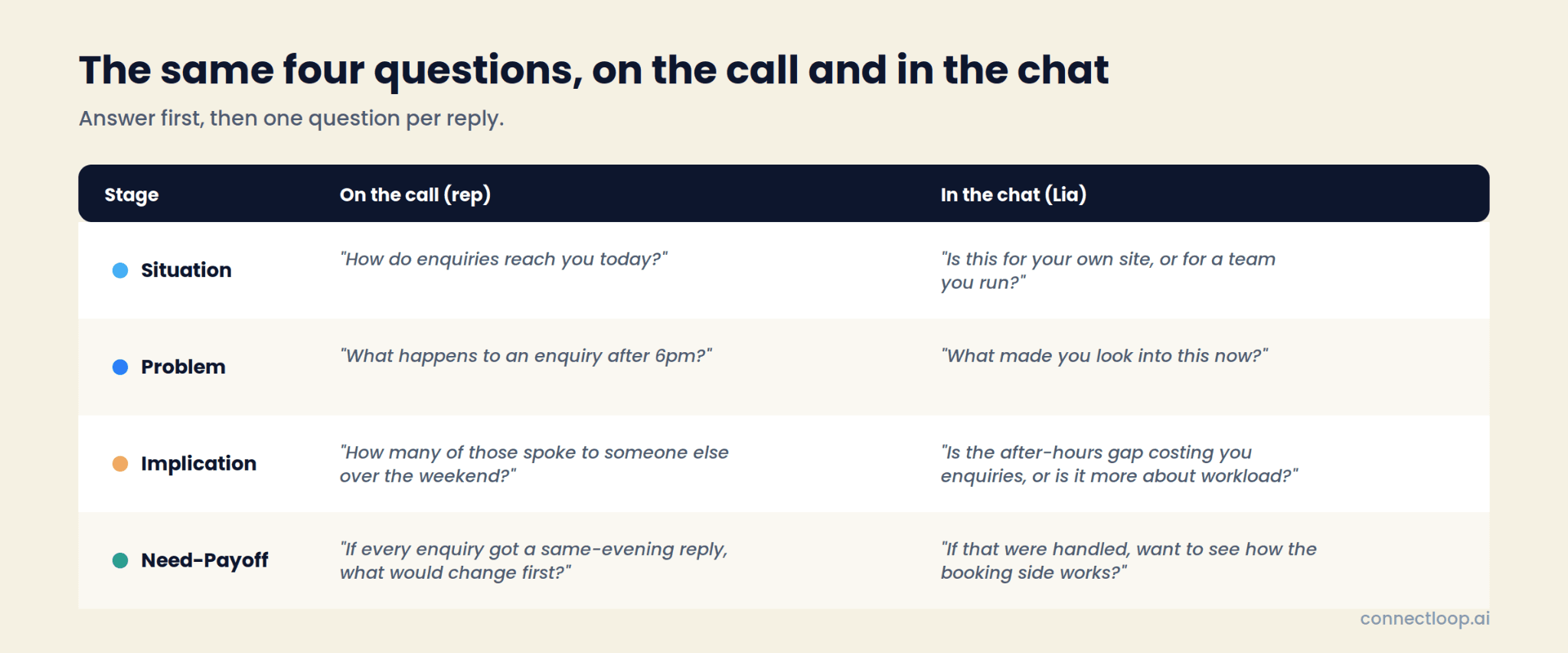
The chat versions are shorter, one per reply, and the Need-Payoff question offers the next step rather than asking for a monologue. That is the inbound lead qualification pattern: the same framework, sized for the channel.
What happens when the buyer skips a question?
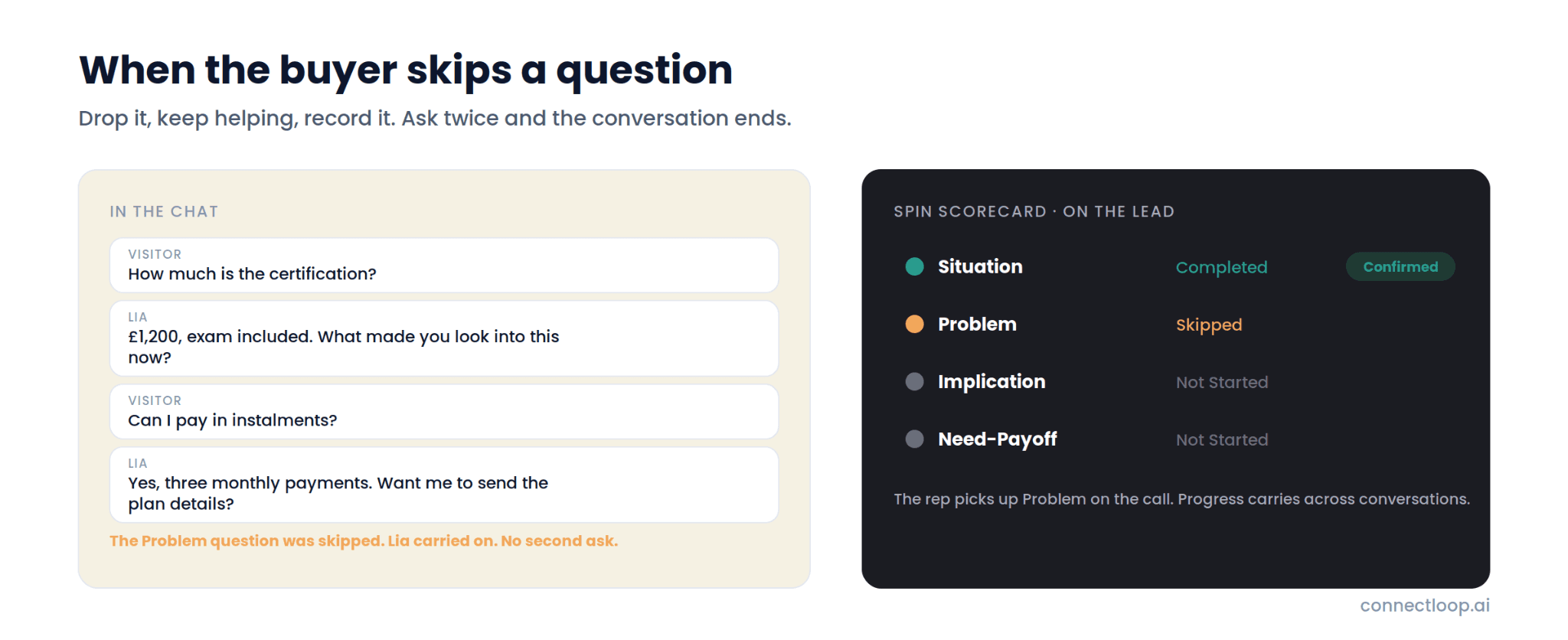
On a call the rep reads the silence and moves on. In a chat the rule has to be explicit: if the visitor ignores or declines a question, drop it, carry on being helpful, and record the step as skipped. Asking twice turns discovery into interrogation, and in writing that ends the conversation.
ConnectLoop builds this in. When Sales Methodology is on, Lia weaves one SPIN question at a time into the flow. If the visitor skips it, Lia stops asking and continues as a normal assistant. The scorecard marks that step Skipped, so the rep knows to pick it up on the call if it matters. A skipped question is information: the buyer has told you they aren't ready to share that yet.
The same rule holds for reps. Sales Frameworks let a rep mark a step Skip during a live call when it doesn't apply, and undo it if the buyer circles back. What earlier calls with the same customer already covered is carried in, so nothing is re-asked. The sales playbook guide explains how to write those steps.
Where do the answers go?
The answers to SPIN questions should land on the lead record as evidence, not in a notes field nobody reads. In ConnectLoop they land on a methodology scorecard: each SPIN step marked Not Started, In Progress, Completed, Skipped or Not Applicable, and each captured answer marked Inferred (Lia deduced it from what was said) or Confirmed (the visitor stated it directly).
Progress accumulates across every conversation with that lead, so a Problem step completed on WhatsApp on Tuesday stays completed when the rep calls on Thursday. The team can edit any step by hand, and manual edits are permanent.
The distinction between Inferred and Confirmed is the honest part. "Nobody replies until Monday" confirms a Problem. "They probably lose enquiries over the weekend" is an Inference until the buyer says so. A rep reading the scorecard knows which is which before the call, and the lead scoring that follows weights confirmed statements higher.
On the call itself, the framework runs live. Sales Assistance surfaces each SPIN step as a cue card with the suggested wording you wrote, marks it covered as the conversation moves, and scores framework coverage afterwards with the buyer's quote as evidence for each step. The stages of the sales process guide shows where that call sits in the wider process.
How do you write your own SPIN questions?
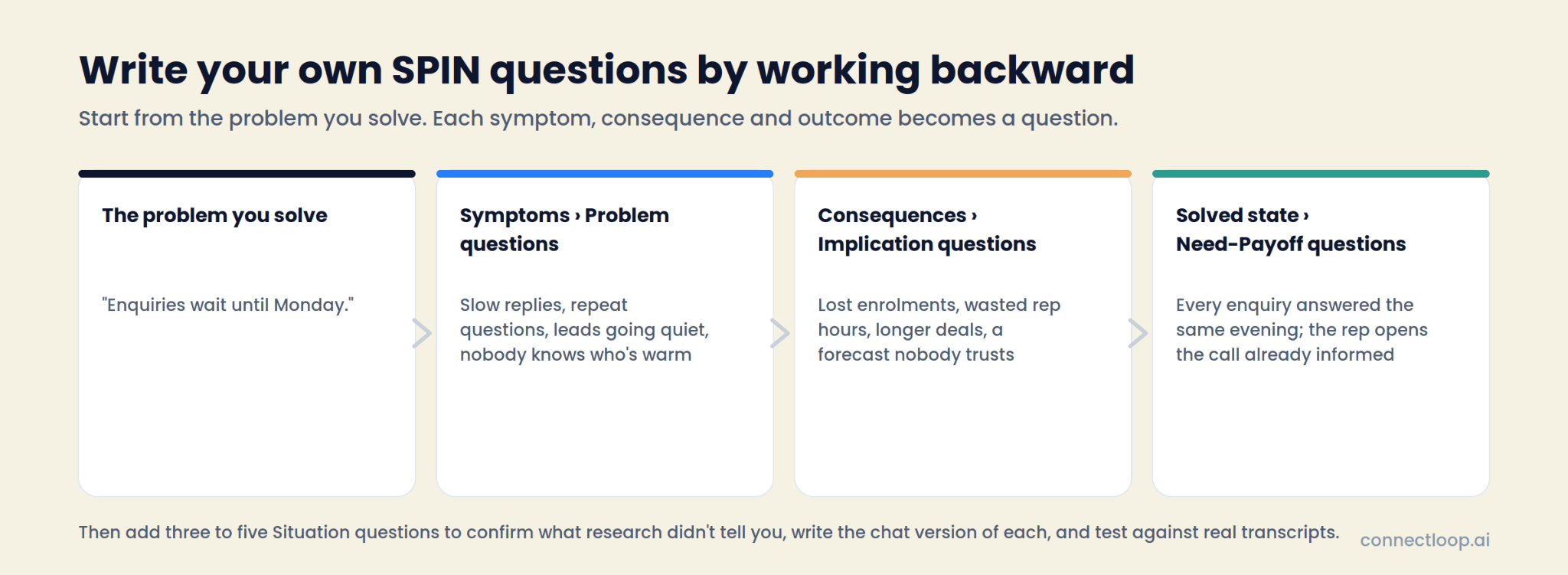
Write your question bank by working backward from the problem your product solves, turning each symptom of that problem into a Problem question, each consequence into an Implication question, and each outcome into a Need-Payoff question, then keeping only enough Situation questions to confirm what research didn't tell you. Test them on real conversations and cut the ones that get one-word answers or wander off the purpose behind every question.
- Name the problem you solve, in the buyer's words. Not "inefficient lead response" but "enquiries wait until Monday."
- List the symptoms the buyer notices. Slow replies, repeat questions, leads going quiet, nobody knowing who's warm. Each becomes a Problem question.
- List the consequences. Lost enrolments, wasted rep hours, deals that take longer, a forecast nobody trusts. Each becomes an Implication question. Two or three per problem.
- Describe the solved state, not the product. "Every enquiry answered the same evening," not "24/7 AI coverage." Each solved state becomes a Need-Payoff question.
- Add three to five Situation questions that confirm what you couldn't find out beforehand.
- Write the chat version of each. Shorter, one per reply, answer-first.
- Put the wording where it will be used. In the agent's playbook for the first conversation; in a Sales Framework step with suggested wording for the call. That is your talk track, and the question sequence the tracker follows.
- Test and refine. Record calls with permission, read the transcripts, and check the scorecard: which steps get Confirmed, which get Skipped. Rewrite the ones that don't land.
ConnectLoop's Sales Frameworks ship SPIN as four ready-made steps, each with a description and suggested wording. Duplicate it, replace the wording with yours, and mark it "use for next call." The rep sees your questions as cue cards at the moment each step fits.
What are the most common SPIN mistakes?
The common mistakes are asking too many Situation questions, skipping Implication because it feels uncomfortable, disguising a pitch as a Need-Payoff question, following the list like a script, and running SPIN on a transactional sale that doesn't need it. Each has a simple fix.
- Too many Situation questions. The buyer feels interviewed. Fix: research beforehand, confirm rather than ask, cap at five.
- Skipping Implication. The rep goes from "you have a problem" straight to "here's the product." The buyer hasn't felt the cost yet. Fix: two Implication questions per problem, always.
- A pitch disguised as a question. "Wouldn't it be great to have instant replies?" Fix: ask about the buyer's outcome, not your feature.
- Following the list like a script. The buyer volunteers a problem and the rep asks the next Situation question anyway. Fix: treat SPIN as a mental model, not a checklist. Follow the thread.
- Using SPIN on a transactional deal. Someone wants to buy a course today; the rep asks about implications. Fix: match the depth to the decision.
- Asking twice in a chat. The visitor skipped it once. Fix: drop it and record it as skipped.
- Losing the answers. Great discovery, no record. Fix: a scorecard the rep reads before the next call.
How does SPIN compare with MEDDIC and Challenger?
SPIN is a conversation framework: how to ask. MEDDIC is a qualification framework: what to confirm. Challenger is a teaching framework: how to reframe. They fit different stages of the same deal and are stronger combined than alone.
| Framework | Type | Best stage | What it adds | In ConnectLoop |
|---|---|---|---|---|
| SPIN | Conversation | Discovery | The buyer states the need in their own words | Lia asks it in the chat; reps run it as a Sales Framework |
| MEDDIC / MEDDICC | Qualification | Deal review, stages 3 to 7 | Seven checkpoints that predict whether a deal is real | Scorecard steps alongside SPIN; MEDDICC in the framework library |
| Challenger | Teaching | Presentation | Reframe the buyer's thinking with a new insight | Six-step Challenger in the framework library |
| BANT | Qualification | First conversation | Budget, authority, need, timeline in four questions | Standard framework; a fast triage for inbound |
A common combination: SPIN in the first conversation and on the discovery call, MEDDICC for the deal review, Challenger for the demo. ConnectLoop's MEDDPICC sales methodology guide covers the qualification side; hybrid frameworks such as SPIN plus BANT can be built in a few minutes by importing steps from each.
Key takeaways
- SPIN selling questions come in four types: Situation collects facts, Problem finds pain, Implication makes it urgent, Need-Payoff gets the buyer to state the value.
- The goal is moving the buyer from an implied need ("nobody replies until Monday") to an explicit need ("we need enquiries answered the same evening").
- Ask few Situation questions, always ask Implication questions, and never disguise a pitch as a Need-Payoff question.
- In a chat, answer first, ask one question per reply, and stop if the buyer skips it. ConnectLoop's Lia runs SPIN this way on website, WhatsApp and email.
- Record every answer on a scorecard with a status per step and Inferred or Confirmed per answer, so the rep starts the call from evidence.
- On the live call, SPIN runs as a Sales Framework with your wording surfaced as cue cards and coverage scored afterwards.
- Write your own questions by working backward from the problem you solve, then test them against real transcripts.
- Combine SPIN with MEDDICC for deal review and Challenger for the demo; they answer different questions.

About the author
ConnectLoop Staff
Written by the ConnectLoop team. ConnectLoop is an AI sales agent for inbound revenue teams, based in Cambridge, Massachusetts.
About ConnectLoop →Frequently asked questions
Situation, Problem, Implication, Need-Payoff. Four types of question, asked broadly in that order, that lead a buyer from describing their current setup to stating the value of a solution in their own words.
Enough to reach an explicit need, and no more. A rule of thumb for a 30-minute discovery call: three to five Situation questions, two or three Problem questions, two or three Implication questions per problem, and two or three Need-Payoff questions. In a chat, one question per reply.
They are leading if they name your feature: "Wouldn't instant replies help?" They are not leading if they ask about the buyer's outcome: "If enquiries were answered the same evening, what would change?" The second lets the buyer own the answer.
Yes. ConnectLoop's Lia asks SPIN questions one at a time inside website, WhatsApp and email conversations, answers the visitor's own question first, stops if the visitor declines, and records each answer on a scorecard as Inferred or Confirmed.
SPIN is a way of asking that leads the buyer to a stated need. BANT is a checklist of four things to confirm: budget, authority, need, timeline. Many teams use BANT-style questions inside a SPIN conversation, and ConnectLoop's framework library lets you build exactly that hybrid.
Better than for outbound, in one way: the buyer arrived with a Problem already in mind. The adjustment is to answer their question first, then ask yours one at a time, and to keep the Implication and Need-Payoff questions short.
Yes, because it describes how buyers decide, not a sales tactic. What has changed is the channel. SPIN written for a chat window, with one question per reply and a rule for skipped questions, is the current version.
On the lead record, step by step, with a status per step and a mark for whether the buyer stated the answer or the seller inferred it. ConnectLoop's methodology scorecard does this automatically and carries it across conversations and calls.
Follow it. Skip the remaining Situation questions, ask an Implication question about the problem they raised, and come back to facts only if a gap matters. The list is a mental model, not a sequence to complete.
SPIN works when the questions are written in the buyer's words
They also have to be asked where the buyer actually is. If your first conversations happen on a website at 9pm, ConnectLoop asks the first SPIN question there and hands your rep a scorecard for the call. Train Lia on your site in about sixty seconds on the free plan, switch on Sales Methodology, and read the first conversation it qualifies.