
Sales Negotiation
How to Negotiate in Sales: From the First Price Question to the Signed Deal
Negotiating in sales means reaching terms both sides can live with, without giving away margin to get there. The sales negotiation tactics that work rest on a handful of negotiation skills: preparation, anchoring, trading instead of conceding, active listening and a clear walk-away point. In inbound sales the negotiation starts earlier than most guides admit, often in a chat window, which is where ConnectLoop's agent handles the first exchange before a rep takes over.

Published · Updated
Table of contents
- What is a sales negotiation?
- Where does a sales negotiation actually start?
- What sales negotiation tactics actually work?
- What is negotiable in a sale, and what isn't?
- What negotiation skills should a rep build first?
- How do you prepare for a sales negotiation?
- What is a sales negotiation tactics checklist?
- How do you read the buyer before a negotiation call?
- Who should make the first offer, and how does anchoring work when your price is public?
- How do you trade instead of conceding?
- What are some sales negotiation examples?
- How do you handle price objections?
- How do you negotiate over chat and email?
- How do you find the decision-maker and the buying committee?
- When should you walk away from a deal?
- What should the rep receive from the first inbound conversation?
- How do you negotiate small and mid-market deals with no procurement team?
- How do you train a sales team to negotiate?
- Key takeaways
- Frequently asked questions
What is a sales negotiation?
A sales negotiation is the conversation between buyer and seller that turns interest into agreed terms: price, scope, timeline, payment terms and contract length. It is not a single meeting at the end of the sales cycle. It begins the moment a buyer first asks what something costs, and it ends when both parties believe the deal is mutually beneficial, a win-win rather than a victory. For most inbound teams that first moment now happens with an AI sales agent before a rep sees the lead.
Most guides place negotiation in the closing phase of the sales funnel. That is where the formal version happens, but the buyer's perception of value, and therefore their willingness to pay, is shaped by every conversation before it. Sellers who treat negotiation as a late-stage event arrive at the table having already lost ground.
What is a consultative negotiation?
A consultative negotiation treats the buyer as a partner with a problem rather than an opponent with a budget. The seller asks questions, uncovers the need beneath each demand and structures a deal around the outcome the buyer wants. Trading replaces discounting, rapport replaces pressure, and value selling replaces feature lists. It is the approach that protects revenue quality and margin retention rather than just win rate.
The alternative, positional bargaining, is two sides trading numbers until one gives up. It works for one-off transactions and damages everything else: the relationship, the renewal, and the reference.
Why is negotiation important in sales?
Negotiation decides not only whether a deal closes but how healthy it is when it does. Two teams can hit the same win rate while one protects margin, secures multi-year terms and trades concessions for expansion, and the other discounts heavily and shortens contract length to get the signature. Same number of closed deals, very different ACV. The second team has bought its revenue at a loss.
Beyond margin, the way a seller negotiates sets the tone for the whole customer relationship. A buyer who was pressured into a deal expects to be pressured in the renewal. A buyer who was listened to expects to be listened to, and stays. Negotiation is also where the gains from good B2B lead generation are either kept or given back.
Does negotiation apply to customer success?
Yes. Renewals, upgrades and expansion conversations are negotiations with the same structure: a stated demand, a need underneath it, and a trade to be found. The difference is that the customer success manager already has the relationship and the usage data, which makes converting demands into needs easier than it is for a new-business rep.
Where does a sales negotiation actually start?
For inbound sales teams, the negotiation starts with the first pricing question, not the first proposal. That question increasingly arrives in a website chat, on WhatsApp or by email, often outside working hours, before any rep is involved. Whoever answers it sets the anchor for the rest of the deal, whether they meant to or not.
Consider the three messages an inbound team sees most: "What does this cost?", "Do you have a discount for annual?" and "How do you compare with [competitor]?" Each is a negotiation move. A vague or inconsistent answer signals that pricing is soft. A confident, consistent answer signals that it is not.
This is why ConnectLoop treats the first inbound exchange as part of the negotiation process. Its agent, Lia, answers pricing questions from the company's approved content, the same answer every time, at any hour, so the anchor a buyer hears is the one the company chose. The negotiation itself passes to the rep, which the hand-off section below covers in detail.
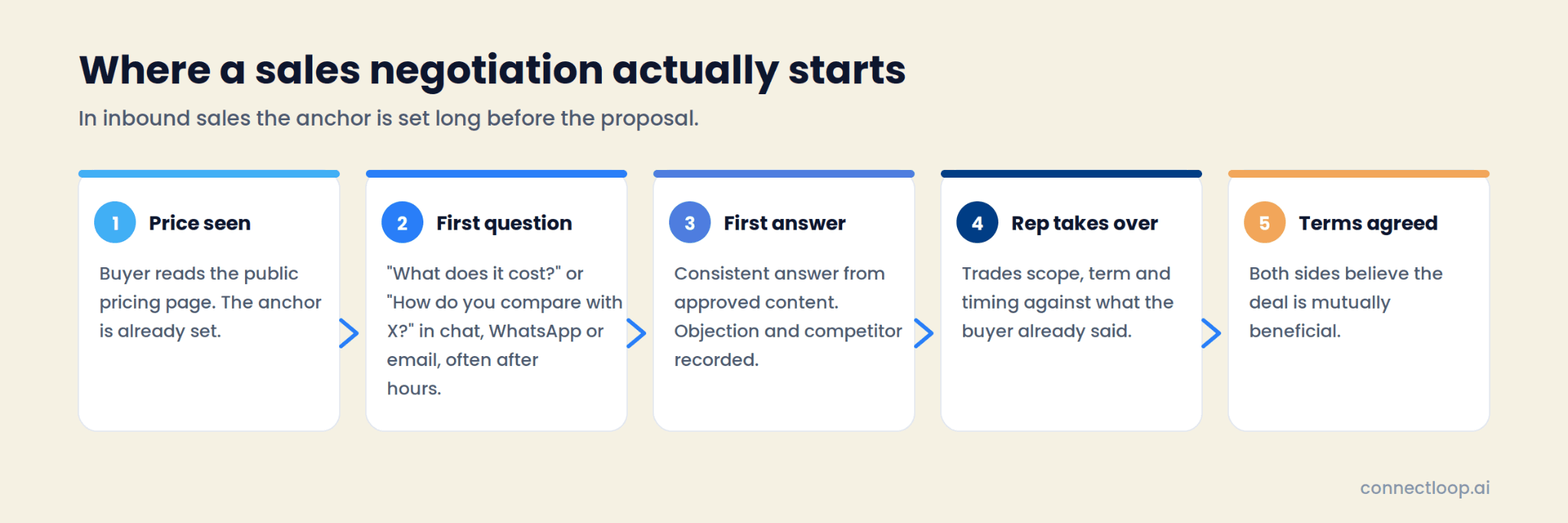
ConnectLoop also makes the starting point measurable. Its Conversational Intelligence groups every inbound conversation by what drove it, pricing, features, integrations, setup or billing, and separately tracks the competitors and comparisons buyers raise. A sales leader can open the Conversation Drivers and Trends tabs and see, for any 7, 30 or 90-day period, how many conversations opened with a price question or a competitor's name before anyone on the team was involved. That figure is the size of the negotiation that happens before the rep.
What sales negotiation tactics actually work?
The sales negotiation tactics that hold up are the ones that protect value without damaging trust: setting or holding the anchor, asking before answering, trading instead of conceding, framing the cost of inaction, and using silence. Pressure tactics and fake deadlines win single deals and lose renewals. ConnectLoop sees the same pattern in inbound conversations: the calm, consistent answer keeps the buyer talking.
- Prepare your BATNA and walk-away point first. Every other tactic depends on knowing what you will do if the deal does not close.
- Make the first offer, or hold the public one. The first credible number sets the range. If your price is on the website, the anchor is already set; defend it rather than reopening it.
- Ask before you answer. When a buyer pushes on price, ask what they are comparing it to and what would make the decision easier to support. SPIN selling questions, especially implication questions, surface the real need behind the demand.
- Mirror the buyer's last words. Repeat the last few words as a question, then wait. The buyer explains what they actually meant.
- Use silence after stating a price. The seller who fills the pause with a justification or a discount negotiates against themselves.
- Trade, never concede. Use an if-then structure: "If you can sign a two-year term, we can do that price." Every move on price changes scope, term or timing.
- Frame the cost of inaction. Loss aversion makes a cost avoided land harder than an equal gain, so show what staying with the current process costs each month.
- Give a constraint rationale, not a criticism. Explain why the price cannot move instead of attacking the buyer's alternative.
- Split your concessions, bundle your asks. Buyers prefer gains in small steps and losses all at once.
- Summarise and ask for commitment. Restate what the buyer gains, confirm alignment, and ask for the close rather than waiting for it.
Each tactic is covered in more depth in the sections below, with examples.
What is negotiable in a sale, and what isn't?
Most terms in a deal are negotiable: contract length, payment terms, start date, onboarding, training and scope. A few should be fixed before any conversation: the published list price, your pricing floor, security and data terms, and the core product itself. Deciding which is which in advance stops reps improvising under pressure. ConnectLoop recommends writing the list down so the same line holds on every deal.
The table below is a starting point. What sits in each column depends on your business, your margins and your quarter.
| Term | Usually negotiable? | How to handle it |
|---|---|---|
| Published list price | No | Hold it. Change what the buyer receives, not the number on the page. |
| Discount off list | Only as a trade | Pair it with a longer term, annual billing or a signature date. |
| Contract length | Yes | Your strongest trade: longer term in exchange for a lower effective price. |
| Payment terms (monthly, annual, upfront) | Yes | Monthly at the monthly rate; annual or upfront earns the better price. |
| Start date and implementation timeline | Yes | A faster start in exchange for a signature by a set date. |
| Onboarding, training and support | Yes | Include it on an annual plan rather than giving it away. |
| Seats, volume or usage limits | Yes | Expand for a higher commitment, or tier the price. |
| Pilot or trial terms | Yes, within limits | Prefer a paid pilot credited against the first year. |
| Scope and features | Partly | Add scope with a matching change in timeline or price. |
| Security, data handling and legal terms | Rarely | Set by policy, reviewed by the right people, kept out of price negotiation. |
| Your pricing floor and walk-away point | No | Decided before the call and shared with your manager. |
Price negotiation is the part buyers raise first, but it is rarely the part that matters most to them. A buyer pushing for 10% off often cares more about starting before quarter end, or about having onboarding included. The non-negotiables belong in your sales playbook, so every rep, and the AI agent answering the first pricing question, draws the same line.
What negotiation skills should a rep build first?
Build preparation and active listening first, then objection handling, emotional control and the discipline of a walk-away point. Preparation comes first because it makes the others possible: a rep who knows what they can trade can afford to listen. These negotiation skills in sales are all learnable, and ConnectLoop's own inbound conversations show where each one is tested: the moment a buyer asks for a lower price.
None of these is a trick or a negotiation technique to memorise. Practised in this order, they build on each other.
Why does preparation matter more than any tactic?
Preparation means knowing four things before the conversation: what the buyer needs, what they are weighing you against, what you can trade, and your BATNA, your best alternative to a negotiated agreement. A seller who knows their walk-away point negotiates from choice. A seller who does not negotiates from fear.
Preparation also includes the buyer's side: their budget, their timeline, which stakeholders sit on the buying committee, and what their own alternatives are. Most of this is captured during inbound lead qualification, if that step is done properly, and the rest is covered in the preparation section below.
How does active listening change the outcome?
Active listening means hearing the need beneath the demand. "This feels expensive" is rarely a budget statement; it is usually uncertainty about return, or fear of a wrong decision. A seller who answers the words with a discount has solved the wrong problem. A seller who asks "what would make this decision easier to support?" finds the real one.
One practical measure: the talk-to-listen ratio. Sellers who dominate the conversation learn less and concede more. The point of listening is not politeness. It is information, and information is leverage.
What is objection handling in a negotiation?
Objection handling is the discipline of treating every "no" as a data point rather than a verdict. Price objections, timing objections and competitor objections each tell you something about how the buyer is evaluating the deal. The skill is to ask before you answer, so the response addresses what they actually meant.
Social proof helps here: a relevant customer result answers "is it worth it" better than a restated feature. Urgency helps only when it is real; manufactured scarcity and deadline pressure damage trust in ways a discount never repairs. Objections raised early, in the first chat or email, are the cheapest to handle because nobody has taken a position yet. This is one reason capturing them in the first inbound conversation matters so much.
Why does emotional intelligence matter at the table?
Managing emotions, your own and the buyer's, keeps the negotiation on outcomes rather than positions. A rep who gets defensive under a lowball offer loses the room. A rep who notices hesitation, slows down and restates value keeps it. Buyers under pressure make worse decisions, and a seller who adds to that pressure often ends up with a smaller deal, or none.
Strategic silence is the practical form of this. After stating a price, stop talking. The seller who fills the silence with a justification, or worse, a concession, has just negotiated against themselves.
What is a walk-away point and why do you need one before you start?
A walk-away point is the set of terms below which the deal is not worth doing: a pricing floor, a minimum contract length, a scope you will not cut. It is decided before the negotiation, not during it, because in the moment every concession looks small. Knowing you can walk is the single largest source of confidence a seller has.
How do you prepare for a sales negotiation?
Negotiation preparation is a checklist, not a mood. Most of what you need comes out of discovery, and the discovery call questions guide groups forty of them by call stage. Done properly it takes thirty minutes and removes most of the surprises that cause sellers to concede. The list below assumes the deal is already qualified; if it is not, qualification comes first. ConnectLoop's CRM sync means step one is usually already done before the rep opens the deal.
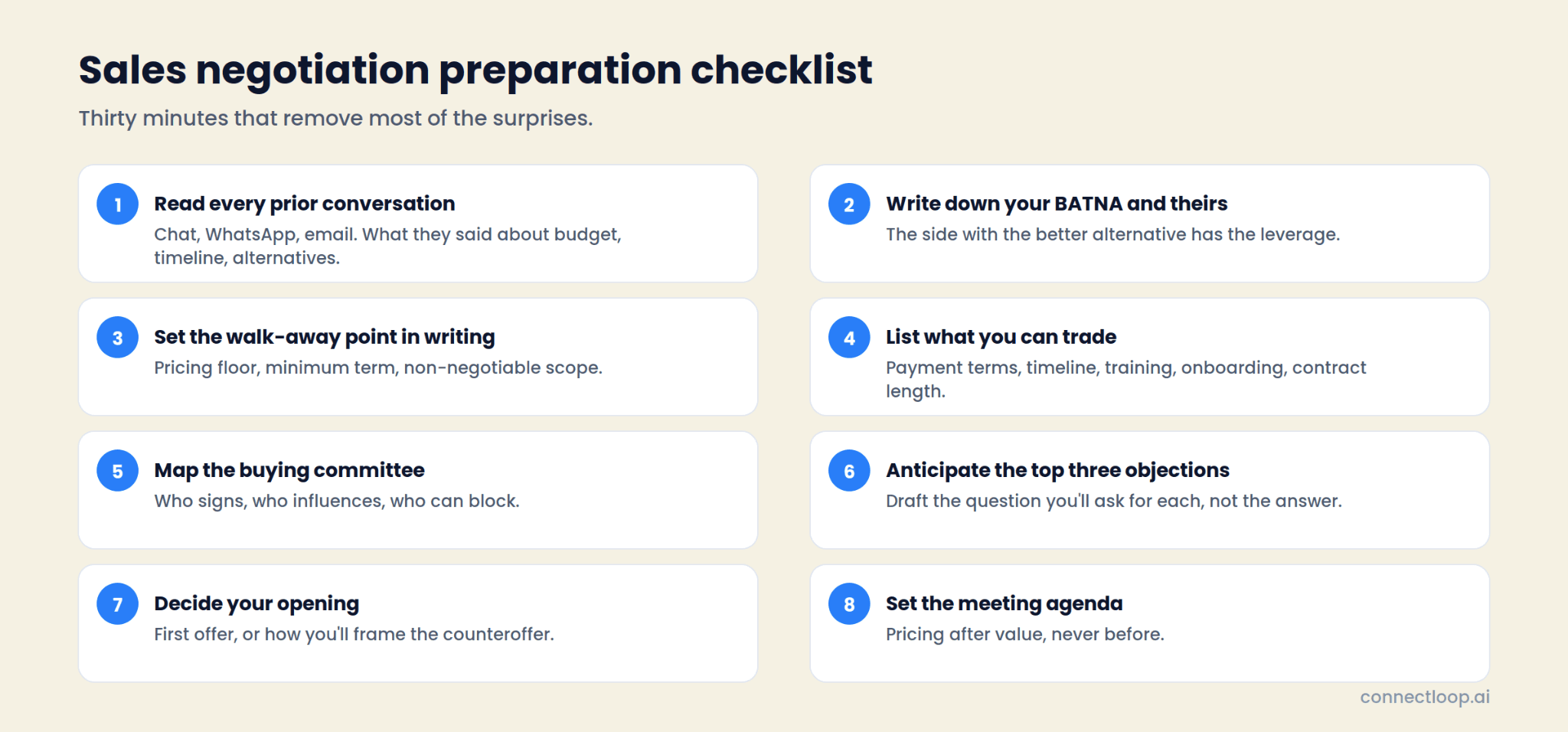
- Read every prior conversation. What the buyer asked in chat, on WhatsApp, by email. What they said about budget, timeline and alternatives. If your AI SDR or agent captured this, it is already in the CRM. If not, ask before the call.
- Write down your BATNA and theirs. What happens to you if this deal does not close, and what happens to them. The side with the better alternative has the leverage.
- Set the walk-away point in writing. Pricing floor, minimum term, non-negotiable scope. Share it with your manager so it holds under pressure.
- List what you can trade. Payment terms, implementation timeline, training add-ons, onboarding support, contract length. Each has a value to the buyer and a cost to you; know both numbers.
- Map the buying committee. Who signs, who influences, who can block. Decide which conversation each person needs.
- Anticipate the top three objections and draft the question you will ask in response to each, not the answer.
- Decide your opening. If you are making the first offer, what is it and why. If they are, how will you frame the counteroffer.
- Set the meeting agenda. Send it before the call, with pricing placed after the demo and value discussion, not before. The seller who sets the agenda leads the negotiation, and a shared agenda primes the buyer to see a joint problem-solving session rather than a sales pitch.
What is a sales negotiation tactics checklist?
A sales negotiation tactics checklist is the short list of moves to run before, during and after a negotiation, so nothing important depends on memory under pressure. Use the one below before any pricing conversation. Add it to your sales playbook, and use ConnectLoop's post-call report to check it after each call.
Before the conversation
1. Know your walk-away point and your best alternative if there's no deal.
2. List what you can trade (term, payment timing, start date, training, scope) and what each costs you.
3. Find out who decides, and what they care about most.
4. Decide your opening position, and why it's fair.
During the conversation
5. Ask what's behind every request before you answer it.
6. Never give a concession without getting something back. Use “If you…, then we…”.
7. Talk about value and outcomes before you talk about price.
8. Leave silence after you state a number.
9. Summarize what's been agreed before moving to the next point.
After the conversation
10. Send a written recap of the agreed terms the same day.
11. Record every concession and what you got in return in the CRM.
12. Note what worked and what didn't for the next negotiation.
How do you read the buyer before a negotiation call?
Read the buyer from what they have already said and done: the first question they asked, the competitor they named, how they reacted to the price, and how often they came back. Buyer psychology shows up in these signals before the call. ConnectLoop puts them in one place, so the rep walks in knowing whether the buyer is anxious about cost, comparing vendors or ready to move.
Four signals are worth reading on every deal.
- The first question. A buyer who opened with "what does it cost?" is price-sensitive or early in research. A buyer who opened with an integration or setup question is already picturing using the product. The two need different negotiations.
- The competitor named. A comparison tells you what the buyer is anchored to. If they named a cheaper tool, expect a price challenge; if they named a more expensive one, value is easier to hold.
- The reaction to price. Did they ask about annual discounts, go quiet, or move straight to booking a meeting? Each response tells you how much room the conversation really has.
- Return visits. A known lead who comes back to the pricing page several times is weighing the decision. Proactive Outreach turns that return visit into a drafted follow-up email that a person on the team copies it into their own inbox to send.
Where the deal sits in the stages of the sales process matters too. A buyer still in discovery reacts badly to hard terms; a buyer at proposal stage expects them.
Reading the record has limits. A transcript shows what the buyer typed, not what they told their boss, and a quiet buyer leaves fewer signals. Treat the record as a starting hypothesis and test it with a question early in the call. A lead scoring model built on what buyers actually said gives that hypothesis a number.
Who should make the first offer, and how does anchoring work when your price is public?
In most negotiations, the first credible number sets the range for everything after it, so making the first offer is usually an advantage. For inbound SaaS and education sellers the question is moot: the buyer has often already seen the price on the website. The anchor has been set. The seller's job is to hold it, not to set it. ConnectLoop's agent repeats that published anchor consistently.
That changes the tactic. With public pricing, the negotiation is about what the buyer receives for that price, and what changes if they want to pay less. It is a scope-and-terms negotiation, not a number negotiation, and sellers who forget this end up discounting a published price, which teaches every future buyer that the list price is fiction.
How do you frame a counteroffer?
Framing means pairing an offer with a rationale that makes it easier to accept. Research by Alice Lee and Daniel Ames at Columbia University compared two kinds of rationale. A constraint rationale explains a genuine limit ("we can't go above X this year"). A disparagement rationale criticises what is on offer ("it isn't worth that"). Sellers were significantly more persuaded by the constraint rationale. The same logic applies in reverse.
When a buyer opens low, the seller's most persuasive response is a constraint rationale, an explanation of why the price cannot move, rather than an attack on the buyer's alternatives. "That figure is below what it costs us to onboard and support an account of your size" holds better than "the cheaper tool won't do what you need."
Should you emphasise losses or gains?
Losses. The principle is loss aversion: Amos Tversky and Daniel Kahneman showed that people are more motivated to avoid a loss than to secure an equivalent gain. Deepak Malhotra and Max Bazerman describe in Negotiation Genius a study in which homeowners were far more likely to buy insulation when the pitch stressed money being lost each month rather than money to be saved. The same price, framed as cost of inaction, lands harder.
A related finding: split concessions into smaller steps, since people prefer to receive gains in increments, and bundle your asks into one request, since people prefer to absorb losses at once.
Can you over-justify a price?
Yes. Overjustification is a real risk. A weak reason can carry a small request, but research by Maaravi, Ganzach and Pazy found weak justifications backfire when the request is substantial. For a seller, the lesson is that a price with clear value needs no pile of explanations. State it, then stop.
How do you trade instead of conceding?
A concession gives something away. A trade exchanges it for something of equal or greater value to you. The difference decides whether a negotiation protects margin or bleeds it; some trainers call it "trade to protect." The rule is simple: every time the buyer asks for something, ask for something back, and never move on price without changing scope, term or timing. ConnectLoop builds its hand-off around this rule.
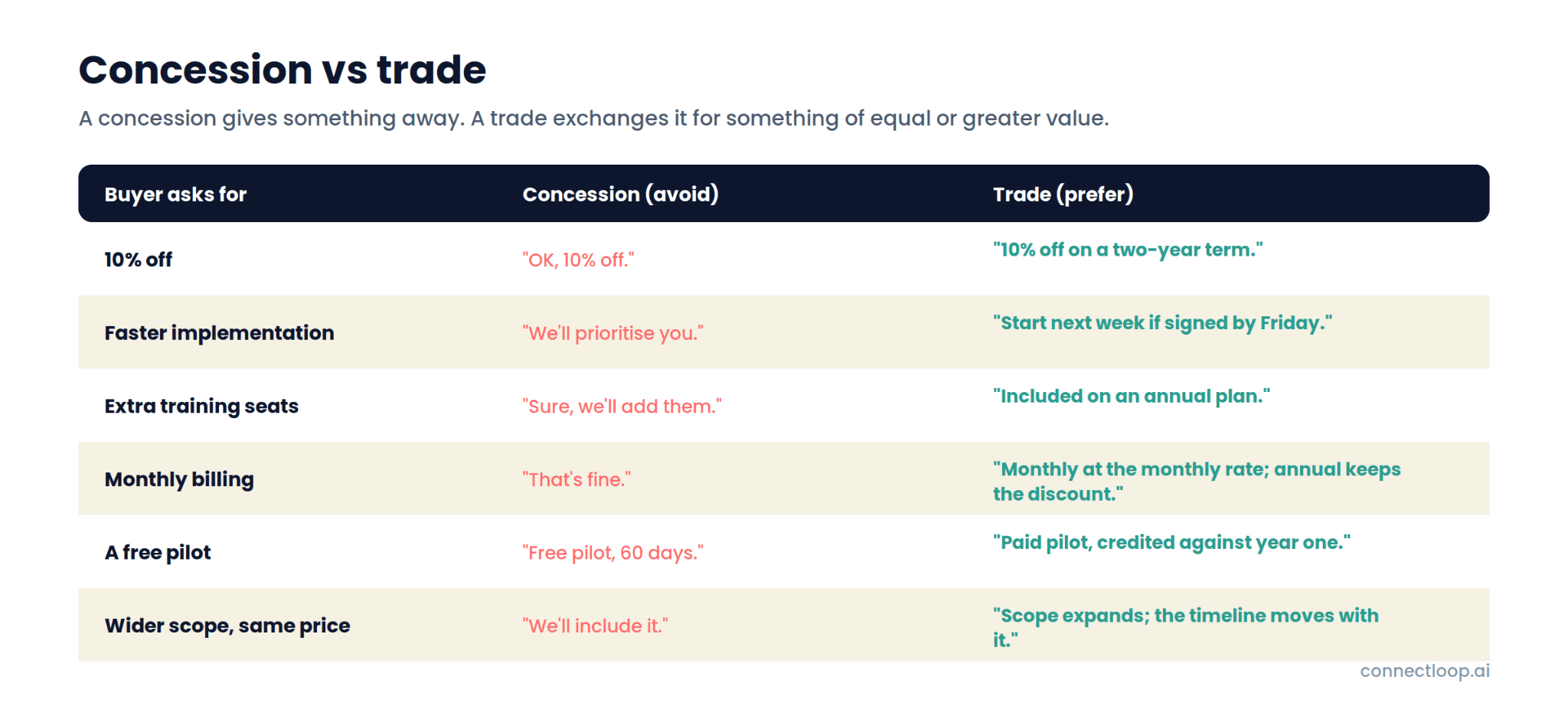
| Buyer asks for | Concession (avoid) | Trade (prefer) |
|---|---|---|
| 10% off | "OK, 10% off." | "10% off on a two-year term." |
| Faster implementation | "We'll prioritise you." | "We can start next week if the contract is signed by Friday." |
| Extra training seats | "Sure, we'll add them." | "Included if we structure this as an annual plan." |
| Monthly billing instead of annual | "That's fine." | "Monthly is available at the monthly rate; annual keeps the discount." |
| A pilot before committing | "Free pilot, 60 days." | "A paid pilot, credited against the first year if you proceed." |
| Wider scope at the same price | "We'll include it." | "We can expand scope; the implementation timeline moves accordingly." |
Define non-negotiables first: pricing floors, service commitments, contract terms that protect margin. Then define what is flexible and can be traded. The moment a seller drops price without a trade, they have trained the buyer, and the buyer's colleagues, to expect it next time.
What does converting demands into needs mean?
Buyers express demands: "we need a discount", "we can't pay that". Under every demand is a need: a budget cycle, a boss to convince, a risk to reduce. Ask clarifying questions until the need is visible, then trade against the need rather than the demand. A buyer who "needs a discount" may actually need a Q1 start date, which costs you nothing.
Which negotiation frameworks are worth knowing?
Three come up constantly, and each has one useful idea. The Challenger Sale argues that sellers should be comfortable discussing money and apply gentle, firm pressure rather than waiting for the buyer to raise price. The "Mafia Offer" idea, an offer so clearly valuable the buyer cannot refuse, is really a reminder that value-based selling beats haggling. And consultative frameworks teach "seek commitment": summarise what the buyer gains, confirm alignment, and ask for the close rather than hoping for it.
None of these replaces the fundamentals above. Sales playbooks that bolt on a framework without preparation, BATNA and a walk-away point produce reps who can name a tactic and still discount.
What is mirroring, and how do you use it?
Mirroring is repeating the last few words a buyer said, as a question, and then staying quiet. Chris Voss, the former FBI negotiator who wrote Never Split the Difference, describes it as the fastest way to make someone elaborate. "We're not finding enough use for what we're already paying for" becomes "Not enough use?", and the buyer explains what they actually mean. It works in chat and email as well as on calls.
What are some sales negotiation examples?
The six short scripts below show common negotiation moments and a response that protects value without damaging the relationship. Each one follows the same pattern: acknowledge the request, ask what is behind it, then offer a trade rather than a straight concession. ConnectLoop's Sales Assistance shows cues for moments like these during live Google Meet and Zoom calls.
1. "Another vendor quoted us less."
Buyer: Another vendor quoted us about 20% less.
Rep: Thanks for telling me. Before we compare numbers, can I check we're comparing the same thing? Does their quote include onboarding and support for your whole team?
Buyer: I'm not sure it does.
Rep: Then let's line the two up properly. If the scope matches and there's still a gap, I'd rather look at the contract term than cut the support you'll rely on.
2. "We need finance to approve this."
Buyer: I like it, but finance has to sign off.
Rep: That makes sense. What does finance usually look for in a decision like this: payback period, total cost or something else?
Buyer: Payback, mostly.
Rep: Then I'll send you a one-page summary showing the payback in your numbers, so you have it ready for that meeting. When is it?
3. "Procurement always asks for 15% off."
Buyer: Our procurement team asks every vendor for 15% off. It's policy.
Rep: Understood. I can't take 15% off the same agreement, but I can show procurement a lower total. If you commit to an annual term paid upfront, the effective price drops. Would that meet their policy?
4. "We'll sign this week if you drop the setup fee."
Buyer: If you remove the setup fee, we can sign by Friday.
Rep: Signing this week works well for us too. The setup fee covers your onboarding, so I'd keep that. What I can do is add a second training session at no charge if we have the signed agreement by Friday. Does that work?
5. "Our budget is lower than your price."
Buyer: Our budget for this is lower than your quote.
Rep: Thanks for being direct. Is the budget fixed for this year, or could more become available if the first phase shows results?
Buyer: It's fixed until January.
Rep: Then let's start with the part that solves your biggest problem first, within budget, and agree now how we'd expand in January.
6. "Can we pay monthly instead of annually?"
Buyer: Could we pay monthly? Annual is a big commitment.
Rep: Monthly is possible at the monthly rate. Many teams start annually because the price is lower. Would a three-month review point make annual feel less risky?
How do you handle price objections?
Handle a price objection by finding out what it is really about before responding to it. Objection handling covers the twenty-five that come up most. Ask what the buyer is comparing the price to, what would need to be true for it to make sense, and who else is involved in the decision. Then restate value in the buyer's own terms and, if a move is warranted, trade rather than concede. ConnectLoop records each price objection so the rep sees it before replying.
The most common mistake is speed. A buyer says "that's more than we expected" and the rep, wanting to save the deal, offers a discount before understanding the objection. A lowball counter deserves the same treatment: a question, not a counter-discount. Fast concessions shrink deal size and set the wrong expectation for the entire relationship.
When in a call should you bring up pricing?
After value, before the close. Bringing up price before the buyer understands what they get for it invites a number comparison. Leaving it to the end makes it feel like a surprise. The strongest sellers raise it themselves, once the buyer's problem and the solution's fit are established, because raising it signals confidence and buyers prefer the vendor to go first.
In inbound sales this is complicated by the fact that the buyer often raises price first, in the very first message. That is not a problem if the answer is consistent. It is a problem if the first answer is "let me get someone to talk to you about that," which tells the buyer the price is negotiable before the negotiation has started.
How do you negotiate over chat and email?
Negotiating in writing follows the same principles as negotiating on a call, but three things change: there is no tone of voice, silence reads differently, and everything is on the record. Conversational messaging covers how those threads run. Inbound teams negotiate in writing more than they realise, and almost no negotiation training covers it. ConnectLoop's agent works in exactly this setting, across website chat, WhatsApp and email.
Tone has to be carried by word choice. Short, warm, specific sentences work. Long justifications read as defensiveness, and in writing the buyer can re-read them. State the price, state what it includes, ask one question. Stop.
Silence in a chat is not strategic; it is abandonment. A buyer who asks about price and waits four hours for a reply has been told something about how the company treats customers. Speed to first response matters more in writing than on the phone, because there is nothing else filling the gap.
Everything written is quotable. A rep who types "I can probably get you 15% off" in a chat has created a floor. This is why Lia answers pricing only from your approved content, and why ConnectLoop keeps every conversation tracked from first message onward: what was said is exactly what the rep will be held to.
How do you find the decision-maker and the buying committee?
Ask early and directly: "Who else will be involved in this decision, and who signs off on spend?" In mid-market and enterprise deals the answer is usually several people, each with a different priority, and the negotiation has to satisfy the finance owner, the technical evaluator and the daily user. ConnectLoop's agent asks these questions in the first conversation and records the answers.
Negotiating hard with someone who cannot say yes wastes both sides' time. The BANT and MEDDIC questions that qualify a deal are the same ones that surface the buying committee.
The signals that you are not talking to the decision-maker: vague counterarguments ("we'll consider it"), an inability to commit to a timeline, and every request being "checked with the team." When you see them, ask for the introduction rather than pressing harder.
In inbound sales the first person to reach out is often a researcher, not the buyer. The right response is not to negotiate with them but to give them what they need to bring the decision-maker in, and to find out who that is.
When should you walk away from a deal?
Walk away when the buyer's demands fall below your pre-set walk-away point, when they want unprofitable concessions with nothing in return, when the scope they need is something your product cannot deliver, or when the relationship is already adversarial before the contract is signed. An unprofitable deal costs more than a lost one. At ConnectLoop, the walk-away call always stays with the rep.
Knowing you can walk changes how you negotiate before you ever have to. It lowers anxiety, keeps concessions deliberate and, occasionally, makes the buyer reconsider. The rep who cannot walk always ends up paying for the deal.
Walking away should also be polite and open-ended. Timing is often the real problem, and a buyer who was treated well when they said no is the one who comes back in two quarters. A follow-up email sent when the timing is right closes more of these than a discount would have.
What should the rep receive from the first inbound conversation?
The rep should receive everything the buyer already said: the pricing question, the discount ask, the competitor named, the stated budget or timeline, and the intent signal behind it. If the first conversation happened with an AI agent, none of this should have to be re-asked. ConnectLoop is built around that hand-off, and it is worth being precise about where the agent's job ends.
Which negotiation moves does an AI agent handle, and which go to the rep?
Lia answers price and comparison questions from approved content, records discount requests and captures budget and timeline. Discounts, trades and the walk-away decision stay with the rep, who has the full picture.
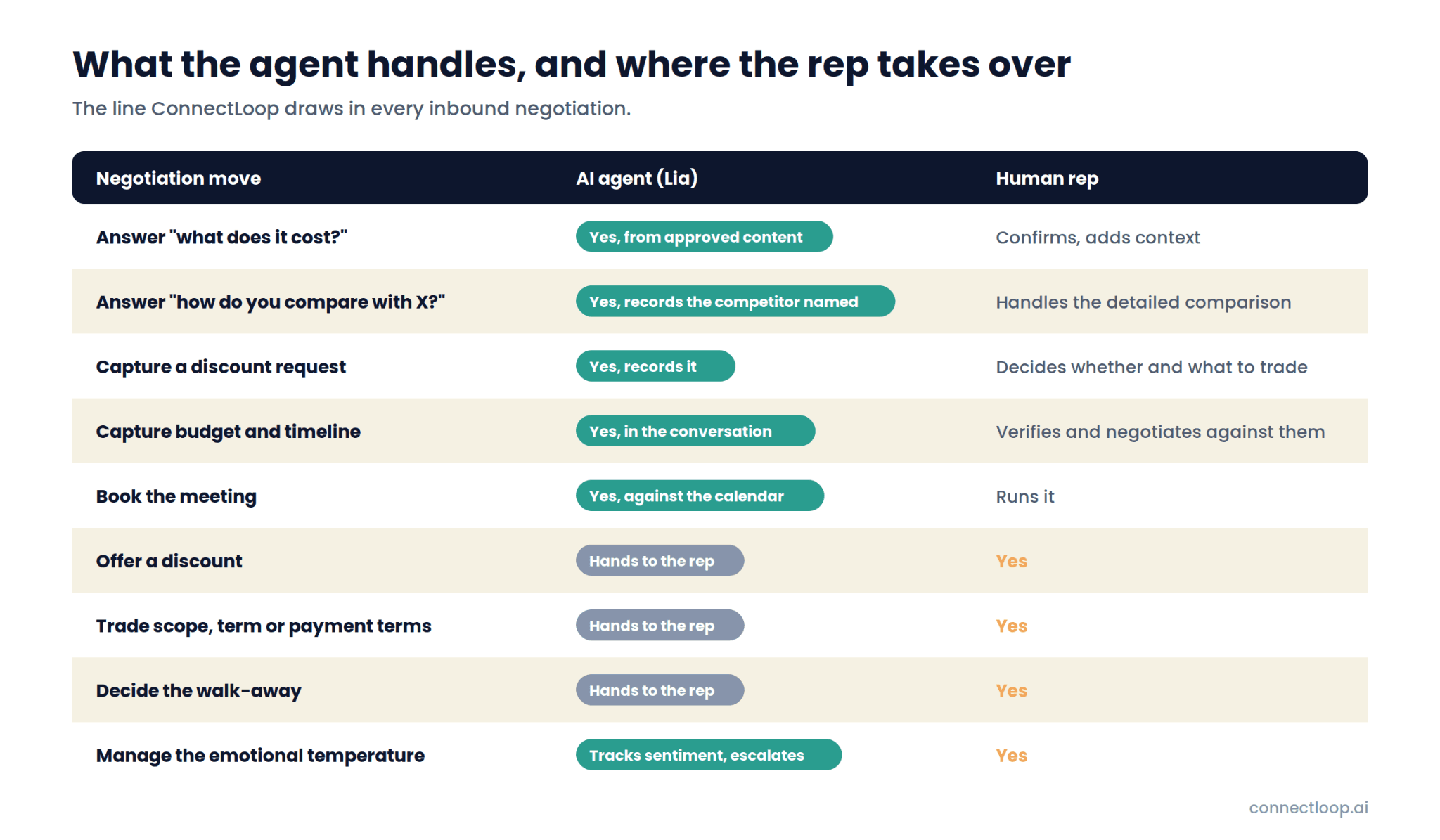
| Negotiation move | AI agent (Lia) | Human rep |
|---|---|---|
| Answer "what does it cost?" | Yes, from approved pricing content, consistently | Confirms, adds context |
| Answer "how do you compare with X?" | Yes, from approved positioning, and records the competitor named | Handles the detailed comparison |
| Capture a discount request | Yes, acknowledges it, records it and passes it to the rep | Decides whether and what to trade |
| Capture budget and timeline | Yes, through qualification questions in the conversation | Verifies and negotiates against them |
| Book the meeting | Yes, against real calendar availability | Runs it |
| Offer a discount | Hands to the rep | Yes |
| Trade scope, term or payment terms | Hands to the rep | Yes |
| Decide the walk-away | Hands to the rep | Yes |
| Read the room and manage emotions | Tracks sentiment and escalates to a human when it turns | Yes |
How does ConnectLoop handle the first pricing conversation?
ConnectLoop's AI sales agent, Lia, answers questions on website chat, WhatsApp and email around the clock, trained on the company's own site in about sixty seconds. When a visitor asks about price, Lia gives the approved answer. When they ask for a discount or name a competitor, Lia records it and asks what is driving the comparison, using SPIN and MEDDIC-style qualification questions inside the conversation rather than a form.
If the visitor is ready, Lia books a meeting. If the conversation turns negative, or the visitor asks for a person, it escalates. Either way the full transcript and the intent score sync to the CRM, so the rep opens the negotiation already knowing what the buyer said, which competitor they mentioned, and what they were hoping to pay.
Proactive Outreach follows the same boundary. Proactive Outreach drafts follow-up emails for known leads who return to the website. Your team copies each draft into their own inbox to send, then marks it Sent or Dismisses it, so every message that goes out has a person behind it.
Where the rep takes over
Discounting, trading and deciding terms are judgment calls that depend on the account, the quarter and the relationship, and ConnectLoop keeps them with the rep. The agent's role is to make sure the first price a buyer hears is the right one, that everything the buyer said is kept, and that the rep's first conversation is the second one, not the first. The same hand-off applies when a returning visitor is recognised through anonymous visitor identification and Lia drafts the follow-up for a person to send.
How do you negotiate small and mid-market deals with no procurement team?
In a $2,000 to $50,000 deal there is usually no procurement department, no legal review and no RFP. The buyer is often a founder, a director or an operations lead who negotiates on their own behalf, quickly, and who has probably already seen your pricing page. The negotiation is shorter, more personal and more sensitive to speed than an enterprise deal. Most ConnectLoop customers sell at this size.
Three adjustments follow. First, the anchor is public, so hold it and negotiate scope. Second, the buyer's BATNA is usually "keep doing it manually," so the cost of inaction is your strongest frame. Third, response time is a negotiating tactic: the vendor who answers the 9pm pricing question at 9pm has a lead the slower vendor cannot recover.
Trades still work at this deal size. Annual versus monthly, onboarding included versus self-serve, start date this week versus next month. What does not work is enterprise theatre: long proposals, multi-step approvals and a negotiation calendar that outlasts the buyer's attention. The exception is transactional sales, where an AI agent for e-commerce handles the whole exchange from price question to checkout.
How do you train a sales team to negotiate?
Negotiation training works when it is frequent, low-stakes and tied to live deals. A single annual workshop rebuilds fundamentals; weekly practice on real objections builds the reflexes. ConnectLoop's view is simple: train on the objections your own buyers raise, not on generic scripts, and review what was actually said rather than what the rep remembers.
Sales role play, whether with a manager or an AI sales coaching tool, lets reps rehearse the discount ask and the competitor comparison until the calm response is automatic. Call recording and conversation intelligence tools make the review side scalable.
The practical curriculum: BATNA and walk-away for every open deal, the concession-versus-trade table above applied to your own price list, and objection drills on the five objections your inbound conversations raise most. That last set is easy to find if you are capturing objections at the first conversation.
How do you measure negotiation skill improvement?
Track deal size, discount rate, contract length and the ratio of concessions given to value received, per rep, per quarter. Pair the numbers with deal reviews and shadowed calls. Improvement shows up as reps who protect margin without losing the deal, and who can explain what they got in return for every concession. Whether the rep is an SDR or a BDR changes which numbers matter: discount rate for the closer, qualification accuracy for the opener.
What are the warning signs a negotiation is going wrong?
Repeated pressure for discounts with no trade offered, scope that keeps shifting, a buyer who will not name the decision-maker, and a rep who is getting defensive. Each is visible in the transcript before it is visible in the forecast. Managers who read conversations, not just pipeline stages, can coach mid-deal, and quota pressure at quarter end is exactly when those signs are most often ignored. Regular sales coaching on transcripts catches all four before the forecast does.
Key takeaways
- A sales negotiation starts with the first pricing question, not the first proposal. In inbound sales that question often arrives in chat, WhatsApp or email before a rep is involved.
- The sales negotiation tactics that work protect value: hold the anchor, ask before answering, trade with an if-then structure, frame the cost of inaction and use silence.
- Decide what is negotiable before the call. Contract length, payment terms, start date and onboarding are trades; the list price, pricing floor and security terms are fixed.
- Preparation is the master skill: know your BATNA, your walk-away point, what you can trade and who is on the buying committee before the conversation.
- Read the buyer from the record: first question, competitor named, reaction to price and return visits tell you what kind of negotiation to expect.
- Trade, never concede. Every move on price is paired with a change in contract length, scope, start date or payment terms.
- Negotiating in writing needs short messages, approved answers and fast replies, because everything typed becomes a floor.
- An AI agent can answer, capture and book, and hand the rep a complete record. Discounting, trading and walking away stay with a human. ConnectLoop's Lia is built on that line.

About the author
ConnectLoop Staff
Written by the ConnectLoop team. ConnectLoop is an AI sales agent for inbound revenue teams, based in Cambridge, Massachusetts.
About ConnectLoop →Frequently asked questions
Preparation, because it makes every other skill possible. A seller who knows their BATNA, their walk-away point and what they can trade can afford to listen, stay calm and hold the price. A seller who does not know those things concedes to relieve their own anxiety.
The most effective sales negotiation tactics are preparing your walk-away point, asking what is behind every request, trading instead of conceding, anchoring with a clear reason, and summarizing agreements in writing. They work because they keep value on both sides of the deal. ConnectLoop's checklist above turns these into twelve steps for every negotiation.
Holding the anchor, asking what is behind a request before answering it, trading with an if-then structure, framing the cost of inaction, mirroring and using silence after stating a price. Pressure tactics and fake deadlines may close one deal but damage the renewal.
Usually contract length, payment terms, start date, onboarding, training, seat or usage volume and scope. The published list price, your pricing floor and security or legal terms should be fixed before the conversation, so reps trade around them instead of discounting.
Usually yes, because the first credible number anchors the discussion. If your pricing is public, the first offer has already been made; your job is to hold it and negotiate scope and terms rather than the number.
Ask what is driving the request before answering it. Then, if a move is justified, trade rather than concede: a lower price for a longer term, a faster start for a signature by a date, more seats for an annual plan. Never move on price alone.
BATNA is your best alternative to a negotiated agreement: what you will do if this deal does not close. The side with the stronger alternative has the leverage. Knowing yours, and estimating the buyer's, tells you how hard you can hold.
It can answer pricing questions consistently, capture discount requests and competitor mentions, qualify the buyer and book the meeting. Discounting, trading terms and the walk-away call belong to the rep, because they depend on judgment about the account. ConnectLoop's Lia is built on exactly that split.
Keep messages short and specific, answer pricing questions from approved content, avoid improvised numbers because everything written becomes a floor, and reply fast, since silence in writing reads as neglect rather than strategy.
When terms fall below your pre-set floor, when the buyer wants concessions with nothing in return, when your product cannot do what they need, or when the relationship is adversarial before signature. Walk away politely; timing is often the real issue.
No procurement, no legal review, a buyer who negotiates personally and has likely seen your price already. Hold the public anchor, negotiate scope, frame the cost of inaction, and answer fast. Enterprise-style proposals and long approval chains lose these buyers.
Good negotiation is mostly good preparation and a clear line about what you will and will not move on
If your first pricing conversations happen on a website at 9pm, ConnectLoop makes sure that first answer is the right one and that the rep who picks up the deal starts with everything the buyer already said. Train Lia on your site in about sixty seconds on the free plan and read the first pricing conversation Lia handles.