
Sales Qualification
MEDDPICC Sales Methodology: How to Qualify Deals, Including the Ones That Start Inbound
The MEDDPICC sales methodology is a qualification framework with eight checkpoints: Metrics, Economic Buyer, Decision Criteria, Decision Process, Paper Process, Implicate the Pain, Champion and Competition. It grew out of MEDDIC and MEDDICC, and it tells a sales team whether a deal is real before they invest time in it. ConnectLoop applies the same checkpoints to inbound conversations, so qualification starts before a rep picks up.

Published · Updated
Table of contents
- What is the MEDDPICC sales methodology?
- Where did MEDDPICC come from?
- What is the difference between MEDDIC, MEDDICC and MEDDPICC?
- What does each MEDDPICC element mean, and what should you ask?
- How do you use a MEDDPICC scorecard?
- What questions do you ask for each MEDDPICC letter?
- What does a MEDDPICC example look like, scored element by element?
- When should you use MEDDPICC instead of BANT or SPIN?
- What are the alternatives to MEDDIC?
- Can MEDDIC be used for inbound as well as outbound sales?
- How does MEDDPICC work when the buyer comes to you?
- How do you implement MEDDPICC in a sales team?
- How long does it take to roll out MEDDPICC across a sales team?
- What are the limits of MEDDPICC?
- Key takeaways
- Frequently asked questions
What is the MEDDPICC sales methodology?
MEDDPICC is a sales qualification methodology for complex B2B deals. The MEDDPICC framework exists for navigating sales complexity: multiple stakeholders, long cycles and formal procurement. Each letter is a question the seller must answer with evidence, not opinion. If any answer is missing, that gap is where the deal will most likely stall. Teams use it in deal reviews, CRM fields and forecast calls to separate real pipeline from hope.
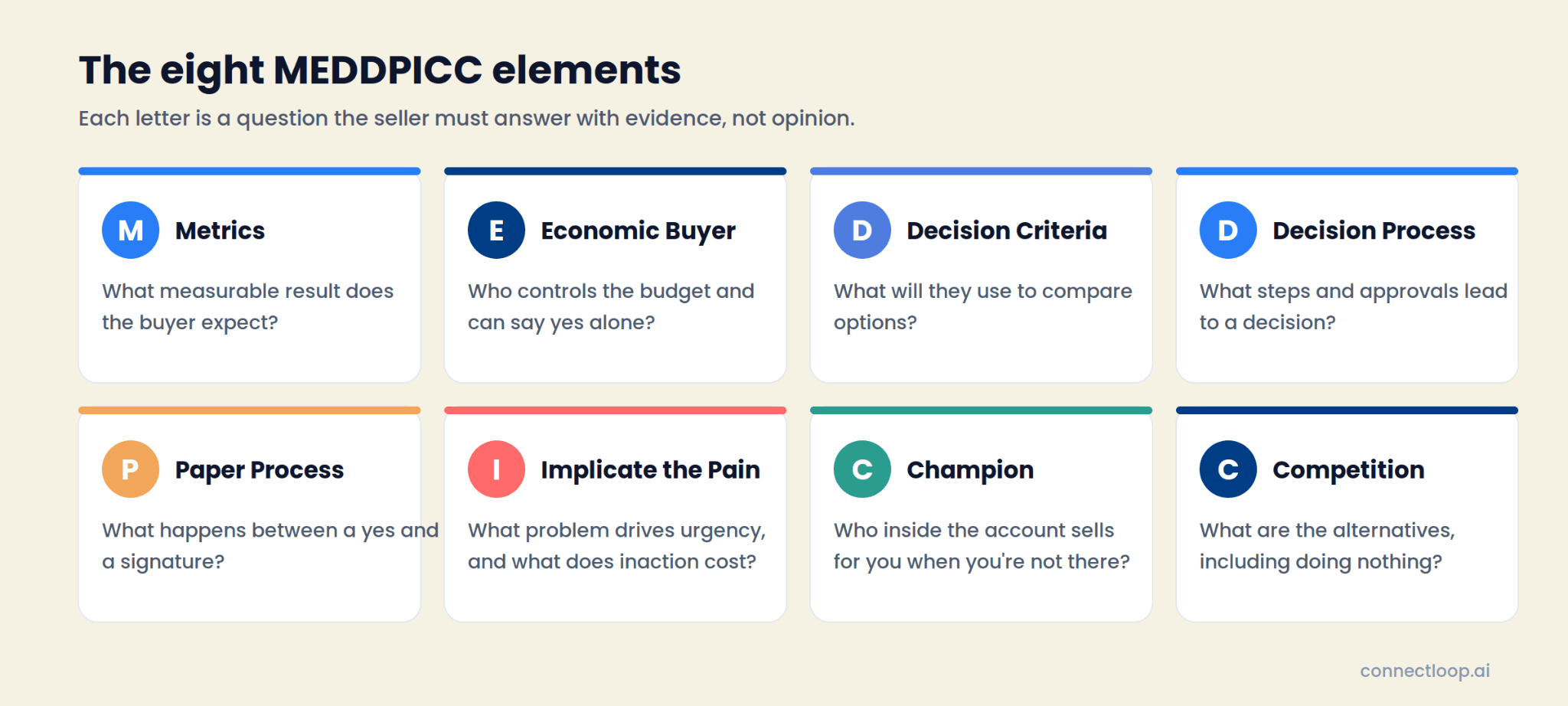
The eight elements:
| Letter | Element | The question it answers |
|---|---|---|
| M | Metrics | What measurable result does the buyer expect? |
| E | Economic Buyer | Who controls the budget and can say yes alone? |
| D | Decision Criteria | What will they use to compare options? |
| D | Decision Process | What steps and approvals lead to a decision? |
| P | Paper Process | What happens between a yes and a signature? |
| I | Implicate the Pain | What problem drives urgency, and what does inaction cost? |
| C | Champion | Who inside the account sells for you when you are not there? |
| C | Competition | What are the alternatives, including doing nothing? |
Unlike a sales process, which describes stages, MEDDPICC is a checklist you run at every stage. A deal can be in "proposal" with five unanswered elements. The framework makes the unanswered visible. MEDDPICC runs across stages three to seven of the stages of the sales process, from discovery to close.
Where did MEDDPICC come from?
MEDDIC was created inside PTC, the Boston-area software company, in the mid-1990s. Its internal training team, including Dick Dunkel and Jack Napoli, wrote it as a checklist of what the best sellers did. The framework is widely credited with helping PTC scale during a period of rapid growth, though the specific revenue figures repeated online are not sourced.
Two letters were added later. The extra C for Competition produced MEDDICC; the P for Paper Process produced MEDDPICC, the version most enterprise teams now use. Andy Whyte's MEDDICC and Darius Lahoutifard's Always Be Qualifying popularised the modern forms.
What is the difference between MEDDIC, MEDDICC and MEDDPICC?
MEDDIC has six elements. MEDDICC adds Competition. MEDDPICC adds Paper Process as well, giving eight. The additions exist because enterprise deals rarely die at "no"; they die in procurement, legal and security review after the buyer already said yes, or to a competitor the seller never knew was in the room.
A short MEDDIC definition: a six-point checklist (Metrics, Economic Buyer, Decision Criteria, Decision Process, Identify Pain, Champion) that a seller fills with evidence to judge whether a deal will close. MEDDICC and MEDDPICC keep that core and add the two letters where modern deals most often go missing. ConnectLoop's agent tracks the MEDDICC version inside inbound conversations.
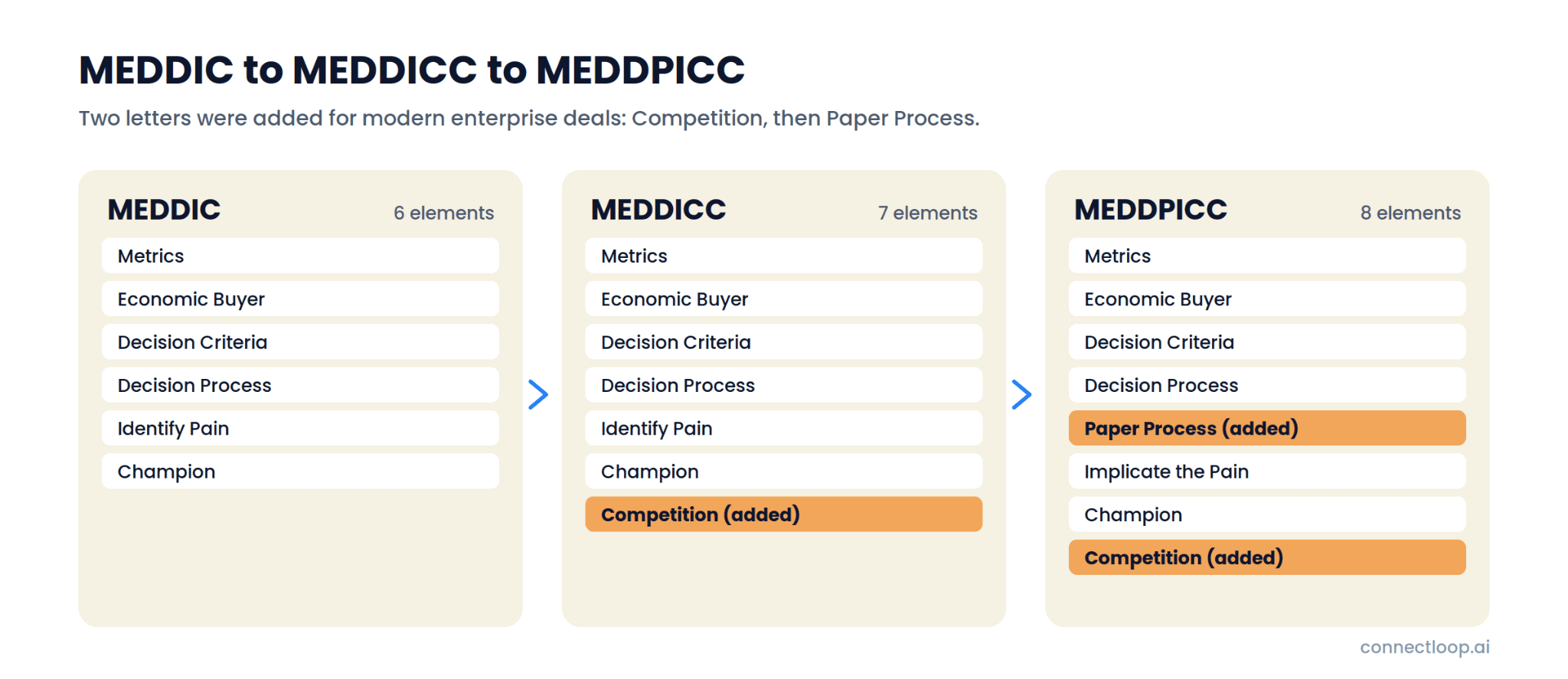
| MEDDIC | MEDDICC | MEDDPICC | |
|---|---|---|---|
| Elements | 6 | 7 | 8 |
| Adds | — | Competition | Competition + Paper Process |
| Best for | Fewer stakeholders, simpler buying process | Competitive evaluations | Formal procurement, legal, security review |
| Typical deal | Mid-market | Mid-market to enterprise | Enterprise and regulated industries |
ConnectLoop's earlier comparison of BANT vs MEDDIC covers the choice between a lightweight and a heavyweight framework. This article assumes you have chosen the heavyweight one and want to run it well.
What is the MEDDIC framework?
MEDDIC is a deal qualification framework with six elements: Metrics, Economic Buyer, Decision Criteria, Decision Process, Identify Pain and Champion. It checks whether a deal is real, who can approve it and why the buyer would act. MEDDICC and MEDDPICC build on it. On the ConnectLoop website, Lia uses MEDDIC to qualify inbound conversations.
| Letter | Element | What it checks |
|---|---|---|
| M | Metrics | The measurable result the buyer wants |
| E | Economic Buyer | The person who can approve the spend |
| D | Decision Criteria | How the buyer will compare options |
| D | Decision Process | The steps and people needed to say yes |
| I | Identify Pain | The problem that makes change necessary |
| C | Champion | The insider who wants the deal to happen |
MEDDPICC keeps all six, renames Identify Pain to Implicate the Pain, and adds Paper Process and Competition. That's why teams usually learn MEDDIC first.
What does each MEDDPICC element mean, and what should you ask?
Each element is evidence collected through discovery questions and confirmed through behaviour. "I have budget" is a claim. An introduction to the person who owns that budget is evidence. One definition and one question per element.
What are Metrics in MEDDPICC?
Metrics are the quantified outcomes the buyer expects: revenue gained, cost removed, hours saved. They turn a feature conversation into a business case the economic buyer can approve. Without a number, value is an opinion.
Ask: "If this works, what number on your dashboard changes in twelve months?"
Who is the Economic Buyer?
The economic buyer has budget authority over the line your deal draws from. They are rarely your first contact. Deals that never reach this person stall at "my boss will approve it."
Ask: "Who signs off on spend for this, and have they approved something similar before?"
What are Decision Criteria?
Decision criteria are the requirements the buying committee uses to compare options: technical, financial, vendor-related. Learn them early and, where legitimate, help shape them. A criterion you did not know about is one a competitor may have written.
Ask: "What are the must-haves versus nice-to-haves, and who defined them?"
What is the Decision Process?
The decision process is the sequence of evaluations, meetings and approvals between "we are interested" and "we have chosen." Mapping it early prevents the surprise board review that pushes a Q1 close to Q3.
Ask: "Walk me through every step between now and a signed agreement."
What is the Paper Process?
The paper process covers legal review, procurement onboarding, security questionnaires and finance approval after the buyer has decided. In enterprise sales this gap often runs several weeks, and it is where deals quietly slip a quarter.
Ask: "Once you decide, what does procurement and legal look like, and how long did it take last time?"
Knowing the economic buyer and the paper process is what lets a rep plan the negotiation; see these sales negotiation tactics for what to trade and what to hold.
What does Implicate the Pain mean in MEDDPICC?
MEDDIC called this element Identify Pain. Identifying pain in MEDDPICC finds the problem. Implicating it means the buyer feels the cost of inaction. Research into stalled deals has found that a large share are lost to buyer indecision rather than to a competitor, a pattern visible in the sales conversations themselves. Pain without a cost does not beat indecision.
Ask: "What does this problem cost you each quarter, and what happens if it is still here in six months?" The discovery call questions guide has more ways to reach the cost of inaction.
How do you find and develop a Champion in the MEDDPICC framework?
A champion has influence inside the account, access to the economic buyer and a personal stake in your solution winning. A coach likes you and shares information but will not act. Champions are developed, not found: give them the data and talking points to sell internally, then test them by asking for the economic buyer meeting. A champion sets it up.
Ask: "Who inside the organisation benefits most if this succeeds, and can they get us in front of the budget holder?"
What does competition analysis in MEDDPICC cover?
Competition analysis in MEDDPICC includes the other vendors on the shortlist, an internal build, and the status quo. Doing nothing costs no budget and no change management, which makes it the most dangerous alternative in the deal.
Ask: "Who else is on the list, and what would need to be true for you to change nothing?" When the answer comes back as a concern rather than a name, objection handling covers the response.
How do you use a MEDDPICC scorecard?
A MEDDPICC scorecard rates each of the eight elements from 0 to 3, based on evidence, not on how the deal feels. Add the scores for a total out of 24, then focus on the lowest element. ConnectLoop's Sales Assistance tracks MEDDICC live on Google Meet and Zoom calls, so reps can fill gaps before the call ends.
The 0-3 scale
| Score | Meaning | Matches the article's status |
|---|---|---|
| 0 | Unknown: nothing learned yet | Red |
| 1 | Claimed: the seller assumes it, but the buyer hasn't said it | Red |
| 2 | Stated: the buyer said it, but nobody has checked it | Yellow |
| 3 | Confirmed: there is evidence, such as an email, a meeting with the right person or a document | Green |
MEDDPICC scorecard template (copy into your CRM or a sheet)
| Element | Question to answer | Evidence | Score (0-3) | Next action |
|---|---|---|---|---|
| Metrics | What number will the buyer use to judge success? | |||
| Economic Buyer | Who signs, and have we spoken to them? | |||
| Decision Criteria | What will they compare, and in what order? | |||
| Decision Process | What steps and dates lead to a yes? | |||
| Paper Process | What legal, security or procurement steps come before signature? | |||
| Implicate the Pain | What does the problem cost if nothing changes? | |||
| Champion | Who inside is selling for us when we're not in the room? | |||
| Competition | What else are they considering, including doing nothing? | |||
| Total | /24 |
How to read the total
| Total | What it means | What to do |
|---|---|---|
| 20-24 | Well qualified | Forecast it and protect the timeline |
| 13-19 | Real, with gaps | Fix the lowest-scoring element before the next stage |
| 0-12 | Early or at risk | Go back to discovery before you send a proposal |
Any element at 0 in a late-stage deal is a warning, whatever the total. A deal with no Economic Buyer contact rarely closes on time.
What questions do you ask for each MEDDPICC letter?
Ask two kinds of question per letter: one that opens the topic and one that tests the answer. The opener gets a claim; the follow-up turns it into evidence the seller can write in the CRM. The table below gives both for all eight MEDDPICC letters, plus the evidence that moves each one to Green. ConnectLoop's scorecard marks each answer Inferred or Confirmed for the same reason.
| Letter | Opening question | Follow-up that tests it | Evidence that makes it Green |
|---|---|---|---|
| M — Metrics | "How do you measure this today?" | "What would the number need to be for this to count as a success?" | A baseline and a target the buyer stated themselves |
| E — Economic Buyer | "Whose budget would this come from?" | "Could we include them in the next call, even for ten minutes?" | A meeting with the budget owner, or a written approval path from them |
| D — Decision Criteria | "What does a good choice look like to your team?" | "If two vendors met all of those, what would break the tie?" | A written or confirmed list, ranked |
| D — Decision Process | "Who else needs to weigh in before you choose?" | "Which of those people could stop the decision?" | Named steps, named people, rough dates |
| P — Paper Process | "Have you bought software of this size before?" | "Who in legal or procurement should get our documents now, before the decision?" | A procurement contact and a known timeline |
| I — Implicate the Pain | "What made this a priority now rather than last year?" | "Who in the business feels it most when this goes wrong?" | A cost or consequence the buyer quantified |
| C — Champion | "Who would own this project day to day?" | "What would you need from us to make the case internally?" | The contact takes an action you asked for, such as an introduction |
| C — Competition | "What other options are you looking at?" | "What do you like about them that we should know?" | Named alternatives, including staying as they are |
Use the follow-ups sparingly in an early call. Two or three per conversation is enough; the rest belong in later meetings. The SPIN selling questions guide covers the discovery questions that surface pain before these MEDDPICC questions come into play.
What does a MEDDPICC example look like, scored element by element?
Here is a fictional deal for a clinic group, scored element by element with the same Red, Yellow and Green status used in this guide. It shows how an apparently healthy deal can still carry one serious gap. ConnectLoop marks each answer as Inferred or Confirmed, which maps neatly onto these colors.
A MEDDPICC example is one deal scored letter by letter, with the evidence behind each score and the action it triggers. The worked deal below is fictional, built to show the method rather than a real ConnectLoop customer. It shows how one Red letter, not the overall impression, decides what the seller does next.
The deal (illustrative): Harbourline Clinics, a fictional network of 14 outpatient clinics, is evaluating a patient-scheduling platform. First contact came through the vendor's website. Estimated value: $85,000 a year. Target close: end of the quarter.
| Letter | What the seller found | Status | Next action |
|---|---|---|---|
| Metrics | No-show rate is 18%; the goal is under 10% within a year | Green | Use the 8-point gap in the business case |
| Economic Buyer | The COO owns the budget; the seller has spoken only to the operations manager | Yellow | Ask the operations manager for a 15-minute call with the COO |
| Decision Criteria | Must integrate with the existing patient record system; SMS reminders required | Green | Send the integration documentation |
| Decision Process | Operations manager recommends, COO approves, IT signs off on security | Green | Confirm dates for each step |
| Paper Process | Unknown; last software purchase took "a while" in procurement | Red | Ask for the procurement contact and send the security questionnaire now |
| Implicate the Pain | Each no-show costs roughly $150 in lost clinic time, by the buyer's own estimate | Green | Multiply out for the proposal |
| Champion | The operations manager wants this and has shared internal numbers, but has not yet acted on a request | Yellow | Test with the COO introduction |
| Competition | One other vendor, plus keeping the current phone reminders | Green | Address the status quo directly in the proposal |
On the 0-3 scorecard above, this deal scores 19 out of 24: five Green letters at 3 points, two Yellow at 2 and one Red at 0. That puts it in the "real, with gaps" range, and the Red letter is the one to fix first.
The scorecard makes the next move obvious. Five of the eight letters are Green, two are Yellow and one is Red, and the Red on Paper Process is the one that would push the deal into next quarter. Starting the security review before the decision, and testing the champion with one specific ask, are the two actions that protect the close date.
In ConnectLoop, the Pain, Decision Criteria and Competition lines of a scorecard like this can already be filled from the buyer's first website conversation, so the seller starts the first call at Economic Buyer and Paper Process.
When should you use MEDDPICC instead of BANT or SPIN?
Use MEDDPICC when deals involve multiple stakeholders, formal procurement and a sales cycle measured in months. Use BANT for short, transactional sales with one or two decision-makers. Use SPIN for the discovery conversation itself. MQL vs SQL covers the earlier handover, before any of these frameworks applies. The three are not rivals; many teams run all of them.
| Framework | What it is | Where it fits |
|---|---|---|
| BANT | Four-point lead qualification: Budget, Authority, Need, Timeline | Top of funnel, short cycles, inbound triage |
| SPIN | Questioning method: Situation, Problem, Implication, Need-payoff | Inside discovery calls, at any deal size |
| MEDDPICC | Eight-point deal qualification and forecast discipline | Complex, multi-stakeholder deals once they enter the pipeline |
A common pattern is BANT or SPIN on the first conversation, then MEDDPICC once the opportunity is created. ConnectLoop's Lia is built around that pattern: SPIN questions to open the conversation, MEDDIC checkpoints to qualify it.
What are the alternatives to MEDDIC?
The main MEDDIC alternatives are BANT for quick triage, CHAMP and ANUM for teams that want need or authority first, GPCT and SPICED for goal-led conversations, and SPIN, Gap Selling and Challenger for discovery and reframing. Most are lighter than MEDDIC, and none tracks paper process. ConnectLoop's Sales Assistance can run several of them, including BANT, SPIN, MEDDICC, Challenger or a custom sequence.
| Alternative | What it checks | Choose it when |
|---|---|---|
| BANT | Budget, Authority, Need, Timeline | Deals are small and fast, and you need to sort leads quickly |
| CHAMP | Challenges, Authority, Money, Prioritisation | You want the buyer's problem first and budget later |
| ANUM | Authority, Need, Urgency, Money | Reaching the decision-maker early is the main hurdle |
| GPCT | Goals, Plans, Challenges, Timeline | Buyers respond better to goals than to budget questions |
| SPICED | Situation, Pain, Impact, Critical Event, Decision | You sell subscriptions and care about renewal as much as the first sale |
| SPIN | Situation, Problem, Implication, Need-payoff questions | You need a questioning method inside discovery, at any deal size |
| Gap Selling | The gap between the buyer's current and future state | Buyers have not yet decided to change |
| Challenger | Teach, tailor, take control | Buyers need a new view of their problem before they will move |
On MEDDIC vs BANT specifically: BANT asks whether a lead is worth a meeting, and MEDDIC asks whether an opportunity will close. Many teams use BANT to decide which inbound leads reach a rep and MEDDIC once a deal is in the pipeline. The choice is less about which framework is better and more about which question you need answered at that point.
Can MEDDIC be used for inbound as well as outbound sales?
Yes. The letters are the same in both; what changes is the order in which you learn them and who collects the first evidence. In outbound, the seller starts with research and must create the pain. In inbound, the buyer arrives with the pain and the competition already in mind. ConnectLoop is built for the inbound order.
| Outbound | Inbound | |
|---|---|---|
| Who starts the conversation | The seller | The buyer |
| Letters usually learned first | Economic Buyer and Metrics, from account research | Implicate the Pain and Competition, from the buyer's first questions |
| Hardest letter to fill | Implicate the Pain, because the buyer was not looking | Economic Buyer, because the first contact is often a researcher |
| Who collects the first evidence | An SDR or the account executive | Whoever, or whatever, answers the first enquiry |
| Main risk | Pushing a deal the buyer never prioritised | Losing what the buyer already said before the rep calls |
The practical rule for mixed teams: keep one MEDDPICC scorecard for both motions, and record where each piece of evidence came from. A champion found through outbound research and a pain stated in an inbound chat belong on the same record. The next section shows the inbound version in detail.
How does MEDDPICC work when the buyer comes to you?
Most MEDDPICC guides assume an outbound rep with weeks to build the picture. Inbound is different: the buyer starts the conversation, often outside working hours. Some elements are discoverable in that first exchange. Others need a relationship, and pretending otherwise produces bad data. Here is the split ConnectLoop works from:
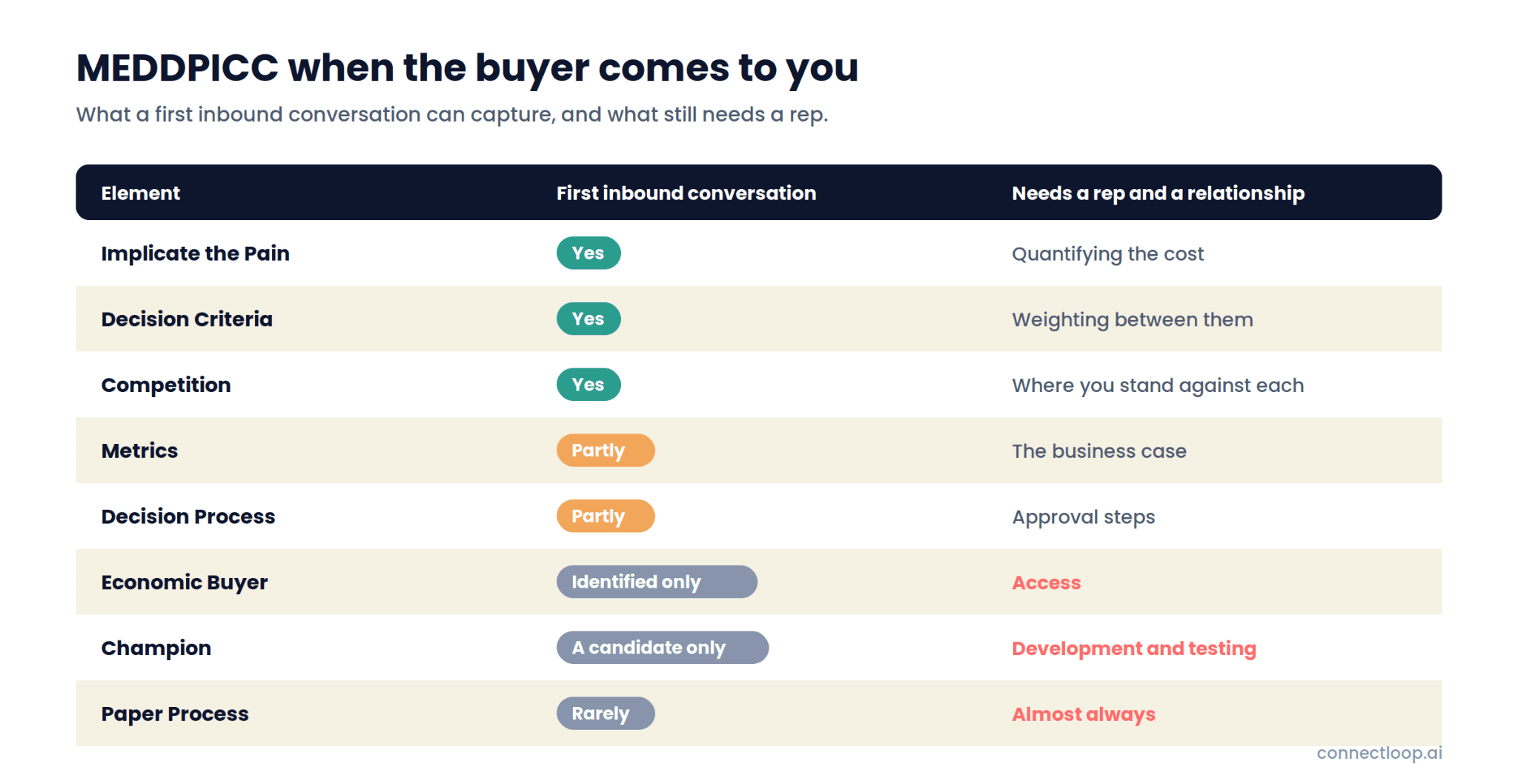
| Element | First inbound conversation | Needs a rep and a relationship |
|---|---|---|
| Implicate the Pain | Yes: the buyer usually opens with it | Quantifying the cost |
| Decision Criteria | Yes: must-haves surface when they ask about features and integrations | The weighting between them |
| Competition | Yes: buyers name alternatives when comparing | Where you stand against each |
| Metrics | Partly: the goal, rarely the number | The business case |
| Decision Process | Partly: timeline and who else is involved | Approval steps |
| Economic Buyer | Identified, not accessed | Access |
| Champion | A candidate, not a champion | Development and testing |
| Paper Process | Rarely | Almost always |
How does ConnectLoop apply MEDDPICC to inbound conversations?
ConnectLoop's AI sales agent, Lia, answers questions on website chat, WhatsApp and email at any hour, and asks qualification questions as part of the conversation rather than as a form. Those questions are structured around MEDDIC and SPIN, so the transcript a rep receives already contains the pain, the criteria, the alternatives and the timeline in the buyer's own words. The full approach is described in ConnectLoop's guide to inbound lead qualification.
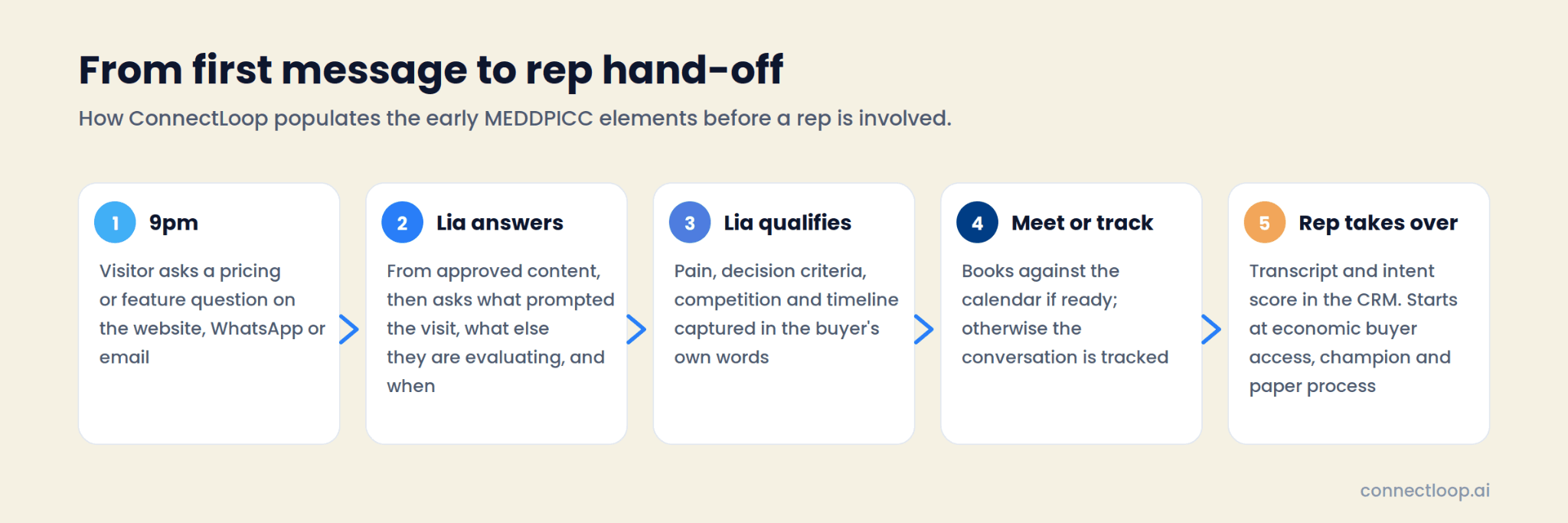
What that looks like in practice:
- A visitor asks a pricing or feature question at 9pm. Lia answers from the company's approved content, which it trains on in about sixty seconds from the website.
- In the same exchange, Lia asks what problem prompted the visit, what else they are evaluating and when they need it in place. That covers Implicate the Pain, Competition and part of the Decision Process.
- If the visitor is ready, Lia books a meeting against real calendar availability. If not, the conversation is tracked from first message onward.
- The rep opens the record with the transcript and an intent score, and starts at the elements only a human can close: economic buyer access, champion development and paper process.
The honest limit: Lia does not get you access to the economic buyer, and it does not develop a champion. Those are relationships, and ConnectLoop treats them as a human's job. What the agent does is make sure the rep's first call is the second conversation, not the first.
Proactive Outreach fits the same boundary. When a known lead returns to the site, Lia drafts a follow-up email, and a human reviews, edits and sends it or dismisses it. Nothing goes out on its own.
How do you implement MEDDPICC in a sales team?
Implementation is a behaviour change measured in quarters, not a training day. Teams that make it stick build the CRM fields first, train against live deals second, and coach the weakest elements weekly until the vocabulary becomes the language of deal reviews. Done consistently, that is where the win rate moves.
- Build the MEDDPICC scorecard before the training. One CRM field per element on the opportunity, with a status (Red, Yellow, Green or a score) and a notes field for the evidence.
- Define what Green means. Write it down: Green is confirmed by the buyer, not inferred by the rep. This one definition removes most of the arguments.
- Retro-qualify the current pipeline. Score every open deal against all eight. Expect most of it to turn Red on Paper Process and Economic Buyer; that is the baseline.
- Set a stage gate. No deal enters the commit forecast with a Red. Two Yellows is the usual tolerance.
- Run deal reviews on the eight elements, not on "how's it looking." The scorecard is the agenda.
- Coach the pattern, not the person. If most of the team is Red on the same element, that is an enablement gap.
- Feed inbound qualification into the same fields. When the first conversation happens with an AI agent or SDR, the pain, criteria, competition and timeline it captured should land in the CRM before the rep opens the record. ConnectLoop syncs the contact, the transcript and the intent score to HubSpot, Salesforce, Pipedrive or Zoho, so the rep starts at Metrics and Economic Buyer instead of re-asking what the buyer already said.
- Review quarterly which qualification gaps predicted losses. Weight the scorecard on your own data, not a template.
How long does it take to roll out MEDDPICC across a sales team?
Plan for two to three quarters. CRM setup and first training take a few weeks; consistent use in deal reviews, without prompting, takes the rest. Teams that roll out a sales methodology as a single workshop usually see the vocabulary fade within a quarter. ConnectLoop's call scoring shows framework coverage per rep, which makes the slow part measurable.
| Phase | Timing | What happens | Sign it is working |
|---|---|---|---|
| Set up | Weeks 1–2 | CRM fields, the definition of Green, the stage gate written down | Every open deal has a scorecard, even if mostly Red |
| Train on live deals | Weeks 3–6 | Reps score their own deals; managers review two deals each per week | Reps can name the Red letters on their top three deals |
| Enforce the gate | Months 2–3 | Forecast calls use the scorecard as the agenda; no Reds in commit | Fewer late-quarter surprises in the forecast |
| Make it habit | Months 4–9 | Coaching targets the weakest letter across the team | Reps use the letters in deal talk without being asked |
| Tune | Every quarter after | Compare lost deals against their scorecards and reweight | The scorecard predicts losses better than gut feel |
Two things shorten the timeline. Start with the managers, because reps copy what their manager asks in deal reviews. And pick one letter per month as the coaching focus, rather than all eight at once; Paper Process and Economic Buyer are the usual first two.
What are the limits of MEDDPICC?
MEDDPICC is excellent at managing a deal once the buyer has decided to change, and weaker at creating that decision. It also depends on fresh data: a champion who left last month is still Green in the CRM until somebody updates the field. Neither flaw is fatal, but both need a workaround.
Keenan, author of Gap Selling, argues that most of the sale is decided in the buyer's first two questions, why change and why now, and that MEDDPICC concentrates on what comes after. Front-loading discovery on pain and urgency is the fix. For data decay, weekly verbal verification in deal reviews is the low-tech answer.
ConnectLoop has its own boundary here. It captures what buyers say in inbound conversations across website chat, WhatsApp and email. It has no view of what happens on a sales call, in procurement or in the buyer's internal meetings, so the later MEDDPICC elements still depend on the rep keeping the record current.
Key takeaways
- MEDDPICC is an eight-element qualification framework: Metrics, Economic Buyer, Decision Criteria, Decision Process, Paper Process, Implicate the Pain, Champion, Competition.
- It grew out of MEDDIC, created at PTC in the mid-1990s, with Competition (MEDDICC) and Paper Process (MEDDPICC) added for modern enterprise deals.
- Each element is evidence from the buyer, not an inference by the rep. Ask an opening question and a follow-up per letter, and mark Green only when confirmed.
- A worked example shows the value: one Red letter, not the overall impression, decides the seller's next action.
- Use BANT or SPIN on the first conversation, MEDDPICC once the opportunity exists; CHAMP, GPCT, SPICED and Gap Selling are alternatives for lighter or goal-led sales.
- MEDDIC works for inbound and outbound; inbound learns pain and competition first, outbound learns economic buyer and metrics first.
- Rolling out MEDDPICC takes two to three quarters, starting with managers and one letter per month.
- Its blind spots are buyer indecision and data decay: front-load pain discovery and verify fields weekly.

About the author
ConnectLoop Staff
Written by the ConnectLoop team. ConnectLoop is an AI sales agent for inbound revenue teams, based in Cambridge, Massachusetts.
About ConnectLoop →Frequently asked questions
Metrics, Economic Buyer, Decision Criteria, Decision Process, Paper Process, Implicate the Pain, Champion and Competition. Each is a qualification checkpoint a deal must pass before it belongs in a forecast.
A methodology. A sales process is the sequence of stages a deal moves through. MEDDPICC is the checklist you run inside every stage to test whether the deal is real.
A seller scores each letter with the evidence found so far: for example, Metrics Green because the buyer stated a target, Economic Buyer Yellow because only the manager has been met, and Paper Process Red because procurement is unknown. The Red letter sets the next action, such as starting the security review early.
It depends on deal size. BANT suits short, transactional sales. CHAMP and GPCT suit teams that want to lead with the buyer's challenges or goals. SPICED suits subscription businesses. For complex enterprise deals, MEDDPICC itself is usually the right choice.
Yes, with a split. Pain, decision criteria, competition and timeline can be captured in the first inbound conversation. Economic buyer access, champion development and paper process need a rep. ConnectLoop's Lia captures the first group in the conversation and hands the second group to a human.
Its full weight suits deals with several stakeholders, formal procurement and multi-month cycles. For smaller deals, individual elements still help, especially Implicate the Pain and Champion, but scoring all eight on a small transactional sale is more overhead than insight.
Most practitioners point to Champion, because a deal without an internal advocate stalls no matter how well the other seven are documented. Metrics is the usual second, since a buyer who cannot state the value rarely gets the budget approved.
CRM setup and first training take a few weeks. Consistent use in deal reviews, where reps apply the vocabulary without prompting, typically takes two to three quarters. Treating it as a one-off training event is the most common reason it fails.
A MEDDPICC scorecard is a one-page table that rates all eight elements of a deal, usually from 0 to 3, based on the evidence collected. It shows how qualified the deal is and which element is weakest. ConnectLoop teams review the lowest-scoring element first in every pipeline meeting.
Not any more. On 21 April 2026 the United States District Court for the Eastern District of Pennsylvania ruled that MEDDPICC is a generic term describing a sales qualification methodology, and ordered the US Patent and Trademark Office to cancel the registration, according to the announcement from the law firm Fox Rothschild, which acted in the case. Any organisation can use, teach or publish about MEDDPICC.
MEDDPICC works when the first conversation is good and the record stays honest
If your first conversation happens on a website at 9pm, ConnectLoop is built to make it count. Train Lia on your site in about sixty seconds on the free plan and read the first transcript she produces.