
Lead Qualification
MQL vs SQL: The Difference, the Handoff, and How to Qualify Faster
A marketing qualified lead (MQL) has shown interest and fits your ideal customer profile, but isn't ready to talk to sales yet. A sales qualified lead (SQL) has clear buying intent and is ready for a sales conversation. This guide covers the difference, the handoff and how ConnectLoop helps teams qualify inbound leads faster.

Published
Table of contents
- What is the difference between an MQL and an SQL?
- Where do SAL and PQL fit between MQL and SQL?
- Where do MQLs and SQLs sit in the sales funnel?
- Which signals show a lead is ready to become an SQL?
- How does lead scoring decide when an MQL becomes an SQL?
- Which framework should you use to confirm an SQL?
- How do you write MQL and SQL definitions both teams agree on?
- How should the handoff from marketing to sales work?
- Can a lead move from MQL to SQL in a single conversation?
- What should you do with leads that aren't ready?
- How do you spot interest before a lead becomes an MQL?
- How do you measure the MQL to SQL conversion rate?
- How does ConnectLoop help turn MQLs into SQLs faster?
- Key takeaways
- Frequently asked questions
What is the difference between an MQL and an SQL?
An MQL is a lead who has engaged with marketing and fits your target profile but hasn't shown readiness to buy. An SQL is a lead who has shown purchase intent and meets your qualification criteria, so sales should talk to them now. ConnectLoop's view: the difference is intent, not interest.
| MQL (marketing qualified lead) | SQL (sales qualified lead) | |
|---|---|---|
| Stage of the buyer's journey | Awareness and interest | Decision and action |
| What they've done | Read a guide, joined a webinar, signed up for a newsletter | Asked about pricing, requested a demo, asked how setup works |
| Intent | Exploring the problem | Evaluating a solution to buy |
| Who owns them | Marketing | Sales |
| What they need next | Educational content and nurturing | A conversation with a person |
| Typical next step | Stay in a nurture program | Discovery call or demo |
| Main risk | Contacted too early and put off | Left waiting and lost to a faster competitor |
Both are leads, and both are valuable. The mistake is treating them the same way.
What does an MQL look like in practice?
An MQL is someone who fits your ideal customer profile and has engaged more than once, but hasn't asked to buy. For example, a marketing manager at a mid-size software company who downloaded an ebook and opened two newsletters. They're interested, not yet ready. ConnectLoop recommends nurturing them, not calling them.
Common MQL signals:
- Downloading an ebook or guide.
- Signing up for a newsletter or a webinar.
- Reading several blog posts over a few weeks.
- Opening and clicking marketing emails.
Each of these shows interest in the topic. None shows a decision to buy.
What does an SQL look like in practice?
An SQL is someone who has shown they're seriously considering a purchase. For example, a head of sales who visited the pricing page twice, then asked in chat whether your product connects to their CRM. Their questions are about buying, not learning. ConnectLoop treats questions like these as the clearest sign a lead is sales ready.
Common SQL signals:
- A demo request or a request to speak to sales.
- Questions about pricing, contracts or implementation.
- Repeat visits to the pricing page or comparison guides.
- Confirmed budget, authority, need and timeline.
Where do SAL and PQL fit between MQL and SQL?
Some teams use more stages than MQL and SQL. A sales accepted lead (SAL) is an MQL that sales has reviewed and agreed to work. A product qualified lead (PQL) is a user who reached a key moment in a free trial or free product. ConnectLoop suggests using only the stages your team actually acts on.
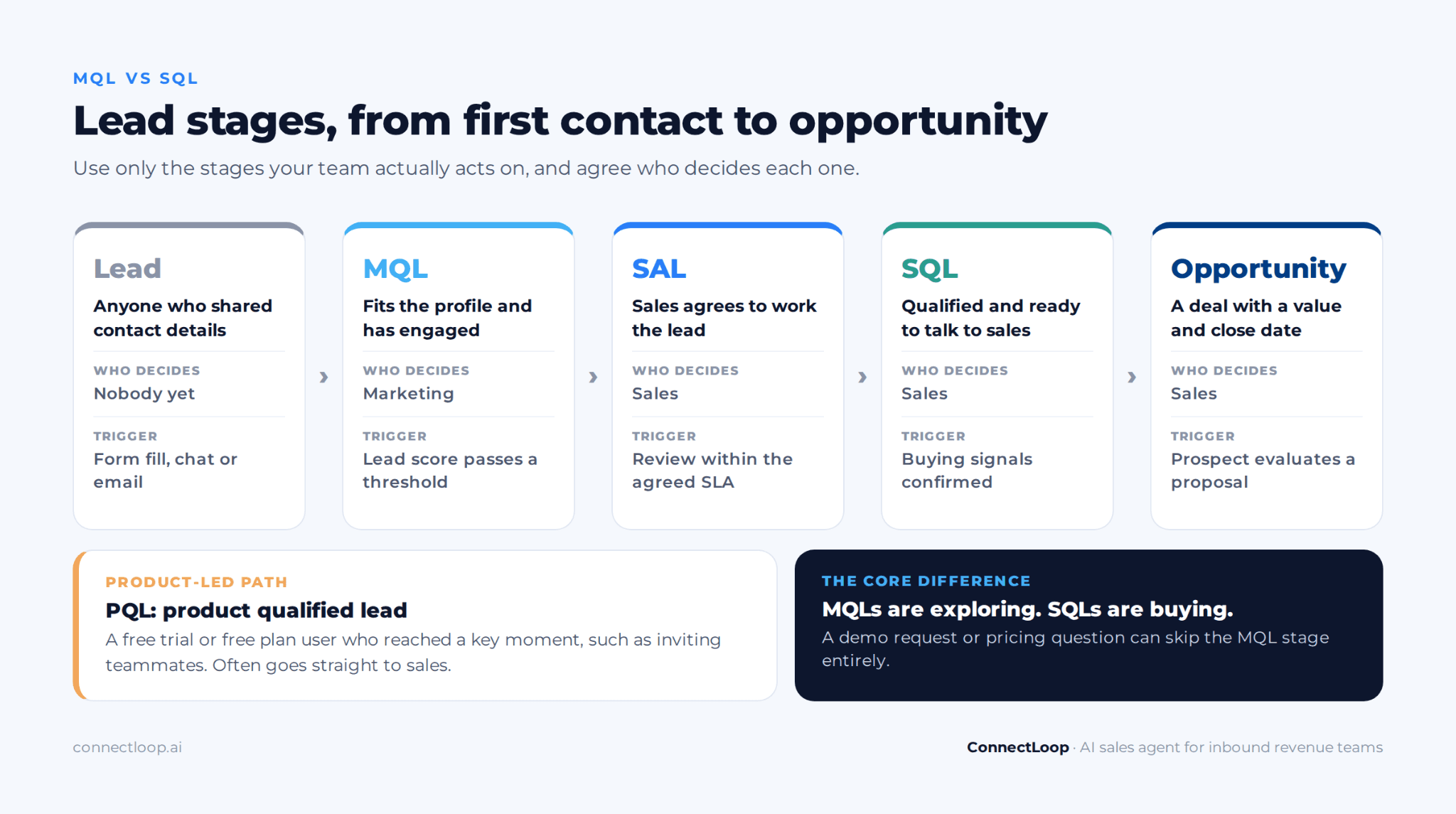
| Stage | What it means | Who decides | Common trigger |
|---|---|---|---|
| Lead | Anyone who has shared contact details | Nobody yet | Form fill, chat or email |
| MQL | Fits the profile and has engaged | Marketing | Lead score passes a threshold |
| SAL | Sales has accepted the MQL to work | Sales | Sales review within an agreed time |
| SQL | Qualified and ready for a sales conversation | Sales | Buying signals confirmed, often on a discovery call |
| PQL | Got real value from a free trial or free plan | Product and sales | Key product action, such as inviting teammates |
| Opportunity | A deal with an expected value and close date | Sales | Prospect agrees to evaluate a proposal |
The SAL stage is useful because it creates accountability. When sales formally accepts or rejects each MQL, marketing gets a clear signal about lead quality.
PQLs matter most for product-led companies. A user who has already used your product is often more qualified than any MQL, because they've seen the value first-hand.
Where do MQLs and SQLs sit in the sales funnel?
MQLs sit at the top of the funnel and in the middle, during awareness and interest. SQLs sit at the bottom of the funnel, during decision and action. Each stage needs different content and a different owner. ConnectLoop sees many inbound buyers skip stages entirely, arriving with a pricing question on their first visit.
Content that fits each stage:
- Awareness (MQL): blog posts, ebooks and newsletters that explain the problem.
- Interest (MQL): webinars, guides and educational content that explore solutions.
- Decision (SQL): case studies, comparison guides and datasheets that help the buyer choose.
- Action (SQL): demos, a free trial, pricing details and a clear way to talk to sales.
The sales funnel is a model, not a rule. Real buyers jump between stages, and B2B buyers often research quietly before they show up. A buyer whose first action is a demo request was never an MQL; route them straight to sales.
The stages of the sales process show what happens after a lead becomes an SQL.
Which signals show a lead is ready to become an SQL?
Two kinds of signals matter: fit and behavior. Fit shows whether the lead matches your ideal customer profile. Behavior shows whether they're actively buying. The strongest signal of all is what the buyer asks, because a pricing or integration question is direct buying intent. ConnectLoop captures those questions in the conversation.
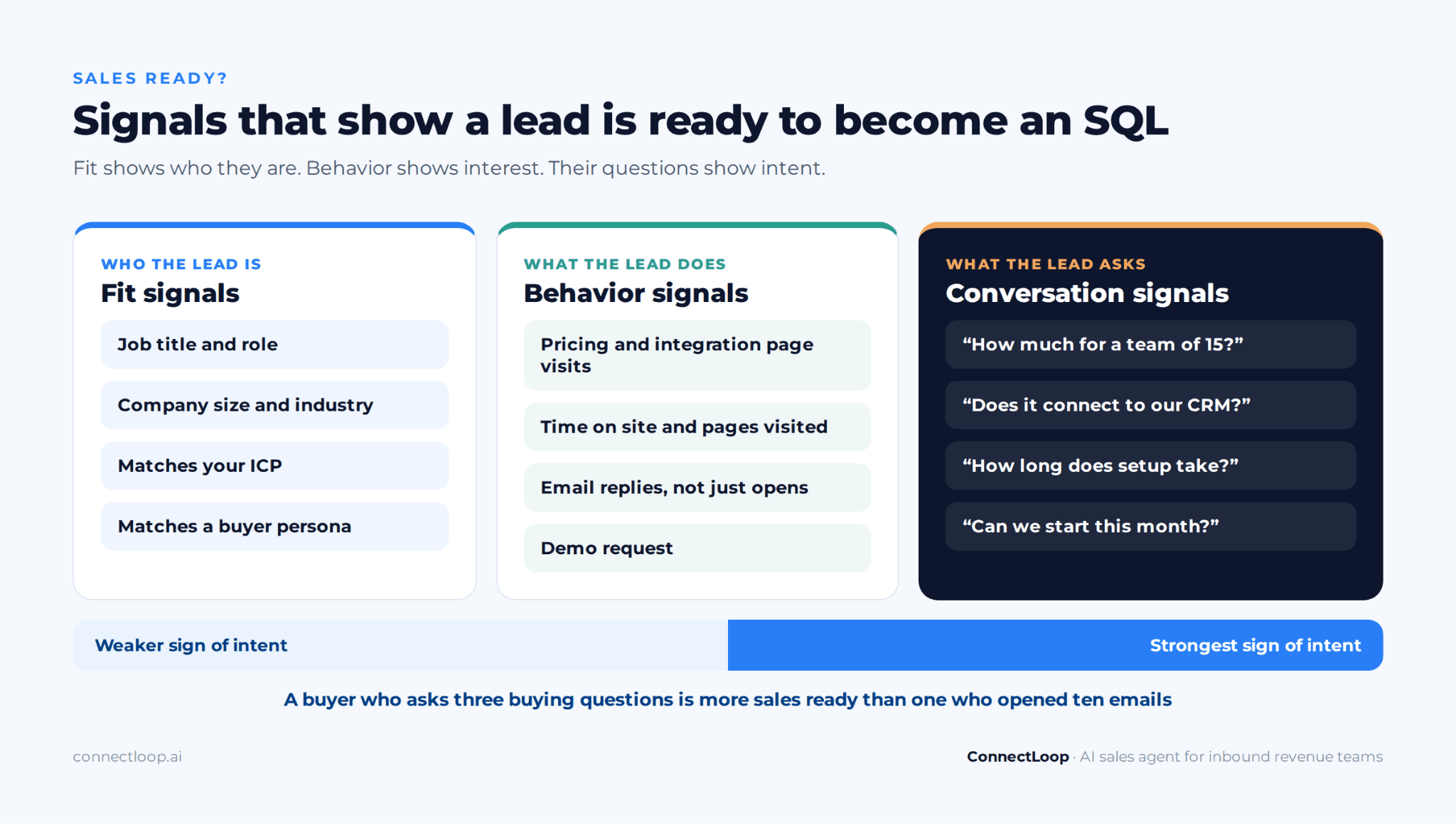
Fit signals (who the lead is):
- Demographics and job title. Is this person likely to influence or make the decision?
- Company information. Company size, industry and location compared with your ICP.
- Buyer persona match. Does their role match a persona you've seen buy before?
Lead behavior signals (what the lead does):
- Website visits and pages visited. Pricing, integration and security pages carry more weight than blog posts.
- Time on site. Longer sessions on product pages suggest serious evaluation.
- Email engagement. Replies matter more than opens.
- Demo request. The clearest single signal of purchase intent.
Conversation signals (what the lead asks):
- "How much does this cost for a team of 15?"
- "Does it connect to our CRM?"
- "How long does setup take?"
- "Can we start this month?"
These are leading indicators: they appear before a deal exists and predict the likelihood to buy better than clicks do. A buyer who asks three buying questions in one chat is more sales ready than one who opened ten emails.
How does lead scoring decide when an MQL becomes an SQL?
Lead scoring gives each lead points for fit and behavior. When the lead score passes an agreed lead score threshold, the lead moves to the next stage. Good scoring also removes points over time through score decay, so old activity doesn't keep a cold lead looking hot. ConnectLoop uses a simple hot, warm or cold score instead.
A basic points model might look like this:
- Fit: right job title, right company size and right industry each add points.
- Behavior: a pricing page visit adds more points than a blog visit; a demo request adds the most.
- Decay: points fade if the lead goes quiet for several weeks.
- Threshold: above one score, a lead is an MQL; above a higher score, sales reviews it.
Points-based scoring has a weakness. It counts clicks, not meaning. A researcher who reads every page can outscore a decision-maker who visited once and asked the right question.
AI-driven lead scoring addresses part of this by learning from past wins and losses. Scoring based on the conversation goes further: it rates the lead by what they actually said and asked. ConnectLoop scores each conversation hot, warm or cold, which is easier for a rep to act on than a number like 73.
Lead scoring covers how to build and tune a model in more detail.
Which framework should you use to confirm an SQL?
Use BANT for most inbound leads: budget, authority, need and timeline. It's quick and easy to confirm in one conversation. For complex, high-value deals, use MEDDIC, which goes deeper on metrics, the economic buyer and the decision process. ConnectLoop supports both, so qualification follows the framework your team already uses.
BANT asks four questions:
- Budget: Is money available, or can it be found?
- Authority: Is this person the decision-maker, or can they reach one?
- Need: Is there a real problem your product solves?
- Timeline: When do they need a solution in place?
MEDDIC adds depth for larger deals: metrics, economic buyer, decision criteria, decision process, identified pain and a champion. It's especially useful when executive buy-in and several approvers are involved.
Neither framework should be a checklist read aloud to the buyer. The best qualification happens naturally, with questions asked in the flow of the conversation. BANT vs MEDDIC explains how to choose, and the MEDDPICC sales methodology covers the extended version.
How do you write MQL and SQL definitions both teams agree on?
Write them down together, in one shared document, with specific criteria, an owner for each stage and a service level agreement (SLA) for response time. Review rejected leads every month and adjust. Definitions that live in one person's head cause most handoff arguments. ConnectLoop recommends starting with five clear rules, not fifty.
A simple process both teams can follow:
- Agree on the ideal customer profile. List the company size, industries, roles and regions you sell to.
- Define an MQL. For example: fits the ICP and has engaged with two or more pieces of content in 30 days.
- Define an SQL. For example: fits the ICP, has shown a buying signal and has confirmed at least need and timeline.
- Set the SLA. Agree how fast sales responds to each new SQL, and how quickly sales accepts or rejects each MQL.
- Create a rejection reason list. "Wrong size", "student", "no budget" and "already a customer" are common examples.
- Build shared dashboards. Both teams see the same numbers, from the same CRM data.
- Run a monthly feedback loop. Review rejected leads and conversion rates, then tune the definitions.
Sales and marketing alignment is less about meetings and more about shared definitions. When both teams agree what an SQL is, arguments about lead quality turn into conversations about improving the numbers.
A shared sales playbook is a natural home for these definitions.
How should the handoff from marketing to sales work?
The handoff should be fast, automatic and full of context. Automated lead routing sends each SQL to the right person based on territory, company size or product. The rep then gets the lead's history, not just a name and email. ConnectLoop passes the full conversation transcript and qualification answers with every handoff.
Who handles each step usually depends on team size:
- SDR or BDR: confirms qualification and books the meeting. SDR vs BDR explains the difference.
- Appointment setter: in some teams, a dedicated role focused only on booking meetings.
- Account executive: runs the discovery call and owns the deal from SQL to opportunity.
A good handoff includes:
- What the lead asked, in their own words.
- What they shared: company size, use case, budget range and timeline.
- What they looked at: pages visited and content downloaded.
- Their score: hot, warm or cold, or the lead score.
- The next step: a booked meeting, not a "please follow up" note.
With this context, the rep opens the discovery call by confirming what the buyer already said instead of starting from zero. Marketing automation and your CRM should carry this information automatically; manual copy and paste is where context gets lost.
Why do leads go cold during the handoff?
Leads go cold when nobody responds quickly. The most common causes are slow lead routing, unclear ownership, leads arriving outside working hours, and reps waiting for more information. Every hour of delay gives the buyer time to lose interest or talk to a competitor. ConnectLoop answers inbound leads instantly, at any hour.
Typical handoff failures:
- After-hours leads. A demo request on Friday evening waits until Monday.
- No clear owner. The lead sits in a shared queue.
- Missing context. The rep has to research before calling, so the call slips.
- Slow acceptance. Sales doesn't review MQLs within the agreed SLA.
Speed to lead explains why response time has such a large effect on conversion.
Can a lead move from MQL to SQL in a single conversation?
Yes. When a buyer asks questions in website chat, WhatsApp or email, an AI agent can answer, ask qualifying questions and book a meeting in the same thread. The lead moves from interested to sales ready in minutes, without a form or a waiting queue. ConnectLoop's AI sales agent, Lia, qualifies leads this way.
Here's how it typically works:
- A visitor asks: "Does this work for a team of 20?"
- Lia answers from your approved content, then asks what tools they use today.
- The visitor mentions their CRM and that they need something live next month.
- Lia confirms fit, scores the conversation hot and offers real times from the rep's calendar.
- The visitor books. The rep receives the transcript and qualification answers.
In this flow, the MQL and SQL stages still exist, but they happen in one conversation instead of over weeks. The buyer never fills in a form or waits for a reply.
Inbound lead qualification and AI appointment booking explain each part in more detail, and conversational messaging covers the channels.
What should you do with leads that aren't ready?
Put them back into lead nurturing, with a clear reason and a planned next touch. A lead that isn't ready today may be ready next quarter. Disqualify only leads that will never fit, such as students or companies outside your market. ConnectLoop helps by drafting follow-ups when known leads come back.
Three paths for leads that don't become SQLs:
- Nurture: the lead fits but isn't ready. Send relevant educational content and invite them to webinars.
- Recycle: the lead was an SQL but the timing slipped. Return them to marketing with notes, and set a date to check in.
- Disqualify: the lead will never fit. Mark the reason so marketing can adjust targeting.
Rejected leads are useful data, not waste. If sales rejects many MQLs for the same reason, the MQL definition needs to change.
When a recycled lead shows interest again, such as returning to the pricing page, that's the moment to reach out. How to write a follow-up email after no response has templates for re-engaging quiet leads.
How do you spot interest before a lead becomes an MQL?
Most website visitors never fill in a form, so they never become leads at all. You can still see interest by identifying the companies behind anonymous visits and watching which pages they view. That lets you reach the right accounts earlier. ConnectLoop's Visitor Intelligence identifies the companies behind anonymous website traffic.
Signals worth watching before anyone converts:
- Several visitors from the same company, suggesting a buying group is researching.
- Pricing and integration page visits from companies that match your ICP.
- Return visits over a short period.
These accounts aren't MQLs yet, but they're worth watching. A well-timed chat prompt or a relevant piece of content can turn an anonymous visit into a conversation. Identifying anonymous website visitors explains how it works.
How do you measure the MQL to SQL conversion rate?
Divide the number of MQLs that became SQLs in a period by the total number of MQLs in that period, then multiply by 100. Track it monthly, by source and by channel. Then track SQL to opportunity conversion to see if sales agrees with the qualification. ConnectLoop tracks every conversation from first message to booked call.
MQL to SQL conversion rate = (SQLs ÷ MQLs) × 100
For example, 40 SQLs from 200 MQLs is a 20% conversion rate.
Published benchmarks vary widely by industry, deal size and how each company defines an MQL, so your own trend matters more than an industry average. Watch for these patterns:
- Low MQL to SQL rate: the MQL definition may be too loose, or nurturing too weak.
- High MQL to SQL but low SQL to opportunity rate: the SQL definition may be too loose.
- Big differences by source: some channels bring better leads; shift budget toward them.
- Slow movement between stages: the handoff or response time is the bottleneck.
Track these alongside pipeline value and the time from first touch to opportunity. Inbound sales metrics lists the other numbers worth watching.
How does ConnectLoop help turn MQLs into SQLs faster?
ConnectLoop qualifies inbound leads inside the conversation. Lia answers buyers on website chat, WhatsApp and email 24/7, asks qualifying questions, scores each conversation hot, warm or cold, and books the meeting. The rep gets the full transcript. ConnectLoop removes the wait between an MQL showing interest and a person responding.
ConnectLoop is an AI sales agent platform for inbound revenue teams. It replaces a live chat tool, a scheduling app, a follow-up sequencer and a support inbox with one system, and an agent can be trained on your website in about 60 seconds. To understand the category, read what an AI sales agent is.
How ConnectLoop supports each stage:
- Before the MQL: Visitor Intelligence identifies the companies behind anonymous traffic.
- MQL: Lia answers questions instantly from your approved content, at any hour.
- SQL: Lia qualifies in the conversation using frameworks such as SPIN and MEDDIC, and scores intent. On calls, Sales Assistance tracks BANT, MEDDICC or your own method.
- Handoff: Lia books against real calendar availability and passes the transcript to the rep. Complex conversations go to a person through the AI-to-human handoff.
- Not ready yet: when a known lead returns, Proactive Outreach drafts a personalized follow-up that a person reviews, edits and sends or dismisses.
- CRM: conversations, contacts and meetings sync to Salesforce, HubSpot or Zoho.
- Knowledge Gaps: shows questions Lia couldn't answer, often the same questions that stall qualification.
ConnectLoop is CASA Verified by Google, a Verified Meta Business and an official Meta Business Partner.
What stays with your team?
Your team still owns the definitions, the relationships and the deals. ConnectLoop handles fast answers, qualification and booking for inbound conversations, while marketing sets the ICP and nurture strategy and sales runs discovery, negotiation and closing. ConnectLoop is built for inbound leads, so outbound prospecting stays a human job.
Your content sets the ceiling. Lia qualifies only as well as your pricing, product and integration pages allow, and the Knowledge Gaps report shows where they fall short. For handling the questions that come up once leads are qualified, see objection handling.
Key takeaways
- The MQL vs SQL difference is intent. MQLs are exploring; SQLs are actively buying.
- SAL and PQL add useful stages. SAL adds accountability; PQL captures users who've already seen your product work.
- The strongest buying signal is a question. Pricing, integration and timing questions beat clicks and opens.
- Scoring should reflect meaning, not just activity. Use score decay, and consider scoring conversations hot, warm or cold.
- Write definitions down together. Shared criteria, an SLA, shared dashboards and a monthly feedback loop keep teams aligned.
- The handoff needs speed and context. Route leads automatically and pass the full history to the rep.
- ConnectLoop qualifies inside the conversation. Lia answers, qualifies and books inbound leads at any hour, so MQLs become SQLs without the wait.

About the author
ConnectLoop Staff
Written by the ConnectLoop team. ConnectLoop is an AI sales agent for inbound revenue teams, based in Cambridge, Massachusetts.
About ConnectLoop →Frequently asked questions
MQL usually comes first. A lead engages with marketing, becomes an MQL, then becomes an SQL once they show buying intent and meet your qualification criteria. Some leads skip the MQL stage entirely: a buyer whose first action is a demo request or a pricing question should go straight to sales.
A lead is sales qualified when they fit your ideal customer profile and show clear buying intent, such as a demo request or questions about pricing and setup. Most teams also confirm need and timeline, and often budget and authority, using a framework like BANT before the lead reaches an account executive.
A sales accepted lead (SAL) is an MQL that sales has reviewed and agreed to work. It sits between MQL and SQL and creates accountability: sales must accept or reject each MQL within an agreed time, and rejection reasons help marketing improve lead quality.
A product qualified lead (PQL) has used your product, usually through a free trial or free plan, and reached a moment that shows real value. An SQL has shown buying intent through conversations or behavior, not necessarily product use. Product-led companies often treat PQLs as their most valuable leads.
Both teams share it. Marketing attracts and nurtures leads until they're MQLs, and sales, often SDRs or BDRs, confirms qualification and turns them into SQLs. A shared definition, an SLA and a regular feedback loop make the handoff work. AI agents can also qualify inbound leads in the conversation.
It varies widely, from minutes to months. A buyer who asks a pricing question and books a call in the same chat moves from MQL to SQL almost instantly. A buyer still researching the problem may take weeks or months of nurturing. Long, complex deals usually take the longest.
Tighten the MQL definition, respond faster, and qualify in the conversation instead of through long forms. Review rejected leads monthly to find patterns, nurture leads that aren't ready, and focus budget on the sources that produce the most SQLs. Fast, helpful first replies usually make the biggest difference.
ConnectLoop's AI sales agent, Lia, qualifies inbound leads in website chat, WhatsApp and email at any hour. Lia answers questions from your approved content, asks qualifying questions, scores each conversation hot, warm or cold, and books meetings against real calendar availability. The rep receives the full transcript before the call.
Turn interest into a booked meeting, in one conversation
ConnectLoop qualifies inbound leads inside the conversation. Lia answers buyers on website chat, WhatsApp and email 24/7, asks qualifying questions, scores each conversation hot, warm or cold, and books the meeting. The rep gets the full transcript, so there's no wait between an MQL showing interest and a person responding.