
AI Sales Agents
Human Handoff: When Your AI Sales Agent Should Bring In a Person
Human handoff is the moment an AI sales agent passes a conversation to a person, with everything the buyer already said attached. A good handoff happens for a clear reason, reaches the right rep quickly and never makes the buyer repeat themselves. ConnectLoop's agent, Lia, hands off with the transcript, intent score, summary and a recommended next step.

Published
Table of contents
- What is human handoff in an AI sales agent?
- How is a handoff different from routing, escalation and fallback?
- When should an AI sales agent hand off to a human?
- What should the AI pass to the person?
- Who does the conversation go to, and how is it routed?
- Does the person take over the same chat, or follow up on another channel?
- Does the buyer notice the switch, and should they be told?
- Where should the handoff be logged?
- Why is a booked meeting the best handoff in inbound sales?
- How does ConnectLoop handle human handoff?
- How do you set up human handoff, step by step?
- How do you measure whether handoffs are working?
- What are the common mistakes in AI-to-human handoff?
- Should AI replace SDRs?
- Key takeaways
- Frequently asked questions
What is human handoff in an AI sales agent?
Human handoff, also called AI-to-human handoff, is the planned transfer of a live conversation from an AI agent to a person. The agent recognises it should step aside, tells the buyer, and sends the conversation context to a rep. ConnectLoop treats it as part of the sales process, not as an error state.
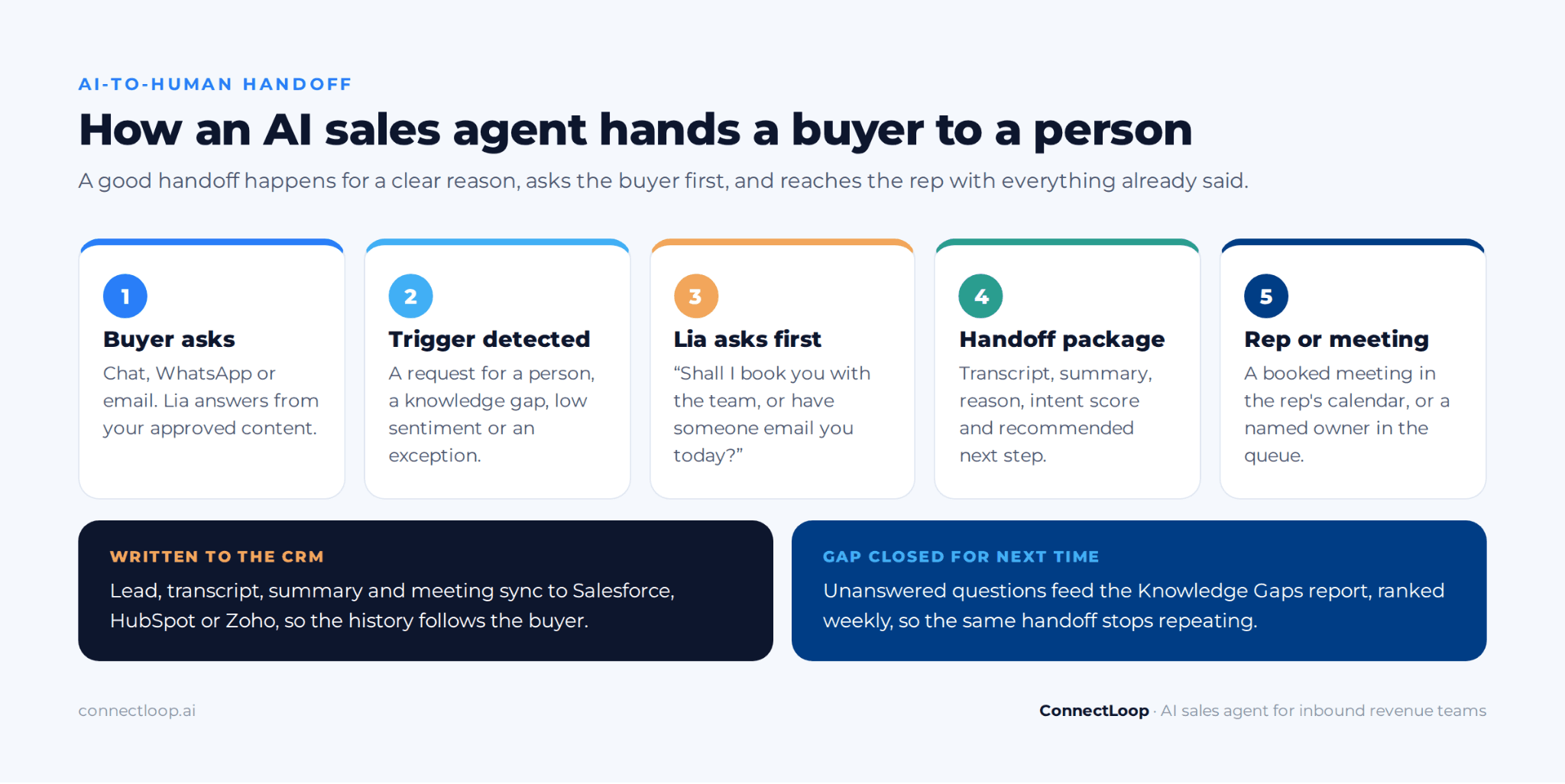
An AI sales agent answers questions, qualifies the lead and books meetings. Some conversations need human expertise: a custom deal, a sensitive account issue, or a buyer who simply wants a person.
The handoff is where human-in-the-loop design becomes visible to the buyer. Done well, it feels like one continuous conversation with one seller. Done badly, it feels like starting again.
Does a handoff mean the AI failed?
No. A handoff means the agent recognised the limit of what it should decide. The failure is guessing instead of handing off, or handing off without context. ConnectLoop designs Lia to say when she doesn't know, offer a person, and flag the gap, rather than produce a confident wrong answer.
The useful split is simple. AI handles volume, speed and consistency: published pricing, product questions, qualification questions and calendar booking.
People handle judgment: negotiation, exceptions, relationships and anything that commits the business. A handoff is the agent sending the buyer to the right side of that line.
At that point the agent's job is to prepare the decision, not make it. Human intervention then starts from a summary, not a blank screen.
How is a handoff different from routing, escalation and fallback?
The four terms overlap but describe different moves. Routing decides where a conversation goes. Escalation raises it to someone with more authority. Fallback is what the agent does when it can't answer. Handoff is the actual transfer to a person, with context. ConnectLoop uses all four, and the difference matters when you design the rules.
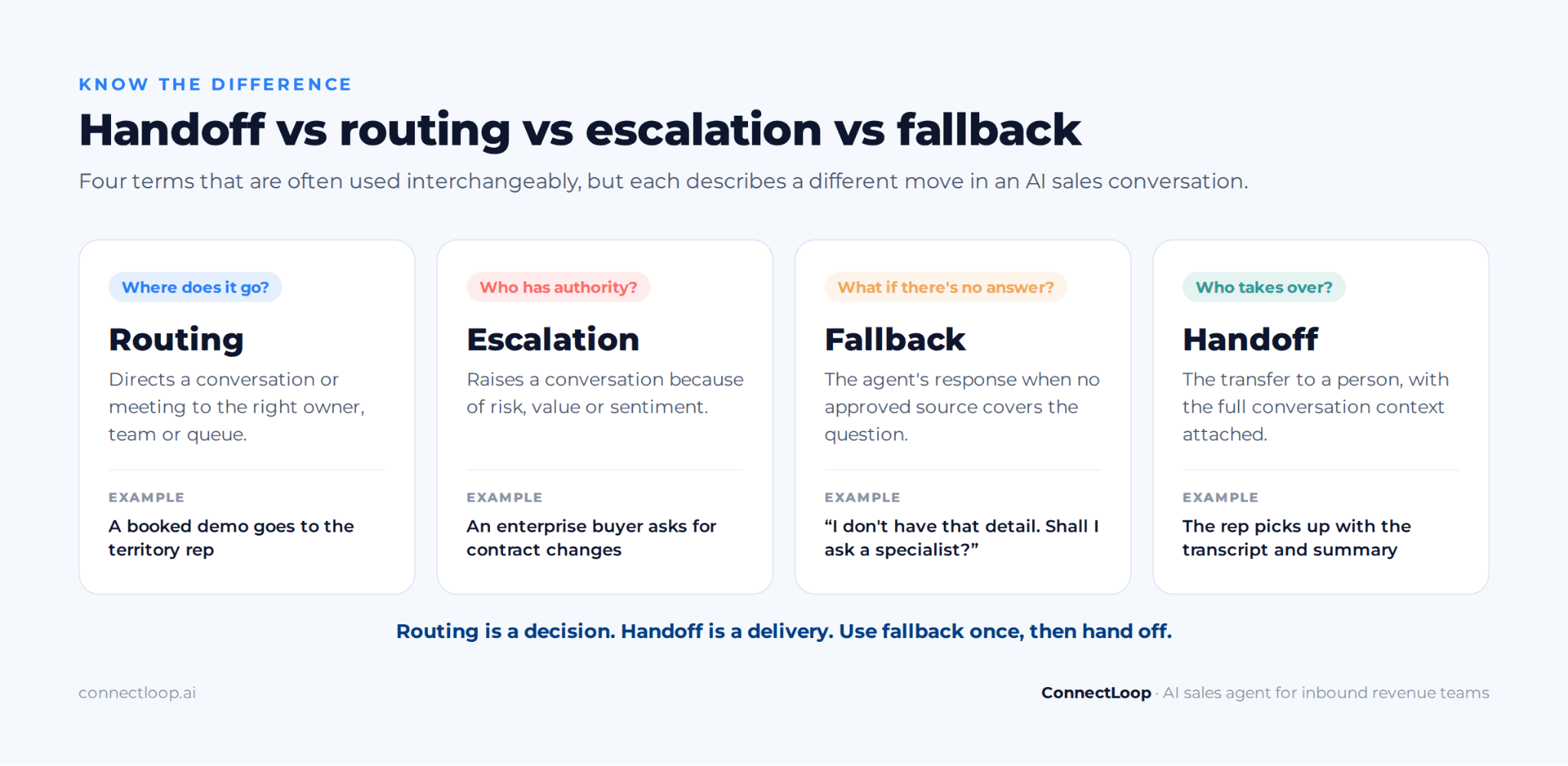
| Term | What it means | Who acts next | Example |
|---|---|---|---|
| Routing | Directing a conversation or meeting to the right owner, team or queue | The assigned owner | A booked demo goes to the rep who owns that territory |
| Escalation | Raising a conversation because of risk, value or sentiment | A senior rep or manager | An enterprise buyer asks for contract changes |
| Fallback | The agent's response when it lacks an approved answer | The agent, then a person | "I don't have that detail. Shall I ask a specialist?" |
| Handoff | The transfer of the conversation to a person, with the full context | A named rep or shared queue | The rep picks up with the transcript and a summary |
Intelligent conversation routing reduces how many handoffs you need. When the agent answers routine questions and books qualified buyers straight into a calendar, people only see conversations that genuinely need them.
That is the core of AI routing vs AI handoff. Routing is a decision; handoff is a delivery. A good system makes both.
The handoff vs fallback distinction matters just as much. A fallback keeps the buyer with the agent for one more try; a handoff ends the agent's turn. Use fallback once, then hand off.
Can AI route conversations to support or hiring instead of sales?
Yes. Not every inbound conversation is a sales lead. Existing customers ask support questions, job seekers ask about roles, and partners ask about partnerships. ConnectLoop's agent classifies intent first, so a support request can go to the support team and a buying conversation stays with sales.
This protects pipeline quality. When every chat lands in the sales queue, reps waste time sorting it.
Intent recognition at the start keeps the sales queue for buyers and sends everyone else to the right place, with the conversation summary attached.
When should an AI sales agent hand off to a human?
Hand off when a person can do something the agent shouldn't: decide an exception, answer beyond the approved content, calm an upset buyer, or move a high-value deal forward. The clearest escalation triggers are an explicit request, a knowledge-base gap, negative sentiment and commercial ambiguity. ConnectLoop logs the reason for every handoff.
Write escalation criteria down before launch. Vague rules like "escalate complex conversations", or a single complexity threshold, produce either over-escalation or buyers stuck with an agent that should have stepped aside.
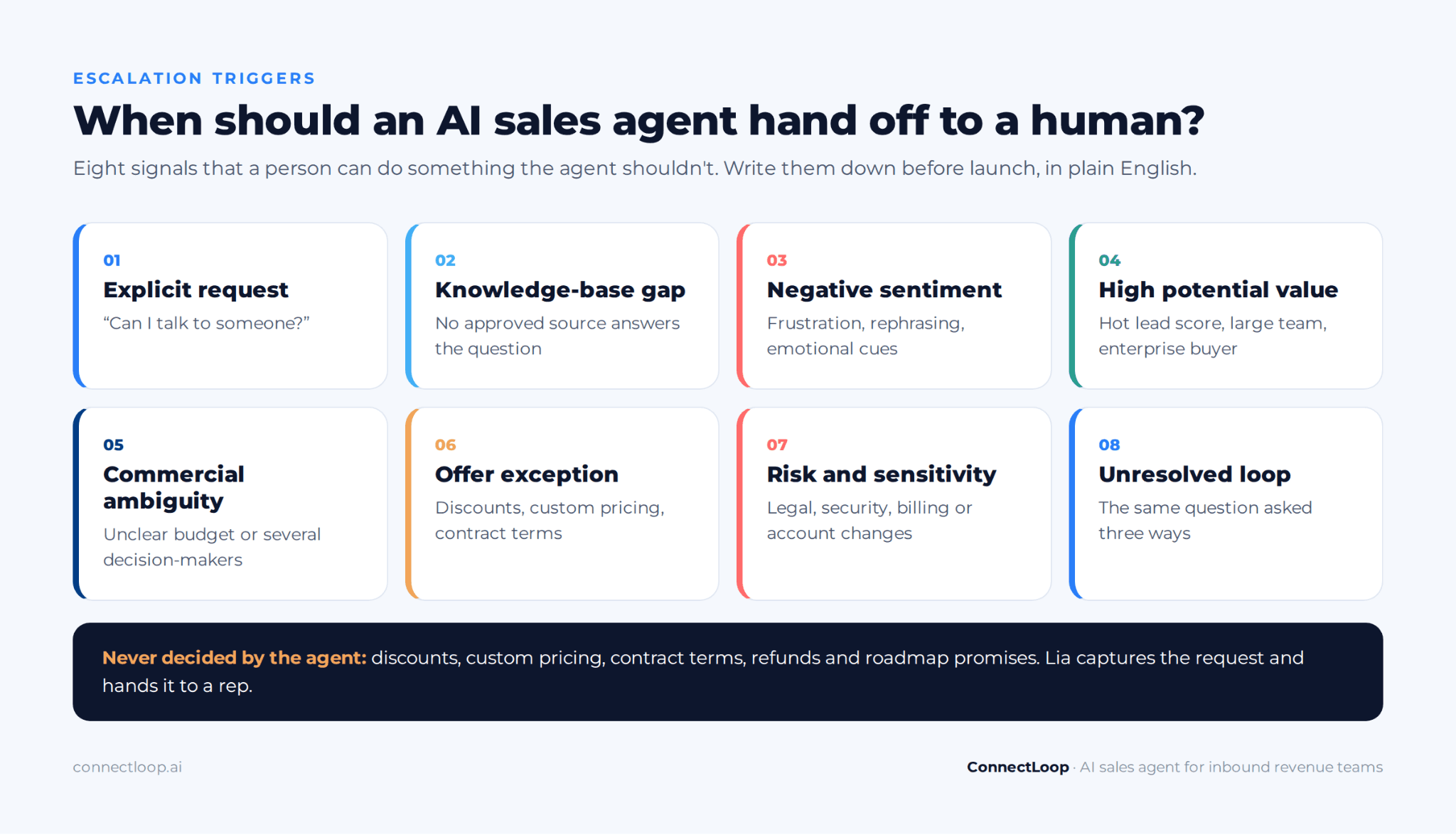
| Situation | Observable signal | Recommended action | What the rep should receive |
|---|---|---|---|
| Explicit request to speak to a person | "Can I talk to someone?" | Offer a person immediately, or a meeting | Transcript and the question that prompted it |
| Knowledge-base gap | No approved source answers the question (lack of evidence) | Say so, capture the question, offer a person | The unanswered question, verbatim |
| Negative sentiment | Frustration, repeated rephrasing, emotional cues | Hand off with an apology, not a script | Sentiment trend and what was already tried |
| High potential value | Hot lead score, large team size, enterprise domain | Book a meeting with a senior rep | Intent score, company details, qualification status |
| Commercial ambiguity | Unclear budget, multiple decision-makers, procurement steps | Book a discovery call | Open questions and qualification gaps |
| Offer exception | Discount requests, custom pricing, contract terms | Hand off; the agent makes no commitment | The exact request and the buyer's stated reason |
| Risk and sensitivity | Legal, security, billing or account changes | Escalate to the named owner | Full conversation history |
| Unresolved after several replies | The same question asked three ways | Hand off before the buyer gives up | The loop, and the answers that didn't land |
Sentiment detection and tone analysis help, but they are signals, not verdicts. Natural language processing can spot frustration in words like "again" or "still". It can't always tell sarcasm from satisfaction, so pair it with a clear path to a person.
Knowledge-base gaps are easier to detect. Most AI agents answer through retrieval-augmented generation (RAG): they look up approved content before replying. When the lookup finds nothing relevant, that lack of evidence is the trigger to hand off, not to improvise.
What should an AI sales agent never decide on its own?
Anything that commits the business beyond published terms. Discounts, custom pricing, contract terms, refunds, roadmap promises and legal or security assurances belong to a person. ConnectLoop's approach is to keep these out of the agent's knowledge base entirely, so the agent captures the request and hands it to a rep.
Knowing what an AI sales agent should never decide is the sales-specific rule most handoff guides skip. An agent that offers 15% off to close a chat has made a negotiation decision with no context on margin, deal size or precedent.
The rep can trade instead of discount, as covered in how to negotiate in sales. The knowledge base guide explains what to keep out of the agent's sources and why.
Can AI answer pricing questions?
Yes, when the pricing is published and approved. Pricing questions are among the most common in inbound sales, and an agent that answers them instantly keeps buyers moving. An account or pricing request that goes beyond the published plans, such as a custom quote or volume deal, is the point to hand off. ConnectLoop follows this split.
Load the current pricing page, plan limits and add-ons into the agent's sources. Update them the day pricing changes.
Everything else, such as multi-year terms, non-standard seat counts or bundled services, becomes a handoff with the buyer's numbers attached.
Can a buyer ask for a human at any time?
They should be able to. Gartner found in 2026 that 87% of customers say companies using generative AI must offer a way to reach a human agent. ConnectLoop's view is that an agent which blocks a buyer from a person costs more trust than it saves in rep time.
The Gartner survey of 3,566 customers, published 4 August 2026, also found the ability to switch to a human was the most common answer to what would make customers more willing to use AI.
"A person" doesn't have to mean "right now". Out of hours, the honest offer is a booked meeting or a confirmed callback time.
What should the AI pass to the person?
A handoff package: who the buyer is, what they asked, why the handoff happened, and what should happen next. The rep should be able to act within a minute of opening it. ConnectLoop sends the full transcript, an AI-written summary, the intent score and a recommended next step, and writes them to the CRM.
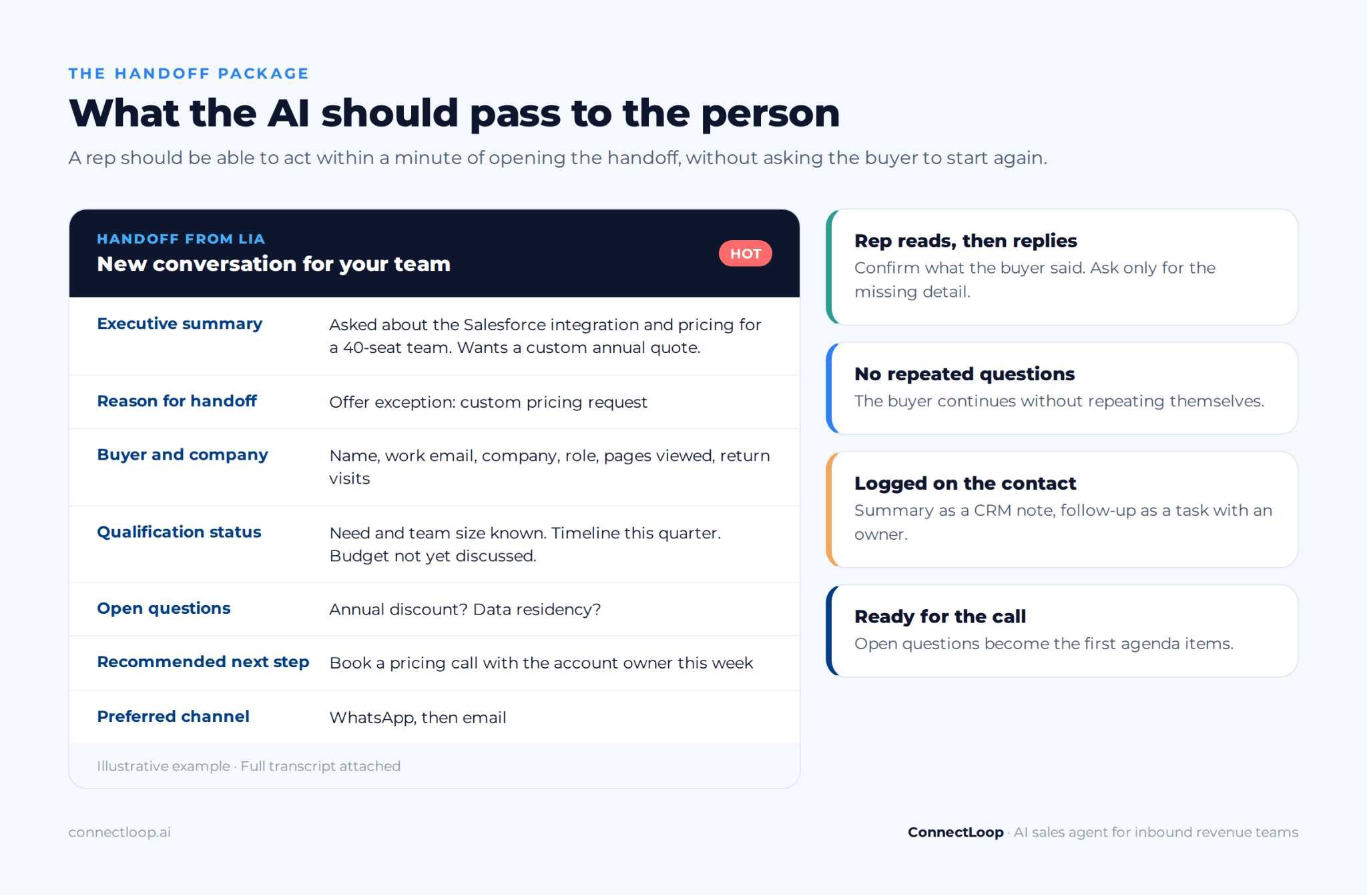
| Element | What it contains | Why the rep needs it |
|---|---|---|
| Executive summary | Two or three lines: who, what, why now | Lets the rep decide priority in seconds |
| Reason for handoff | The trigger: request, gap, sentiment, exception or value | Tells the rep what problem to solve first |
| Buyer and company details | Name, email or phone, company, role, enrichment data | Avoids asking for details the buyer already gave |
| Intent and lead score | Lead temperature (hot, warm or cold) and the signals behind it | Sets urgency and who should take it |
| Qualification status | What is known about need, timeline, budget and decision-makers | Shows what still needs discovering |
| Conversation history | The full transcript, plus earlier visits and conversations | Gives the rep context without re-asking |
| Open questions | Unanswered questions and open objections | Lets the rep answer first and pitch second |
| Recommended next step | Book a demo, send a quote, call back today | Turns the handoff into an action |
| Preferred channel | Chat, WhatsApp, email or phone, and the contact method | Lets the rep follow up where the buyer is |
Company details can come from the conversation, from enrichment, or from de-anonymisation of website traffic. ConnectLoop's Visitor Intelligence follows each visitor's journey from the first visit and attaches it when they share their details, as covered in how to identify anonymous website visitors.
Keep the summary short. Reps skim. A handoff summary that runs to a page will be skipped, and the rep will ask the buyer to start again anyway.
The qualification fields should follow the framework your team already uses. The comparison of BANT vs MEDDIC shows which fits inbound deals; inbound lead qualification covers the questions to capture.
How do you stop the buyer repeating themselves after the handoff?
Pass the transcript and summary with the handoff, and have the rep open with what they already know. "You asked about the Salesforce integration and a 40-seat team" shows the buyer they were heard. ConnectLoop puts the summary and transcript on the contact record, so the rep reads before replying.
Repetition is the most common handoff complaint for a reason. When a buyer explains their situation to an agent and then again to a rep, it signals that the two don't talk to each other.
Three habits let the buyer continue without repeating themselves. Read the summary first. Confirm, don't re-ask. If something is missing, ask for that one detail only.
Who does the conversation go to, and how is it routed?
To the person best placed to act on it, chosen by rules you set: the account owner, the territory rep, a round robin across the team, or a shared queue. Hot leads should reach a named rep; lower-priority handoffs can sit in a queue. ConnectLoop routes booked meetings to the right rep through your connected calendar and CRM.
Common routing methods each suit a different team:
- Account owner first: existing CRM owner gets every handoff from their accounts. Best for teams with named accounts.
- Round robin: handoffs rotate evenly across reps. Best for small inbound teams with similar roles.
- Shortest queue: the rep with the fewest open handoffs gets the next one. Best when response time matters most.
- Shared queue: any available rep picks up. Best for after-hours follow-up and support-heavy teams.
Add review states so the queue reflects urgency. A simple three-level model works: immediate for hot leads and upset buyers, normal for standard follow-up, and nurturing for buyers who aren't ready yet.
Team notifications should match the urgency. Email alerts suit normal priority; immediate handoffs need a channel the team watches, such as Slack, Teams or a mobile notification.
What does the team see when a conversation is escalated?
A record with the reason, the summary, the buyer's details, the channel and a status. The status shows whether someone has acted: open, notified or closed. ConnectLoop's Conversational Intelligence shows escalated conversations with the reason, and alerts waiting on the team appear on the Overview so nothing sits unnoticed.
Every handoff should leave a trail of who received it, when, and what they did. Traceability matters for coaching and for spotting patterns, such as the same question escalating every week.
A shared queue without status tracking becomes a pile. Assign each item to one person, even in a shared model.
What happens if no sales rep is available?
"No sales rep available" should never mean no next step. The agent should keep the buyer moving: answer what it can, book a meeting into the next available slot, and confirm when a person will follow up. An after-hours handoff that says "someone will be in touch" with no time loses the buyer. ConnectLoop's agent books directly into real calendar availability, at any hour.
Inbound conversations don't keep office hours. WhatsApp traffic in particular skews to evenings and weekends, as covered in how a WhatsApp AI agent works.
Speed to lead after handoff matters as much as before it. A buyer who books at 11pm should get a confirmation instantly and a prepared rep in the morning. See speed to lead for why the first hour decides so many deals.
Does the person take over the same chat, or follow up on another channel?
Both models work. In a manual takeover, the rep joins the same window and the buyer keeps chatting in one thread. In a follow-up model, the agent stays in the chat and the rep contacts the buyer by their preferred channel. ConnectLoop keeps one record per buyer, so either path carries the full conversation history.
A rep who can take over on the spot suits live, high-intent conversations, such as a buyer on the pricing page ready to talk numbers. The live agent takes over the same chat and the conversation continues without a gap.
Following up suits everything else. The buyer picks a contact method, such as email, phone or WhatsApp, and the rep replies there with context.
Omnichannel is where many handoffs break. A buyer who chats in the website widget, then messages on WhatsApp, then replies to an email should exist as one buyer record across chat, WhatsApp and email, not three strangers. Some tools extend this to Instagram, Messenger and RCS; the principle is the same. Conversational commerce depends on the same continuity.
On WhatsApp, the 24-hour customer service window applies to the business. Free-form replies are possible within 24 hours of the buyer's last message; after that, the business needs an approved template message. A slow rep can lose the window as well as the buyer.
What happens after the rep is done?
The conversation should be able to return to the agent. Human-to-AI handback means the rep resolves the exception, and the agent resumes routine questions with the rep's outcome in its context. ConnectLoop records the rep's activity on the same contact, so the next conversation starts from the latest state, not from scratch.
Handback is the half of the handoff that almost no one designs. Without it, the buyer's next chat starts fresh, and the agent may repeat an offer the rep already changed.
Write the rep's outcome to the record in one line, such as "Custom quote sent, 40 seats, expires 30 Nov". The agent and the next rep both read it.
Does the buyer notice the switch, and should they be told?
They should be told. Being clear that the buyer is talking to AI, and when a person joins, protects trust. In the EU it is also a legal requirement. ConnectLoop recommends a consent-first handoff: the agent asks before connecting and says who will follow up and when.
Under Article 50 of the EU AI Act, providers must design AI systems that interact directly with people so that users are informed they are interacting with AI, unless that is obvious. These transparency obligations apply from 2 August 2026.
Disclosing that the buyer is talking to AI doesn't weaken the conversation. A short line such as "I'm Lia, ConnectLoop's AI assistant. I can answer most questions or connect you with the team" sets the right expectation.
At the handoff itself, a consent-first agent asks before connecting: "Would you like me to book a call with Sam, or have someone email you today?"
Where should the handoff be logged?
In the CRM, on the contact and the deal, so the history follows the buyer. Use a CRM note for the summary, a task for the follow-up, and a ticket only when it's a support issue. ConnectLoop writes the lead, transcript, summary and booked meeting to Salesforce, HubSpot or Zoho automatically.
Where to log the handoff depends on what the person needs to do:
- CRM note: the session summary and transcript, for anyone who opens the contact later
- Task: the follow-up, with an owner and a due time
- Deal or opportunity: the qualification status and next step, when the handoff is a buying conversation
- Ticket: only for support issues, so sales and support queues stay separate
- Team channel: the alert, linking back to the record. A message without a record link is lost by Friday
Teams that build their own handoff often connect webhooks to workflow tools such as n8n, so a handoff event creates a CRM task and a team notification at the same time.
That works, but it adds a system to maintain. Whatever the tool, the CRM history should be the single record of truth.
Why is a booked meeting the best handoff in inbound sales?
Because a handoff to a booked meeting turns a waiting room into a commitment. The buyer leaves with a time, the rep arrives prepared, and nothing depends on someone checking a queue. For qualified inbound buyers, ConnectLoop's agent checks real availability on Google Calendar or Outlook and books the meeting inside the conversation.
Most handoff designs end at a notification. For a support question that's fine. For a qualified buyer, a notification is a delay, and delay is where inbound deals go cold.
Buyers still want a rep at the right moment. Gartner's survey of 645 B2B buyers, published 20 May 2026, found 67% prefer a rep-free experience overall, yet 69% turn to sales reps to validate AI-generated insights.
That's the pattern a good handoff serves. Let buyers self-serve until they want a person, then give them a person who already knows the conversation. AI appointment booking explains how booking works inside the chat, including reschedules.
How does ConnectLoop handle human handoff?
ConnectLoop's agent, Lia, answers from your approved content and hands off when she shouldn't decide alone. Each handoff carries the transcript, a summary, the intent score and a recommended next step, and is written to your CRM. Unanswered questions feed the Knowledge Gaps report, so every handoff improves the agent.
ConnectLoop is an AI sales agent platform for inbound revenue teams. Lia works across website chat, WhatsApp, email and voice, answering questions in real time, qualifying leads and booking meetings 24/7.
It replaces the stack of live chat tool, scheduling app, follow-up sequencer and support inbox with one system, and tracks every conversation from first message to booked call. The agent trains on your website in about 60 seconds.
Here is how the handoff works in practice:
- Grounded answers or a handoff. Lia answers from approved sources. When the answer isn't there, she says so, offers a person and flags the gap, instead of guessing.
- Sensitive conversations escalate with the full transcript. Escalation paths include a full conversation and activity audit trail.
- A handover threshold you control. In Conversational Intelligence, conversations whose sentiment falls to your handover threshold, or where the visitor asks for a person or a meeting after the agent couldn't help, appear with the reason. Lower the threshold to catch more; raise it to catch only the serious ones.
- Scored before your team sees it. Every lead is scored hot, warm or cold from buyer intent signals such as pages viewed and return visits, so the rep knows which buyer to call now and which warm and cold leads to nurture. Lead scoring explains how scores are built.
- Written to your CRM. The lead, transcript, summary and meeting sync to Salesforce, HubSpot or Zoho, so the CRM history stays complete.
- Booked into real availability. Lia books meetings against Google Calendar or Outlook availability, inside the conversation, and meetings route to the right rep.
- Context on WhatsApp. The buyer stays in WhatsApp, and a person picks up with the full transcript, the detected intent and what has already been tried.
ConnectLoop is CASA Verified by Google, a Verified Meta Business and an official Meta Business Partner, which matters when the handoff happens on WhatsApp for sales.
Where people stay in charge. Discounts, custom terms and contract decisions stay with your reps; Lia captures the request and hands it over. Follow-up stays human too: Proactive Outreach drafts follow-up emails that a person reviews, edits, and sends or dismisses, so even the follow-up email after no response has a person behind it.
How does each handoff make Lia better?
Every question Lia couldn't answer is logged, and ConnectLoop's Knowledge Gaps report surfaces them weekly, ranked by how often they come up. Your team adds the missing answer once, and the same knowledge-base gap stops causing handoffs. ConnectLoop also logs the reason for each escalation, so recurring triggers become visible.
This is closing the knowledge gap in practice. A handoff for a missing integration answer this week should be an instant answer next week.
Over time, the handoffs that remain are the ones that genuinely need a person: exceptions, negotiations and high-value conversations.
What happens when the handed-off buyer gets on a call?
The rep starts the call already knowing the conversation. ConnectLoop's Sales Assistance carries everything said in chat, plus the buyer's open objections, into the call. A customer dossier keeps open promises and stakeholders, and live call coaching shows cues during Google Meet and Zoom calls, with no bot joining.
This is the last step most handoff designs miss: the rep prepared for the call, not just notified about it.
The handoff summary becomes the call plan, and the open questions become the first agenda items. What AI sales coaching actually does explains the live coaching side, and Sales Assistance shows the product.
How do you set up human handoff, step by step?
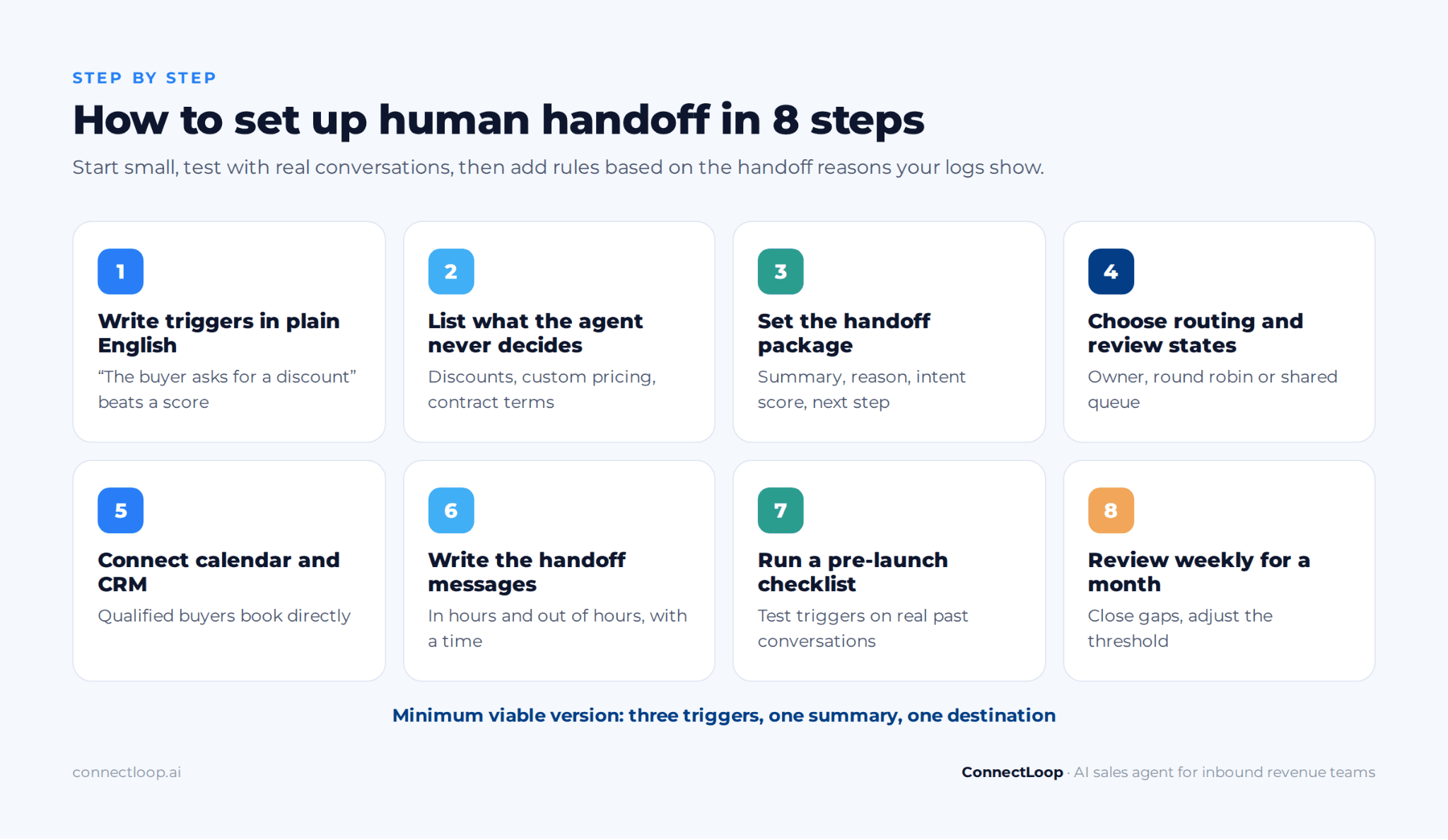
Start with written triggers, a short handoff package and one routing rule, then test with real conversations before launch. Most teams over-design the first version. ConnectLoop recommends launching with three triggers and a booked-meeting path, then adding rules based on the reasons the logs show.
- Write the triggers in plain English. Plain-English handoff conditions, such as "the buyer asks for a discount" or "the buyer asks twice for something the agent can't answer", are easier to review than scores.
- Define what the agent must never decide. List the exceptions: discounts, custom pricing, contract terms, refunds and roadmap promises.
- Set the handoff package. Choose the fields the rep receives: summary, reason, buyer details, intent score, open questions, next step.
- Choose routing and review states. Decide who receives each type: owner, round robin or shared queue, and which handoffs are immediate, normal or nurturing.
- Connect the calendar and CRM. Qualified buyers should book directly, and every handoff should land on the contact record.
- Write the handoff messages. Draft what the agent says when it hands off, in hours and out of hours, including who follows up and when.
- Run a pre-launch checklist. Test each trigger with real past conversations. Check that the rep sees the context, the CRM record updates, and the buyer gets a clear message.
- Review weekly for the first month. Read the handoff reasons, close knowledge gaps, and adjust the threshold if the queue is too full or too quiet.
The sales playbook is the right home for these rules, so reps and the agent work from the same source.
What is the minimum viable version of a handoff?
Three triggers, one summary, one destination. Hand off on an explicit request, a knowledge-base gap and any offer exception. Send the transcript and a three-line summary to the CRM and one team channel. ConnectLoop's default handoff covers this without custom setup: transcript, summary, intent score and next step.
Leave intent score thresholds, per-agent rules and complex routing for later. They are design decisions worth making once you've seen a month of real handoff reasons.
Can you control when the handoff happens, and set rules per agent?
Yes, and you should. Rules belong to the business, not the model. Teams with more than one agent, such as one for sales and one for support, often need per-agent handoff rules. ConnectLoop lets you set the handover threshold under Agent Behavior, so you decide how sensitive escalation should be.
A sales agent might hand off any enterprise-sized lead immediately. A support agent might hand off only after two failed attempts.
Different rules for different jobs keep each queue clean.
How do you measure whether handoffs are working?
Track how often the agent hands off, how fast a person responds, and what the handoff produces. The most useful sales metric is the handoff-to-meeting rate: the share of handoffs that end in a booked meeting. ConnectLoop records each handoff reason, so you can see which triggers produce meetings and which produce noise.
| Metric | What it measures | What to look for |
|---|---|---|
| Handoff rate | Share of conversations handed to a person | A sudden rise usually means a new knowledge gap |
| Handoff time | Time from handoff to first human reply | Minutes in hours; a clear booked time out of hours |
| Handoff-to-meeting rate | Share of sales handoffs that end in a booked meeting | Rising means the right conversations reach reps |
| Repeat-question rate | How often reps ask for details the buyer already gave | Should be close to zero |
| Top handoff reasons | The triggers behind handoffs, ranked | Gaps you can close vs exceptions that need people |
| Knowledge gaps closed | Unanswered questions turned into approved answers | Should track the top reasons each week |
There is no reliable public benchmark for a "good" handoff rate. It depends on your product's complexity and how much your agent is allowed to answer. Compare against your own baseline, not someone else's.
These measures fit alongside the wider inbound sales metrics your team already reports.
What are the signs your agent is escalating too many conversations?
Reps complain about low-value handoffs, the queue never empties, and many handoffs are questions the website already answers. Those are signs of over-escalation. The fix is usually content, not thresholds. ConnectLoop's Knowledge Gaps report shows which questions cause the most handoffs, so you fix the biggest first.
Other signs of escalating too many conversations:
- Most handoff reasons are the same few questions
- Handoffs from cold leads outnumber those from hot leads
- Reps close handoffs without action
- The agent hands off on any pricing question, including published prices
- Buyers are offered a person before the agent has tried to help
Under-escalation is the opposite risk: frustrated buyers kept in a loop. Watch both.
What are the common mistakes in AI-to-human handoff?
The most common mistakes are handing off without context, hiding the path to a person, guessing instead of handing off, and ending the handoff in a notification nobody owns. Each one costs trust at the moment a buyer is deciding. ConnectLoop's handoff design addresses each with transcripts, consent-first offers and calendar booking.
- Handoff without context. The rep asks "How can I help?" and the buyer starts again.
- Hiding the human. Making buyers fight the agent to reach a person. It saves rep minutes and loses deals.
- Guessing instead of handing off. An agent that invents an answer to avoid a handoff creates a bigger problem for the rep later.
- No owner. A shared queue with no assignment, so every rep assumes someone else has it.
- No out-of-hours path. "We'll get back to you" with no time, on the evening the buyer was ready.
- Letting the agent negotiate. Discount logic in the agent's sources. Exceptions belong to people.
- Logging nowhere. The handoff lives in a chat tool, not the CRM, so the next rep has no history.
- Never reviewing the reasons. The same gap causes the same handoff for months.
Should AI replace SDRs?
Not for the conversations that need judgment. An AI SDR handles the volume work well: instant answers, qualification and booking at any hour. Human SDRs and reps handle discovery, negotiation and relationships. ConnectLoop is built for that split, with the handoff as the point where the work passes from Lia to your team.
The SDR role changes rather than disappears. Instead of screening every chat, the SDR receives qualified buyers with context and spends time on the conversations that move the sales pipeline.
In a B2B sales process, the handoff usually sits between qualification and discovery, as shown in the stages of the sales process.
The SDR vs BDR guide covers how inbound and outbound roles divide, and where an AI agent fits each.
Key takeaways
- Human handoff is part of the sales process, not a failure. The failure is guessing, or handing off without context.
- Write escalation triggers in plain English: explicit request, knowledge-base gap, negative sentiment, high value, commercial ambiguity and offer exceptions.
- Discounts, custom pricing and contract terms always go to a person. Keep them out of the agent's knowledge base.
- Send a short handoff package: summary, reason, buyer details, intent score, open questions and a recommended next step.
- For qualified inbound buyers, the best handoff is a booked meeting, not a notification.
- Tell buyers they're talking to AI and ask before connecting them. In the EU, Article 50 of the AI Act requires it from 2 August 2026.
- Measure the handoff-to-meeting rate and the top handoff reasons, and close the knowledge gaps behind them every week.
- ConnectLoop hands off with the transcript, summary and intent score, writes it to your CRM, and carries the context into the sales call.

About the author
ConnectLoop Staff
Written by the ConnectLoop team. ConnectLoop is an AI sales agent for inbound revenue teams, based in Cambridge, Massachusetts.
About ConnectLoop →Frequently asked questions
No. Live chat puts a person in every conversation from the start. Human handoff lets an AI agent handle the conversation and brings a person in only when needed, with the context attached. Teams using handoff staff for exceptions, not for every visitor. See chatbot vs AI agent for how the two differ.
During working hours, within minutes for hot leads and upset buyers. Out of hours, the agent should give a specific follow-up time or book a meeting. The worst outcome is an open-ended "someone will be in touch," which leaves the buyer free to try another vendor.
Not if the handoff carries the transcript and summary, and the rep reads them first. The rep should confirm what the buyer said and ask only for missing details. Repetition is the clearest sign that the handoff package is incomplete or isn't reaching the rep.
Yes. The buyer can stay in WhatsApp while a person picks up the thread with the conversation history. Keep in mind WhatsApp's 24-hour customer service window: after 24 hours from the buyer's last message, the business needs an approved template to restart the conversation.
Not strictly, but without one the handoff history lives in a chat tool and is hard to find later. A CRM keeps the summary, transcript, follow-up task and outcome on the contact, so any rep can pick up the account. ConnectLoop syncs with Salesforce, HubSpot and Zoho.
Yes. It builds trust, and in the EU, Article 50 of the AI Act requires users to be told they are interacting with AI unless it is obvious, from 2 August 2026. A short introduction and a clear offer of a person cover both.
It can, if the rep's outcome is written back to the record. This handback means the agent resumes routine questions with the latest state, such as a quote sent or a meeting moved, instead of repeating earlier information.
There is no reliable public benchmark, because it depends on product complexity and on what the agent is allowed to answer. Track your own rate weekly. A rising rate usually means a new knowledge gap; a falling rate with steady meetings means the agent is answering more on its own.
Yes, with different triggers. Ecommerce handoffs usually involve order problems, returns or large custom orders rather than contract terms. The AI agent for ecommerce guide covers what the agent handles on product pages and when a person should step in.
They should become new approved answers. ConnectLoop's Knowledge Gaps report ranks unanswered questions by frequency each week, so your team fixes the most common ones first and the same handoff doesn't repeat.
Hand off to people for the moments that need them
A good human handoff keeps the buyer in one conversation from the first question to the booked call. The agent handles speed and volume; your reps handle judgment, with everything they need in front of them. ConnectLoop's agent, Lia, answers from your content, hands off with full context, books qualified buyers into your reps' calendars, and turns every unanswered question into a better answer next time. See how ConnectLoop works on your own website.