
Lead Qualification
Lead Scoring: How to Build a Model That Reps Actually Trust
Lead scoring ranks every lead by how likely they are to buy, so reps call the right person first. A score combines fit (who the lead is) with engagement (what they did), then sets a threshold for sales-ready. ConnectLoop adds a third input most models miss: what the lead actually said in the conversation, with the reasoning shown next to the number.

Published
Table of contents
- What is lead scoring and how does it work?
- Why does lead scoring matter?
- What data goes into a lead scoring model?
- How do you build a lead scoring model, step by step?
- How should points be weighted, and when should they expire?
- What is negative scoring?
- Manual, predictive or conversation-based: which should you use?
- How does ConnectLoop score leads?
- What should travel with the score to the rep?
- What are the most common lead scoring mistakes?
- Key takeaways
- Frequently asked questions
What is lead scoring and how does it work?
Lead scoring is a lead scoring system that assigns points to each lead based on attributes and behaviour, adds them up, and ranks leads by the total. A high score means high likelihood to convert, or, in plainer words, buyer readiness. Once a lead crosses a set score threshold, they are sales-ready and handed to a rep. Everyone below it stays in lead nurturing.
Two kinds of data feed the score. Explicit data is what the lead tells you or what you can look up: job title, company size, industry, location. Implicit data is what they do: website visits, a pricing page view, a form submission, email opens and clicks, a demo request. Explicit data measures fit; implicit data measures engagement. Some tools keep these as a separate fit score and engagement score and report a combined score; others use one number.
A third kind of data is what the lead says when they talk to you. It is the most direct signal of buying intent there is, and it is the one most lead scoring models leave out because they were built for email marketing, not conversations.
Why does lead scoring matter?
Lead scoring matters because reps have more leads than time, and without a ranking they work the queue in the order it arrived. Scoring lets teams prioritize leads by a repeatable rule instead of gut feel, so the hot lead who asked about pricing twice gets called before the cold lead who downloaded one PDF in March.
According to Salesforce's State of Sales research, reps spend only a small slice of an average week prioritising leads and opportunities, alongside the time spent researching and prospecting. A working score gives that slice back.
It also fixes the oldest argument in B2B: marketing says the leads were good, sales says they were not. A shared lead scoring model is a contract: both teams agree what a qualified lead looks like, marketing hands over MQLs that meet it, and sales acceptance rate measures whether the model is right. Sales and marketing alignment becomes a number.
Scoring also scales beyond leads. Account scoring ranks companies, opportunity scoring ranks open deals, customer scoring finds expansion and churn risk, and content-based scoring weights which assets a lead consumed. The same mechanics apply. The wider benefit is predictability. When lead quality is measured, pipeline value and revenue forecasting rest on something firmer than volume, and the sales funnel stops leaking at the qualification stage.
What data goes into a lead scoring model?
A lead scoring model uses fit data, engagement data and, in ConnectLoop's approach, conversation data. Fit tells you whether this person could buy. Engagement tells you whether they are interested now. Conversation tells you why, what they are comparing you with, and when they need it.
| Category | Type | Examples | What it tells you |
|---|---|---|---|
| Fit (prospect identity) | Explicit, demographic and firmographic | Job title, company size, industry, location, budget range | Could this person buy from us? |
| Engagement (prospect engagement) | Implicit, behavioural | Website visits, pricing page, form submission, email opens and clicks, content download, webinar, demo request, free trial signup, CTA click, meeting booked | Are they interested, and how much? |
| Conversation | Stated | Reason for reaching out, competitor named, timeline given, budget mentioned, objection raised, request to speak to someone | What do they want, and how soon? |
| Negative | Any of the above | Unsubscribe, generic email address, location outside your service area, student or competitor domain | Should we score this lead down or out? |
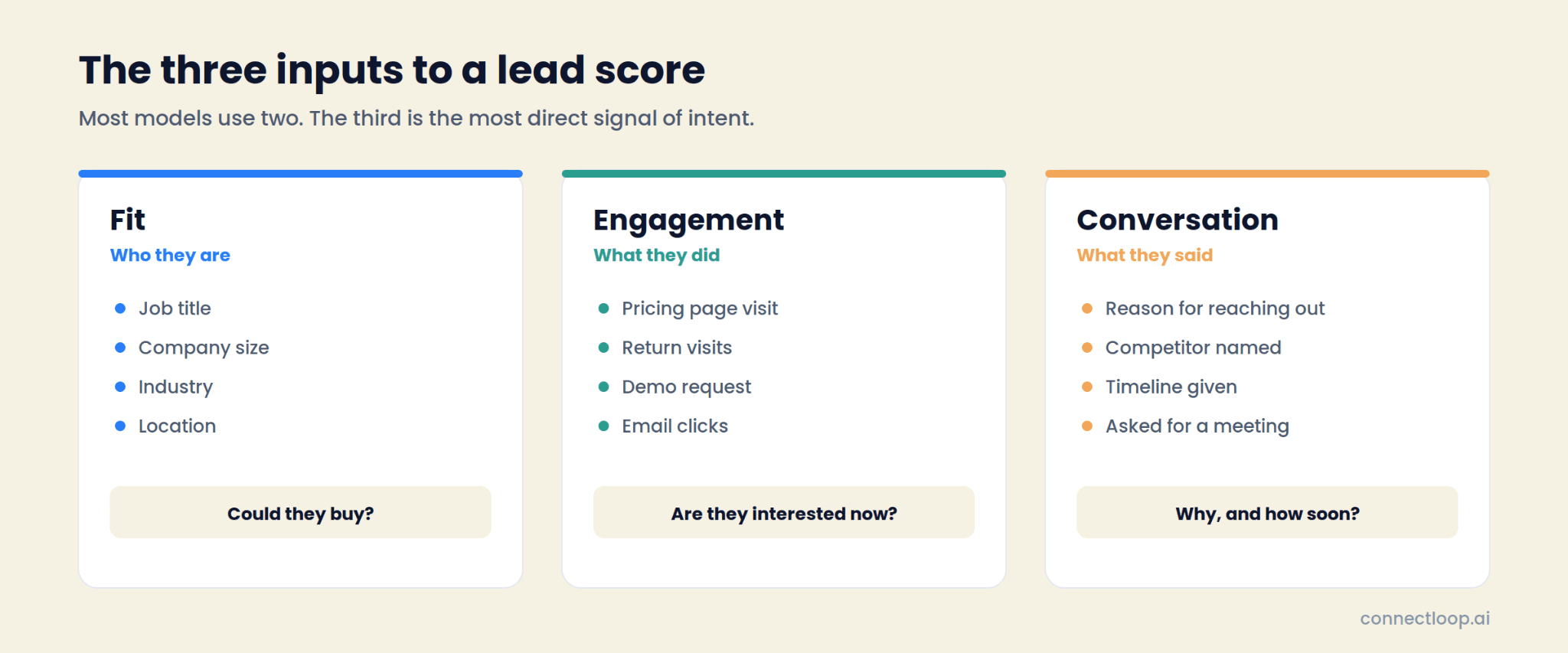
Fit and engagement are what every model has used for years; one marketing automation vendor coined the phrase "digital body language" for engagement data, and it holds. Conversation data is newer because it needs a channel that records what buyers say at scale. Website chat, WhatsApp and email give inbound teams exactly that.
How do you build a lead scoring model, step by step?
Build a lead scoring model by defining who can buy, deciding which behaviours predict a purchase, assigning points to each, setting a threshold for sales-ready, and reviewing the model against real outcomes every month. The process below takes an afternoon to set up and a quarter to tune.
- Set minimum customer criteria. The non-negotiables: region you serve, company type, a real business email. Leads that fail these get no score at all, so reps never see them.
- Define your ideal customer profile. Pull the last twelve months of won deals. Note the job titles, company sizes, industries and locations that repeat. These become your fit rules and your target market.
- Calculate your baseline conversion rate. Leads converted to customers, divided by total leads, times 100. Every attribute is judged against this number.
- Find the close rate per attribute. For each fit attribute and each behaviour, what share of leads with it became customers? Anything with a close rate above the baseline earns points. The further above, the more points. This is the closed deal analysis that keeps the model honest.
- List the behaviours to track. Website visits, pricing page, form submissions, email opens and clicks, content downloads, webinar attendance, demo requests, free trial signups. Mark the critical conversion behaviours, the ones most customers did before buying, such as booking a demo.
- Add conversation signals. A stated timeline, a named competitor, a request for a proposal, a question about integrations. If your agent or reps capture these, they belong in the model with the highest point values, because they are stated intent rather than inferred.
- Assign points by category first, then by rule. Decide how much of the total score fit can earn and how much engagement can earn (an even split is a fair start), then distribute points to individual rules inside each category. This prevents a lead scoring highly on fit alone.
- Set the score threshold. The score at which a lead becomes sales-ready. Start where your historical data says most buyers sat, then tune against sales acceptance rate.
- Add negative scoring and decay. Subtract points for unsubscribes, generic addresses and out-of-area locations. Let engagement points expire so a click from six months ago stops counting.
- Connect the score to action. Set up lead routing so sales-ready leads reach a rep through the CRM, put the rest into lead nurturing, and use a workflow to set an SLA for how fast a sales-ready lead gets a reply. This is where automation earns its keep: the score decides, the workflow acts.
- Review monthly. Which low-scoring leads converted? Which high-scoring leads went nowhere? Each is a rule to add or a weight to change. Revisit the whole model quarterly.
ConnectLoop's guide to inbound lead qualification covers step six in more detail, since capturing conversation signals is a qualification job before it is a scoring job.
How should points be weighted, and when should they expire?
Weight points by how strongly each signal predicts a purchase, cap each category so no single type of signal dominates, and let engagement points decay so the score reflects current interest rather than history. A pricing page visit last night should outweigh ten newsletter opens last year.
A simple working structure: a 100-point scale, fit capped at 50, engagement capped at 50. Some teams prefer a fit-by-engagement matrix, A to D for fit against 1 to 4 for engagement, so an A1 is the best lead and a D4 the worst; the logic is the same. Inside engagement, critical conversion behaviours (demo request, meeting booked, proposal asked for) earn 15 to 25 each; interest behaviours (pricing page, webinar, content download) earn 5 to 10; light touches (an email open, a single page view) earn 1 to 2.
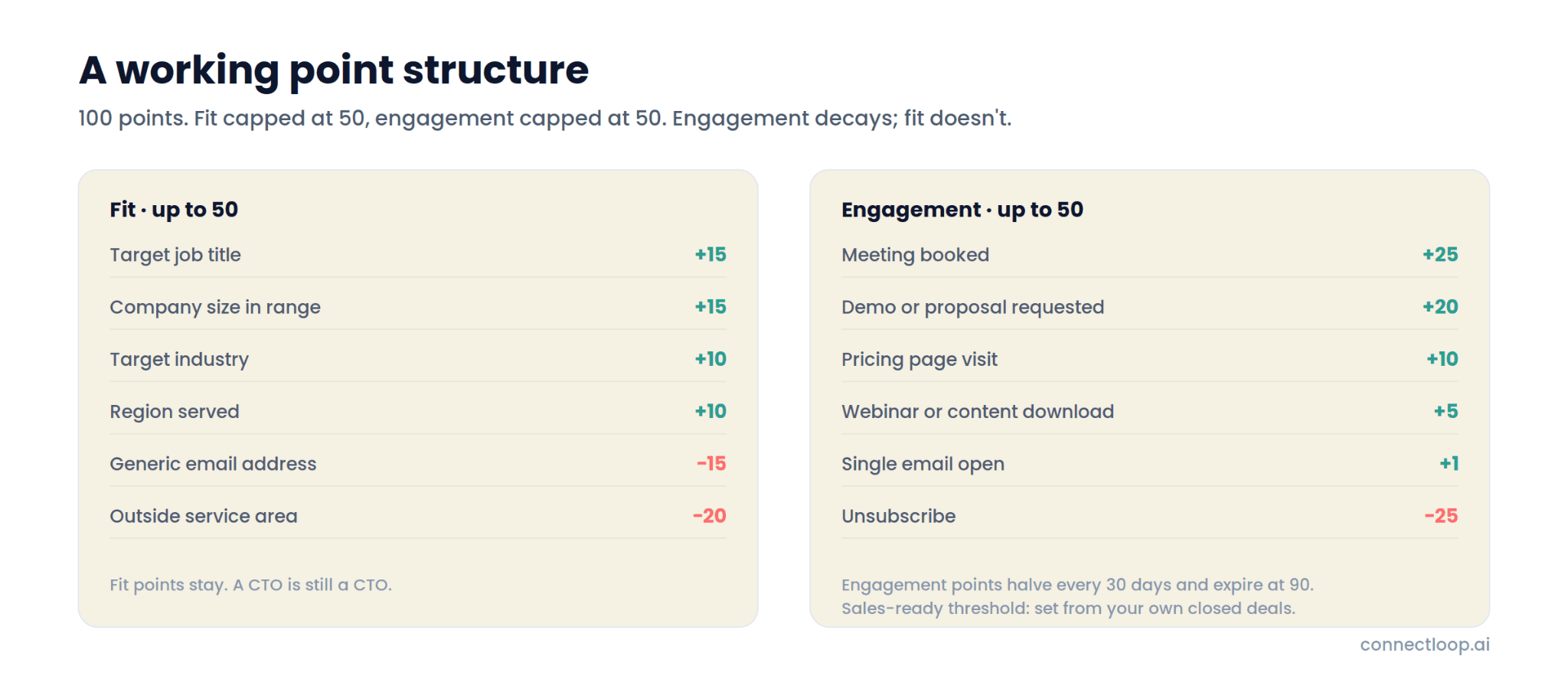
Score decay handles time. Set engagement points to lose half their value every 30 days, with expiring points dropping to zero after 90. Fit points do not decay; a CTO is still a CTO. The effect is that a lead who was hot in January and silent since drops back to warm without anyone touching the record.
Two traps. Over-scoring rewards repeated small actions: cap them, so twenty email opens never outrank one pricing visit. And under-weighting stated intent: "we need this live by the end of the quarter" says more than any click, and the model should reflect that.
What is negative scoring?
Negative scoring subtracts points for signals that a lead is a poor fit or losing interest: an unsubscribe, a generic email address, a location you do not serve, a competitor's domain, a job title that never buys. It keeps the model honest by letting bad signals cancel good ones instead of only ever adding up.
Without it, a student with a personal email who downloaded three guides can outscore a director at a target account who visited pricing once. The rule of thumb: every positive rule should have a mirror. If a pricing page visit adds points, an unsubscribe subtracts them. If a target industry adds points, an industry you never sell to subtracts them. The score can go negative; that is fine. A negative score is a lead to leave alone.
Manual, predictive or conversation-based: which should you use?
Manual lead scoring is a rules table you write and maintain. Predictive lead scoring uses AI to find the patterns in your historical data and set the weights for you. Conversation-based scoring adds what the lead said to either. Most teams should start manual, add conversation signals immediately, and move to predictive once they have enough closed deals to train on.
| Approach | How it works | Needs | Best for | What it sees |
|---|---|---|---|---|
| Manual | You write the rules and point values | A few hours and your win data | Small teams, new products, fast changes | Fit and clicks you chose to track |
| Predictive (AI) | A model learns weights from past conversions | Enough closed deals to train on, typically dozens | Established teams with volume | Patterns in fit and engagement you might miss |
| Conversation-based | Stated intent from chats, emails and calls is scored alongside behaviour | A channel that captures what leads say | Inbound teams of any size | Why they came, what they compared, when they need it |
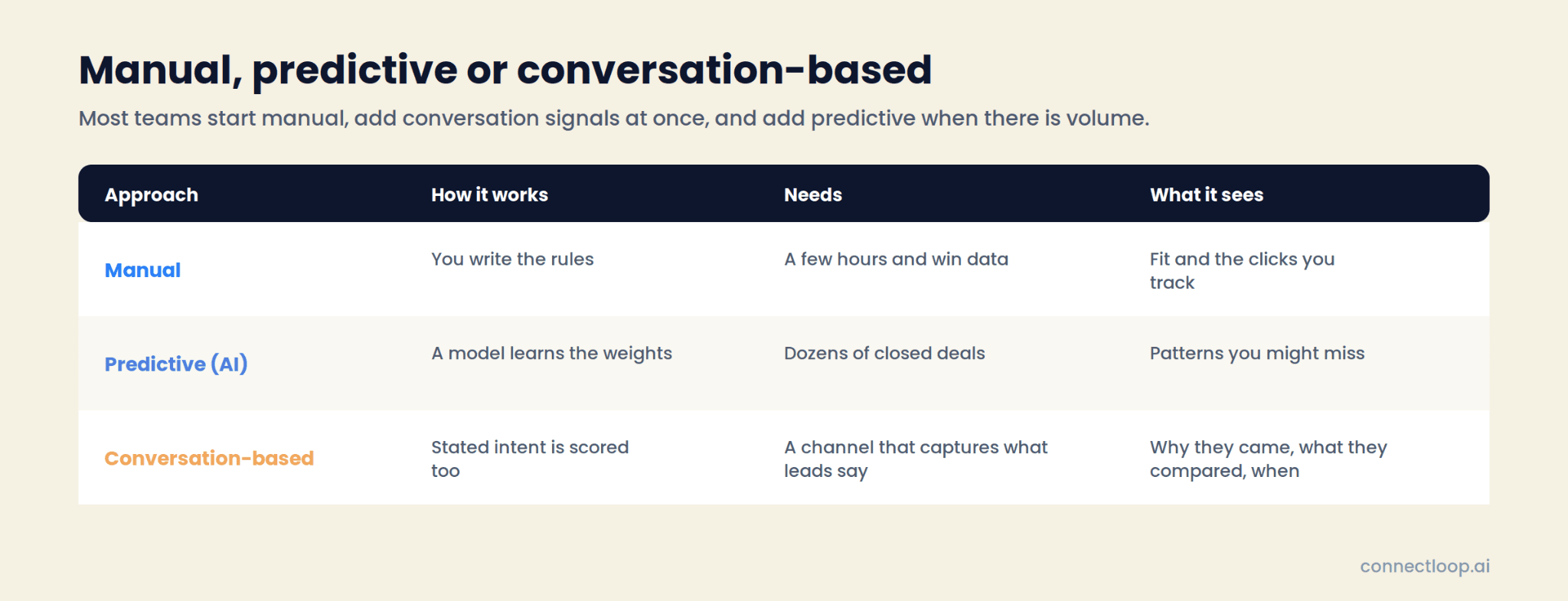
Predictive scoring has a real floor: one major CRM's AI scoring requires at least 50 contacts including 25 who converted before it will build a model. Conversation-based scoring works from the first lead, because it scores what that lead said, not a pattern across hundreds. The best setups combine all three: rules for fit, AI for weighting once there is volume, and conversation signals as the highest-value input throughout.
How does ConnectLoop score leads?
ConnectLoop scores every lead from the first conversation, combines what they did with what they said, and shows the reasoning next to the score. Its agent, Lia, works on website chat, WhatsApp and email, and the score exists by the time the first chat ends, not weeks later after enough emails have been opened.
What goes into the score?
Three things. Behaviour: pages viewed, return visits, time on site, whether they viewed pricing or a cancellation page. Conversation: why they reached out, what they compared you with, the timeline they gave, whether they asked for a person or a meeting. And, with Sales Methodology on, the answers to SPIN and MEDDICC questions Lia asks one at a time inside the chat.
How is the score shown?
Two ways. Lead temperature, Hot, Warm or Cold, on every lead, with a Temperature tab that shows the AI reasoning behind the score in plain sentences. And an intent score with a High, Medium or Low band, which is the same score that powers Conversational Intelligence, where leads are ranked with the predicted reason they reached out next to each one.
A rep reading "Hot: asked about pricing twice, named a competitor, wants it live before October, booked a meeting" trusts the score.
What about leads who have not identified themselves yet?
Visitor Intelligence scores the anonymous journey. Every browser gets an anonymous ID; ConnectLoop tracks visits, active days, pages viewed and return frequency, writes a short summary of what the visitor seems to be after, and labels intent High, Medium or Low before there is an email address. When the visitor fills in a form, the whole history attaches to their record and the score carries over.
How does the methodology scorecard fit in?
When Sales Methodology is on, everything Lia learns lands on a scorecard on the lead: each SPIN or MEDDICC step marked Not Started, In Progress, Completed, Skipped or Not Applicable, and each captured answer marked Inferred (Lia deduced it) or Confirmed (the visitor stated it). Progress accumulates across every conversation with that lead. Your team can edit any step, and manual edits are permanent.
A score built on confirmed statements is stronger than one built on inferred ones, and the rep can see which is which. ConnectLoop's MEDDPICC guide explains what each step captures.
How does the score reach the rep?
Through the CRM. Session data is written back to each contact in HubSpot, Salesforce, Pipedrive or Zoho as structured first-party intent data: pages viewed, visit count, time on site, the live intent score and its signals, the predicted reason for reaching out, and sentiment. Leads are routed to the right team member by tag, and a lead marked Needs Follow Up triggers reminders every 24 hours until someone acts. ConnectLoop ranks the queue and explains the ranking; a person decides who to call and what to say.
What should travel with the score to the rep?
The score should arrive with its reasons, the transcript, the pages viewed, the stated intent and the sentiment of the last conversation. A number on its own makes the rep re-do the work the score was meant to save.
- The reasoning. Two sentences on why the score is what it is.
- The transcript or summary. What the lead asked and what they were told.
- Pages viewed and return visits. Which products held their attention.
- Stated intent. Reason for reaching out, competitor named, timeline, budget if given.
- Scorecard status. Which qualification steps are Confirmed, which are Inferred, which are open.
- Sentiment. Whether the last exchange was positive, neutral or negative.
- Source. Website, WhatsApp, email, or a lead capture popup, and which campaign if any.
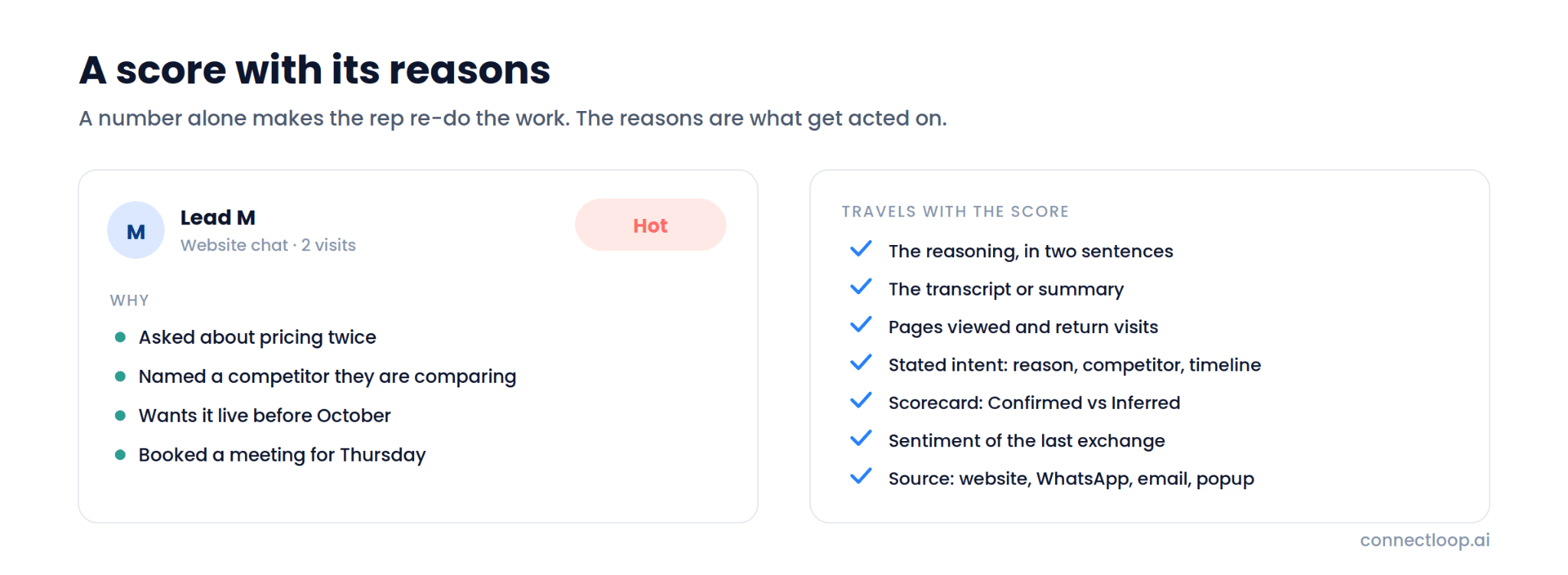
This is the handoff. The speed to lead guide covers the other half: how fast that call needs to happen.
What are the most common lead scoring mistakes?
The common mistakes are scoring only clicks, never subtracting points, setting a threshold and forgetting it, letting old engagement count forever, and handing reps a number with no explanation. Each has a fix that takes less time than the deals it costs.
- Scoring behaviour but not conversation. A lead who said "we're deciding this month" is scored the same as one who did not. Fix: add stated intent as the highest-weighted input.
- No negative scoring. Bad-fit leads climb the queue on curiosity alone. Fix: mirror every positive rule with a negative one.
- Never reviewing the threshold. The sales-ready line was set once and drifted. Fix: check sales acceptance rate monthly and move the line.
- No decay. A webinar from last year still counts. Fix: halve engagement points every 30 days.
- Over-scoring repeated small actions. Twenty email opens outrank one pricing visit. Fix: cap repeated behaviours.
- Scores without reasons. Reps ignore numbers they cannot explain. Fix: show the top three signals next to the score.
- Scoring starts at the form. The anonymous journey is invisible. Fix: score visitors before they identify and attach the history when they do.
- One model for every segment. A $5,000 buyer and a $50,000 buyer behave differently. Fix: a threshold per segment.
Key takeaways
- Lead scoring ranks leads by fit (who they are) and engagement (what they did), with a threshold that marks sales-ready.
- The signal most models miss is what the lead said: reason for reaching out, competitor named, timeline given. Weight it highest.
- Build the model from closed deal analysis: close rate per attribute against the baseline conversion rate decides the points.
- Cap each category, mirror every positive rule with a negative one, and let engagement points decay.
- Predictive scoring needs volume to train; conversation-based scoring works from the first lead.
- ConnectLoop scores from the first conversation, shows the reasoning behind lead temperature and intent, labels anonymous visitors before they identify, and writes the score and its signals to the CRM.
- A score should never travel alone. Send the reasons, the transcript, the pages and the stated intent with it.
- Review monthly, revisit quarterly, and measure the model by sales acceptance rate.

About the author
ConnectLoop Staff
Written by the ConnectLoop team. ConnectLoop is an AI sales agent for inbound revenue teams, based in Cambridge, Massachusetts.
About ConnectLoop →Frequently asked questions
Whatever score your converted customers typically had before they bought. On a 100-point scale many teams set sales-ready between 60 and 75, but the right number comes from your own closed deal analysis.
Qualification is the conversation that establishes fit, need, authority and timing, using a framework such as BANT, SPIN or MEDDICC. Scoring is the ranking that results from qualification and behaviour combined. ConnectLoop's Lia does the qualification in the chat and the score updates as answers arrive.
A marketing qualified lead has crossed the score threshold marketing agreed with sales. A sales qualified lead has been accepted by a rep after a conversation confirmed the fit. The gap between the two, the sales acceptance rate, is the best measure of whether the scoring model works.
Enough converted leads for a model to find a pattern, which for most CRM tools means dozens of conversions at minimum. Teams below that volume should use a manual model with conversation signals, which scores accurately from the first lead.
Yes, for engagement. Interest fades, and a score that never decays ranks last year's browsers above this week's. Fit points should stay: a job title or company size does not expire.
Yes. ConnectLoop's Visitor Intelligence gives every browser an anonymous ID, tracks visits, pages and return frequency, and labels buying intent High, Medium or Low before the visitor submits a form. The history attaches to their record the moment they identify themselves.
A three-band summary of the score: Hot means high purchase intent and immediate follow-up, Warm means interested but not urgent, Cold means low engagement. ConnectLoop shows the AI reasoning behind each temperature on the lead's record.
Review outcomes monthly and revisit the model quarterly, or whenever you launch a product, enter a market, or see the lead-to-customer conversion rate move. The question is always: which leads did the model get wrong, and what rule would have caught them?
The score decides the order of the queue and explains why. The rep decides what to say, when to push and when to stop. ConnectLoop keeps the score and its reasons visible so that judgment starts from evidence.
A lead score is only as good as what feeds it
If your leads arrive through a website, WhatsApp or email, the richest signal is the conversation itself, and ConnectLoop is built to score it. Train Lia on your site in about sixty seconds on the free plan and read the reasoning behind the first score.