
AI Sales Agents
Conversational Commerce: How to Sell Inside WhatsApp and Website Chat
Conversational commerce is selling through a two-way conversation, on WhatsApp, website chat, Messenger or SMS, instead of through a browse-and-checkout page. The buyer asks, the business answers, recommends and books or sells in the same thread. ConnectLoop applies this to inbound sales: Lia, an AI sales agent, answers, qualifies and books meetings on website chat, WhatsApp and email, and writes every conversation to the CRM.

Published
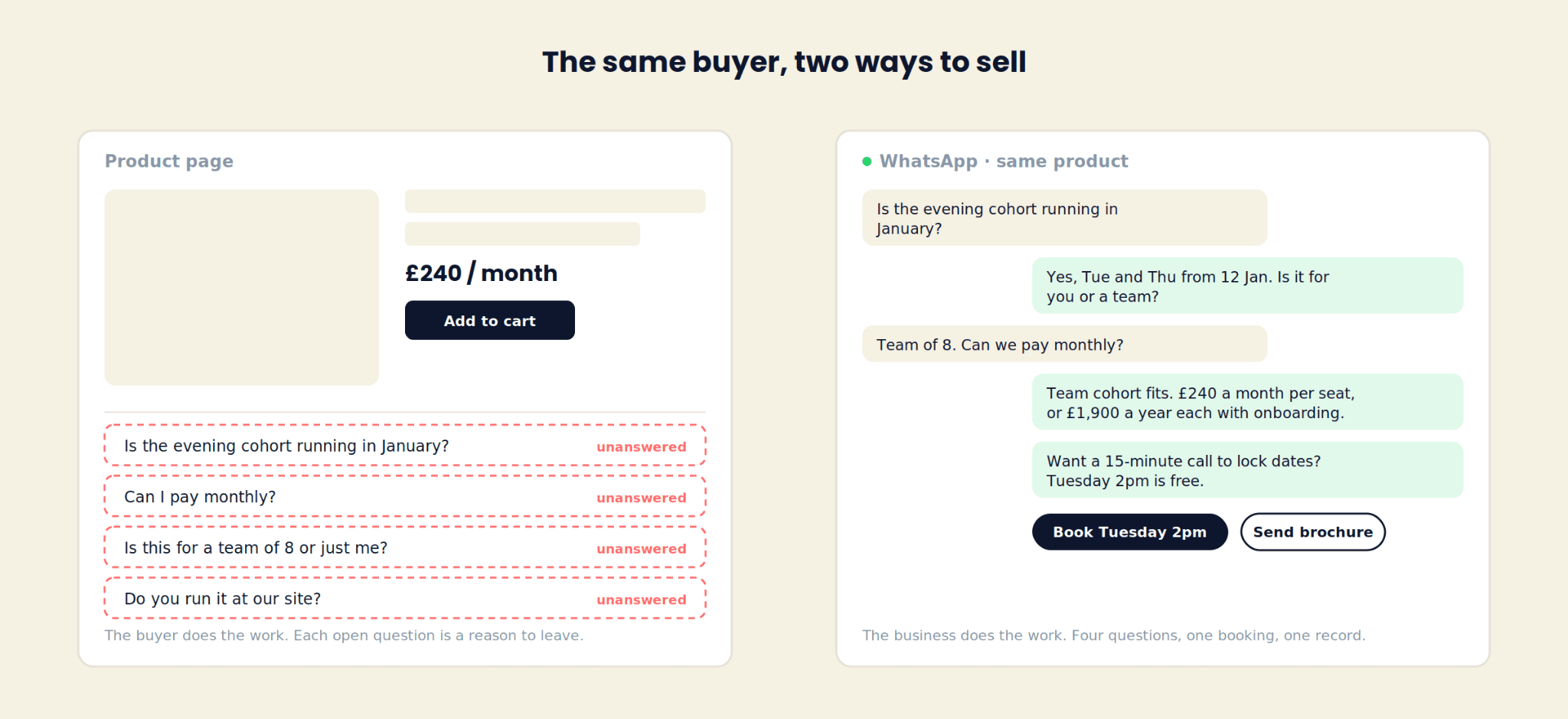
Table of contents
- What is conversational commerce?
- How does conversational commerce work?
- What are the types of conversational commerce?
- Conversational commerce vs social commerce vs conversational marketing
- How does WhatsApp commerce work?
- What does conversational ordering look like step by step?
- Live chat vs chatbot vs AI agent: which one sells?
- How do product recommendations in chat work?
- Does conversational commerce work for B2B and high-ticket sales?
- How does ConnectLoop handle conversational commerce?
- How do you set up conversational commerce on a WooCommerce store?
- How do you measure conversational commerce?
- What are the common mistakes?
- Key takeaways
- Frequently asked questions
What is conversational commerce?
Conversational commerce means buying and selling through messaging: the customer asks a question in a chat, the business answers in real time, and the purchase, booking or order happens inside that conversation. The term covers messaging apps, website chat, SMS, voice assistants and social DMs. Conversational ecommerce is the same idea applied to an online store.
The conversational commerce definition most people use comes down to one shift. On a product page, the buyer does the work: search, filter, compare, decide. In a conversation, the business does that work on the buyer's behalf, one question at a time.
That is why the format matters for anything with a question attached, and why some vendors call the agent a digital concierge or AI shopping assistant. A £240-a-month diploma, a five-seat software plan, a sofa in three fabrics: each has a question the product page cannot answer for that person. Conversational commerce answers it, then moves to the next step.
How does conversational commerce work?
A buyer sends a message on a channel the business has connected. Software, a person, or both read the message, pull the answer from product data or a knowledge base, reply, and take an action: recommend a product, add an item to a cart, send a payment link, or book a call. The conversation and its outcome are written to the CRM or store.
The parts that make this work are the same on every channel:
- A channel: WhatsApp Business, website chat, Messenger, Instagram DMs, SMS or RCS.
- A brain: a conversational AI agent using natural language processing to read intent, or a human agent, or a rules-based chatbot.
- A source of truth: the product catalog, pricing, availability, policies and FAQs the answers come from.
- An action layer: cart, checkout or payment link, calendar booking, or lead capture.
- A record: the CRM or order system where the conversation and its result land.
Generative AI and machine learning changed the middle part. Before large language models, the "brain" was a flow builder: every path scripted in advance. Now the agent can read a question it has never seen, answer from the catalog, and decide what to do next. The difference between a chatbot and an AI agent is the difference between a menu and a conversation.
What are the types of conversational commerce?
There are five working types: messaging-app commerce (WhatsApp, Messenger, WeChat), website chat commerce, social DM commerce (Instagram, TikTok), SMS and RCS commerce, and voice commerce (Alexa, Siri, Google Assistant). Most businesses start with the two their buyers already use: WhatsApp and the chat window on their own site.
| Type | Where the buyer is | Best for | Watch out for |
|---|---|---|---|
| Messaging apps (WhatsApp, Messenger, WeChat, Telegram) | On their phone, in an app they open daily | Follow-ups, reorders, post-purchase updates, markets outside the US | Opt-in rules; 24-hour reply window on WhatsApp |
| Website chat | On your site, mid-decision | Pre-sale questions, qualification, booking | Only reaches people already on the page |
| Social DMs (Instagram, TikTok) | Reacting to a post or ad | Discovery, impulse purchases, click-to-message ads | Volume spikes; hard to track to revenue |
| SMS / RCS | Anywhere, no app needed | Reminders, delivery updates, one-tap reorders | Low tolerance for marketing; cost per message |
| Voice assistants | At home, hands busy | Reorders of known items | Almost no product discovery; tiny share of new purchases |
An omnichannel setup means the same agent, catalog and customer record on every one of these, so a buyer who starts on the website and returns on WhatsApp is recognised. The word "commerce" here covers more than a shopping cart. For a training provider, the "order" is a booked place on a cohort. For a SaaS company, it is a booked demo or a started trial. Conversational ordering is the pattern; the object being ordered varies. Telegram and WeChat follow the same messaging-app rules in the markets where they lead.
Conversational commerce vs social commerce vs conversational marketing
Conversational commerce is selling in a conversation, on any channel, across the whole customer journey. Social commerce is selling on a social platform, usually through a shop tab or a shoppable post, with or without a conversation. Conversational marketing is using conversation to attract and qualify buyers before the sale. They overlap, and one conversation can do all three, but they are measured differently.
| Conversational commerce | Social commerce | Conversational marketing | |
|---|---|---|---|
| Where | Any messaging channel | Instagram, TikTok, Facebook shops | Website chat, ads, landing pages |
| Goal | Complete a purchase or booking in the chat | Complete a purchase on the platform | Capture and qualify a lead |
| Measured by | Orders or bookings from conversations | Platform sales | Qualified leads, meetings |
| Typical action | Recommend, add to cart, pay, book | Tap to buy | Answer, qualify, hand to sales |
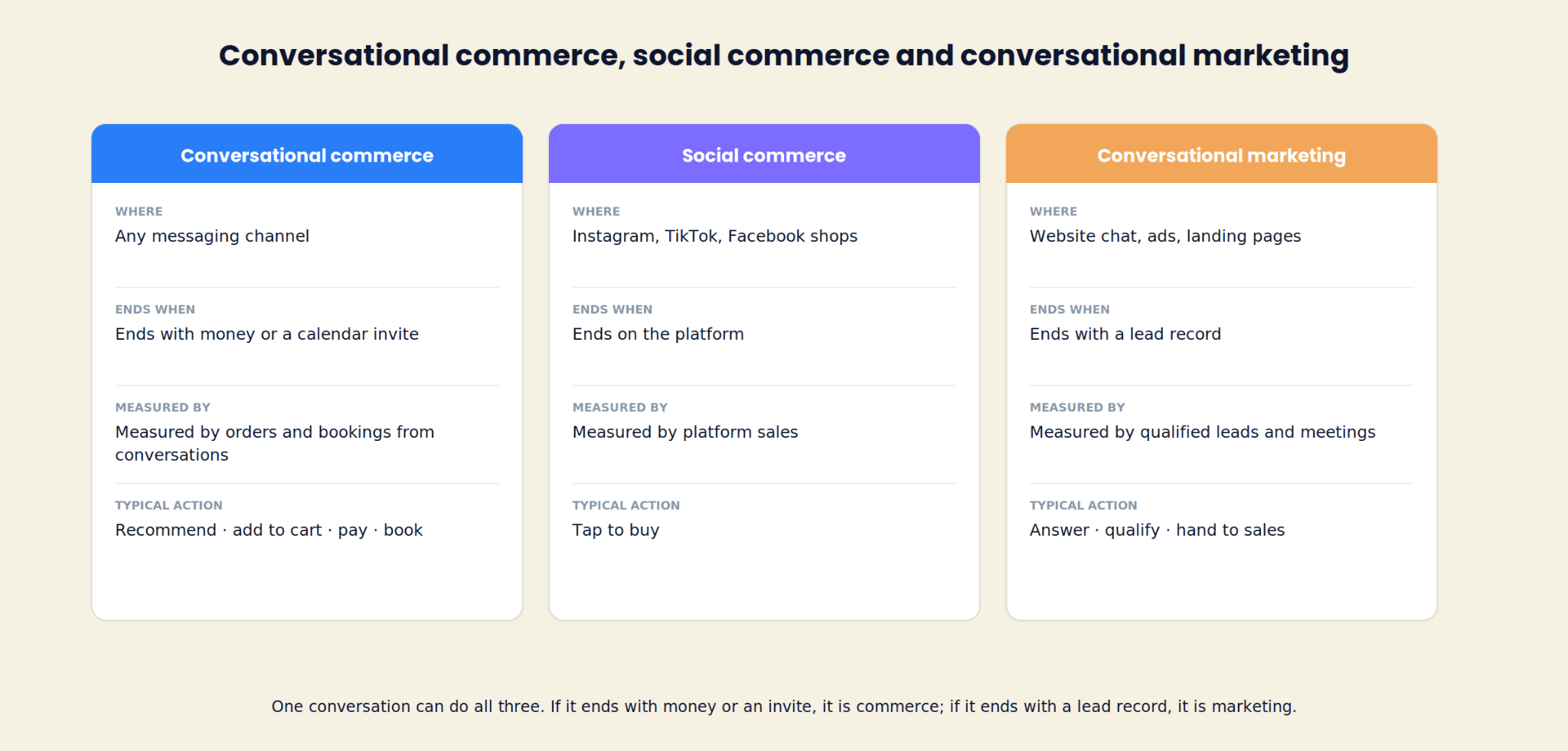
The practical rule: if the conversation ends with money or a calendar invite, it is commerce. If it ends with a lead record, it is marketing. Good systems do both in the same thread.
How does WhatsApp commerce work?
WhatsApp commerce runs on the WhatsApp Business Platform: a business connects a verified number, publishes a product catalog, and replies to customer messages with text, product cards, quick-reply buttons and payment or checkout links. Customers must message first or opt in; the business has a 24-hour window to reply freely, after which it needs an approved template message.
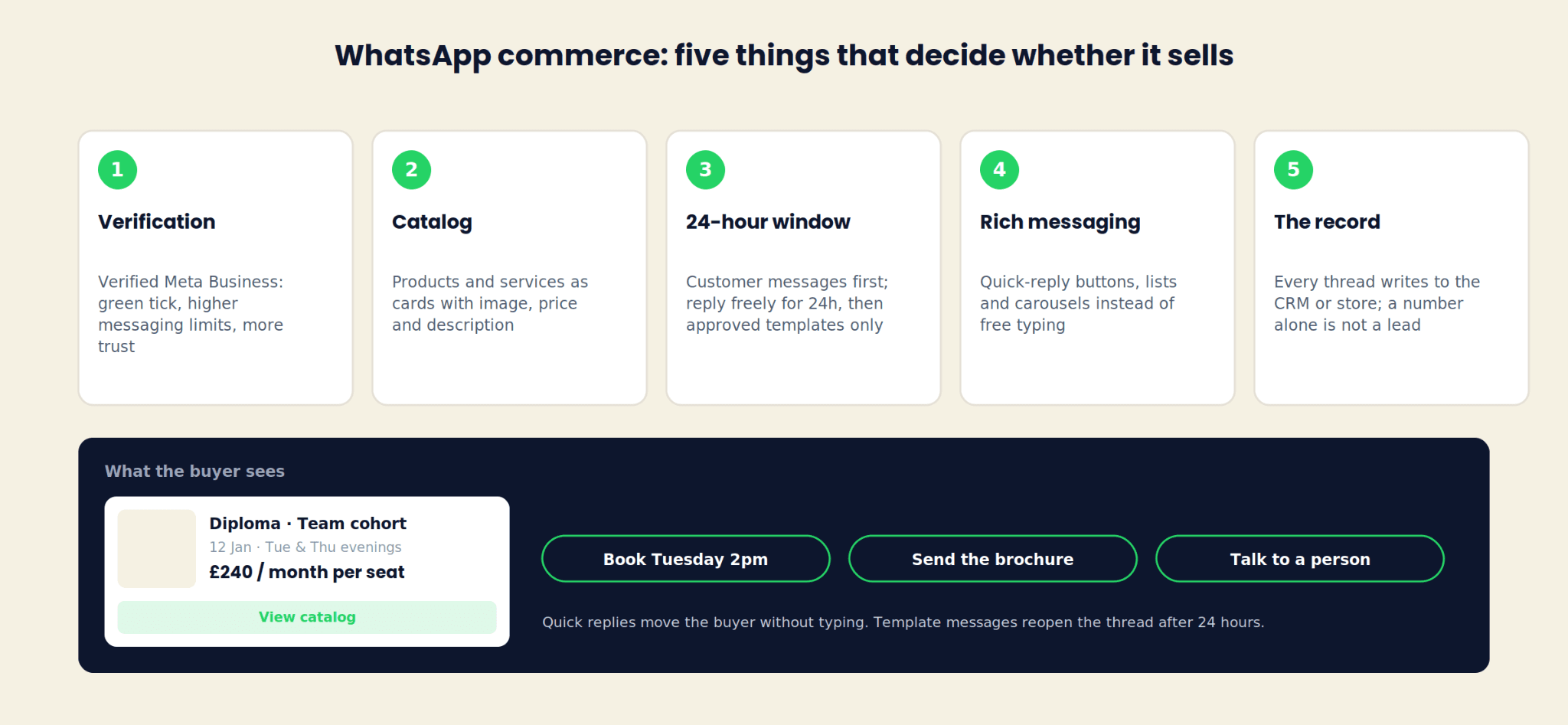
WhatsApp is the channel most guides mention and least explain. Five things decide whether it works as a sales channel:
- Verification. A Verified Meta Business gets the green tick and higher messaging limits. Buyers trust it more, and Meta throttles unverified senders sooner.
- The catalog. Products or services live in the WhatsApp catalog, so the agent can send a product card with image, price and description instead of a text description.
- Opt-in and the 24-hour window. Every conversation the customer starts opens a 24-hour window. Outside it, only approved template messages can be sent. Plan follow-ups around this.
- Rich messaging. Quick-reply buttons ("Book Tuesday", "Send the brochure"), list messages and product carousels reduce typing and move the buyer faster than free text.
- Where the thread ends. A WhatsApp conversation that does not write to your CRM or store is a lost record. The number of the buyer is not a lead until it is attached to what they asked.
Meta reports more than 2 billion WhatsApp users worldwide, according to Meta's own figures, and in the UK, India, Brazil, the Gulf and most of Europe it is the default way to message a business. ConnectLoop connects WhatsApp through Meta's Embedded Signup as an official Meta Business Partner, so the same agent that answers on the website answers on WhatsApp, from the same content. The mechanics are in how a WhatsApp AI agent works.
What does conversational ordering look like step by step?
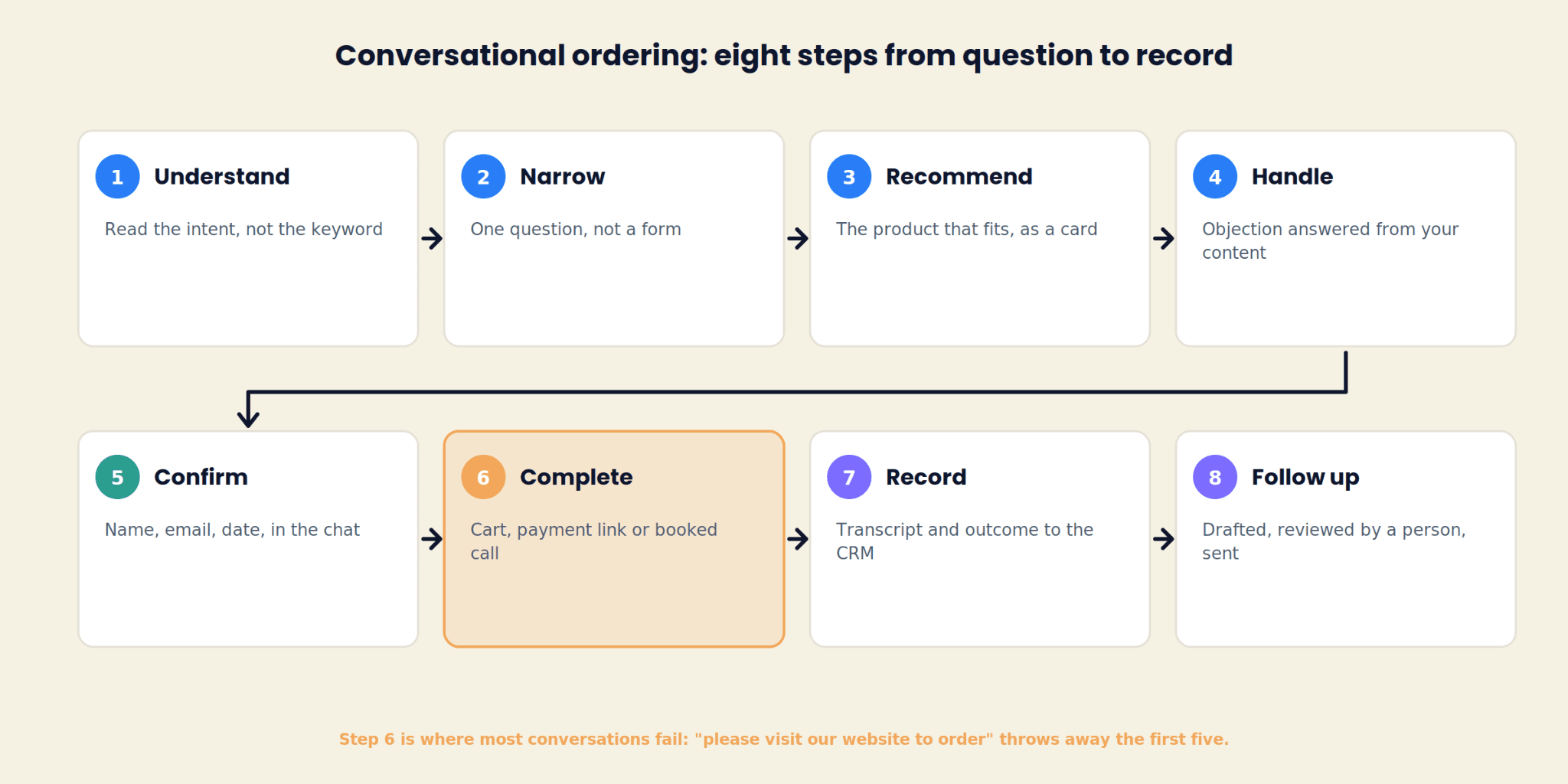
Conversational ordering is the sequence from a buyer's first question to a confirmed order or booking inside the chat. Done well, it takes five to eight messages. Each step has one job: understand, narrow, recommend, confirm, complete, record.
- Understand the ask. "Do you have the evening course in January?" The agent reads the intent (availability, a specific product, a date) rather than matching a keyword.
- Narrow with one question. "Yes. Tuesday and Thursday evenings. Is this for you or for a team?" One question, not a form.
- Recommend. The agent sends the product or plan that fits, as a card with price and what is included, from the catalog or website content.
- Handle the objection. "Can I pay monthly?" The answer comes from your pricing content, not a script.
- Confirm the details. Name, email, quantity or date. Captured in conversation, not on a separate page.
- Complete. Add to cart in chat and send the checkout link, take payment through a link, or book the call on a real calendar with an invite to both sides.
- Record. The conversation, the reason for buying, the objection and the outcome are written to the CRM or the store's customer record.
- Follow up. If the buyer does not complete, a follow-up goes out. In ConnectLoop's model, Proactive Outreach drafts it and a person reviews and sends it.
The most common failure is step 6. A conversation that ends with "please visit our website to order" throws away the momentum the previous five steps built. The second is speed: a question answered the next morning is answered after the buyer has moved on, which is the whole case for speed to lead.
Live chat vs chatbot vs AI agent: which one sells?
Live chat sells when a person is online; a scripted chatbot sells only what its script anticipated; an AI agent sells from your product content at any hour and hands over when the conversation needs a person. For most stores and service businesses, the agent handles the first 80% of conversations and the human takes the ones with money on the line.
| Live chat (human) | Scripted chatbot | AI agent | |
|---|---|---|---|
| Answers off-script questions | Yes | No | Yes, from your content |
| Available at 9pm | Only if staffed | Yes | Yes |
| Recommends the right product | Depends on the rep | From a fixed menu | From the catalog and the conversation |
| Adds to cart / books in chat | Manually | If built into the flow | Yes, through connected store or calendar |
| Knows when to stop | Yes | No | Yes, hands over on a defined threshold |
| Cost per conversation | Highest | Lowest | Low, priced on conversations |
The full breakdown is in live chat vs AI agent. For commerce the deciding question is the off-script one, because every buyer's question is off-script to them.
How do product recommendations in chat work?
Product recommendations in chat come from two inputs: what the buyer said in the conversation, and what the store knows about its products. The agent matches the stated need (budget, size, date, use case) to the catalog and sends the one or two products that fit, as cards the buyer can act on. Recommendation quality depends on catalog quality, not on the AI.
Three things separate a useful recommendation from a random one:
- It uses the conversation. "You said a team of eight and a Q1 deadline, so the team cohort on 14 January fits; here is the group rate." That is a recommendation. "You might also like…" is a widget.
- It comes from your content. The agent should recommend only what your catalog, pricing page or course list says exists. An AI shopping assistant that invents a bundle costs you the sale and the trust.
- It knows its limits. If the buyer asks something the content does not cover, the agent says so and hands to a person, and the gap is logged so the content can be fixed.
That last point is where ConnectLoop's Knowledge Gaps report earns its place: every question Lia could not answer from the site is listed, so the catalog and FAQs improve week by week.
Does conversational commerce work for B2B and high-ticket sales?
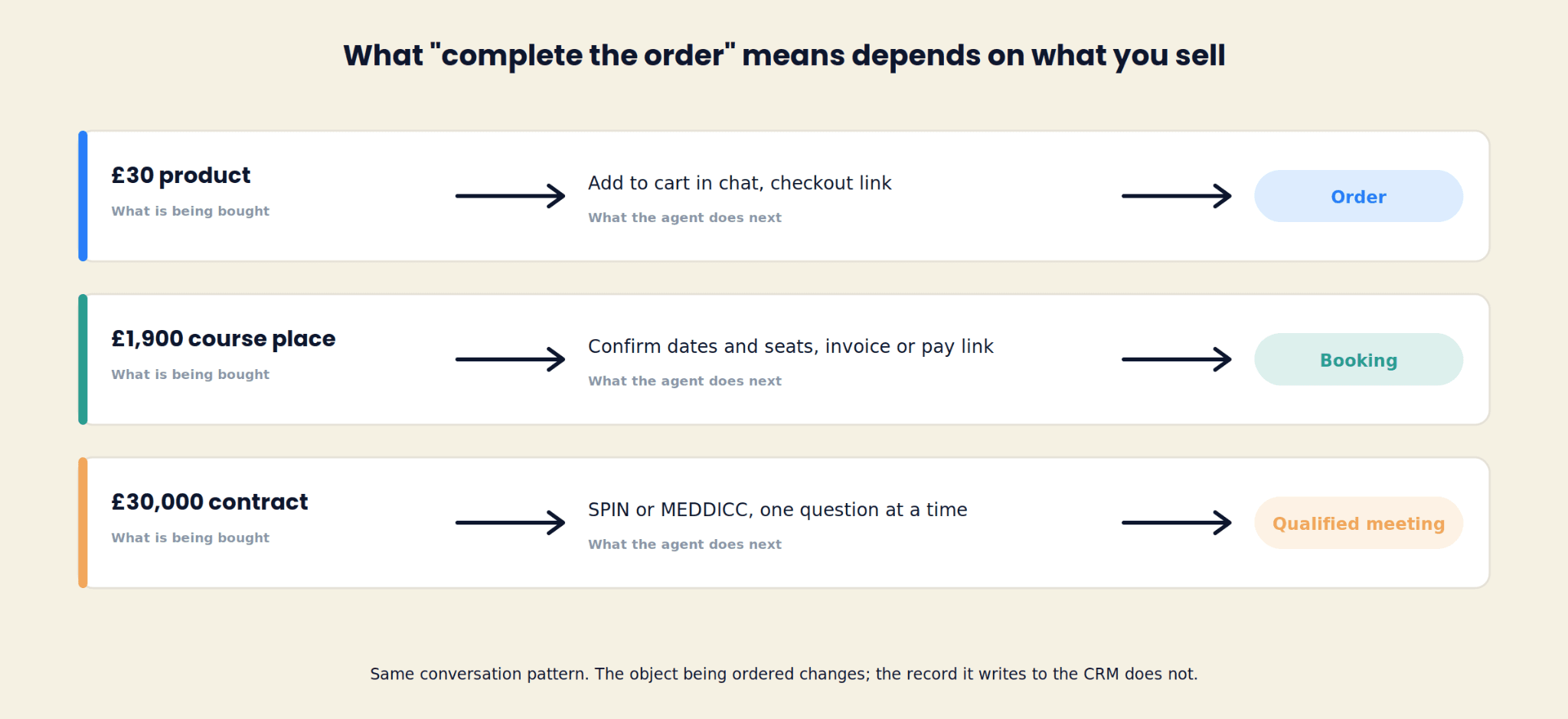
Yes, and it is arguably where it works best. A considered purchase has more questions per buyer than a retail one, and each unanswered question is a reason to leave. In B2B the "order" is a qualified meeting, a started trial or a quote request, and the conversation's job is to qualify and book rather than to take payment.
The difference is what the agent does after the first answer. For a £30 product, the next step is add to cart. For a £30,000 contract, the next step is a discovery question. ConnectLoop's Sales Methodology runs SPIN, BANT or MEDDIC one question at a time inside the chat, records each answer as Inferred or Confirmed, and stops when the buyer declines to answer.
The output is a lead record that carries the reason for reaching out, the timeline, the competitor named, the budget signal and the booked meeting, with a lead score built from the conversation rather than a form. For a sales team, that is the conversational commerce equivalent of a completed checkout.
How does ConnectLoop handle conversational commerce?
ConnectLoop puts one AI sales agent, Lia, on website chat, WhatsApp and email. Lia is trained on your website in about 60 seconds, answers from that content, qualifies with a chosen sales framework, books meetings into a connected calendar and writes the whole conversation to HubSpot, Salesforce, Zoho, Pipedrive or a Google Sheet. Follow-ups are drafted for a person to review and send.
This is how the parts of conversational commerce map to what ConnectLoop does:
| Conversational commerce step | What ConnectLoop does |
|---|---|
| Channel | Website chat, WhatsApp Business (Verified Meta Business, official Meta Business Partner), connected Gmail or Outlook inbox |
| Brain | Lia, answering from your site content; Agent Studio sets persona and rules |
| Source of truth | Your website, uploaded documents, and connected store content; Knowledge Gaps shows what is missing |
| Recommend | Lia recommends the plan, product or course that matches what the buyer said |
| Qualify | Sales Methodology: SPIN, MEDDICC, BANT or a custom framework, one question at a time |
| Complete | Meeting booked on Google Calendar, Outlook Calendar or Calendly with invites to both sides; checkout continues on your store |
| Record | Lead, transcript, reason, intent score, sentiment and meeting written to the CRM or sheet |
| Follow up | Proactive Outreach drafts the message; a human edits, sends or dismisses |
Two limits worth stating. ConnectLoop books meetings and captures leads inside the conversation; payment itself happens on your store's checkout, not inside the chat. And Lia works on chat, WhatsApp and email; voice calls are handled by your team, with Sales Assistance giving reps live cues during those calls.
Visitor Intelligence adds the part most conversational commerce tools lack: the history before the first message. Every anonymous visit is tracked with an intent label, so when the buyer finally asks a question, Lia and the rep know they have been to the pricing page three times.
How do you set up conversational commerce on a WooCommerce store?
Connect the store so the agent can answer from live product data, put the chat on every product page, connect WhatsApp for buyers who leave and come back, connect the calendar if you sell anything that needs a call, and make sure every conversation writes to a customer record. Test with a real question before launch.
- Connect WooCommerce. In ConnectLoop's Connected Apps, connect the store so Lia answers product, price and availability questions from what is actually in the catalog rather than from a cached page.
- Train the agent on the site. Point Lia at the store. Product pages, shipping policy, returns and FAQs become the source of answers. Check the Knowledge Gaps report after the first week and fill what is missing.
- Put chat where questions happen. Product pages, cart page, checkout page. Most pre-purchase questions are asked with the product in view.
- Connect WhatsApp. Buyers who leave the site often come back on their phone. The same agent, the same catalog, the same customer record.
- Decide the handover rule. Set the sentiment threshold and the topics (refunds, bulk orders, custom quotes) that go straight to a person.
- Connect the record. HubSpot, Salesforce, Zoho, Pipedrive, or Google Sheets if the store runs its pipeline in a spreadsheet.
- Run Live Test. Ask the three questions your support inbox gets most. Check the answers, the recommendation, and the record it wrote.
The WooCommerce integration page covers the connection in detail, and AI agent for ecommerce covers what the agent does on a store day to day.
How do you measure conversational commerce?
Measure the share of conversations that end in an order, booking or qualified lead; the time from first message to that outcome; the share resolved without a human; and revenue attributed to conversations. Registrations, message counts and "engagement" are activity, not results. These sit alongside the wider inbound sales metrics a revenue team already tracks.
| Metric | Definition | What good looks like |
|---|---|---|
| Conversation-to-outcome rate | Conversations ending in an order, booking or qualified lead ÷ all conversations | Rises as content gaps close |
| Time to outcome | First message to order or booking | Minutes in chat; hours if a person is needed |
| Resolved by agent | Conversations that reached an outcome with no handover | 60–80% for well-covered catalogs |
| Handover rate and reason | Share handed to a human, and why | Falling over time as gaps are filled |
| Attributed revenue | Orders or closed deals with a conversation in the record | The number the CFO asks for |
| Abandoned-conversation recovery | Buyers who left mid-chat and returned after a follow-up | Depends on follow-up speed |
| Repeat rate | Buyers who come back through the same channel | The retention and upsell number; needs the customer data written to one record |
ConnectLoop's Conversational Intelligence reports the drivers of conversations, the resolved-by-agent rate, sentiment, friction points and intent bands, so these numbers come from the system rather than from a spreadsheet built by hand.
What are the common mistakes?
The five that come up most: treating the chat as a support inbox rather than a sales channel; scripting every path and stalling on the first off-script question; ending the conversation with "visit our website"; letting the agent answer questions the content does not cover; and leaving conversations unrecorded so the rep starts from zero on the call.
Each has a fix. Give the agent a sales playbook, not just an FAQ. Use an agent that answers from content rather than a flow. Connect the calendar and the store so the conversation can finish. Review the Knowledge Gaps report weekly. Connect the CRM before launch, not after.
One more that is easy to miss: sending on WhatsApp without opt-in. Meta enforces the rules, and a blocked number takes the channel down for everyone.
Key takeaways
- Conversational commerce is selling inside a conversation; the buyer asks, the business answers, recommends and completes the order or booking in the same thread.
- WhatsApp and website chat are the two channels to start with; voice and social DMs come later.
- Conversational ordering has eight steps; the one most businesses drop is completing the order or booking inside the chat.
- An AI agent that answers from your catalog beats a scripted chatbot because every buyer's question is off-script.
- Product recommendations in chat are only as good as the catalog; log what the agent cannot answer and fix the content.
- For B2B and high-ticket sales, the "order" is a qualified meeting; run a sales framework in the chat and book on a real calendar.
- Measure conversation-to-outcome rate, resolved-by-agent rate and attributed revenue, not message counts.
- ConnectLoop's Lia runs this on website chat, WhatsApp and email, books the meeting, and writes the whole conversation to the CRM; payment stays on your store's checkout.

About the author
ConnectLoop Staff
Written by the ConnectLoop team. ConnectLoop is an AI sales agent for inbound revenue teams, based in Cambridge, Massachusetts.
About ConnectLoop →Frequently asked questions
Ecommerce is buying through a website or app the customer navigates alone. Conversational commerce is buying through a real-time conversation where the business answers, recommends and completes the order or booking. Most businesses run both: the store for buyers who know what they want, the conversation for buyers with a question.
On WhatsApp with a connected catalog, and on website chat connected to the store, yes: the agent sends a product card and the buyer adds it or is taken to a pre-filled checkout. Whether the whole payment completes inside the chat depends on the platform and the payment provider.
Most businesses can use the WhatsApp Business Platform after verification. Meta restricts some categories (for example, certain financial, gambling and adult products) and requires customer opt-in before a business sends messages. Check Meta's commerce policy for your category.
An AI agent. A chatbot follows a script and stalls on the first question it did not anticipate, which in commerce is most questions. An agent answers from your product content, recommends, books and hands over when needed.
With ConnectLoop, the agent is trained on the website in about 60 seconds. Connecting WhatsApp through Meta's Embedded Signup, the calendar and the CRM takes an afternoon. The first week is spent reviewing the Knowledge Gaps report and filling what the site did not cover.
No. It handles the first conversation, the qualification and the booking, at any hour. The rep takes the call, the negotiation and anything with money on the line. Outbound stays a human job; Proactive Outreach drafts follow-ups for a person to send.
It says so and hands to a person, and the question is logged in Knowledge Gaps so the content can be fixed. The wrong behaviour is guessing; an invented answer about price or availability costs the sale.
Yes. For a training provider, consultancy or SaaS company, the "order" is a booked call, a place on a cohort or a started trial. The conversation qualifies and books instead of taking payment. This is where ConnectLoop is used most.
The transcript, the reason the buyer reached out, the products or plans discussed, any objection, the qualification answers, the sentiment, and the outcome: order, booking or lead. A name and an email alone is a form submission, not a conversation record.
ConnectLoop's Lia runs this on website chat, WhatsApp and email
Lia books the meeting and writes the whole conversation to the CRM; payment stays on your store's checkout. The agent is trained on your website in about 60 seconds, and connecting WhatsApp through Meta's Embedded Signup, the calendar and the CRM takes an afternoon.