
AI Sales Agents
Chatbot vs AI Agent: What the Difference Means for a Sales Team
A chatbot follows a script; an AI agent reasons about what a visitor wants, takes action across your systems, and decides what to do next. For a support desk that difference is convenience. For a sales team it is the difference between answering "what does it cost?" and turning that question into a qualified, booked meeting, which is what ConnectLoop's agent, Lia, is built to do.

Published
Table of contents
- A note on terminology
- What is a chatbot?
- What is an AI agent?
- What are the benefits of AI agents?
- What is the middle ground: LLM chatbots and copilots?
- What are the key differences between AI agents and chatbots?
- What are the similarities?
- What does each one do with the same sales conversation?
- Where should an AI agent stop and hand over to a person?
- What does "trained on your website" mean in practice?
- Can an AI agent keep your brand voice?
- Are AI agents more expensive than chatbots?
- How do AI agents work in production?
- How do you measure success differently?
- When should you use a chatbot vs an AI agent?
- Can a chatbot be upgraded into an AI agent?
- Do rule-based chatbots still make sense in 2026?
- How do industry-specific implementations differ?
- What does the small-business version look like?
- How do you make the right choice for your enterprise?
- Key takeaways
- Frequently asked questions
A note on terminology
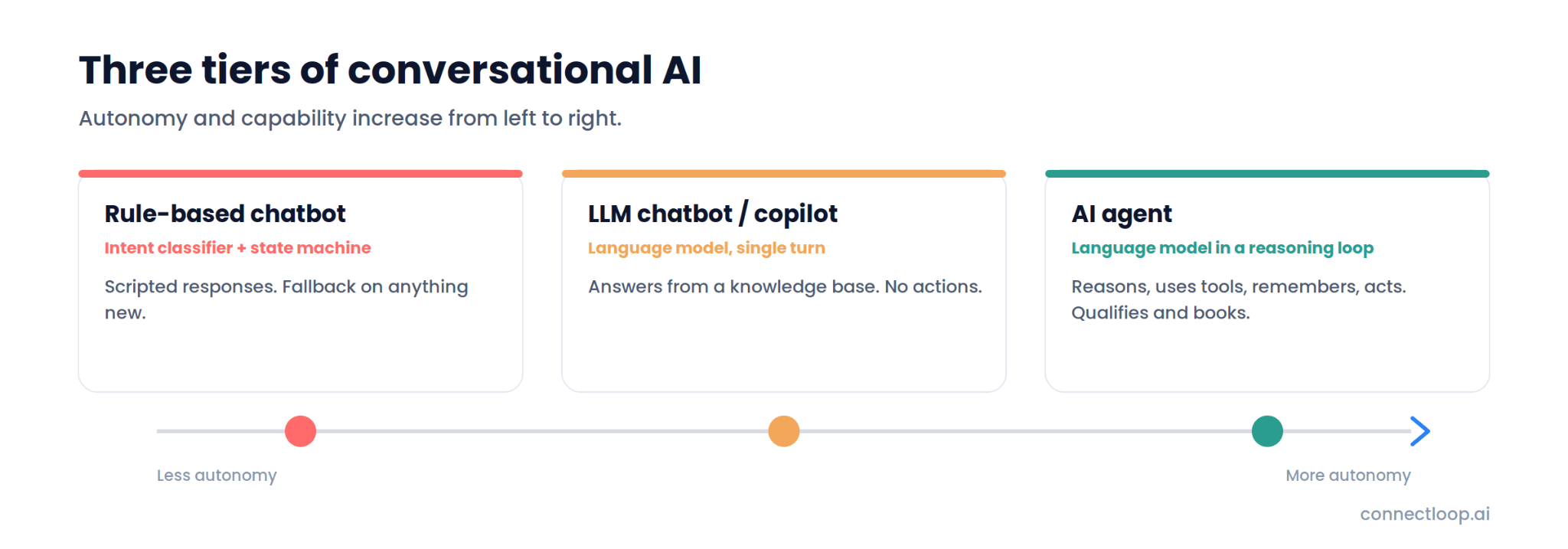
Vendors use "chatbot" and "AI agent" to mean different things depending on what they sell, so this article uses three terms. A rule-based chatbot follows scripts with no language model. An LLM chatbot uses a language model to answer, one request at a time, without taking actions. An AI agent uses a language model inside a reasoning loop, with tools, memory and autonomy.
Some products called "AI agents" are LLM chatbots with no tool access. Some products called "chatbots" do more reasoning than systems calling themselves agents. Judge the architecture, not the label. The rest of this article uses the three terms consistently.
What is a chatbot?
A chatbot is a program that holds a conversation by following predefined rules. It matches what the user typed to an intent it was trained on, walks a scripted conversational flow, and returns a templated response. It is fast, predictable and cheap to run, and it handles routine inquiries well as long as the user says something it expected.
The rule-based chatbot has three parts. Natural language understanding (NLU), a narrower form of natural language processing (NLP), does intent classification and entity extraction: it decides the user wants order status and pulls out the order number, a step often called slot filling. It needs training on many sample utterances to do that reliably.
A dialogue manager, which is a state machine, decides the next step from a decision tree. A response generator fills a template with the extracted values. If the intent isn't recognised, a fallback handler says "I didn't understand that."
This architecture has been around since ELIZA in 1964, and it still powers a lot of customer service widgets. Menu-based, keyword-based and rule-based chatbots are all versions of the same idea, and most no-code and low-code chatbot builders produce them.
A legacy chatbot's benefits are real: cheap, predictable, on-brand. Its capabilities stop at the edge of the script. Their strength is control: every response was written by a person. Their limitation is that every question the designers didn't anticipate ends at the fallback.
What are the main chatbot use cases?
Chatbot use cases are the closed-domain jobs where every question is predictable: FAQs, order status, password resets, routing a customer support ticket to the right queue, collecting a name and email, booking an appointment through a fixed flow. Each works because the set of things a user might say is small and known in advance.
What are the limitations of chatbots?
The limitations follow from the design. A rigid intent taxonomy means every unexpected phrasing hits the fallback. There is no reasoning across turns, so the bot cannot combine what was said earlier with what is asked now. Slot filling handles dates and order numbers but breaks on open descriptions.
And effort scales linearly: every new use case needs new intents, flows, templates and integration code. The cost shows up in speed to lead: the enquiry that fell through the fallback at 9pm waits for a person in the morning.
What is an AI agent?
An AI agent is an autonomous system built around a large language model that can reason about a task, use tools, hold memory across the conversation, and carry out multi-step workflows without a script.
Instead of matching intents, it reads the whole context, makes its own decisions about what to do, executes the task, checks the result, and continues until the job is done. That autonomy, bounded by guardrails, is what separates it from every kind of chatbot, including the AI-powered contextual ones.
The core of the design is a reasoning loop, sometimes called a ReAct loop after the research paper that formalised it: observe, reason, act, evaluate, repeat. Tool use, also called function calling, is what lets the agent do things rather than only say things: search a knowledge base, look up a record in real time, book a calendar slot, write to a CRM.
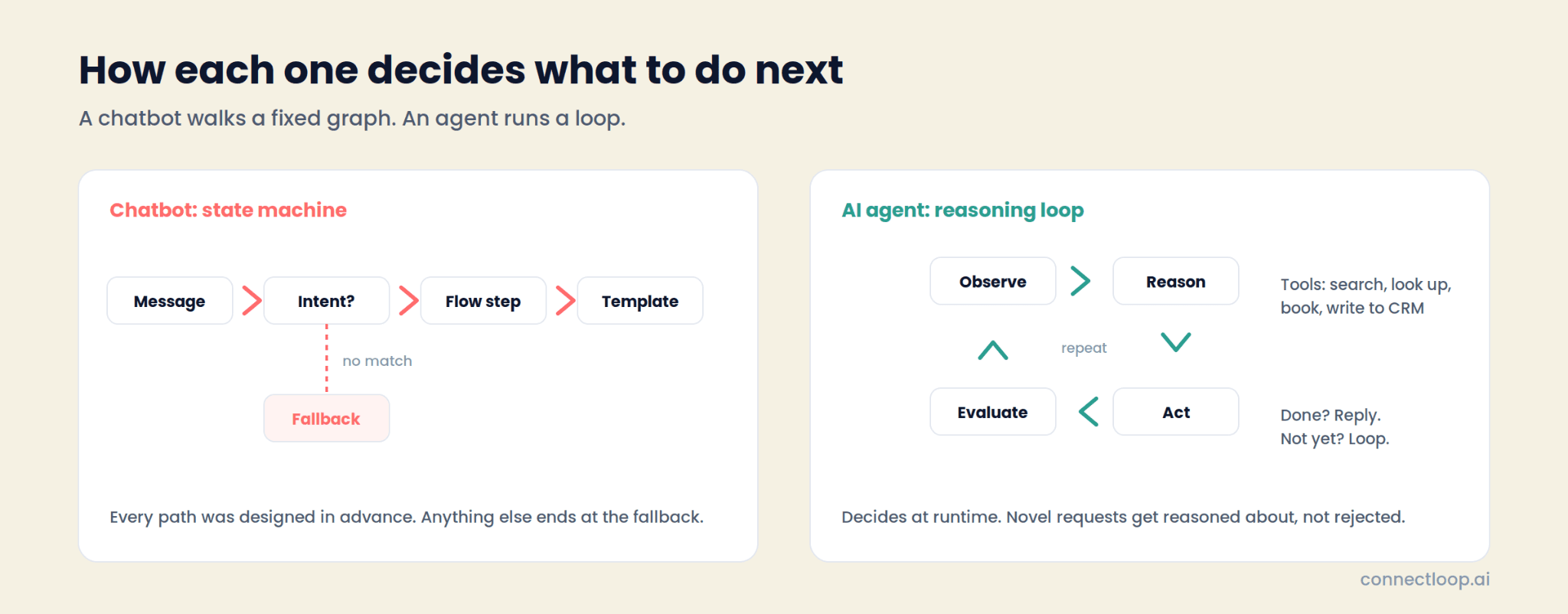
Each tool has a schema that tells the model what it does and what it needs, and the agent can integrate with systems through APIs or MCP servers. The generative AI model handles the language; the loop handles the decision-making.
Because the language model handles natural language directly, there is no intent taxonomy to build and maintain. New questions don't need new flows. Retrieval-augmented generation (RAG) grounds the agent's answers in your own documents through semantic search, often with reranking so the best passages come first, and guardrails decide what it may and may not do.
Memory works in layers: conversation history, working memory for tool results, and long-term memory across sessions where the platform supports it. Long conversations are kept inside the model's token window through summarization or a sliding window over older turns.
What are the main AI agent use cases?
AI agent use cases are the open-ended jobs: answering product questions nobody scripted, lead qualification inside a conversation, booking an appointment against a live calendar, resolving a multi-step request across systems, proactive follow-up when a lead returns, and deciding when to escalate to a human with the full context attached.
Each works because the agent reasons at runtime instead of matching a flow.
What are the limitations of AI agents?
More capability means more to configure. An agent needs a knowledge base worth answering from, tool permissions set deliberately, and guardrails that decide where it stops. Its answers are generated, so grounding and traceability matter.
And each conversation carries an inference cost. None of these is a reason to avoid an agent; each is a setting to get right, and the sections below cover how.
What are the benefits of AI agents?
An AI agent answers the questions a script never anticipated, takes the actions a chatbot can only point to, remembers what was said, and keeps the same quality at 9pm as at 9am.
For a sales team the benefits compound: more conversations resolved, more of them qualified, more of them booked, and a rep who starts every call already knowing what the buyer said.
- Coverage of the long tail. New questions need no new flows, so the agent handles the requests that used to end at a fallback.
- Action, not just answers. Booking, CRM updates and hand-offs happen inside the conversation.
- Consistency. The same approved content and the same tone in every conversation, on every channel.
- Lower maintenance. Add a document or a tool instead of designing a flow.
- Faster implementation. A knowledge base and a calendar connection instead of an intent taxonomy.
- Measurable outcomes. Resolution rate, sentiment, intent and meetings booked, all from the conversations themselves.
For teams working through B2B SaaS lead generation strategies, the agent is the half that decides how many of the leads those strategies bring in actually survive.
What is the middle ground: LLM chatbots and copilots?
Most products sold as "AI chatbots" in 2026 sit between the two. An LLM chatbot uses a language model to understand and answer, usually grounded in a knowledge base by RAG, but works one request at a time: no tool use, no multi-step reasoning, no actions in other systems.
A copilot is the same idea aimed at an employee rather than a customer.
This tier is a real improvement over scripted bots. It handles open-ended questions in any language the model supports, and it answers from your content rather than a template, with genuine contextual understanding of what was asked. For a pure FAQ job it may be enough.
The line shows up the moment the visitor needs something done. An LLM chatbot can explain how booking works; booking itself needs a tool. It can describe pricing; asking what prompted the visit and recording the answer needs the loop.
That second capability is the whole job of an AI SDR, and it is why the architecture matters. Adding a single tool moves it toward the agent end of the spectrum, which is why the distinction is one of degree, and why the architecture still matters.
What are the key differences between AI agents and chatbots?
Chatbots follow rules; AI agents reason. Chatbots retrieve a scripted response; agents generate personalized responses from context and tool results. Chatbots need manual updates to change behaviour; agents keep learning from feedback and adapt, and that adaptation is what makes the customer experience improve over time.
Chatbots hold short-term slot values; agents hold working memory and, in many designs, long-term memory across sessions. Chatbots hit a fallback on novel requests; agents reason from context and take action. For a sales team the practical difference is what happens after the first answer.
| Dimension | Rule-based chatbot | LLM chatbot / copilot | AI agent |
|---|---|---|---|
| Core engine | NLU classifier and state machine | LLM, single turn | LLM inside a reasoning loop |
| Response generation | Template lookup | Generated from context | Generated from context and tool results |
| Conversation flow | Predefined dialogue graph | Open-ended, one exchange at a time | Dynamic, multi-step, decided at runtime |
| Tool use | Hardcoded API call per intent | None | Chooses tools from an available set |
| Memory | Slots, reset each session | Conversation history | Working memory plus multi-session memory |
| Novel requests | Fallback | Answers if the knowledge base covers it | Reasons, acts, or escalates with context |
| Training and configuration | Intents, flows, templates per use case | Knowledge base | Knowledge base plus tools and instructions |
| Time to implement | Weeks of flow design | Days | About a minute from a website URL, then tuning |
| Personalization | Slot-filled name | Contextual answers | Adapts to what the visitor said and did |
| Knowledge access | Keyword match | RAG with semantic search | RAG with semantic search and reranking |
| Cost structure | Near-zero per message, maintenance compounds | Per-token cost | Per-token cost plus tool execution |
| Failure mode | Silent misrouting or fallback | Hallucination | Hallucination or wrong tool call, both mitigated by grounding and guardrails |
| Latency | Milliseconds | One to three seconds | Variable, depends on steps |
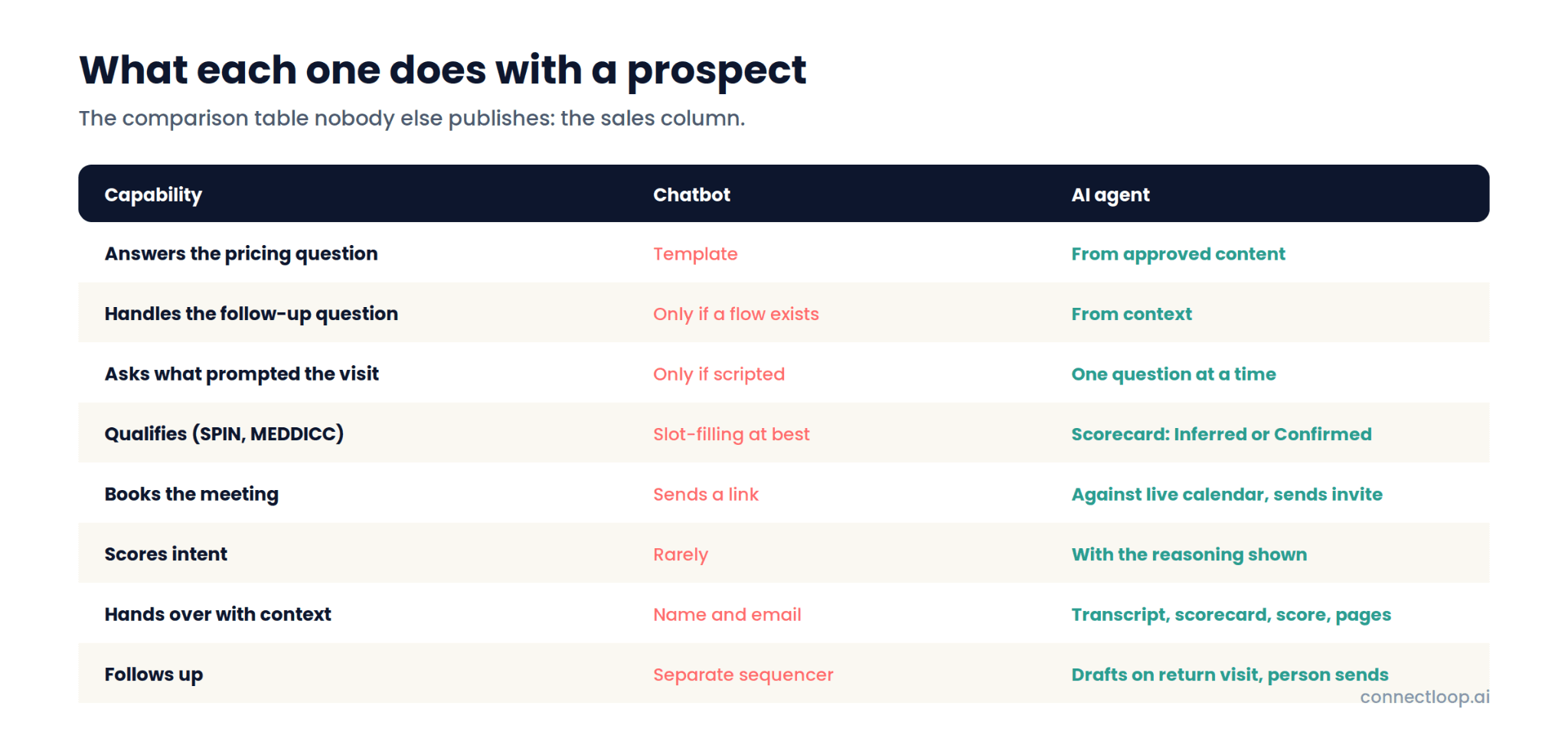
The table above is the version every guide publishes. The one that matters for a sales team is below.
What are the similarities?
Both run in a conversational interface, both aim to answer at any hour, both automate repetitive tasks, both reduce the need for human intervention on routine questions, and both can sit on a website, in WhatsApp or in an inbox.
Both are more often customer-facing than employee-facing, though copilots for staff use the same technology. Both need a knowledge base to be useful. From the visitor's side, the first message looks the same either way. The difference is entirely in what happens next.
They also share the same measures of failure: the visitor leaves without an answer, or gets a wrong one. Where they differ is how often each happens and what each system can do about it.
What does each one do with the same sales conversation?
The clearest way to see the difference is to give both the same visitor. It's 9pm. Someone lands on a training provider's pricing page and opens the chat.
With a chatbot
| Who | Message |
|---|---|
| Visitor | How much is the project management certification? |
| Chatbot | Our certification programs start from £1,200. Would you like to (1) view all courses (2) contact sales (3) something else? |
| Visitor | Does that include the exam, and can I start next month? |
| Chatbot | I didn't quite get that. Would you like to (1) view all courses (2) contact sales (3) something else? |
| Visitor | 2 |
| Chatbot | Please leave your name and email and a member of our team will be in touch. |
The visitor's second question, the one that reveals timing and intent, is lost. The lead arrives on Monday as a name and an email.
With an AI agent
| Who | Message |
|---|---|
| Visitor | How much is the project management certification? |
| Lia | The project management certification is £1,200 for the full programme, which includes the course materials and one exam sitting. Are you looking at it for yourself or for a team? |
| Visitor | For myself. Can I start next month? |
| Lia | Yes, the next cohort starts on the 6th. If it helps, I can hold a place and set up a fifteen-minute call with an adviser to confirm the details. Would Thursday at 10 or Friday at 2 work? |
| Visitor | Thursday. |
| Lia | Done. You'll get a calendar invite shortly. One last thing so the adviser can prepare: is there a deadline you're working to, or a reason you're looking now? |
| Visitor | My employer will fund it if I finish by March. |
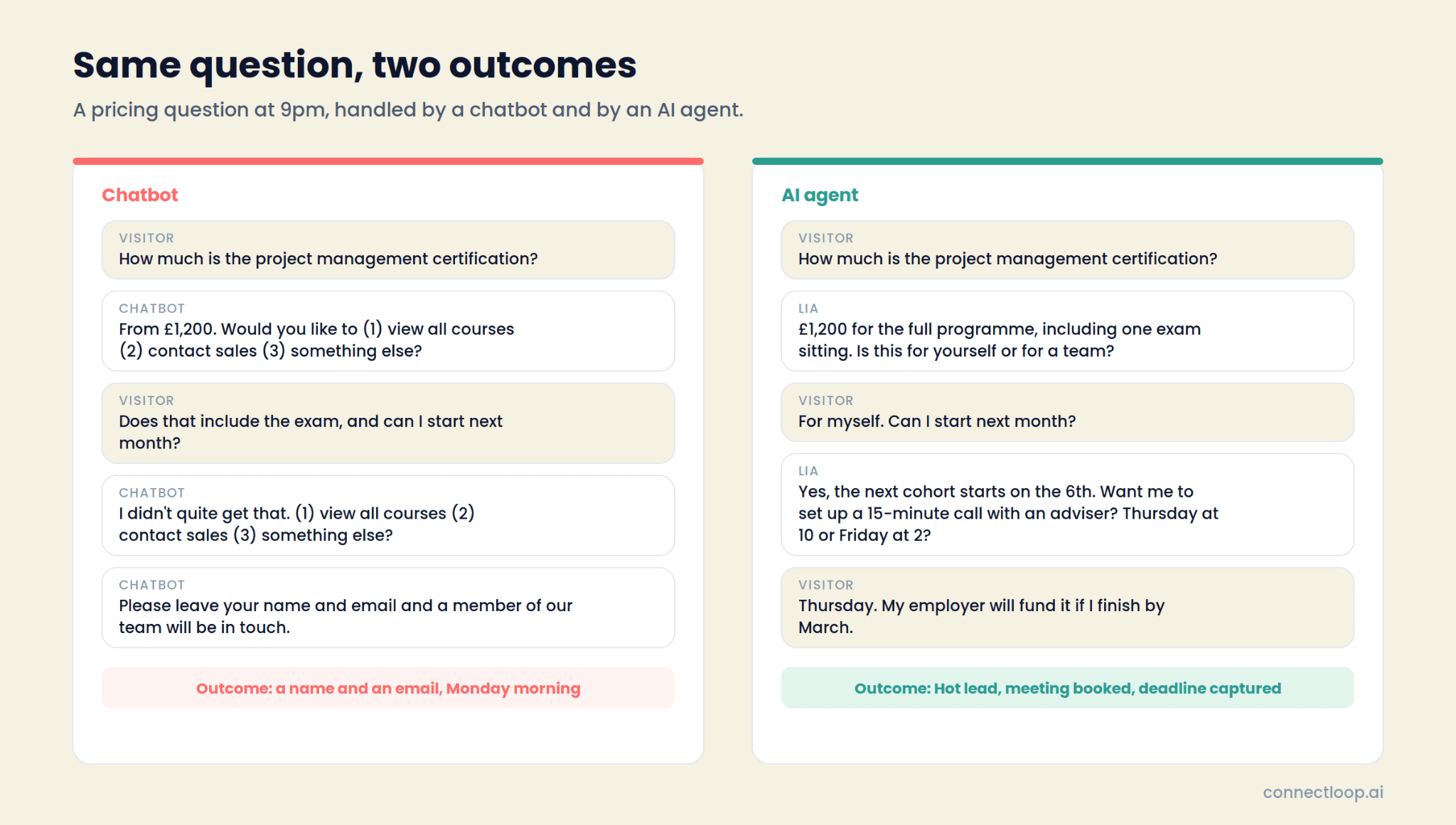
The human agent, the rep, opens the record with the transcript, a Hot lead score shown as temperature, and the reasons: pricing asked, start date confirmed, meeting booked, employer-funded deadline in March. That is a qualified opportunity, produced at 9pm, from the same first question.
This is the whole argument. A chatbot answers. An AI agent answers, asks, qualifies, books and hands over. The AI appointment booking step alone changes what a rep finds on Monday morning. For customer support the gap is convenience. For sales it is revenue.
| Capability | Chatbot | AI agent |
|---|---|---|
| Answers the pricing question | Yes, from a template | Yes, from your approved content |
| Handles the follow-up question | Only if a flow exists | Yes, from context |
| Asks what prompted the visit | Only if scripted | Yes, one question at a time, in the flow |
| Qualifies with SPIN or MEDDICC | Slot-filling at best | Yes, with each answer marked Inferred or Confirmed |
| Books the meeting | Sends a link | Books against live calendar availability, sends the invite |
| Scores intent | Rarely | Yes, with the reasoning shown |
| Hands over with context | Name and email | Transcript, scorecard, intent score, pages viewed, synced to the CRM |
| Follows up | Requires a separate sequencer | Drafts a follow-up when the lead returns, for a person to send |
| Stops when the visitor declines a question | Not applicable | Yes, and records the step as skipped |
Where should an AI agent stop and hand over to a person?
An AI agent should run the first conversation, answering, qualifying and booking, and hand over the moment the visitor asks for a person, the conversation turns, or the deal needs judgment.
Discounting, negotiating and closing stay with a human because they depend on the relationship, not on the knowledge base. Designing that boundary is the most important decision in deploying an agent.
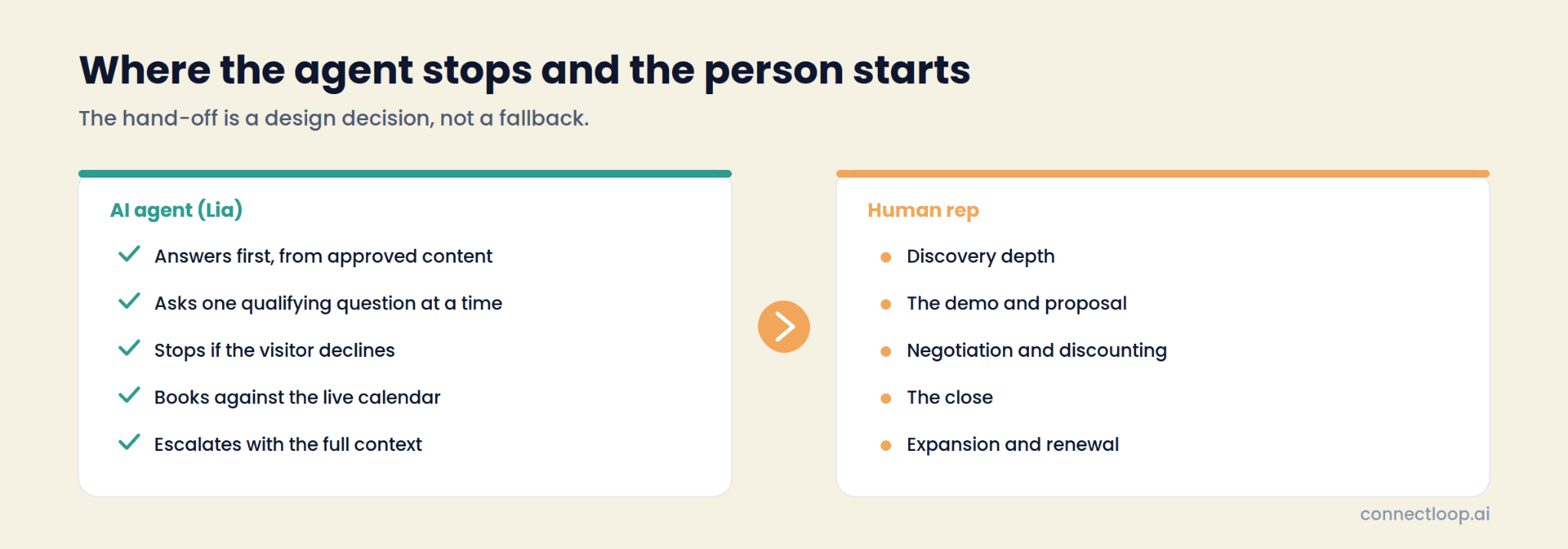
ConnectLoop draws the line like this:
- The agent answers first. Whatever the visitor asked, from approved content, before anything else. Discovery never blocks help.
- The agent asks one qualifying question at a time. What prompted the visit, what else they are evaluating, when they need it. If the visitor skips a question, the agent stops asking and carries on as a normal assistant. The scorecard records the step as skipped.
- The agent books. Against real calendar availability, with an invite, routed to the right team member by tag.
- The agent escalates. When the visitor asks for a human or a meeting after the agent couldn't help, or when sentiment crosses the handover threshold, a person is brought in with the full context.
- The rep takes over. Discovery depth, the demo, the proposal, negotiation, the close and expansion.
The same boundary applies to follow-up. When a known lead returns to the site, ConnectLoop's Proactive Outreach drafts a follow-up email about what they looked at; a person reviews it, sends it or dismisses it. Every message that goes out has a human behind it. The stages of the sales process guide maps this split stage by stage.
What does "trained on your website" mean in practice?
It means the agent's knowledge base is built from your own pages and documents, the source documents, and every answer is grounded in that content through retrieval-augmented generation.
When a visitor asks something, the agent retrieves the relevant passages, generates the answer from them, and stays inside them. Where the content has no answer, the agent says so and the question is logged for you to fill.
In ConnectLoop this is concrete. Paste your website URL and Lia selects the highest-value pages, typically your homepage, products, services, pricing, about and FAQ, and trains on them in about a minute, picking up your brand colours for the widget at the same time.
Upload PDFs, Word documents or FAQ files for the detail a website leaves out. A strong FAQ document is the single biggest improvement to answer quality.
When a question falls outside the knowledge base, it lands in Knowledge Gaps: a list of exactly what visitors asked that the content couldn't answer, with a status you mark Resolved once the document is added.
Conversational Intelligence goes further, grouping every conversation by what drove it and flagging the friction points, a question left unanswered, a visitor who had to ask twice, a long silence after a long reply, each with a recommendation.
That is the honest answer to the hallucination question. Grounding keeps the agent inside your content; Knowledge Gaps tells you where the content needs to grow.
The same visibility extends to the people who never open the chat: Visitor Intelligence lets you identify anonymous website visitors by what they read and how often they return. Your content sets the ceiling, and the tool shows you where the ceiling is.
Can an AI agent keep your brand voice?
Yes, and with more control than a scripted chatbot gives you, because the controls apply to every answer rather than to the ones you wrote flows for. The strongest argument for chatbots has always been brand voice and prescriptive flows: every word pre-approved.
The trade is usually framed as flexibility vs control. An agent with a configured personality, vocabulary and behaviour keeps the voice while still handling the questions nobody scripted.
ConnectLoop's Agent Studio makes this a set of training modules rather than a prompt-engineering exercise:
- Personality and tone. Friendly, professional, neutral or sales-forward, with a creativity setting from on-script to expressive.
- Response style. Short, medium or detailed, with formatting rules for longer answers.
- Voice and vocabulary. Preferred terms the agent must use ("say Services, not Competencies") and phrases it must never use ("ASAP", "act now").
- Sales behaviour. How hard to push for a meeting, from soft mentions to assertive calls to action, and whether booking is offered at all.
- Instructions and playbook. Business context, target audience and selling approach in one prompt, with four persona templates to start from: Consultative Advisor, Objection Handler, Luxury / Premium Brand, No-pressure Educator.
Train several agents with different personalities and activate the one that fits. Version history means a change that hurts can be reverted. ConnectLoop's guide to building a sales playbook covers how to write the instructions module.
Are AI agents more expensive than chatbots?
Per conversation, an AI agent costs more than a rule-based chatbot because every exchange involves language-model inference; per outcome it is usually cheaper, because the agent resolves far more conversations without a person and produces qualified, booked leads rather than contact forms. The comparison that matters is cost per booked meeting, not cost per message.
Chatbot economics are simple: near-zero marginal cost per interaction, and a maintenance cost that compounds as the script grows. Its ROI shows up as deflection, tickets that never reached a person.
Every new use case means new intents, new flows, new templates and new integration code. Organisations with hundreds of intents often spend more maintaining the chatbot than an agent platform would cost.
AI agent economics run the other way: a per-token or per-conversation cost, and a maintenance model that is "add a document, add a tool." Its ROI shows up as resolution rate and, for sales, meetings booked; the implementation cost is measured in configuration effort, which is hours rather than weeks.
According to Gartner's published research on customer service costs, a human-handled support interaction runs to several dollars at minimum, which sets the bar an agent has to beat. For a sales team the bar is different again: the cost of a lead that arrived at 9pm and got a reply on Tuesday.
ConnectLoop prices on conversations rather than seats, with a free plan to start, so the cost scales with the volume the agent actually handles.
How do AI agents work in production?
A production AI agent runs inside three layers of control: guardrails that define what it may say and do, grounding that keeps answers inside your content, and tool permissions that decide which systems it can read from and write to.
Where several agents run at once, an agentic AI platform handles the orchestration between them. Those layers are what turn a language model into something you can put in front of customers.
Guardrails. Allowed topics, tone constraints, escalation thresholds, and the rule that the agent answers the visitor's question before asking its own. In ConnectLoop the handover threshold for sentiment is a setting, and a visitor who declines a qualifying question is never asked again. The qualifying questions themselves follow SPIN and MEDDICC, one step at a time.
Grounding. RAG retrieves from the knowledge base before the model generates, and the system can show which content informed each answer. Where nothing relevant exists, the agent says so rather than inventing.
Tool permissions. Which calendar it can book into, which CRM fields it can write, which team member a lead routes to. An agent that can book meetings and sync transcripts does not need, and should not have, access to billing.
Governance sits on top. Stack Overflow's 2025 Developer Survey found that roughly 87% of developers have concerns about the accuracy of AI agents, which is a reason to demand traceability, not a reason to keep a scripted bot.
PwC's survey of organisations adopting AI agents found 66% reporting measurable value through productivity, and the ones reporting it are the ones that scoped the agent's job and its boundaries clearly.
How do you measure success differently?
Chatbots are measured on coverage: intents recognised, fallback rate, flows completed. AI agents are measured on outcomes: resolution rate, cost per resolution, CSAT, sentiment trends, and whether answers were grounded. A sales agent adds a third set: qualified leads, meetings booked, intent scored, and what the rep received at hand-off.
For a chatbot, the diagnostic tool is the fallback log. For an agent, it is the conversation itself: which topics it resolved, where sentiment turned, which questions went unanswered.
ConnectLoop's Conversational Intelligence reads every conversation Lia has and reports conversation drivers with a resolved-by-agent rate for each, sentiment over time against the handover threshold, competitors named, and friction points ranked by frequency, every one linked to the source chat.
The sales-specific measures come from the same place. Intent Scoring ranks identified visitors High, Medium or Low with the predicted reason they reached out. Lead temperature, Hot, Warm or Cold, carries the AI's reasoning.
And every booked meeting is tracked from the first message, so the number that matters most, conversations that became meetings, is on the dashboard rather than in a spreadsheet. Those same conversations are the raw material for sales coaching, because they show where the hand-off worked and where it stalled.
When should you use a chatbot vs an AI agent?
Use a rule-based chatbot when every response must be pre-approved word for word, when the use case is a handful of fixed transactions at very high volume, or when a legacy bot is embedded with no migration path. Use an AI agent for everything else, and for anything involving a prospect rather than a ticket, because the agent is the only one of the two that can qualify, book and hand over.
The assessment criteria most guides list still apply:
- Complexity of the use case. Fixed, rule-bound transactions are the ideal use cases for a chatbot. Open questions and multi-step tasks need an agent.
- Personalization needs. Generic answers are fine for a chatbot. Answers that depend on what the visitor said and did need an agent, as does any qualification framework beyond a fixed form; the BANT vs MEDDIC comparison shows why.
- Budget. A chatbot is cheaper per message; an agent is cheaper per outcome once conversations have any complexity.
- Scalability. A chatbot scales in volume; an agent scales in scope, because new questions need no new flows.
- Data privacy and security. Both need it. An agent's broader tool access means tool permissions matter more.
- Compliance. Where every word must be pre-approved, a scripted layer for those specific responses is reasonable.
The hybrid approach some vendors recommend, scripted flows for the sensitive moments and an agent for the rest, is a legitimate design, and it is what a well-configured agent already is: guardrails for the moments that need control, reasoning for everything else.
Can a chatbot be upgraded into an AI agent?
Not by adding features, because the architectures differ; but most of what you built for a chatbot carries over. The knowledge base becomes the agent's RAG corpus. The API integrations become tools the agent can call. The FAQ content trains the agent directly.
What you leave behind is the intent taxonomy and the dialogue flows, which the model replaces with reasoning at runtime.
In practice the migration is shorter than the original chatbot build. For ConnectLoop it is: paste the website URL, upload the FAQ and product documents you already have, connect the calendar and CRM, choose a persona, test it in Live Test, and activate. The pieces that took months to script are the pieces the agent no longer needs.
Do rule-based chatbots still make sense in 2026?
For a small set of cases, yes: regulated responses that must be pre-approved verbatim, extreme-volume single-turn transactions where inference cost matters, and legacy systems with no budget to replace.
For most new deployments, and for any sales use, an AI agent is the better default, because it handles everything a chatbot handles plus the long tail of questions and the actions that turn a conversation into a meeting.
The question has shifted. It is no longer "chatbot or agent" but "how do we configure and bound the agent for our domain." That is a question about tone, knowledge, tool permissions and the hand-off, and every one of those is a setting rather than a project.
How do industry-specific implementations differ?
The architecture is the same everywhere; what changes is which conversations matter and where the hand-off sits. A chatbot in any industry handles the fixed, high-volume questions. An AI agent handles the conversations that decide revenue, and those look different in an education provider, a services firm and an online store.
| Industry | Chatbot handles | AI agent handles |
|---|---|---|
| Education and training providers | Course dates, fees, location | Which course fits the visitor's goal, funding deadlines, booking an adviser call, following up when they return to the syllabus page |
| Professional services | Office hours, contact details | Scoping the enquiry, qualifying budget and timeline, booking the consultation with the right specialist by tag |
| SaaS and software | Password resets, plan names | Comparing plans against the visitor's needs, integration questions, competitor comparisons, booking the demo |
| E-commerce | Order status, returns policy | Product recommendations from the live catalogue, add-to-cart in the conversation, revenue attributed to the agent |
| Healthcare and clinics | Opening hours, directions | Explaining treatments from approved content, booking appointments against practitioner availability, escalating clinical questions to a person |
ConnectLoop's education and services customers use the same agent with different personas and knowledge bases; the e-commerce version adds a WooCommerce connection so Lia recommends real products with live prices and stock, as the AI agent for e-commerce guide describes.
What does the small-business version look like?
For a five-person education provider or services firm, the AI agent is the one that is feasible at all. A rule-based chatbot needs someone to design intents and flows and keep them current. An agent needs a website, a FAQ document, a connected calendar and about a minute. ConnectLoop is built for that size of team.
What that looks like from first signup:
- Create an account with a work email; the company profile is built from the domain.
- Paste the website URL. Lia scans the site, detects the brand colours and logo, selects the highest-value pages and trains on them. Or upload a document if the best content lives in a brochure.
- Pick a personality preset: very salesy, long and detailed, or warm and concise. Fine-tune later in Agent Studio.
- Connect the channels: paste one embed snippet into the website, connect a WhatsApp Business number through Meta's guided signup, connect a Gmail or Outlook inbox. One agent, one knowledge base, three channels.
- Connect the calendar and CRM. Meetings book against real availability; transcripts, intent scores and pages viewed sync to HubSpot, Salesforce, Zoho or Pipedrive.
- Test in Live Test, then go live. Watch Knowledge Gaps for the first week and add the documents it asks for.
No intent taxonomy, no flow designer, no IT project. The agent handles the 9pm enquiry the day it is switched on. The AI sales agent guide covers what that first conversation looks like in more depth.
How do you make the right choice for your enterprise?
For an enterprise the choice is rarely one or the other; it is where to draw the line between scripted control and agent autonomy, and how to govern the agent side. Enterprise-ready AI agents are the ones that come with the controls built in: guardrails, grounding with traceability, tool permissions, workspace separation and version history, so the flexibility never outruns the oversight.
Considerations that decide it:
- Task complexity. Map the top twenty conversations. Fixed transactions can stay scripted; anything with judgment goes to the agent.
- Compliance risk. Where wording must be pre-approved, keep a scripted layer for those specific responses inside the agent's guardrails.
- Integration needs. List the systems the agent must read from and write to, and set permissions per system.
- Autonomy tolerance. Decide what the agent may do alone (answer, qualify, book) and what needs a person (discount, negotiate, close).
- Governance. Who owns the knowledge base, who reviews Knowledge Gaps, who can change the agent's instructions, and how versions are tracked. For the calls that follow the hand-off, AI sales coaching applies the same framework the agent started.
- ROI goals. Measure cost per outcome, not per message, and set the outcome: tickets resolved for support, meetings booked for sales.
ConnectLoop supports enterprise deployment with multiple workspaces for separate business units or clients, role-based permissions for company and workspace admins, per-agent instructions with version history, and a knowledge base that stays yours.
Key takeaways
- A chatbot follows a script; an AI agent reasons, uses tools, remembers and acts. The middle tier, the LLM chatbot, answers well but cannot act.
- For support the difference is convenience. For sales it is the difference between a contact form and a qualified, booked meeting.
- The same 9pm pricing question ends at a fallback with a chatbot and at a booked meeting with an agent.
- An agent should answer, qualify, book and hand over. Discounting, negotiating and closing stay with a person, by design.
- "Trained on your website" means grounded answers from your own content, with Knowledge Gaps showing exactly where the content needs to grow.
- Brand voice is a setting, not a reason to keep a script: tone, vocabulary, sales behaviour and persona are configured once and apply to every answer.
- Measure agents on outcomes: resolution rate, sentiment, friction, and for sales, meetings booked and what the rep received.
- For a small team the agent is the feasible option: a website URL, a FAQ document, a calendar and about a minute.
For a support desk, the chatbot-versus-agent decision is about how many tickets close without a person. For a sales team it is about how many conversations become meetings, and only one of the two can make that happen.

About the author
ConnectLoop Staff
Written by the ConnectLoop team. ConnectLoop is an AI sales agent for inbound revenue teams, based in Cambridge, Massachusetts.
About ConnectLoop →Frequently asked questions
No. The difference is architectural. A chatbot follows a predefined script; an agent reasons about the task at runtime, uses tools, and decides what to do next. They look similar from the outside because both are conversations. Inside, one is a lookup and the other is a loop.
For most customer-facing uses, yes, over the next few years, because an agent does everything a chatbot does plus the long tail of questions and the actions. Scripted responses will survive where regulation demands pre-approved wording, usually as a controlled layer inside an agent rather than a separate product.
A language model can generate a plausible answer that is wrong, which is why production agents ground every answer in a curated knowledge base and can show which content informed it. In ConnectLoop, questions the knowledge base has not covered yet are logged in Knowledge Gaps rather than guessed at, and the fix is adding the document.
A chatbot answers in milliseconds because it performs a lookup. An AI agent typically answers in one to a few seconds depending on the reasoning steps and tool calls. For sales and support conversations that is comfortably fast enough; the visitor is reading, not racing.
An AI chatbot uses a language model to understand and answer, one request at a time, from a knowledge base. An AI agent adds a reasoning loop, tool use and memory, so it can carry out multi-step tasks such as qualifying a lead and booking a meeting. Most products sold as AI chatbots are the first; the second is what a sales team needs.
Yes. ConnectLoop's Lia asks SPIN and MEDDICC questions one at a time inside the conversation, records each answer as Inferred or Confirmed on a scorecard, stops if the visitor declines, and scores intent with the reasoning shown. The inbound lead qualification guide explains the method.
When the visitor asks for a person or a meeting, when sentiment crosses a threshold you set, or when the deal reaches a stage that needs judgment. The hand-off carries the transcript, scorecard, intent score and pages viewed, routed to the right team member by tag, so the rep's first call starts where the conversation ended. Whether that rep is an SDR or a BDR decides what they do with it next.
Robotic process automation runs fixed, rule-based back-office tasks such as data entry with high speed and accuracy. An AI agent handles unstructured input, reasons about ambiguous requests and adapts. RPA is a script for systems; an agent is a colleague for conversations.
In ConnectLoop, yes: the same agent, with the same knowledge base and behaviour, answers on website chat, on a WhatsApp Business number and in a connected Gmail or Outlook inbox. A visitor who starts on the site and continues on WhatsApp is talking to the same Lia.
Complexity of the use case, how personal the answers need to be, budget per outcome rather than per message, how the scope will grow, data privacy and tool permissions, and where the human hand-off should sit. For anything involving prospects, add one more: whether the tool can qualify and book, or only answer.
ConnectLoop's Lia answers, qualifies and books
Lia works on website chat, WhatsApp and email, then hands the rep a conversation that has already started. Train it on your site in about a minute on the free plan and read the first one it handles.