
Sales Enablement
Sales Playbook: How to Build One Your Team and Your AI Agent Can Both Run
A sales playbook is the document that tells your sales team what to do at each stage of the sales process: who you sell to, what to say, which questions to ask, how to handle objections and when to close. The best ones are short, specific and written as instructions. ConnectLoop takes that a step further: a playbook Lia, its AI agent, executes in the first conversation and your reps follow on the call.

Published
Table of contents
- What is a sales playbook and what does one look like?
- Why does a sales playbook matter?
- What is included in a sales playbook?
- What are sales plays, with examples?
- How do you create a sales playbook, step by step?
- What does the play for the first inbound conversation look like?
- How do you write a playbook an AI agent can run?
- How does the playbook show up during a live call?
- Document, CRM or agent: where should the playbook live?
- How do you roll out a sales playbook and get reps to use it?
- How do you measure whether the playbook is being followed?
- How do you keep a sales playbook up to date?
- What does a sales playbook look like for a five-person team?
- Key takeaways
- Frequently asked questions
What is a sales playbook and what does one look like?
A sales playbook is a comprehensive guide to how your company sells: the target customer profiles, the stages of the sales process across the whole sales cycle, the sales methodology, the messaging and scripts, the sales strategies and tactics for each stage, the plays for common selling situations, and the KPIs that define success. It is the single source of truth and go-to guide a rep checks before guessing, the reference point that replaces asking a manager.
What it looks like depends on who reads it. For a rep, it is a document or a CRM view: personas, deal stages, discovery questions, objection handling, email templates. For an AI agent, it is a set of instructions: tone, response length, vocabulary, sales behaviour and a written playbook prompt. ConnectLoop's Agent Studio holds both in one place.
A good test of a playbook is whether it answers the question a rep would otherwise ask their manager. "What do I say when they ask about a competitor?" "Which qualifying questions come first?" "When do I stop pushing for a meeting?" If the answer is in the playbook, it is doing its job.
Why does a sales playbook matter?
A sales playbook shortens onboarding for new reps, removes guesswork from selling situations, keeps messaging consistent across the sales team and makes forecasting more accurate, because every deal moves through the same deal stages with the same milestones. It also turns the habits of top performers into something the whole team can use.
The benefits break down as follows:
- Faster onboarding. New hires get a step-by-step guide to the sales process instead of learning by watching. Ramp time drops.
- Consistency. Every prospect hears the same value proposition and gets the same customer experience, whichever rep they speak to. That is what standardize means in practice: the same play, run the same way, at every touchpoint of the sales funnel.
- Less guesswork. Common objections have written answers. Common scenarios have plays. Handling objections becomes a lookup, which helps reduce ambiguity and lifts productivity: reps spend time selling, not improvising.
- Shared best practices. What top sellers do gets written down, so the whole team learns from it.
- Accurate forecasting. Defined deal stages and milestones mean pipeline reports reflect reality.
- Sales and marketing alignment. Personas, positioning, lead scoring criteria and the lead handoff are agreed once, in writing, so the marketing team and the sales team work from the same definitions.
- Performance you can see. Sales goals, sales quotas and sales metrics are written down, so revenue growth is measured against a plan rather than a feeling.
ConnectLoop adds one more: a playbook written as instructions can be run by an AI agent for the first conversation, which means the playbook covers the hours nobody on the team is working. The stages of the sales process guide explains which stages that first conversation covers.
What is included in a sales playbook?
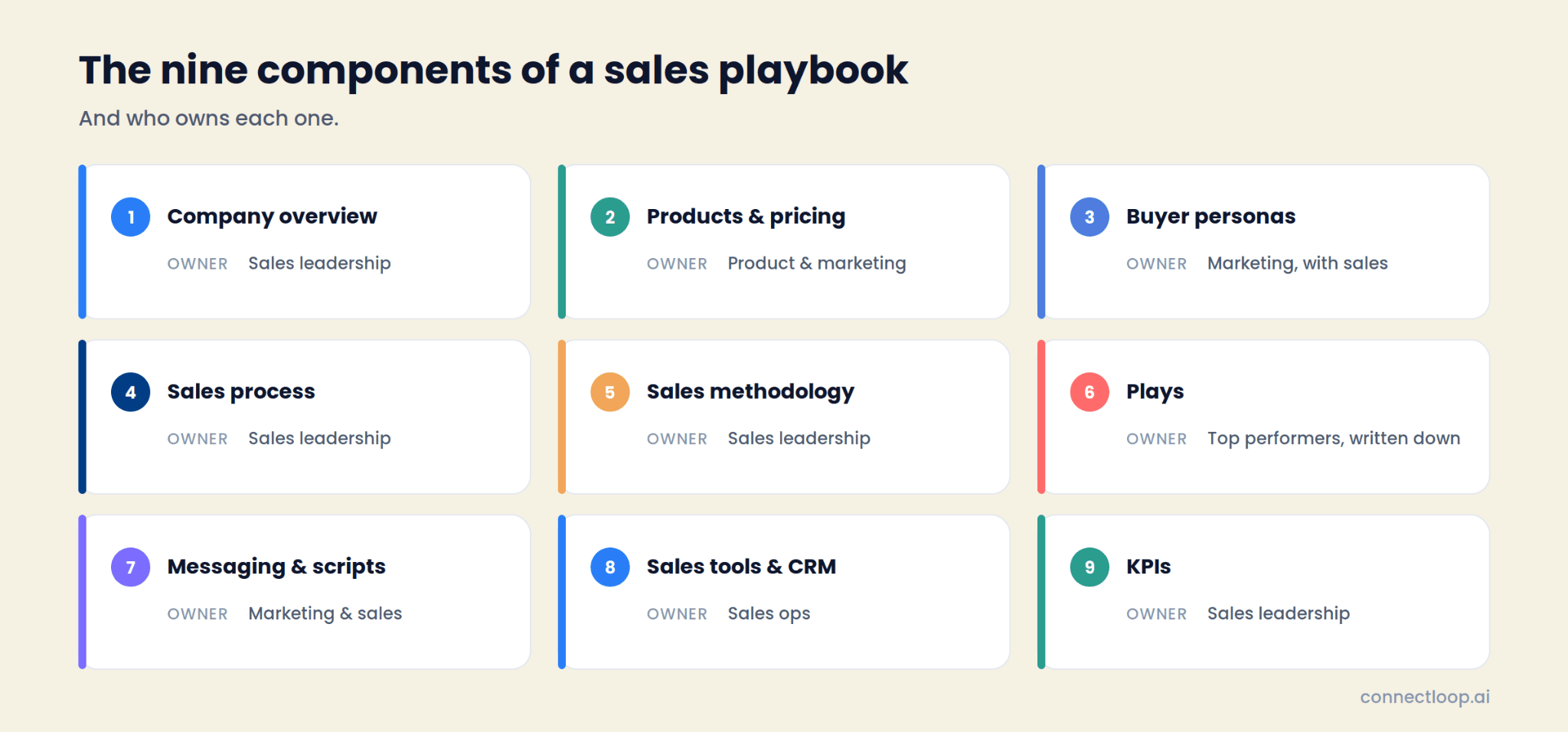
A sales playbook has nine components: company overview, products and pricing, buyer personas, sales process, sales methodology, plays, messaging and scripts, sales tools and CRM, and KPIs. Some teams add training resources and competitive positioning. Length is not the goal; a rep should find any answer in under a minute.
| Component | What it contains | Who owns it |
|---|---|---|
| Company overview | Company information, mission and values, company culture, company strategy, sales strategy, roles and responsibilities, how sales fits the business objectives | Sales leadership |
| Products and pricing | What you sell, features and benefits, pricing, product information a rep must get right | Product and marketing |
| Buyer personas | Ideal customer, customer personas, pain points, buying process, the touchpoints along the buyer's journey, who is in the decision-making process | Marketing, with sales input |
| Sales process | Sales pipeline stages from prospecting through proposal, negotiation and closing, milestones, what each stage must produce, the lead handoff | Sales leadership |
| Sales methodology | Which of the sales methodologies applies where: SPIN, MEDDICC, BANT, Challenger, Solution Selling, and why | Sales leadership |
| Plays | Step-by-step instructions for specific scenarios: qualification, demo, follow-up, ghosting, closing | Top performers, written down |
| Messaging and scripts | Value proposition, elevator pitch, discovery questions, objection handling, call scripts, email scripts and templates, lead nurturing sequences, battle cards from competitor analysis | Marketing and sales together |
| Sales tools and CRM | The technology and tech stack: which tools, when, how to log, lead ownership, how the playbook is embedded in the CRM workflow | Sales ops |
| KPIs | Key performance indicators: conversion rates, time to close, average deal size, win rates, quota, what gets reviewed weekly | Sales leadership |
| Training resources | Training materials, case studies, customer proof, recorded calls, sales coaching notes | Sales enablement |
Two things most playbooks leave out. The play for the inbound enquiry that arrives outside working hours, and the instructions for whatever software handles it. Both are covered below.
What are sales plays, with examples?
A sales play is a step-by-step set of instructions for one selling situation: what to do, in what order, with what wording. Plays are the practical part of the playbook. A rep facing a stalled deal does not need the company mission; they need the ghosting play.
Common plays, with the shape each one takes:
- Prospecting play. Who to target, which channel, the opening message, the follow-up cadence, when to stop.
- Lead qualification play. The qualifying questions in order, what a good answer sounds like, what disqualifies, where to record the answers.
- Product demo play. Which three features to show for which persona, the questions to ask before showing anything, how to close the demo.
- Ghosting play. The follow-up sequence when a prospect goes quiet: what to send, spacing, the last message. ConnectLoop's guide to the follow-up email after no response is a play written out in full.
- Follow-up play. What to send after a call, referencing what was discussed, with one next step.
- Closing play. How to ask, how to handle the last objection, what to trade instead of discounting.
The best plays are written like recipes: numbered, specific, with the exact wording a rep can say out loud. "Handle the pricing objection" is a heading. "Ask what they are comparing the price to before answering" is a play.
How do you create a sales playbook, step by step?
Create a sales playbook by auditing how your team sells today, defining the ideal customer and the sales process, writing the plays from what top performers already do, adding scripts and objection handling, and putting it where reps will actually use it. Budget an afternoon for the first version and a quarter to make it stick.
- Assemble a small team. A sales leader, one or two frontline reps or sales development representatives, someone from the marketing team, a subject matter expert from product, and someone from customer success. Name a playbook owner who is not carrying a quota, and get C-suite buy-in on the strategy section.
- Audit existing processes. Interview sales reps. Which emails work, which discovery questions open people up, what top performers do differently. Collect the scripts already in use.
- Define the ideal customer and target personas. Industry, company size, role, pain points, how they buy. Pull it from won deals, not assumptions.
- Map the buyer's journey and the sales process. Deal stages, what each stage must produce, the milestones that move a deal forward. Include the inbound path: how a visitor reaches you, what they ask first, who answers.
- Choose the sales methodology per stage. BANT or SPIN at qualification, SPIN at discovery, MEDDICC for deal review, Challenger for presentations. ConnectLoop's BANT vs MEDDIC comparison covers the choice.
- Write the plays. One per scenario, numbered steps, suggested wording. Start with the five situations reps ask about most.
- Add messaging and scripts. Value proposition, elevator pitch, discovery questions, the ten most common objections with answers, call scripts, email templates, a nurturing sequence for leads who are not ready, and battle cards for the two competitors you meet most. Keep the wording personalized to each persona rather than generic.
- Write the agent's version. If an AI agent handles the first conversation, translate the relevant plays into instructions it can follow: tone, vocabulary, which questions to ask and in what order, what to do when a visitor declines. The section below shows how.
- Set the KPIs. Conversion rate by stage, time to close, average deal size, win rate. Define what a sales leader reviews weekly.
- Put it where reps work. Embed it in the workflow: integrate with the CRM for stage criteria and templates, and with the tool that surfaces plays during calls, rather than a PDF nobody opens.
- Test it live. Run the plays on real conversations for two weeks, collect feedback, fix what did not survive contact.
- Schedule the review. Update regularly: quarterly, plus whenever pricing, product or positioning changes. Build the feedback loop into the calendar.
What does the play for the first inbound conversation look like?
The first inbound conversation is the play most sales playbooks skip, because it happens before a rep is involved: on a website at 9pm, on WhatsApp on a Sunday, in an inbox on a public holiday. It needs a play like any other stage, and it is the one an AI agent can run exactly as written.
The play, as ConnectLoop runs it:
- Answer the question first. The visitor came with a question. Answer it from approved content before anything else. Discovery never gets in the way of help.
- Ask one qualifying question, inside the conversation. What prompted the visit, what else they are evaluating, when they need it in place. One at a time, in the natural flow, never as a form.
- Stop if they decline. If the visitor ignores or skips a question, drop it and carry on being helpful. The scorecard records the step as skipped; the rep can pick it up later.
- Record what was said. Reason for reaching out, competitor named, timeline, budget if given. Mark each answer Confirmed if the visitor stated it, Inferred if it was deduced.
- Offer the meeting when they are ready. Book it against real calendar availability, send the invite, route the lead by tag.
- Hand over with everything attached. Transcript, summary, scorecard, intent score, pages viewed, synced to the CRM.
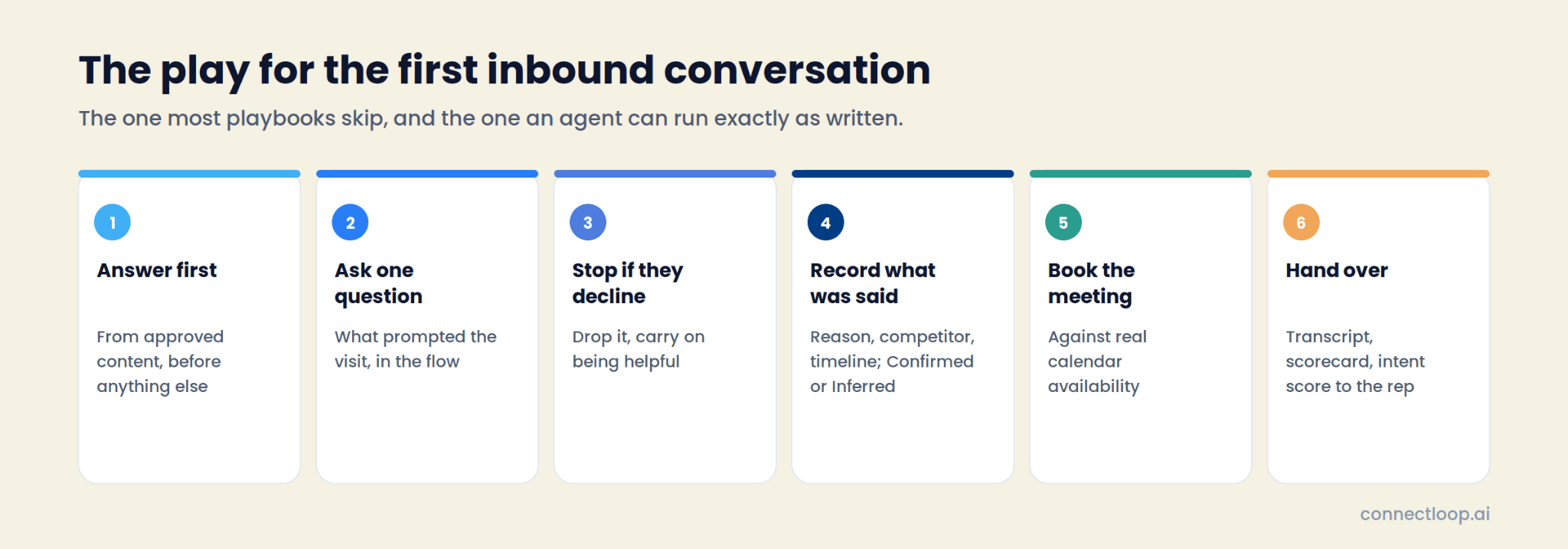
Written this way, the play is unambiguous enough for software and useful enough for a human SDR. That is the test of a good play.
How do you write a playbook an AI agent can run?
An AI agent's playbook is the same content as a rep's, written as instructions instead of advice: what tone to use, how long to answer, which words to prefer and avoid, how hard to push for a meeting, and the business context and playbook in one prompt. ConnectLoop's Agent Studio breaks this into five modules, each of which maps to a section of a conventional playbook.
What are the five modules?
| Playbook section | Agent Studio module | What you set |
|---|---|---|
| Messaging and tone | Personality & Tone | Tone preset (friendly, professional, neutral, sales-forward) and creativity, from on-script to expressive |
| Scripts and formatting | Response Style | Response length (short, medium, detailed) and structure: paragraphs, bullets, headings |
| Positioning and vocabulary | Voice & Vocabulary | Preferred terms ("say Services, not Competencies") and phrases to avoid ("ASAP", "act now") |
| Closing play | Sales Behavior | Sales aggressiveness (low, medium, high) and whether the agent may offer to book meetings |
| The playbook itself | Instructions & Playbook | Business context, target audience, special guidelines and the selling approach, in one prompt of up to 5,000 characters |
The first four are settings. The fifth is the playbook, and it is where most of the writing happens.
What do the persona templates look like?
Rather than a blank prompt, ConnectLoop ships four selling personas as starting points. Each is a complete playbook you edit rather than write:
- Consultative Advisor. Diagnoses needs first, recommends second. For considered purchases where the buyer wants to be understood before being sold to.
- Objection Handler. Surfaces concerns early and answers with empathy plus evidence. For products with a known set of objections.
- Luxury / Premium Brand. Refined, unhurried, exclusive. Sells the experience rather than the feature list.
- No-pressure Educator. Informs and empowers, zero pressure. For education providers and anyone whose buyers research for weeks before deciding.
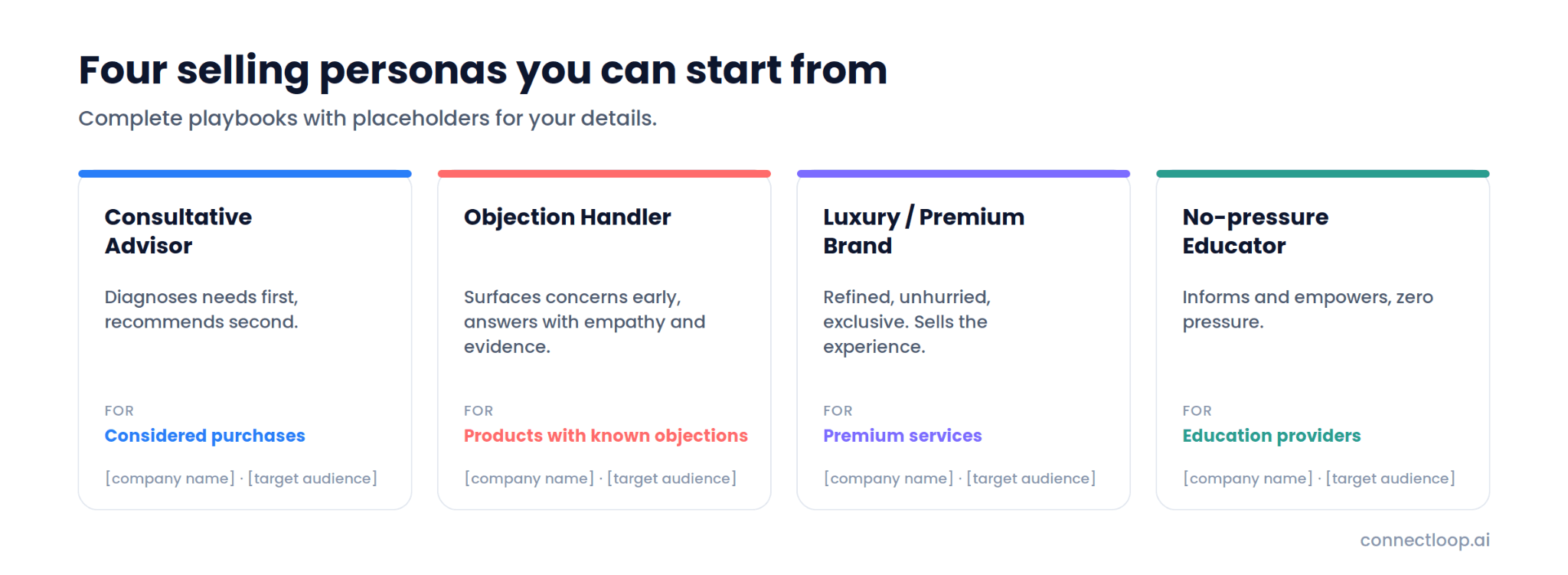
Each template contains placeholders in square brackets: [agent], [company name], [industry], [product/service], [target audience]. Every one has to be replaced with your real details, because an unfilled placeholder shows up in replies. It is the same discipline as a rep's email template with [FIRST NAME] left in, made visible.
What should the agent's playbook not try to do?
Facts. The playbook shapes how the agent talks; it answers with facts from the knowledge base. When a visitor asks something the knowledge base has not covered yet, the fix is in Training or Knowledge Gaps, not in the prompt. Keeping the two apart is what stops a playbook from turning into a script the agent recites regardless of what was asked.
How does the playbook show up during a live call?
For the stages a rep runs, ConnectLoop's Sales Assistance turns the playbook into a live tracker and a set of cue cards. The rep runs the call as normal; the assistant listens in the browser, follows the chosen framework step by step, and surfaces the playbook's own wording at the moment it fits. Adoption stops depending on memory.
How are frameworks written as plays?
Sales Frameworks is where the methodology section of the playbook becomes executable. Four standards are in the library from day one: SPIN (Situation, Problem, Implication, Need-payoff), MEDDICC, BANT and Challenger (Warm-up, Reframe, Rational drowning, Emotional impact, A new way, Your solution). Each is an ordered set of steps.
A custom framework is built the same way: up to 12 steps, each with a step name, a description of what must be covered, and the suggested wording the rep can say out loud. Duplicate a standard and edit it, or import steps from several frameworks into one hybrid. The framework marked "use for next call" becomes the default every rep starts from.
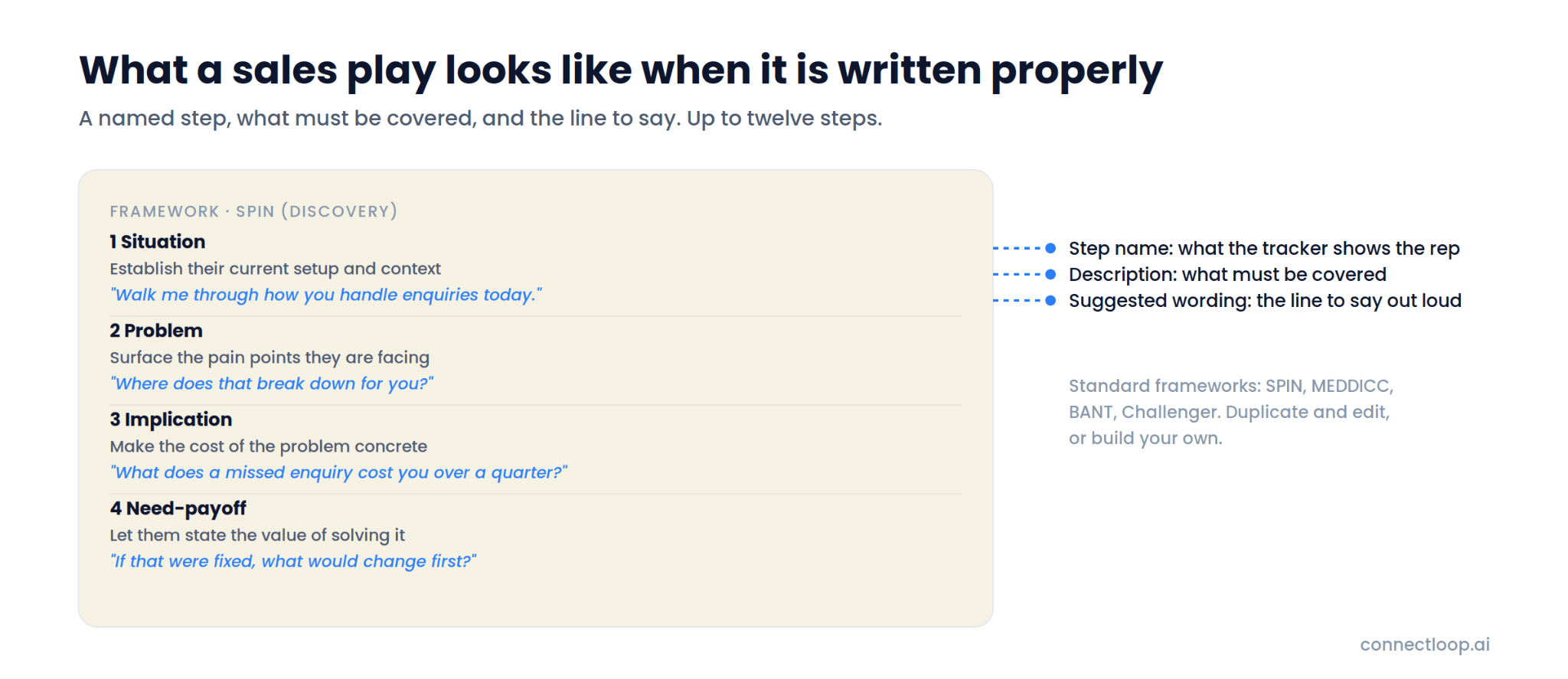
That is what a play looks like when it is written properly: a named step, a description, a line to say.
What does the rep see?
During the call, a Progress tab marks each framework step covered, pending or skipped. Cue cards appear as the buyer speaks: objection, pricing, product knowledge, memory and script cues, each with the suggested wording, the reason it was raised and branches for "if the buyer says X, respond with Y." A rep can mark a step skipped when it does not apply. What earlier calls with the same customer already covered is carried in, so nothing is re-asked.
Talk ratio, pace and buyer sentiment run alongside. Action items are captured as they are agreed.
Document, CRM or agent: where should the playbook live?
The playbook should live wherever a rep is when they need it. For most teams that means three places at once: a short reference document for onboarding, the CRM for stage criteria and templates, and the tool that runs or surfaces plays during conversations. Each carries a different part.
| Where it lives | What it holds | Strength | Limit |
|---|---|---|---|
| Document (PDF, wiki, doc) | Company overview, personas, methodology, full plays, training resources | Complete, easy to write and read once | Out of sight during a call; goes stale |
| CRM | Deal stage entry criteria, required fields, email templates, activity reminders | In the workflow; enforces the process | Holds the what, rarely the how or the wording |
| Agent (first conversation) | Tone, vocabulary, sales behaviour, qualification questions in order, the playbook prompt | Runs the play exactly as written, at any hour | Answers facts from the knowledge base, not the prompt |
| Live call assistant | Framework steps with wording, cue cards, objection responses | Surfaces the play at the moment it applies; scores coverage after | Needs the rep to run the call in the browser |
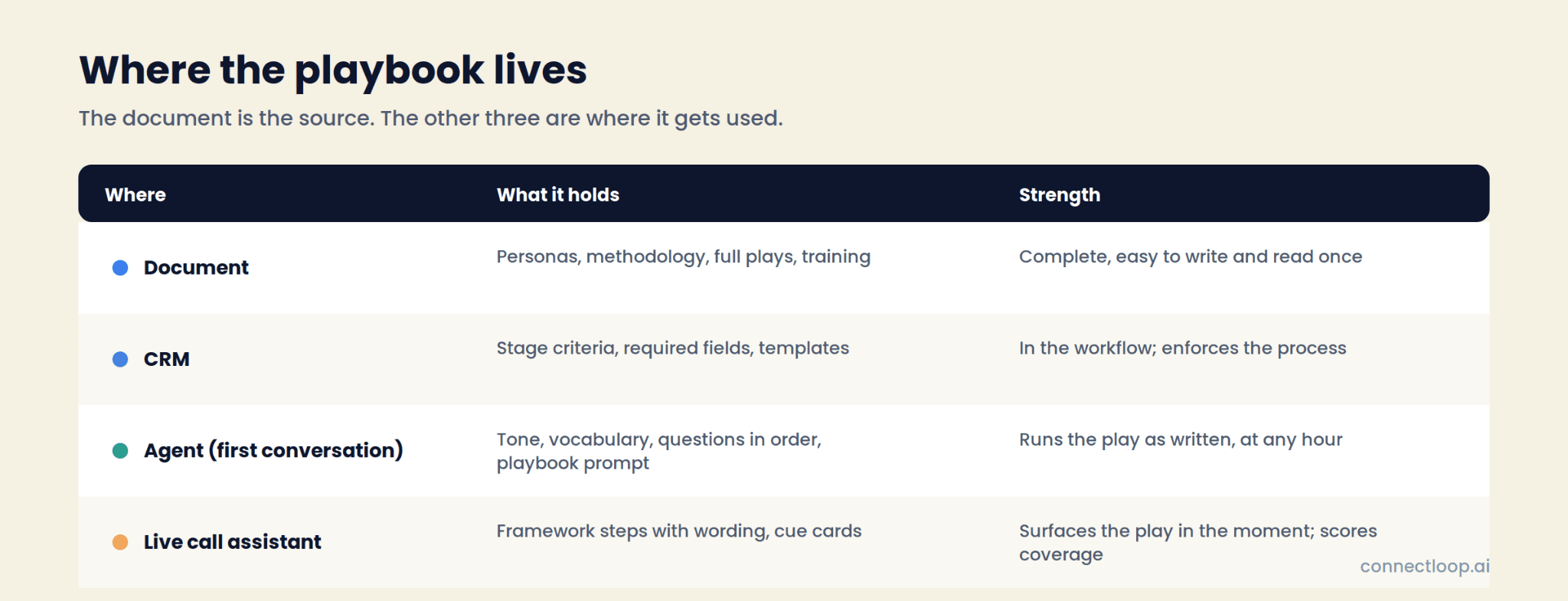
The document is the source. The CRM, the agent and the assistant are where it gets used.
How do you roll out a sales playbook and get reps to use it?
The rollout works by presenting the playbook as a tool that makes reps' jobs easier, walking through the plays in a workshop, embedding it where reps already work, and answering every "what do I do when" question with "check the playbook" for the first month. Adoption follows usefulness; a playbook nobody needs is a playbook nobody opens.
The usual obstacles and what fixes them:
- Too generic or too specific. Plays that do not match real conversations get ignored. Fix: write them from recorded calls and rep interviews, then revise after two weeks of use.
- Out of sight, out of mind. A PDF in a shared drive is not a playbook. Fix: put stage criteria in the CRM, the agent's instructions in the agent, the call plays in the assistant.
- Resistance to change. Reps with their own way of working will not switch for a document. Fix: show the coverage scores; the framework tracker makes it visible which steps get results.
- Nobody owns it. Fix: a named playbook owner with a quarterly review on the calendar.
For the agent's half there is no adoption problem at all. The agent runs the playbook as written, every conversation, from the moment it is activated. That consistency is the reason to write the first-conversation play carefully.
How do you measure whether the playbook is being followed?
Measure adherence, not just usage. To measure usage tells you the playbook was opened; adherence tells you the play was run. The cleanest measure is framework coverage: for each call, which steps were covered, with evidence of who said it and when. ConnectLoop scores this automatically for every assisted call.
What the numbers look like:
- Framework coverage per call. Each step marked covered, partial or not covered, with the quote that proves it.
- Average framework coverage across the team, on the Sales Assistance dashboard, beside calls assisted and cues accepted.
- Coverage across all calls with one customer. The customer dossier shows which steps have been covered over the relationship and what is still open, so the next call starts at the right place.
- Cues accepted. How often a rep used the suggested wording, tracked separately from how often it was shown.
For the first conversation, the equivalent is the methodology scorecard on each lead: each SPIN or MEDDICC step marked Not Started, In Progress, Completed, Skipped or Not Applicable. A team-wide pattern of skipped steps is information about the play, not about the reps. Sales coaching works best when it starts from these numbers rather than from memory.
Pair adherence with outcomes: win rates, conversion rates by stage, time to close, average deal size. A play with high coverage and low conversion needs rewriting. A play with low coverage and high conversion needs promoting.
How do you keep a sales playbook up to date?
Review the playbook quarterly, and immediately whenever pricing, product, positioning or the competitive landscape changes. Use the data you already have: which plays get skipped, which objections keep appearing, which questions the agent could not answer. A living document is one that changes because of evidence, not because a date came round.
The inputs that should trigger a change:
- Knowledge Gaps. Questions the agent could not answer are a list of what the playbook and knowledge base are missing.
- Conversational Intelligence. New competitor mentions, rising objections and confusion themes across all conversations point at plays that need updating. ConnectLoop's Conversational Intelligence groups these automatically.
- Framework coverage trends. A step the whole team skips is a step to rewrite or remove.
- Rep and customer feedback. What reps hear that the playbook does not cover, and what customers say about the experience.
- Version history. Agent Studio keeps versions of the agent's playbook, so a change that hurts can be reverted.
What does a sales playbook look like for a five-person team?
For a small team, a sales playbook is one page for humans and one prompt for the agent. The page holds the ideal customer, the five deal stages with what each produces, the ten most common objections with answers, and three plays. The prompt holds tone, vocabulary, the qualifying questions in order and the selling persona.
This is the version most guides skip, because they are written for enterprises with a playbook owner, a taskforce and a sales kickoff. A five-person education provider or services firm needs none of that. It needs the first inbound conversation handled well at any hour, the rep's call started from what was already said, and a review every quarter.
ConnectLoop is built for exactly that size of team. Lia runs the first-conversation play on website chat, WhatsApp and email; the scorecard and transcript reach the rep; the framework tracker runs the call play; and coverage is scored without anyone filling in a form. The one-page playbook stays one page, tailored to the way that team actually sells.
Key takeaways
- A sales playbook is the single source of truth for how your team sells: personas, process, methodology, plays, scripts and KPIs. The best ones are short and written as instructions.
- Plays are the practical part. Number the steps, include the exact wording, write them from what top performers already do.
- The play most playbooks skip is the first inbound conversation. Answer first, one qualifying question at a time, stop if they decline, book, hand over with everything attached.
- A playbook an AI agent can run has five parts: tone, response style, vocabulary, sales behaviour and the playbook prompt. ConnectLoop ships four persona templates to start from.
- Methodologies become plays when they are written as ordered steps with suggested wording. ConnectLoop's Sales Frameworks do this for SPIN, MEDDICC, BANT and Challenger, or your own.
- During a live call, the playbook should surface as a tracker and cue cards, not as a document in another tab.
- Measure adherence, not usage: framework coverage per call with evidence, and the qualification scorecard per lead.
- Review quarterly, and let Knowledge Gaps, conversation themes and coverage trends decide what changes.

About the author
ConnectLoop Staff
Written by the ConnectLoop team. ConnectLoop is an AI sales agent for inbound revenue teams, based in Cambridge, Massachusetts.
About ConnectLoop →Frequently asked questions
The sales process is the sequence of deal stages a deal moves through. The playbook is everything a rep needs to run each stage well: personas, methodology, plays, scripts and KPIs. The process is a section of the playbook, not a synonym for it.
A methodology is an approach used inside a stage: SPIN for discovery, MEDDICC for deal review, Challenger for presentations. The playbook says which methodology applies where and writes it out as steps with wording. In ConnectLoop, that is what a Sales Framework is.
As short as it can be while still answering the questions reps actually ask. Some enterprise playbooks run to 50 or 80 pages; a small team's can be one page plus the agent's instructions. Length is a cost, not a feature.
Yes, if the playbook is written as instructions. ConnectLoop's Agent Studio holds tone, response style, vocabulary, sales behaviour and a free-form playbook prompt, with four persona templates to start from. Lia runs it on every first conversation, and Sales Frameworks turn the methodology into steps a rep follows on the call.
The four persona templates in ConnectLoop's Agent Studio (Consultative Advisor, Objection Handler, Luxury / Premium Brand, No-pressure Educator) are complete selling playbooks with placeholders for your details. The four standard frameworks (SPIN, MEDDICC, BANT, Challenger) are plays written as ordered steps you can duplicate and edit.
Quarterly at minimum, and immediately after any change to pricing, product, positioning or the competitors you meet. Use Knowledge Gaps, conversation themes and framework coverage to decide what changes, rather than rewriting everything on a schedule.
A named owner who is not carrying a quota, with input from frontline reps, marketing and customer success. Top performers supply the plays; the owner writes them down. The C-suite signs off on the strategy section so the playbook carries authority.
Measure adherence with evidence. Framework coverage per call shows which steps were covered and quotes the moment. The methodology scorecard on each lead shows which qualification steps were completed, skipped or confirmed. Usage of a document tells you far less.
Yes, and inbound is where a playbook pays off fastest, because the first conversation can be run exactly as written by an agent at any hour. The play covers answering, one-question-at-a-time qualification, stopping when a visitor declines, booking, and the hand-off to a rep with the transcript attached.
A sales playbook earns its keep when it is followed
It is followed when it is where the selling happens. If your first conversations happen on a website, WhatsApp or email, ConnectLoop runs that play as written and hands your reps a call that starts from what the buyer already said. Train Lia on your site in about sixty seconds on the free plan, pick a persona, and read the first conversation it handles.