
AI Sales Agents
Live Chat vs AI Agent: Which One Books the Meeting?
Live chat puts a real person behind the chat widget during staffed hours. An AI agent answers from your own content at any hour, qualifies the visitor, books the meeting and hands the conversation to a person with everything attached. For a support desk the choice is about cost per conversation. For a sales team it is about the 9pm enquiry, which is where ConnectLoop's agent, Lia, does the work a live chat seat was never staffed for.

Published
Table of contents
- What is the difference between live chat, a chatbot and an AI agent?
- When does live chat win?
- When does a rule-based chatbot win?
- When does an AI agent win?
- What does each option cost per conversation?
- What happens to the same 9pm enquiry with each option?
- What should the hand-off to a human carry?
- Where should a human stay in the loop, by design?
- Do you still need a live chat tool if you have an AI agent?
- How does qualification work inside the conversation?
- What does the agent know, and where do the gaps show?
- Do you have to tell visitors they are talking to an AI?
- Which should a small team choose?
- How do you set up an AI agent in place of live chat?
- Key takeaways
- Frequently asked questions
What is the difference between live chat, a chatbot and an AI agent?
Live chat is a human agent, a real person, typing replies in real time through a chat widget. A rule-based chatbot follows a decision tree of scripted, canned replies with no language model behind it. An AI agent runs on a large language model trained on your content, understands freeform questions, takes actions such as booking a meeting, and knows when to hand off to a human.
The three get sold under overlapping language, and most vendors now sell a hybrid model, a layered stack of all three with a decision guide for which use case goes where. The honest test is simpler: what sits behind the widget. A person: live chat. A script: chatbot. A model with a knowledge base and permission to act: AI agent. ConnectLoop's chatbot vs AI agent guide covers the second and third in depth; this article is about the first and third, because that is the choice most sales teams are actually making.
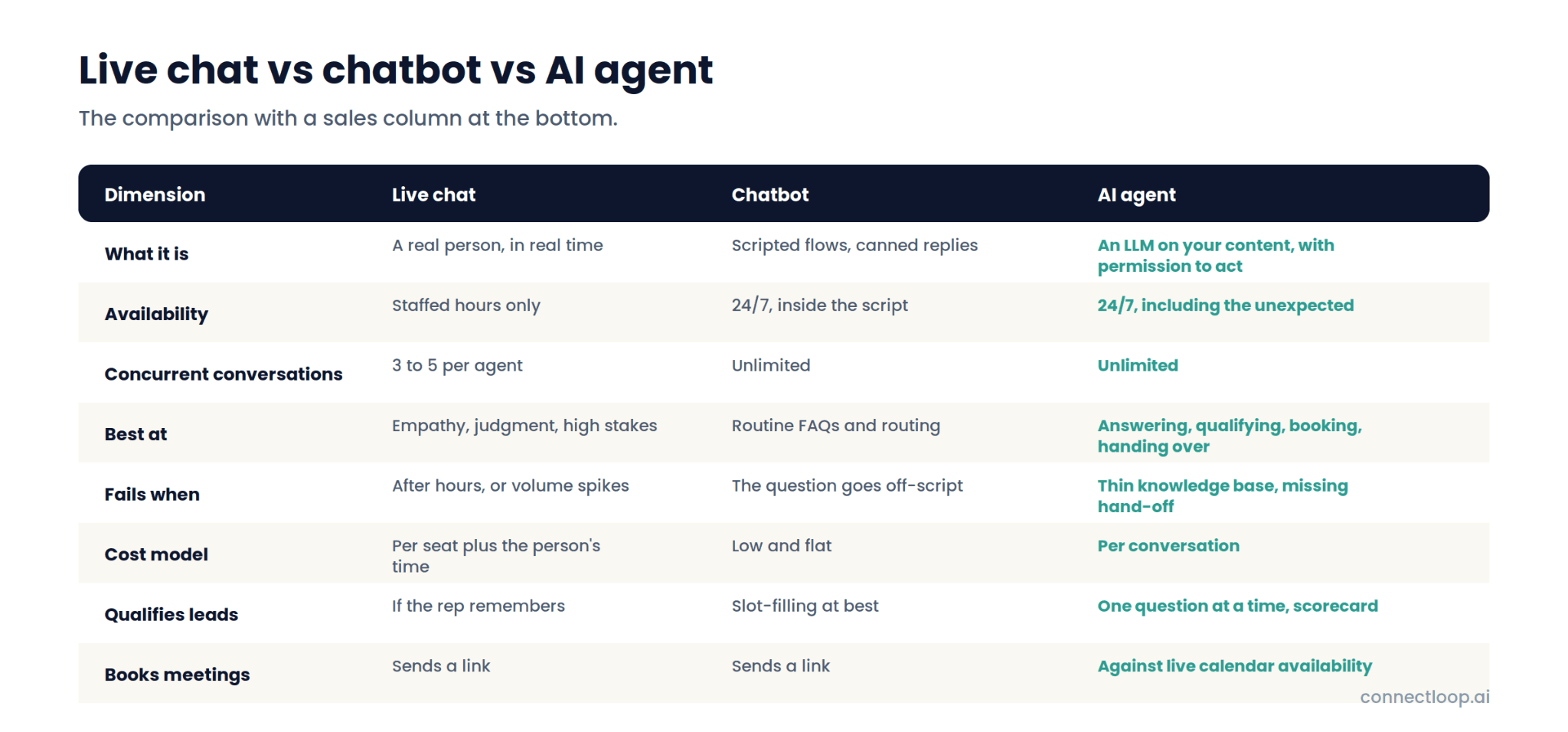
| Dimension | Live chat (human) | Rule-based chatbot | AI agent |
|---|---|---|---|
| What it is | A real person replying in real time | Scripted button flows and canned replies | An LLM that answers from your content and acts |
| Availability | Staffed hours only | 24/7, inside the script | 24/7, including questions nobody scripted |
| Response time | Minutes to first response, when someone is online | Under two seconds | Under a few seconds |
| Scalability | Hire to scale | Unlimited | Unlimited |
| Concurrent conversations | Three to five per agent | Unlimited | Unlimited |
| Best at | Empathy, judgment, nuance, high-stakes moments | Routine questions, FAQs, order status, triage | Answering, qualifying, booking, handing over |
| Complex queries | Strongest, when staffed | Dead end | Resolves from content, escalates the rest |
| Fails when | Volume spikes, or it's after hours | The question goes off-script | The knowledge base is thin, or the hand-off is missing |
| Setup effort | Low, plus a rota | Medium, build the flows | About a minute from a website URL, then tuning |
| Cost model | Per seat, plus the person's time | Low and flat | Per conversation |
| Qualifies leads | If the rep remembers to | Slot-filling at best | One question at a time, with a scorecard |
| Books meetings | Sends a link | Sends a link | Books against live calendar availability |
When does live chat win?
Live chat wins when the conversation carries stakes, emotion or a decision only a person can make, and a person is actually available. A buyer weighing a large contract wants someone who can read hesitation. A customer with a billing dispute wants judgment. Those high-value conversations are worth a human's minutes, and a human agent's customer satisfaction scores on complex queries reflect it.
The strength and the limit are the same fact: a human is answering. That means coverage stops when the rota does, throughput is three to five concurrent chats per agent, and every additional hour of availability is an additional salary. For a support desk with volume during business hours, that trade can be right.
For a sales team it is rarely the whole answer, because the moments that need a person are the later ones: the demo, the negotiation, the close. The first conversation, the one at 9pm on a Tuesday, needs a reply more than it needs empathy. That is the conversation live chat leaves unanswered.
When does a rule-based chatbot win?
A rule-based chatbot wins for a small set of predictable, high-volume questions where the answer never changes: opening hours, order status, shipping policy, password resets. It answers instantly for cents, and it makes a reasonable front door for routing and triage: sorting a visitor to the right queue before a person is involved.
The limit is rigidity. One question phrased outside the script and the visitor hits a dead end or a loop, which is the frustration people report about chat automation more than any other. Containment rate and deflection look fine on the dashboard; the visitor who left is not on it. A chatbot whose most-used button is "talk to a human" is a routing form. For a prospect with a real question about pricing, fit or timing, it is a wall.
When does an AI agent win?
An AI agent wins whenever the questions are varied, the hours are long and the goal is an outcome rather than a deflection. Pre-sales product consultation, lead qualification and booking are its home ground; post-sale it handles the routine and escalates the rest. It understands the question however it is phrased, answers from your content, asks what it needs to qualify the visitor, books the meeting and hands the rest to a person with the context attached. For an inbound sales team that is the whole first stage of the sales process.
The condition is that the agent is built for the job. You train it on your content, give it guardrails and governance that say where it stops, memory across sessions so a returning visitor is recognised, autonomy to act on the tasks you allow, and a handoff that carries more than a name. ConnectLoop's Lia is designed around those three, which is why the rest of this article uses it as the worked example.
Gartner's August 2026 survey of 3,566 customers found that 58% of people who used generative AI in a service context used it to complete a task, not just to get an answer, and in B2B the figure was 74%. Buyers are already asking AI to do things. The question is whether the AI on your site can.
What does each option cost per conversation?
A human-handled conversation costs the agent's time, and the time is the expensive part. A chatbot costs cents. An AI agent costs a per-conversation amount in between. Cost per interaction is the support metric; the honest comparison for sales is cost per outcome: per qualified lead, per booked meeting. According to Crisp's 2026 cost analysis, a routine human-handled conversation runs to around $20 to $25, against well under a dollar for an automated one.
The arithmetic that matters for a sales team is different from a support desk's. A live chat seat has a loaded cost, an onboarding period and a throughput ceiling of a few dozen conversations a day. Past that volume you are hiring a second seat. The agent's cost curve is flat until token volume becomes the constraint, and it does not stop at 6pm.
ConnectLoop prices on conversations rather than seats, with a free plan to start, so the cost scales with what the agent actually handles rather than with how many people you could afford to put on a rota.
What happens to the same 9pm enquiry with each option?
The clearest way to compare is one visitor, one question, three outcomes. It's 9pm. Someone lands on a training provider's pricing page and opens the chat.
With live chat
| Who | Message |
|---|---|
| Visitor | How much is the project management certification? |
| Widget | Thanks for your message. Our team is offline right now. Leave your email and we'll get back to you. |
| Visitor | (closes the tab) |
The lead arrives on Monday as an email address, if they bothered to leave one. Most don't.
With a rule-based chatbot
| Who | Message |
|---|---|
| Visitor | How much is the project management certification? |
| Chatbot | Our certification programmes start from £1,200. Would you like to (1) view all courses (2) contact sales (3) something else? |
| Visitor | Does that include the exam, and can I start next month? |
| Chatbot | I didn't quite get that. Would you like to (1) view all courses (2) contact sales (3) something else? |
The follow-up question, the one that reveals intent and timing, is lost.
With an AI agent
| Who | Message |
|---|---|
| Visitor | How much is the project management certification? |
| Lia | £1,200 for the full programme, which includes the course materials and one exam sitting. Are you looking at it for yourself or for a team? |
| Visitor | For myself. Can I start next month? |
| Lia | Yes, the next cohort starts on the 6th. I can hold a place and set up a fifteen-minute call with an adviser to confirm the details. Would Thursday at 10 or Friday at 2 work? |
| Visitor | Thursday. My employer will fund it if I finish by March. |
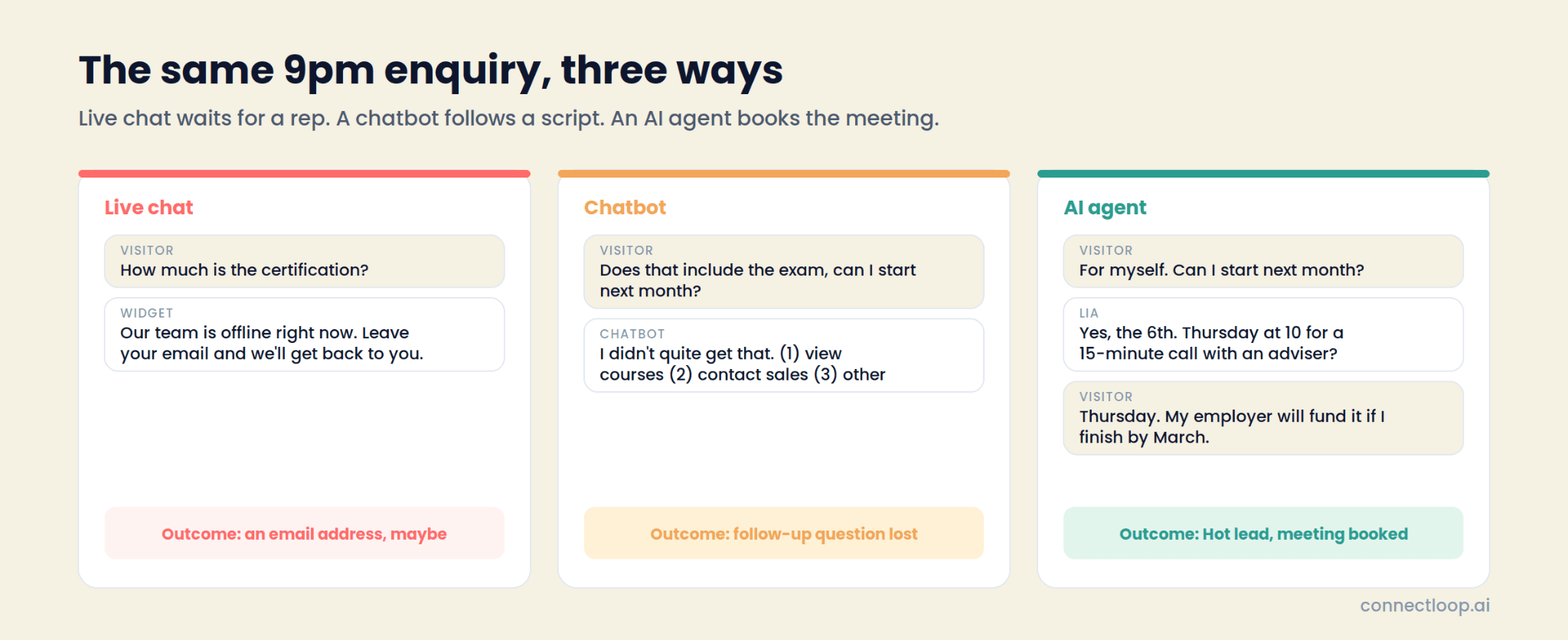
The rep opens Monday with a booked meeting, a Hot lead, and the reason: employer-funded, deadline in March. Same first question, three different Mondays. The prices and dates here are illustrative; the shape of the outcome is not.
What should the hand-off to a human carry?
Every hybrid live chat guide says the handoff should carry "the full transcript" so the visitor never has to repeat themselves. That is the minimum. A hand-off that lets the rep start where the conversation ended carries the transcript, the reason the visitor reached out, the qualification answers, an intent score with its reasons, the pages they viewed, and the sentiment of the last exchange, all on the record the rep already uses.
In ConnectLoop the hand-off is a design, not a forward button:
- Transcript and summary of every exchange on the website, WhatsApp or email.
- Methodology scorecard: each SPIN or MEDDICC step marked Completed, Skipped or Not Started, each answer marked Inferred or Confirmed.
- Intent score and lead temperature with the AI's reasoning in plain sentences, as the lead scoring guide describes.
- Pages viewed and return visits from Visitor Intelligence, including the anonymous history before the visitor identified themselves.
- Sentiment of the conversation, and whether it crossed the handover threshold.
- Routing to the right team member by tag, with a follow-up reminder if the lead sits unattended.
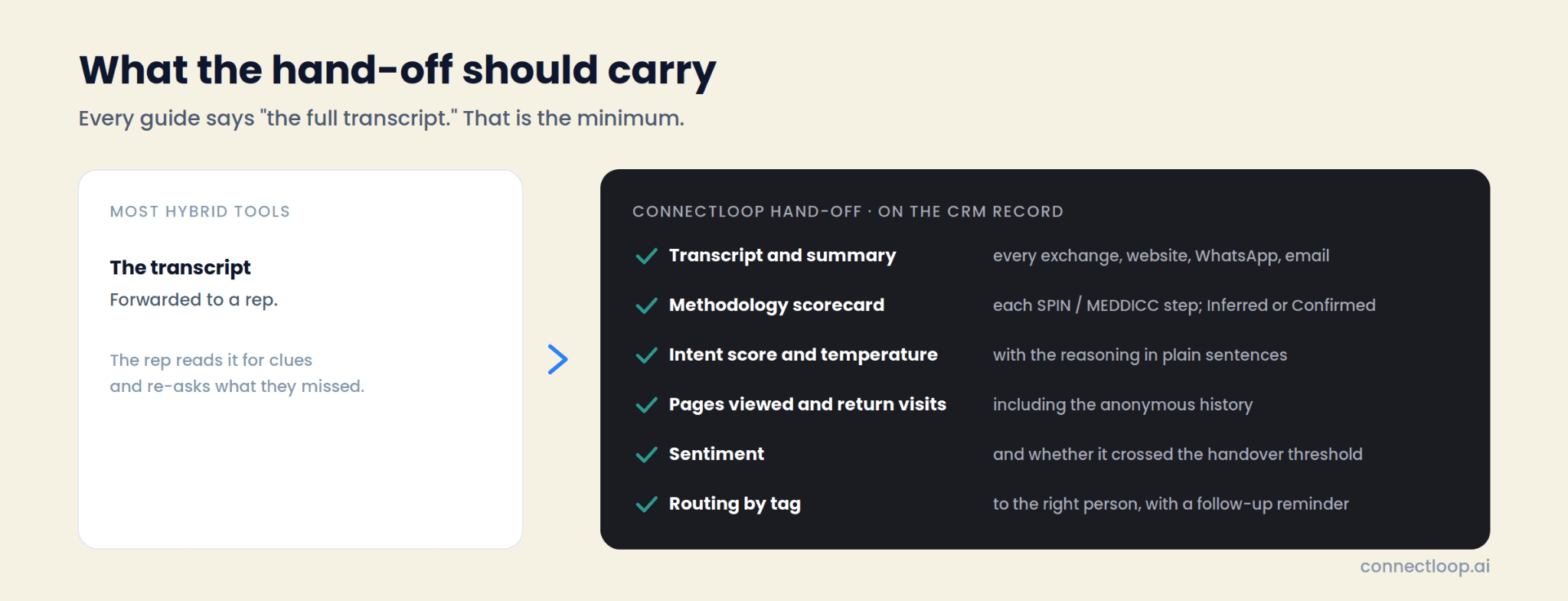
All of it syncs to HubSpot, Salesforce, Zoho or Pipedrive. A rep who reads that record before the call is continuing the discovery rather than restarting it, with the whole conversation history in front of them. The resolution of the first conversation becomes the start of the second. The stages of the sales process guide shows which stage that call now starts at.
Where should a human stay in the loop, by design?
A human should take over when the visitor asks for one, when the conversation turns, and when the next step needs judgment about the account: discounting, negotiating terms, closing, and any decision about money or commitments. Those stay with a person because they depend on the relationship, and the agent's job is to arrive there with the groundwork done.
Gartner's same August 2026 survey found 87% of customers say an option to reach a human is essential when a company uses generative AI. That is a design requirement, and it is one the agent should meet with a real path to a person, not a "leave your email" form. ConnectLoop's escalation triggers cover the three cases: the visitor asks for a person or a meeting, sentiment crosses a threshold you set under Agent Behavior, or the agent reaches a question the knowledge base does not cover yet.
The split, for a sales conversation:
| Lia handles | A person handles |
|---|---|
| Answering the first question from approved content | Discovery depth on the call |
| Asking qualifying questions one at a time | The demo and the proposal |
| Booking the meeting against the calendar | Negotiation and any discount |
| Capturing the reason, competitor, timeline | The close |
| Drafting a follow-up when a lead returns | Sending the follow-up |
| Escalating with the context attached | Everything after the escalation |
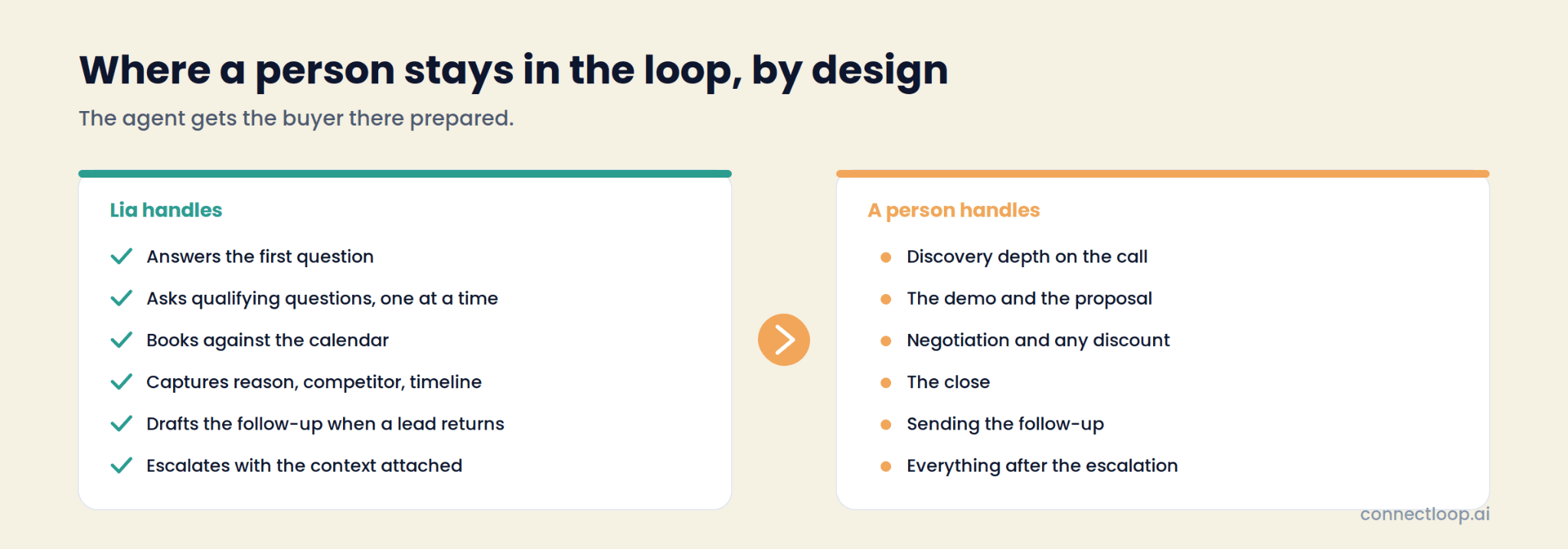
ConnectLoop's guide to how to negotiate in sales covers the human side of that table.
Do you still need a live chat tool if you have an AI agent?
For most inbound sales teams, no. The reason live chat tools exist is to put a person in the widget, and the agent puts a better first responder there at every hour. What the team still needs is a way for a person to take over when it matters, and that is a hand-off inside the same system rather than a second product.
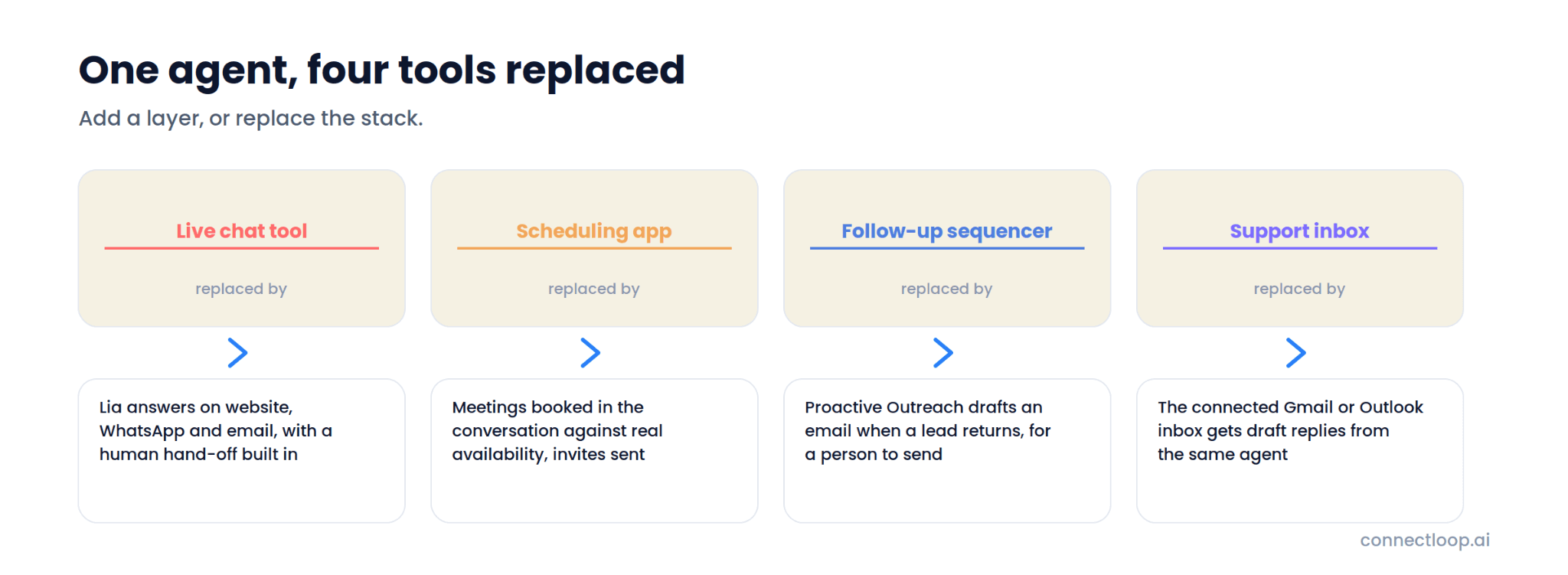
This is the difference between adding a layer and replacing a stack. The advice to match the technology to the touchpoint ends up as a four-tool stack: a live chat tool, a scheduling app, a follow-up sequencer, and a unified inbox for the email that arrives separately. ConnectLoop replaces the four with one system:
| Tool it replaces | What the agent does instead |
|---|---|
| Live chat tool | Lia answers on the website, WhatsApp and email from one knowledge base, with a human hand-off built in |
| Scheduling app | Meetings are booked in the conversation against team members' working hours and connected calendars, with invites sent |
| Follow-up sequencer | When a known lead returns to the site, Proactive Outreach drafts a personalised email for a person to review and send |
| Support inbox | The connected Gmail or Outlook inbox gets draft replies from the same agent, with the same knowledge |
One record per visitor, from the first anonymous visit to the booked call. The person who takes over sees all of it. The WhatsApp AI agent guide shows the same agent on the second channel.
How does qualification work inside the conversation?
The agent qualifies by asking, one question at a time, inside the flow of a helpful conversation, and by stopping the moment a visitor declines. Live chat qualifies only if the rep remembers to; a chatbot qualifies by form. The agent's version is closer to what a good rep does on a call, with the added discipline of recording the answer where the next person will read it.
With Sales Methodology on, Lia weaves SPIN and MEDDICC questions into the chat: what prompted the visit, what else they are evaluating, when they need it in place. The visitor's own question is always answered first. If they skip a qualifying question, Lia drops it, carries on, and records the step as Skipped for the rep to pick up. The SPIN selling questions guide has forty of them written for exactly this channel, and the inbound lead qualification guide covers the method.
The result is a scorecard on the lead, not a transcript a rep has to read for clues.
What does the agent know, and where do the gaps show?
The agent knows what you gave it: the pages it trained on, the documents you uploaded, the FAQ you wrote. It answers from that content and stays inside it. Where a visitor asks something the content has not covered yet, the question is logged rather than guessed at, so the knowledge base grows from real gaps instead of assumptions.
ConnectLoop's Knowledge Gaps list is exactly that: every question the training content has not covered yet, with a status you mark Resolved once the document is added. Conversational Intelligence goes further, grouping every conversation by what drove it, flagging friction points such as a question asked twice or a long silence after a long reply, and recommending the fix. Your content sets the ceiling, and the tool shows you where the ceiling is.
That is also the answer to the accuracy question. Grounding keeps the agent inside your content; the gap list tells you what to add next. Train Lia from a website URL in about a minute, add the FAQ document, and watch the gap list for the first week. The training section of the AI sales agent guide covers what to upload first.
Do you have to tell visitors they are talking to an AI?
In the EU, yes. Since 2 August 2026, Article 50 of the EU AI Act requires that anyone interacting with an AI system is told so clearly, at the latest at the first interaction. Elsewhere it is not yet a legal duty, and it is still the right call, because a labelled agent that answers well earns more trust than a widget pretending to be "Sarah."
For a sales conversation, disclosure is a small design choice with a large effect. Name the agent, say what it can do, and keep the route to a person one click away. Buyers respond to an honest first responder; they resent discovering the "person" was a script. ConnectLoop's widget names Lia and offers the hand-off throughout, which meets the rule and the expectation at once.
Which should a small team choose?
A five-person education provider, services firm or SaaS startup rarely has a live chat seat to staff at all, and CSAT surveys never capture the visitor who got an offline message. The choice is not live chat versus an agent; it is an agent versus an unanswered widget. For that team the agent is the first responder the business never had, and the person it hands to is whoever picks up the phone in the morning.
The setup is proportionate. No rota, no flow designer, no support desk. A website URL, a FAQ document, a connected calendar and about a minute. The agent handles the 9pm enquiry the day it goes live, and the rep's Monday starts with meetings rather than a form backlog.
ConnectLoop's speed to lead guide covers why that first reply time matters more for a small team than for anyone.
How do you set up an AI agent in place of live chat?
Six steps, most of them under a minute each.
- Paste your website URL. Lia scans the site, detects your brand colours, selects the highest-value pages and trains on them. Upload a FAQ document and any brochures for the detail the site leaves out.
- Choose a personality. Warm and concise, long and detailed, or sales-forward, then fine-tune tone, vocabulary and how hard the agent pushes for a meeting in Agent Studio.
- Connect the channels. One embed snippet on the website, a WhatsApp Business number through Meta's guided signup, and a Gmail or Outlook inbox. One agent, one knowledge base, three channels.
- Connect the calendar and CRM. Add team members with working hours and booking enabled, so meetings land in real availability with invites sent. Transcripts, scores and pages viewed sync to HubSpot, Salesforce, Zoho or Pipedrive.
- Set the hand-off. Turn on Sales Methodology for one-question-at-a-time qualification, set the sentiment handover threshold, and assign tags so leads route to the right person.
- Test in Live Test, then go live. Ask what a prospect would ask, try to make it guess, then watch Knowledge Gaps for the first week and add what it asks for.
The AI appointment booking guide covers step four in detail, and the sales playbook guide covers what to write in step two.
Key takeaways
- Live chat is a person in the widget during staffed hours. A chatbot is a script. An AI agent answers from your content at any hour, qualifies, books and hands over.
- For a support desk the comparison is cost per conversation. For a sales team it is the 9pm enquiry: live chat leaves it unanswered, the agent books the meeting.
- The hand-off should carry more than the transcript: the scorecard, the intent score with reasons, pages viewed and sentiment, synced to the CRM.
- A person stays in the loop by design for discovery depth, the demo, negotiation and the close, and whenever the visitor asks for one.
- One agent replaces four tools: the live chat widget, the scheduler, the follow-up sequencer and the support inbox, with one record per visitor.
- Qualification happens inside the conversation, one question at a time, with a stop rule when the visitor declines.
- The agent answers from your content and logs what it cannot answer, so the knowledge base grows from real gaps.
- Name the agent and keep the human one click away; in the EU it is the law, everywhere it is what buyers trust.

About the author
ConnectLoop Staff
Written by the ConnectLoop team. ConnectLoop is an AI sales agent for inbound revenue teams, based in Cambridge, Massachusetts.
About ConnectLoop →Frequently asked questions
For the first conversation with a prospect, yes: it answers at any hour, qualifies, books and hands over with context. For the later conversations, the demo, the negotiation, the close, a person is better, and the agent's job is to get the buyer there prepared. ConnectLoop is built on that split.
Yes, when it includes a real hand-off to a person. The live chat tool's only job is to put a human in the widget; an agent that answers better, at every hour, and escalates with the transcript, scorecard and intent score attached makes the separate tool unnecessary. ConnectLoop also replaces the scheduler, the follow-up sequencer and the support inbox.
The agent escalates, with the full context attached, to a team member routed by tag. Gartner's 2026 research found 87% of customers consider a route to a human essential when a company uses generative AI, and ConnectLoop keeps that route open in every conversation.
Both. Lia answers the visitor's question first, then asks SPIN and MEDDICC questions one at a time inside the conversation, records each answer as Inferred or Confirmed on a scorecard, and stops if the visitor declines a question.
Live chat costs a seat and the person's hours, with a ceiling of a few dozen conversations a day per agent. ConnectLoop prices on conversations rather than seats, with a free plan, so the cost follows the volume the agent handles and there is no rota to fund.
In the EU, yes, since 2 August 2026 under Article 50 of the AI Act. Everywhere, it is good practice: a named agent with a visible route to a person earns more trust than a widget pretending to be a human.
It answers only from your content, and questions the content does not cover are logged in Knowledge Gaps rather than guessed. Add the document, mark the gap resolved, and the next visitor gets the answer. Conversational Intelligence shows the friction points across all conversations so you fix the common ones first.
That is the team it suits best. A website URL, a FAQ document, a calendar and about a minute of setup gives a five-person business a first responder at every hour, with the hand-off going to whoever is available in the morning.
Yes. The same agent, with the same knowledge base and the same behaviour, answers on website chat, a WhatsApp Business number and a connected Gmail or Outlook inbox. A visitor who starts on the site and continues on WhatsApp is talking to the same Lia.
If your chat widget says "our team is offline" after 6pm, the comparison is already decided
ConnectLoop's Lia takes the 9pm enquiry, qualifies it, books the meeting and hands your rep a conversation that has already started. Train it on your site in about a minute on the free plan and read the first one it handles.