
Sales Communication
Objection Handling in Sales: 25 Common Objections and How to Answer Them
Objection handling in sales is how a seller responds when a buyer raises a concern about price, timing, authority, need or trust. Done well, it uncovers the real issue and moves the deal forward. This guide gives a step-by-step method, 25 common objections with answers, and how ConnectLoop helps teams handle objections before and during calls.

Published
Table of contents
- Why does objection handling matter in sales?
- What are the main types of sales objections?
- Which objection handling framework should you use?
- How do you handle a sales objection, step by step?
- What are the most common sales objections, and how do you answer them?
- How do objections change by deal stage?
- How does discovery prevent objections?
- How do you handle objections in chat, WhatsApp and email?
- When should an AI agent hand an objection to a person?
- When should you walk away from an objection?
- How do you build an objection list and train your team?
- How do you measure objection handling?
- How does ConnectLoop help teams handle objections?
- Key takeaways
- Frequently asked questions
Why does objection handling matter in sales?
An objection is usually a sign of interest, not rejection. A buyer who raises a concern or pushback is still thinking about buying. How the seller responds decides whether that concern becomes a reason to move forward or a reason to stop. ConnectLoop treats every objection as a question the buyer needs answered before saying yes.
Good objection handling does three things:
- It builds trust and rapport. The buyer sees you listen instead of pushing, which lowers resistance.
- It reveals the real issue. "Too expensive" often means "I'm not sure it will work."
- It keeps deals moving. Unanswered concerns turn into silence and stalled deals.
Buyers also arrive better informed than they used to. Many have read reviews, compared pricing pages and asked AI tools before they ever speak to a rep, so their objections are often specific. A vague answer loses them quickly.
What's the difference between an objection and a brush-off?
An objection is a real concern about the purchase, such as cost, fit or timing. A brush-off is a way to end the conversation without engaging, such as "I'm busy" or "send me some info". Objections deserve a full answer. Brush-offs need a short reason to keep talking. ConnectLoop's advice: ask one question to tell them apart.
Try: "Is that a timing question, or is there something about the approach that doesn't fit?" A buyer with a real objection will tell you. A buyer who's brushing you off will usually confirm they're not interested, which saves you both time.
What are the main types of sales objections?
Most sales objections fall into seven types: price or budget, authority, need, timing, competitor or current solution, trust, and contract terms. Each has a typical root cause and a best first response. Naming the type helps you respond to the real objection, not the words. ConnectLoop groups objections this way so teams can build responses for each.
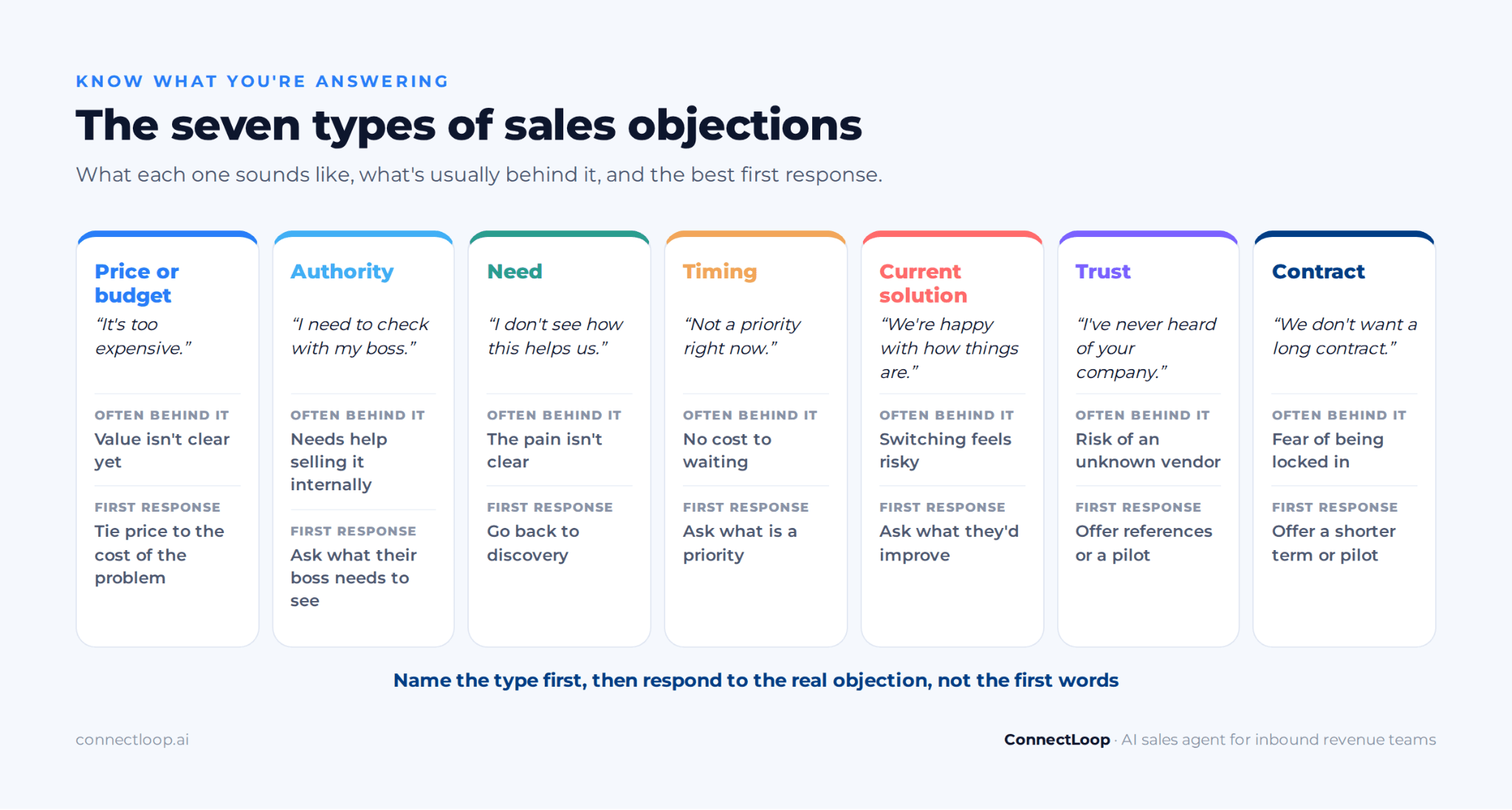
| Objection type | What it sounds like | What's often behind it | Best first response | Consider walking away when |
|---|---|---|---|---|
| Price or budget | "It's too expensive." | Value isn't clear yet, or no budget is set | Ask what they're comparing it to, then tie price to the cost of the problem | There's no budget and no way to create one |
| Authority | "I need to check with my boss." | They can't decide alone, or they need help selling it internally | Ask what their boss will need to see, and offer to help build the case | No one with authority will engage |
| Need | "I don't see how this helps us." | The pain isn't clear, or you pitched the wrong problem | Go back to discovery: ask how they handle it today | They truly don't have the problem |
| Timing | "Not a priority right now." | Other projects, or no cost to waiting | Ask what is a priority, and what would make this one urgent | There's no trigger within a year |
| Competitor or current solution | "We're happy with how things are." | Switching feels risky, or the status quo is "good enough" | Ask what they'd improve if they could | They're locked into a long contract |
| Trust | "I've never heard of your company." | Risk, reputation or past bad experiences | Offer proof: customer references, a pilot, or a security review | They need references you can't yet provide |
| Contract | "We don't want a long contract." | Fear of being stuck with the wrong choice | Offer a shorter term, a pilot program or a lower-tier option | Terms they need would make the deal unprofitable |
A need objection is the one to take most seriously, because it questions whether you solve a real problem at all. Most buyers raise more than one. Start with the objection that matters most to them, not the one easiest for you to answer.
Which objection handling framework should you use?
The best framework is one your whole team uses consistently. LAER (listen, acknowledge, explore, respond) suits complex B2B objections because it forces exploration before answering. Feel-felt-found works for emotional concerns but can sound scripted. ConnectLoop recommends a five-step method that adds confirming the objection is resolved.
| Framework | Steps | Best for | Watch out for |
|---|---|---|---|
| LAER | Listen, acknowledge, explore, respond | Complex objections with a hidden root cause | Skipping "explore" and jumping to the answer |
| Feel-felt-found | "I understand how you feel. Others felt the same. They found…" | Emotional or risk-based concerns | Sounding rehearsed; needs a real example behind "found" |
| Five-step method (below) | Pause, acknowledge, clarify, respond, confirm | Most B2B sales conversations | Rushing the confirm step |
Feel-felt-found only works if the "found" is true. If you don't have a real customer story to share, use LAER instead.
Frameworks help most when they're written into your sales playbook, so every rep uses the same language and new reps learn faster.
How do you handle a sales objection, step by step?
Pause, acknowledge the concern, ask open-ended questions to find the root cause, respond to the real objection with proof, then confirm it's resolved and agree the next step. Most objections fall apart under a calm "tell me more". ConnectLoop recommends never answering an objection before you've asked at least one question about it.
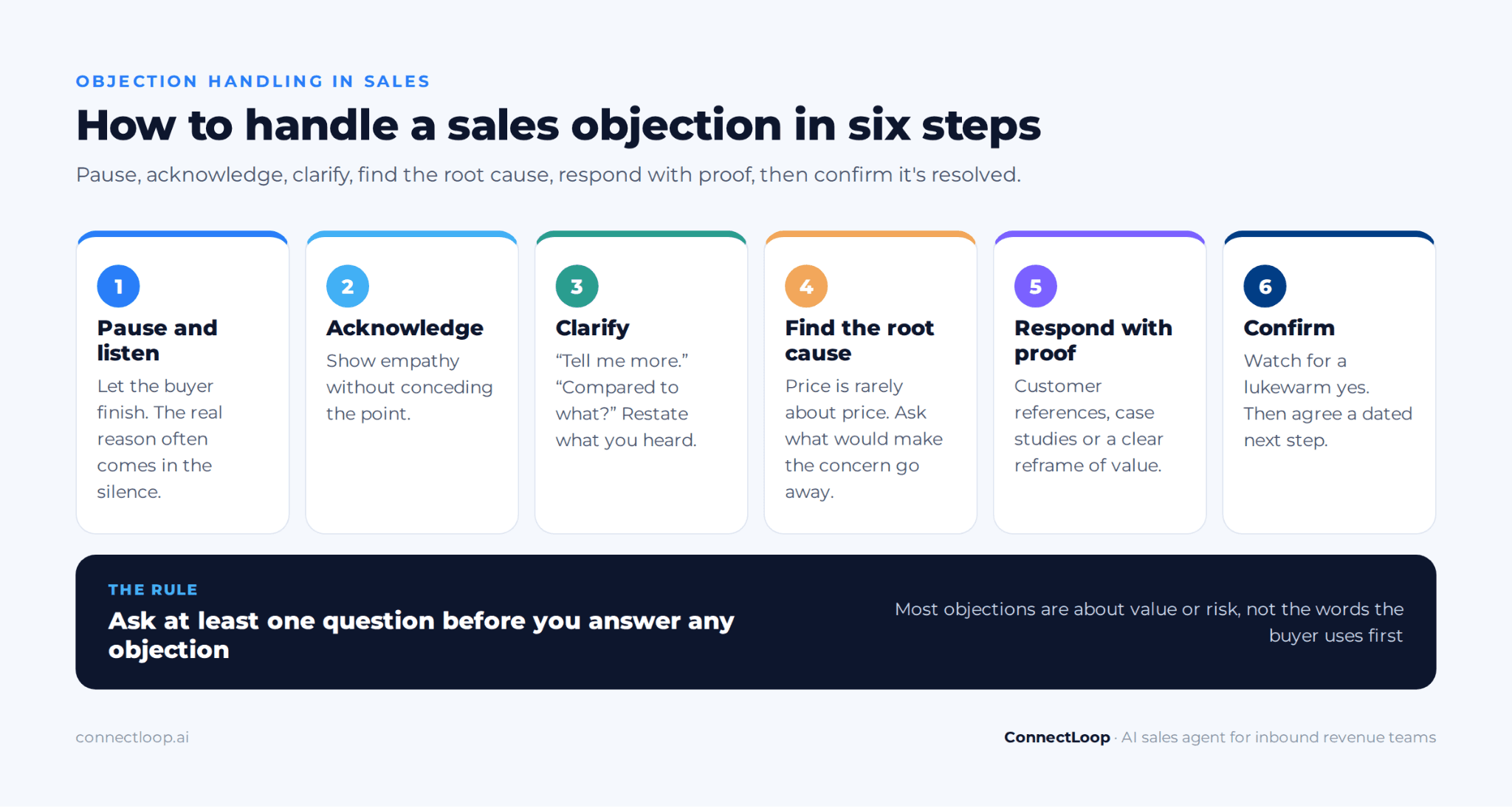
- Pause and listen. Practise active listening and let the buyer finish. A few seconds of silence shows you're taking it seriously, and buyers often add the real reason in the pause.
- Acknowledge and empathize without agreeing. "That's a fair question" or "I can see why that matters" shows empathy without conceding the point.
- Clarify the real objection. Ask open-ended questions: "Tell me more about that", "Compared to what?" or "What else is on your mind?" Paraphrase or restate what you heard to check you've understood.
- Find the root cause. Price is rarely about price. Ask what would need to be true for the concern to go away.
- Respond with proof. Answer the real objection, not the first words. Use social proof such as a customer reference or case study, a short calculation, or a clear reframe of your value proposition.
- Confirm and move forward. Ask "Does that answer your concern?" Watch for a lukewarm yes, such as "I guess so", which means the objection is still there. Then agree a concrete next step.
The confirm step is where most reps fall short. A buyer who says "sure" just to move on will raise the same objection later, often by going quiet.
What are the most common sales objections, and how do you answer them?
The most common objections are about price, authority, timing, the current solution and trust. Below are 25 real-world objections with what's usually behind each and a sample response. Adapt the wording to your product and the buyer. ConnectLoop suggests saving your best responses in a shared objection template so every rep can use them.
How do you handle price and budget objections?
Price objections are usually value objections in disguise. The buyer isn't sure the result is worth the cost, or they're comparing you to something cheaper that does less. Don't discount straight away; a quick discount tells the buyer your price was never real. ConnectLoop advises tying price to the cost of the problem first.
1. "It's too expensive." Behind it: the value isn't clear yet. Try: "Too expensive compared to what? If we look at what the current problem costs each month, does the gap change?"
2. "We don't have budget for this." Behind it: budget isn't set, or it's allocated elsewhere. Try: "Is there no budget this year, or is it set aside for other projects? If the business case is clear, who decides where budget moves?"
3. "Your competitor is cheaper." Behind it: they're comparing price, not total cost of ownership. Try: "That's useful to know. Does their price include setup, support and the features we discussed? Let's compare like for like."
4. "Can you give us a discount?" Behind it: sometimes a real constraint, sometimes a bargaining chip or a red herring. Try: "Before we talk price, let's confirm the package covers what you need. If it does, I'll see what's possible on terms."
5. "We're cutting costs this year." Behind it: risk aversion. Try: "Understood. Where is the team spending time or losing revenue today? If this pays for itself, it may support the cost-cutting goal."
6. "I need to see the ROI first." Behind it: they need a number to take to finance. Try: "Let's build it together. What would you need to see in the first 90 days to call this a success?"
Flexible options can help when the value is clear but the budget is tight: phased pricing, a lower-tier option or a short pilot program. For late-stage price talks and sales negotiation, how to negotiate in sales goes deeper.
How do you handle "I need to check with my boss"?
An authority objection means the buyer can't decide alone or needs help convincing others. Treat it as a request for support, not a stall. Find out who else is involved, what they care about and how you can help your contact make the case. ConnectLoop recommends offering to join the internal conversation.
7. "I need to check with my boss." Behind it: they need approval, or they're unsure themselves. Try: "Of course. What will your boss want to see before saying yes? I can put together a one-page summary for that conversation."
8. "Our leadership isn't bought in yet." Behind it: no executive sponsor. Try: "Would a short executive briefing help? I'm happy to answer their questions directly."
9. "Finance and procurement need to review this." Behind it: a formal approval process. Try: "That's normal. What do they usually need, and how long does it take? Let's plan for it now so it doesn't delay the timeline."
10. "I'm not the right person for this." Behind it: you're talking to the wrong contact. Try: "Thanks for telling me. Who usually leads projects like this? Would you be open to introducing us?"
The strongest response to an authority objection is a champion: an internal advocate who wants the project to succeed. Give them a simple business case, answers to likely questions from the CFO, and a clear picture of what success looks like.
How do you handle timing objections like "not a priority right now"?
Timing objections often mean there's no cost to waiting, or other projects feel more urgent. Don't argue about timing. Ask what is a priority, and whether this problem connects to it. If there's genuinely no urgency, agree a specific point to reconnect. ConnectLoop treats "not now" as useful information, not a defeat.
11. "Not a priority right now." Behind it: the problem doesn't feel urgent. Try: "Fair enough. What is the top priority this quarter? Does this problem affect it at all?"
12. "Call me back next quarter." Behind it: a polite delay. Try: "Happy to. What will be different next quarter? If I know what to watch for, I'll reach out at the right moment."
13. "We're in the middle of another project." Behind it: limited capacity. Try: "That makes sense. Would it help if setup took less of your team's time? Let's see what the effort really looks like."
14. "Send me more information." Behind it: often a brush-off, sometimes genuine interest. Try: "Sure. So I send something useful, which part matters most to you: pricing, setup or how it fits your current tools?"
How do you handle "we're happy with how things are" and competitor objections?
Current-solution objections mean switching feels riskier than staying. The buyer doesn't see enough gain to justify the effort. Don't criticise their current tool. Ask what they'd change if they could, and find the gap. ConnectLoop's view: respect the status quo, then show what it costs.
15. "We're happy with how things are." Behind it: the status quo is good enough. Try: "Good to hear. If you could improve one thing about the current process, what would it be?"
16. "We already use a competitor." Behind it: switching cost and loyalty. Try: "What made you choose them? And is there anything you wish they did better?"
17. "We can build this ourselves." Behind it: a belief that it's simple, or a preference for control. Try: "That's an option. Have you estimated the build time and the ongoing maintenance? Let's compare that with buying."
18. "Your product doesn't have [feature]." Behind it: a must-have, or a nice-to-have presented as one. Try: "How would you use that feature? Sometimes the outcome is possible another way. If it isn't, I'll tell you."
19. "It won't work with our tools." Behind it: integration risk. Try: "Which tools matter most? Let me check exactly what connects today and what doesn't."
How do you handle trust objections?
Trust objections come from risk: the buyer doesn't know your company, has heard something negative, or was burned before. Answer with proof, not promises. Customer references, case studies, a pilot and clear security information all reduce risk. ConnectLoop advises being honest about what you can't yet prove.
20. "I've never heard of your company." Behind it: risk of choosing an unknown vendor. Try: "That's fair. Here's who we work with and what we've done for them. Would speaking to a customer help?"
21. "We tried something similar and it failed." Behind it: a past bad experience. Try: "I'm sorry that happened. What went wrong? If we can't avoid the same problem, I'll say so."
22. "I saw a bad review." Behind it: reputation concern. Try: "Thanks for raising it. Here's what happened and what changed. I'd rather you hear it from me."
23. "We don't want a long contract." Behind it: fear of being locked in. Try: "Understood. Would a shorter term or a pilot help you see results before committing?"
How do you handle objections about AI itself?
Buyers evaluating AI sales tools often worry the AI will give wrong answers or mislead customers. Answer these directly and honestly. Explain where answers come from, what happens when the AI doesn't know, and whether buyers are told they're talking to AI. ConnectLoop answers these concerns with approved content, human handoff and clear disclosure.
24. "What if the AI says something wrong?" Behind it: fear of damaging customer trust. Try: "Lia answers from the content you approve: your website, documents and playbooks. When she can't find an answer, the question is logged in a Knowledge Gaps report, and the conversation can be handed to a person."
25. "Will customers know they're talking to AI?" Behind it: worry about honesty and regulation. Try: "They should, and it's worth saying so clearly. Disclosure is good practice and is becoming a legal requirement in more places, including under Article 50 of the EU AI Act from 2 August 2026."
To understand how AI agents differ from older bots, see chatbot vs AI agent.
How do objections change by deal stage?
Early objections are usually about need and timing. Mid-deal objections are about authority and budget. Late objections are about price, contract terms and competitors. Knowing the stage tells you what the objection is really testing. ConnectLoop sees inbound buyers raise many early objections in chat, before a rep is involved.
Thinking about objections by deal stage helps you respond to what's really being tested.
- Early stage (first contact and discovery). "Is this for us?" and "Why now?" These test fit and urgency. Treat them as qualification questions.
- Mid stage (evaluation). "Who else needs to agree?" and "Is there budget?" These test whether your champion can build the case internally.
- Late stage (proposal and close). "Can you match their price?" and "We need different terms." These are often negotiation, not real doubts about fit.
A late-stage objection about need is a warning sign. It usually means discovery missed something. The stages of the sales process explains where each conversation fits.
How does discovery prevent objections?
Good discovery surfaces concerns early, when they're easy to address. If you know the buyer's budget, decision process and timeline before you propose, fewer surprises appear at the end. Most late objections are questions discovery should have asked. ConnectLoop recommends asking about blockers directly: "What could stop this from moving forward?"
Questions that bring objections into the open early:
- "Who else will be involved, and what will they care about?"
- "How did you decide on the last similar purchase?"
- "What's happened when you tried to fix this before?"
- "What would make this a bad fit for you?"
Listen for buying signals too. Questions about implementation, ramp time or contract length mean the buyer is picturing life after the purchase.
Consultative selling methods such as SPIN put pain points and their impact on the table before any pitch. A consistent qualification framework helps too. BANT vs MEDDIC compares the two most common, and the MEDDPICC sales methodology adds the paper process, which is where procurement objections hide. For a full question list, see discovery call questions.
How do you handle objections in chat, WhatsApp and email?
Written objections need shorter answers with proof attached. In chat or WhatsApp, reply quickly, answer the specific concern in two or three sentences, and offer a next step such as a call. In email, link to evidence instead of explaining everything. ConnectLoop's Lia answers many early objections in chat before a rep gets involved.
Written objection handling works differently from a live call:
- Speed matters more. A buyer who asks "Is this expensive?" in chat at 9pm and gets no reply until morning has often moved on. Speed to lead explains why.
- Keep it short. Long written answers get skimmed. Answer the question, then offer more.
- Attach proof. Link to a case study, pricing page or integration list instead of describing it.
- Ask one question back. "Is that mainly about upfront cost or ongoing cost?" keeps the conversation going.
- Know when to switch to a call. Complex or emotional objections are easier to resolve by voice.
For more on running sales conversations over messaging, see conversational messaging and how a WhatsApp AI agent works.
How are inbound objections different from outbound objections?
Inbound objections come from buyers who already showed interest, so they're usually specific questions about price, fit or setup. Outbound objections come from people who didn't ask to be contacted, so they're often brush-offs like "not interested" or "how did you get my number?" ConnectLoop is built for inbound, where objections are real questions worth answering well.
Typical inbound objections:
- "How does pricing work for a team our size?"
- "Does it connect to our CRM?"
- "How long does setup take?"
Typical outbound objections (cold call, cold email or voicemail):
- "I'm not interested."
- "How did you get my details?"
- "We're all set, thanks."
Inbound teams should spend their time on fast, accurate answers. Outbound teams, often SDRs, need short pattern-interrupts to earn a conversation. SDR vs BDR explains who usually handles each.
When should an AI agent hand an objection to a person?
An AI agent should hand over when an objection needs judgment, negotiation or empathy it can't provide: discount requests, contract changes, complaints, or a buyer who is frustrated or asks for a person. It should also hand over when the answer isn't in its approved content. ConnectLoop passes the full conversation so the buyer doesn't repeat themselves.
Good handoff triggers for objections:
- Price negotiation. Discounts and custom terms should be a person's decision.
- Legal or security questions that go beyond published information.
- Frustration or a complaint. A buyer who's upset needs a human response.
- No approved answer. It's better to hand over than to guess.
- The buyer asks. If someone wants to talk to a person, connect them.
The AI-to-human handoff article covers how to set these rules up.
When should you walk away from an objection?
Walk away when the objection reveals a real lack of fit: no budget and no way to create one, no problem you solve, no access to a decision-maker, or unprofitable terms. Pushing past a real objection wastes both sides' time. ConnectLoop believes an honest "we're not the right fit" builds more trust than a forced close.
Red flags that usually mean walk away, or pause:
- The buyer can't describe a problem, even after good discovery questions.
- There's no budget, no timeline and no decision-maker involved.
- They need a must-have feature you don't offer and won't build soon.
- Every concern you answer is replaced by a new one, a sign the real objection is hidden or the interest isn't real.
Knowing your own walk-away point helps in negotiation too. It's your BATNA: the best alternative to a negotiated agreement. If a deal gets worse than that point, stepping back is the right call.
How do you build an objection list and train your team?
Collect real objections from calls, chats and emails, group them by type, write the best response for each, and practise them with role play. Update the list monthly as new objections appear. ConnectLoop's Knowledge Gaps report is a useful source: it shows the questions buyers ask that your content doesn't yet answer.
- Collect. Pull objections from call notes, recordings, chat transcripts and lost-deal reviews.
- Group. Sort them into the seven types above.
- Write responses. For each, note what's usually behind it, a sample response and the proof to share.
- Store them centrally. Add them to your sales playbook so the institutional knowledge doesn't live in one person's head.
- Practise. Use role play, including AI role play, so reps rehearse before buyers hear it. Sales role play has scenarios to start with.
- Review real calls. Listen for how top performers handle objections and share those examples.
Coaching makes the biggest difference when it happens close to the call. Benefits of sales coaching and AI sales training tools cover the options, from manager reviews to conversation intelligence.
How do you measure objection handling?
Track which objections come up most, at which stage, and what happens to deals afterwards. The most useful numbers are objections by type, win rates after each type, and how often objections become deal blockers. These show where training or content is needed. ConnectLoop's view: if one objection keeps winning, fix the content or offer, not just the script.
Metrics worth tracking:
- Objection frequency by type. Which concerns come up most often?
- Stage of objection. Are objections appearing late that should appear early?
- Win rate after objection. Which objections do reps handle well, and which lose deals?
- Time to resolve. How long deals stall after a specific objection.
- Pipeline conversion. Whether better handling improves movement between stages.
- Forecast accuracy. Deals with unresolved objections are the ones most likely to slip.
Inbound sales metrics lists other numbers worth tracking alongside these.
How does ConnectLoop help teams handle objections?
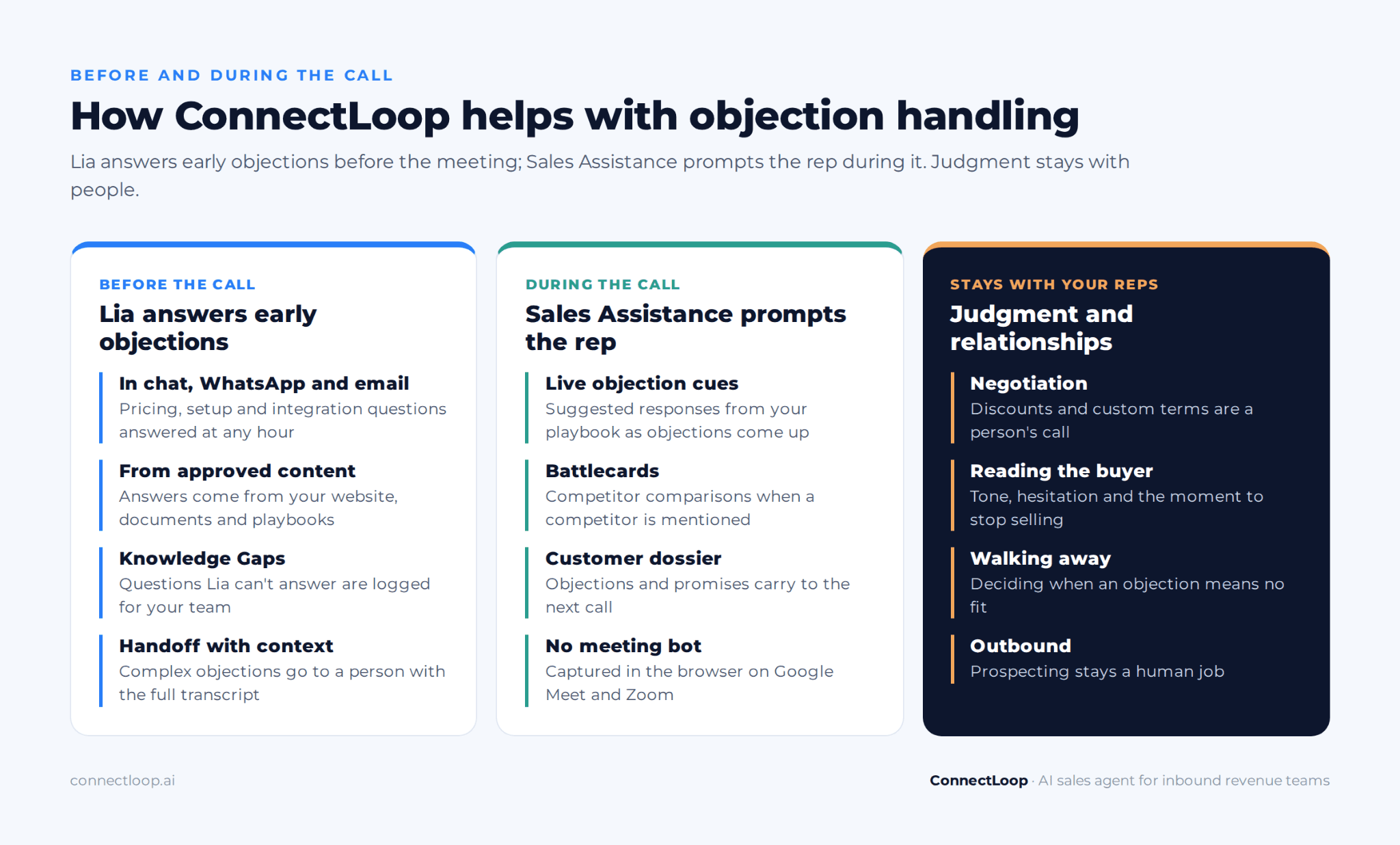
ConnectLoop helps on both sides of the call. Before it, Lia answers early objections in website chat, WhatsApp and email from your approved content, and hands complex ones to a person. During it, ConnectLoop's Sales Assistance shows live objection cues and battlecards on Google Meet and Zoom calls, with no bot joining the meeting.
ConnectLoop is an AI sales agent platform for inbound revenue teams. It replaces a live chat tool, a scheduling app, a follow-up sequencer and a support inbox with one system, and tracks every conversation from first message to booked call.
Before the call:
- Lia answers common objections instantly. Questions about pricing, setup or integrations get accurate answers at any hour, from content you approve.
- Knowledge Gaps shows what's missing. When Lia can't answer a question, it's logged, so your team can see which objections the content doesn't cover yet.
- Handoff with context. Complex objections go to a person with the full transcript.
- Visitor Intelligence adds context. It identifies the companies behind anonymous website traffic, so reps know who's asking. See identifying anonymous website visitors.
During and after the call:
- Live objection cues. Sales Assistance shows suggested responses from your own playbook as objections come up.
- Battlecards. Competitor comparisons appear when a competitor is mentioned.
- Customer dossier. Objections, promises and stakeholders carry from one call to the next.
- Follow-up drafts. After the call, a draft is ready for the rep to review and send.
- Proactive Outreach. When a known lead returns to your site, ConnectLoop drafts a personalised follow-up email that a person reviews, edits and sends or dismisses.
ConnectLoop is CASA Verified by Google, a Verified Meta Business and an official Meta Business Partner. For a deeper look at live coaching, read what AI sales coaching actually does.
What stays with your reps?
The objections that need judgment, negotiation and relationships stay with people. Lia handles common questions and Sales Assistance suggests responses, but reps decide how to read the buyer, when to push and when to walk away. ConnectLoop is built for inbound conversations, so outbound prospecting stays a human job.
Your content sets the ceiling. Lia answers only from the material you provide, so a thin pricing page or missing integration list will show up quickly in the Knowledge Gaps report. That's useful: it turns hidden objections into a clear list to fix.
Key takeaways
- Objections usually signal interest. A buyer who raises a concern is still considering the purchase.
- Name the type first. Price, authority, need, timing, current solution, trust and contract objections each need a different first response.
- Ask before you answer. Pause, acknowledge, clarify the real objection, respond with proof, then confirm.
- Watch for the lukewarm yes. "I guess so" means the objection is still there.
- Answer written objections short and fast. In chat, WhatsApp and email, reply quickly with proof and a next step.
- Know when to hand over or walk away. Negotiation and frustration need a person; no budget, no problem and no decision-maker may mean no deal.
- ConnectLoop helps before and during the call. Lia answers early objections from approved content, and Sales Assistance shows live cues, while judgment stays with your reps.

About the author
ConnectLoop Staff
Written by the ConnectLoop team. ConnectLoop is an AI sales agent for inbound revenue teams, based in Cambridge, Massachusetts.
About ConnectLoop →Frequently asked questions
Pause, acknowledge the concern, and ask an open-ended question to find the real objection before you answer. Then respond with proof, such as a customer reference or a clear comparison, and confirm the concern is resolved. Most objections are about value or risk, not the words the buyer first uses.
The most common objections are about price ("it's too expensive"), authority ("I need to check with my boss"), timing ("not a priority right now"), the current solution ("we're happy with how things are") and trust ("I've never heard of your company"). Most buyers raise more than one before deciding.
Ask what they're comparing the price to, then connect the cost to the problem it solves. Avoid discounting straight away. If the value is clear but budget is tight, consider phased pricing, a lower-tier option or a short pilot. Often "too expensive" means the value isn't clear yet.
LAER stands for listen, acknowledge, explore and respond. You listen fully, acknowledge the concern without agreeing, explore it with open questions to find the root cause, then respond to the real objection. It works well for complex B2B objections because it stops reps answering too quickly.
Ask directly: "Does that answer your concern?" A clear yes, followed by willingness to agree a next step, means it's resolved. A lukewarm yes, hesitation or a change of subject usually means the concern is still there. Ask "What else is on your mind?" to bring it back out.
Reply quickly, keep the answer to two or three sentences, and attach proof such as a case study or pricing page. Ask one question back to keep the conversation going. If the objection is complex or emotional, offer a short call instead of a long written reply.
Yes. AI agents can answer common objections in chat, WhatsApp and email at any hour, using approved content, and hand complex ones to a person. During calls, live coaching tools can suggest responses as objections come up. ConnectLoop does both, while reps keep control of negotiation and judgment.
Stop when the objection shows a real lack of fit: no problem your product solves, no budget and no way to create one, no access to a decision-maker, or terms that would make the deal unprofitable. Walking away honestly protects your time and your reputation with the buyer.
Handle objections before and during the call
Before the call, Lia answers early objections in website chat, WhatsApp and email from your approved content, and hands complex ones to a person. During it, ConnectLoop's Sales Assistance shows live objection cues and battlecards on Google Meet and Zoom calls, with no bot joining the meeting.