
Sales Communication
Conversational Messaging for Sales: How to Turn Chat, WhatsApp and Email Into Booked Meetings
Conversational messaging is a two-way, real-time conversation between a business and a buyer on their preferred channels, such as website chat, WhatsApp or email. For sales teams, its job is to answer, qualify and book a meeting inside the thread. ConnectLoop's agent, Lia, does this across channels, 24/7.

Published
Table of contents
- What is conversational messaging?
- How is conversational messaging different from transactional messaging, live chat and chatbots?
- Why is demand for conversational messaging growing?
- What are the benefits of conversational messaging for sales teams?
- Which channels does conversational messaging use in 2026?
- How does conversational messaging work for inbound sales?
- What are the main use cases for conversational messaging?
- How do AI and automation fit into conversational messaging?
- What compliance rules apply to conversational messaging?
- How do you build a conversational messaging strategy?
- How do you choose a conversational messaging platform?
- How do you measure conversational messaging in sales terms?
- What are the common mistakes in conversational messaging?
- How does ConnectLoop handle conversational messaging for sales?
- Key takeaways
- Frequently asked questions
What is conversational messaging?
Conversational messaging is a back-and-forth conversation between a business and a person over a messaging channel, where both sides can ask and answer. It replaces one-way messages with dialogue. ConnectLoop applies it to inbound sales, where the conversation's goal is a qualified buyer and a booked meeting.
The defining feature is that the buyer can reply and get a useful answer. A delivery update you can't respond to is a notification. A thread where the buyer asks "Does this integrate with HubSpot?" and gets an accurate answer in seconds is a conversation.
Conversations can be real-time, like website chat, or asynchronous, like WhatsApp and email. In asynchronous messaging, the buyer replies when it suits them, and the thread keeps its history.
What makes a message conversational?
A message is conversational when it invites a reply, responds to what the person actually said, and remembers the earlier context. Personalisation helps, but a first name isn't enough. Personalised experiences come from using what the buyer already told you. ConnectLoop's view is that a conversational message answers the buyer's question before asking one of its own.
Three tests are useful:
- It can be answered. The buyer can reply and something useful happens.
- It uses context. The reply reflects what the buyer already said, on any channel.
- It moves forward. Each message brings the buyer closer to an answer or a next step.
Is messaging a type of conversational communication?
Messaging is a channel; conversational communication is a way of using it. Messaging becomes conversational when it supports two-way messaging with context. A text blast that can't be answered uses a messaging channel but isn't a conversation. ConnectLoop treats every inbound message as the start of a conversation that should end in an answer or a next step.
How is conversational messaging different from transactional messaging, live chat and chatbots?
Transactional messaging sends one-way updates. Broadcast messaging sends the same campaign to many people. Live chat puts a person in every conversation. Chatbots follow scripts. Conversational messaging with an AI agent answers open questions, two ways, at any hour. ConnectLoop combines the AI agent with a handoff to people when it's needed.
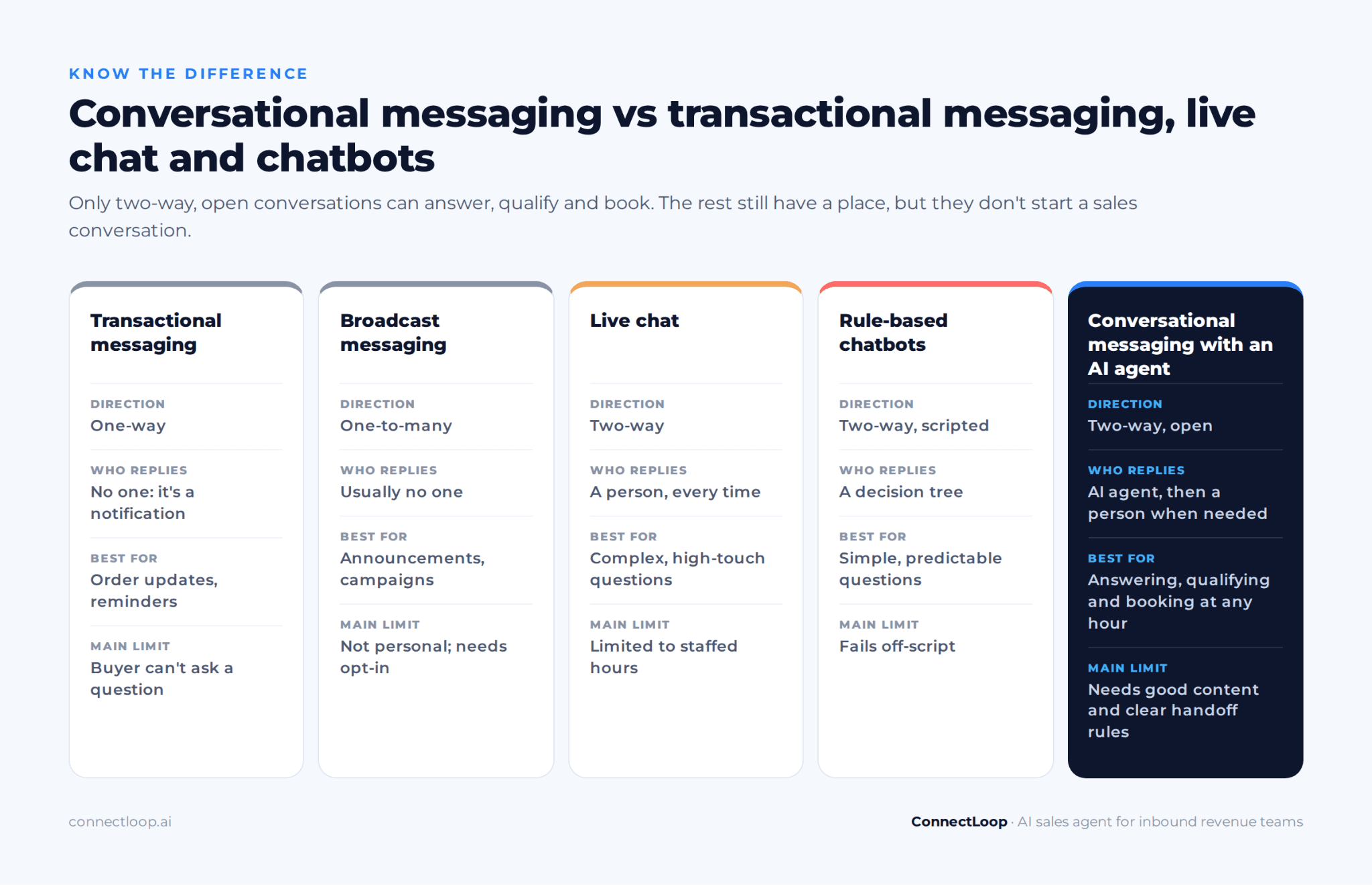
| Approach | Direction | Who replies | Best for | Main limit |
|---|---|---|---|---|
| Transactional messaging | One-way | No one; it's a notification | Order updates, reminders, alerts | The buyer can't ask a question |
| Broadcast messaging | One-to-many | Usually no one | Announcements and campaigns | Not personal; needs opt-in |
| Live chat | Two-way | A person, every time | Complex, high-touch questions | Limited to staffed hours |
| Rule-based chatbots | Two-way, scripted | A decision tree | Simple, predictable questions | Fails off-script |
| Conversational messaging with an AI agent | Two-way, open | An AI agent, then a person when needed | Answering, qualifying and booking at any hour | Needs good content and clear handoff rules |
Transactional notifications still have a place. Booking confirmations and appointment reminders are useful. But they finish a conversation; they don't start one.
The difference between a chatbot and an AI agent matters most. A chatbot follows a script; an AI agent understands an open question and answers from your content. Chatbot vs AI agent covers that in detail.
How is conversational messaging different from a contact centre?
A contact centre is built around queues and agents, mostly for support. Conversational messaging is built around threads the buyer controls, on channels they already use. ConnectLoop's approach for sales is to answer instantly in the thread, so buyers don't wait in a queue to ask a pre-sales question.
Contact centres measure handle time, and marketing teams often measure customer engagement in clicks. Sales conversations should measure what the conversation produced: a qualified lead, a booked meeting or a clear "not now".
Why is demand for conversational messaging growing?
Buyers already use messaging and AI to get answers, and they want the same speed from businesses. Gartner research from 2026 shows buyers prefer self-service but still want a person at key moments. ConnectLoop is built for that pattern: instant answers first, and a rep when the buyer is ready.
Three 2026 findings from Gartner explain the shift:
- Buyers prefer to self-serve. In a survey of 645 B2B buyers published 20 May 2026, 67% said they prefer a rep-free experience, yet 69% turn to sales reps to validate AI-generated insights.
- Customers already use AI tools. A survey of 3,566 customers published 8 July 2026 found customers are about three times more likely to use third-party generative AI tools than company-provided chatbots.
- People want a way to reach a human. Gartner's 4 August 2026 release found 87% of customers say companies using generative AI must offer access to a human agent.
Together, these findings point to one design. Answer fast in the buyer's channel, and make the path to a person obvious.
Where is conversational messaging heading?
Towards AI agents that complete tasks inside the thread, such as booking, rescheduling and qualifying, rather than chatbots that only answer FAQs. Agentic AI, richer channels like RCS, and clear AI disclosure rules are shaping it. ConnectLoop's agent already books meetings and syncs results inside the conversation.
The future of conversational messaging has three clear directions:
- Messaging becomes the interface. Buyers will expect to ask, compare, book and reschedule in one thread.
- Agentic AI does the work. AI agents take actions such as checking a calendar or updating a CRM, not just reply.
- Transparency becomes standard. Telling people they're talking to AI is now a legal requirement in the EU, covered below.
What are the benefits of conversational messaging for sales teams?
Faster response times, more qualified conversations, and meetings booked without a form or an email chain. Buyers get answers in their channel; reps get context before the call. ConnectLoop adds a record of every conversation, from first message to booked call, so the benefit shows up in pipeline.
The main benefits for revenue teams:
- Faster responses at every hour. Buyers who get an answer while they're still interested are easier to convert. Speed to lead covers why the first minutes matter.
- Qualification inside the thread. The conversation captures need, timeline and team size naturally, as inbound lead qualification describes.
- Fewer steps to a meeting. Booking in the conversation removes the form, the follow-up email and the calendar ping-pong.
- Better customer insights. Every question becomes data on objections, competitors and missing content.
- More customer trust. Accurate, consistent answers on the buyer's preferred channel build trust and relationship-building over time.
- Convenience and accessibility. Buyers message when it suits them, without calling or waiting on hold.
Higher conversion rates are the expected result. They depend on answer quality and on how quickly a ready buyer reaches a rep, not on the channel alone.
Which channels does conversational messaging use in 2026?
Website chat, WhatsApp, email, SMS, RCS, Facebook Messenger, Instagram and regional apps. For B2B inbound sales, website chat, WhatsApp and email carry most first conversations. ConnectLoop's agent works across website chat, WhatsApp and email. Choose channels based on where your buyers already message you, not on what's newest.
| Channel | Typical use | Notes for sales teams |
|---|---|---|
| Website chat (webchat) | First questions on product and pricing pages | Highest buying intent; the buyer is already on your site |
| Personal, asynchronous conversations | Strong in Latin America, Europe and beyond; Meta's rules apply (see compliance) | |
| Detailed questions, follow-up, proposals | Still the default for B2B; works best with fast, specific replies | |
| SMS and MMS | Reminders, short updates, two-way texting | US business texting has its own registration and consent rules |
| RCS (Rich Communication Services) | Rich media, buttons and branded messages on Android | Growing; supported by Google Messages |
| Facebook Messenger and Instagram | Consumer brands, social-led enquiries | More common in B2C than B2B |
| iMessage | Apple users | Business messaging is available through Apple's own programme |
| Viber, Telegram and super apps | Regional channels such as KakaoTalk, LINE and WeChat | Essential in some markets, rare in others |
| In-app chat and push notifications | Product-led companies | Push is one-way; in-app chat can be conversational |
A note on outdated advice: some guides still recommend Google Business Messages. Google shut it down on 31 July 2024, and new conversations stopped on 15 July 2024. Check any channel list against the date it was written.
Internal tools like Slack and Microsoft Teams also carry conversations, but mostly between colleagues. In sales, they work best for alerting a rep when a buyer needs a person.
How do you know which channels your customers actually use?
Look at where conversations already start: website chat logs, WhatsApp messages, email replies and form fields asking for a preferred contact method. Regional channel preferences matter too. ConnectLoop's Visitor Insights shows the source of each visitor and conversation, such as website, WhatsApp, email or lead capture, so you can see the split.
Ask in the conversation as well. "Would you prefer we continue on WhatsApp or email?" is a simple question that gives you real data.
Don't add channels just to look omnichannel. Each channel needs fast replies, or it becomes a place where buyers wait.
Why do website chat and email matter so much for B2B?
Because that's where B2B buying conversations usually start. A buyer comparing vendors is on your pricing page, or replying to an email, before they ever message you on an app. ConnectLoop treats website chat and email as conversational channels, with the same AI agent answering on both, alongside WhatsApp.
Email is often treated as one-way: campaigns and sequences. But a buyer's reply to an email is a conversation, and it deserves a fast, specific answer.
Good subject lines start the thread; good replies keep it alive. Email subject lines for sales covers the first part.
How does conversational messaging work for inbound sales?
The buyer asks a question; the agent answers from approved content, qualifies with natural questions, and books a meeting in the same thread. When a person is needed, the conversation passes to a rep with full context. ConnectLoop runs this flow on website chat, WhatsApp and email, and logs every step to your CRM.
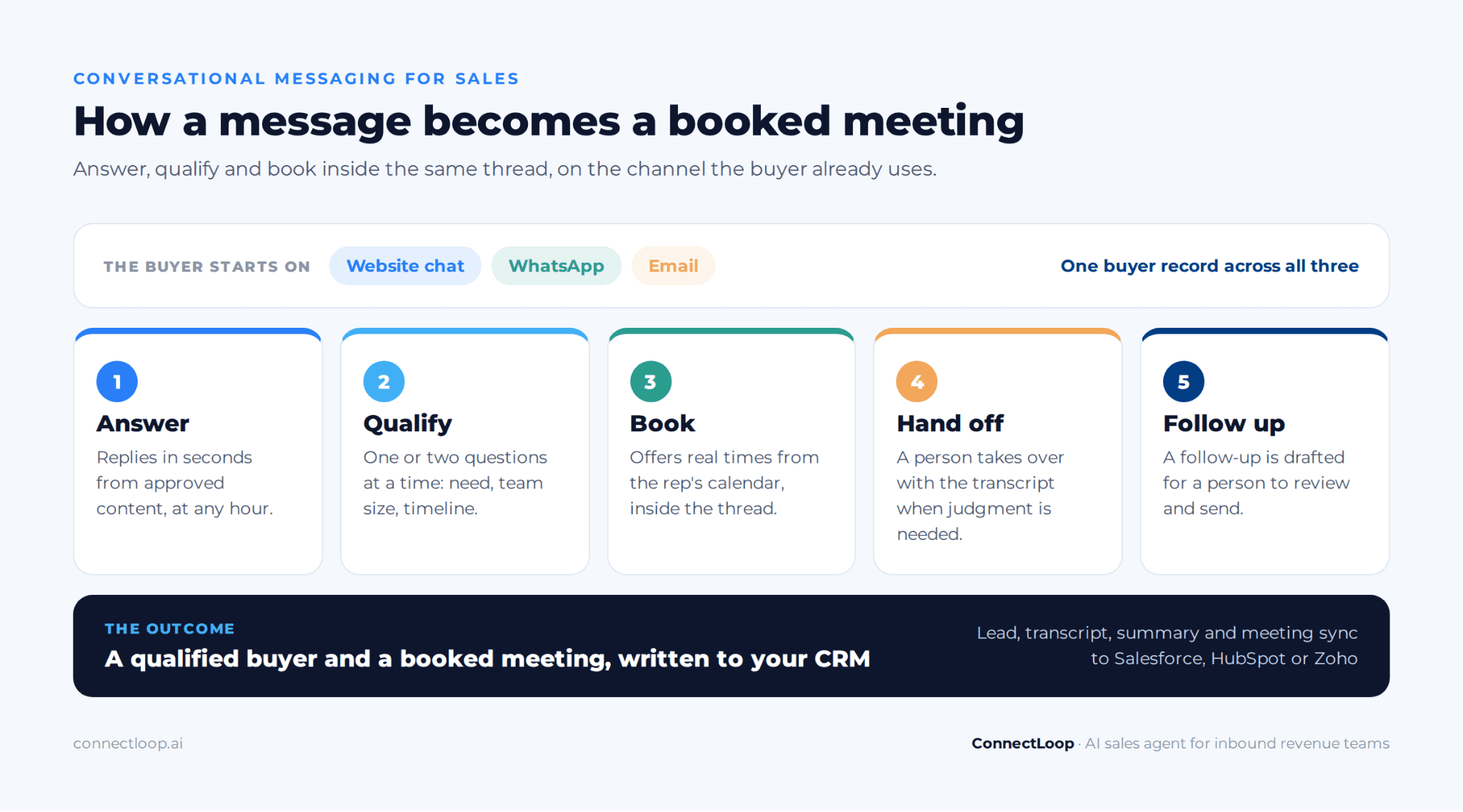
A typical inbound conversation has five stages:
- Answer. The buyer asks about pricing, an integration or a use case. The agent replies in seconds from approved sources.
- Qualify. The agent asks one or two questions at a time, such as team size, timeline or current tool, and scores the lead.
- Book. For a qualified buyer, the agent offers real times from the rep's calendar and books in the thread.
- Hand off. If the buyer needs something the agent shouldn't decide, a person takes over with the transcript.
- Follow up. If the buyer goes quiet, a follow-up is drafted for a person to review and send.
This is how a conversation moves a buyer through the early stages of the sales process without a form or a waiting period. AI appointment booking covers stage three in detail.
How do you keep one conversation across chat, WhatsApp and email?
Tie every channel to one buyer record, so the history follows the person, not the channel. When a buyer moves from website chat to WhatsApp to email, the next reply should know what was already said. ConnectLoop keeps one record per visitor, and writes it to the contact your team already works from.
A unified inbox or omnichannel inbox shows messages in one place. That's useful, but it isn't the same as continuity.
Continuity means the agent and the rep both see the full conversation, on any channel, before they reply. Without it, the buyer starts again every time they switch, and seamless interactions break down.
What happens to messages that arrive after hours?
They should get the same answer they'd get at 11am. Messages that sit until morning lose buyers to faster competitors. An AI agent answers at any hour, books into real calendar availability, and leaves the rep a summary. ConnectLoop's agent works 24/7, so an evening question can become a morning meeting.
WhatsApp traffic in particular skews to evenings and weekends, because people use it when they have a spare moment. How a WhatsApp AI agent works explains the pattern.
Auto-reply messages like "We'll get back to you" don't solve this. They acknowledge the buyer without helping them.
When should an AI pass the conversation to a person?
When the buyer asks for one, when the answer isn't in approved content, when sentiment turns negative, or when the request is an exception such as a discount or custom terms. ConnectLoop's agent hands off with the transcript, a summary and the reason, so the rep doesn't ask the buyer to repeat themselves.
AI-human collaboration works best with clear rules. The agent handles volume and speed; people handle judgment, negotiation and relationships.
The AI-to-human handoff guide covers triggers, routing and what the rep should receive.
What are the main use cases for conversational messaging?
Sales, support, marketing, feedback, re-engagement and reminders. For revenue teams, the strongest use cases are answering pre-sales questions, qualifying leads and booking meetings. ConnectLoop focuses on the sales side, where a conversation can turn directly into pipeline.
The main use cases:
- Conversational sales: answering product and pricing questions, qualifying, and booking demos inside the thread.
- Customer support and customer service: resolving common questions quickly and routing complex ones to a person.
- Conversational marketing: starting a conversation from a campaign, rather than sending people to a form.
- Conversational commerce: product questions, recommendations and buying in the chat. See conversational commerce and the AI agent for ecommerce.
- Feedback and customer insights: asking one question after a purchase or meeting, and learning from the answers.
- Re-engagement and customer loyalty: reaching back out to buyers who went quiet, with something useful to say.
- Reminders and appointment rescheduling: confirming meetings and letting the buyer move them in the thread.
What are some conversational marketing examples?
A campaign that ends in a conversation rather than a form. For example, an ad that opens a WhatsApp chat, a pricing page that invites a question, or an email that asks one specific question and gets a real reply. ConnectLoop's agent picks up these conversations wherever they start.
Three practical examples:
- Pricing page prompt: "Comparing plans? Ask me anything about limits or integrations."
- Event follow-up: "Thanks for visiting our stand. Want the integration list for your CRM?"
- Return visitor: a buyer who comes back to the pricing page twice gets a timely, relevant offer of help. Proactive interactions like this work when they answer a likely question, not when they interrupt.
Each one invites a question. None of them asks the buyer to fill in a form first. That is conversational engagement: the business opens a door, and the buyer chooses to walk through it.
How do AI and automation fit into conversational messaging?
AI makes conversational messaging possible at scale: understanding open questions, answering from your content, and taking actions like booking. Automation handles the routine. People handle judgment. ConnectLoop uses AI agents for the first conversation and hands off to your team when a person is needed.
Three types of technology are often confused:
- Auto-reply: a fixed message. Useful for confirmations, useless for questions.
- Rule-based chatbots: decision trees. Reliable for narrow tasks, frustrating off-script.
- Conversational AI and AI agents: generative AI that understands open questions, plus agentic AI that can act, such as checking a calendar or updating a CRM.
Over-automation is a real risk. An agent that blocks the way to a person, or answers questions it shouldn't, does more damage than a slow reply.
How do you stop an AI from giving wrong answers?
Limit it to approved content, and make it hand off when the answer isn't there. An agent that guesses creates problems for the rep later. ConnectLoop's agent answers from your approved sources, says when it doesn't know, offers a person, and logs the question so your team can add the answer.
The quality of the answers depends on the content behind them. How to build a knowledge base for AI agents explains what to include and what to keep out, such as discount rules and custom pricing.
Review unanswered questions weekly. Each one is either a missing answer or a reason to hand off.
What compliance rules apply to conversational messaging?
Get consent before messaging people, follow each channel's own rules, keep records responsibly, and tell people when they're talking to AI. In the US, business texting has TCPA consent rules and 10DLC registration. WhatsApp has its own 24-hour customer service window. ConnectLoop is an official Meta Business Partner and a Verified Meta Business, so WhatsApp conversations run on Meta's official platform.
The main rules to plan for:
- Opt-ins and consent. Get clear permission before sending marketing messages on any channel.
- US business texting. The TCPA governs consent for texts and calls, and A2P messaging over standard US numbers requires 10DLC registration. Check current requirements with your provider and legal team.
- WhatsApp's customer service window. Business conversations on WhatsApp at scale run through the WhatsApp Business API, also called the WhatsApp Business Platform. According to Meta's WhatsApp Business Platform documentation, a buyer's message opens a 24-hour customer service window. Free-form replies can only be sent inside it; outside it, the business must use an approved template message.
- AI disclosure. Under Article 50 of the EU AI Act, AI systems that interact directly with people must inform them they're interacting with AI, unless it's obvious. This applies from 2 August 2026.
- Data retention. Decide how long conversation data is kept, who can see it, and how a buyer can ask for it to be deleted.
This is general guidance, not legal advice. Rules vary by country and change often, so confirm the details for the markets you sell into.
What does good messaging etiquette look like?
Reply fast, keep messages short, ask one question at a time, and respect the buyer's timing. Messaging sits next to personal chats, so it should feel helpful, not pushy. ConnectLoop recommends the same habits for its agent: introduce itself as AI, answer first, and ask before booking or handing off.
A few practical rules:
- Don't send several messages in a row without a reply.
- Use rich media, such as a short video or a PDF, only when it answers the question.
- Avoid sending marketing messages late at night in the buyer's time zone.
- Always make it easy to stop the conversation or reach a person.
How do you build a conversational messaging strategy?
Start with one sales goal, the channels your buyers already use, and the content the agent will answer from. Then connect booking and your CRM, set handoff rules, and measure meetings, not messages. ConnectLoop recommends launching on website chat first, then adding WhatsApp and email once the answers are right.
- Set clear goals. Choose one primary outcome, such as booked meetings from inbound conversations, and one guardrail, such as response time.
- Pick your channels. Start where conversations already happen. For most B2B teams, that's website chat and email, then WhatsApp.
- Prepare approved content. Pricing, product, integrations, objections and policies. Keep exceptions such as discounts out of the agent's sources.
- Define qualification. Decide what the agent must learn before booking. BANT vs MEDDIC helps you choose the framework.
- Connect calendar and CRM. Qualified buyers should book directly, and every conversation should land on the contact record.
- Set handoff rules. Write down when the agent passes the thread to a person, and who receives it.
- Train the team. Team training covers how reps read handoffs, follow up and close knowledge gaps. Put the rules in your sales playbook.
- Measure and improve weekly. Use the data: review unanswered questions, conversion by channel and meetings booked.
How do you choose a conversational messaging platform?
Choose a conversational messaging platform that covers your buyers' channels, answers only from approved content, books meetings, hands off cleanly, and writes everything to your CRM. ConnectLoop is built for inbound sales teams that want those steps in one system instead of five separate tools.
Questions to ask any platform:
- Channels: Does it cover the channels your buyers actually use, with one record per buyer?
- Answer quality: Does the AI answer only from your content, and say when it doesn't know?
- Booking: Can it book against real calendar availability inside the conversation?
- Handoff: Does a person receive the transcript, summary and reason?
- CRM integration: Does it sync leads, transcripts and meetings to Salesforce, HubSpot or your CRM?
- Compliance: Does it support opt-ins, channel rules and AI disclosure?
- Reporting: Can you see conversations, meetings booked and unanswered questions?
Be wary of platforms that report only on message volume. More messages isn't the goal; more qualified conversations is.
How do you measure conversational messaging in sales terms?
Measure what conversations produce: response time, qualified conversations, meetings booked and pipeline. Open rates show whether a message was seen, not whether it helped anyone buy. ConnectLoop tracks every conversation from first message to booked call, so these numbers come from the same record.
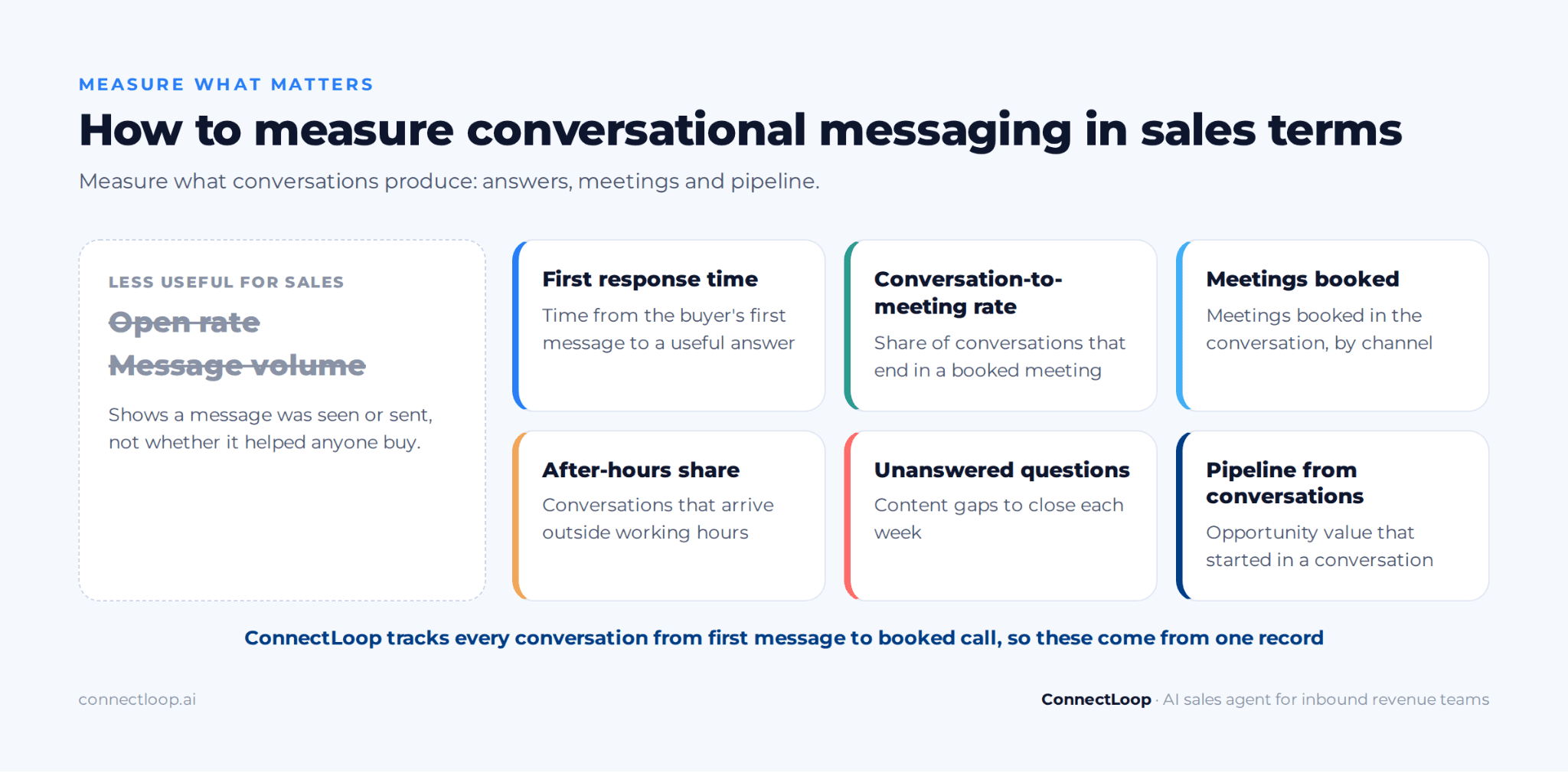
| Metric | What it measures | Why it matters |
|---|---|---|
| First response time | Time from the buyer's first message to a useful answer | Slow answers lose interested buyers |
| Conversation-to-meeting rate | Share of conversations that end in a booked meeting | The clearest measure of sales value |
| Meetings booked | Meetings booked in the conversation, by channel | Shows which channels produce pipeline |
| After-hours share | Share of conversations outside working hours | Shows what would be missed without 24/7 cover |
| Unanswered questions | Questions the agent couldn't answer | Content gaps to close each week |
| Pipeline from conversations | Opportunity value that started in a conversation | Connects messaging to revenue |
Open rate still matters for broadcast messages. For two-way conversations, it says little.
These measures sit alongside your wider inbound sales metrics. Lead scoring helps you separate conversation volume from conversation quality.
What are the common mistakes in conversational messaging?
The most common mistakes are one-way messages dressed up as conversations, slow replies, over-automation, wrong AI answers and no path to a person. Each one teaches buyers that messaging you isn't worth it. ConnectLoop addresses them with instant answers, approved content and a clear handoff.
- One-way messaging with a reply button. If replies go to an unmonitored inbox, it isn't a conversation.
- Too many channels, too few replies. Better to answer well on two channels than slowly on six.
- Starting again on every channel. Buyers repeat themselves when channels aren't linked to one record.
- Letting the AI guess. A confident wrong answer about pricing or features costs more than a handoff.
- Hiding the human. Customers expect a way to reach a person, as the Gartner research above shows.
- Skipping compliance. Missing opt-ins, ignoring WhatsApp's window or not disclosing AI.
- Measuring opens instead of outcomes. Track meetings and pipeline, not message counts.
- No follow-up. Buyers who go quiet need a timely, useful message. See follow-up email after no response.
How does ConnectLoop handle conversational messaging for sales?
ConnectLoop is an AI sales agent platform for inbound revenue teams. Its agent, Lia, answers buyers on website chat, WhatsApp and email in real time, qualifies leads and books meetings 24/7. Every conversation is tracked from first message to booked call and written to your CRM.
An AI sales agent like Lia replaces the stack of live chat tool, scheduling app, follow-up sequencer and support inbox with one system. The agent trains on your website in about 60 seconds.
Here is what that looks like in practice:
- Answers from approved content. Lia answers from your sources. When the answer isn't there, she says so, offers a person and flags the gap.
- Qualifies and scores. Every lead is scored hot, warm or cold before your team sees it.
- Books in the thread. Lia checks real availability on Google Calendar or Outlook and books the meeting inside the conversation.
- One record per buyer. Leads, transcripts, summaries and meetings sync to Salesforce, HubSpot or Zoho.
- Hands off with context. Sensitive conversations go to your team with the full transcript.
- Learns from gaps. Unanswered questions appear in the Knowledge Gaps report, ranked by how often they come up.
- Works in three languages. Lia replies in English, Spanish or Portuguese.
Visitor Intelligence adds context before the first message. It follows each visitor's journey and attaches it to the conversation when they share their details, as covered in how to identify anonymous website visitors.
ConnectLoop is CASA Verified by Google, a Verified Meta Business and an official Meta Business Partner, which matters for WhatsApp sales.
Where ConnectLoop focuses, and where people stay in charge:
- Inbound channels. ConnectLoop is built for the channels where B2B inbound conversations start: website chat, WhatsApp and email, with one record per buyer across all three.
- Human-reviewed follow-up. Proactive Outreach drafts personalised follow-up emails that a person reviews, edits, and sends or dismisses.
- Decisions that commit the business. Discounts, custom pricing and contract terms stay with your reps.
Does conversational messaging replace SDRs?
No. It changes what SDRs spend time on. An AI agent handles the first answer, qualification and booking at any hour; SDRs and reps handle discovery, negotiation and relationships. ConnectLoop is built for that split, with the handoff as the point where work passes from Lia to your team.
What is an AI SDR explains what the agent takes on. SDR vs BDR covers how inbound and outbound roles divide.
Key takeaways
- Conversational messaging is two-way. If the buyer can't reply and get a useful answer, it's a notification, not a conversation.
- For sales teams, the goal is a booked meeting, not an opened message. Answer, qualify and book in the same thread.
- Website chat, WhatsApp and email carry most B2B inbound conversations. Add other channels only where your buyers already are.
- Keep one record per buyer, so the conversation continues across channels without starting again.
- AI should answer only from approved content and hand off to a person when the answer isn't there.
- Follow each channel's rules: consent, US texting registration, WhatsApp's 24-hour window, and AI disclosure under Article 50 of the EU AI Act.
- Measure conversation-to-meeting rate, meetings booked and pipeline, not open rates.
- ConnectLoop's agent, Lia, answers, qualifies and books across website chat, WhatsApp and email, 24/7, and writes every conversation to your CRM.

About the author
ConnectLoop Staff
Written by the ConnectLoop team. ConnectLoop is an AI sales agent for inbound revenue teams, based in Cambridge, Massachusetts.
About ConnectLoop →Frequently asked questions
No. Live chat needs a person for every conversation and only works during staffed hours. Conversational messaging covers any two-way channel, including WhatsApp and email, and can use an AI agent to answer at any hour, with a person joining when needed.
Yes. B2B buyers research independently and ask detailed questions about pricing, integrations and security. Answering those questions instantly on website chat, WhatsApp or email, then booking a meeting in the thread, shortens the path from first question to first call.
Website chat on pricing and product pages, because buyers there already have intent. Add email replies next, then WhatsApp if your buyers use it. Start where conversations already happen and expand once replies are fast and accurate.
Most don't, if the answers are accurate and a person is easy to reach. Gartner found in 2026 that 87% of customers say companies using AI must offer access to a human agent. Be clear that it's AI, and make the handoff obvious.
Yes, if it connects to your calendar. The agent offers real available times and books in the thread. Keep WhatsApp's 24-hour customer service window in mind for follow-ups: after 24 hours from the buyer's last message, an approved template is needed.
As fast as possible, ideally within a minute while the buyer is still on the page or in the app. An AI agent makes instant replies possible at any hour; a person should follow up quickly on anything the agent hands over.
Conversational marketing is a strategy: using conversations instead of forms to generate and qualify demand. Conversational messaging is the method and the channels used to hold those conversations. Conversational marketing relies on conversational messaging to work.
It works better with one. A CRM integration keeps the transcript, qualification and booked meeting on the contact, so every rep sees the history. Without it, conversations stay in a separate tool and are hard to act on.
No. Google shut down Google Business Messages on 31 July 2024. Guides that still recommend it are out of date. RCS and website chat are common alternatives, depending on your audience.
Track first response time, conversation-to-meeting rate, meetings booked by channel, after-hours share, unanswered questions and pipeline from conversations. These show sales impact. Message volume and open rates don't.
Turn every message into a next step
Conversational messaging works for sales when every message gets an accurate answer, qualified buyers can book in the thread, and a person steps in when judgment is needed. ConnectLoop's agent, Lia, does this across website chat, WhatsApp and email, at any hour, and writes every conversation to your CRM. See how ConnectLoop answers your buyers on your own website.