
Sales Communication
120 Email Subject Lines for Sales That Get Replies
The best email subject lines for sales name the thing the buyer already cares about: the question they asked, the call they booked, the quote they received. Generic curiosity and intrigue lines work once; catchy subject lines are rarely the ones that get a reply. This list gives 120 subject lines organised by sales stage, each with the first line that goes under it, including the inbound follow-ups ConnectLoop's AI sales agent drafts through Proactive Outreach for a rep to review and send.

Published
Table of contents
- What makes a good sales email subject line?
- Why organise subject lines by stage instead of by trick?
- How long should a sales email subject line be?
- What are the best cold email subject lines?
- What subject line do you use after a website chat?
- What subject line do you use after a booked call?
- What subject line do you use after a demo?
- What subject line do you use after sending a quote?
- What are good follow-up email subject lines?
- What subject lines work for the second and third follow-up?
- What subject lines work when there has been no response?
- What are good meeting request subject lines?
- What is the WhatsApp or SMS equivalent of a subject line?
- How do you write a subject line in five steps?
- How does ConnectLoop write the subject line from the conversation?
- What are the dos and don'ts?
- How do you A/B test subject lines with a small list?
- Key takeaways
- Frequently asked questions
What makes a good sales email subject line?
A good sales email subject line tells the reader, in under 50 characters, why this email is about them and what happens if they open it. It uses something specific to the buyer: their question, their company, their deadline, the person who referred them. It matches the first line underneath it, because the inbox shows both.
Sales email subject lines are judged on the open rate, but the response rate and click-through rate are what pay. Three tests before you send:
- Would the buyer recognise it as theirs? "Quick question" could be from anyone. "Your question about monthly billing" could only be from you.
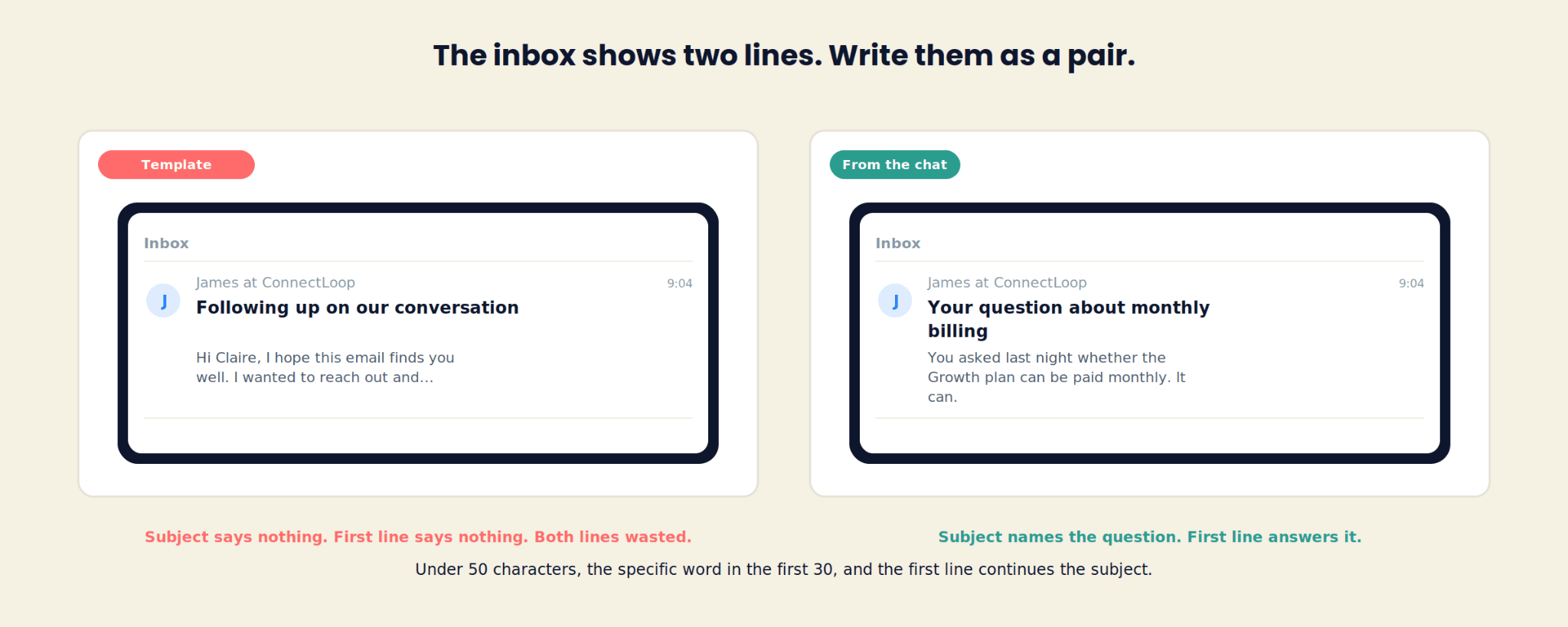
- Does the first line continue it? The preview text is the second half of the subject line. If the subject says "Your Thursday call" and the first line says "Hope this email finds you well," the pair fails.
- Would it survive the reply? The buyer replies, and your subject line becomes the thread name for the rest of the deal. "Did I lose you?" is a poor name for a three-month conversation.
One limit worth stating up front: the subject line moves the open rate. The reply rate is decided by the email body and by how soon after the conversation it arrives. A perfect subject line on a late, generic email still gets no answer.
Why organise subject lines by stage instead of by trick?
Most lists group subject lines by psychological device: curiosity, urgency, scarcity, FOMO, social proof, pain point. Quantified subject lines, referral subject lines and event or webinar subject lines each get their own section, as if the rep chose a device first. A rep does not sit down thinking "I need a curiosity line." They think "she asked about pricing last night and I need to follow up." Organising by the stages of the sales process puts the right line next to the moment it is for.
The stages in this article, in the order a buyer moves through them:
| Stage | The buyer's situation | What the subject line has to do |
|---|---|---|
| Cold outreach | Has never heard of you | Earn one open on relevance alone |
| After a website chat | Asked Lia or a rep a question and left an email | Continue the conversation they started |
| After a booked call | Has a meeting on the calendar | Confirm and prepare |
| After a demo | Has seen the product | Move to a decision |
| After a quote | Has a number | Get the objection into the open |
| Follow-up 1 | Went quiet after any of the above | Give a reason to reply that is not "checking in" |
| Follow-up 2 and 3 | Still quiet | Add something new each time |
| No response | Fourth touch or later | Close cleanly or reopen later |
| Meeting request | You want time on the calendar | Make the ask small and specific |
Cold outreach is included because it is what most people search for. Everything from the second row down is where an inbound team lives, and it is where the other lists stop.
How long should a sales email subject line be?
Keep it under 50 characters, and put the specific word in the first 30. Subject line length and character limits are the one area where mobile optimisation is not optional. Mobile mail clients cut subject lines at roughly 35–40 characters; desktop clients show 60 or more. The examples in this article run from 12 to 48 characters. Preview text, also called the preheader, adds another 40–90 characters, so write the first line of the email to carry what the subject could not.
Length is a constraint, not a target. "Thursday 2pm confirmed" is 22 characters and complete. Padding it to 50 makes it worse.
What are the best cold email subject lines?
The best cold email subject lines name the buyer's company, a specific problem, or a mutual contact, and ask nothing that sounds like a pitch. Curiosity lines get opens from people who then feel tricked. Referral and quantified lines get opens from people who then read.
| # | Subject line | First line under it | Why it works |
|---|---|---|---|
| 1 | [Company] + ConnectLoop | I noticed your team answers website enquiries by form. Here is a shorter route. | Two names, no verb, reads like an internal thread |
| 2 | Enquiries after 6pm at [Company] | Your contact page says the team replies within one working day. | Names a pain point the buyer has not said out loud |
| 3 | [Referral name] suggested I write | She mentioned your inbound leads sit overnight. | Referral subject lines outperform everything else in cold outreach |
| 4 | Question about [Company]'s demo requests | Do they go to one inbox or to a person? | A real question, not a fake one |
| 5 | 12 enquiries a month, 3 replies | That is what one of your competitors' sites produced in a test. | Quantified, and about them |
| 6 | Your pricing page | Visitors who reach it usually have one question left. | Short, specific, no claim |
| 7 | [Competitor] and the 9pm lead | They answer it in a minute. Here is how. | Social proof without a testimonial |
| 8 | Before you hire the next SDR | One thing to check about where the inbound leads go first. | Pattern interrupt tied to a decision they are making; the AI SDR question in one line |
| 9 | [Name], one idea for [Company] | It is about the form on your contact page. | Personalised, low commitment |
| 10 | How [Company] handles WhatsApp enquiries | Or does it? Most sites in your sector do not. | Channel-specific, opens a gap |
| 11 | Two minutes on inbound at [Company] | Not a pitch deck, one screenshot. | Names the time cost |
| 12 | Who answers your chat at 11pm? | If the answer is nobody, this is worth two minutes. | Direct question the buyer can answer instantly |
| 13 | Saw the new pricing page | One thing that might be costing you enquiries. | Shows you looked |
| 14 | [Company] and after-hours leads | A short note on what happens to them now. | Plain, no tricks |
| 15 | Same problem, three of your peers | Each of them fixed it in an afternoon. | Social proof at a peer level |
Spam trigger words to keep out of cold subject lines: free, guarantee, urgent, act now, limited time, and anything in capitals. Spam filters score them before anyone reads them, and a call-to-action in the subject line ("Book now") reads the same way. Industry-specific subject lines help only when the industry word is one the buyer uses about themselves. The AI SDR question behind line 8 is covered in its own guide.
What subject line do you use after a website chat?
After a website chat, the subject line quotes the question the buyer asked. They typed it minutes or hours ago, so it is the most recognisable thing you can write. "Your question about the January cohort" is opened because it is theirs. "Following up on our chat" is a template.
This is the stage no other list covers: the subject line after a chat. For an inbound team it is the most common email of the week, and the personalisation in it is the buyer's own words rather than a merge field. Where a chat ended mid-qualification, line 18 picks the thread back up.
| # | Subject line | First line under it | Situation |
|---|---|---|---|
| 16 | Your question about monthly billing | You asked last night whether the Growth plan can be paid monthly. It can. | Pricing question in chat |
| 17 | The January cohort dates | Tuesday and Thursday evenings from 12 January, as Lia mentioned. | Availability question |
| 18 | Team of eight, one question back | You mentioned eight seats. Are they all on the sales side? | Chat ended mid-qualification |
| 19 | The WhatsApp setup you asked about | Three steps, about twenty minutes, no developer needed. | Feature question |
| 20 | Re: your chat at 9:42pm | Picking up where Lia left off. You asked about the trial. | Late-night chat, morning follow-up |
| 21 | What we covered, in four lines | Growth plan, monthly billing, trial with no card, Thursday call. | Summary email |
| 22 | The brochure you asked for | Attached, plus the two pages that answer your compliance question. | Document request |
| 23 | Your comparison with [Competitor] | You asked how we differ on booking. Short answer below. | Competitor named in chat |
| 24 | Answering your last question | You asked if it works in-house. It does, and here is how. | Chat closed on an open question |
| 25 | One thing I did not cover | You asked about onboarding. Here is what the first week looks like. | Adding to the chat |
| 26 | The 9pm enquiry from [Company] | That was you, I think. Happy to pick it up. | Visitor gave email but left before answers |
| 27 | Still deciding on the plan? | You looked at Launch and Growth. The difference is one feature. | Return visitor who asked in chat |
| 28 | The trial link | No card, ten minutes to set up, and Lia is trained on your site. | Trial requested in chat |
| 29 | Thursday works, or Tuesday? | You asked about a call. Either day, morning or afternoon. | Meeting interest expressed |
| 30 | Your question, the honest answer | It does not do voice calls. Here is what it does instead. | Question the agent answered with a limit |
The pattern is one sentence: subject line names the question, first line answers it or moves it forward.
What subject line do you use after a booked call?
After a booked call, the subject line carries the day and time, so it doubles as a reminder in the inbox. The first line says what the call will cover, based on what the buyer said when booking. A confirmation email that says "Confirming our meeting" tells them nothing they did not know.
| # | Subject line | First line under it | Situation |
|---|---|---|---|
| 31 | Thursday 2pm confirmed | Invite attached. We will start with your question on monthly billing. | Booking confirmation |
| 32 | Before Thursday: two things | The plan comparison you asked about, and one question so I prepare properly. | Pre-call prep |
| 33 | Your call tomorrow at 10 | Agenda in three lines. Reply if you want to add one. | 24-hour reminder |
| 34 | Thursday: what we will cover | Monthly billing, WhatsApp setup, and the team-of-eight question. | Agenda |
| 35 | One question before we meet | Is the January deadline fixed, or is there room? | Pre-call qualification |
| 36 | Moved to 3pm, as requested | Updated invite attached. Same link. | Reschedule |
| 37 | Who is joining on Thursday? | If your ops lead is coming, I will bring the integration screen. | Multi-stakeholder |
| 38 | The invite for Thursday | In case the calendar did not catch it. | Invite resend |
| 39 | 10 minutes, then you decide | That is the plan for tomorrow. No slides. | Setting expectations |
| 40 | What I read before our call | Your chat with Lia and the three pages you visited. Starting from there. | Showing preparation |
Number 40 is only possible when the conversation and the visit history before the buyer identified themselves are on the lead record. That is the point of writing the call to the record before the rep opens the email.
What subject line do you use after a demo?
After a demo, the subject line names the one thing the buyer reacted to, and the first line asks the question that moves the deal. "Thanks for your time today" is polite and forgettable. "The booking flow you liked" is a thread they will reopen.
| # | Subject line | First line under it | Situation |
|---|---|---|---|
| 41 | The booking flow you liked | Here is the two-minute recording of that part, for your ops lead. | Post-demo recap |
| 42 | Your three questions from today | Monthly billing, the WhatsApp number, and the handover rule. Answers below. | Open questions |
| 43 | Next step from this afternoon | You said a trial on your own site would settle it. Link below. | Agreed next step |
| 44 | The one thing we did not show | The Sales Assistance view. Thirty seconds if you want it. | Feature not covered |
| 45 | Your team-of-eight setup | Roles, tags and the calendar, as we discussed. Two screenshots. | Configuration follow-up |
| 46 | The competitor question | You asked how we differ from [Competitor] on handover. Written down. | Objection raised |
| 47 | Trial on [Company]'s site | Lia trained on your pages this morning. Try the pricing question. | Trial set up after demo |
| 48 | What your ops lead asked | The CRM sync detail, with the field list. | Stakeholder question |
| 49 | Where the demo left off | You were about to ask about pricing when we ran out of time. | Demo cut short |
| 50 | Decision by the 15th? | You mentioned the date. Anything I can clear before then? | Timeline stated |
What subject line do you use after sending a quote?
After a quote, the subject line invites the objection instead of waiting for it, which is the first move in any sales negotiation. Buyers who go quiet after a price usually have one concern they have not said. A subject line that names the likely concern, or asks for it plainly, gets a reply; "Following up on the proposal" gets silence.
| # | Subject line | First line under it | Situation |
|---|---|---|---|
| 51 | The quote, and the one question | Is it the number, or the twelve-month term? | Quote sent, no reply |
| 52 | Monthly version of the quote | You asked about monthly. Here it is beside the annual. | Payment terms |
| 53 | Aside from price? | If there is anything else in the way, I would rather know. | Isolating the objection |
| 54 | What the quote includes | Onboarding and the WhatsApp setup are in it. Some people miss that. | Value clarification |
| 55 | Your quote, valid until the 30th | Not a pressure tactic; the plan pricing changes then. | Honest deadline |
| 56 | Twelve lost enquiries a month | That was your number. The quote is less than one of them. | Cost of inaction |
| 57 | Two ways to structure it | Same total, different timing. Pick whichever suits the budget cycle. | Trading value |
| 58 | Procurement questions? | If the quote has gone to someone else, happy to talk to them. | Decision-maker change |
| 59 | The comparison with [Competitor]'s quote | Line by line, since you mentioned you have both. | Competing quote |
| 60 | Anything wrong with the quote? | Plain question. If it is a no, that is fine too. | Direct |
What are good follow-up email subject lines?
A good follow-up subject line gives a reason to reply that did not exist last time: a new answer, a date, a document, a change. "Following up" and "Checking in" are the two most-sent subject lines in sales and the least opened, because they announce that nothing has changed. Email sequences and drip email tools send them on a timer, which is why buyers recognise them instantly.
| # | Subject line | First line under it | Situation |
|---|---|---|---|
| 61 | Next steps | Three of them, in order, from where we left off. | After any call |
| 62 | The answer to your onboarding question | Two weeks, one call, no developer. | Answering something left open |
| 63 | New since we spoke | The WhatsApp connection you asked about is live. | Product change |
| 64 | Your trial: day 3 | Lia has answered 14 questions on your site. Two it could not. | Trial follow-up |
| 65 | The case you asked for | A training provider your size, same after-hours problem. | Social proof requested |
| 66 | Re: Thursday 2pm confirmed | Following the thread so it stays in one place. | Reply in thread |
| 67 | One line from your ops lead | She asked about the field mapping. Attached. | Stakeholder follow-up |
| 68 | What changed on your site | You added a pricing page. Lia picked it up. | Visitor Intelligence signal |
| 69 | Still Thursday? | Just confirming the 2pm holds. | Soft confirmation |
| 70 | The thing I promised | The comparison table. Sorry for the delay. | Fulfilling a promise |
| 71 | Your question, second attempt | I answered it badly last time. Clearer version below. | Correcting yourself |
| 72 | Back on your site yesterday? | Visitor Intelligence flagged a return visit. Anything I can answer? | Return visit |
| 73 | [Company]'s trial results | 41 conversations, 6 bookings, one week. | Trial data; the buyer's lead score usually moves here |
| 74 | Two minutes, then I stop | Short question, then I leave you alone until you write. | Respecting attention |
| 75 | Is this still on the list? | If priorities moved, tell me and I will move too. | Gentle check |
The follow-up email after no response guide has full templates for each of these, and the lead score behind line 73 has its own.
What subject lines work for the second and third follow-up?
The second and third follow-ups each need something new: a different angle, a piece of evidence, a smaller ask. Most sequences jump from "following up" straight to "should I close your file?", which skips the two emails where deals are actually reopened. Vary the type, not just the wording.
| # | Subject line | First line under it | Which follow-up |
|---|---|---|---|
| 76 | A smaller ask | Not a call. One question, yes or no. | Second |
| 77 | The number, not the pitch | Your after-hours enquiries last month, from your own site. | Second |
| 78 | Something for your ops lead | The CRM field list. No reply needed from you. | Second |
| 79 | Wrong person? | If someone else owns this now, point me and I will stop writing to you. | Second |
| 80 | 30 seconds of video | Me, showing the one screen you asked about. | Second |
| 81 | A different angle | Forget the plan. What happens to the 9pm enquiry today? | Third |
| 82 | The last useful thing | A one-page setup guide. Keep it whether or not we talk. | Third |
| 83 | Your competitor's chat window | Try it at 10pm tonight. Then try yours. | Third |
| 84 | Two options | Trial on your site, or a ten-minute call. Or neither, and I stop. | Third |
| 85 | What I would do at [Company] | One paragraph, unsolicited, free to ignore. | Third |
![A timeline from day 1 to day 25 showing what each email adds: after the chat, "Your question about monthly billing" answers the question; follow-up 1 on day 4, "New since we spoke", adds a change; follow-up 2 on day 9, "A smaller ask", lowers the ask; follow-up 3 on day 16, "What I would do at [Company]", adds a point of view; and on day 25 "Closing this for now" closes cleanly. Four different reasons to reply before the close, where most sequences send the same "following up" four times.](/_next/image?url=%2Fblog%2Fsales-follow-up-subject-line-sequence.png&w=3840&q=75&dpl=dpl_uUbsUgqr8fyTkbYk4zMQ1NM5g2BR)
What subject lines work when there has been no response?
No-response subject lines, sent after three or four unanswered emails, close the loop politely and leave a door open for re-engagement later. The breakup email works because it is honest; it fails when it is a trick. Say you are stopping, and mean it.
| # | Subject line | First line under it | Type |
|---|---|---|---|
| 86 | Closing this for now | No reply needed. If it becomes relevant, my details are below. | Clean close |
| 87 | Should I close your file? | Honest question. A no is a useful answer. | Classic breakup |
| 88 | Did I lose you? | If the timing is wrong, say so and I will come back in a quarter. | Classic breakup |
| 89 | Last note from me | One resource, then I stop. The after-hours guide. | Value close |
| 90 | Reaching out one last time | If the problem went away, good. If not, it is here when you need it. | Standard |
| 91 | Wrong time, or wrong fit? | Either is fine. Knowing which helps me. | Diagnostic |
| 92 | Back in January? | I will drop you a line then, unless you say otherwise. | Scheduled return |
| 93 | A no is fine | Really. I would rather have it than silence. | Permission to decline |
| 94 | The quiet since Thursday | Reading it as "not now." Correct me if not. | Naming the silence |
| 95 | Your file, and a question | Closing it. Was there something we got wrong? | Feedback ask |
What are good meeting request subject lines?
A good meeting request subject line makes the ask small, specific and easy to accept: a length, a topic, and a day. "Would love to connect" asks for an unknown amount of time on an unknown subject. "10 mins on Thursday about the WhatsApp setup" asks for one thing.
| # | Subject line | First line under it | Situation |
|---|---|---|---|
| 96 | 10 mins this week? | On the monthly billing question. Thursday or Friday? | Short call |
| 97 | Thursday, 15 minutes, one screen | The booking flow. Then you decide. | Demo request |
| 98 | Pick a slot | Link below, any 15 minutes that suit. | Calendar link |
| 99 | Your ops lead and me, 20 minutes | The integration questions, answered in one go. | Multi-stakeholder |
| 100 | Can I show you the 9pm enquiry? | Live, on your site, in ten minutes. | Demo on their site |
| 101 | Thursday 2pm? | If yes, reply "yes" and the invite follows. | One-word reply |
| 102 | Before the 15th | You mentioned the date. A short call this week would help. | Deadline-driven |
| 103 | Coffee, or a screen share | Whichever is easier. Twenty minutes either way. | Choice |
| 104 | Your question deserves a call | The handover rule is easier to show than write. | Justified ask |
| 105 | Meeting invite: Thursday | Tentative. Decline if it does not suit, no offence taken. | Invite first |
What is the WhatsApp or SMS equivalent of a subject line?
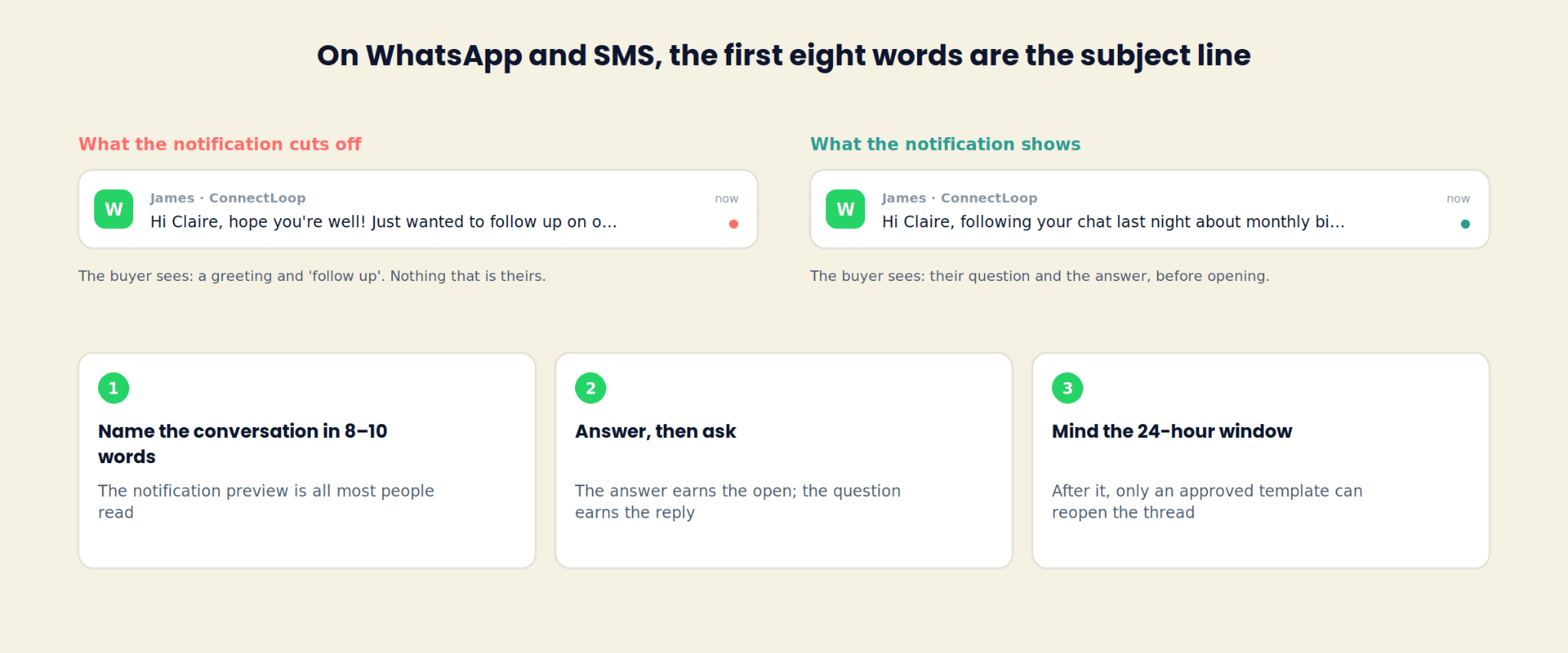
On WhatsApp and SMS there is no subject line, so the first sentence does its job. It has to name the conversation in the first eight to ten words, because that is what shows in the notification. Everything that applies to a subject line applies to the first line of a message.
| # | WhatsApp or SMS first line | Situation |
|---|---|---|
| 106 | Hi Dan, following your chat last night about monthly billing: yes, it can be paid monthly. | After a website chat |
| 107 | Thursday 2pm is confirmed. Invite is on its way to your email. | After a booked call |
| 108 | You asked about the January cohort. Dates are 12 Jan, Tue and Thu evenings. | Availability |
| 109 | The quote is with you. Is it the number or the term that needs changing? | After a quote |
| 110 | You were back on our site yesterday. Anything I can answer? | Return visit |
| 111 | Closing this for now. Message me if it becomes relevant. | No response |
| 112 | One question before Thursday: is the January deadline fixed? | Pre-call |
| 113 | 10 minutes this week on the WhatsApp setup? Thursday or Friday. | Meeting request |
| 114 | The brochure you asked for, plus the compliance page. | Document |
| 115 | Your trial: 14 questions answered on your site, 2 it could not. | Trial update |
WhatsApp has one rule email does not: the business can message freely for 24 hours after the customer's last message; after that, only an approved template can reopen the thread. The WhatsApp AI agent guide covers the window.
How do you write a subject line in five steps?
Start from the conversation, not from a list. Find the most specific thing the buyer said, put it in the subject line, write the first line to continue it, check the length, and read the pair as it will appear in the inbox.
- Find the buyer's own words. The question they asked, the date they mentioned, the competitor they named. From the chat transcript, the call notes or the CRM record.
- Put the specific thing first. "Your question about monthly billing", not "Following up on your question about monthly billing". The first 30 characters are all a phone shows.
- Write the first line as the second half. It should answer or advance what the subject line named. If the subject is a question, the first line is the answer.
- Cut to under 50 characters. Remove greetings, "re:" when it is not a reply, and any word that is not doing work.
- Read the pair on a phone. Subject line, then preview text. If the second does not follow from the first, rewrite one of them.
Five more subject lines built this way, from real inbound situations:
| # | Buyer's words | Subject line | First line |
|---|---|---|---|
| 116 | "Do you do this in-house for a team of 12?" | In-house, team of 12: yes | Half-day, at your site. Dates are the only open question. |
| 117 | "We are comparing you with two others" | The comparison, done for you | Three columns, the differences that matter for your setup. |
| 118 | "Need this sorted before Q1" | Before Q1: the timeline | Setup in a week, live before December. Here is the plan. |
| 119 | "Our reps hate the current chat tool" | What your reps will notice first | The chat window they stop having to watch. |
| 120 | "Can I try it before deciding?" | Try it on your site today | No card. Lia is trained on your pages already. |
How does ConnectLoop write the subject line from the conversation?
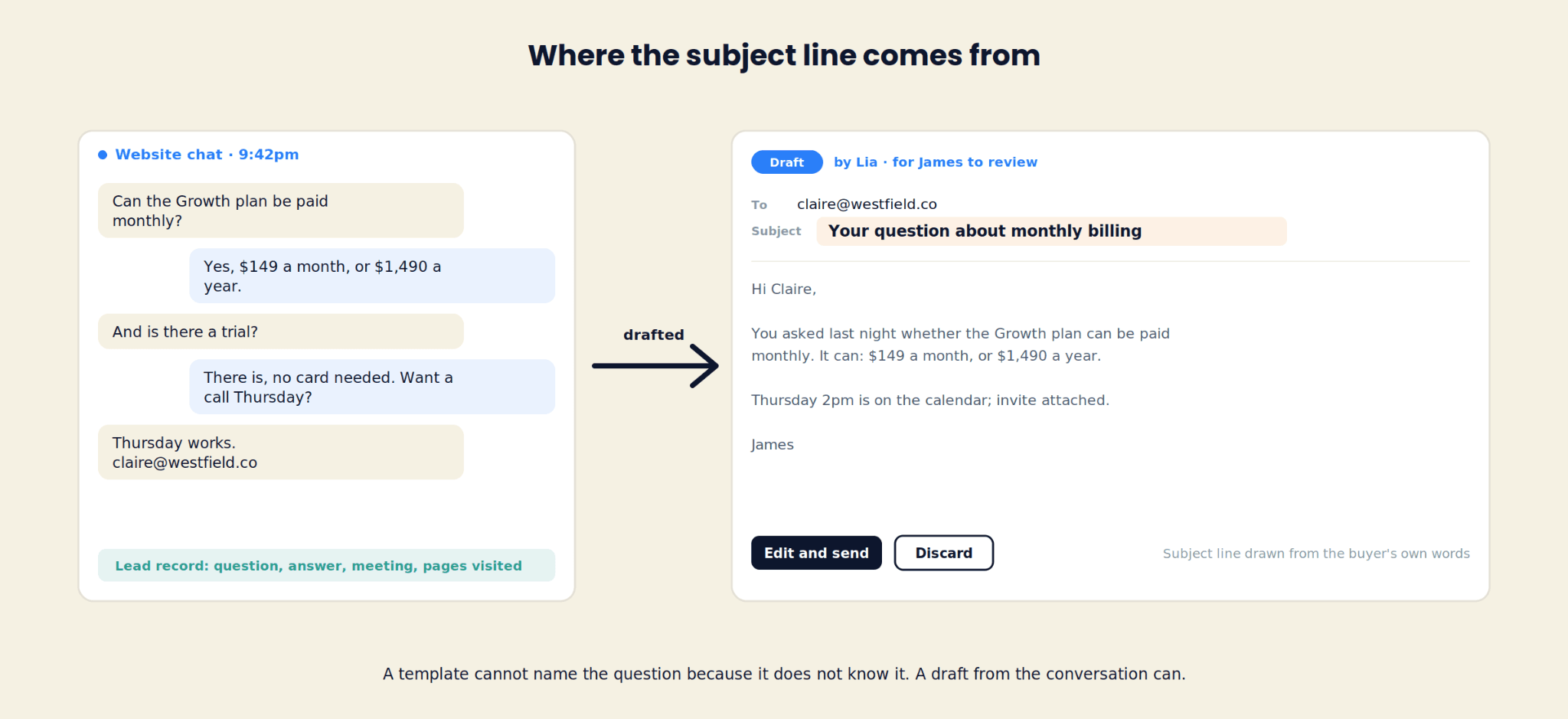
ConnectLoop's Proactive Outreach drafts the follow-up email, subject line included, from what the buyer said to Lia on website chat or WhatsApp and from the pages they visited. The rep reviews the draft, edits the subject line if they want, and sends or dismisses it. Nothing goes out without a person choosing to send it: the subject line is written by the AI and sent by the rep.
This is why the subject lines in the inbound sections above are possible at all. A template cannot say "Your question about monthly billing" because a template does not know the question. The draft can, because the conversation is on the lead record. The same record gives the rep the buyer's visit history, the reason they reached out, their intent score and the meeting Lia booked.
What the draft uses:
- The conversation: the question asked, the answer given, the objection raised, the competitor named.
- The visit history: pages viewed, return visits, and whether the pricing page was opened, from Visitor Intelligence.
- The outcome: meeting booked, trial started, or conversation left open.
- The trigger: a return visit, an unanswered question, or a set period of silence after the chat. These are behavioural triggers from the site and the conversation, not a send time picked from a time-zone table.
- The record: the draft, the send and the reply are written back through the CRM integration, so revenue attribution for a follow-up is visible on the deal.
What stays with the rep: the decision to send, the wording, the timing, and anything the draft got wrong. Outbound prospecting stays a human job; the drafts are for people who have already spoken to you.
ConnectLoop's own open and reply rates by subject line type are not published here; they are on the roadmap for this page once there is enough volume across categories to report them fairly.
What are the dos and don'ts?
Do use the buyer's words, keep it under 50 characters, match the first line, and write the subject line you would want as a thread name for three months. Don't use spam trigger words, fake "Re:" prefixes, questions you do not want answered, or urgency the buyer did not create.
| Do | Don't |
|---|---|
| Name the question they asked | Write "Following up" or "Checking in" |
| Put the specific word in the first 30 characters | Start with "Hi [Name], I wanted to…" |
| Use the day and time for confirmations | Write "Confirming our meeting" |
| Ask one real question | Ask a rhetorical one |
| Stop when you say you are stopping | Send a breakup email and then three more |
| Match brand voice to the chat the buyer had | Switch from a friendly chat to a formal email |
| Write as the trusted advisor who answered their question | Write as a vendor chasing a close |
| Name the [Pain point] in their words | Name it in yours |
| Write for the phone | Rely on the desktop preview |
| Test two lines on a real segment | A/B test on 20 emails and call it data |
How do you A/B test subject lines with a small list?
With fewer than 200 emails a month, A/B testing subject lines produces noise, not evidence. Instead, test by category: run one subject line style for a month on all follow-ups after a chat, then a different style the next month, and compare reply rates, not open rates. Reply is the number that pays.
Three things to log for each email so the comparison means something: the stage it was sent at, the days since the last conversation, and whether the buyer replied within seven days. Open rate and read rate are affected by mail clients pre-loading images and tell you less every year; reply rate is unambiguous, and conversion to a meeting is the number that matters.
For a team sending 1,000 or more a month, split by category and test two lines per category for two weeks. Tools that offer predictive scoring of AI-generated subject lines are calibrated on marketing lists, not on follow-ups to people who spoke to you, so treat their scores as a guess.
Keep the winner as the default for that stage and test the next pair. The inbound sales metrics guide has the conversation-to-meeting rate this feeds into.
Key takeaways
- The best sales email subject line names something the buyer said: their question, their date, their competitor. Generic curiosity lines get one open.
- Organise subject lines by sales stage, not by psychological trick; a rep is always writing at a specific moment.
- The first line of the email is the second half of the subject line. Write them as a pair and read them on a phone.
- Inbound follow-ups after a chat, a call, a demo or a quote are the emails most teams send and the ones no list covers; 45 of the 120 examples here are for those moments.
- Under 50 characters, specific word in the first 30, no spam trigger words, no fake "Re:".
- The second and third follow-ups need something new each time; do not jump straight to the breakup email.
- On WhatsApp and SMS the first eight to ten words are the subject line.
- Subject lines move opens; the body and the timing decide replies. Measure reply rate by stage, not open rate overall.
- ConnectLoop's Proactive Outreach drafts the subject line from the conversation on the lead record; the rep reviews, edits and sends.

About the author
ConnectLoop Staff
Written by the ConnectLoop team. ConnectLoop is an AI sales agent for inbound revenue teams, based in Cambridge, Massachusetts.
About ConnectLoop →Frequently asked questions
There is no single best subject line, because the best one names something specific to the buyer. For an inbound team the highest-performing pattern is the buyer's own question as the subject line, with the answer as the first line: "Your question about monthly billing" followed by "It can be paid monthly."
Only if it is a reply or a forward. A fake "Re:" gets one open and loses trust for the rest of the deal. Replying in the real thread after a booked call is the honest version and works better, because the thread already has the buyer's own words in it.
Under 50, with the specific word in the first 30. Phones cut subject lines at roughly 35–40 characters. The shortest useful line in this article is 12 characters; the longest is 48.
Using the buyer's first name alone has been done so often that it no longer signals attention. Using something they said does: their question, their deadline, their competitor. Personalisation is about content, not merge fields.
"Following up", "Checking in", "Quick question" with no question, anything with free, urgent or guarantee, fake "Re:", and any line that promises something the email does not deliver. Also avoid curiosity lines on follow-ups; the buyer already knows who you are.
Within the hour if the chat ended with an open question, and the same day otherwise. The subject line "Your question about monthly billing" works at 9am the next morning; it works less well a week later. Speed matters more than wording; see the speed to lead guide.
Yes, and the useful version writes them from the conversation rather than from a template. ConnectLoop's Proactive Outreach drafts the subject line and the email from what the buyer said to Lia; a person reviews and sends. AI-generated subject lines from a generic prompt produce the same curiosity lines everyone else sends.
Different job. Marketing subject lines go to a list; sales subject lines go to a person who has spoken to you. Re-targeting and re-engagement campaigns sit in between and follow marketing rules. The examples in this article are for the second kind, and they belong in the follow-up section of a sales playbook rather than a campaign tool. Event and newsletter subject lines follow marketing rules: clear topic, date, and what the reader gets.
Yes, at the margin. Spam trigger words, all capitals and excessive punctuation raise the spam score. But deliverability is decided mostly by domain reputation, sending volume and whether people reply. A boring subject line on a warmed-up domain lands; a clever one on a cold domain does not.
Proactive Outreach drafts the subject line from the conversation on the lead record
The rep reviews, edits and sends. The useful version of AI subject lines writes them from what the buyer said to Lia rather than from a template, because a generic prompt produces the same curiosity lines everyone else sends.