
Sales Process
Discovery Call Questions: 40 Questions for B2B Sales Calls, by Stage and Framework
Good discovery call questions help a seller understand the buyer's problem, why it matters now, who decides and what success looks like, before any pitch. This guide gives 40 questions grouped by call stage and mapped to BANT, SPIN and MEDDICC. It also covers how ConnectLoop handles inbound discovery when the buyer has already shared context.

Published
Table of contents
- What should a discovery call achieve?
- What types of discovery questions are there?
- Which discovery call questions should you ask?
- How do discovery questions map to BANT, SPIN and MEDDICC?
- How is inbound discovery different from outbound discovery?
- How do you use what the buyer told you before the call?
- How do you run a discovery call, step by step?
- What does a simple discovery call script look like?
- What discovery call mistakes should you avoid?
- How do you know if a discovery call went well?
- How can reps practise discovery questions?
- How does ConnectLoop help with discovery before and during the call?
- Key takeaways
- Frequently asked questions
What should a discovery call achieve?
A discovery call should leave both sides with a clear answer to one question: is there a real problem worth solving together, and is now the time? The rep learns the pain, impact, decision process and timeline. The buyer learns whether the seller understands them. ConnectLoop treats discovery as diagnosis, not a pitch.
Sales discovery is the point in the B2B buying journey where a lead becomes a real opportunity, or doesn't. A strong discovery call produces four things:
- A clear problem statement, in the buyer's own words.
- A reason to act now, such as a compelling event, a deadline or a rising cost.
- A map of the buying group, including who signs and who can block.
- An agreed next step, with a date, not "let's stay in touch".
Buyers come to the call better informed than ever. According to Gartner's May 2026 survey of 645 B2B buyers, 67% prefer a rep-free buying experience, yet 69% turn to sales reps to validate what AI tools told them.
That changes the job. A rep who only shares information adds little. A rep who asks sharp questions and helps the buyer think clearly becomes a trusted advisor.
What types of discovery questions are there?
Discovery questions fall into a few types: open-ended questions to explore, closed-ended questions to confirm facts, probing questions to go deeper, and targeted questions for priorities, process, stakeholders and fit. Good calls mix them on purpose. ConnectLoop recommends mostly open questions early, then more closed questions as the call moves toward next steps.
| Question type | What it does | Example | Use it when |
|---|---|---|---|
| Open-ended | Lets the buyer explain in their own words | "Walk me through how leads reach your team today." | Early in the call, to explore |
| Closed-ended | Confirms a fact quickly | "Is this budget already approved?" | Confirming details, wrapping up |
| Probing | Goes one layer deeper on an answer | "You said replies are slow. Slow how, and for which leads?" | After any vague or emotional answer |
| Priority-alignment | Checks where this sits against other goals | "Where does this rank against your other projects this quarter?" | Testing urgency |
| Process-clarifying | Uncovers how decisions and buying work | "What happens between a yes from you and a signed contract?" | Mapping the purchase approval process |
| Stakeholder-mapping | Finds everyone who influences the decision | "Who else will feel the impact of this change?" | Building a multithreaded deal |
| Fit-check | Tests whether you're the right solution | "What would make this a bad fit for you?" | Before proposing a demo |
Priority-alignment questions, process-clarifying questions, stakeholder-mapping questions and fit-check questions are the narrower tools. Clarifying questions and follow-up questions sit inside all of these. They're the "tell me more" moments that turn a surface answer into a useful one.
Which discovery call questions should you ask?
Ask questions in the order the conversation naturally flows: open, understand the situation, find the pain, test urgency, map the decision, confirm budget and timeline, then agree next steps. You won't need all 40 on one call. ConnectLoop suggests choosing 8 to 12 that fit the buyer and skipping anything they've already answered.
Adjust the wording for different buyer personas. A finance leader cares about cost and risk; an operations lead cares about workflow and ramp time.
What questions open the call and build rapport?
Opening questions set the tone. They show you've done your homework, give the buyer control of the agenda and make it easy to talk. Keep them short and tied to something real, such as the buyer's role, a recent company change or what they asked before the call. ConnectLoop's advice: confirm, don't re-ask.
1. "Before we start, what would make this call worth your time?"
2. "I saw you asked about [topic] earlier. Is that still the main thing on your mind?"
3. "How does this project fit into your role right now?"
4. "What's changed in your team or business in the last few months?"
5. "Is there anything you'd like to cover first?"
What questions uncover the buyer's situation and current solution?
Situation questions show how things work today: the process, the tools, the people and the workarounds. They give you context for everything that follows. Keep them brief, because buyers tire of questions you could have researched. ConnectLoop recommends asking only what isn't on their website or in your CRM.
6. "Walk me through what happens today, from the moment a [lead, order, ticket] arrives."
7. "Which tools does your team rely on for this, and which ones do people avoid?"
8. "Who owns this process today?"
9. "What have you tried so far to improve it?"
10. "What worked about those attempts, and what didn't?"
11. "If I shadowed your team for a day, what would surprise me?"
What questions reveal pain points and hidden problems?
Pain questions turn a general complaint into a specific, measurable problem. The first answer is rarely the real one, so follow each with a probing question. Look for frustrations, obstacles, workarounds and missed results. ConnectLoop recommends asking "why" at least twice before moving on.
12. "What's the most frustrating part of how this works today?"
13. "Where are the bottlenecks, and where do things fall through the cracks?"
14. "Can you give me a recent example of when that happened?"
15. "What did that example cost you, in time, money or customers?"
16. "Who feels this problem most, and how do they work around it?"
17. "Of all these challenges, which would you fix first if you could fix only one?"
18. "Is there anything about this that's hard to raise internally?"
The last question often surfaces hidden pain points: politics, past failures or a fear of failure that the buyer won't volunteer.
What questions test urgency and the cost of inaction?
Urgency questions, the "why now" questions, show whether the buyer will act or only explore. A real compelling event, such as a launch, a deadline or a target at risk, separates active deals from window shopping. Ask about the cost of doing nothing, not just the benefit of change. ConnectLoop treats "no urgency" as useful, honest information.
19. "What prompted you to look at this now, rather than six months ago?"
20. "What happens if nothing changes over the next year?"
21. "Is there a date or event this needs to be solved by?"
22. "Where does this rank against your other priorities this quarter?"
23. "What would solving this make possible that isn't possible today?"
Question 20 frames the opportunity cost. The status quo always has a price, and buyers often haven't put a number on it.
What questions map stakeholders and the decision-making process?
Stakeholder questions find everyone who influences the decision: the economic decision-maker, the champion, approvers and possible blockers. Most B2B deals involve a buying committee, so one contact is rarely enough. Map the purchase approval process early. ConnectLoop recommends asking how the last similar decision was made.
24. "Besides you, who will be involved in this decision?"
25. "Who signs off on the budget for something like this?"
26. "How did your team make the last purchase of a similar size?"
27. "What does the approval process look like once you decide?"
28. "Do procurement, finance, legal or IT need to review anything?"
29. "Who might have concerns about this change, and why?"
30. "Who would be the best person internally to champion this?"
These questions support sales multithreading: building relationships with several people so the deal doesn't depend on one contact.
What questions clarify budget, timeline and evaluation criteria?
These questions confirm whether a deal can actually happen: money, timing and how the buyer will choose. Ask them once you've shown you understand the problem, not in the first five minutes. Buyers share budget more readily when the value is clear. ConnectLoop advises framing budget as investment against the cost of the problem.
31. "Have you set aside budget for this, or would it need a business case?"
32. "How will you measure ROI on this investment?"
33. "When do you need a solution in place, and what's driving that date?"
34. "What are your must-haves, and what are nice-to-haves?"
35. "Where are you in your evaluation process, and are you looking at other options, including building it yourselves?"
36. "What would implementation and ramp time need to look like for this to work?"
Clear must-haves also protect both sides from scope creep once the project starts.
What questions confirm fit and next steps?
Closing questions check that you're a real fit, because not every buyer is your ideal client, and turn the call into a concrete next step. Summarise, invite corrections and agree who does what by when. A call without a dated next step is the easiest deal to lose. ConnectLoop recommends booking the next meeting before you hang up.
37. "Based on what we've discussed, what does success look like six months from now?"
38. "What risks or blockers could stop this from moving forward?"
39. "Did I miss anything important?"
40. "Who else should join the next call, and when works for them?"
How do discovery questions map to BANT, SPIN and MEDDICC?
Each framework covers similar ground in different ways. BANT checks budget, authority, need and timing. SPIN Selling moves from situation to problem, implication and need-payoff. MEDDICC goes deeper on metrics, the economic buyer, decision criteria, process, pain, champion and competition. ConnectLoop supports all three, so teams can map questions to the framework they use.
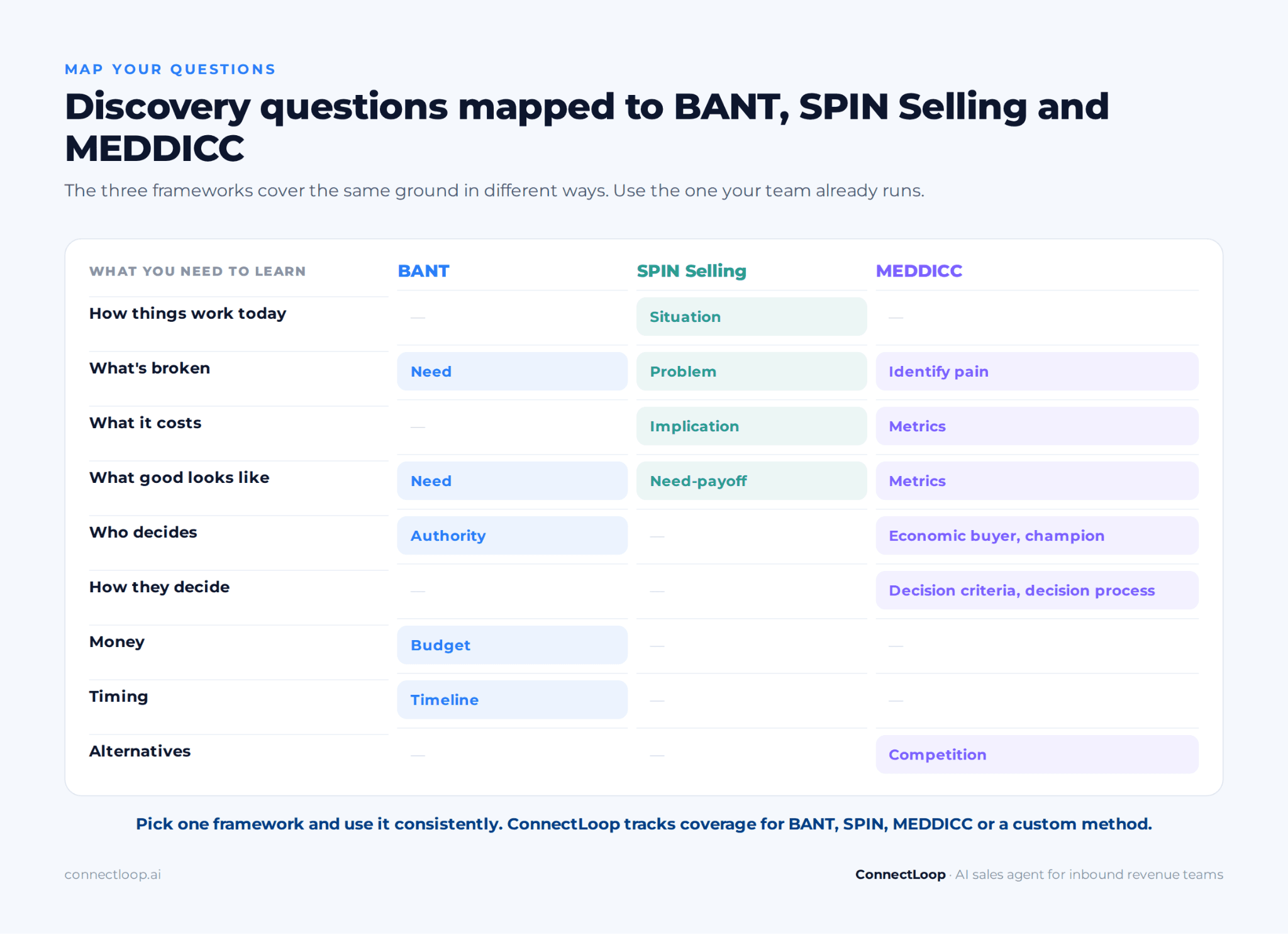
| What you need to learn | BANT | SPIN Selling | MEDDICC | Questions from this list |
|---|---|---|---|---|
| How things work today | Situation | 6, 7, 8, 9 | ||
| What's broken | Need | Problem | Identify pain | 12, 13, 14, 17 |
| What it costs | Implication | Metrics | 15, 20, 32 | |
| What good looks like | Need | Need-payoff | Metrics | 23, 37 |
| Who decides | Authority | Economic buyer, champion | 24, 25, 30 | |
| How they decide | Decision criteria, decision process, paper process | 26, 27, 28, 34 | ||
| Money | Budget | 31, 32 | ||
| Timing | Timeline | 21, 33 | ||
| Alternatives | Competition | 35 |
Pick one framework and use it consistently. BANT vs MEDDIC explains how to choose, and the MEDDPICC sales methodology adds the paper process for complex deals.
How is inbound discovery different from outbound discovery?
In outbound discovery, the rep starts cold and must earn interest before asking anything. In inbound discovery, the buyer reached out first, so the rep should confirm what they already shared and go deeper. Repeating basic questions to an inbound buyer wastes their time. ConnectLoop is built for inbound, where the buyer has often answered several questions already.
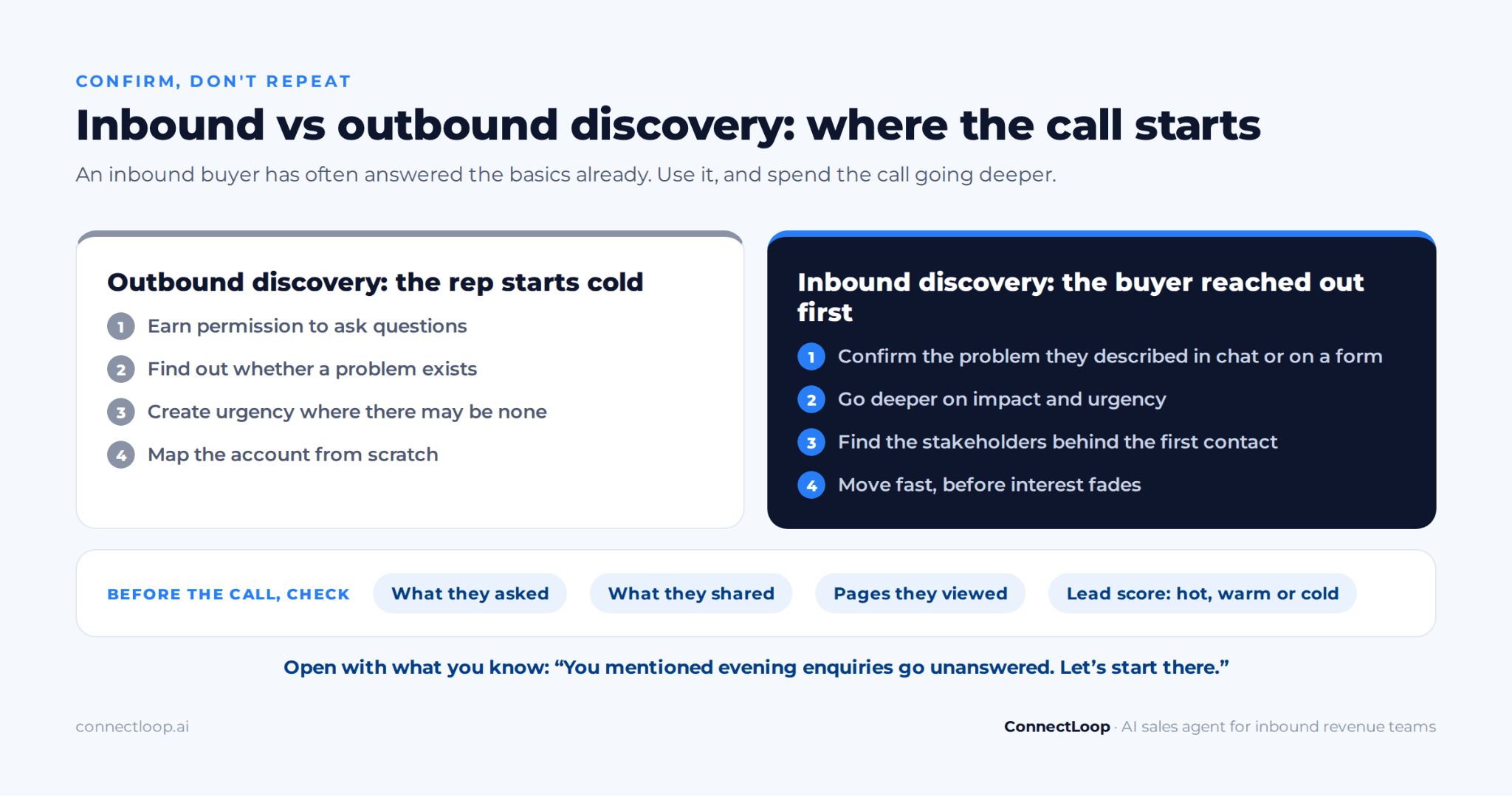
Outbound discovery usually needs to:
- Earn permission to ask questions at all.
- Uncover whether a problem exists.
- Create urgency where there may be none.
- Map the account from scratch.
Inbound discovery usually needs to:
- Confirm the problem the buyer described in chat or on a form.
- Go deeper on impact and urgency.
- Find the other stakeholders behind the first contact.
- Move quickly, because interest fades fast.
The same applies to service businesses. When a client books a consult call through an inquiry form, their answers are the starting point, not a script to repeat. Buyers in early vendor exploration rarely want to explain themselves twice.
Speed matters most in inbound. A buyer who asked a question on Tuesday and gets a call on Friday has often moved on. Speed to lead covers why the first response shapes the whole deal, and SDR vs BDR explains who usually runs each kind of discovery.
How do you use what the buyer told you before the call?
Read everything the buyer has already shared, including chat transcripts, form answers, pages visited and emails, then open the call by confirming it. Skip questions they've answered and spend the time on impact, urgency and stakeholders. ConnectLoop passes the full conversation and qualification answers to the rep, so the first call starts from context.
Before the call, check:
- What they asked. Their first questions show what they care about most.
- What they shared. Company size, use case, timeline or budget range from a lead capture form or chat.
- What they looked at. Pricing, integrations or security pages signal intent. Identifying anonymous website visitors explains how teams see this.
- How warm they are. A lead score of hot, warm or cold tells you how hard to push. Lead scoring covers how scores are built.
Then open with a line like: "You mentioned your team misses evening enquiries. Let's start there. How often does that happen?"
This approach respects the buyer's time. It also shows them you listened, which builds trust faster than any rapport question.
How do you run a discovery call, step by step?
Prepare, set an agenda, ask open questions first, listen more than you talk, go deeper on pain and impact, map the decision, then summarise and agree a dated next step. Most first discovery calls run 30 to 45 minutes. ConnectLoop recommends ending with five minutes to spare for next steps.
- Research the buyer. Review their website, LinkedIn, CRM record and any earlier conversations. Note two or three things to confirm.
- Set the agenda. State the call length, what you'd like to learn and what they'll get from it. Ask if they want to add anything.
- Start with open-ended questions. Let the buyer describe the situation in their words before you narrow down.
- Practise active listening. Take notes on exact phrases. Repeating back what you heard ("So the real issue is…") shows understanding and invites correction.
- Use silence. After an important question, wait. Buyers often add the most useful detail in the pause.
- Go deeper on pain and impact. Ask for examples, costs and who's affected. Hold the pitch until the problem is clear.
- Map the decision. Find the stakeholders, approvers, process and timeline.
- Summarise and agree next steps. Confirm the problem, the impact and what happens next, with names and a date. Send a short follow-up the same day. For complex deals, turn next steps into a mutual action plan, shared in a digital sales room or a simple document.
For the written follow-up, how to write a follow-up email after no response helps when a buyer goes quiet after a good call. Discovery is one step in a longer journey, covered in the stages of the sales process.
What does a simple discovery call script look like?
A good discovery call script is a flexible outline, not a word-for-word read. It covers an opener, an agenda, a few questions for each stage and a clear close. Reps should adapt it to what the buyer says. ConnectLoop suggests keeping the script to one page so it supports the conversation instead of replacing it.
Opener (2 minutes) "Thanks for making time. You mentioned [topic] when you reached out. I'd like to understand that better, share how others handle it, and agree whether a deeper look makes sense. Does that work?"
Situation (5 minutes) "Walk me through how this works today. Who's involved, and which tools do you use?"
Pain and impact (10 to 15 minutes) "What's the hardest part? Can you give me a recent example? What did that cost you?"
Urgency (5 minutes) "Why look at this now? What happens if nothing changes this year?"
Decision (5 to 10 minutes) "Who else needs to be involved? How did you decide on the last similar purchase?"
Close (5 minutes) "Here's what I heard: [summary]. Did I miss anything? I suggest a demo with [names] next week. Does Thursday work?"
Teams that want a shared version of this script often keep it in their sales playbook, alongside objection responses and qualification rules.
What discovery call mistakes should you avoid?
The most common mistakes are pitching too early, asking too many questions in a row, accepting vague answers, ignoring buying signals and ending without a dated next step. Each one makes the buyer feel interviewed instead of understood. In ConnectLoop's view, a deal that stalls later often started with discovery that stayed on the surface.
Watch for these:
- Pitching too early. Jumping to features before the problem is clear makes your value proposition sound generic.
- Interrogating. Firing questions without reacting to the answers feels like a form. Respond, then ask.
- Accepting the first answer. "It's slow" isn't a problem statement. Ask how slow, for whom and at what cost.
- Missing buying signals. Questions about implementation, pricing or contract terms are intent signals. Follow them.
- Ignoring red flags. No budget, no urgency and no access to the decision-maker together usually mean no deal yet.
- Only one contact. A deal that depends on one person stalls when that person is busy or leaves.
- No next step. "I'll send some info" is how ghosting starts.
How do you handle short or guarded answers?
Guarded answers usually mean the buyer doesn't yet trust you, doesn't see why you're asking, or isn't the right person. Explain why the question matters, share what similar teams experience, and ask permission before sensitive topics. ConnectLoop recommends offering a specific example the buyer can react to.
Try these approaches:
- Explain the why. "I ask because the answer changes what I'd recommend."
- Offer a reference point. "Some teams lose leads after hours. Others lose them in handoffs. Which sounds closer?"
- Ask permission. "Can I ask a direct question about budget?"
- Check the fit. "Is someone else closer to this day to day? Should we bring them in?"
Objections that come up in discovery are useful. They show you what to address before the proposal, not after. How to negotiate in sales covers the later stages.
How do you know if a discovery call went well?
A discovery call went well if you can state the buyer's problem, its cost, why it matters now, who decides and what happens next, and the buyer agrees with your summary. A dated next step with the right people invited is the clearest signal. ConnectLoop's Sales Assistance helps by tracking framework coverage and action items.
After each call, check whether you can answer these:
- What problem does the buyer want to solve, in their words?
- What does it cost them today?
- What's the compelling event or deadline?
- Who are the economic decision-maker, the champion and the approvers?
- What are their evaluation criteria?
- What's the next step, and is it on the calendar?
If you can answer five of six, the call did its job. If you can answer two, book a second discovery call before any demo.
Good discovery shows up in better outcomes and a healthier sales pipeline. Across a team, track the share of calls with a confirmed next step, framework coverage and how many discovery calls turn into qualified opportunities. Inbound sales metrics lists the numbers worth watching. Conversation intelligence tools can show patterns across calls, such as which questions reps skip most often.
How can reps practise discovery questions?
Reps improve discovery through practice, feedback on real calls and coaching. Role play builds confidence with hard questions before a live buyer hears them. Reviewing recorded or live calls shows which questions get skipped. ConnectLoop's Sales Assistance adds live prompts during real calls, so learning happens in the conversation itself.
Three practical methods:
- Role play. Pair reps up, or use AI role play, to rehearse budget, stakeholder and urgency questions. Sales role play has scenarios to start with.
- Call review. Listen back to one call a week and note where the rep pitched too early or missed a follow-up question.
- Live coaching. Prompts during the call remind reps of the next question while there's still time to ask it. What AI sales coaching actually does explains how this works.
For a wider view of the options, see AI sales training tools and the benefits of sales coaching.
How does ConnectLoop help with discovery before and during the call?
ConnectLoop handles the first layer of discovery before the call and supports the rep during it. Lia answers inbound buyers on website chat, WhatsApp and email, asks qualifying questions, scores intent and books the meeting. ConnectLoop's Sales Assistance then shows live discovery prompts during Google Meet and Zoom calls, with no bot joining.
ConnectLoop is an AI sales agent platform for inbound revenue teams. It replaces a live chat tool, a scheduling app, a follow-up sequencer and a support inbox with one system, and tracks every conversation from first message to booked call.
Before the call:
- Lia answers and qualifies. Lia answers questions from your approved content and asks discovery questions naturally in the conversation, using frameworks such as SPIN and MEDDIC.
- Every lead is scored. Conversations are rated hot, warm or cold based on what the buyer said and did.
- Visitor Intelligence adds context. It identifies the companies behind anonymous website traffic, so reps know who's interested.
- The meeting is booked in the thread. Lia books against real calendar availability, with no separate scheduler. See AI appointment booking.
- The rep gets the full picture. The AI-to-human handoff passes the transcript and qualification answers to the rep.
During and after the call:
- Live discovery prompts. Sales Assistance shows cues for discovery questions, objections, pricing and next steps as the conversation happens.
- Framework tracking. It tracks which steps of your framework the rep has covered, including SPIN, MEDDICC, BANT or a custom methodology.
- A customer dossier. Open promises, stakeholders and framework coverage carry from one call to the next.
- Follow-up drafts. After the call, a follow-up draft is ready for the rep to review and send from their own inbox.
- Proactive Outreach. When a known lead returns to your site, ConnectLoop drafts a personalised follow-up email that a person reviews, edits and sends or dismisses.
ConnectLoop is CASA Verified by Google, a Verified Meta Business and an official Meta Business Partner. To understand the category, read what an AI sales agent is.
What does ConnectLoop leave to your reps?
The parts of discovery that need judgment and relationships stay with your reps. Lia asks the first qualifying questions and Sales Assistance prompts the next one, but the rep decides what to probe, reads the buyer's tone and builds trust. ConnectLoop is built for inbound conversations, so outbound prospecting stays a human job.
Your content also sets the ceiling. Lia answers from the material you provide, and the Knowledge Gaps report shows questions it couldn't answer. Those gaps are often the same questions buyers bring to discovery calls, which makes the report a useful prep list.
Key takeaways
- Discovery is diagnosis. The goal is a clear problem, a reason to act now, a map of decision-makers and a dated next step.
- Mix question types on purpose. Open-ended questions to explore, probing questions to go deeper, closed questions to confirm.
- Choose 8 to 12 questions per call. Pick from the 40 by stage, and skip what the buyer has already answered.
- Map questions to one framework. BANT, SPIN Selling and MEDDICC cover the same ground differently.
- Inbound discovery should confirm, not repeat. Use chat transcripts, form answers and intent signals to start deeper.
- Avoid the classic mistakes. Don't pitch too early, accept vague answers or end without a booked next step.
- ConnectLoop supports discovery on both sides of the call. Lia qualifies before the meeting and Sales Assistance prompts reps during it, while judgment stays with people.

About the author
ConnectLoop Staff
Written by the ConnectLoop team. ConnectLoop is an AI sales agent for inbound revenue teams, based in Cambridge, Massachusetts.
About ConnectLoop →Frequently asked questions
Most reps cover 8 to 12 core questions on a 30 to 45 minute call, plus follow-up questions based on the answers. Quality matters more than quantity. Choose questions for the stage and the buyer, and skip anything the buyer has already answered in chat, on a form or by email.
A first discovery call usually runs 30 to 45 minutes. Simple, low-cost purchases may need only 20 minutes, while complex B2B deals often need two or three conversations with different stakeholders. Set the length in the agenda at the start, and leave five minutes at the end to agree next steps.
There's no single best question, but "What happens if nothing changes?" is one of the most useful. It reveals the cost of inaction, tests urgency and shows whether the buyer will actually act. Follow it with "Can you give me an example?" to turn the answer into something specific.
Qualification checks whether a lead meets your criteria, such as budget, authority, need and timing. Discovery goes deeper into the buyer's problem, its impact and how they decide. Qualification can often happen before the call, in chat or on a form. Discovery usually needs a real conversation.
Ask about budget after you understand the problem and its cost, usually in the second half of the call. Buyers share budget more openly when they can see the value. Frame it as investment: "Have you set aside budget for this, or would it need a business case?"
Review the buyer's website, LinkedIn profile, CRM record and any earlier conversations, such as chat transcripts or form answers. Note what you already know, what you need to confirm and what you still need to learn. Prepare 8 to 12 questions and a short agenda, and decide the next step you'll propose.
Send a short follow-up the same day. Summarise the problem, the impact and the agreed next step, and include any resources you promised. Update the CRM with what you learned, especially stakeholders, timeline and evaluation criteria. If the buyer goes quiet, follow up with something useful, not just a reminder.
Yes. AI agents can ask basic qualifying questions before the call, score leads and pass full context to the rep. During the call, live coaching tools can prompt the next discovery question or flag a missed framework step. ConnectLoop does both, while the rep keeps control of the conversation and the judgment calls.
Start the call already knowing the answers
ConnectLoop handles the first layer of discovery before the call and supports the rep during it. Lia answers inbound buyers on website chat, WhatsApp and email, asks qualifying questions, scores intent and books the meeting. Sales Assistance then shows live discovery prompts during Google Meet and Zoom calls, with no bot joining.