
Sales Communication
Customer Engagement Strategy: How to Build One for B2B Buyers
A customer engagement strategy is a plan for how your business talks with buyers and customers across every channel, from the first website visit to renewal. For B2B teams, it starts before the sale, with fast, useful answers. This guide covers channels, steps, metrics and how ConnectLoop helps teams engage inbound buyers.

Published
Table of contents
- What does a customer engagement strategy actually cover?
- Why does B2B customer engagement start before the sale?
- Which customer engagement strategies work best for B2B teams?
- Which channels should a B2B engagement strategy use?
- How do you build a customer engagement strategy, step by step?
- How do you engage website visitors who haven't said who they are?
- How are AI agents changing customer engagement?
- Which customer engagement metrics should you track?
- How do you keep customers engaged after the sale?
- What do good customer engagement examples look like in B2B?
- How does ConnectLoop support a customer engagement strategy?
- Key takeaways
- Frequently asked questions
What does a customer engagement strategy actually cover?
It covers who you engage, where, when and how: the audience, the channels, the moments that matter in the customer journey, the content you share and the way you measure results. A good strategy turns scattered interactions into one relationship. ConnectLoop sees the strongest strategies treat the first reply as seriously as the renewal call.
A complete strategy answers five questions:
- Who are we engaging? Your audience, from first-time visitors to long-term customers.
- Where do they want to talk? The channels they already use, such as chat, email or WhatsApp.
- When do they need us? The touchpoints along the lifecycle where a fast, helpful response changes the outcome.
- What do we say? Useful content and answers, personalized to their situation, with relevance to where they are in the journey.
- How do we know it's working? The goals and metrics that tie engagement to revenue.
Without a written strategy, engagement happens by accident. Marketing sends emails, sales sends follow-ups, support answers tickets, and nobody sees the whole picture.
What's the difference between customer engagement and customer experience?
Customer experience (CX) is how customers feel about every interaction with your company. Customer engagement is the active, two-way part of that experience: the conversations, replies and moments where the customer participates. Good engagement improves CX, but CX also includes things like product quality and billing. ConnectLoop focuses on the conversation side of the experience.
Put simply, customer engagement vs customer experience is a question of scope:
- Customer experience is the whole journey, including the parts the customer never talks to you about.
- Customer engagement is the interactive part, where you and the customer exchange something: a question, an answer, feedback or a decision.
A customer-centric company manages both, but engagement is where most B2B deals are won or lost.
Why does B2B customer engagement start before the sale?
Because B2B buyers do most of their research before they speak to anyone, and the first question they ask often decides whether they keep going. A slow or unhelpful first reply ends the relationship before it starts. ConnectLoop treats every inbound question as the opening of a long customer relationship, not a lead to process.
Pre-sale engagement looks different from engagement with existing customers:
- Buyers are anonymous at first. They browse pricing and product pages without filling in a form.
- They decide as a group. A buying committee, or buying group, of several stakeholders each brings different questions.
- They expect instant answers. A question asked at 9pm should not wait until 10am.
- They compare options quietly. One poor interaction is enough to drop you from the shortlist.
This is where most engagement strategies have a blind spot. They invest in onboarding and loyalty, while the first conversation waits in a shared inbox. Speed to lead explains why the first reply matters so much.
Engagement before the sale also shapes everything after it. A buyer who got clear, honest answers early is easier to onboard and more likely to stay.
Which customer engagement strategies work best for B2B teams?
The strategies that work best for B2B teams are fast first responses, engaging buyers on their preferred channel, personalization based on real behaviour, useful educational content, one shared customer record, and a clear handoff between teams. Loyalty and advocacy matter too, but they depend on getting the early conversations right. ConnectLoop focuses on the conversations that start the relationship.
Ten strategies worth building into your plan:
- Answer in minutes, at any hour. Speed is the simplest form of respect for a buyer's time.
- Meet buyers where they already talk. Website chat, email and WhatsApp, not just a contact form.
- Personalize with real data. Use first-party data and behavioral data, such as pages viewed or questions asked, to tailor every reply.
- Publish educational content. Guides, comparisons and a public knowledge base let buyers help themselves through self-service.
- Run webinars and events. They give buyers a low-pressure way to engage with your team and each other.
- Build a community. A customer community or user group turns customers into a source of answers and user-generated content.
- Practice listening and act on feedback. Collect customer feedback after key moments and show customers what changed because of it.
- Build sales and marketing alignment. Agree on one definition of a qualified lead and one view of every conversation.
- Hand off cleanly. Pass full context from marketing to sales, and from sales to customer success.
- Reward advocacy. Make it easy for happy customers to leave reviews, give testimonials and refer peers through word of mouth.
Gamification and points-based loyalty programs are common in consumer engagement but rarely fit B2B. Recognition, early access and community roles usually work better for business customers.
Which channels should a B2B engagement strategy use?
Use the channels your buyers already use, and connect them so a conversation can move between them without starting over. For most B2B teams that means website chat, email and WhatsApp first, supported by social media, webinars and, for product-led companies, in-app messaging. ConnectLoop works across website chat, WhatsApp and email with one shared conversation history.
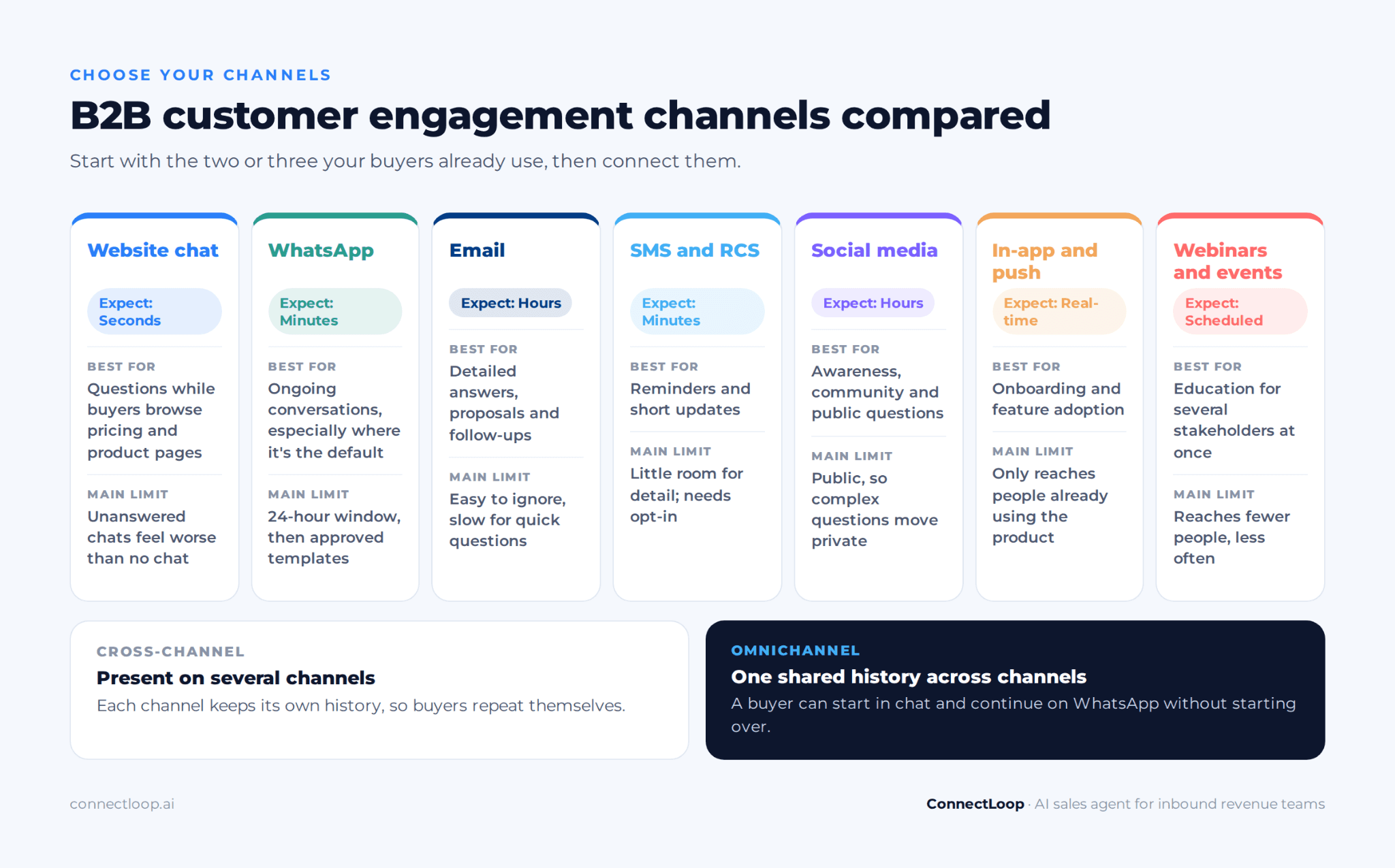
| Channel | Best for | Speed buyers expect | Main limitation |
|---|---|---|---|
| Website chat | Questions while buyers browse pricing and product pages | Seconds | Unanswered chats feel worse than no chat |
| Ongoing conversations, especially in markets where it's the default | Minutes | Business messaging rules limit when you can start a conversation | |
| Detailed answers, proposals and follow-ups | Hours | Easy to ignore and slow for quick questions | |
| SMS and RCS | Reminders and short updates | Minutes | Little room for detail; needs clear opt-in |
| Social media | Awareness, community and public questions | Hours | Public, so complex questions move to a private channel |
| In-app messaging and push notifications | Onboarding and feature adoption in a web or mobile app | Real-time | Only reaches people already using your product |
| Webinars and events | Education and relationships with several stakeholders at once | Scheduled | Reaches fewer people, less often |
Omnichannel and cross-channel are often used as if they mean the same thing. Cross-channel means you're present on several channels. Omnichannel means those channels share one history, so a buyer who starts in chat and continues on WhatsApp doesn't have to repeat themselves.
Conversational messaging covers how to turn these conversations into booked meetings.
How do you engage buyers on WhatsApp?
Engage buyers on WhatsApp with fast, personal replies inside the conversation they started. Business messages are freely allowed for 24 hours after the customer's last message; after that, businesses must use pre-approved message templates. Plan your follow-up around that window. ConnectLoop is an official Meta Business Partner and supports WhatsApp conversations natively.
Practical WhatsApp rules for B2B teams:
- Reply quickly. Buyers expect WhatsApp to feel like a real conversation.
- Keep messages short. Send a link to detail rather than long blocks of text.
- Use templates for re-engagement. Outside the 24-hour window, a template message reopens the conversation.
- Get opt-in. Only message people who have chosen to talk to you there.
How a WhatsApp AI agent works explains the setup in more detail.
How do you build a customer engagement strategy, step by step?
Start with goals and your audience, map the customer journey and its touchpoints, build a single customer view, choose channels, set response standards, personalize, add automation with a clear human handoff, and measure what changes. Each step builds on the one before. ConnectLoop recommends starting with the moment buyers first reach out.
- Set goals. Decide what engagement should achieve for your go-to-market plan: more meetings booked, faster responses, higher retention or more referrals. Tie each goal to revenue.
- Define your audience. List the roles in a typical buying group and what each one cares about.
- Build a customer journey map. Map every touchpoint from first visit to renewal, and mark the moments where buyers most often stall or leave.
- Create a single customer view. Connect your CRM and, if you have one, a customer data platform (CDP), so every team sees the same history.
- Choose your channels. Start with two or three that match where your buyers already are, and connect them.
- Set response standards. Agree how fast each channel should be answered, including evenings and weekends.
- Personalize and automate. Use intent and behaviour to tailor messages. Let AI agents handle routine questions, with a clear handoff to a person for the rest.
- Measure and improve. Review the metrics monthly, act on customer feedback and adjust the plan.
Keep the first version simple. A strategy that covers three channels well beats one that covers seven badly.
The stages of the sales process can help you decide which touchpoints matter most at each step of your customer journey map.
How do you engage website visitors who haven't said who they are?
Most website visitors never fill in a form, so engaging them means recognizing intent from behaviour: which company they're from, which pages they view and how often they return. Then you offer help at the right moment, without being pushy. ConnectLoop's Visitor Intelligence identifies the companies behind anonymous website traffic.
Signals that show real intent:
- Pricing page visits, especially repeat visits.
- Integration and security pages, which suggest a buyer is checking fit.
- Several people from the same company, a sign the buying group is involved.
- Return visits within a few days.
When these signals appear, a helpful chat prompt or a well-timed follow-up can start a conversation. Identifying anonymous website visitors explains how this works.
Combine intent with a simple score so your team knows who to prioritize. Lead scoring covers how to build one.
How are AI agents changing customer engagement?
AI agents can answer questions, qualify buyers and book meetings in real time, on every channel, at any hour. Unlike older chatbots, they understand open questions instead of following a fixed script. Used well, they make personalization at scale possible. ConnectLoop's AI sales agent, Lia, engages inbound buyers this way, with a person ready to take over.
It helps to separate three kinds of automation:
- Chatbots follow scripted decision trees. They're fine for simple, predictable questions.
- Virtual agents handle support tasks such as password resets or order status.
- AI agents understand the question, answer from your content, ask follow-up questions and take actions such as booking a meeting.
Chatbot vs AI agent explains the differences in detail, and what an AI sales agent is covers the sales use case.
Other AI tools shape engagement behind the scenes:
- Predictive analytics spots customers likely to buy, expand or leave.
- Next best action recommends the most useful message or offer for each customer.
- Journey orchestration coordinates messages across channels so customers aren't overwhelmed.
- Conversation intelligence analyzes sales calls to show what buyers care about.
- Digital sales rooms give a buying group one shared space for proposals and documents.
When should an AI agent hand a conversation to a person?
An AI agent should hand over when a conversation needs judgment, negotiation or empathy: pricing exceptions, complex technical questions, complaints, or a buyer who asks for a person. It should also hand over when the answer isn't in its approved content. ConnectLoop passes the full transcript, so the buyer never has to repeat themselves.
A clean handoff protects the relationship. The buyer feels heard, and the person taking over starts from context rather than from zero. The AI-to-human handoff covers how to set the rules.
How do you keep AI answers accurate and trustworthy?
Keep AI answers accurate by limiting them to content you've approved, tracking every question the AI couldn't answer, and telling buyers clearly when they're talking to AI. Accuracy builds trust; a confident wrong answer damages it. ConnectLoop's Knowledge Gaps report shows exactly which questions your content doesn't cover yet.
Three habits keep AI engagement honest:
- Approved content only. The AI answers from your website, documents and knowledge base.
- Track the gaps. Unanswered questions become a to-do list for your content team.
- Disclose AI clearly. Buyers should know when they're talking to an AI agent.
How to build a knowledge base for AI agents explains how to prepare that content.
Which customer engagement metrics should you track?
Track metrics that connect engagement to revenue, not just activity. Marketing teams watch engagement scoring and conversion rate, service teams watch CSAT and CES, and leadership watches retention and customer lifetime value. Sales teams need their own measures, such as first response time and meetings booked. ConnectLoop tracks every conversation from first message to booked call.
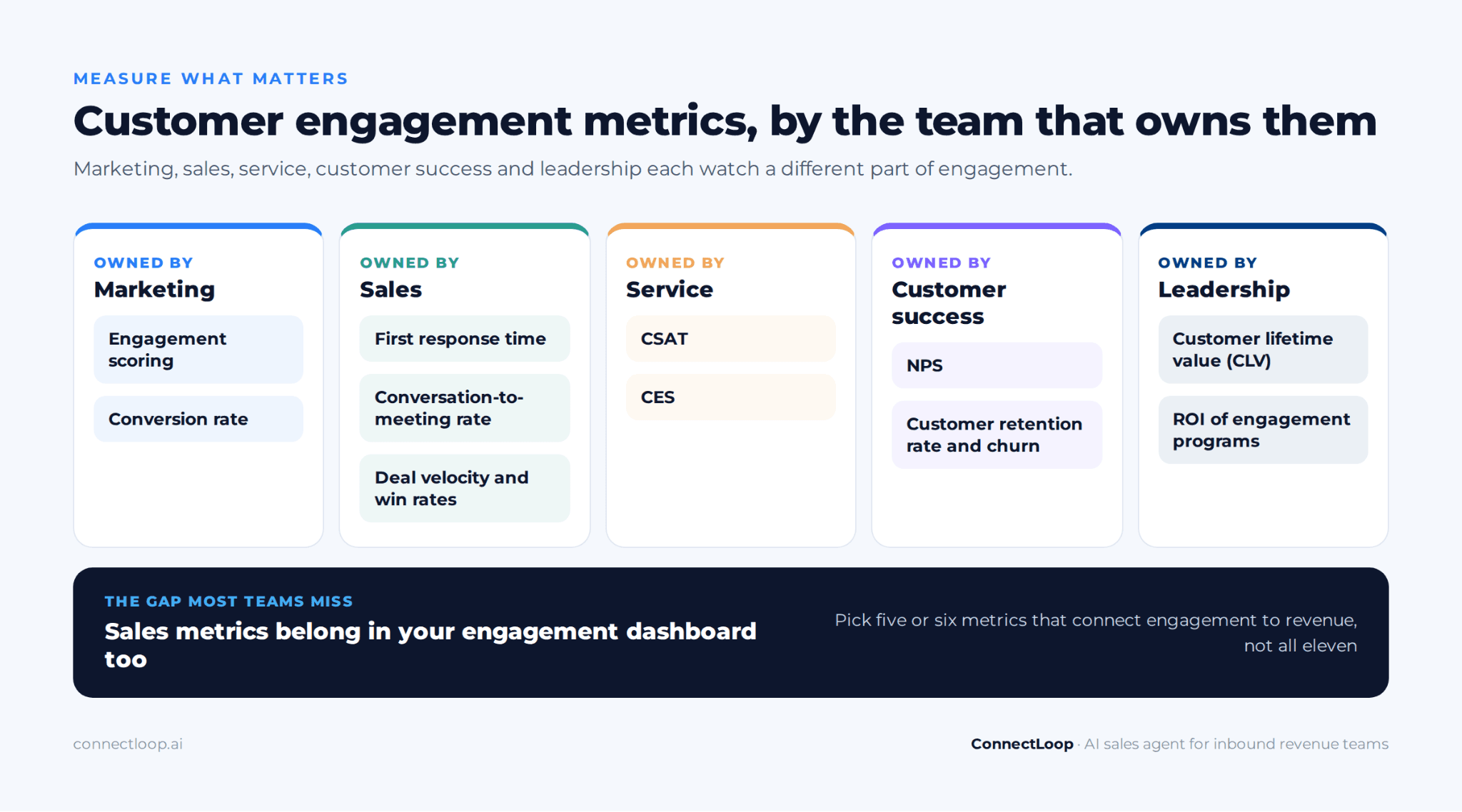
| Metric | What it shows | Owned by |
|---|---|---|
| Engagement scoring | How actively a contact interacts with your content and channels | Marketing |
| Conversion rate | Share of visitors or leads who take the next step | Marketing and sales |
| First response time | How fast buyers get a useful answer | Sales |
| Conversation-to-meeting rate | Share of conversations that end in a booked meeting | Sales |
| Deal velocity and win rates | How quickly deals move and how many close | Sales |
| CSAT (customer satisfaction score) | Satisfaction with a specific interaction | Service |
| CES (customer effort score) | How easy it was to get help | Service |
| NPS (net promoter score) | How likely customers are to recommend you | Customer success |
| Customer retention rate and churn | How many customers stay, and how many leave | Customer success |
| Customer lifetime value (CLV) | Total revenue a customer brings over time | Leadership |
| ROI of engagement programs | Revenue gained compared with cost | Leadership |
Pick five or six metrics, not all eleven. The right set depends on whether your biggest gap is early in the journey, such as slow replies, or late, such as churn.
Inbound sales metrics goes deeper on the numbers that matter before a deal reaches the CRM.
How do you keep customers engaged after the sale?
Keep customers engaged with a strong onboarding experience, a clean customer success handoff, regular value check-ins, helpful post-purchase support and a reason to stay involved, such as a community or customer events. Watch early warning signs and act before customers leave. ConnectLoop's focus is the inbound conversation, which sets up everything that follows.
The post-sale lifecycle in B2B usually looks like this:
- Welcome message and onboarding. Confirm what was agreed, introduce the team and set the first milestones.
- Customer success handoff. Pass the full history from sales, so customers don't repeat their goals.
- Ongoing value. Share educational content, product updates and invitations to webinars.
- Churn prevention. Use usage and support data to spot accounts at risk, then reach out early.
- Re-engagement and win-back. Reconnect with quiet accounts, and with former customers, when something relevant changes.
- Advocacy. Invite happy customers to share reviews, testimonials and referrals.
Loyalty programs exist in B2B too, but they work best as recognition and access, such as early product previews or advisory boards, rather than points.
What do good customer engagement examples look like in B2B?
Good B2B engagement examples share three traits: they're fast, they're personal to the buyer's situation, and they make the next step easy. The scenarios below show how a strategy works in practice. ConnectLoop sees the biggest difference come from the moments teams usually miss, such as evenings and repeat visits.
These are illustrative scenarios, not specific customers:
A pricing question at night. A buyer asks in website chat how pricing works for a team of 20. An AI agent answers from the pricing page, asks two qualifying questions and books a call for the next morning. The rep starts the call already knowing the team size and timeline.
A returning visitor. A known lead comes back to the pricing page a week after a demo. A personalized follow-up email is drafted for the rep, who edits it and sends it the same day. How to write a follow-up email after no response has templates.
A webinar attendee. After a webinar, attendees get a short recap with the recording and one relevant resource. Those who asked questions during the session get a personal reply.
A buying group. Three people from the same company ask different questions over WhatsApp and email. Because the conversations share one history, the rep sees the full picture and runs a better discovery call.
How does ConnectLoop support a customer engagement strategy?
ConnectLoop handles the first and most time-sensitive part of B2B customer engagement: inbound conversations. Lia answers buyers on website chat, WhatsApp and email 24/7, qualifies them, scores intent and books meetings, then hands complex conversations to your team with full context. ConnectLoop tracks every conversation from first message to booked call.
ConnectLoop is an AI sales agent platform for inbound revenue teams. It replaces a live chat tool, a scheduling app, a follow-up sequencer and a support inbox with one system, and an agent can be trained on your website in about 60 seconds.
How it fits into an engagement strategy:
- Instant answers on every channel. Lia replies in seconds, from content you approve.
- Qualification in the conversation. Lia asks questions naturally instead of sending buyers to a long form. See inbound lead qualification.
- Intent scoring. Each conversation is scored hot, warm or cold.
- Booking in the thread. Meetings are booked against real calendar availability. See AI appointment booking.
- Visitor Intelligence. Identifies the companies behind anonymous traffic.
- Proactive Outreach. When a known lead returns, ConnectLoop drafts a personalized follow-up that a person reviews, edits and sends or dismisses.
- Knowledge Gaps. Shows which questions your content doesn't answer yet.
- CRM sync. Conversations, contacts and meetings flow into your CRM.
ConnectLoop is CASA Verified by Google, a Verified Meta Business and an official Meta Business Partner.
What stays with your team?
The relationship-building parts of engagement stay with people. ConnectLoop handles fast answers, qualification and booking, while your team owns strategy, complex conversations, negotiation, onboarding and long-term customer success. ConnectLoop is built for inbound conversations, so outbound prospecting stays a human job.
Your content sets the ceiling. Lia answers only from the material you provide, so a thin pricing page or missing integration list will show up quickly in the Knowledge Gaps report. Fixing those gaps improves engagement on every channel at once.
For handling the tougher questions that come up once buyers are engaged, see objection handling.
Key takeaways
- B2B customer engagement starts before the sale. The first reply to an inbound question often decides whether a buyer stays.
- Engagement is the active part of customer experience. CX covers the whole journey; engagement covers the conversations.
- Meet buyers on their channels, and connect them. Website chat, email and WhatsApp with one shared history beat scattered tools.
- Build the strategy in eight steps. Goals, audience, journey map, single customer view, channels, response standards, personalization and measurement.
- Use AI agents with a clear handoff. AI handles speed and scale; people handle judgment and relationships.
- Measure what connects to revenue. Add sales metrics like first response time and meetings booked to the usual NPS and CSAT.
- ConnectLoop covers the inbound conversation. Lia answers, qualifies and books, while your team owns the relationship.

About the author
ConnectLoop Staff
Written by the ConnectLoop team. ConnectLoop is an AI sales agent for inbound revenue teams, based in Cambridge, Massachusetts.
About ConnectLoop →Frequently asked questions
The main goal is to build a lasting relationship that leads to revenue, through useful, timely interactions at every stage of the customer journey. In B2B, that starts with fast answers before the sale and continues through onboarding, support and renewal. Each interaction should make the next one easier.
B2B engagement involves longer sales cycles, larger buying groups and higher-value decisions. Buyers research quietly, ask detailed questions and need several stakeholders to agree. B2C engagement leans more on loyalty programs, push notifications and promotions. B2B relies on expertise, speed and trust built through conversations.
Website chat, email and WhatsApp are usually the core channels, because they're where buyers ask questions. Social media, webinars and events support awareness and education. For product-led companies, in-app messaging matters after signup. The best results come from connecting channels so conversations share one history.
Choose metrics that tie engagement to revenue. Common ones include engagement scoring, conversion rate, CSAT, NPS, customer retention rate and customer lifetime value. Sales teams should add first response time, conversation-to-meeting rate and meetings booked. Review five or six of these monthly rather than tracking everything.
Yes. AI agents can answer questions instantly on every channel, qualify buyers and book meetings at any hour, which makes personalization at scale possible. They work best with approved content, a clear handoff to a person for complex conversations, and honest disclosure that the buyer is talking to AI.
A customer journey map is a visual outline of every touchpoint a customer has with your business, from first visit to renewal. It shows where buyers get stuck, which channels they use at each stage and where engagement needs to improve. It's the foundation of a good engagement strategy.
Look for a relevant reason to reconnect, such as a return visit to your website, a new feature that solves their problem, or a change in their business. Send a short, personal message, not a generic newsletter. On WhatsApp, use an approved template if more than 24 hours have passed.
ConnectLoop's AI sales agent, Lia, engages inbound buyers on website chat, WhatsApp and email 24/7. Lia answers from your approved content, qualifies buyers, scores intent and books meetings, then hands complex conversations to your team with the full transcript. Every conversation is tracked from first message to booked call.
Engage buyers from the first question
ConnectLoop handles the first and most time-sensitive part of B2B customer engagement: inbound conversations. Lia answers buyers on website chat, WhatsApp and email 24/7, qualifies them, scores intent and books meetings, then hands complex conversations to your team with full context.