
AI Sales Agents
AI Chatbot vs AI Agent: What Is the Difference for B2B Websites?
An AI chatbot answers questions in a conversation. An AI agent goes further: it understands the visitor's goal, asks follow-up questions and completes tasks such as qualifying a lead or booking a meeting. ConnectLoop is an AI sales agent that answers, qualifies and books across website chat, WhatsApp and email.

Published
Most B2B websites already have a chat bubble in the corner. For years it worked like a searchable FAQ: a visitor typed a question and got an answer or a link. That was useful, and for many simple questions it still is.
Buyers now expect more from that same window. They want to describe their situation, get a specific answer and take the next step without filling in a form and waiting for a call. This guide explains how chatbots and AI agents differ, where each fits and how to choose for your website in 2026.
Table of contents
- What is an AI chatbot?
- What is an AI agent?
- What is the difference between an AI chatbot and an AI agent?
- Why are B2B companies moving to AI agents in 2026?
- When is a chatbot the right choice?
- When does an AI agent make more sense?
- What can an AI sales agent do on a B2B website?
- How do you move from a chatbot to an AI agent?
- How do you measure an AI agent?
- How does ConnectLoop work as an AI sales agent?
- Key takeaways
- Frequently asked questions
What is an AI chatbot?
An AI chatbot is software that answers questions in a chat window, using scripted flows, a knowledge base or a language model. Its job is to respond: a visitor asks, and the chatbot replies. ConnectLoop describes this as the "answer" layer of a website conversation.
Chatbots come in three common forms:
- Rule-based chatbots follow a decision tree with buttons and preset replies.
- FAQ chatbots match a question to the closest article or answer in a knowledge base.
- Generative chatbots use a language model to write answers from your content.
All three are strong at one thing: giving visitors quick answers to common questions at any hour.
What is an AI agent?
An AI agent is software that works toward a goal. It understands what the visitor wants, plans the steps, uses connected tools such as a calendar or CRM and completes the task in the same conversation. ConnectLoop's AI agent is built around sales goals: a qualified lead and a booked meeting.
Four abilities define an AI agent:
- It reasons about intent. It works out what the visitor is trying to achieve, even when the question is vague.
- It asks questions back. It gathers the details it needs, such as company size or timeline.
- It takes actions. It checks availability, books meetings, captures contact details and updates records.
- It remembers context. It carries the conversation forward across messages and return visits.
For a deeper look at the sales version, see ConnectLoop's guide to what an AI sales agent is.
What is the difference between an AI chatbot and an AI agent?
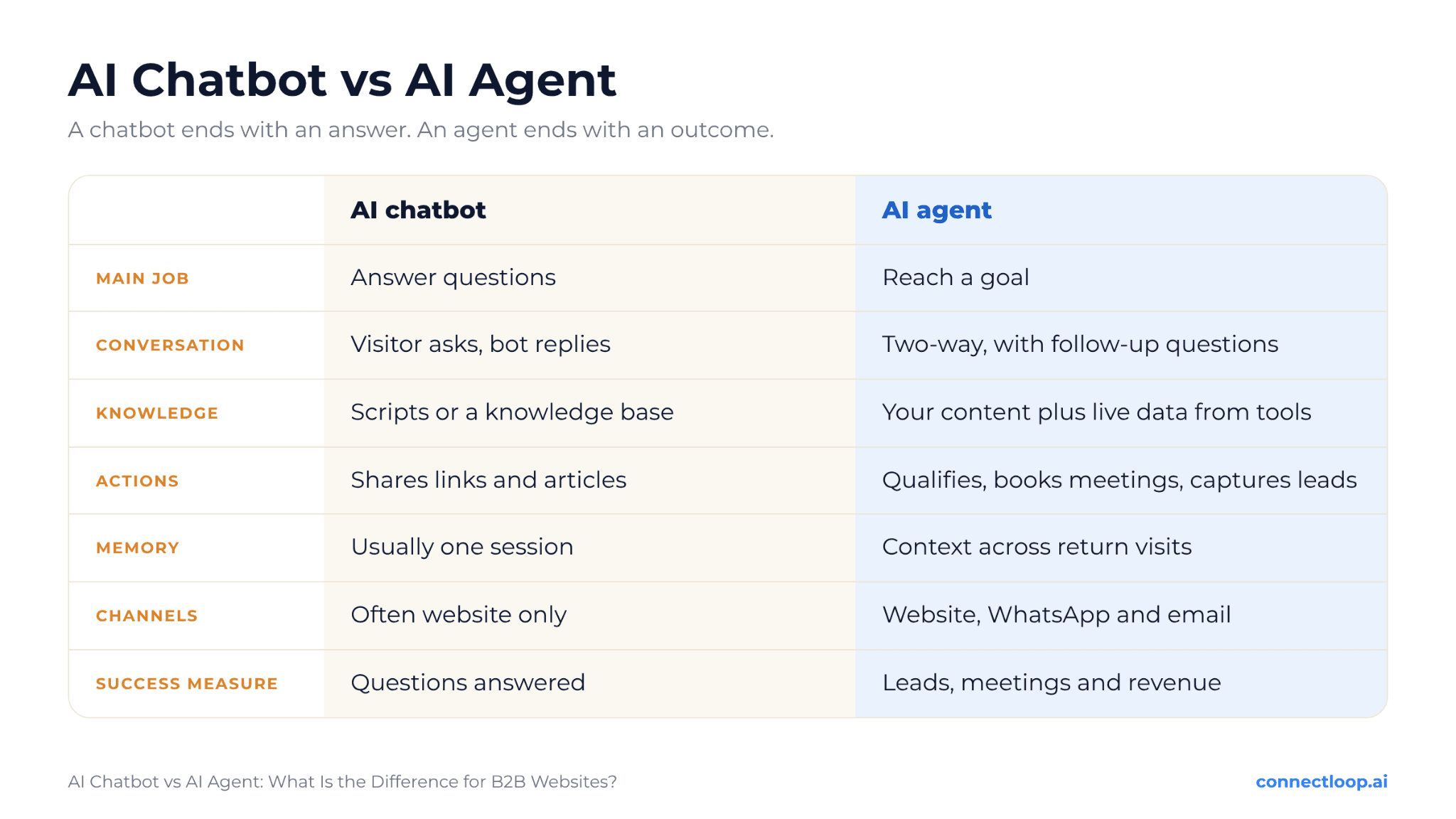
The difference is that a chatbot responds and an agent acts. A chatbot's conversation ends with an answer. An agent's conversation ends with an outcome, such as a qualified lead, a booked meeting or a handoff to your team. ConnectLoop sums it up as answers versus results.
| AI chatbot | AI agent | |
|---|---|---|
| Main job | Answer questions | Reach a goal |
| Conversation style | Visitor asks, bot replies | Two-way, with follow-up questions |
| Knowledge | Scripts or knowledge base | Your content plus live data from connected tools |
| Actions | Shares links and articles | Qualifies, books meetings, captures leads, updates the CRM |
| Memory | Usually one session | Context across messages and return visits |
| Channels | Often website only | Website, WhatsApp and email |
| Success measure | Questions answered | Leads, meetings and revenue |
| Human handoff | Passes the visitor to a form or inbox | Hands over with a full summary of the conversation |
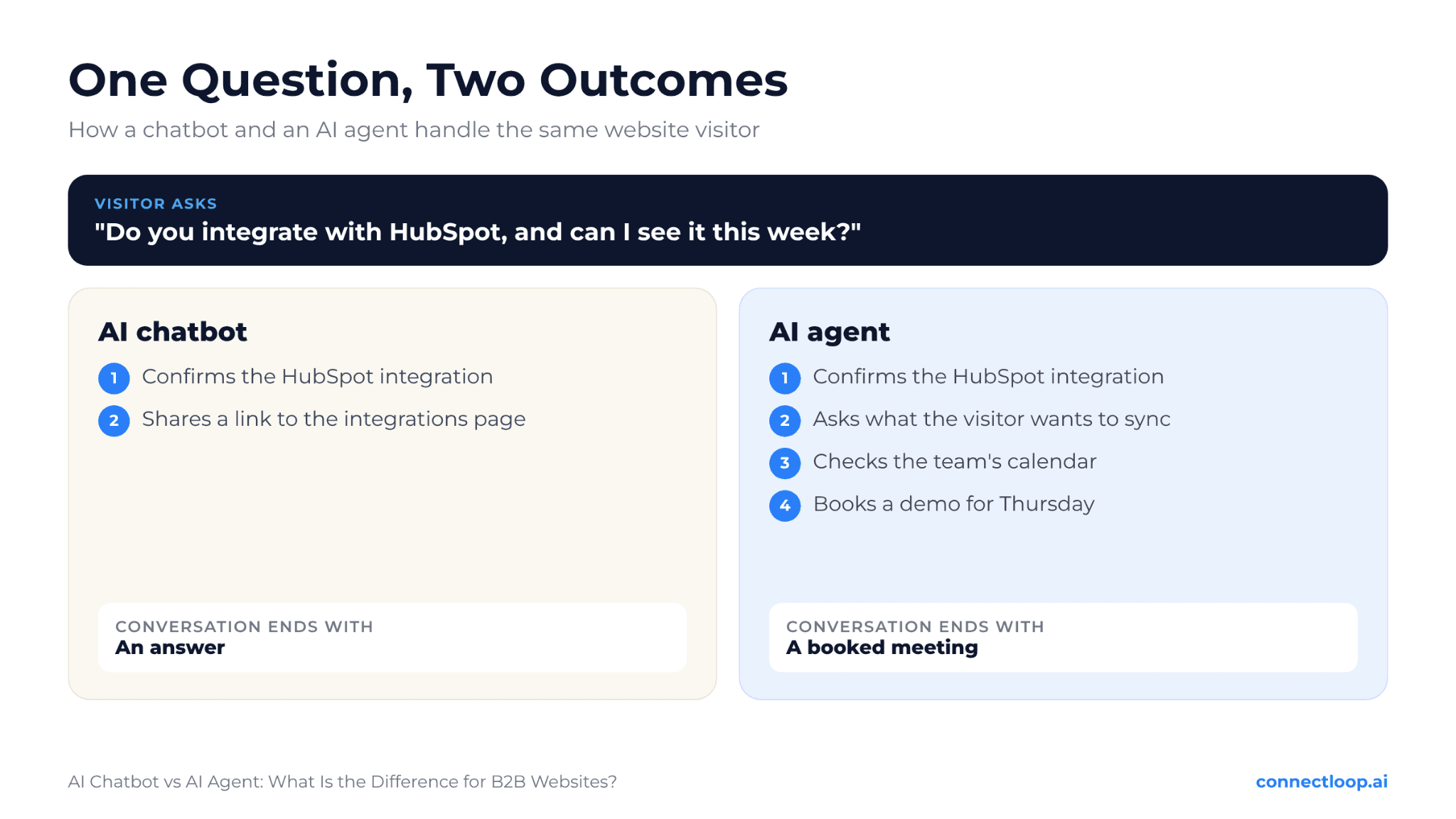
A simple example shows the gap. A visitor writes, "Do you integrate with HubSpot, and can I see it this week?"
- A chatbot confirms the integration and shares a link to the integrations page.
- An AI agent confirms the integration, asks what the visitor wants to sync, checks the calendar and books a demo for Thursday.
Why are B2B companies moving to AI agents in 2026?
B2B companies are moving to AI agents because buyers want to complete tasks in the conversation, and companies want pipeline from their website traffic. An agent serves both. ConnectLoop sees this shift most clearly in lead qualification and meeting booking.
The 2026 research shows where companies are heading:
- Conversations come first. Adobe's 2026 AI and Digital Trends research found that 62% of companies plan to use agentic AI for conversational customer engagement over the next 18 months.
- Sales is a leading use case. In Adobe's 2026 AI and Digital Trends report, 58% of organizations expect to have agents that support sales with product recommendations or lead qualification.
- Agents will represent the brand. In the same report, 54% expect an agent to act as a brand-facing digital representative.
Speed is the other driver. The first company to give a helpful answer often wins the conversation, as ConnectLoop's guide to speed to lead explains. An agent responds in seconds and moves the visitor forward in the same reply.
When is a chatbot the right choice?
A chatbot is the right choice when visitors mostly need quick answers to simple, repeated questions. If the goal is to guide people to the right page or article, a chatbot does that well and is quick to set up. ConnectLoop recommends matching the tool to the job you need done.
A chatbot fits well when:
- Questions are simple and repeat often, such as opening hours, shipping or password resets.
- The main goal is to guide visitors to existing help content.
- Conversations rarely need a next step such as a meeting.
- Your team is comfortable following up on leads from a form.
Many companies start here, then add agent abilities as their goals grow from answering questions to creating pipeline.
When does an AI agent make more sense?
An AI agent makes more sense when the conversation should end in a business outcome. If your website's job is to generate leads, book meetings or sell, the agent's ability to qualify and act is what delivers the result. ConnectLoop is designed for exactly these inbound sales goals.
An AI agent is the stronger fit when:
- Your site gets traffic outside business hours and you want those visitors served right away.
- Your sales process starts with qualification questions.
- You want meetings booked directly in the conversation.
- Buyers reach you on several channels, such as website chat, WhatsApp and email.
- You want every conversation summarized and scored for your team.
Qualification is often the turning point. ConnectLoop's guide to inbound lead qualification shows how an agent handles it in a natural conversation.
What can an AI sales agent do on a B2B website?
An AI sales agent can run the first sales conversation from start to finish: answer product questions, qualify the visitor, capture contact details, book a meeting and hand a summary to your team. ConnectLoop's agent does this across website chat, WhatsApp and email.
Here is what that looks like in practice:
- Answers with your content. The agent learns from your website and replies in your company's voice.
- Qualifies in conversation. It asks your qualifying questions naturally, one at a time.
- Captures the lead. It collects name, email and company as part of the chat.
- Books the meeting. It checks your calendar and confirms a time. ConnectLoop's guide to AI appointment booking covers the details.
- Recommends products. For online stores, it suggests products and helps shoppers add them to the cart, as described in ConnectLoop's guide to the AI agent for ecommerce.
- Hands off to your team. A team member can step in at any time, with the full conversation summary in front of them.
- Follows up. When a known lead returns, the agent drafts a follow-up email for your team to review and send.
How do you move from a chatbot to an AI agent?
Move from a chatbot to an AI agent in five steps: define the goal, prepare your content, connect your tools, set the handoff rules and launch on one page first. ConnectLoop recommends starting with the page that already gets your highest-intent traffic.
- Define one goal. Choose the outcome you want, such as booked demos or qualified leads.
- Prepare your content. Make sure your website clearly covers pricing, features, integrations and common questions. The agent's answers are built on it.
- Connect your tools. Link your calendar and CRM so the agent can book meetings and record leads.
- Set qualification and handoff rules. Decide which questions the agent asks and when a team member steps in.
- Launch, review and improve. Start on your pricing or demo page, read the conversations weekly and add content for any question the agent could not answer.
The better your content, the better the agent performs. Reviewing real conversations is also the fastest way to learn what buyers want, as ConnectLoop's guide to conversation intelligence explains.
How do you measure an AI agent?
Measure an AI agent by the outcomes it creates: leads captured, leads qualified, meetings booked and pipeline influenced. Conversation counts show how much activity there is, and outcome metrics show the value it produces. ConnectLoop recommends tracking both from the first week.
| Metric | What it tells you |
|---|---|
| Conversations started | How many visitors engage with the agent |
| Chat-to-lead rate | How many conversations turn into a captured lead |
| Qualified lead rate | How many leads match your criteria |
| Meetings booked | How many conversations end with a scheduled call |
| Response time | How quickly visitors get a first answer |
| Unanswered questions | Which topics to add to your content |
| Pipeline and revenue influenced | The business result of the agent's conversations |
Review these alongside the conversations themselves. A single transcript often explains a number better than a dashboard can.
How does ConnectLoop work as an AI sales agent?
ConnectLoop is an AI sales agent for inbound revenue teams. It trains on your website in about 60 seconds, then answers visitors, qualifies them and books meetings across website chat, WhatsApp and email. Every conversation is summarized and scored for your team.
What teams get with ConnectLoop:
- Fast setup. The agent learns from your website content and is ready to answer in about a minute.
- Qualification in your style. You choose the questions and how proactive the agent is, with Low, Medium and High settings.
- Meetings on your calendar. The agent books directly into Google Calendar, Outlook Calendar or Calendly.
- One agent on every channel. The same agent works on website chat, WhatsApp and email.
- Smooth team handoff. The agent keeps helping while a team member joins, then steps back when they take over.
- Lead summaries and scores. Each lead comes with a summary, a hot or cold score and a suggested next step.
- CRM integrations. Leads and conversations sync to the CRM your team already uses.
ConnectLoop is CASA Verified by Google and an official Meta Business Partner. You can start on the free plan and add the agent to your own website to see how it handles real visitors.
Key takeaways
- An AI chatbot answers questions. An AI agent works toward a goal and completes tasks.
- The clearest difference is the ending: a chatbot ends with an answer, an agent ends with an outcome.
- Chatbots suit simple, repeated questions. Agents suit lead generation, qualification and meeting booking.
- 62% of companies plan to use agentic AI for conversational customer engagement within 18 months, according to Adobe's 2026 research.
- Moving to an agent takes five steps: goal, content, tools, handoff rules and a focused launch.
- Measure an agent by leads, meetings and pipeline, alongside conversation volume.
- ConnectLoop is an AI sales agent that answers, qualifies and books across website chat, WhatsApp and email.

About the author
ConnectLoop Staff
Written by the ConnectLoop team. ConnectLoop is an AI sales agent for inbound revenue teams, based in Cambridge, Massachusetts.
About ConnectLoop →Frequently asked questions
An AI chatbot responds to questions with answers. An AI agent understands the visitor's goal, asks follow-up questions and completes tasks such as qualifying a lead, booking a meeting or updating a CRM, all within the conversation.
In its basic form it is a chatbot: you ask and it answers. When it is connected to tools and given a goal, such as searching, booking or completing a multi-step task, it behaves as an agent. The difference lies in goals and actions, not the underlying model.
An AI agent can handle the first conversation at any hour: answering questions, qualifying visitors and booking meetings. Your team then joins the conversations that benefit most from a person. Together they cover more visitors than live chat alone.
Yes. A modern AI agent works across channels, so the same agent can answer on your website, on WhatsApp and by email. ConnectLoop's guide to the WhatsApp AI agent explains how it works on that channel.
Setup can be quick. ConnectLoop's agent trains on your website content in about 60 seconds. After that, you connect your calendar and CRM and set your qualification questions before going live.
An AI agent's accuracy comes from the content it learns from. Clear, current website content on pricing, features and policies leads to precise answers. Reviewing conversations and adding content for new questions keeps accuracy high over time.
Pricing models vary. Some tools charge per seat, some per resolution and some by conversation volume. ConnectLoop offers a free plan and prices on conversations, so you can test the agent on your own site before choosing a paid plan.
If your website's job is to generate leads or sales, and visitors arrive outside business hours or leave without talking to anyone, an AI agent is a strong fit. If visitors only need quick answers to simple questions, a chatbot may be enough.
See which one your visitors actually need
Point Lia at your website and it trains on your content in about a minute, then answers real visitors on chat, WhatsApp and email, asks your qualifying questions and books the meeting in the same conversation. A week of transcripts tells you more about whether you need an answer layer or an outcome layer than any comparison table.