
Sales Enablement
Win-Loss Analysis: How Sales Teams Learn From Every Won and Lost Deal
Win-loss analysis is the practice of studying closed deals, both won and lost, to understand why buyers chose you, chose someone else or chose nothing at all. It combines CRM data, conversation records and buyer interviews. ConnectLoop helps teams capture the conversations behind every deal, so the real reasons are on record.

Published
Every closed deal carries a lesson. A won deal shows what buyers valued enough to sign. A lost deal shows where the story, the timing or the fit broke down. Most teams log a quick reason in the CRM, such as "price" or "timing," and move straight on to the next opportunity.
Win-loss analysis slows that moment down just enough to learn from it. Done well, it tells sales leaders what to coach, tells marketing what to say and tells product what to build next. This guide explains what to look at, where the data comes from and how to run a program that keeps paying off in 2026.
Table of contents
- What is win-loss analysis?
- Why does win-loss analysis matter in 2026?
- What should a win-loss analysis look at?
- Where does win-loss data come from?
- How do you run a win-loss analysis?
- What questions should you ask in a win-loss interview?
- How is AI changing win-loss analysis?
- How do you turn win-loss findings into sales coaching?
- What keeps a win-loss program running long term?
- How does ConnectLoop support win-loss analysis?
- Key takeaways
- Frequently asked questions
What is win-loss analysis?
Win-loss analysis is a structured review of closed opportunities that explains why each deal was won or lost. It looks past the CRM reason code to the buyer's real decision drivers. ConnectLoop sees it as the fastest way to turn closed deals into better qualification, messaging and coaching.
A good program studies three outcomes, not two:
- Won deals: what convinced the buyer to choose you.
- Lost deals: why the buyer chose another option.
- No-decision deals: why the buyer stayed with the status quo.
No-decision deals are easy to overlook, yet they often hold the clearest lessons about urgency and business impact.
Win-loss analysis also produces a simple number to track over time, the win rate:
Win rate = deals won ÷ (deals won + deals lost) × 100
The number shows how often you win. The analysis explains why.
Why does win-loss analysis matter in 2026?
Win-loss analysis matters in 2026 because the reasons sellers record and the reasons buyers give rarely match. Teams that rely on CRM codes alone end up fixing the wrong problems. ConnectLoop treats buyer-confirmed reasons as the only reliable starting point for change.
The 2026 research makes the gap clear:
- Sellers and buyers tell different stories. Corporate Visions' March 2026 analysis of more than 100,000 B2B purchase decisions found that a seller's account of a lost deal matches the buyer's account only 30% to 50% of the time.
- CRM loss codes miss the real reason. Perspective AI's 2026 Win/Loss Interview Report found that CRM stage-loss codes matched the buyer-confirmed loss driver 38% of the time, and seller debriefs 51% of the time.
- Insight is arriving faster. The same report found that the time from deal close to insight fell from 41 days in 2024 to 4 days in 2026 for teams using AI-moderated interviews.
- Coverage is growing. Those teams now review 71% of closed deals, up from 6% in 2024.
Put simply, the teams that ask buyers directly, and ask quickly, learn the real reasons while they can still act on them. The same principle drives the benefits of sales coaching: feedback works best when it is specific and timely.
What should a win-loss analysis look at?
A win-loss analysis should look at six areas: the buyer's need, the sales experience, product fit, price and value, the competing options and the decision process. Each area answers a different "why." ConnectLoop recommends scoring every closed deal against the same six areas so patterns appear quickly.
| Area | Question it answers | Team that acts on it |
|---|---|---|
| Buyer need | Was the problem urgent and clearly defined? | Sales, marketing |
| Sales experience | Did the rep understand the buyer and guide the process well? | Sales leaders |
| Product fit | Did the product meet the must-have requirements? | Product |
| Price and value | Did the buyer see enough value for the cost? | Sales, leadership |
| Competing options | What did the buyer compare you with, including doing nothing? | Marketing, product |
| Decision process | Who was involved, and what slowed or sped up the decision? | Sales, RevOps |
The buyer need and decision process areas connect directly to qualification. If losses cluster around unclear needs or a missing decision-maker, revisit how your team handles inbound lead qualification.
Where does win-loss data come from?
Win-loss data comes from four sources: CRM records, seller debriefs, conversation records and buyer interviews. Each one adds a different view, and the strongest programs combine all four. ConnectLoop focuses on conversation records, because they show what the buyer actually said during the deal.
| Source | What it shows | Best use |
|---|---|---|
| CRM records | Deal size, stage, cycle length, lead source, loss reason code | Spotting patterns across many deals |
| Seller debriefs | The rep's view of what happened | Context on deal strategy and relationships |
| Conversation records | Buyer questions, objections and commitments in their own words | Checking claims against what was really said |
| Buyer interviews | The buyer's honest reason for the decision | Confirming the real decision driver |
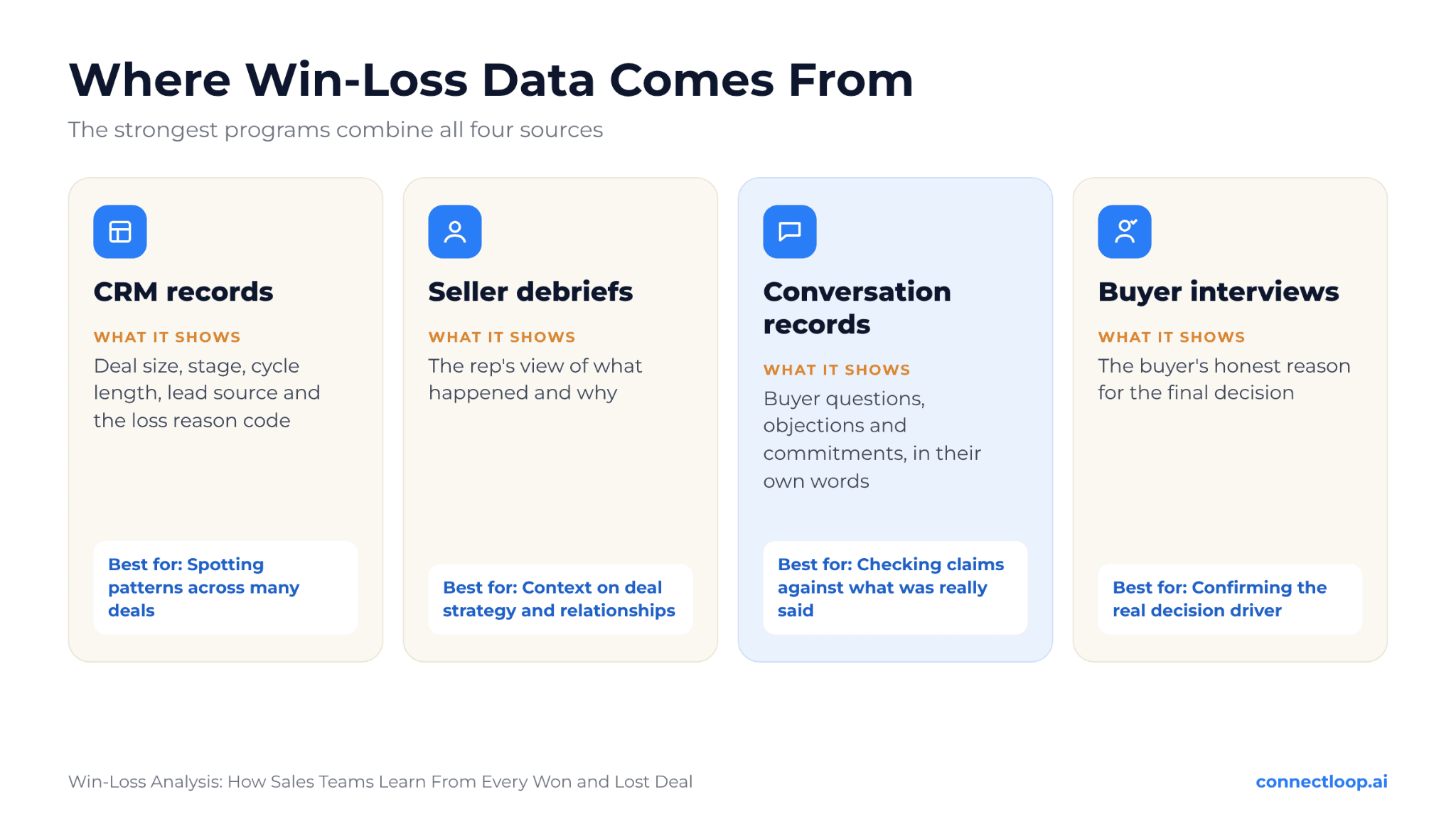
Conversation records sit between the seller's memory and the buyer's interview. Calls, chat, email and WhatsApp threads show the objections that came up, the questions that went unanswered and the moment interest faded. ConnectLoop's guide to conversation intelligence explains how teams capture and analyze these conversations.
How do you run a win-loss analysis?
You run a win-loss analysis in seven steps: set a goal, choose the deals, gather the data, interview buyers, code the reasons, find the patterns and share actions with each team. ConnectLoop suggests starting with one quarter of closed deals and one clear question.
- Set one goal. Pick a single question to answer, such as "Why do mid-market deals stall after the demo?"
- Choose the deals. Include wins, losses and no-decisions from the same period, not only the large or painful ones.
- Gather the data. Pull CRM fields, call and chat records, and a short debrief from each rep. Clean records matter here; ConnectLoop's guide to CRM for sales teams covers what good deal data looks like.
- Interview buyers. Reach out within two to four weeks of the decision, while details are still fresh. Keep each interview to 20 to 30 minutes.
- Code the reasons. Tag each deal against the six areas above, using the buyer's words rather than the seller's.
- Find the patterns. Look for reasons that repeat across five or more deals. One deal is a story; five deals are a pattern.
- Share actions with each team. Turn each pattern into one owner and one change, such as a new discovery question for sales or a new comparison page for marketing.
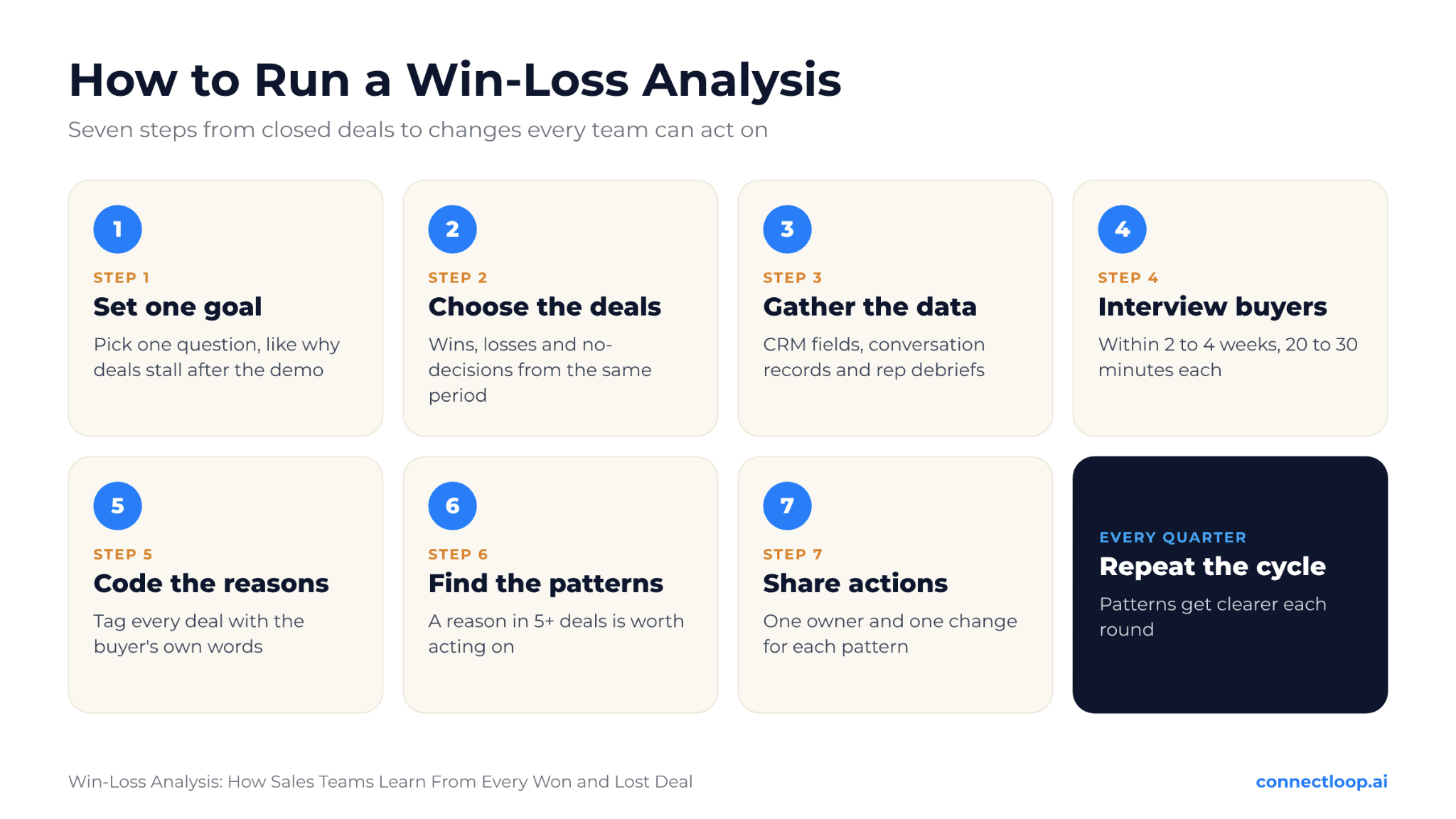
Repeat the cycle every quarter. The value grows as patterns build up over time.
What questions should you ask in a win-loss interview?
Ask open questions about the buyer's problem, their evaluation, the options they compared and the moment they decided. Avoid questions that defend your product. ConnectLoop recommends 8 to 10 questions, asked the same way in every interview, so answers can be compared across deals.
Questions for every buyer:
- What problem were you trying to solve, and why did it become a priority?
- Who else was involved in the decision, and what mattered most to each of them?
- Which options did you consider, including keeping things as they were?
- What did you need to see or hear before you felt confident?
- Was there a moment when the decision became clear?
Extra questions for won deals:
- What almost made you choose a different option?
- What would you tell a colleague about why you chose this solution?
Extra questions for lost deals:
- What did the option you chose do better?
- What could the sales team have done differently?
Many of these questions mirror strong discovery. If the same gaps keep appearing in interviews, add the missing questions to your discovery call questions so reps ask them earlier.
How is AI changing win-loss analysis?
AI is changing win-loss analysis in three ways: it reviews far more deals, it delivers insight within days and it can connect win-loss patterns to open deals in real time. ConnectLoop sees the last shift as the most valuable, because it turns hindsight into guidance.
Jeff Kirchick, VP of Sales at Zorro and author of "Authentic Selling," described this future at The AI Strategy, the monthly AI leadership event ConnectLoop hosts in Cambridge, MA. His ideal is an AI agent that studies every won and lost deal, then gives reps the next best action on each open opportunity. For example, it might flag that in deals the team wins, a certain stakeholder is usually engaged by this stage, and that has not happened yet.
Jeff also shared how a company he advises built an AI "brain" from every conversation it had. While planning for 2027, it showed that many accounts in their ideal customer profile were raising the same new need. The insight pointed to a product opportunity the team had not been looking for.
His advice came with one condition: the data has to be clean first. If your deal records are unreliable, fix the process before adding AI on top. The same thinking applies to real-time sales coaching, where live prompts work best on top of a clear sales framework.
How do you turn win-loss findings into sales coaching?
Turn each win-loss pattern into one specific behavior, then coach that behavior on live deals. A finding like "we lose when finance joins late" becomes a coaching goal: confirm the budget owner by the second meeting. ConnectLoop connects these goals to call scores, so managers can see whether the new habit sticks.
A simple way to do this:
- Pick the top pattern from the quarter. Choose the one with the biggest revenue impact.
- Write it as a behavior. Describe what the rep should do, and when.
- Add it to call scoring. Include it in the criteria managers use for every call. ConnectLoop's guide to sales call scoring shows how to set this up.
- Share a winning example. Clip a moment from a won deal where a rep did it well.
- Check the next quarter's results. See whether the pattern shrinks in the next round of analysis.
This loop keeps coaching grounded in real buyer decisions, not opinions.
What keeps a win-loss program running long term?
Consistency keeps a win-loss program running and useful. Teams that review closed deals every quarter, involve buyers directly and share findings openly get steadily better results. ConnectLoop recommends treating win-loss as a standing habit, not a one-time project after a bad quarter.
The programs that last share five habits:
- They review every type of outcome. Wins, losses and no-decisions all get the same attention.
- They keep the buyer's voice central. Seller debriefs add context, and buyer interviews confirm the real reason.
- They make it safe for reps. The goal is learning, so findings are shared as team patterns rather than individual blame.
- They close the loop. Every pattern ends with an owner, an action and a date.
- They report back. Leaders share what changed because of the findings, so teams keep contributing.
Win-loss analysis works best alongside direct buyer conversations. Conversation records show what was said during the deal, and buyer interviews explain what happened after the last call, when the final decision was made.
How does ConnectLoop support win-loss analysis?
ConnectLoop gives win-loss analysis its raw material: a full record of every buyer conversation across website chat, email, WhatsApp and sales calls. Each conversation is summarized with the questions, objections and next steps that shaped the deal. This makes it easier to check what really happened in any won or lost deal.
Here is how ConnectLoop fits into each stage of a win-loss program:
- Before the deal closes: ConnectLoop scores and summarizes every lead conversation, so the team knows why a lead is hot or cold and what the suggested next step is.
- During sales calls: ConnectLoop's Sales Assistance gives live prompts during the call and scores the conversation afterward.
- After the deal closes: Conversation summaries and call scores stay with each lead's record, so win-loss reviews start from what the buyer actually said.
Teams that want to connect these insights to coaching can explore ConnectLoop's sales coaching solution.
Key takeaways
- Win-loss analysis explains why deals were won, lost or ended with no decision.
- Seller accounts match buyer accounts only 30% to 50% of the time, according to Corporate Visions' 2026 analysis.
- The strongest programs combine CRM records, seller debriefs, conversation records and buyer interviews.
- Review six areas on every deal: buyer need, sales experience, product fit, price and value, competing options and decision process.
- Turn each pattern into one coachable behavior and track it through call scoring.
- AI now delivers insight within days and can point reps to the next best action on open deals.
- ConnectLoop captures the conversations behind every deal, so win-loss reviews start from the buyer's own words.

About the author
ConnectLoop Staff
Written by the ConnectLoop team. ConnectLoop is an AI sales agent for inbound revenue teams, based in Cambridge, Massachusetts.
About ConnectLoop →Frequently asked questions
Win-loss analysis in sales is a structured review of closed deals that explains why each one was won, lost or ended with no decision. It combines CRM data, conversation records and buyer interviews to find the real decision drivers and turn them into improvements for sales, marketing and product.
Divide the number of deals won by the total number of deals won and lost, then multiply by 100. For example, 30 wins and 70 losses give a 30% win rate. Track it by segment, deal size and lead source to see where the team performs best.
Run it every quarter, with buyer interviews spread throughout the quarter. A steady rhythm builds patterns over time and keeps findings fresh. Many teams also run a quick review after any large deal, won or lost.
Product marketing, sales enablement or RevOps usually owns the program, with input from sales leaders and product. The owner should be close enough to sales to understand the deals, and neutral enough that buyers and reps share openly.
Start with 15 to 20 closed deals from one quarter, mixing wins, losses and no-decisions. That is enough to spot early patterns. Treat any reason that appears in five or more deals as worth acting on.
Yes. Won deals show what buyers valued most and what almost made them choose another option. Those answers help sales repeat what works and help marketing sharpen the message.
A pipeline review looks at open deals to forecast revenue and plan next steps. Win-loss analysis looks at closed deals to understand why they ended the way they did. The two work best together, with win-loss findings shaping how open deals are managed.
AI transcribes and analyzes buyer conversations, codes loss reasons, finds patterns across many deals and shortens the time from deal close to insight. ConnectLoop applies this to the conversations behind each deal, so teams can review what buyers actually said.
Start your next win-loss review from what the buyer actually said
Lia captures and summarizes every conversation across your website, WhatsApp and email, with the questions, objections and next steps that shaped each deal. Sales Assistance scores the calls and keeps the notes on the lead's record, so a closed deal still has its own evidence three months later.