
AI Sales Agents
AI Agents for Sales: 8 Use Cases Revenue Teams Rely On in 2026
AI agents for sales are AI systems that handle sales work on their own, such as answering buyer questions, qualifying leads, booking meetings and coaching reps. The best teams use them to remove low-value work, so sellers spend more time with buyers. ConnectLoop builds AI agents for inbound revenue teams across chat, email, voice and WhatsApp.

Published
The guide in one minute
- AI agents for sales act, not just suggest. They answer, qualify, book and update, inside clear limits.
- The 8 strongest use cases cover the whole inbound journey: instant answers, qualification, booking, routing, intent signals, follow-up drafts, live coaching and conversation insights.
- Start with one use case tied to one number, such as response time or meetings booked.
- People stay in charge of trust, judgment and the relationship. AI does the prep.
- Measure revenue outcomes, not activity counts.
ConnectLoop puts these use cases into one AI sales agent that trains on your website in about 60 seconds and connects to 15+ CRMs.
Table of contents
- What are AI agents for sales?
- Why are sales teams adopting AI agents in 2026?
- What are the 8 best use cases for AI agents in sales?
- Which use case should you start with?
- Where should people stay in charge?
- How do you measure the results of AI sales agents?
- How does ConnectLoop put AI agents to work for sales teams?
- Key takeaways
- Frequently asked questions
What are AI agents for sales?
AI agents for sales are AI systems that complete sales tasks from start to finish, not just suggest them. They read context, decide on the next step and act, such as replying to a lead or booking a call. ConnectLoop defines a sales agent by what it finishes, not by what it drafts.
The difference from older sales tools is action. A chatbot follows a script. A copilot suggests a reply that a person still has to send. An AI agent understands the question, checks what it knows about the buyer, takes the step and logs it in the CRM.
There are two broad kinds:
- Buyer-facing agents talk to prospects directly. They answer questions, qualify interest and book meetings on your website, by email, by phone or on WhatsApp.
- Seller-facing agents work beside your team. They prepare research, suggest the next best action during a call and turn conversations into notes and CRM updates.
ConnectLoop's guide to what an AI sales agent is covers the basics in more detail. This article focuses on where these agents create the most value in a real sales process.
Why are sales teams adopting AI agents in 2026?
Sales teams are adopting AI agents in 2026 because buyers move faster and more of the journey happens without a rep. Agents let teams respond instantly and guide sellers toward the right next step. ConnectLoop sees speed and guidance as the two biggest reasons teams start.
The 2026 research points the same way:
- Buyers want more self-service. Gartner's March 2026 survey of B2B buyers found that 67% prefer a rep-free experience, and 45% used AI during a recent purchase.
- Guidance drives growth. Gartner's May 2026 research found that sales organizations giving sellers AI-enabled next best actions are 2.6x more likely to achieve commercial growth.
- Reps still matter at key moments. The same Gartner research found that 69% of B2B buyers prefer to validate AI-generated insights with a sales rep.
- Trust has limits. G2's 2026 Buyer Behavior Report found that 47% of buyers would let an agent research and recommend while people keep the final decision, and only 9% are comfortable letting an agent execute on its own.
Put together, these numbers describe a clear model. Buyers want fast, self-guided answers. They also want a person when the decision gets serious. AI agents for sales handle the first part, so your team can be fully present for the second.
What are the 8 best use cases for AI agents in sales?
The 8 best use cases for AI agents in sales are instant answers, lead qualification, meeting booking, lead routing, buying intent signals, follow-up drafts, live call coaching and conversation insights. Each one removes a slow, manual step from the inbound journey. ConnectLoop covers all 8 in one platform.
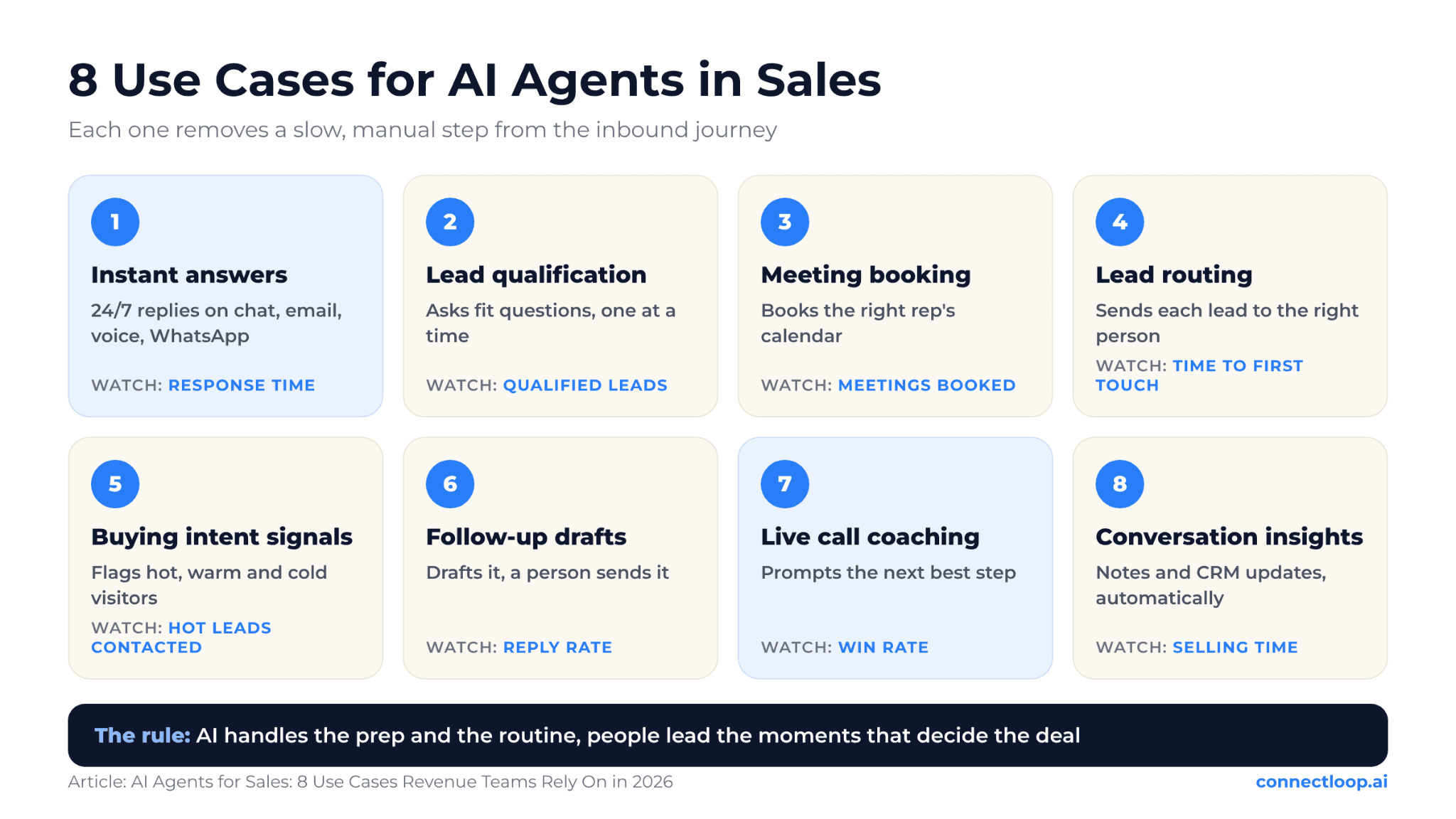
Here is a quick view before the details:
| Use case | What the AI agent does | Who stays in charge | Number to watch |
|---|---|---|---|
| Instant answers | Replies to buyer questions 24/7 on chat, email, voice and WhatsApp | Your content team sets the answers | Response time |
| Lead qualification | Asks qualifying questions and scores fit | Sales leaders set the criteria | Qualified leads per week |
| Meeting booking | Books calls on the right rep's calendar | Reps own the meeting | Meetings booked |
| Lead routing | Sends each lead to the right person | RevOps sets the rules | Time to first human touch |
| Buying intent signals | Tracks visits and flags serious buyers | Reps decide who to call | Hot leads contacted |
| Follow-up drafts | Writes a follow-up for a returning lead | A person reviews and sends | Reply rate |
| Live call coaching | Prompts the rep with the next step during calls | The rep runs the call | Win rate |
| Conversation insights | Turns calls and chats into notes and CRM updates | Managers coach from the data | Selling time per rep |
1. Answer buyer questions instantly
An AI agent answers product, pricing and fit questions the moment a buyer asks, day or night. It uses your website and approved content, so answers stay accurate. ConnectLoop's agent works across website chat, email, voice and WhatsApp from one knowledge base.
This use case matters most for inbound teams. A buyer who asks a question at 9 PM and waits until morning often keeps researching other vendors. An agent keeps that buyer engaged while interest is high.
ConnectLoop's research on speed to lead explains why the first few minutes decide so much of the outcome. Your content sets the ceiling for answer quality, so keep pricing pages, FAQs and product pages up to date.
2. Qualify inbound leads
An AI agent qualifies leads by asking the questions your team would ask, such as company size, timeline and use case, inside a natural conversation. Qualified buyers move forward and others get helpful resources. ConnectLoop lets sales leaders set the criteria the agent follows.
Good qualification feels like help, not a form. The agent asks one question at a time and responds to what the buyer says. Every answer is saved, so the rep never asks the same question twice.
For a deeper look at the criteria themselves, see ConnectLoop's guide to inbound lead qualification.
3. Book meetings automatically
An AI agent books meetings by offering open times on the right rep's calendar as soon as a buyer is ready. There is no back-and-forth email chain. ConnectLoop's agent books, confirms and logs the meeting in your CRM in the same conversation.
Booking is where many inbound leads drop off. A buyer says "yes, let's talk," then waits for a scheduling email that arrives hours later. An agent closes that gap in seconds.
ConnectLoop's article on AI appointment booking walks through the setup, including time zones, buffers and round-robin calendars.
4. Route leads to the right person
An AI agent routes each lead to the right rep based on territory, deal size, product interest or account ownership. The buyer reaches someone who can actually help. ConnectLoop applies your routing rules the moment a lead qualifies, so no lead sits unassigned.
Routing sounds simple until a team grows. Shared inboxes, manual assignment and unclear ownership slow every handoff. An agent applies the rules the same way every time.
ConnectLoop's guide to lead routing compares the main routing methods and when to use each one.
5. Spot buying intent before a buyer reaches out
An AI agent spots buying intent by tracking which pages a visitor reads, how long they stay and how often they return. It then flags serious buyers as hot, warm or cold. ConnectLoop's visitor intelligence follows each journey and attaches the full history when a visitor shares their details.
This gives reps context before the first call. A rep who knows the buyer read the pricing page three times this week starts a very different conversation from a rep going in blind.
ConnectLoop tracks the visitor journey and keeps it ready for the moment a visitor shares their details in a conversation. Learn more on the visitor intelligence page.
6. Draft follow-ups for a person to send
An AI agent drafts a follow-up email when a known lead comes back to your website, using what they viewed and what they said before. A person on your team reviews it and sends it. ConnectLoop's Proactive Outreach keeps every follow-up personal and human-sent.
This is where AI and people work best together. The agent notices the return visit and writes a relevant draft. The rep adds judgment and sends it from their own inbox.
That approach matches what an attendee shared at The AI Strategy, the monthly AI leadership event ConnectLoop hosts in Cambridge, MA: AI works best as the intelligence layer, while the outreach itself stays human and personalized. For timing ideas, see ConnectLoop's guide to follow-up emails after no response.
7. Coach reps during live calls
An AI agent coaches reps during live calls by listening to the conversation and prompting the next best question or step. The rep stays in control and gets help in the moment, not a week later. ConnectLoop's Live Assist guides reps through each stage of a framework in real time.
Live coaching fixes problems while the call can still be saved. If a rep skips a key discovery question, the prompt appears before the buyer hangs up.
ConnectLoop's Sales Assistance ships with the ConnectLoop YES Framework™, a 24-step method in five stages: Discover, Define, Connect, Validate and Commit. Read more in ConnectLoop's guide to real-time sales coaching.
8. Turn conversations into insights and CRM updates
An AI agent turns every chat, email and call into a summary, next steps and CRM updates, without manual note-taking. Managers see patterns across the whole team, such as common objections and winning questions. ConnectLoop's conversational intelligence makes each conversation useful long after it ends.
At ConnectLoop's November 2026 edition of The AI Strategy, Jeff Kirchick, VP of Sales at Zorro, called conversations "the holy grail" of a go-to-market team. His point was simple: a company that captures every conversation gets smarter over time.
ConnectLoop's sales call report template shows what a useful summary should include, whether a person or an agent writes it.
Which use case should you start with?
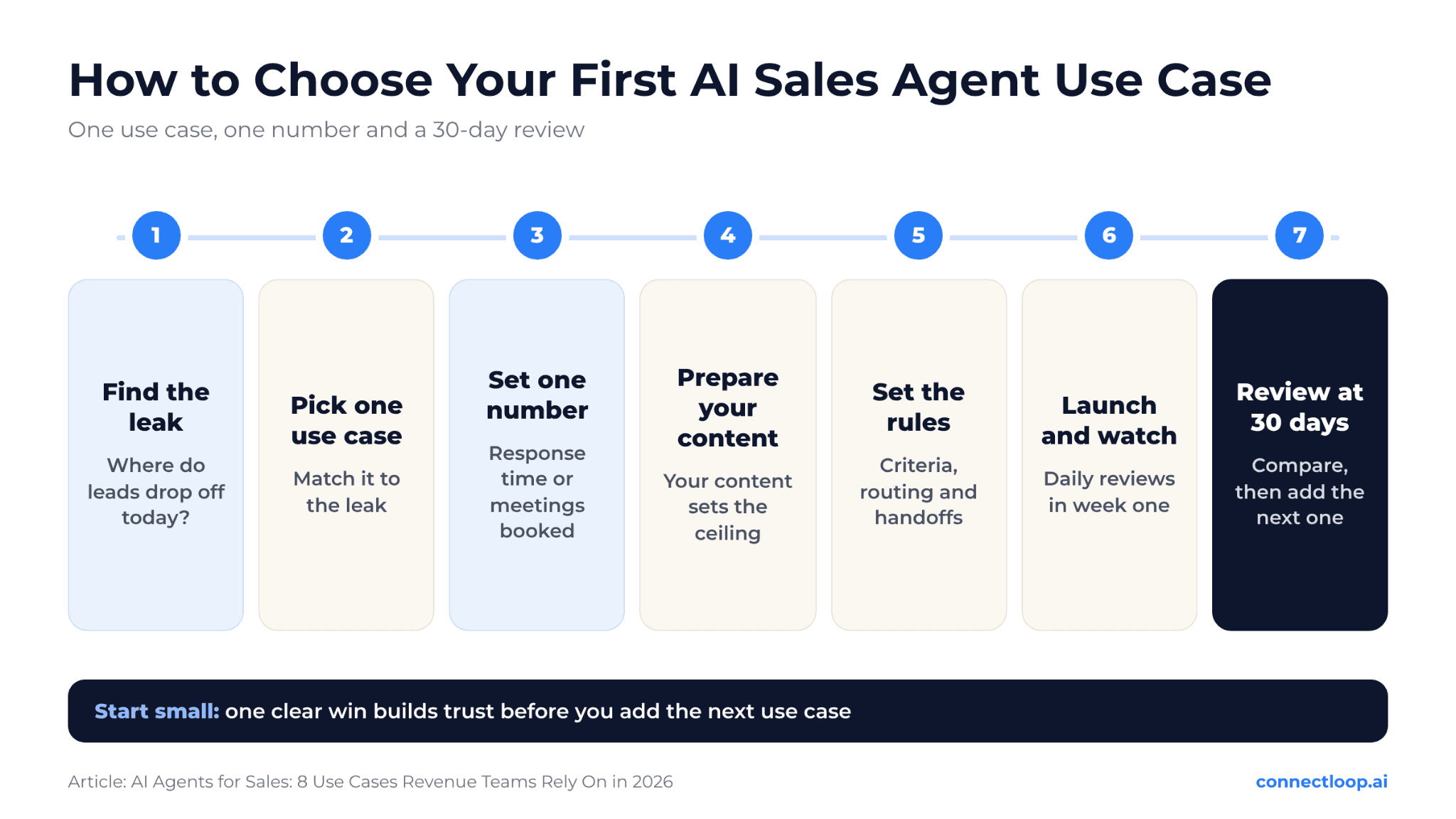
You should start with the use case that fixes your biggest leak, which for most inbound teams is response time or meeting booking. One clear win builds trust before you expand. ConnectLoop recommends one use case, one number and a 30-day review.
Follow these steps to choose:
- Find the leak. Look at where leads drop off today: slow replies, unbooked meetings, missed follow-ups or unqualified pipeline.
- Pick one use case. Match the leak to one use case from the list above.
- Set one number. Choose a single metric, such as median response time or meetings booked per week.
- Prepare your content. Update the pages and answers the agent will use. Your content sets the ceiling for quality.
- Set the rules. Define qualification criteria, routing rules and when the agent hands off to a person.
- Launch and watch. Review conversations daily in the first week, then weekly.
- Review at 30 days. Compare the number to your starting point, then add the next use case.
Teams that try to automate everything at once usually end up with many tools and unclear results. Gartner's July 2026 research predicts AI agents will outnumber sellers 10 to 1 by 2028, yet fewer than 40% of sellers will say agents improved their productivity. Starting small and measuring clearly is how teams stay on the right side of that gap.
Where should people stay in charge?
People should stay in charge of discovery, trust building, negotiation and the long-term relationship. These moments depend on empathy and judgment. ConnectLoop designs its agents so AI handles the prep and the routine, while people lead the moments that decide the deal.
Jeff Kirchick made this point clearly at The AI Strategy. He argued that discovery should stay human in complex sales, because "that is where you build your champion." He also noted that the one thing AI will never have is a shared experience with a buyer.
A simple way to split the work:
- AI handles: first answers, qualification questions, scheduling, routing, research, note-taking, CRM updates and first drafts.
- People handle: discovery in complex deals, pricing decisions, negotiation, sending personal outreach and managing key accounts.
This split also matches what buyers say. Gartner's 2026 research shows most buyers want a rep to validate AI-generated insights, and G2's 2026 report shows few buyers want an agent to execute decisions alone. ConnectLoop keeps a person in the loop wherever trust is on the line, which is why Proactive Outreach drafts are always sent by a person.
How do you measure the results of AI sales agents?
You measure AI sales agents by revenue outcomes, such as response time, meetings booked, conversion rate and selling time, not by how many messages the agent sends. More activity only counts when it creates more pipeline. ConnectLoop reports on the outcomes that sales leaders already track.
Track these numbers before and after launch:
- Median response time: how fast buyers get a first answer.
- Lead-to-meeting rate: how many qualified conversations become booked meetings.
- Meeting show rate: whether booked meetings actually happen.
- Time to first human touch: how quickly a rep follows up on a hot lead.
- Pipeline created: the value of opportunities that started with the agent.
- Selling time per rep: hours spent with buyers instead of on admin.
Jeff Kirchick offered a useful rule at The AI Strategy: if AI doubles your leads but conversion stays flat, you may have added noise, not value. Judge every use case by whether it moves pipeline and revenue. ConnectLoop's guide to CRM for sales teams explains how to keep that data clean.
How does ConnectLoop put AI agents to work for sales teams?
ConnectLoop puts AI agents to work through one AI sales agent that answers, qualifies, books, routes and follows up across chat, email, voice and WhatsApp. It also coaches reps live and captures every conversation. ConnectLoop replaces live chat, a scheduler, a follow-up sequencer and a support inbox with one system.
Here is how the 8 use cases map to ConnectLoop:
- Instant answers, qualification and booking: the ConnectLoop AI sales agent, trained on your website in about 60 seconds.
- Routing and CRM updates: 15+ CRM integrations that keep every lead and conversation in sync.
- Buying intent signals: visitor intelligence that tracks each journey and scores intent as hot, warm or cold.
- Follow-up drafts: Proactive Outreach, where a person on your team always reviews and sends.
- Live call coaching: Sales Assistance and Live Assist, with the ConnectLoop YES Framework™ and other standard frameworks.
- Conversation insights: conversational intelligence across every channel.
ConnectLoop is CASA Verified by Google, a Verified Meta Business and an official Meta Business Partner, so teams can connect email and WhatsApp with confidence. To see how it fits your sales process, explore ConnectLoop's conversational intelligence page or try it free on your own website.
Key takeaways
- AI agents for sales complete tasks from start to finish, while chatbots and copilots only follow scripts or suggest.
- Gartner's 2026 research shows 67% of B2B buyers prefer a rep-free experience, which makes instant, accurate answers essential.
- The 8 strongest use cases are instant answers, qualification, booking, routing, intent signals, follow-up drafts, live coaching and conversation insights.
- Start with the use case that fixes your biggest leak, and tie it to one number for 30 days.
- People should lead discovery, negotiation and relationships, while AI handles prep, routine steps and first drafts.
- Measure outcomes such as response time, meetings booked and pipeline created, not message volume.
- Your content sets the ceiling for answer quality, so keep key pages current.
- ConnectLoop combines all 8 use cases in one AI sales agent across chat, email, voice and WhatsApp.

About the author
ConnectLoop Staff
Written by the ConnectLoop team. ConnectLoop is an AI sales agent for inbound revenue teams, based in Cambridge, Massachusetts.
About ConnectLoop →Frequently asked questions
AI agents for sales are AI systems that complete sales tasks on their own, such as answering buyer questions, qualifying leads, booking meetings and updating the CRM. They act inside rules your team sets. ConnectLoop's AI sales agent handles these tasks for inbound teams across chat, email, voice and WhatsApp.
AI sales agents understand context and take action, while chatbots follow fixed scripts. An agent can answer an unexpected question, qualify the buyer and book a meeting in one conversation. ConnectLoop's agent trains on your website, so it answers in your own words instead of a decision tree.
The best first use case for most inbound teams is instant answers or meeting booking, because both fix fast, visible leaks. Pick the one where you lose the most leads today. ConnectLoop recommends tracking one number, such as response time, for the first 30 days.
AI agents will replace many routine sales tasks, but people stay essential for discovery, trust and negotiation. Gartner's 2026 research found 69% of B2B buyers prefer to validate AI insights with a rep. ConnectLoop uses AI to give reps more time with buyers, not less.
AI agents can draft outreach, but the best results come when a person reviews and sends it. Buyers trust personal messages from real people. ConnectLoop's Proactive Outreach drafts a follow-up when a known lead returns to your website, and a person on your team always sends it.
AI sales agents connect to your CRM to read account context and write back conversations, lead scores, meetings and next steps. This keeps data accurate without manual entry. ConnectLoop integrates with 15+ CRMs, so every conversation lands in the right record automatically.
Setup time depends on the platform and your content, but a basic agent can be live the same day. The longer work is setting qualification rules and handoff points. ConnectLoop's agent trains on your website in about 60 seconds, so teams can test it right away.
You measure ROI by comparing response time, meetings booked, conversion rate and pipeline created before and after launch. Activity counts alone can hide weak results. ConnectLoop reports on the outcomes sales leaders already track, so the impact is easy to see in revenue terms.
Start with one use case, not all eight
ConnectLoop's AI sales agent trains on your website in about 60 seconds, then answers buyers on chat, email, voice and WhatsApp, qualifies them against your criteria, books the meeting and writes the whole conversation back to your CRM. Pick the leak you want closed first and watch one number for 30 days.