
Lead Qualification
Lead Routing: How to Get Every Lead to the Right Rep Fast
Lead routing is the process of automatically assigning each new lead to the right salesperson or team, based on rules such as territory, company size, product interest or availability. Good routing gets a qualified buyer to a person who can help within minutes. ConnectLoop sees routing as the step that decides whether speed to lead actually happens.

Published
Table of contents
- What is lead routing?
- Why does lead routing matter in 2026?
- How does lead routing work?
- What are the main lead routing methods?
- Which lead routing method should you choose?
- How do you build lead routing rules?
- What data do you need for accurate lead routing?
- How should you route leads from chat, WhatsApp and email?
- How does AI change lead routing?
- How do you measure lead routing?
- What are the most common lead routing mistakes?
- Key takeaways
- Frequently asked questions
What is lead routing?
Lead routing, also called lead assignment or lead distribution, is how a business decides who owns each new lead and how that lead reaches them. It uses rules in a CRM or routing tool to match leads with reps. ConnectLoop treats routing as part of the buyer's first conversation, not a back-office task.
Every inbound lead raises the same questions. Who should talk to this person? How quickly? What does the rep need to know first?
Lead routing answers those questions automatically. A simple setup might send all demo requests to one sales team in turn. A more advanced setup might look at the buyer's company size, region, product interest and existing account, then send them to the exact rep who owns that segment.
Lead routing usually covers four jobs:
- Matching: linking the lead to an existing account or contact, if one exists.
- Assigning: choosing the right rep or team based on rules.
- Alerting: telling the rep right away, by email, chat or CRM task.
- Tracking: recording when the lead arrived and when the first reply was sent.
Why does lead routing matter in 2026?
Lead routing matters in 2026 because buyers expect fast answers and slow assignment quietly kills deals. Leads that sit unassigned in a shared inbox go cold, even when reps reply quickly once they finally see them. ConnectLoop sees routing as the most overlooked fix for slow response times.
The 2026 data shows the size of the gap:
- Routing tools cut response time sharply. Workato's 2026 study of 114 B2B companies found that companies using a lead routing tool took about 3 hours 32 minutes to respond, compared with nearly 13 hours for companies without one.
- Fast replies are rare. In the same study, only 1 of 114 companies sent a personal email within 5 minutes of a demo request, and only 31% called the lead at all.
- Most teams are still slow. A 2026 benchmark of 253,817 inbound leads across 1,247 companies found a median response time of 42 hours.
Routing does not fix everything, but it removes the biggest delay: the time between a lead arriving and the right person knowing about it. ConnectLoop's guide to speed to lead explains why those first minutes matter so much.
How does lead routing work?
Lead routing works in five steps: a lead is captured, its data is enriched and matched to any existing account, rules decide the owner, the owner is alerted, and the handoff is tracked. ConnectLoop adds a step before routing: qualifying the buyer in conversation, so only real opportunities reach sales.
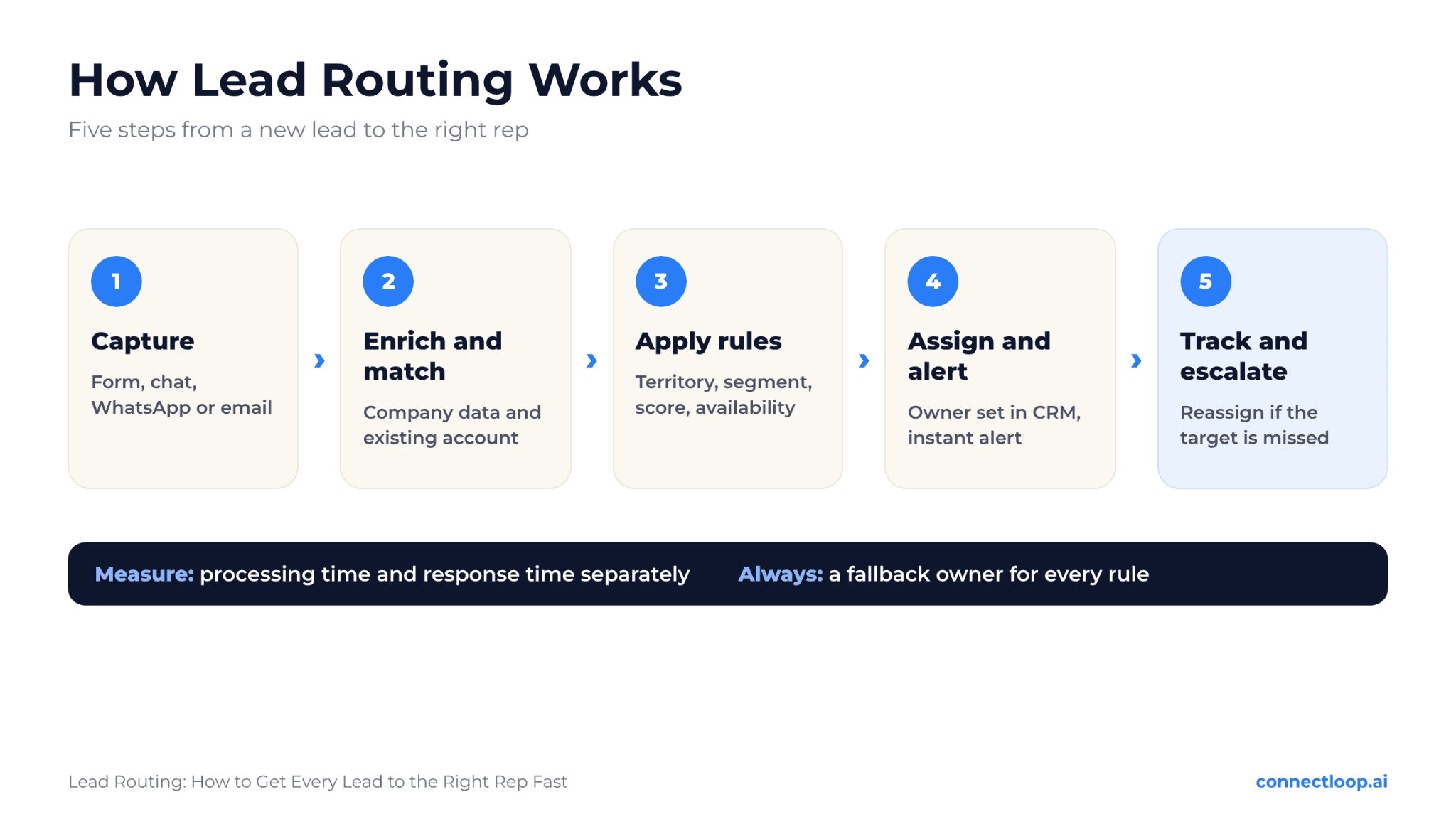
- Capture. A buyer fills in a form, starts a chat, sends a WhatsApp message or replies to an email.
- Enrich and match. The system adds company details and checks whether the buyer belongs to an existing account in the CRM.
- Apply rules. Routing rules pick the right owner based on territory, segment, product, score or availability.
- Assign and alert. The lead is assigned in the CRM, and the rep gets an instant alert with context.
- Track and escalate. If the rep does not respond within the agreed time, the lead is reassigned or escalated.
Step 5 is the one most teams skip. Without a time limit and a backup owner, a lead assigned to a rep on vacation simply waits.
What are the main lead routing methods?
The main lead routing methods are round robin, territory-based, account-based, segment-based, skill-based, score-based and availability-based routing. Most teams combine two or three. ConnectLoop recommends starting with the simplest method that fits your sales team, then adding rules only when the data shows a need.
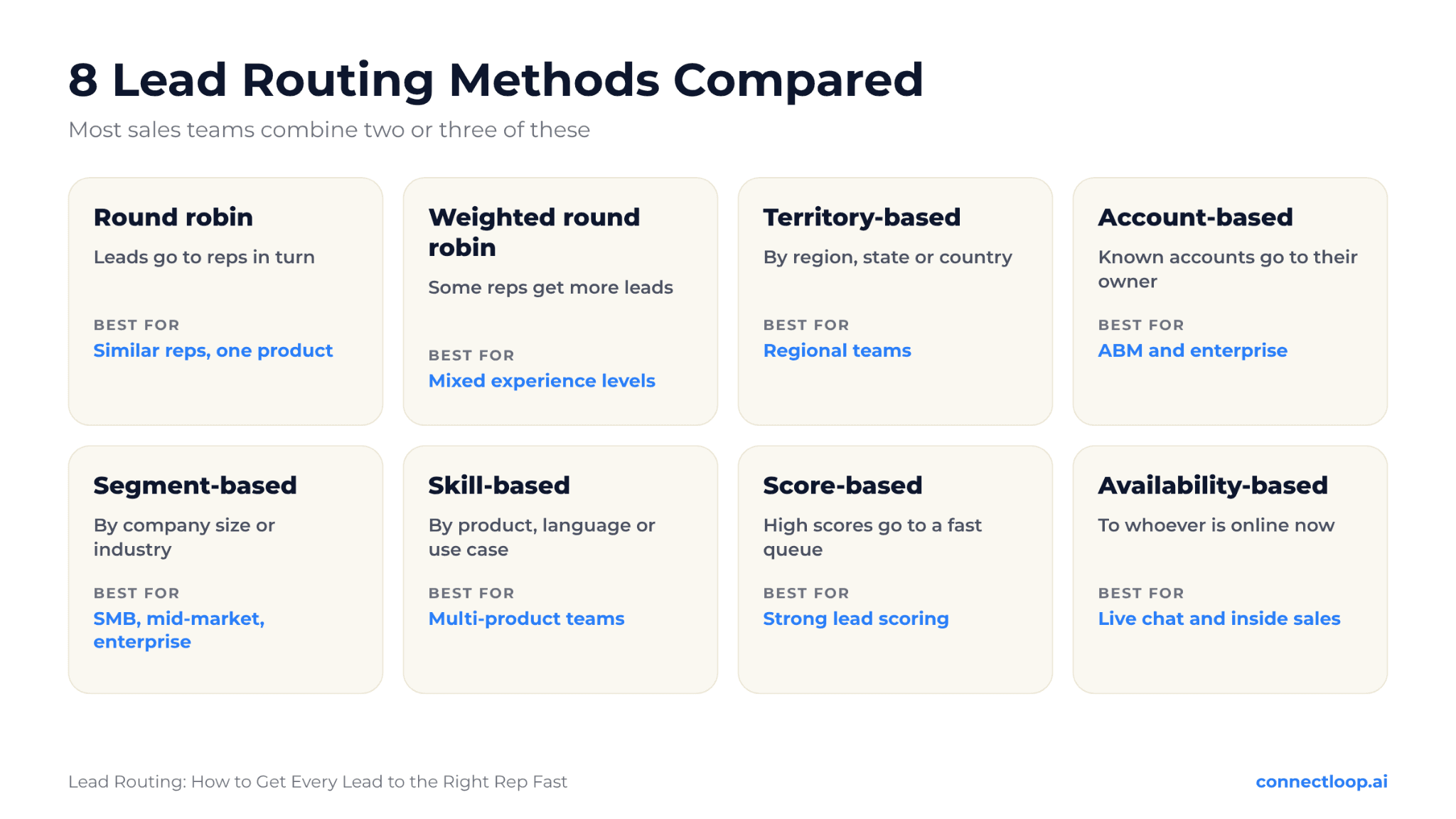
| Method | How it works | Best for | Watch out for |
|---|---|---|---|
| Round robin | Leads go to reps in turn, one after another | Teams where reps sell the same thing to similar buyers | Ignores rep skill and lead quality |
| Weighted round robin | Some reps get more leads than others | Teams with mixed experience or part-time reps | Weights need regular review |
| Territory-based | Leads go to the rep who owns a region, state or country | Field sales and regional teams | Uneven lead volume by region |
| Account-based | Leads from a known account go to that account's owner | ABM and enterprise teams | Needs accurate lead-to-account matching |
| Segment-based | Leads route by company size, industry or deal size | Teams with SMB, mid-market and enterprise reps | Needs reliable company data |
| Skill-based | Leads route by product, language or use case | Multi-product or multilingual teams | Too many skills create tiny queues |
| Score-based | High-score leads go to senior reps or fast queues | Teams with strong lead scoring | Only as good as the scoring model |
| Availability-based | Leads go to whoever is online and has capacity | Live chat, inside sales and support | Needs real-time status tracking |
Which lead routing method should you choose?
Choose your lead routing method based on how your sales team is organized. Teams selling one product to similar buyers can start with round robin. Teams split by region, segment or account need rules that match that structure. ConnectLoop suggests mirroring your org chart first, then refining.
A simple way to decide:
- One small team, one product: round robin, with availability checks.
- Reps split by region: territory-based routing, with round robin inside each territory.
- SMB, mid-market and enterprise teams: segment-based routing by company size.
- Named accounts: account-based routing first, then segment rules for new companies.
- Strong lead scoring in place: score-based routing on top of any of the above. ConnectLoop's guide to lead scoring explains how to build the score.
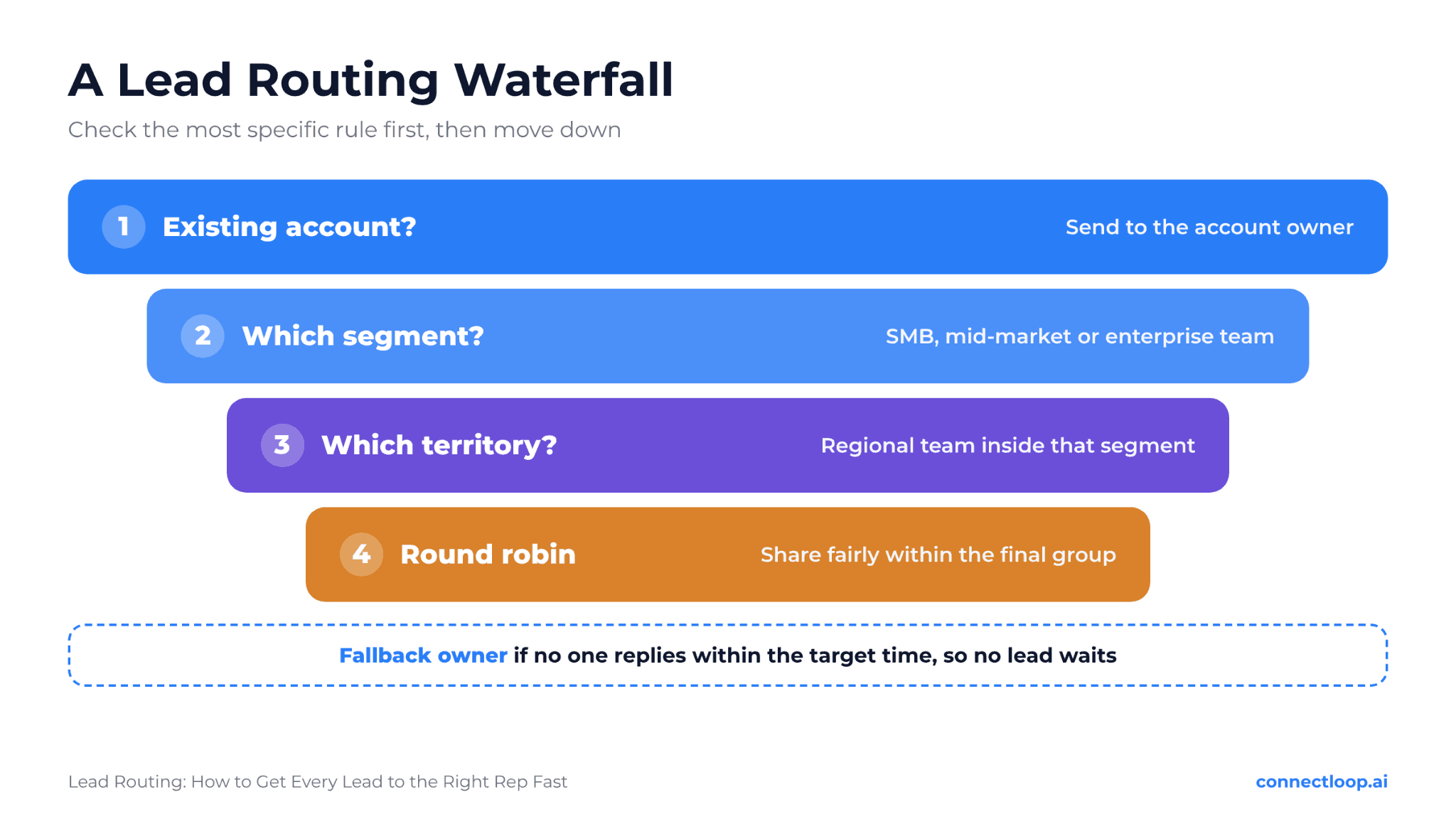
Most mature teams end up with a routing waterfall: check for an existing account owner first, then segment, then territory, then round robin to share leads fairly within the final group.
How do you build lead routing rules?
Build lead routing rules in eight steps: map your sales structure, define lead types, set qualification criteria, write the rules, set response time targets, add a fallback owner, test with real leads, then review monthly. ConnectLoop recommends writing every rule down in plain language before building it in any tool.
- Map your sales structure. List every rep and team, and what each one owns: regions, segments, accounts or products.
- Define your lead types. Demo requests, pricing questions, trial sign-ups, content downloads and partner inquiries all need different handling.
- Set qualification criteria. Decide what makes a lead ready for sales and what goes to nurturing instead. ConnectLoop's guide to MQL vs SQL covers this split.
- Write the rules in order. Start with existing accounts, then the most specific rules, then broader ones.
- Set response time targets. For example, demo requests within 5 minutes, pricing questions within 15 minutes and content downloads within one business day.
- Add fallback owners. Every rule needs a backup for vacations, sick days and nights.
- Test with real leads. Run last month's leads through the new rules and check where each one would land.
- Review monthly. Check response times, reassignment rates and win rates by route, then adjust.
Keep the rule set as small as possible. Every extra rule is another place for a lead to get stuck.
What data do you need for accurate lead routing?
Accurate lead routing needs clean data on the buyer's company, location, size, industry, product interest and any existing account. Missing or messy data sends leads to the wrong rep or to nobody. ConnectLoop helps by capturing intent and details during the buyer's conversation, before routing starts.
The fields that matter most:
- Company name and domain, for account matching.
- Company size and industry, for segment routing.
- Country, state or region, for territory routing.
- Product interest or use case, for skill routing.
- Lead source and lead type, such as demo request or pricing question.
- Engagement history, such as pages viewed and past conversations.
Short forms convert better, but they collect less data. Enrichment tools and conversation can fill the gaps. When a buyer explains their need in chat, that answer is often more useful for routing than any form field. Visitor intelligence adds company details for buyers who have not filled in a form yet, as ConnectLoop explains in its guide to website visitor identification.
How should you route leads from chat, WhatsApp and email?
Route leads from chat, WhatsApp and email the same way as form leads, with the same rules, the same owners and the same response time targets. The difference is speed: conversation leads expect an answer in seconds. ConnectLoop handles the first reply instantly, then routes qualified buyers with the full conversation attached.
Conversation channels need a few extra rules:
- Answer first, route second. A buyer in chat should get a helpful answer right away, not "someone will be in touch."
- Keep one owner per buyer. If a buyer moves from chat to email to WhatsApp, they should keep the same owner.
- Pass the full history. The rep should see every question the buyer asked, so they never repeat it.
- Cover nights and weekends. Many serious questions arrive outside office hours.
WhatsApp is now a major B2B channel in many markets. ConnectLoop's guide to the WhatsApp Business API explains how businesses connect it to their sales process.
How does AI change lead routing?
AI changes lead routing by qualifying buyers in conversation, reading intent from what they say, answering instantly at any hour and passing complete context to the right rep. Rules still decide who owns a lead, but AI decides what happens in the first minutes. ConnectLoop's Lia handles that first conversation.
Here is how Lia fits into a routing flow:
- A buyer asks a question on your website, WhatsApp or email.
- Lia answers in seconds, using your website and knowledge base.
- Lia asks qualifying questions, such as company size, use case and timing.
- When the buyer is ready, Lia books a meeting with your team.
- The lead and the full conversation sync to your CRM, so your routing rules assign the right owner with complete context.
This changes what "fast routing" means. The buyer gets a useful answer immediately, even at midnight, and the rep receives a qualified lead instead of a bare form. When a question needs a person, Lia hands the conversation over, as covered in ConnectLoop's guide to AI-to-human handoff. For the booking step, see ConnectLoop's guide to AI appointment booking.
How do you measure lead routing?
Measure lead routing by how fast leads reach the right owner, how fast they get a reply, how often they are reassigned, and how routed leads convert to meetings and revenue. ConnectLoop recommends tracking processing time and response time separately, so you can see whether routing or reps cause delays.
| Metric | What it shows | Good sign |
|---|---|---|
| Lead processing time | Time from lead arrival to assignment | Seconds, not hours |
| Rep response time | Time from assignment to first reply | Inside your target for that lead type |
| Speed to lead | Total time from arrival to first reply | Minutes for high-intent leads |
| Unassigned or unworked leads | Leads that never got an owner or a reply | As close to zero as possible |
| Reassignment rate | How often leads move to a new owner | Low and falling |
| Lead-to-meeting rate by route | Which routes book the most meetings | Similar or improving across routes |
| Win rate by route | Which routes create revenue | Highest on your priority routes |
Review these monthly with sales and marketing together. ConnectLoop's guide to inbound sales metrics shows how they fit into a wider dashboard.
What are the most common lead routing mistakes?
The most common lead routing mistakes are too many rules, no fallback owner, ignoring rep availability, poor lead-to-account matching, routing unqualified leads to busy reps and never reviewing the rules. ConnectLoop recommends fixing fallbacks and availability first, because they cause most lost leads.
Watch for these:
- No fallback owner. Leads assigned to someone on vacation wait for days.
- Ignoring time zones and hours. A lead routed to an offline rep at night waits until morning.
- Duplicate records. Poor matching sends the same buyer to two reps, or to the wrong one.
- Too many rules. Complex logic is hard to debug and easy to break.
- Routing every lead to sales. Low-intent leads clog rep queues. Send them to nurturing instead, as explained in ConnectLoop's guide to lead nurturing.
- No response time targets. Without a written target, nobody knows a lead is late.
- Set and forget. Territories, teams and products change, so rules must change too.
Honest limitation: routing only moves leads to people. It cannot make a rep reply faster or sell better once the lead arrives. The best results come from pairing clear routing rules with instant first responses and coaching. ConnectLoop's guide to inbound lead qualification covers the conversation that comes next.
Key takeaways
- Lead routing automatically assigns each new lead to the right rep based on rules such as territory, segment, account or availability.
- In Workato's 2026 study, companies with a routing tool responded in about 3.5 hours, compared with nearly 13 hours without one.
- The main methods are round robin, territory, account, segment, skill, score and availability-based routing. Most teams combine a few.
- Build rules in order: existing accounts first, then segments and territories, then round robin within the group.
- Every rule needs a response time target and a fallback owner.
- Route chat, WhatsApp and email leads with the same rules, but answer them first.
- Track processing time and response time separately to see where delays come from.
- ConnectLoop's Lia answers and qualifies buyers instantly, books meetings and passes the full conversation to your CRM for routing.

About the author
ConnectLoop Staff
Written by the ConnectLoop team. ConnectLoop is an AI sales agent for inbound revenue teams, based in Cambridge, Massachusetts.
About ConnectLoop →Frequently asked questions
Lead routing means sending each new lead to the right salesperson automatically. Rules decide who gets the lead, based on things like location, company size or product interest. ConnectLoop's Lia answers and qualifies the buyer first, then the lead reaches your team with full context.
Round robin routing gives leads to reps in turn, one after another, so everyone gets a fair share. It works best when reps sell the same product to similar buyers. ConnectLoop recommends adding availability checks, so leads skip reps who are offline or away.
Lead scoring ranks leads by how likely they are to buy. Lead routing decides who handles each lead. Scores often feed routing rules, for example sending high-score leads to a fast queue. ConnectLoop's Lia adds qualification in conversation, so scores reflect what buyers actually say.
High-intent leads, such as demo requests and pricing questions, should reach the right rep within seconds and get a reply within minutes. Lower-intent leads can wait longer. ConnectLoop's Lia replies to buyers instantly, so no lead waits while routing and assignment happen.
Yes, even a team of two or three benefits from simple rules, such as round robin with a fallback owner. Routing prevents leads from sitting in a shared inbox. ConnectLoop helps small teams by answering every buyer instantly and booking meetings directly into their calendars.
Account-based routing sends leads from a known company to the rep who already owns that account. It avoids two reps contacting the same company. It needs accurate matching between leads and accounts in your CRM. ConnectLoop syncs conversations to the CRM to support this matching.
Use an always-on first response, then route to the next available rep or a follow-up queue for the morning. Many serious buyers ask questions at night. ConnectLoop's Lia answers and qualifies them around the clock and can book meetings for the next business day.
Most teams use their CRM's built-in assignment rules, a dedicated routing tool or an AI agent that qualifies leads before assignment. The right choice depends on team size and rule complexity. ConnectLoop works alongside your CRM through its integrations, so routing rules stay where your team already works.
No lead should wait for a rule to fire
Routing decides who owns a lead. Lia decides what the buyer hears in the first ten seconds. It answers on website chat, WhatsApp and email at any hour, qualifies the buyer, books the meeting, and syncs the whole conversation to your CRM so your rules assign the right owner with full context.