
Lead Generation
Lead Nurturing: How to Turn Cold Leads Into Booked Meetings
Lead nurturing is the process of building relationships with leads who are not ready to buy yet, by sending them useful, timely and relevant messages until they are. It covers email, website chat, messaging and sales follow-up. ConnectLoop sees nurturing as the bridge between a first visit and a booked meeting.

Published
Table of contents
- What is lead nurturing?
- Why does lead nurturing matter in 2026?
- How is lead nurturing different from lead generation and lead scoring?
- How does a lead nurturing process work?
- How do you build a lead nurturing program?
- What content works at each stage of the funnel?
- Which channels work best for lead nurturing?
- What does a good nurture email sequence look like?
- How do buying signals improve lead nurturing?
- How can AI help with lead nurturing?
- How do you measure lead nurturing?
- What are the most common lead nurturing mistakes?
- Key takeaways
- Frequently asked questions
What is lead nurturing?
Lead nurturing is the ongoing work of helping potential customers move from first interest to purchase. It means giving each lead the right information at the right time, answering their questions and staying in view while they research. ConnectLoop treats nurturing as a conversation, not a mailing list.
Most leads are not ready to talk to sales when they first arrive. They might be early in their research, waiting for budget, or comparing options. Lead nurturing keeps your brand helpful and present during that time, so when the buyer is ready, you are the first company they think of.
A strong lead nurturing strategy has four parts:
- Segmentation: grouping leads by role, company, interest or stage.
- Relevant content: sending material that answers each group's real questions.
- Timing: reaching out when the lead shows interest, not on a random schedule.
- A clear next step: making it easy to ask a question, start a trial or book a meeting.
Why does lead nurturing matter in 2026?
Lead nurturing matters in 2026 because B2B buying takes months, involves many people and happens mostly without sellers. Buyers research alone, pause, then come back. ConnectLoop sees nurturing as how a company stays on the shortlist through that long, quiet period.
The 2026 research makes the case clearly:
- Long cycles: a 2026 study of 3,596 completed B2B purchases found the average buying cycle lasts about 10 months.
- Hidden research: the same study found buyers spend about 60% of the journey researching before they contact a seller.
- Few form fills: only 35% of buyers filled out a vendor form with their own details, so most research stays anonymous.
- Big buying groups: Forrester's State of Business Buying 2026 found a typical purchase involves 13 internal stakeholders and 9 external influencers.
- Stalled is not lost: of more than 1,000 stalled or abandoned evaluations in the 2026 study, 78% of buyers expected to revisit the purchase within 12 months.
That last number is the strongest argument for nurturing. Most leads that go quiet are delayed, not gone. Teams that keep helping them are in place when the project restarts. ConnectLoop's guide to the B2B buyer journey explains these patterns in more depth.
How is lead nurturing different from lead generation and lead scoring?
Lead generation attracts new leads. Lead scoring ranks them by fit and interest. Lead nurturing builds the relationship until a lead is ready to buy. All three work together. ConnectLoop recommends designing them as one system, so a lead never falls between steps.
| Lead generation | Lead scoring | Lead nurturing | |
|---|---|---|---|
| Main goal | Attract new leads | Rank leads by fit and intent | Move leads toward a purchase |
| Key question | "How do you reach more buyers?" | "Who is most ready?" | "What does this lead need next?" |
| Typical tools | Content, SEO, ads, events | CRM rules, behavior data, intent signals | Email, chat, messaging, sales follow-up |
| Main owner | Marketing | Marketing and sales operations | Marketing and sales together |
| Success measure | New leads and cost per lead | Accuracy of sales-ready leads | Conversion to meetings and pipeline |
Scoring and nurturing depend on each other. Scores tell you who needs more nurturing and who is ready for sales. ConnectLoop covers scoring models in its guide to lead scoring.
How does a lead nurturing process work?
A lead nurturing process starts when someone first shows interest, continues with helpful messages matched to their stage, watches for buying signals, and hands the lead to sales when they are ready. ConnectLoop adds one more step: responding instantly whenever a nurtured lead asks a question.
The typical flow looks like this:
- Capture. A visitor signs up, downloads content, chats or asks a question.
- Segment. The lead is grouped by role, company size, interest and stage.
- Educate. The lead receives useful content matched to their problem.
- Watch signals. Return visits, pricing page views and replies show rising interest.
- Engage. A timely, personal follow-up turns interest into a conversation.
- Qualify. The lead's fit, need and timing are confirmed.
- Hand off. Sales takes over with full context, or the lead returns to nurturing.
Leads move both ways. A sales-qualified lead (SQL) whose project pauses should go back into nurturing, not into a dead folder. ConnectLoop's guide to MQL vs SQL explains how leads move between these stages.
How do you build a lead nurturing program?
Build a lead nurturing program in eight steps: define your ideal customer, map the buyer journey, segment leads, create content for each stage, choose channels, set triggers, agree on a sales handoff, then measure and improve. ConnectLoop suggests starting with one segment and expanding once it works.
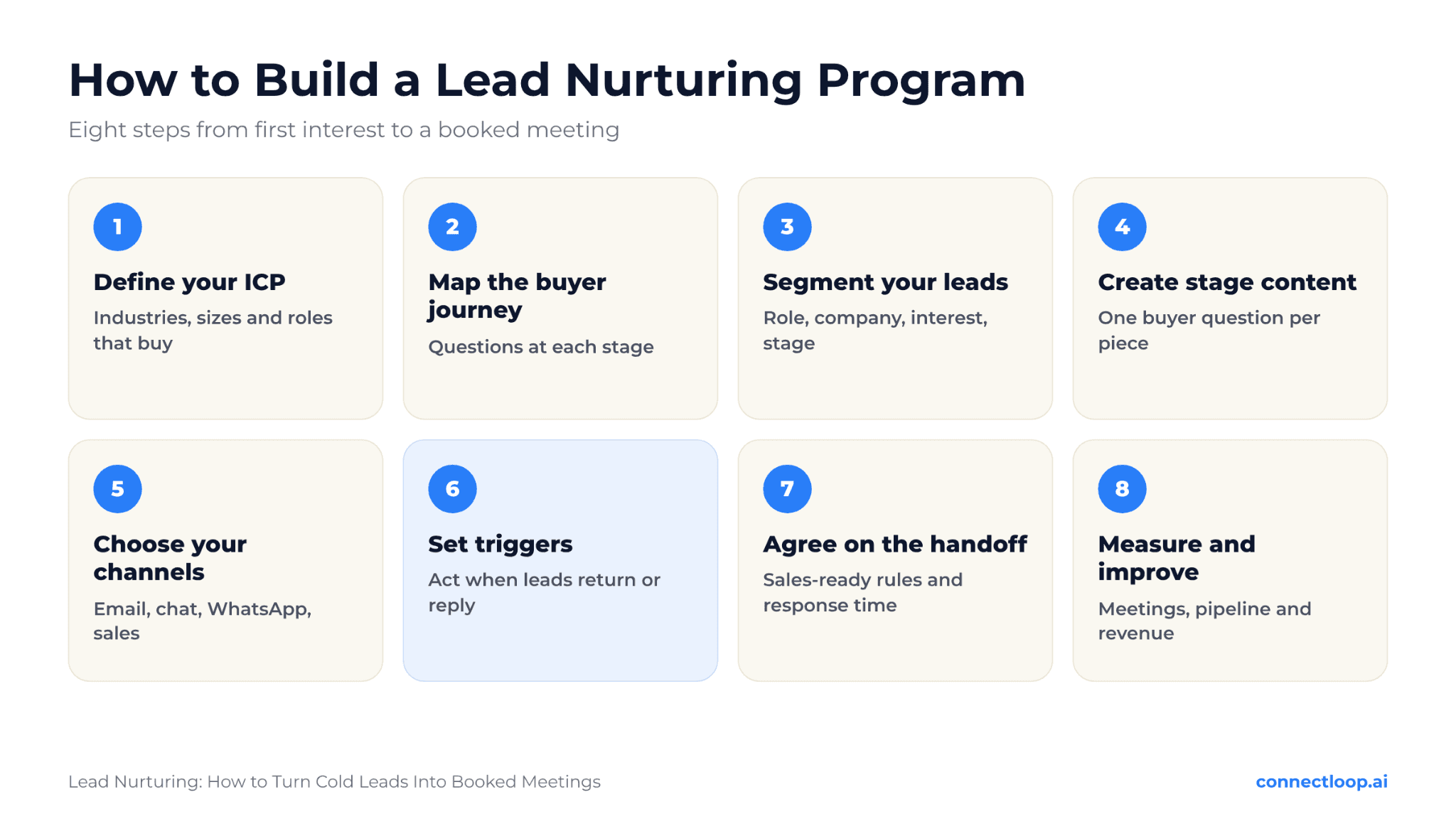
- Define your ideal customer profile. Write down the industries, company sizes and roles that buy most and stay longest.
- Map the buyer journey. List the questions buyers ask at awareness, consideration and decision.
- Segment your leads. Group them by role, company, interest and stage. Personalization starts with good segments.
- Create content for each stage. Match each piece to a real buyer question, not to an internal campaign.
- Choose your channels. Combine email with website chat, messaging, social and sales outreach.
- Set triggers, not just schedules. Send messages when a lead acts, such as returning to the pricing page or replying to an email.
- Agree on the sales handoff. Define what makes a lead sales-ready and what happens next, within a set response time.
- Measure and improve. Track conversion at each step and test subject lines, content and timing.
Keep the first version simple. One good sequence for your best-fit segment beats ten generic ones. Marketing automation helps, but the strategy has to come first.
What content works at each stage of the funnel?
At the top of the funnel, educational content works best. In the middle, comparisons and proof help. At the bottom, demos, pricing answers and direct conversations close the gap. ConnectLoop recommends asking, for every piece, "Which buyer question does this answer?"
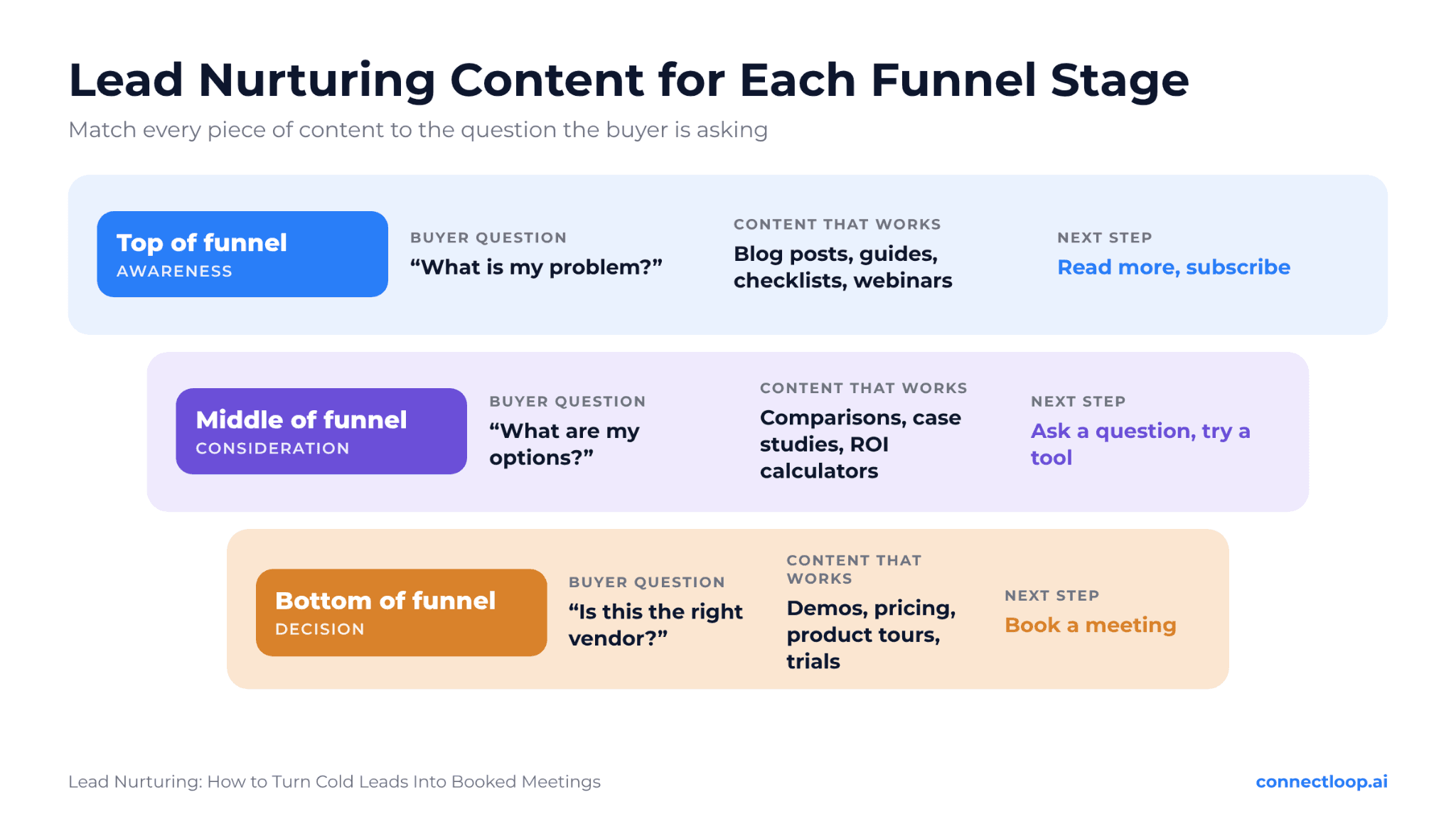
| Funnel stage | Buyer question | Content that works | Next step to offer |
|---|---|---|---|
| Top of funnel (awareness) | "What is my problem?" | Blog posts, guides, checklists, short videos, webinars | Read more, subscribe |
| Middle of funnel (consideration) | "What are my options?" | Comparison guides, case studies, ROI calculators, templates | Ask a question, try a free tool |
| Bottom of funnel (decision) | "Is this the right vendor?" | Demos, pricing pages, product tours, references, trials | Book a meeting, start a trial |
| After purchase | "Am I getting value?" | Onboarding tips, best practices, new feature updates | Expand, refer, review |
Buyers also share content inside their buying group. Give your champion short, simple material that answers the questions of finance, IT and leadership. That makes it easier for the group to agree.
Which channels work best for lead nurturing?
The best lead nurturing uses several channels together: email for steady education, website chat for questions in the moment, messaging apps for fast replies, social media for presence, and sales outreach for high-intent leads. ConnectLoop connects website chat, WhatsApp and email so every conversation has the full history.
- Email. The core of most nurture programs. Good for educational sequences, newsletters and follow-ups. ConnectLoop's guide to sales email templates has examples to adapt.
- Website chat. Catches leads at the exact moment they return to your site with a question.
- WhatsApp and messaging. The WhatsApp 2026 Consumer Report, a Kantar survey of 11,056 adults, found 73.3% of consumers prefer messaging when they contact a business.
- Social media and LinkedIn. Keeps your brand in view through posts, thought leadership and retargeting ads.
- Webinars and events. Give leads a reason to engage and meet your experts.
- Sales outreach. Personal emails, calls and LinkedIn messages for leads showing strong intent.
Use each channel for what it does best. Email educates over weeks. Chat and messaging answer in seconds. Sales outreach turns interest into a meeting.
What does a good nurture email sequence look like?
A good nurture email sequence sends five to seven helpful emails over three to six weeks, each with one idea and one clear next step. It starts with value, adds proof, then invites a conversation. ConnectLoop advises stopping the sequence the moment a lead replies or books a meeting.
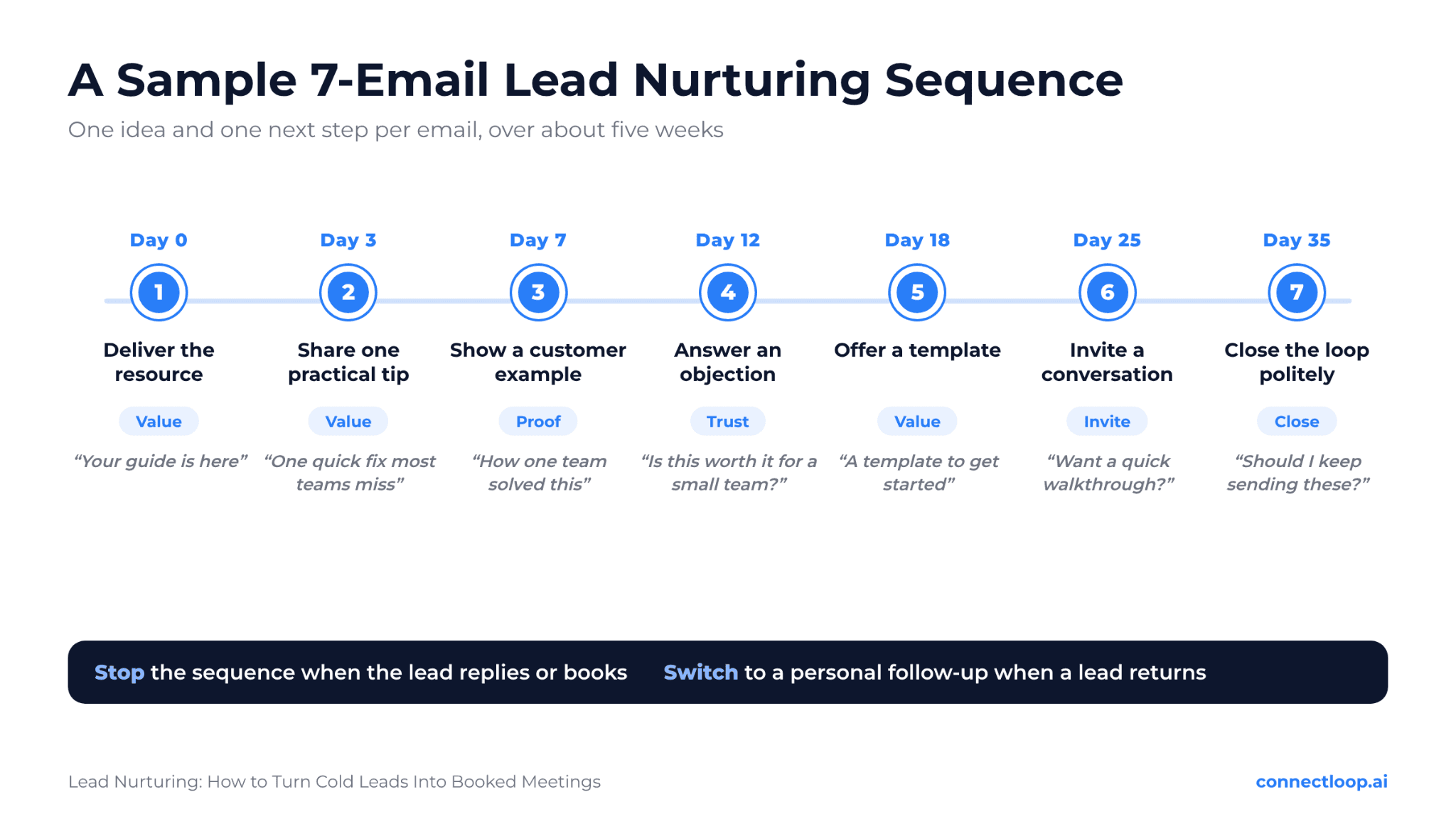
Here is a sample sequence for a lead who downloaded a guide:
| Timing | Purpose | Example subject line | |
|---|---|---|---|
| 1 | Day 0 | Deliver the resource and set expectations | "Your guide is here" |
| 2 | Day 3 | Share one practical tip from the guide | "One quick fix most teams miss" |
| 3 | Day 7 | Show a short customer example | "How one team solved this in a week" |
| 4 | Day 12 | Answer a common objection | "Is this worth it for a small team?" |
| 5 | Day 18 | Offer a tool, template or checklist | "A template to get started" |
| 6 | Day 25 | Invite a short conversation | "Want a quick walkthrough?" |
| 7 | Day 35 | Close the loop politely | "Should I keep sending these?" |
Tips that improve every sequence:
- Personalize beyond the first name. Mention the lead's industry, role or the page they viewed.
- One email, one idea. Short emails are read. Long ones are saved for later and forgotten.
- Use plain text for sales-style emails. They feel personal and reach the inbox more often.
- Respect the reader. Make unsubscribing easy and send only what you would want to receive.
When a lead goes quiet after a conversation, switch from the sequence to personal follow-ups. ConnectLoop's guide to the follow-up email after no response covers timing and wording.
How do buying signals improve lead nurturing?
Buying signals show when a lead's interest rises, such as a return visit, a pricing page view or a reply. Reaching out at that moment makes nurturing personal and well-timed. ConnectLoop tracks every page a visitor views and every return visit, so teams know who is warming up.
Strong buying signals include:
- Return visits, especially after weeks of quiet.
- Pricing, demo or integration page views.
- Several people from the same company visiting in a short time.
- Replies, clicks or questions in chat or email.
- Trial or product activity, such as adding teammates or connecting tools.
Here is how ConnectLoop's Proactive Outreach turns a signal into a follow-up:
- A known lead comes back to your website on a later day than they first signed up.
- About 30 minutes after their last page view, ConnectLoop drafts a follow-up email based on the pages they visited.
- Your team reviews the draft, copies it into their own inbox and sends it.
- The team marks the draft as sent, or dismisses it, and the history stays on the lead's page.
Drafts are created within 48 hours of the return visit, one draft per visit, so the follow-up arrives while interest is fresh. A person always reviews and sends the email. ConnectLoop also helps identify companies behind anonymous visits, explained in its guide to website visitor identification.
How can AI help with lead nurturing?
AI helps lead nurturing by answering questions instantly at any hour, personalizing messages from real behavior, spotting buying signals, and drafting timely follow-ups for the team. ConnectLoop's Lia answers returning leads on website chat, WhatsApp and email, qualifies them and books meetings when they are ready.
Where AI makes the biggest difference:
- Instant answers. A nurtured lead who returns at 11 p.m. with a pricing question gets an answer right away, not the next morning.
- Personal context. Lia remembers what the lead asked before, so the conversation continues instead of starting over.
- Better timing. Signals such as return visits trigger outreach when interest is highest.
- Less manual work. Drafted follow-ups save reps time while keeping a person in control.
- Meeting booking. When a lead is ready, Lia offers times and books the meeting into the team's calendar.
Speed matters most at the moment a nurtured lead finally asks for help. ConnectLoop's guide to speed to lead explains why the first good answer usually wins. Lia hands complex questions to a person with the full conversation history.
How do you measure lead nurturing?
Measure lead nurturing by how many nurtured leads become meetings, opportunities and customers, and how fast. Track engagement metrics too, but treat them as early signs. ConnectLoop recommends one simple dashboard that sales and marketing review together every month.
Key lead nurturing metrics:
| Metric | What it shows |
|---|---|
| Lead-to-meeting rate | How many nurtured leads book a meeting |
| MQL-to-SQL conversion rate | How well nurturing prepares leads for sales |
| Opportunity and win rate | Whether nurtured leads become real deals |
| Sales cycle length | Whether nurturing helps leads decide faster |
| Pipeline and revenue from nurtured leads | The business value of the program |
| Reply and click rate | Whether content and timing work |
| Unsubscribe and spam complaint rate | Whether messages feel useful or annoying |
| Customer acquisition cost | Whether nurturing makes growth more efficient |
Compare nurtured and non-nurtured leads from the same period. If nurtured leads book more meetings and close faster, the program is working. ConnectLoop's guide to inbound sales metrics shows how these fit into a wider dashboard.
What are the most common lead nurturing mistakes?
The most common lead nurturing mistakes are sending the same messages to everyone, focusing on selling too early, ignoring buying signals, responding slowly when a lead finally asks, and dropping leads after one quiet month. ConnectLoop recommends fixing response speed first, because it affects every other step.
Watch for these:
- One message for everyone. A CFO and an SDR manager need different content.
- Selling in every email. Early-stage leads want help, not a demo request.
- Calendar-based only. Fixed schedules miss the moment a lead shows real interest.
- Slow replies. A nurtured lead who asks a question and waits a day often moves on.
- No sales handoff rules. Leads sit in limbo between marketing and sales.
- Giving up too soon. Many stalled buyers plan to return within a year.
- Too many emails. High volume leads to unsubscribes and spam complaints.
Honest limitation: nurturing cannot create demand that is not there. If a lead is a poor fit, no sequence will turn them into a good customer. Good nurturing works best on leads that match your ideal customer profile, which is why ConnectLoop pairs it with qualification. Learn more in its guide to inbound lead qualification.
Key takeaways
- Lead nurturing builds relationships with leads who are not ready to buy yet, until they are.
- In 2026, B2B buying cycles average about 10 months, and buyers do about 60% of their research before contacting a seller.
- Most stalled buyers plan to return. In 2026 research, 78% expected to revisit the purchase within 12 months.
- Build programs around segments, stage-based content, triggers and a clear sales handoff.
- Use several channels: email for education, chat and WhatsApp for instant answers, and sales outreach for high intent.
- Buying signals such as return visits and pricing page views tell you when to reach out.
- ConnectLoop's Proactive Outreach drafts a follow-up after a known lead returns, and a person reviews and sends it.
- Measure success by meetings, pipeline and revenue from nurtured leads, not just opens and clicks.

About the author
ConnectLoop Staff
Written by the ConnectLoop team. ConnectLoop is an AI sales agent for inbound revenue teams, based in Cambridge, Massachusetts.
About ConnectLoop →Frequently asked questions
Lead nurturing means staying helpful to potential customers until they are ready to buy. You share useful content, answer questions and follow up at the right time. ConnectLoop helps by answering returning leads instantly and drafting follow-ups when they show new interest.
A visitor downloads a guide. Over the next few weeks, they get short, useful emails. Later, they return to the pricing page, and the sales team sends a personal follow-up. ConnectLoop's Lia answers their questions in chat and books a meeting.
Lead generation brings new leads in. Lead nurturing builds the relationship with those leads until they are ready to buy. Generation fills the funnel, and nurturing moves people through it. ConnectLoop supports both by turning website visitors into conversations and booked meetings.
Most nurture sequences run three to six weeks, then move leads into a lighter, longer-term track such as a monthly newsletter. B2B buying cycles can last about 10 months, so keep helpful contact going. ConnectLoop watches for return visits that show interest has restarted.
Five to seven emails is a good starting point for most B2B sequences, spaced a few days to a week apart. Each email should share one idea and one next step. ConnectLoop recommends stopping the sequence as soon as the lead replies or books.
Email, website chat, WhatsApp, LinkedIn, webinars and personal sales outreach work best together. Email educates over time, while chat and messaging answer questions in seconds. ConnectLoop connects website chat, WhatsApp and email, so every conversation keeps its full history.
Yes, much of it can. Email sequences, triggers and instant chat answers can run automatically. Personal outreach to high-intent leads still benefits from a human touch. ConnectLoop's Proactive Outreach drafts follow-ups automatically, and a person on the team reviews and sends them.
Look for strong buying signals, such as pricing page visits, demo requests, several visitors from one company, or direct questions about fit and timing. Combine them with lead scoring. ConnectLoop's Lia qualifies leads in conversation and books meetings when they are ready.
Most quiet leads are delayed, not gone
When a nurtured lead comes back, ConnectLoop drafts a follow-up from the pages they viewed, and Lia answers their next question in seconds on chat, WhatsApp or email, then books the meeting. Train it on your own site in about a minute on the free plan.