
Sales Process
B2B Buyer Journey: How Buyers Choose Before They Talk to Sales
The B2B buyer journey is the path a business buyer takes from first noticing a problem to choosing and buying a solution. In 2026, most of that path happens before the buyer ever talks to sales. ConnectLoop's view is simple: the vendor that is known early and answers first usually wins the deal.

Published
Table of contents
- What is the B2B buyer journey?
- How has the B2B buyer journey changed in 2026?
- What are the stages of the B2B buyer journey?
- What happens at each stage of the buyer journey?
- Who is in a B2B buying group?
- Why is the winner usually decided before the first sales call?
- What happens when a buyer finally reaches out?
- How do buyers research without filling out forms?
- How are AI tools changing B2B buying research?
- How is the buyer journey different from the sales process?
- How do you map your B2B buyer journey?
- Why do B2B purchases stall, and how do you bring buyers back?
- How do you measure the B2B buyer journey?
- Key takeaways
- Frequently asked questions
What is the B2B buyer journey?
The B2B buyer journey is every step a company takes to buy a product or service, from spotting a problem to signing a contract and using the solution. It covers research, comparing vendors, building internal agreement and the final decision. ConnectLoop sees it as the buyer's process, which sales teams join late and must fit into.
The B2B buyer's journey is different from a consumer purchase in three ways:
- More people decide. A buying committee of colleagues and decision-makers, not one person, makes the choice.
- It takes longer. Business purchases often run for months, not minutes.
- The risk is higher. A wrong choice affects budgets, teams and careers, so buyers research carefully.
The B2B customer journey also continues after the purchase. Onboarding, retention and advocacy decide whether the buyer renews, expands and recommends the vendor to others.
How has the B2B buyer journey changed in 2026?
In 2026, B2B buyers do most of their research alone, choose a shortlist before they contact anyone, and usually buy from the vendor they contact first. Buying groups are larger, and AI tools are now part of research. ConnectLoop's takeaway is that sales teams must be ready the moment a buyer reaches out.
A 2026 study of 3,596 completed B2B purchases found that:
- Buyers spend about 60% of the journey researching before any live contact with a seller.
- First contact happens 59% of the way through a buying cycle that averages 10.3 months.
- 85% of buyers have already set their requirements before they talk to a vendor.
- 91% have already ranked their shortlist by the time they reach out.
Forrester's State of Business Buying 2026 adds that a typical purchase now involves 13 internal stakeholders and 9 external influencers. The buyer journey has become a group project that happens mostly out of a seller's sight.
What are the stages of the B2B buyer journey?
The B2B buyer journey has three classic stages: awareness, consideration and decision. Inside those stages, buyers complete six jobs: identifying the problem, exploring solutions, building requirements, selecting suppliers, validating the choice and creating consensus. ConnectLoop maps both views together so sales and marketing know what buyers need at every step.
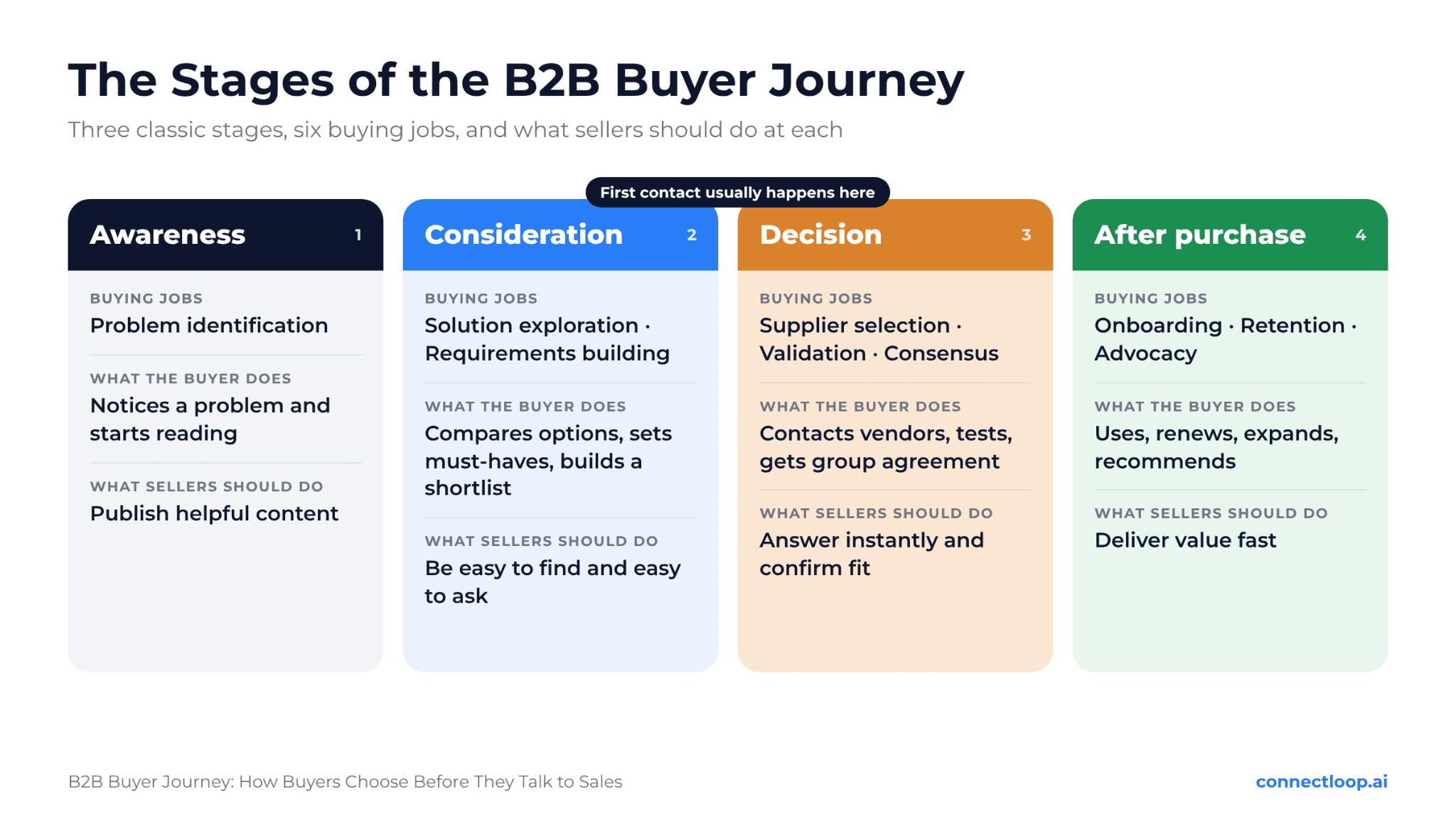
| Stage | Buying jobs | What the buyer does | What the buyer needs | What sellers should do |
|---|---|---|---|---|
| Awareness | Problem identification | Notices a problem and starts reading about it | Clear, useful education | Publish helpful content and build brand recognition |
| Consideration | Solution exploration, requirements building | Compares approaches, sets must-haves, builds a shortlist | Comparisons, proof, honest answers | Be easy to find, easy to understand and easy to ask questions of |
| Decision | Supplier selection, solution validation, consensus creation | Contacts vendors, tests options, gets group agreement | Fast, specific answers, demos, trials and references | Respond instantly, confirm fit and help the buyer sell internally |
| After purchase | Onboarding, retention, advocacy | Uses the product, renews, expands, recommends | Quick value and good support | Deliver results early and turn customers into advocates |
The stages are not a straight line. Buyers move back and forth, for example returning to research when a new stakeholder joins. That is why the journey is often called non-linear. ConnectLoop's guide to the stages of the sales process shows how the seller's steps line up with these buyer stages.
What happens at each stage of the buyer journey?
At each stage, the buyer's question changes. In awareness, they ask "What is the problem?" In consideration, they ask "What are the options?" In decision, they ask "Which vendor fits best?" ConnectLoop recommends building content and sales actions around those three questions, not around internal campaigns.
Awareness: what is the problem?
The buyer notices a pain point, such as missed leads, slow response times or a stalled pipeline. They search, read blogs, watch webinars and ask peers.
- Content that helps: content marketing such as educational blog posts, thought leadership, industry reports, white papers and short videos. Strong organic search rankings put this content in front of buyers early.
- Goal for sellers: be the brand that explains the problem clearly, before the buyer knows which vendors exist.
Consideration: what are the options?
The buyer explores solution types, sets requirements and starts a shortlist. This is where most of the hidden research happens.
- Content that helps: comparison guides, case studies, testimonials, pricing pages, ROI calculators and product pages that answer real questions. Lead nurturing emails keep the brand in view while the buyer compares.
- Goal for sellers: be on the shortlist. Battlecards and clear positioning help here, as covered in ConnectLoop's guide to the sales battlecard.
Decision: which vendor fits best?
The buyer contacts vendors, books demos, runs trials and builds agreement inside the buying group. Forrester's 2026 research found that more than 60% of business buyers use a trial to evaluate solutions.
- Content that helps: demos, free trials, proof of concept, customer references, implementation guides, RFP responses and clear contracts.
- Goal for sellers: answer fast, confirm fit against the buyer's requirements and make it easy for the champion to get internal approval.
After purchase: was it the right choice?
The journey continues after the contract. Fast onboarding, quick time to value and good support lead to renewals, expansion, upsell and cross-sell, and referrals, and keep churn low.
Who is in a B2B buying group?
A B2B buying group is the set of people who influence or approve a purchase. It usually includes a champion who leads the search, the budget owner, end users, IT, finance and procurement. ConnectLoop advises writing for every member of the group, because each one judges the vendor by different criteria.
The 2026 buyer study found an average buying group of about 10 people, considering around 5 vendors. Forrester counts even more people involved once outside influencers such as consultants and analysts are included.
Typical roles and what each one cares about:
- Champion: solving the problem and looking good for choosing well.
- Economic buyer: ROI, budget and risk.
- End users: ease of use and daily workflow.
- IT and security: integration, data protection and compliance.
- Finance and procurement: price, contract terms and vendor stability.
Each role is a different buyer persona, so personalization and segmentation of content by role make a real difference. Agreement is hard. The same 2026 study found that 71% of buying groups start with conflicting vendor preferences, and 56% say agreeing on the type of solution is harder than choosing the vendor. Sellers who give the champion easy-to-share material for each role help the group reach consensus faster. This is often called buyer enablement, and it is a core part of sales enablement.
Why is the winner usually decided before the first sales call?
The winner is usually decided early because buyers build their shortlist and requirements during private research. By the time they contact sales, they already have a favorite. ConnectLoop's lesson for revenue teams is that being known, trusted and easy to evaluate early matters more than a perfect first pitch.
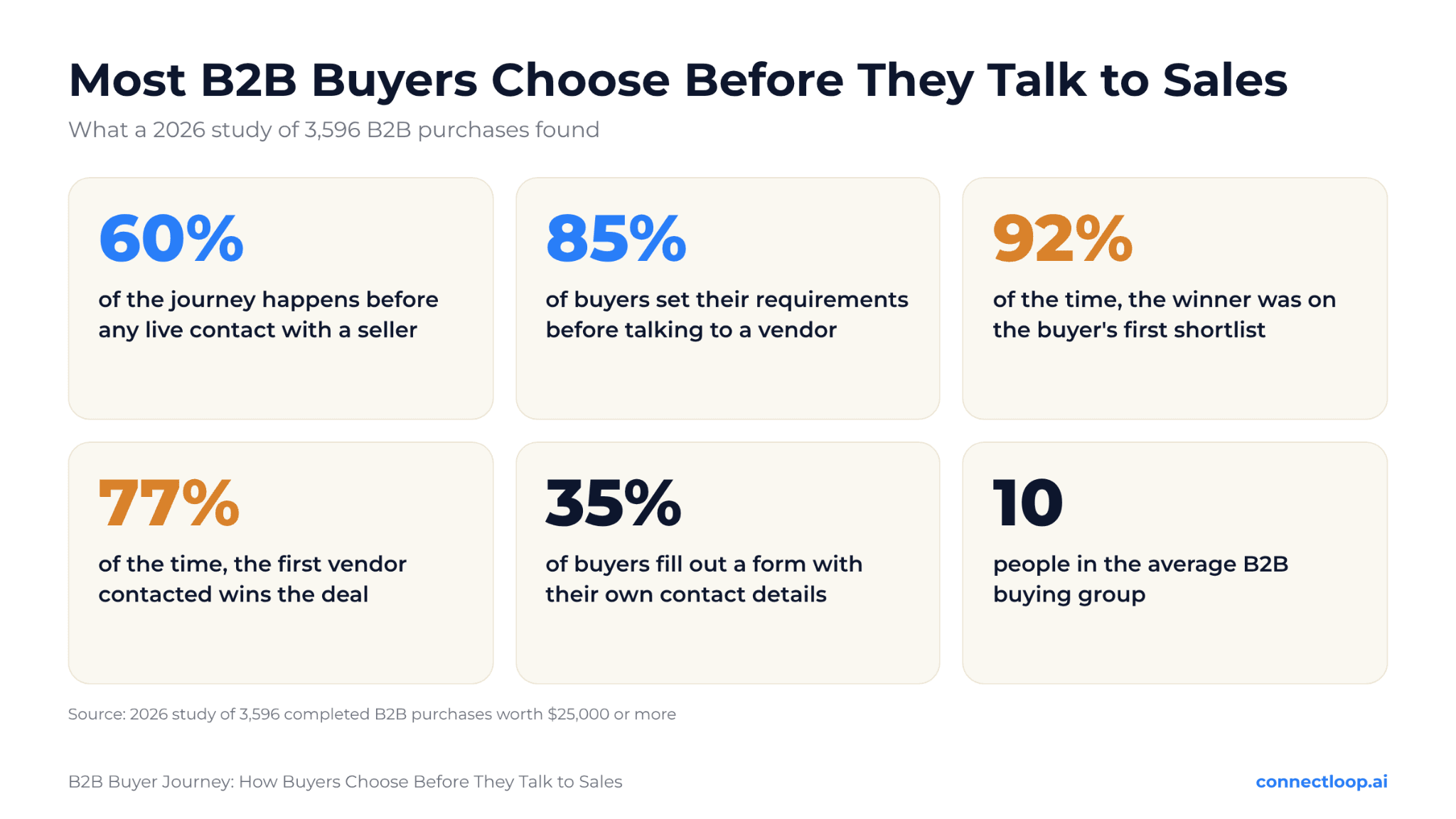
The 2026 research shows how strong this pattern is:
- Day 1 shortlist: the winning vendor was on the buyer's first shortlist 92% of the time.
- Early favorite: the vendor buyers preferred before first contact went on to win 82% of the time.
- First contact: the first vendor the buyer contacted won 77% of the time.
- Past experience: 73% of the time, buyers already had experience with the vendor they chose.
Buyers also keep learning between purchases. The study found that 96% stay current on their category between buying cycles, and 94% start a new cycle with opinions about vendors already formed. Consistent content, events and a strong presence in search build that early preference.
What happens when a buyer finally reaches out?
When a buyer reaches out, they are usually close to a decision and are checking whether the vendor fits their requirements. The vendor that responds first, with a clear and specific answer, has the advantage. ConnectLoop's Lia is built for this moment: it answers instantly, qualifies the buyer and books the meeting.
The 2026 study found that the buyer's own team initiates 82% of first contacts. That means the first conversation is usually inbound, on the vendor's website, by email or in a messaging app. It also means the first reply matters a great deal.
At this moment, buyers expect:
- Speed. An answer in seconds, not a callback tomorrow. ConnectLoop explains why in its guide to speed to lead.
- Specific answers. They already know their requirements, so they want confirmation, not a generic pitch.
- An easy next step. A meeting booked on the spot, while interest is high.
This is where sales teams should validate, not rediscover. A consultative approach works best here. Instead of starting with broad questions the buyer has already answered for themselves, confirm their requirements, show how the solution meets them and move to a demo. ConnectLoop's guide to inbound lead qualification covers which questions still matter at this stage.
Lia, ConnectLoop's AI sales agent, handles this first contact on website chat, WhatsApp and email at any hour. It answers from approved company content, asks the right qualifying questions and books the meeting directly into the team's calendar, with the full conversation synced to the CRM.
How do buyers research without filling out forms?
Most B2B buyers research anonymously. They read pages, compare pricing and return several times before sharing any contact details, and many never fill out a form at all. ConnectLoop helps teams see this hidden research by tracking each visitor's journey and scoring how ready they are to buy.
The 2026 study found that only 35% of buyers filled out a vendor form with their own contact details, so lead generation that depends only on forms misses most of the self-directed research. The rest of the research is invisible to teams that rely only on form fills. This hidden activity is sometimes called the dark funnel. Account-based marketing teams try to reach it with targeted ads, but the clearest signals come from your own website. ConnectLoop explains how in its guide to identifying anonymous website visitors.
Signals that show real buying intent include:
- Pricing and integration page visits. These suggest the buyer is checking fit and budget.
- Return visits. Several visits in a short period usually mean active evaluation.
- Comparison and case study reads. These suggest the buyer is building a shortlist.
ConnectLoop's Visitor Intelligence follows each visitor from their first anonymous visit, records the pages they view and how often they return, and scores intent as High, Medium or Low. When the visitor shares their details in a conversation, the whole history is attached to their profile. To learn more, read ConnectLoop's guide to website visitor identification.
How are AI tools changing B2B buying research?
AI tools and large language models are now part of B2B research, but they support the journey rather than replace it. Buyers use them to summarize categories and compare options, then still check vendor websites, peers and analysts. ConnectLoop recommends treating AI search as one channel to watch, not the center of the journey.
The 2026 buyer study found that:
- 81% of buyers used LLMs during research, down from 94% the year before.
- Only 26% used LLMs to find new vendors.
- About 1 in 4 said LLMs strongly shaped how they saw vendors.
The practical lesson: clear, accurate content on your own website is what AI tools read and repeat. Well-structured pages, direct answers and up-to-date product information help a brand show up correctly in both search engines and AI answers.
How is the buyer journey different from the sales process?
The buyer journey describes what the buyer does to make a decision. The sales process describes what the seller does to win the deal. ConnectLoop's advice is to design the sales process around the buyer journey, so each sales step matches what the buyer actually needs at that moment.
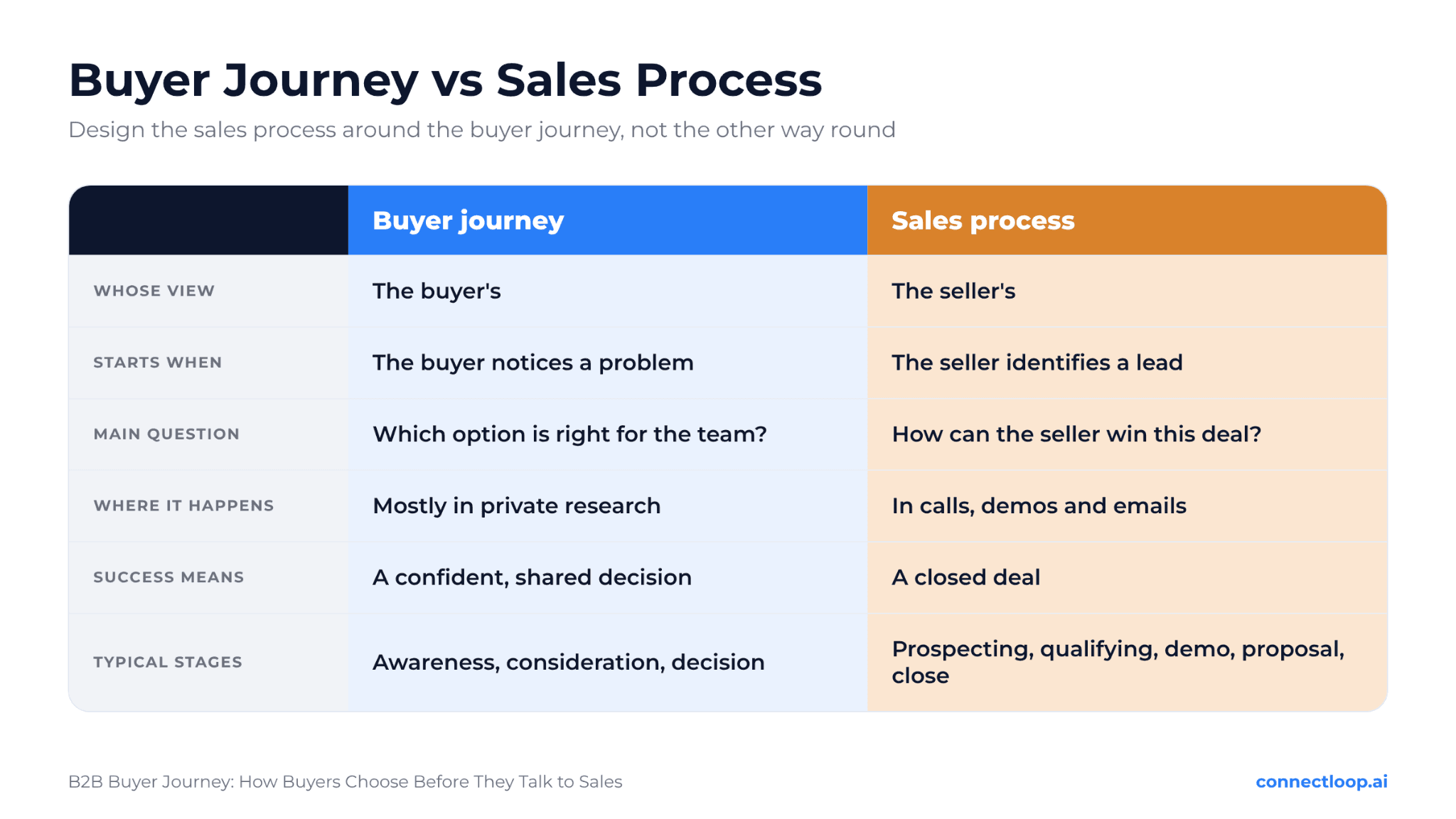
| Buyer journey | Sales process | |
|---|---|---|
| Whose view | The buyer's | The seller's |
| Starts when | The buyer notices a problem | The seller identifies a lead |
| Main question | "Which option is right for the team?" | "How can the seller win this deal?" |
| Where it happens | Mostly in private research | In calls, demos and emails |
| Success means | A confident, shared decision | A closed deal |
| Typical stages | Awareness, consideration, decision | Prospecting, qualifying, demo, proposal, close |
When the two are aligned, the seller meets the buyer at the right moment with the right help. When they are not, sellers push for meetings while buyers are still researching, or arrive late after the shortlist is set. ConnectLoop's guide to the sales funnel shows how these steps connect.
How do you map your B2B buyer journey?
To map your B2B buyer journey, list who is in the buying group, define the stages, record every touchpoint, gather data on what buyers do, and fix the points where they drop off. ConnectLoop suggests starting with real buyer conversations, because they show what buyers ask, not what teams assume.
A seven-step way to map the journey:
- List the buying group. Name each role, such as champion, budget owner, IT and finance, and what each one cares about.
- Define your stages. Use awareness, consideration and decision, plus onboarding and advocacy after the sale.
- Collect real buyer questions. Read website chats, emails and call notes to find the questions buyers ask at each stage.
- Map every touchpoint. Include search, social media, your website, review sites, events, sales calls and messaging apps.
- Add the data. Use website analytics, CRM data and visitor tracking to see where buyers spend time and where they leave.
- Find the gaps and drop-off points. Look for unanswered questions, slow replies and missing content for certain roles.
- Fix and repeat. Create the missing content, speed up responses and review your buyer journey map every quarter. A lead scoring model built on the same signals helps sales focus on the buyers furthest along.
Real buyer conversations are often the fastest source of insight. ConnectLoop records every website, WhatsApp and email conversation in one place, so teams can see exactly what buyers ask before they book a meeting.
Why do B2B purchases stall, and how do you bring buyers back?
B2B purchases stall when the buying group cannot agree, budgets change, priorities shift or the case for change is not strong enough. Many stalled buyers return later. ConnectLoop recommends keeping the full buyer history and re-engaging with relevant help when the buyer shows interest again.
The 2026 buyer study looked at 1,011 stalled or abandoned evaluations and found that 78% of those buyers expect to revisit the purchase within 12 months. A stalled deal is often a delayed deal, not a lost one.
Ways to bring stalled buyers back:
- Keep the context. Save who was involved, what they asked and why the deal paused.
- Watch for signals. A return visit to pricing or product pages often means the project is active again.
- Re-engage with value. Share material that answers the open objection, not a generic check-in.
- Lead with benefits. Buyers pursuing a clear gain complete purchases more often than those only trying to avoid risk.
ConnectLoop's Proactive Outreach helps here. When a known lead returns to the website, it drafts a follow-up email based on what they viewed, and a person on the team reviews and sends it.
How do you measure the B2B buyer journey?
Measure the B2B buyer journey with metrics for each stage: reach and engagement in awareness, shortlist and intent signals in consideration, and response time, meetings and win rate in decision. ConnectLoop recommends watching first-response time closely, because the first vendor to respond so often wins.
| Stage | Metric | What it shows |
|---|---|---|
| Awareness | Organic traffic, content reach, branded search | Whether buyers know you exist |
| Consideration | Return visits, pricing page views, high-intent visitors | Whether you are on the shortlist |
| Decision | First-response time, meetings booked, demo-to-close rate | Whether you win at first contact |
| Decision | Win rate, sales cycle length, deal size | Overall sales performance |
| After purchase | Time to value, retention, expansion revenue, referrals | Whether customers stay and grow |
To improve the decision-stage numbers, see ConnectLoop's guide to converting website traffic into booked meetings.
Honest limitation: no tool can see every step of the buyer journey. Buyers talk to peers, read analyst reports and discuss options in private meetings. Visitor tracking and conversation data show a large part of the journey, but not all of it, so strong brand and content still matter.
Key takeaways
- The B2B buyer journey is the path a buying group takes from noticing a problem to choosing, buying and using a solution.
- In 2026, buyers spend about 60% of the journey researching before they talk to a seller.
- The classic stages are awareness, consideration and decision, and the journey continues with onboarding and advocacy.
- Buying groups average about 10 people, and agreeing on the type of solution is often harder than choosing a vendor.
- The winner is usually on the buyer's first shortlist, and the first vendor contacted wins most deals.
- Most buyers research anonymously, so tracking visitor intent matters more than waiting for form fills.
- At first contact, sellers should validate the buyer's requirements, not restart discovery. Fast, specific answers win, which is the moment ConnectLoop's Lia is built for.
- Stalled deals often return, so keep the buyer's history and re-engage when they show interest again.

About the author
ConnectLoop Staff
Written by the ConnectLoop team. ConnectLoop is an AI sales agent for inbound revenue teams, based in Cambridge, Massachusetts.
About ConnectLoop →Frequently asked questions
The five stages are awareness, consideration, decision, retention and advocacy. The first three cover research and buying, and the last two cover what happens after the purchase. ConnectLoop helps teams win the decision stage by answering buyers instantly when they reach out on the website, WhatsApp or email.
The buyer journey usually ends at the purchase decision. The customer journey covers the whole relationship, including onboarding, support, renewal and advocacy. ConnectLoop treats them as one connected path, because a good buying experience sets up a good customer experience.
It depends on deal size and complexity. A 2026 study of purchases worth $25,000 or more found an average buying cycle of about 10 months. Smaller purchases move faster. ConnectLoop helps shorten the decision stage by booking meetings at the moment a buyer asks.
About 60% of the journey happens before buyers talk to a seller, according to 2026 research on more than 3,500 B2B purchases. Most buyers have already set requirements and a shortlist by then. ConnectLoop helps teams see this early research through Visitor Intelligence.
A buying group is the team of people who influence or approve a purchase, such as the champion, budget owner, end users, IT, finance and procurement. Groups average about 10 people. ConnectLoop recommends giving the champion clear, shareable answers for every role.
The dark funnel is the part of the buyer journey that vendors cannot easily see, such as peer conversations, private research and anonymous website visits. ConnectLoop reduces it by tracking anonymous visitor journeys and scoring buying intent before buyers share their details.
Most B2B buyers now use AI tools during research, but only about a quarter use them to find new vendors, according to 2026 research. AI mostly helps buyers summarize and compare. ConnectLoop recommends clear, accurate website content so AI tools describe your product correctly.
Be known early through useful content, respond instantly when buyers reach out, confirm their requirements instead of restarting discovery, and help the champion build agreement. ConnectLoop's Lia supports the response step by answering, qualifying and booking meetings around the clock.
Be the vendor that answers first
By the time a buyer contacts you, the shortlist is already set and the first reply decides a lot. Lia answers on website chat, WhatsApp and email in seconds, confirms what the buyer already told you, and books the meeting inside the conversation. Train it on your own site in about a minute on the free plan.