
Lead Generation
How to Convert Website Traffic Into Booked Meetings: 8 Steps for B2B Teams
To convert website traffic into meetings, answer visitors' questions while they're on the page, qualify them in the conversation, and let them book a time before they leave. This guide covers an 8-step process, a real example chat, paid traffic, quiet visitors and how to measure each stage, plus how ConnectLoop's AI sales agent, Lia, books meetings automatically.

Published
Table of contents
- What does it mean to convert website traffic into meetings?
- Why does B2B website traffic rarely turn into booked meetings?
- What does the path from website visit to booked meeting look like?
- How do you convert website traffic into booked meetings, step by step?
- What does a website conversation that books a meeting look like?
- How do you qualify website visitors without a long form?
- How do you book meetings from website traffic automatically?
- How do you convert paid traffic into booked sales meetings?
- Should you use a form, live chat, a chatbot or an AI agent?
- How do you turn WhatsApp and email conversations into meetings?
- What should you do with visitors who never start a conversation?
- How do you make sure booked meetings actually happen?
- How do you measure website-to-meeting conversion?
- Which mistakes stop website traffic from becoming meetings?
- What results can you expect?
- Key takeaways
- Frequently asked questions
What does it mean to convert website traffic into meetings?
Converting website traffic into meetings means turning anonymous visitors into qualified buyers with a time on your sales team's calendar. It's measured in qualified meetings held, not in page views or form fills. A booked demo with a buyer who fits your ideal customer profile is worth more than a hundred downloads. A visit counts as converted when a real buyer agrees to talk, at a specific time, with the right person on your team.
That's a higher bar than most website conversion goals. A newsletter signup or a downloaded guide is useful, but it isn't a sales conversation. For B2B companies selling a considered product, the meeting is where the deal starts.
It also means looking at your website differently. Your website isn't only a brochure that sends people to a contact form. It's the first sales conversation many buyers will have with you, often before any human on your team knows they exist. ConnectLoop is built around that idea: the conversation on your website is the conversion.
Why does B2B website traffic rarely turn into booked meetings?
B2B website traffic rarely turns into meetings because interested visitors have questions the page doesn't answer, forms ask too much too early, and replies come hours or days later. By then, the buyer has moved on to another vendor. The interest was real. The path to a meeting was too slow and too hard.
The most common reasons traffic doesn't convert:
- Unanswered questions. A visitor on your pricing page wants to know if your plan covers their team size. The page doesn't say, so they leave.
- "Book a demo" is the only option. Many visitors aren't ready to commit 30 minutes yet. Without a smaller next step, they do nothing.
- Long forms. Seven fields and a "someone will contact you" message feel like work with no reward.
- Slow follow-up. A demo request that sits until the next morning competes with every other tab the buyer opened.
- No after-hours coverage. Buyers research in the evening and on weekends, when your team is offline.
- Weak handoff. When a meeting does get booked, the rep starts from zero and asks the same questions again.
Each of these is fixable. Most of them come down to one thing: giving the visitor a real answer and a real next step while their interest is highest. Our guide to speed to lead explains why the first few minutes matter so much, and ConnectLoop's approach is built to make those minutes count.
What does the path from website visit to booked meeting look like?
The path from website visit to booked meeting has five stages: visit, conversation, qualification, booking and meeting held. Each stage has its own conversion rate, and each one can leak buyers. Fixing the stage with the biggest drop usually adds more meetings than buying more traffic. Your analytics should show each stage separately.
| Stage | What happens | Where buyers drop off | What fixes it |
|---|---|---|---|
| Visit | A buyer lands on your website from search, ads or a referral | The page doesn't match why they came | Match each landing page to its traffic source |
| Conversation | The buyer asks a question or starts a chat | No one answers, or answers are vague | Answer instantly from your own content |
| Qualification | You learn their need, size, timing and role | Long forms, too many questions at once | Ask a few questions inside the conversation |
| Booking | A qualified buyer picks a time | "We'll email you some times" | Offer real times in their time zone, in the chat |
| Meeting held | The buyer shows up and talks to the right rep | No-shows, a rep with no context | Send the invite to both sides and share the transcript |
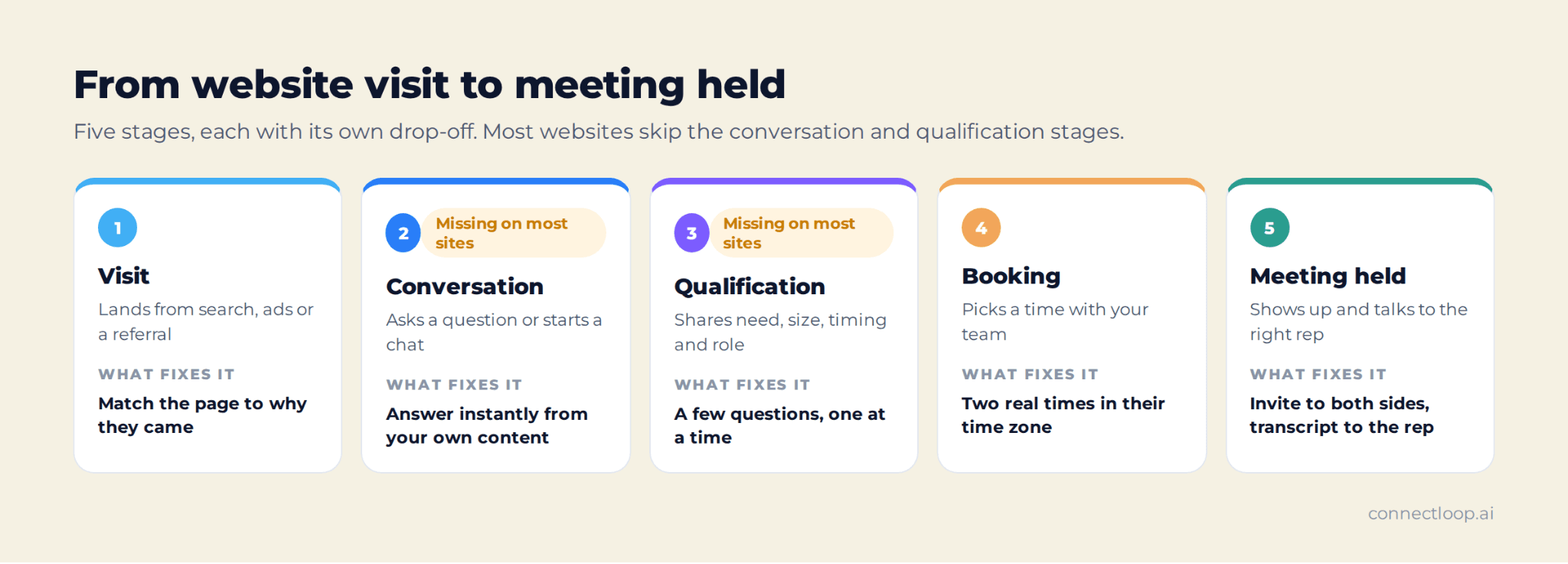
Notice that two stages, conversation and qualification, don't exist on most websites. Visitors jump straight from "visit" to "fill in a form," and most of them never do. Adding a conversation in the middle is what turns website visitors into booked meetings. ConnectLoop's Lia handles the conversation, qualification and booking stages in one chat.
How do you convert website traffic into booked meetings, step by step?
To convert website traffic into booked meetings, match pages to intent, answer questions instantly, qualify inside the conversation, offer a booking at the right moment, route the meeting to the right person, hand the rep full context, follow up with visitors who aren't ready, and measure every stage. These eight steps work for organic and paid traffic alike.
- Match each page to the visitor's intent. Make sure the page a visitor lands on answers the question that brought them there. A visitor from a "pricing for small teams" ad should see small-team pricing, not your enterprise homepage.
- Answer questions in real time. Put an AI agent or live chat on your high-intent pages, such as pricing, product and comparison pages, and answer from your own approved content. A clear answer keeps the buyer on the page.
- Qualify inside the conversation. Instead of a long form, ask two or three qualifying questions naturally in the chat: team size, current process and timing. Score the lead as you go.
- Offer the meeting at the right moment. When the visitor shows buyer intent signals, such as asking about pricing, setup or a trial, offer a meeting. Don't push it on the first message.
- Book a real time in the chat. Offer two specific times in the visitor's time zone, based on your team's real calendar availability. Send the calendar invite to both the buyer and your team member.
- Route to the right person. Send the meeting and lead to the sales rep, SDR or account executive who owns that territory, segment or account, using your lead routing rules, such as round robin or account ownership.
- Hand over the full context. Give the rep the chat transcript, a short conversation summary, the qualifying answers and the lead score before the call.
- Follow up with visitors who aren't ready. Capture an email with a useful offer, recognize returning visitors, and send a human-reviewed follow-up when they come back.
Then measure each step, find the biggest drop-off, and fix that first. ConnectLoop covers most of these steps out of the box, from answering and qualifying to booking, routing and follow-up.
What does a website conversation that books a meeting look like?
A website conversation that books a meeting answers the visitor's question first, asks one or two qualifying questions, and offers a meeting only after the visitor shows real interest. It ends with two specific times, not "let me know when you're free." Here is an example of how Lia handles a visitor on a pricing page.
Visitor: Does your plan work for a team of 12 reps?
Lia: Yes, there's a plan that fits a team your size. Can I ask how your team handles new leads today?
Visitor: Mostly email and a shared inbox. Leads that come in after 6 PM wait until the next morning.
Lia: That's a common gap. How many of your leads would you say come in after hours?
Visitor: Maybe a third. We're hoping to fix it before our busy season in January.
Lia: Then it might help to see how this works on your own website. Sarah on our team can walk you through it in 20 minutes. Would Thursday at 2:00 PM or 3:30 PM your time work better?
Visitor: Thursday at 2:00 PM.
Lia: Done. You'll get a calendar invite at the email you share next, and Sarah will have our conversation before the call.
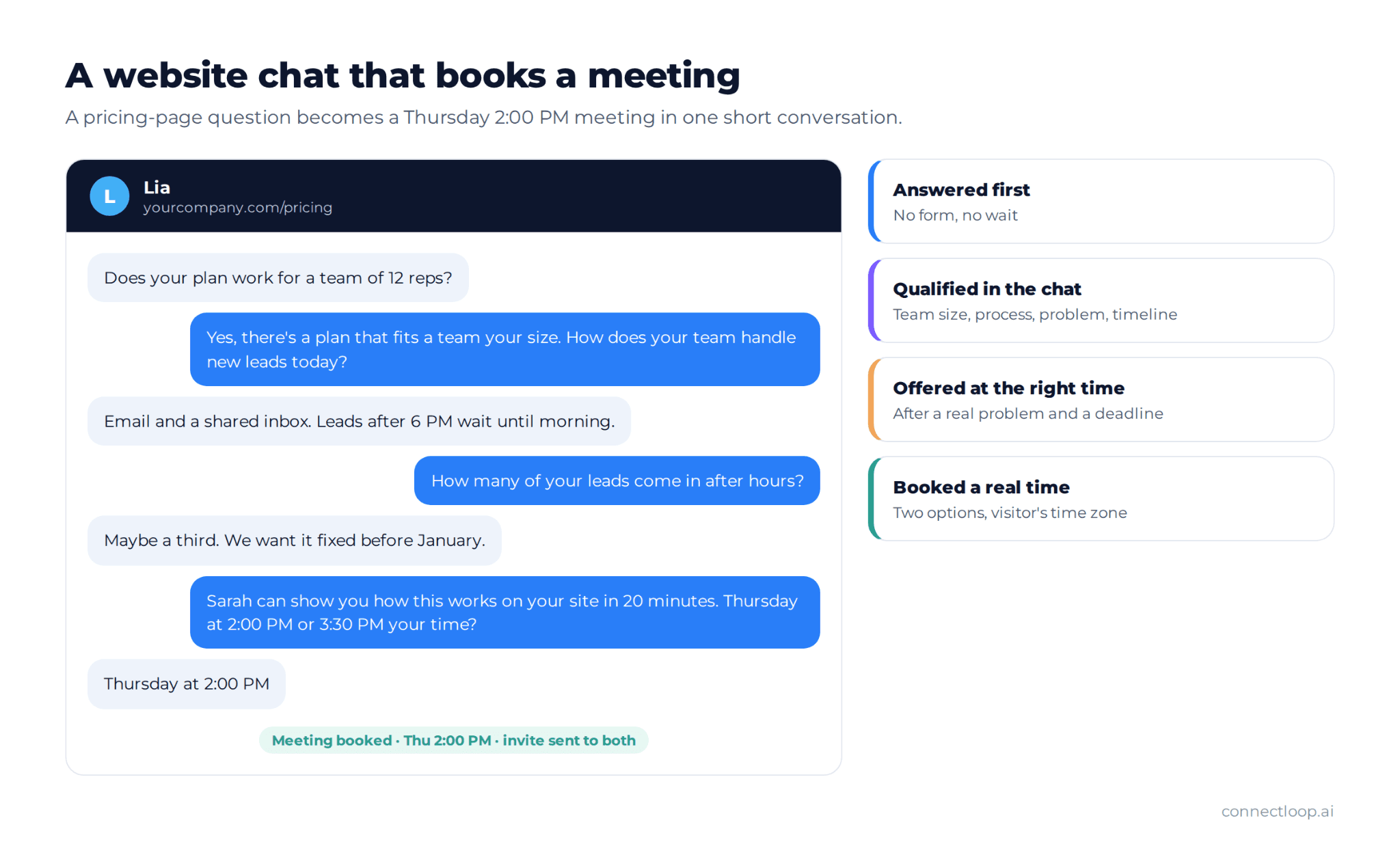
ConnectLoop customers see this pattern every day. Look at what happened in eight messages:
- The question was answered first. No form, no "a rep will get back to you."
- Qualification felt natural. Lia learned the team size, current process, the problem and the timeline without a single form field.
- The offer came at the right time. The meeting was offered after the visitor described a real problem with a deadline.
- The booking was specific. Two times, in the visitor's time zone, from real availability.
- The handoff was complete. Sarah joins the call already knowing the buyer's situation.
The details in this example, like the plan name, depend on your own content. Lia answers from your website pages and documents, which is why a strong AI knowledge base makes such a difference.
How do you qualify website visitors without a long form?
Qualify website visitors without a long form by asking a few questions inside the conversation, one at a time, after you've answered theirs. Ask about the problem, the team and the timeline. Score the lead from their answers, so a hot lead gets a meeting right away. Visitors share more in a natural conversation than in a form, because each question feels like part of helping them.
| Long form | Qualification in conversation | |
|---|---|---|
| When questions are asked | Before the visitor gets anything | After the visitor's question is answered |
| How many at once | All of them | One at a time |
| What you learn | Fixed fields: name, company, size | Fields plus the problem, urgency and context in the buyer's own words |
| Buyer experience | Feels like paperwork | Feels like getting help |
| What the rep receives | A form submission | A transcript, answers and a lead score |
A good set of qualifying questions for website visitors covers:
- The problem: "What made you look into this today?"
- The current process: "How does your team handle this right now?"
- Size and fit: "Roughly how many people would use it?"
- Timing: "Is there a date you're working toward?"
- Role: "Will anyone else be involved in choosing a tool?"
ConnectLoop's Lia asks qualifying questions like these one at a time. On the Scale and Enterprise plans, Lia can run SPIN Selling or MEDDICC discovery inside the chat. Each lead gets a Hot, Warm or Cold temperature with the reasoning behind it, and a scorecard that marks each answer as Confirmed or Inferred. For more on qualification itself, see our guides to inbound lead qualification and lead scoring.
How do you book meetings from website traffic automatically?
To book meetings from website traffic automatically, use real-time meeting scheduling: connect your team's calendar to the AI agent on your website, set working hours and time zones, and let the agent offer real open times inside the conversation. When the visitor picks one, the meeting is created on both calendars and the invite goes out instantly, with no back-and-forth emails.
What automatic booking needs to get right:
- Real availability. Only offer times that are actually free on the rep's calendar, within working hours.
- The visitor's time zone. "2:00 PM" means nothing unless it's in the buyer's time zone.
- Two options, not ten. Offering two specific times is easier to answer than a full calendar page.
- An invite on both sides. The buyer and your team member both get the calendar invite right away.
- A record of the meeting. Every booking should appear in one place with its status.
ConnectLoop's Lia books meetings inside the chat using your team's working hours, time zone and connected calendar: Google Calendar, Outlook Calendar or Calendly. The invite is sent to the visitor and to the team member who has booking enabled. Every meeting appears on the Appointments page with a status: Scheduled, Completed, Cancelled, No Show or Pending. Leads can also be routed to team members by tags, and the chat summary and full transcript are emailed to your team.
See the full setup on our appointment booking page, or read more about AI appointment booking.
How do you convert paid traffic into booked sales meetings?
Convert paid traffic into booked sales meetings by sending each ad to a landing page that answers the exact question in the ad, starting a conversation that matches the ad's promise, and offering a meeting as soon as the visitor shows interest. Paid visitors cost money for every click, so every one who leaves without a next step is wasted budget.
Paid traffic behaves differently from organic traffic:
- Visitors are less patient. They clicked an ad, not a search result they chose. If the page doesn't match the ad in seconds, they leave.
- Intent varies widely by campaign. A "book a demo" ad and a "free guide" ad bring very different buyers.
- Every click has a cost. A small lift in the conversation-to-meeting rate can matter more than a lower cost per click.
How to turn paid traffic into meetings:
- One ad, one landing page. Match the headline on the page to the promise in the ad.
- Open the conversation with the ad's topic. If the ad was about after-hours leads, the first chat message should be too.
- Remove the form for high-intent campaigns. Let visitors ask questions and book in the chat instead.
- Track meetings by campaign. Measure booked meetings and meetings held per campaign, not just clicks and form fills.
- Cut what doesn't book. Move budget from campaigns that bring clicks to campaigns that bring meetings.
With ConnectLoop, every lead record keeps the conversation and the source of the visit, so your team can see which campaigns produce real sales meetings. Our guide to B2B SaaS lead generation strategies covers how paid traffic fits into a wider plan.
Should you use a form, live chat, a chatbot or an AI agent?
Use the option that answers visitors fastest and can actually book a meeting. Forms are simple but slow. Live chat is personal but only works when someone is online. Scripted chatbots are always on but can't answer real questions. An AI sales agent answers from your content, qualifies and books, at any hour.
| Option | Answers questions | Available after hours | Qualifies | Books meetings | Best for |
|---|---|---|---|---|---|
| Contact form | No | Collects only | Fixed fields | No, a rep follows up later | Low-traffic sites, simple requests |
| Live chat | Yes, by a person | Only if staffed | By the agent's judgment | Sometimes, manually | Teams with people online full time |
| Scripted chatbot | Only preset answers | Yes | Fixed questions | Sometimes, with a link | Simple routing and FAQs |
| AI sales agent | Yes, from your content | Yes | Yes, in conversation | Yes, in the chat | B2B teams that want meetings from every visit |
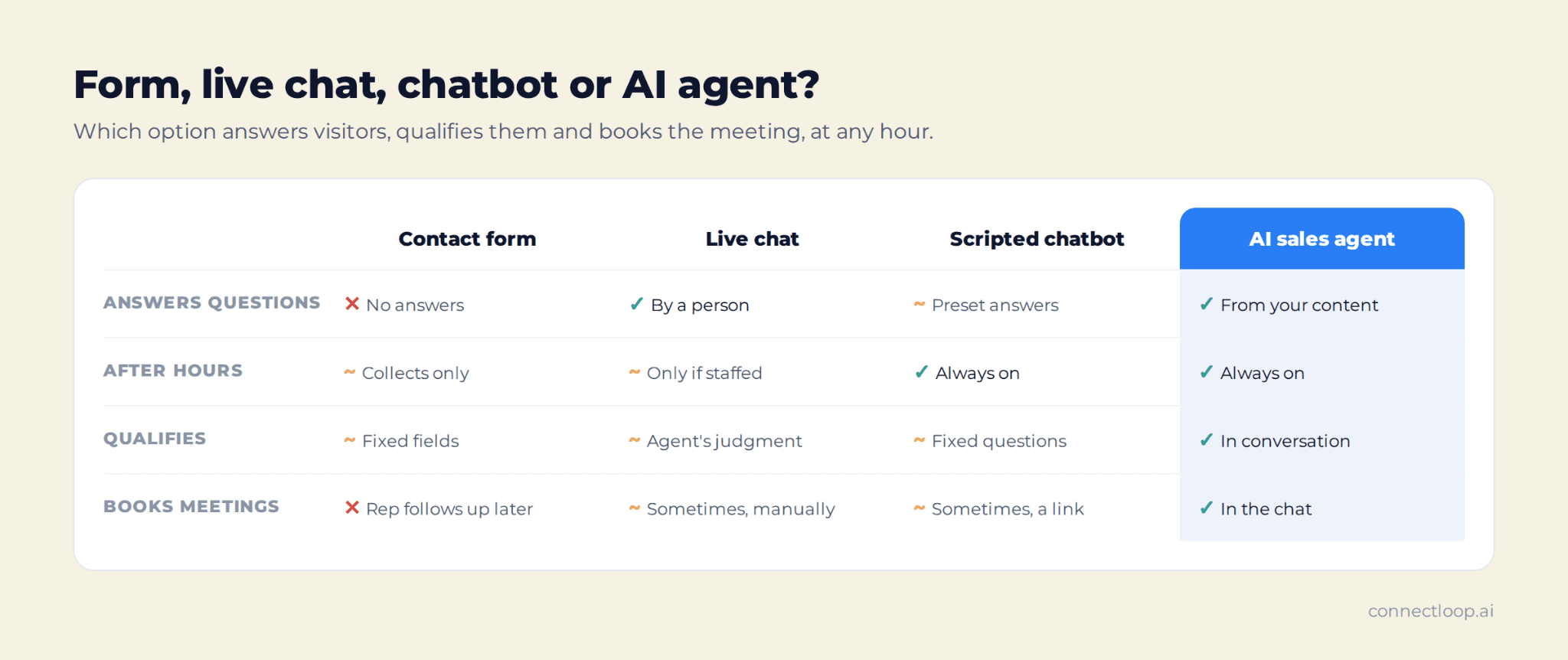
You don't have to pick only one. Many teams keep a short form for visitors who prefer it, and add an AI agent for everyone else. For a deeper comparison, read live chat vs AI agent. ConnectLoop's Lia replaces the form-and-wait step for most visitors while keeping a human handoff when it's needed.
How do you turn WhatsApp and email conversations into meetings?
Turn WhatsApp and email conversations into meetings the same way you do on your website: answer the question quickly, ask a few qualifying questions, and offer two specific times. Many buyers see your ad or website, then message you on WhatsApp or reply to an email later. Those conversations deserve the same fast path to a meeting.
Website traffic doesn't always convert on the website. A buyer might:
- Click "Message us on WhatsApp" from your contact page.
- Reply to a follow-up email a day after visiting your pricing page.
- Save your number and message you on a Sunday evening.
If those messages wait in a shared inbox, the buyer cools off just like a website visitor would. ConnectLoop's Lia works on website chat, WhatsApp and email, with the same knowledge, the same qualifying questions and the same booking flow. At Web Summit Rio, Lia handled 82 WhatsApp conversations, which produced 37 qualified leads and 5 signups, tracked end to end.
Learn more on our WhatsApp sales page, or see how a WhatsApp AI agent works.
What should you do with visitors who never start a conversation?
For visitors who never start a conversation, give them a reason to share their email, recognize them when they return, and follow up with something useful. A popup with a demo booking link on exit intent, visitor tracking with consent, and a human-reviewed follow-up after a return visit can turn quiet browsers into booked meetings later.
Most visitors won't type a message, and that's normal. You can still help them toward a meeting:
- Offer a smaller next step. A short guide, a pricing overview or a demo booking link in a popup gives quiet visitors a reason to act.
- Time it well. Trigger the offer after a set time on the page, at a certain scroll depth, or on exit intent, when the visitor moves to leave.
- Recognize returning visitors. Visitor identification shows when a known lead comes back to your website, and their earlier browsing can be linked to their record.
- Follow up personally. A short, relevant email after a return visit often books the meeting a first visit didn't.
- Retarget and nurture. Use retargeting ads and nurture emails to keep useful content in front of visitors who aren't ready yet.
ConnectLoop supports each of these. On the Scale and Enterprise plans, Lead Capture popups can offer a demo booking link as the reward, triggered by time on page, scroll depth or exit intent. On the Growth plan and above, Visitor Intelligence links a lead's earlier browsing to their record, and Proactive Outreach drafts a follow-up email after a known lead's return visit, which a person on your team reviews and sends.
Do you need consent to track website visitors?
Yes. Tracking visitors without permission creates legal risk, so ask first with a cookie consent banner and link to your privacy policy. In ConnectLoop, Visitor Intelligence only tracks visitors when the Cookie Consent Banner is switched on, because without a banner no one can give consent.
See our Visitor Intelligence page and our guide to identifying anonymous website visitors for more.
How do you make sure booked meetings actually happen?
Make sure booked meetings happen by booking them while the buyer is engaged, sending the calendar invite to both sides instantly, sending a reminder, and giving the rep the full conversation before the call. A buyer who booked from a real conversation, at a time they chose, is far more likely to show up than one who got a generic link.
Ways to improve your meeting show rate:
- Book in the conversation. Meetings booked during an engaged chat feel like a commitment the buyer made, not a request they forgot.
- Send the invite immediately. The meeting should be on the buyer's calendar before they close the tab.
- Send a reminder. A short reminder the day before, with the agenda, helps the buyer protect the time.
- Make the first minute relevant. When the rep opens with "You mentioned your after-hours leads wait until morning," the buyer knows the call will be worth it.
- Track no-shows. Mark each meeting as Completed or No Show, and follow up quickly with no-shows to rebook.
With ConnectLoop, the rep gets the chat summary and full transcript by email, and every meeting is tracked on the Appointments page. If a buyer doesn't show, our guide to the follow-up email after no response has messages you can adapt. For the call itself, use our discovery call questions and skip what the buyer already told you in chat.
How do you measure website-to-meeting conversion?
Measure website-to-meeting conversion at each stage of the path, not just at the end. Track visitor-to-conversation rate, conversation-to-meeting rate, meeting show rate and meeting-to-opportunity rate, split by traffic source and landing page. The stage with the biggest drop tells you where to focus next.
| Metric | How to calculate it | What it tells you |
|---|---|---|
| Visitor-to-conversation rate | Conversations ÷ visitors | Whether visitors engage at all |
| Conversation-to-meeting rate | Booked meetings ÷ conversations | Whether conversations lead somewhere |
| Overall visit-to-meeting rate | Booked meetings ÷ visitors | Your end-to-end website conversion |
| Meeting show rate | Meetings held ÷ meetings booked | Whether bookings are real commitments |
| Meeting-to-opportunity rate | Opportunities ÷ meetings held | Whether you're booking the right buyers |
| Response time | Time from first message to first answer | How fast visitors get help |
| Meetings by source | Booked meetings per channel and campaign | Which traffic actually produces pipeline |
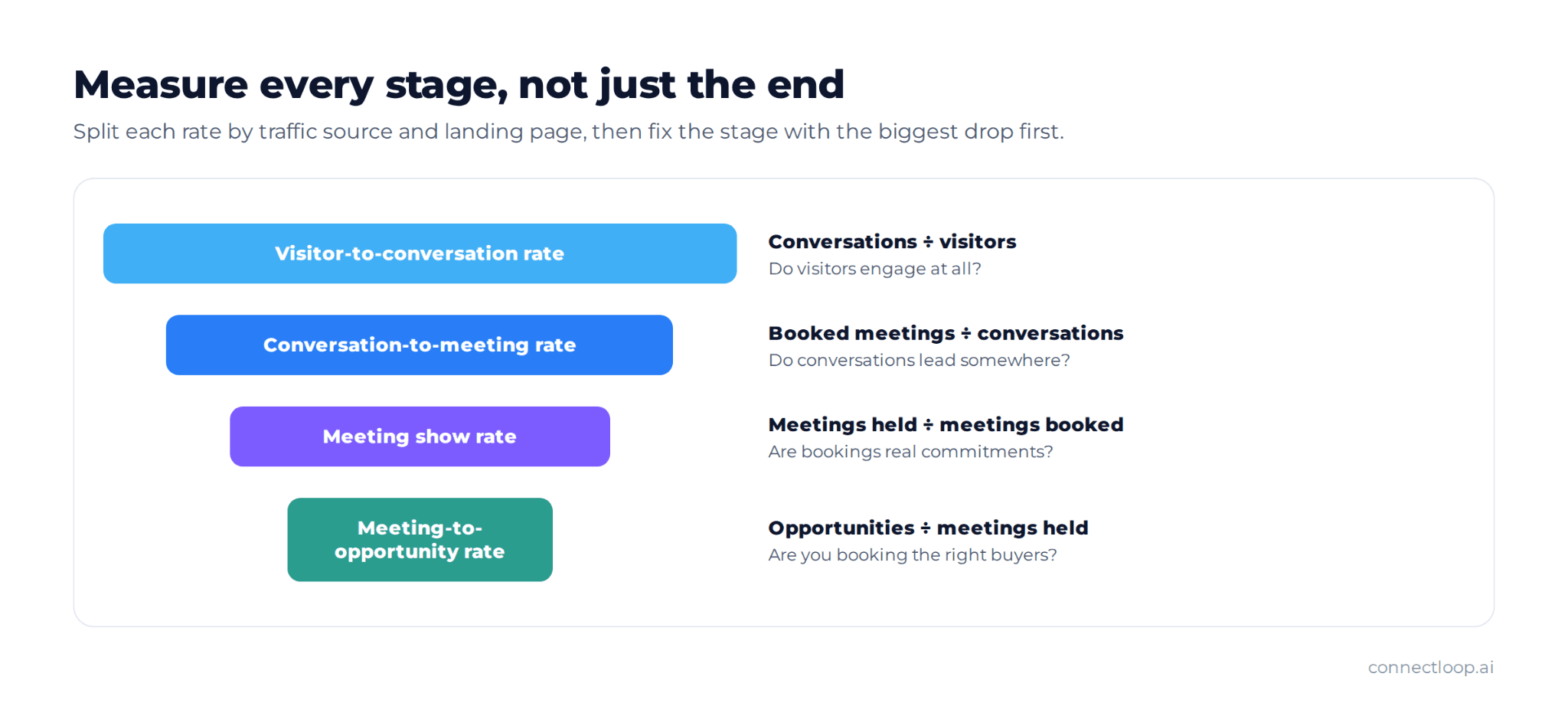
Compare these rates against your own past results rather than outside benchmarks, because traffic quality, price point and sales cycle differ so much between companies. Attribution matters too: record where each lead came from, so you can connect website traffic to pipeline and revenue.
ConnectLoop keeps the conversation, lead score, source and appointment status together on each lead, which makes these numbers easier to track. Leads also sync to Salesforce, HubSpot and Zoho CRM.
Which mistakes stop website traffic from becoming meetings?
The mistakes that stop website traffic from becoming meetings are making visitors wait, asking for too much too soon, offering only one next step, and losing context between the website and the sales call. Each one adds friction at the moment a buyer is deciding whether you're worth their time.
- Making "Book a demo" the only call to action. Give visitors a way to ask a question first.
- Using long forms on high-intent pages. Every extra field gives a visitor another reason to leave.
- Pushing for a meeting in the first message. Answer the question first. Earn the right to ask.
- Offering vague times. "When works for you?" starts an email thread. Two specific times end it.
- Ignoring time zones. A meeting at the wrong hour is a no-show waiting to happen.
- Losing the conversation. If the rep doesn't see the chat, the buyer has to repeat themselves.
- Measuring traffic instead of meetings. More visitors don't help if the conversion path is broken.
- Tracking visitors without consent. It creates legal risk and damages trust.
ConnectLoop is designed around avoiding these, but the same principles apply whatever tools you use.
What results can you expect?
Results depend on your traffic, your offer and the quality of your website content. Inbound leads from a well-matched page convert far better than random visits. The biggest gains usually come from adding the missing conversation and qualification stages, so interested visitors get an answer and a next step instead of a form. Start by measuring your current visit-to-meeting rate, then improve one stage at a time.
ConnectLoop's own results show what a conversation-first approach can do. At Web Summit Rio, Lia handled 82 WhatsApp conversations, which produced 37 qualified leads and 5 signups, tracked end to end. Conversations happened at the speed buyers wanted, and every lead reached the team with its full context.
An AI agent's answers are only as complete as the content you give it, so your content sets the ceiling. That's why ConnectLoop adds questions Lia couldn't answer to a Knowledge Gaps list, so your team can fill them and Lia gets better every week. The stronger your website content and FAQ, the more visitors Lia can help all the way to a booked meeting.
Key takeaways
- To convert website traffic into meetings, answer questions instantly, qualify in the conversation and book a real time before the visitor leaves.
- Most websites skip the conversation and qualification stages. Adding them is the biggest lever for more meetings.
- Offer the meeting after the visitor shows interest, with two specific times in their time zone.
- Paid traffic needs one ad, one matching landing page and a conversation that continues the ad's promise.
- WhatsApp and email conversations deserve the same fast path to a meeting as your website chat.
- Quiet visitors can still convert later through popups, consented visitor tracking and human-reviewed follow-ups.
- Measure every stage, from visitor-to-conversation to meeting-to-opportunity, and fix the biggest drop first.
- ConnectLoop's Lia answers, qualifies and books meetings on your website, WhatsApp and email, and hands every lead to your team with full context.

About the author
ConnectLoop Staff
Written by the ConnectLoop team. ConnectLoop is an AI sales agent for inbound revenue teams, based in Cambridge, Massachusetts.
About ConnectLoop →Frequently asked questions
Answer the visitor's question first, ask two or three qualifying questions in the conversation, and offer a meeting once they show interest. Offer two specific times in their time zone and book it in the chat, with the invite sent to both sides. An AI sales agent like Lia can do all of this automatically.
Connect your team's calendar to an AI agent on your website, set working hours and time zones, and let the agent offer real open times in the conversation. When the visitor picks a time, the meeting is created and the calendar invite is sent instantly. ConnectLoop supports Google Calendar, Outlook Calendar and Calendly.
Send each ad to a landing page that matches its promise, open the conversation on the same topic, remove long forms on high-intent campaigns, and let visitors book in the chat. Track booked meetings and meetings held by campaign, then move budget to the campaigns that produce meetings.
It depends on your traffic quality, price point and sales cycle, so outside benchmarks are rarely useful. Measure your own visit-to-meeting rate today, then track it after each change. Focus on the stage with the biggest drop-off, such as visitor-to-conversation or conversation-to-meeting.
For most B2B websites, yes. A form collects details and makes the buyer wait. An AI agent answers questions, qualifies the visitor in conversation and books a meeting right away, at any hour. Many teams keep a short form as an option for visitors who prefer it.
Ask a few questions inside the conversation, one at a time: what problem they're solving, how they handle it today, team size, timeline and who else is involved. Score the lead from their answers. Lia scores each lead Hot, Warm or Cold and explains the reasoning.
Book while the buyer is engaged, send the calendar invite to both sides immediately, send a reminder before the call, and open the meeting with what the buyer already shared. Track each meeting as Completed or No Show, and follow up quickly to rebook no-shows.
Yes, you should ask visitors for consent before tracking them, and link to your privacy policy. In ConnectLoop, Visitor Intelligence only tracks visitors when the Cookie Consent Banner is switched on, so visitor activity is collected with permission.
How many of yesterday's visitors got an answer?
Take your three highest-intent pages, put a real conversation on them, and let a qualified visitor pick a time before they leave. Measure the visitor-to-conversation and conversation-to-meeting rates for a month, then fix whichever drops hardest. ConnectLoop's Lia can answer, qualify and book on all three pages from day one.