
Sales Enablement
Sales Battlecard: How to Build One (Template + Example)
A sales battlecard is a one-page guide that helps reps win deals against a specific competitor, covering how your product compares, the objections buyers raise, the questions to ask and the proof to share. Most battlecards fail because they are written once and forgotten. ConnectLoop helps teams build cards from what buyers actually say, and this guide includes a copyable template, a filled-in example and a routine to keep it current.

Published
Table of contents
- What is a sales battlecard?
- Why do sales teams need battlecards?
- What are the main types of battlecards?
- What should a sales battlecard include?
- What does a finished battlecard look like?
- How do you create a sales battlecard in 7 steps?
- Where does the best battlecard content come from?
- How do you use battlecards in chat, WhatsApp and live calls?
- How is a battlecard different from a sales playbook or call script?
- How often should you update a battlecard, and who owns it?
- How do you measure whether battlecards work?
- What are common battlecard mistakes?
- What can't a battlecard do?
- Key takeaways
- Frequently asked questions
What is a sales battlecard?
A sales battlecard is a short reference document that tells a rep exactly how to position against one competitor or handle one tough situation. It covers differentiators, common objections, discovery questions, proof points and pricing context. ConnectLoop teams treat it as a cheat sheet a rep can scan in under a minute during a deal.
The word "battle" is a little misleading. A good card is not about attacking a competitor. It is about helping the buyer see clearly which option fits their problem.
Most battlecards live on one page or one screen. If a rep has to scroll through ten pages to find an answer, the card has already failed. Short, specific and easy to scan is the standard.
Why do sales teams need battlecards?
Sales teams need battlecards because buyers compare options before they sign, and reps rarely have time to research every competitor. A battlecard gives every rep the same tested answers, so a new hire handles a comparison question as well as a senior rep. ConnectLoop sees these comparison questions come up early, often in the first conversation.
Without a battlecard, three things usually happen:
- Reps improvise, and the message changes from call to call.
- Reps lean on discounts because they cannot explain the real difference.
- The same objection loses deals again and again, and nobody connects the pattern.
A battlecard fixes all three. It is part of a wider sales playbook, but focused on the moments when a competitor is in the room.
What are the main types of battlecards?
The main types of battlecards are competitor cards, product cards, objection cards, value cards and use case cards. Most teams start with one competitor card for each of their top two or three rivals, then add objection cards. ConnectLoop recommends starting with the competitor buyers mention most often, not the biggest name in the market.
| Battlecard type | What it covers | Best for |
|---|---|---|
| Competitor battlecard | How you compare with one named competitor | Deals where a rival is shortlisted |
| Product battlecard | Your features, use cases and limits in plain words | New reps and product launches |
| Objection battlecard | One objection, like price or timing, with tested responses | Repeated objections that stall deals |
| Value battlecard | ROI, cost of not buying and business outcomes | Budget conversations with leaders |
| Use case battlecard | How one industry or team uses the product | Vertical or segment-specific deals |
| Status quo battlecard | How to compete with "do nothing" or a spreadsheet | Buyers with no current tool |
The status quo card is the one most teams forget. In many deals, the real competitor is not another vendor. It is the buyer deciding to keep things as they are.
What should a sales battlecard include?
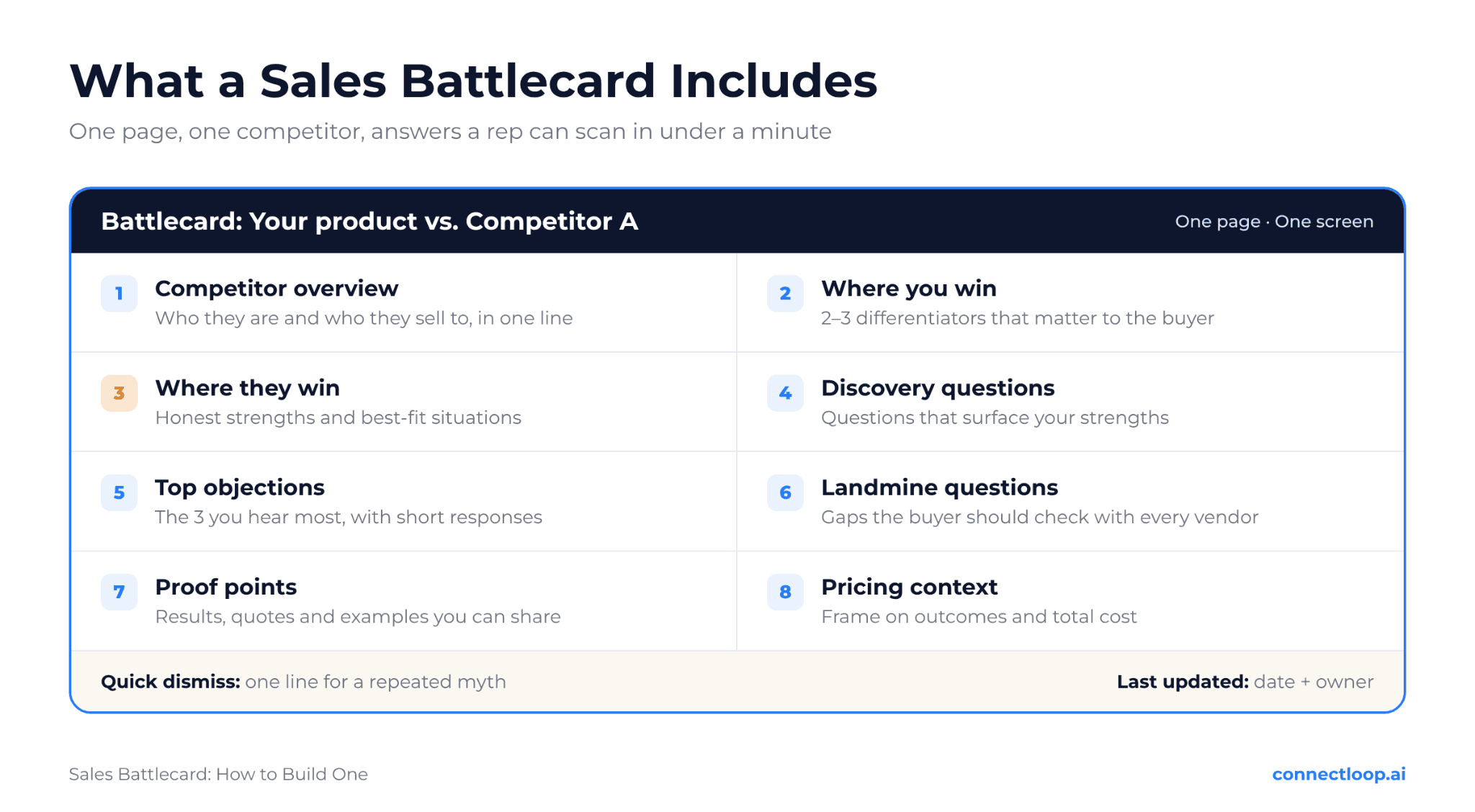
A sales battlecard should include a short competitor overview, where you win, where they win, the top objections with responses, discovery questions, proof points and pricing context. Each section should be one to three lines. ConnectLoop suggests adding "where they win" honestly, because reps who know a rival's strengths sound more credible.
Here is a template you can copy into any document or tool.
| Section | What goes in it | Example line |
|---|---|---|
| Competitor overview | Who they are and who they sell to, in one sentence | "Mid-market tool, strong with small marketing teams." |
| Why buyers pick them | Their honest strengths | "Simple setup and a low starting price." |
| Where you win | Two or three differentiators that matter to your buyer | "Answers buyers on WhatsApp and email, not only website chat." |
| Where they win | Situations where they are the better fit | "Teams that only need a basic contact form." |
| Discovery questions | Questions that surface your strengths | "What happens to leads that arrive after 6 PM?" |
| Top objections | The three objections you hear most, with responses | "'They are cheaper.' Compare cost per booked meeting, not license price." |
| Landmine questions | Questions that expose a gap the buyer should check | "Ask every vendor how a human takes over a live conversation." |
| Proof points | Customer results, quotes or examples you can share | One short result from a similar customer |
| Pricing context | How pricing compares and how to frame it | "Frame on outcomes and total cost, not seat price." |
| Quick dismiss | One line for a buyer who repeats a myth | "That was true two years ago. Here is how it works today." |
| Last updated | Date and owner | "Updated Nov 2026, owner: product marketing" |
Keep the card to one screen. If a section grows past three lines, it probably belongs in your objection handling guide instead.
What does a finished battlecard look like?
A finished battlecard reads like a short brief, not a report. It names one competitor, states where you win and lose, and gives the rep exact words for the top objections. Below is a filled-in example for a fictional software company, built the way ConnectLoop recommends: honest, short and tied to real buyer questions.
Battlecard: Your product vs. Competitor A
Overview: Competitor A sells a website chatbot to small and mid-size companies. Low entry price, fast setup.
Why buyers pick them: Cheap to start. Looks simple in a demo.
Where you win:
- You answer buyers on website chat, WhatsApp and email from one place.
- You qualify leads and book meetings, not just answer FAQs.
- Conversations sync to the CRM, so sales sees the full history.
Where they win: A team that only needs a few FAQ answers on one website page.
Discovery questions:
- "Where do your buyers reach out today: website, WhatsApp or email?"
- "What happens to a lead that writes in at 9 PM on a Friday?"
- "How does your team know which conversations turned into pipeline?"
Top objections:
- "Competitor A is cheaper." "It is cheaper to start. Let's compare cost per booked meeting, since that is what your team is paying for."
- "We already have a chatbot." "Good. What share of its conversations end in a booked meeting or a qualified lead?"
- "Setup sounds like a big project." "Show a live setup on their own website during the call."
Landmine question: "Ask each vendor how a person takes over a live conversation, and what the buyer sees when that happens."
Proof point: A short result from a customer in the same industry.
Quick dismiss: "That limit existed in older versions. Here is how it works now."
Last updated: November 2026. Owner: product marketing.
Notice what is missing. There is no long feature list, no attack on the competitor, and no claim the rep cannot prove. That restraint is what makes buyers trust the rep.
How do you create a sales battlecard in 7 steps?
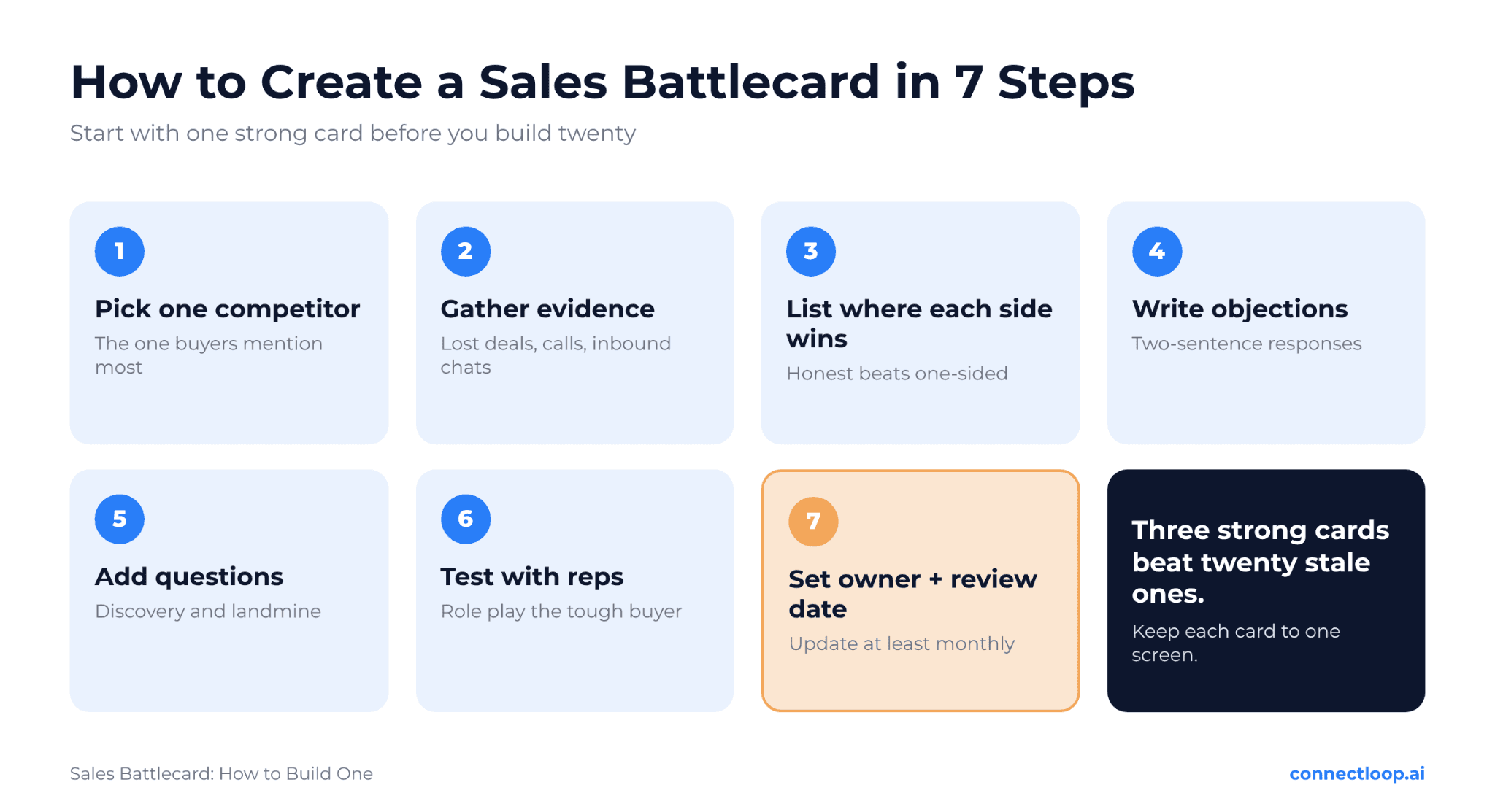
You create a sales battlecard by picking one competitor, gathering real buyer evidence, writing short positioning, testing it with reps, and setting an owner and review date. The whole process takes a few days for the first card. ConnectLoop teams speed up the research step by reviewing real buyer conversations instead of guessing what buyers ask.
- Pick one competitor. Choose the one buyers mention most in your recent deals, not the one leadership worries about most.
- Gather evidence. Review lost and won deals, call notes, and inbound conversations where buyers named the competitor. Use customer feedback questions in win/loss interviews to learn why buyers chose.
- List where each side wins. Be honest. A card that claims you win everywhere gets ignored by reps and doubted by buyers.
- Write the objections and responses. Keep each response to two sentences. Add one follow-up question for each, so the rep keeps the conversation going.
- Add discovery and landmine questions. Pull them from your discovery call questions and choose the ones that surface your strengths naturally.
- Test it with reps. Run a short sales role play where one rep plays the buyer who prefers the competitor. Fix any line that sounds forced.
- Set an owner and a review date. One named person updates the card. Put the next review date on the card itself.
Start with one card and make it good. Three strong cards beat twenty stale ones.
Where does the best battlecard content come from?
The best battlecard content comes from buyers, not from competitor websites. Win/loss interviews, call recordings and inbound conversations show which competitors buyers compare, which objections repeat and which answers work. ConnectLoop captures these questions in website chat, WhatsApp and email conversations, so the card reflects what buyers really ask today.
Competitor websites tell you what a rival wants buyers to believe. Buyer conversations tell you what buyers actually believe. The second is far more useful.
Here are the strongest sources, in order of value:
- Lost deal notes. The reason a buyer chose someone else is the most honest feedback a sales team gets.
- Inbound conversations. Buyers often ask "How are you different from…?" in a chat before they ever book a call. Those questions show exactly what the card must answer.
- Call recordings and scores. Sales call scoring shows which objection responses keep a deal moving and which ones stall it.
- Rep feedback. Ask reps every month which questions they could not answer.
- Customer success notes. Customers who switched from a competitor can explain what pushed them to leave.
In ConnectLoop, Conversational Intelligence surfaces the most common questions and objections from Lia's conversations, and Competitor Intel (on the Growth, Scale and Enterprise plans) keeps competitor information in one place and updates when you refresh it. Both give the card owner fresh material without waiting for the next quarterly review.
How do you use battlecards in chat, WhatsApp and live calls?
You use battlecards in chat and WhatsApp by turning the card's positioning into approved answers your AI agent can give, and on live calls by surfacing the right section at the right moment. ConnectLoop supports both: Lia answers from the content you train it on, and Sales Assistance shows battlecard cue cards during calls.
In chat, WhatsApp and email. Buyers ask comparison questions at all hours. If Lia is trained on your battlecard positioning through the AI knowledge base, every buyer gets the same honest, approved answer, whether they write at 10 AM or 11 PM. Keep these answers factual. Explain where your product fits, not why a rival is bad.
When a competitive question signals a serious deal, it is often better to bring in a person. ConnectLoop's AI to human handoff lets a rep take over the live conversation with the full history in view.
On live calls. Reps rarely open a document mid-call. ConnectLoop Sales Assistance listens in the browser, with no bot joining the meeting, and shows cue cards as the buyer speaks. When a buyer names a competitor or raises a known objection, the rep sees a battlecard cue with suggested wording. This pairs well with a clear sales call script for the rest of the call.
In qualification. Competition is the second "C" in MEDDPICC. Recording which competitor is in each deal helps the team see which battlecards matter most.
How is a battlecard different from a sales playbook or call script?
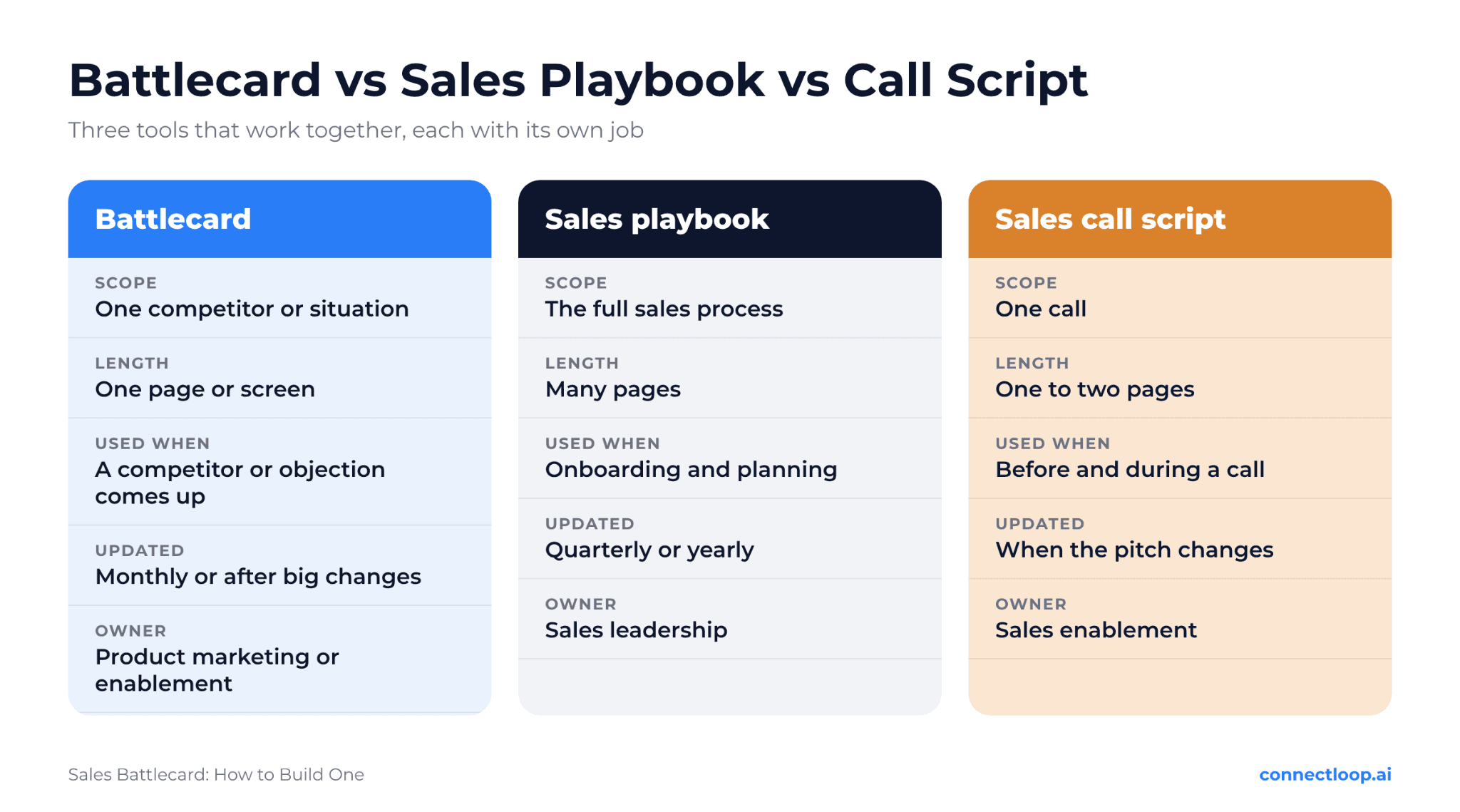
A battlecard covers one competitor or one situation on one page. A sales playbook covers the whole sales process, from prospecting to close. A call script guides the flow of a single call. ConnectLoop teams use all three together, with the battlecard as the quick reference when a competitor shows up.
| Battlecard | Sales playbook | Sales call script | |
|---|---|---|---|
| Scope | One competitor or situation | The full sales process | One call |
| Length | One page or one screen | Many pages | One to two pages |
| When reps use it | When a competitor or objection comes up | Onboarding and planning | Before and during a call |
| Updated | Monthly or after big changes | Quarterly or yearly | When the pitch changes |
| Owner | Product marketing or enablement | Sales leadership | Sales enablement |
The three should link to each other. A playbook points to the right battlecard, and the battlecard points to the full objection handling guide when a rep needs more depth.
How often should you update a battlecard, and who owns it?
Update each battlecard at least once a month, and right away when a competitor changes pricing, launches a major feature or starts winning more deals. One named person should own each card, usually in product marketing or sales enablement. ConnectLoop suggests printing the "last updated" date and owner on the card itself.
Good triggers for an update:
- A competitor changes its pricing or packaging.
- The team loses two or three deals to the same rival in a short period.
- Reps report a new objection they cannot answer.
- Your own product ships a feature that changes the comparison.
Ownership matters more than format. A card with no owner goes stale within a quarter, and reps quickly learn to stop trusting it.
How do you measure whether battlecards work?
You measure battlecards by tracking competitive win rate, the stage where competitive deals are lost, how often reps use the card, and how fast new reps handle comparison questions. Compare each number before and after the card launches. ConnectLoop teams can also check whether buyer comparison questions get answered in the first conversation.
| Metric | What it tells you | How to track it |
|---|---|---|
| Competitive win rate | Share of deals won when a named competitor is involved | Add a "competitor" field in the CRM |
| Stage lost | Where competitive deals drop out | Opportunity stage at close-lost |
| Card usage | Whether reps actually open the card | Views, cue card use, rep survey |
| Objection-to-next-step rate | Whether responses keep deals moving | Call scores and deal notes |
| Ramp time on competitive deals | How fast new reps win against rivals | Wins in first 90 days |
| First-conversation answer rate | Whether comparison questions get answered early | Review of chat and WhatsApp conversations |
Pair these with your wider inbound sales metrics so battlecard results sit next to pipeline numbers, not in a separate report nobody reads.
What are common battlecard mistakes?
The most common battlecard mistakes are making the card too long, attacking the competitor, using claims reps cannot prove, and never updating it. Each one makes reps stop using the card. ConnectLoop sees the same fix work every time: shorter cards, honest comparisons and real buyer language.
- Feature dumps. Twenty features in a table do not help a rep in a live conversation. Pick the two or three that matter to the buyer.
- Bashing the competitor. Buyers notice. It makes the rep look defensive and can push the buyer toward the rival.
- Marketing language. Words like "seamless" and "best-in-class" mean nothing to a buyer. Use plain, specific claims.
- No proof. Every claim on the card needs an example, a result or a demo moment behind it.
- No owner. A card nobody updates becomes wrong, and a wrong card is worse than no card.
- Built without reps. If reps did not help write it, they will not use it. Their questions belong on the card.
Strong reps use battlecards as a guide, not a script. That difference shows up clearly in what separates a good salesperson from a great one.
What can't a battlecard do?
A battlecard cannot fix a real product gap, a poor fit or a weak value proposition. If a competitor genuinely serves a buyer better, no talk track will change that, and pushing harder damages trust. ConnectLoop's view is simple: the card should help reps spot a poor fit early and walk away gracefully.
That honesty pays off. A buyer who hears "they are a better fit for that specific need" remembers the rep who said it. Some of those buyers come back when their needs grow.
A battlecard also cannot replace preparation. It works best when reps already understand the buyer's problem through good discovery and know the stages of the sales process well enough to see where a competitor is likely to appear.
Key takeaways
- A sales battlecard is a one-page guide for winning against one competitor or handling one situation.
- Start with the competitor buyers mention most often, and build one strong card before adding more.
- Include where you win and where the competitor wins. Honesty makes reps more credible.
- The best content comes from buyer conversations, lost deals and call recordings, not competitor websites.
- ConnectLoop helps teams use battlecard positioning in chat, WhatsApp and email through Lia, and on live calls through Sales Assistance cue cards.
- Update each card at least monthly, with one named owner and the date printed on the card.
- Measure competitive win rate, stage lost, card usage and ramp time before and after launch.
- A battlecard cannot fix a real product gap. Use it to spot poor fits early, not to force a deal.

About the author
ConnectLoop Staff
Written by the ConnectLoop team. ConnectLoop is an AI sales agent for inbound revenue teams, based in Cambridge, Massachusetts.
About ConnectLoop →Frequently asked questions
A sales battlecard should fit on one page or one screen. Reps need to find an answer in seconds during a live conversation. If a section runs longer than three lines, move the detail to a linked guide and keep only the key line on the card.
Product marketing or sales enablement usually creates and owns battlecards, with input from reps, sales leaders and customer success. Reps should review every card before launch, because they know which questions buyers ask and which answers work in real conversations.
Review each battlecard at least once a month. Update it right away when a competitor changes pricing, ships a major feature, or starts winning more deals. Print the last updated date on the card so reps know it is current.
Internal battlecards should name the competitor, because reps need to know exactly which rival the card covers. What reps say to buyers is different: they should compare fairly, stick to facts they can prove and never attack the competitor.
A battlecard covers one competitor or one situation on a single page. A sales playbook covers the whole sales process, including prospecting, discovery, demos and closing. The playbook should point reps to the right battlecard when a competitor appears.
Yes. AI can summarize buyer conversations, spot repeated objections and draft card sections for a person to review. ConnectLoop uses Lia's conversations to surface common questions, and Sales Assistance shows battlecard cue cards to reps during live calls.
Keep cards short, involve reps in writing them, and put them where reps already work, such as the CRM or live call cues. Use them in role play and coaching sessions so reps practice the lines before they need them.
Say so. Explain where the competitor fits better and where your product fits better, then let the buyer decide. Honest reps earn trust, and buyers often return when their needs change. A good battlecard includes a "where they win" section for this reason.
Your buyers already told you what belongs on the card
The strongest battlecard content is not on a competitor's website. It is in the comparison questions buyers ask before they ever book a call. ConnectLoop's Conversational Intelligence surfaces the questions and objections that repeat across Lia's conversations, so the card owner has fresh material without waiting for the next quarterly review — and Lia answers those comparison questions from your approved positioning, at 10 AM or 11 PM.