
Sales Process
Sales Funnel: Stages, Examples and How to Build One That Converts
A sales funnel is the path a buyer takes from first hearing about your company to becoming a customer, shown as stages that narrow as people drop out. It shows where you lose prospects and which stage to fix first. This guide covers the six B2B sales funnel stages, funnel vs pipeline, how to build a sales funnel and fix leaks, and where ConnectLoop's AI sales agent, Lia, helps buyers move faster.

Published
Table of contents
- What is a sales funnel?
- Why does a sales funnel matter for B2B teams?
- What are the stages of a sales funnel?
- How do the different sales funnel models compare?
- What is the difference between a sales funnel, a sales pipeline and the sales process?
- How is a B2B sales funnel different from a B2C funnel?
- How do you build a sales funnel, step by step?
- What does a sales funnel look like in numbers?
- Which sales funnel metrics should you track?
- How do you find and fix leaks in your sales funnel?
- Why does speed between funnel stages matter?
- What content works at each stage of the funnel?
- How does AI change each stage of the sales funnel?
- What are some sales funnel examples?
- Which sales funnel mistakes should you avoid?
- Where does the sales funnel model reach its limits?
- Key takeaways
- Frequently asked questions
What is a sales funnel?
A sales funnel is a model of the buyer journey, sometimes called the customer journey, split into stages from awareness to purchase and beyond. It's wide at the top, where many prospects first find you, and narrow at the bottom, where a smaller group becomes customers. Each stage shows how many buyers are still moving and how many have dropped out.
The funnel shape is the point. You start with a lot of website visitors, social followers or event contacts. Some ask a question. Fewer become qualified leads. Fewer still book a meeting, get a proposal and sign. The narrowing tells you where your effort is being lost.
A sales funnel is measured from the buyer's side: what they're doing and whether they move forward. That's what makes it different from your sales process, which describes what your team does. At ConnectLoop, we treat the funnel as a map of buyer conversations, because in B2B most stages start with a question someone needs answered.
What is the difference between a sales funnel and a marketing funnel?
A marketing funnel covers the early stages, from awareness to a captured lead. A sales funnel usually starts where marketing hands off, at a qualified lead, and runs to the closed deal. Many B2B teams now use one shared funnel, because buyers move back and forth between marketing content and sales conversations.
Why does a sales funnel matter for B2B teams?
A sales funnel matters because it shows exactly where buyers stop moving, so you can fix the right problem instead of guessing. Without a funnel, teams often buy more traffic when the real leak is a slow reply, or hire more reps when the real problem is weak qualification.
The main benefits of a well-run sales funnel:
- Clear priorities. You can see which stage loses the most buyers and fix that first.
- Better forecasts. Knowing your stage-to-stage conversion rates lets you predict how many deals today's leads will produce.
- Sales and marketing alignment. Both teams agree on what counts as a lead, an MQL and an SQL, and who owns each stage. Our guide to MQL vs SQL explains the difference.
- The right message at the right time. A first-time visitor needs different content than a buyer comparing proposals.
- Smarter spending. You can compare customer acquisition cost across channels and invest where buyers actually convert.
For ConnectLoop customers, the funnel also shows something many teams miss: how many interested buyers asked a question and never got an answer. That gap is often bigger than any other leak.
What are the stages of a sales funnel?
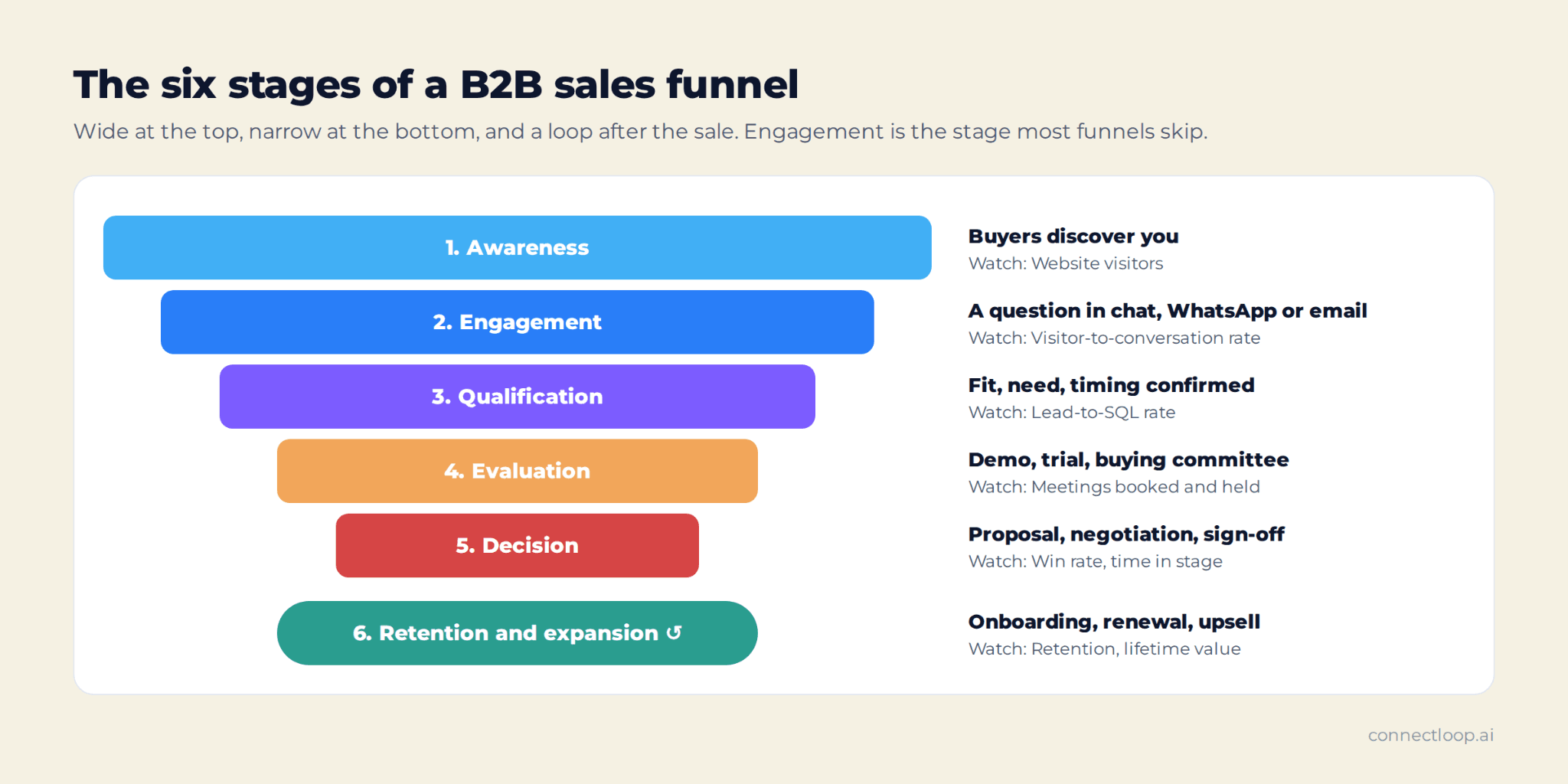
A B2B sales funnel has six stages: awareness, engagement, qualification, evaluation, decision and retention. Buyers discover you, start a conversation, show they're a fit, compare options, decide to buy, and then renew or expand. Each stage has its own goal, owner, content and conversion rate to watch.
Different guides name the stages differently. This six-stage model adds one stage most models skip, engagement, because in B2B the first real conversation is where many buyers are won or lost.
1. Awareness: how do buyers first find you?
At the awareness stage, prospects discover your company through search, social media, ads, referrals or events. They may not know they have a problem yet, or they're just starting to research it. Your goal is to be found and to show you understand their pain points.
- What the buyer does: searches, reads, scrolls, visits your website.
- What you do: use content marketing, run ads and retargeting, and show up where your ideal customer profile spends time.
- Metric to watch: website visitors and traffic by source.
- Where it leaks: visitors land on a page that doesn't match why they came.
2. Engagement: when does a visitor start a conversation?
Engagement is when an anonymous visitor becomes a person you can talk to. They ask a question in website chat, send a WhatsApp message, reply to an email or download a guide. This is the stage most funnels skip, and the one where interested buyers most often slip away unanswered.
- What the buyer does: asks about pricing, features or fit.
- What you do: answer quickly, from accurate content, at any hour.
- Metric to watch: visitor-to-conversation rate and response time.
- Where it leaks: questions sit in an inbox overnight, or a form replaces a real answer.
ConnectLoop's Lia works at this stage, answering buyers on website chat, WhatsApp and email from your own content. Visitors who don't start a chat can still be engaged with a Lead Capture popup, and Visitor Intelligence links their earlier browsing to their record, with consent. See our guide to identifying anonymous website visitors.
3. Qualification: is this buyer a good fit?
Qualification is where you learn whether a lead fits your ideal customer profile and is ready to talk to sales. You check need, size, timing, budget and who's involved in the decision. Qualified leads move forward. Others go into lead nurturing, such as an email nurture sequence, until they're ready.
- What the buyer does: shares their situation, team size and timeline.
- What you do: ask qualifying questions, apply lead scoring, separate MQLs from SQLs.
- Metric to watch: lead-to-SQL rate.
- Where it leaks: long forms, slow follow-up, or qualifying everyone the same way.
Lia qualifies in conversation and scores each lead Hot, Warm or Cold with the reasoning behind it. Our guides to inbound lead qualification and lead scoring go deeper.
4. Evaluation: how do buyers compare their options?
At the evaluation stage, qualified buyers take a closer look. They book a demo, run a free trial, read case studies, talk to references and compare you with alternatives. In B2B, a buying committee often joins here, so more people need answers.
- What the buyer does: attends a product demo, tests the product, shares it with colleagues.
- What you do: run a strong discovery call and demo, share social proof, handle objections, involve stakeholders.
- Metric to watch: meeting booked rate, meeting held rate and opportunity creation.
- Where it leaks: meetings that never happen, demos that don't match the buyer's problem.
Booking the meeting while interest is high matters here. Lia books meetings inside the conversation using your team's real calendar availability. For the call itself, see our discovery call questions and objection handling guides.
5. Decision: what helps a buyer say yes?
At the decision stage, the buyer reviews a proposal, negotiates terms and gets internal approval. This is the bottom of the funnel, where deals close or stall. Clear next steps, honest answers and a simple approval path matter more than pressure.
- What the buyer does: reviews pricing, asks final questions, gets sign-off.
- What you do: send a clear proposal, negotiate, keep every promise, ask for the decision.
- Metric to watch: win rate and time in stage.
- Where it leaks: deals stuck in Proposal, unanswered questions, a champion who can't sign alone.
ConnectLoop's Customer Intelligence flags deals that sit in Proposal longer than 10 days or Negotiation longer than 14 days, and tags promises your team made as Buyer waiting. For the close itself, read our guides to sales closing techniques and how to negotiate in sales.
6. Retention and expansion: what happens after the sale?
A B2B sales funnel doesn't end at purchase. Onboarding, customer success, renewals, upsells and referrals all happen after the contract is signed, and they often matter more to revenue than the first deal. Happy customers also feed the top of the funnel through referrals and reviews.
- What the buyer does: onboards, uses the product, renews, buys more.
- What you do: make onboarding smooth, check in regularly, spot expansion signals.
- Metric to watch: retention rate, expansion revenue and customer lifetime value.
- Where it leaks: poor onboarding, slow support answers.
The same AI agent that answers prospects can answer customers' questions too, so customer retention gets the same fast, accurate replies. Our customer engagement strategy guide covers this stage in detail.
How do the different sales funnel models compare?
Most sales funnel models describe the same journey with different names. AIDA uses four buyer feelings, TOFU, MOFU and BOFU group stages into top, middle and bottom, and the flywheel adds what happens after the sale. This table maps each model to the six B2B stages in this guide.
| Six B2B stages | AIDA | TOFU / MOFU / BOFU | Flywheel |
|---|---|---|---|
| Awareness | Attention | Top of the funnel (TOFU) | Attract |
| Engagement | Interest | Top of the funnel (TOFU) | Engage |
| Qualification | Interest | Middle of the funnel (MOFU) | Engage |
| Evaluation | Desire | Middle of the funnel (MOFU) | Engage |
| Decision | Action | Bottom of the funnel (BOFU) | Engage |
| Retention and expansion | Not covered | After the funnel | Delight |
Pick one model and use it everywhere: in your CRM, your reports and your team meetings. The names matter less than everyone agreeing on what each stage means and when a buyer moves to the next one. ConnectLoop's Pipeline lets you name your own stages, so the funnel in your reports matches the one your team talks about.
What is the difference between a sales funnel, a sales pipeline and the sales process?
The short answer to sales funnel vs sales pipeline: a sales funnel shows how many buyers move through each stage and where they drop out. A sales pipeline shows the open deals your team is working right now and their value. The sales process is the set of steps your team follows to move a deal forward. They describe the same journey from three different angles.
| Sales funnel | Sales pipeline | Sales process | Flywheel | |
|---|---|---|---|---|
| Point of view | The buyer's journey | Your open deals | Your team's actions | The whole customer lifecycle |
| Main question | Where do buyers drop out? | What will close, and when? | What should a rep do next? | How do customers bring more customers? |
| Measured in | Conversion rates between stages | Deal count, value, pipeline velocity | Steps completed | Retention, referrals, expansion |
| Used by | Marketing and sales leaders | Sales managers, forecasting | Reps, enablement | Leadership, customer success |
| Shape | Narrows from top to bottom | A list of deals by stage | A sequence of steps | A loop |
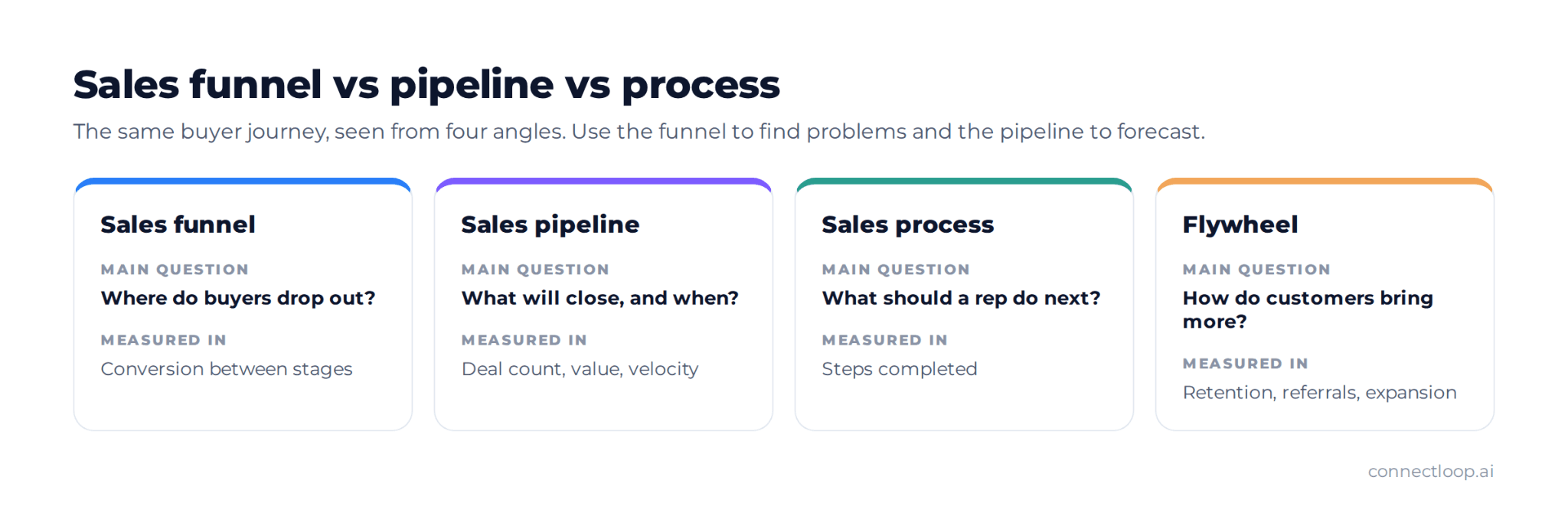
Use the sales funnel to find problems, the sales pipeline to forecast revenue, and the sales process to coach reps. For the steps your team follows, read our guide to the stages of the sales process, and for documenting them, see our sales playbook. ConnectLoop's Pipeline view shows open deals by stage, with last touch and open items on every card.
How is a B2B sales funnel different from a B2C funnel?
In B2B vs B2C funnels, the biggest difference is the length of the journey. A B2B sales funnel is longer, involves more people and depends more on conversations than a B2C funnel. B2C buyers often decide alone, in minutes, based on price and emotion. B2B buyers research for weeks, involve a buying committee and need answers to detailed questions before they commit.
| B2B sales funnel | B2C sales funnel | |
|---|---|---|
| Who decides | A buying committee | Usually one person |
| Sales cycle | Weeks to months | Minutes to days |
| Deal size | Larger, often recurring | Smaller, often one-time |
| Key stages | Engagement, qualification, evaluation, approval | Awareness, consideration, purchase |
| What moves buyers | Answers, proof, ROI, trust | Price, offers, convenience, reviews |
| Role of conversations | Central at almost every stage | Often optional |
| After the sale | Onboarding, renewal, expansion | Repeat purchase, loyalty programs |
Because B2B buyers have more questions, the engagement and qualification stages matter more. That's why ConnectLoop focuses on answering B2B buyers in real time and booking meetings with the right people. For B2C-style stores, our guides to conversational commerce and AI agents for ecommerce cover the shorter path.
How do you build a sales funnel, step by step?
To build a sales funnel, define your ideal customer profile, map the stages, set clear entry rules for each stage, create content for every stage, add a way to answer and qualify buyers quickly, connect everything to your CRM, measure conversion between stages, and fix the biggest leak first. Then repeat.
- Define your ideal customer profile. List the company size, industry, roles and pain points of your best customers. Build buyer personas for the people involved in the decision.
- Map your funnel stages. Use the six stages in this guide, or your own, and write down what the buyer does at each one.
- Set entry and exit rules. Decide exactly what moves a buyer to the next stage, for example "asked a question" for engagement or "confirmed budget and timeline" for qualification.
- Create content for each stage. Blog posts and guides at the top, comparisons and case studies in the middle, pricing, demos and proposals at the bottom.
- Add a fast way to engage and qualify. Put website chat, WhatsApp or an AI agent on high-intent pages, so buyers get answers and qualify in conversation instead of waiting.
- Connect your CRM and calendar. Make sure every lead, conversation and booked meeting lands in one place, with lead routing to the right SDR or account executive and sales automation for routine follow-ups.
- Measure stage-to-stage conversion. Track how many buyers move from each stage to the next, and how long they spend in each one.
- Fix the biggest leak first. Find the stage with the steepest drop, change one thing, and measure again. A/B testing one change at a time shows what actually works.
ConnectLoop covers steps 5 and 6 for most teams. Lia trains on your website in about 60 seconds, answers and qualifies buyers, books meetings and syncs leads to Salesforce, HubSpot and Zoho CRM. To plan the top of the funnel, see our B2B SaaS lead generation strategies.
What does a sales funnel look like in numbers?
A sales funnel in numbers shows how many buyers reach each stage and the conversion rate between them. Multiplying the rates together shows how many visitors you need for one customer, and which stage gives the biggest lift when you improve it. The example below uses sample numbers to show the math, not industry benchmarks.
Example: a B2B software company with 1,000 monthly website visitors
| Stage | Buyers | Conversion to next stage |
|---|---|---|
| Website visitors (awareness) | 1,000 | 4% start a conversation |
| Conversations (engagement) | 40 | 50% qualify |
| Qualified leads (qualification) | 20 | 50% book a meeting |
| Meetings booked (evaluation) | 10 | 80% show up |
| Meetings held | 8 | 40% get a proposal |
| Proposals (decision) | 3 | 33% sign |
| New customers | 1 |
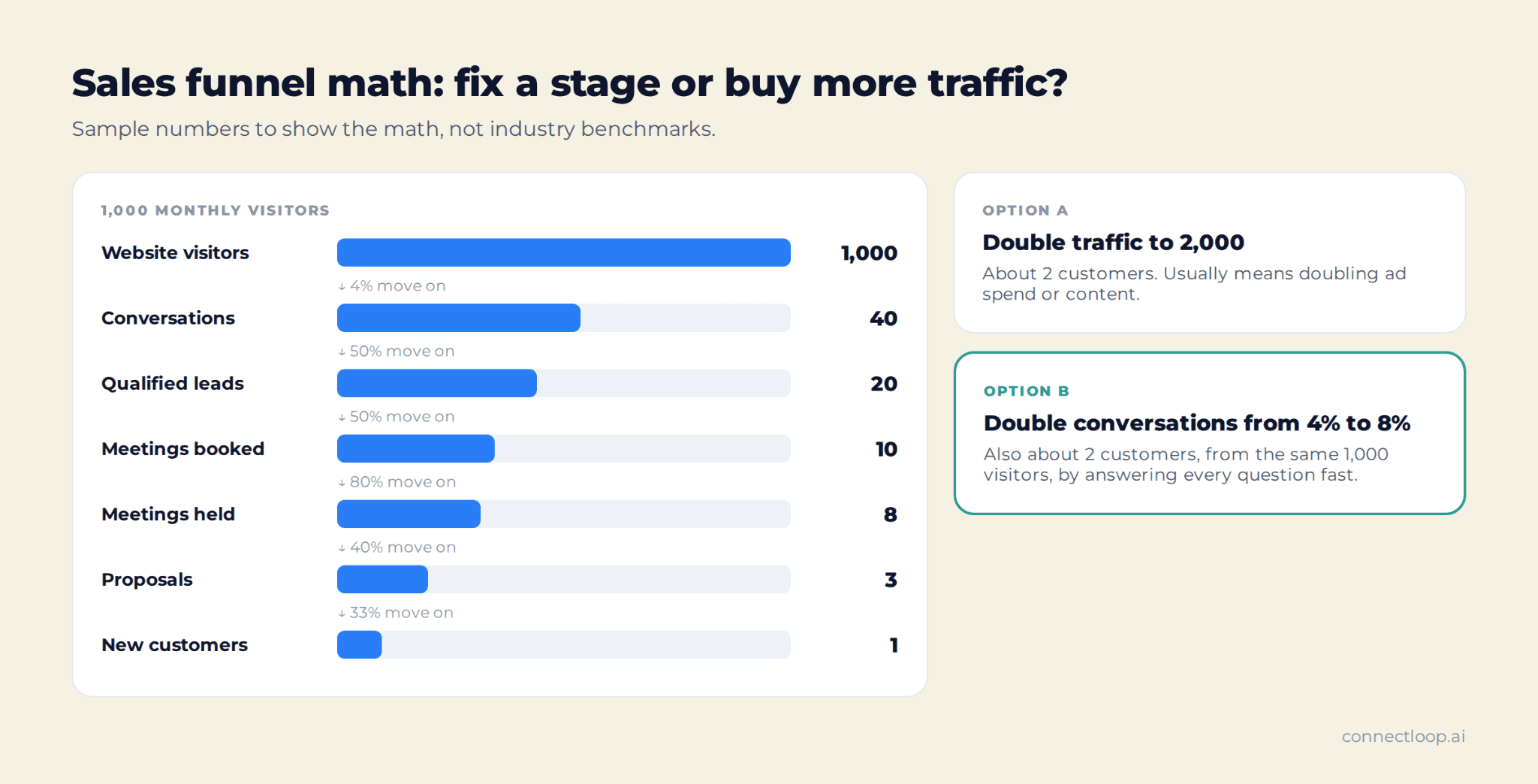
Now compare two ways to get a second customer:
- Double the traffic to 2,000 visitors. Every number doubles, and you get about 2 customers. That usually means doubling your ad budget or content output.
- Double the conversation rate from 4% to 8%, by answering questions instantly and at any hour. You also get 80 conversations and about 2 customers, from the same 1,000 visitors.
The second option is usually cheaper and faster. That's the main lesson of funnel math: fixing a weak stage often beats adding more buyers to the top. ConnectLoop is built to lift the conversation, qualification and booking stages, where most B2B funnels lose the most buyers.
Which sales funnel metrics should you track?
Track the conversion rate between each pair of stages, the time buyers spend in each stage, and the outcomes at the bottom: win rate, deal size and customer lifetime value. Together, these show where buyers drop out, how fast they move, and whether the funnel produces profitable customers.
| Metric | How to calculate it | What it tells you |
|---|---|---|
| Visitor-to-conversation rate | Conversations ÷ visitors | Whether visitors engage |
| Lead-to-SQL rate | SQLs ÷ leads | Whether you attract the right buyers |
| Meeting booked rate | Meetings booked ÷ SQLs | Whether qualified buyers take the next step |
| Meeting show rate | Meetings held ÷ meetings booked | Whether bookings are real commitments |
| Win rate | Deals won ÷ opportunities | How well you evaluate and close |
| Time in stage | Days a buyer spends in each stage | Where deals slow down or stall |
| Sales cycle length | Days from first conversation to signed deal | How long the whole funnel takes |
| Pipeline velocity | (Opportunities × win rate × deal size) ÷ cycle length | How fast the funnel turns into revenue |
| Customer acquisition cost | Sales and marketing cost ÷ new customers | How much each customer costs to win |
| Customer lifetime value | Average revenue per customer over their lifetime | Whether customers are worth what they cost |
Compare these numbers against your own past months rather than outside averages, because funnels vary so much by price, market and sales cycle. Our guide to inbound sales metrics covers the inbound stages in more detail. ConnectLoop keeps the conversation, lead score, source and appointment status together on each lead, which makes stage-by-stage reporting easier.
How do you find and fix leaks in your sales funnel?
To find leaks in your sales funnel, compare the conversion rate at each stage with your past results and look for the steepest drop. Then ask why buyers leave at that point, change one thing, and measure again. A leaky funnel usually has one or two stages doing most of the damage.
| Symptom | Likely cause | Fix |
|---|---|---|
| Lots of traffic, few conversations | Pages don't match visitor intent, no easy way to ask a question | Match landing pages to traffic sources, add chat on high-intent pages |
| Conversations, but few qualified leads | Attracting the wrong buyers, or not asking qualifying questions | Tighten targeting, ask 2–3 qualifying questions in the conversation |
| Qualified leads, but few meetings | Slow follow-up, "we'll email you some times" | Offer real times and book in the conversation |
| Meetings booked, many no-shows | Booked too late, no reminder, generic invite | Book while interest is high, send reminders, share context |
| Meetings held, few proposals | Weak discovery, demo doesn't match the buyer's problem | Improve discovery questions and tailor the demo |
| Proposals sent, deals stall | Champion can't sign alone, unanswered questions | Involve the economic buyer, keep every promise, set dated next steps |
| Customers churn early | Poor onboarding, slow support answers | Improve onboarding and answer customer questions quickly |
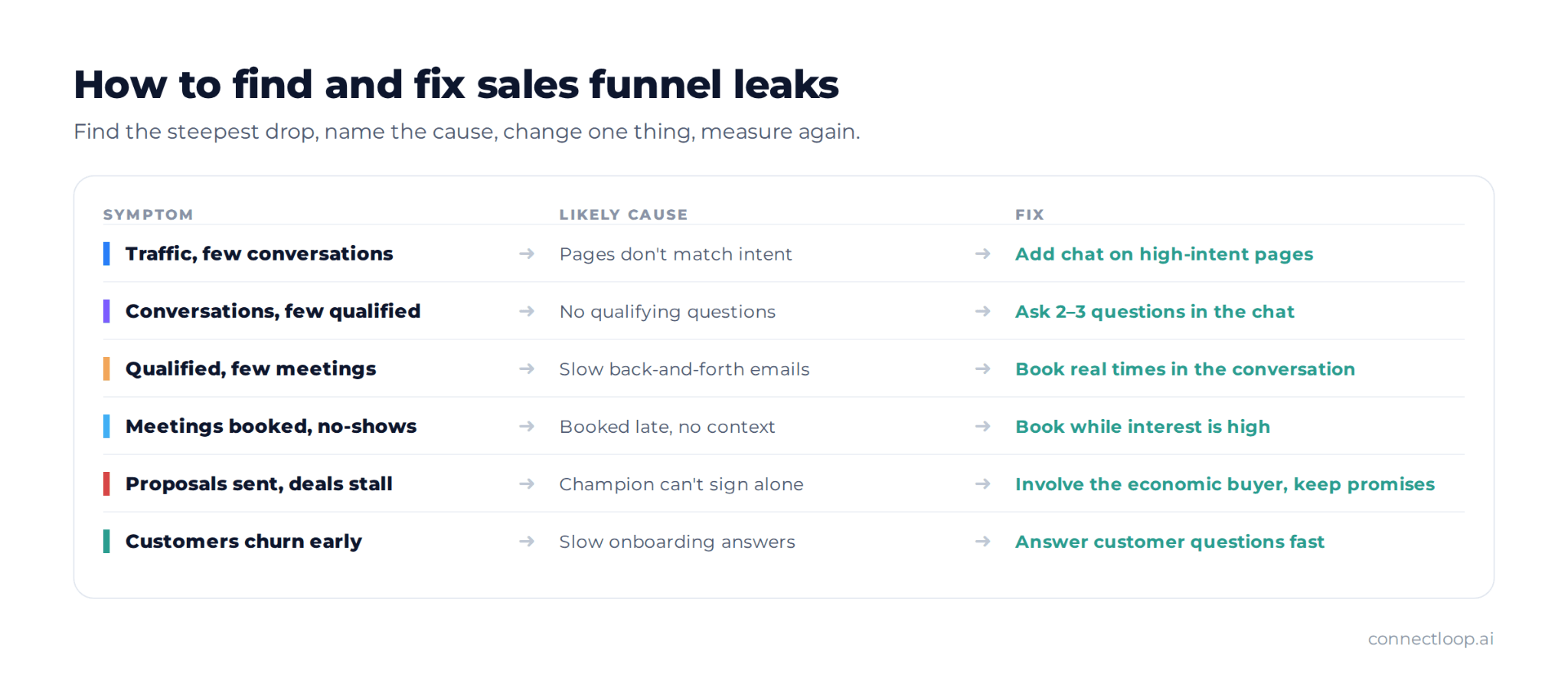
ConnectLoop helps diagnose several of these at once. Lia's conversations show what buyers asked before they left, Knowledge Gaps lists questions Lia couldn't answer, and Customer Intelligence shows which deals have stalled. If buyers go quiet after a proposal, our follow-up email after no response guide has templates you can use.
Why does speed between funnel stages matter?
Speed between funnel stages matters because buyer interest fades with every hour of waiting. A visitor who asks a question at 9 PM and gets an answer the next morning has often moved on. The same is true for a qualified lead waiting for a meeting time, or a buyer waiting on a promised pricing sheet.
Funnels are usually drawn as boxes, but every stage also has a clock. Three places where waiting costs the most:
- Engagement to qualification. Questions asked after hours or on weekends wait until your team is back online.
- Qualification to meeting. An email thread to find a time can take days.
- Proposal to decision. Deals that sit in one stage too long tend to stall for good.
Fixing speed often has a bigger effect than changing your message. Our guide to speed to lead explains why the first minutes count. ConnectLoop's Lia answers at any hour and books meetings in the conversation, and Customer Intelligence tracks time in stage, creating a Stale stage item when a deal sits too long, for example more than 10 days in Qualified.
What content works at each stage of the funnel?
Content at each stage should answer the question the buyer has at that moment. Early on, they want to understand their problem. In the middle, they want to compare solutions. At the bottom, they want proof, pricing and a clear next step. After the sale, they want help getting value fast.
| Stage | Buyer's question | Content that helps |
|---|---|---|
| Awareness | "What's causing this problem?" | Blog posts, guides, social posts, webinars |
| Engagement | "Can this help me?" | Website chat answers, short videos, FAQs |
| Qualification | "Is this right for a team like mine?" | Use case pages, plan comparisons, qualifying conversations |
| Evaluation | "How does it compare, and does it work?" | Product demo, free trial, case studies, comparison pages |
| Decision | "What will it cost and how do we start?" | Pricing, proposals, ROI examples, security details, onboarding plan |
| Retention | "How do we get more value?" | Onboarding guides, help center, check-ins, upsell offers |
Your content also feeds your AI agent. Lia answers buyers from your website pages and documents, so a strong FAQ and clear product pages help at every stage of the funnel. Our guide to the AI knowledge base shows what to include first. ConnectLoop's Knowledge Gaps list tells you which questions your content doesn't answer yet.
How does AI change each stage of the sales funnel?
AI changes the sales funnel by answering buyers instantly, qualifying them in conversation, booking meetings automatically and flagging stalled deals before they're lost. It works best on the repetitive, time-sensitive steps, while people focus on discovery, relationships, negotiation and final decisions.
| Stage | What AI can do | What people still do best |
|---|---|---|
| Awareness | Help produce and personalize content | Choose the story and the market |
| Engagement | Answer questions at any hour on chat, WhatsApp and email | Handle complex or sensitive conversations |
| Qualification | Ask qualifying questions, score leads, route them | Decide on edge cases and strategic accounts |
| Evaluation | Book meetings, prepare reps with the full conversation, guide calls with live cues | Run discovery and demos, build trust |
| Decision | Flag stalled deals and open promises, draft follow-ups | Negotiate, handle objections, close |
| Retention | Answer customer questions, spot expansion signals | Build long-term relationships |
ConnectLoop covers each of these. Lia handles engagement, qualification and booking, with a smooth AI-to-human handoff when a person should take over. Sales Assistance shows reps live cue cards on Google Meet and Zoom calls, Sales Training lets them practice with an AI buyer, and Customer Intelligence keeps deals moving. For the basics, read what an AI sales agent is.
What are some sales funnel examples?
Sales funnel examples show how the same six stages look in different businesses. A B2B software company and a professional services firm both move buyers from awareness to retention, but the channels, content and conversations at each stage are different. The two examples below are illustrations, not real customers.
Example 1: B2B software company (inbound)
- Awareness: a sales leader finds a blog post about slow lead follow-up.
- Engagement: on the pricing page, they ask the website chat whether the product works for a team of 12.
- Qualification: the AI agent asks about their current process and timeline, and scores the lead Hot.
- Evaluation: they book a demo for Thursday in the chat, and the rep joins with the full conversation.
- Decision: after a proposal and a call with their finance lead, they sign an annual plan.
- Retention: onboarding goes smoothly, and six months later they add a second team.
Example 2: professional services firm (WhatsApp)
- Awareness: a business owner sees the firm speak at an industry event.
- Engagement: they scan a QR code and send a WhatsApp message with a question.
- Qualification: the AI agent asks about company size and the service they need.
- Evaluation: they book a consultation call directly in the WhatsApp chat.
- Decision: the firm sends a proposal, answers two follow-up questions the same day, and wins the project.
- Retention: after delivery, the client refers a partner company.
The second example reflects what ConnectLoop saw at Web Summit Rio, where Lia handled 82 WhatsApp conversations, producing 37 qualified leads and 5 signups, tracked end to end. Learn more about how a WhatsApp AI agent works.
Which sales funnel mistakes should you avoid?
The most common sales funnel mistakes are focusing only on the top of the funnel, skipping the conversation stage, using vague stage definitions, measuring only the final conversion rate, and forgetting about customers after the sale. Each one hides where buyers really drop out.
- Only adding more traffic. More visitors don't help if the middle of the funnel leaks.
- Skipping engagement. Jumping from "visit" to "fill in a form" loses buyers who just wanted an answer.
- Vague stage definitions. If "qualified" means something different to every rep, your numbers mean nothing.
- Measuring only the end result. One overall conversion rate can't tell you which stage to fix.
- Ignoring time in stage. Deals that sit still are often deals that are dying.
- Treating every lead the same. A Hot lead and a Cold lead need different next steps.
- Losing context between stages. If the rep doesn't see the buyer's earlier conversation, the buyer has to start over.
- Stopping at the sale. Retention and expansion often matter more than the first deal.
ConnectLoop helps avoid several of these by keeping every conversation, score, meeting and open item attached to the buyer as they move through the funnel. For the people side, a clear sales playbook keeps stage definitions consistent.
Where does the sales funnel model reach its limits?
A sales funnel is a simplification. Real B2B buyers don't always move in a straight line. They loop back, skip stages, and bring new people into the decision halfway through. Use the funnel to spot problems and measure progress, and expect individual buyers to take their own path.
That's why conversations matter so much in a modern funnel. A buyer who jumps from awareness straight to "Can I see a demo?" should be able to book one immediately. A buyer who returns to research after a meeting should get the same accurate answers they got the first time.
The same idea applies to AI. An AI agent can only answer from the content you give it, so your content sets the ceiling for every stage it supports. ConnectLoop's Knowledge Gaps list helps your team close that gap week by week, so Lia can help more buyers move forward.
Key takeaways
- A sales funnel shows how many buyers move through each stage and where they drop out.
- The six B2B sales funnel stages are awareness, engagement, qualification, evaluation, decision, and retention and expansion.
- The engagement stage, when a buyer first asks a question, is where many B2B funnels leak the most.
- A sales funnel shows where buyers drop out, a sales pipeline shows open deals, and the sales process shows what your team does.
- Funnel math often shows that fixing one weak stage beats buying more traffic.
- Track conversion between stages, time in stage, win rate and customer lifetime value.
- Speed between stages matters as much as the message at each stage.
- ConnectLoop helps at every stage: Lia engages, qualifies and books, Sales Assistance guides calls, and Customer Intelligence keeps deals moving.

About the author
ConnectLoop Staff
Written by the ConnectLoop team. ConnectLoop is an AI sales agent for inbound revenue teams, based in Cambridge, Massachusetts.
About ConnectLoop →Frequently asked questions
A sales funnel is the path buyers take from first hearing about you to becoming a customer. It's drawn as a funnel because many people start at the top and fewer reach each stage below. It helps you see where buyers drop out and what to fix.
A common B2B model has six stages: awareness, engagement, qualification, evaluation, decision, and retention and expansion. Other models use AIDA (attention, interest, desire, action) or top, middle and bottom of the funnel. They all describe the same journey.
A sales funnel shows how many buyers move from stage to stage and where they drop out. A sales pipeline shows the open deals your team is working, with their value and expected close dates. Use the funnel to find problems and the pipeline to forecast revenue.
Define your ideal customer profile, map your stages, set clear rules for moving between them, create content for each stage, add a fast way to answer and qualify buyers, connect your CRM and calendar, measure conversion between stages, and fix the biggest leak first.
It depends on your price, market and sales cycle, so outside averages are rarely useful. Track your own conversion rate between each pair of stages month by month. Improving the weakest stage usually gives the biggest gain in customers.
TOFU, MOFU and BOFU stand for top, middle and bottom of the funnel. The top is awareness and first engagement, the middle is qualification and evaluation, and the bottom is the decision and purchase. Each part needs different content and a different next step.
A B2B sales cycle can take from a few weeks to many months, depending on deal size and how many people are involved. Measure time in each stage, not just the total, so you can see where deals slow down and fix that stage.
AI can answer buyers instantly, qualify them in conversation, book meetings automatically, guide reps during calls and flag stalled deals. ConnectLoop's Lia does this across website chat, WhatsApp and email, while your team focuses on discovery, negotiation and relationships.
Which stage of your funnel loses the most buyers?
Write down your last three months by stage: visitors, conversations, qualified leads, meetings booked and held, proposals and new customers. Find the steepest drop, change one thing, and measure again next month. If the drop is between visit and conversation, ConnectLoop's Lia can answer and qualify those buyers at any hour.