
Sales Enablement
Upsell Conversation: How to Upsell Existing Customers With Scripts That Feel Helpful
An upsell conversation is a talk with an existing customer about moving to a higher plan, more seats or added capacity because their needs have grown. The best ones start from the customer's results, not the price list. ConnectLoop helps reps spot the right moment and say the right thing during the call.

Published
Table of contents
- What is an upsell conversation?
- Why do upsell conversations matter more in 2026?
- When is the right time to start an upsell conversation?
- Who should lead the upsell conversation?
- How do you structure an upsell conversation?
- What should you say? 7 upsell conversation scripts
- How do you handle objections in an upsell conversation?
- Which words keep an upsell conversation customer-first?
- How can AI help reps run better upsell conversations?
- How do you measure upsell conversation success?
- Key takeaways
- Frequently asked questions
What is an upsell conversation?
An upsell conversation is a planned discussion where a rep or account manager helps an existing customer see that a bigger plan, more seats or an added capability fits where they are now. It is a value conversation first and a pricing conversation second. ConnectLoop treats it as a coaching moment, not a sales script.
An upsell conversation is different from an upsell offer. An offer is a banner, an email or a pricing page. A conversation is two people working out whether the customer has outgrown what they bought.
That difference matters. A customer who hears "you could upgrade" may ignore it. A customer who says "we keep hitting the limit" out loud, in their own words, is already halfway to yes.
If you want the wider strategy behind expansion revenue, ConnectLoop's guide to upselling and cross-selling covers the difference between the two. This article focuses on the conversation itself: when to start it, what to say and how to keep it helpful.
Why do upsell conversations matter more in 2026?
Upsell conversations matter more in 2026 because existing customers now drive most software growth, while keeping those customers has become harder. A well-timed conversation protects the account and grows it at the same time. ConnectLoop sees expansion as the natural result of a customer getting real value.
The 2026 numbers show why teams are paying attention:
- Existing customers lead growth. Teneo's 2026 B2B Software Vendor Survey of 300 US software vendors found that 66% of growth came from existing customers, a mix vendors expect to continue in 2026.
- Upsell is a top priority. The same Teneo survey lists renewal protection, pricing strategy and cross-sell or upsell as the most critical growth levers for 2026.
- Retention needs more care. Benchmarkit's 2026 benchmarks show median gross revenue retention fell to 84% from 88%, the steepest drop in four years.
- Budgets follow the base. The CMO Survey's 2026 report found companies spend almost 60% of their budgets on selling more existing products and services to existing customers.
Put together, these numbers point one way. The customers you already have are your best growth channel, and the conversation is where that growth is won or lost.
When is the right time to start an upsell conversation?
The right time to start an upsell conversation is when the customer shows a clear signal that their needs have grown, such as hitting a usage limit, adding people or setting a new goal. Timing beats technique. ConnectLoop recommends tying every upsell conversation to a signal the customer can recognize.
Good signals come from three places: product usage, the customer's own words and the business calendar. Here is how to read the most common ones:
| Signal | What it sounds like | First question to ask |
|---|---|---|
| Hitting a usage limit | "We ran out of credits again this month." | "What happens on your side when you hit that limit?" |
| New team members | "We just hired three more reps." | "How are the new hires getting set up today?" |
| A new goal | "Our target doubled for next quarter." | "What has to change for the team to hit that number?" |
| A recent win | "The pilot team beat their quota." | "Which other teams would want the same result?" |
| Feature interest | "Can it also do call scoring?" | "What would that help you fix first?" |
| Renewal window | "Our contract renews in 60 days." | "Looking at the next year, what will look different?" |
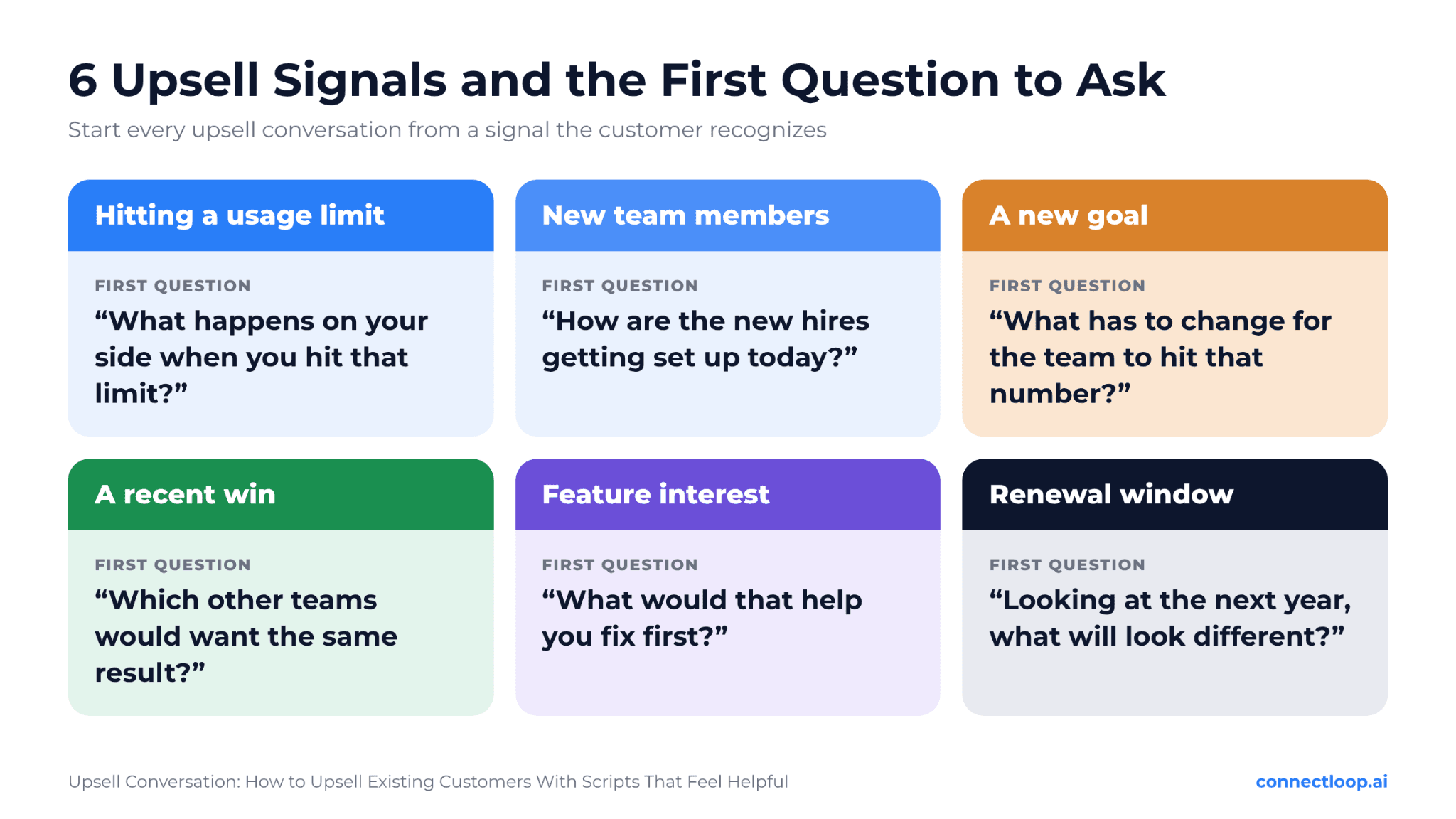
The best signal is one the customer says out loud. That is why discovery call questions still matter after the first sale. Good questions keep surfacing the signals that make an upsell conversation feel natural.
Timing also means picking a moment when the customer feels good about the product. An upsell conversation lands well right after a result, a successful onboarding or a strong quarterly review. ConnectLoop suggests saving open support issues for a separate call so the upsell conversation can focus fully on growth.
Who should lead the upsell conversation?
The upsell conversation should be led by the person the customer trusts most on results, usually the account manager or customer success manager, with the account executive joining for commercial terms. The customer should feel continuity, not a handoff to a stranger. ConnectLoop helps whoever leads the call stay on track.
Each role brings something different:
- Customer success manager. Knows how the customer uses the product and can point to real results. Best for spotting signals and opening the conversation.
- Account manager. Owns the commercial relationship and the renewal. Best for leading the upsell conversation from start to finish.
- Account executive. Brings deal structure and pricing skills. Best for larger expansions with new buyers or new budgets.
Many teams use a simple rule: the person who spots the signal opens the conversation, and the person who owns the contract closes it. A clean, well-explained AI to human handoff follows the same principle: the customer should never have to repeat their story.
ConnectLoop's view is simple. The customer cares about who understands their situation, not about your org chart. Whoever leads should already know the account's history before the call starts.
How do you structure an upsell conversation?
A strong upsell conversation follows six steps: review results, ask what has changed, reflect the gap, connect the upgrade to their goal, make the next step easy and agree on a date. Each step earns the next. ConnectLoop's Sales Assistance can track these steps live during the call.
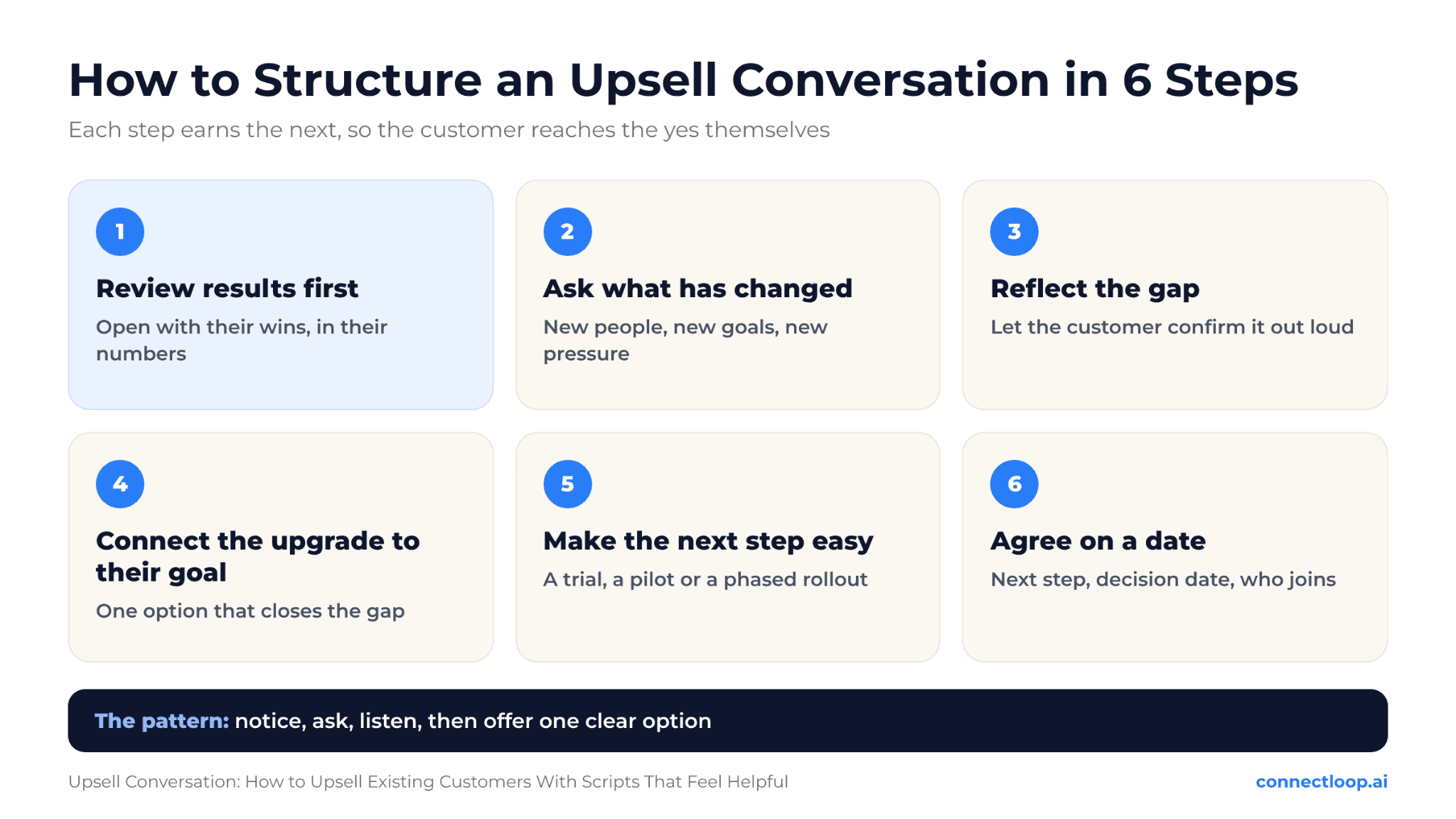
- Review results first. Open with what the customer has achieved since they started. Use their numbers, not yours. This reminds them why they bought and sets a positive tone.
- Ask what has changed. New team members, new goals, new markets or new pressure. Let the customer describe their situation in their own words.
- Reflect the gap. Repeat back what you heard: "So the team is growing, and the current plan covers five seats." Let the customer confirm the gap before you offer anything.
- Connect the upgrade to their goal. Present one option that closes the gap they just described. Explain what changes for them, not every feature on the next tier.
- Make the next step easy. Offer a low-risk path such as a trial of the higher plan, a phased rollout or a pilot with one team.
- Agree on a date. Close with a specific next step, a decision date and who else needs to be involved.
The order matters more than the words. Reps who jump straight to step four skip the part where the customer convinces themselves. Practicing this flow in sales role play is one of the fastest ways to make it feel natural.
What should you say? 7 upsell conversation scripts
The best upsell scripts are short, open with the customer's situation and end with a question instead of a pitch. Use them as starting points and adapt the wording to your voice and your product. ConnectLoop recommends keeping each script under 60 seconds of talking.
Script 1: The usage limit
"I noticed your team hit the monthly limit three times this quarter. That usually means the product is doing its job. When you hit the limit, what does the team do while they wait for it to reset?"
Then, after they answer: "The next plan removes that cap, so the team can keep going. Would it help to see what that looks like for your volume?"
Script 2: The growing team
"You mentioned you've added three reps since we last spoke. Congratulations. How are the new people getting set up with the tools the rest of the team uses?"
Then: "Adding seats now means the new reps start with the same setup as your top performers. Want me to put together the numbers for eight seats?"
Script 3: The new goal
"Last time you said the target for next quarter doubled. What has to be true for the team to hit that?"
Then: "One thing that could help is [capability]. Teams with a similar goal used it to [result]. Would it be useful to walk through how that would work for you?"
Script 4: After a win
"Your pilot team beat quota by 20% last quarter. That's a great result. Which other teams in the company would want the same thing?"
Then: "Rolling it out to the second team could follow the same playbook. Who would we need to bring into that conversation?"
Script 5: The feature question
"You asked whether the product can also score calls. Tell me a little more. What would you want call scoring to help you fix first?"
Then: "That's part of the higher plan. Would a two-week trial on one team help you see if it fits?"
Script 6: The renewal review
"Your renewal is coming up in about two months. Before we talk terms, I'd love to look ahead. What will be different for your team over the next year?"
Then: "Based on what you shared, a plan that covers [need] might fit better than renewing as-is. Should I prepare both options so you can compare?"
Script 7: The "not right now" follow-up
"Totally understand that the timing isn't right. So I can come back at a better moment, what would need to change for this to make sense?"
Then: "That makes sense. I'll check back after [event]. Would it be all right if I share a short example of how another team handled this in the meantime?"
Each script follows the same pattern: notice, ask, listen, then offer one clear option. ConnectLoop's real-time sales coaching guide explains how live prompts help reps remember the follow-up question in the moment.
How do you handle objections in an upsell conversation?
Handle upsell objections by finding the real concern behind the words, then answering that concern with a smaller, safer next step. Most upsell objections are about timing, budget or proof, not about the product. ConnectLoop's Sales Assistance shows objection prompts on screen during the call.
| Objection | What it often means | How to respond |
|---|---|---|
| "We don't have budget." | The value isn't clear enough yet, or the budget cycle is closed. | "When does the next budget cycle start? Let's build the case together before then." |
| "We're not using what we have." | Adoption needs attention before expansion. | "Let's fix that first. Which team is using it least, and what's getting in the way?" |
| "Now isn't a good time." | Other priorities are taking focus. | "What's on your plate right now? I can check back once that's done." |
| "I need to ask my boss." | The contact isn't the decision-maker. | "What will your boss want to know? I can help you put together a one-page summary." |
| "The current plan is fine." | The gap hasn't been felt yet. | "That's great to hear. What would tell you it's time to look again?" |
The second objection deserves special attention. When a customer isn't using what they have, an upsell conversation becomes an adoption conversation. That is good news, not a lost deal. Helping them get value now builds the trust that makes the next upsell conversation easier.
ConnectLoop's guide to benefits of sales coaching shows how managers can use real objections from calls to sharpen team responses over time.
Which words keep an upsell conversation customer-first?
Customer-first upsell conversations use words about the customer's goals, results and choices, and keep product language short. Small word swaps change how the whole conversation feels. ConnectLoop coaches reps to talk about outcomes first and plans second.
Try these swaps:
- Say "your goal" instead of "our product." It keeps the focus on the customer.
- Say "would it help to" instead of "you should." It invites a choice rather than pushing one.
- Say "based on what you shared" instead of "most customers." It shows you listened.
- Say "the next step could be" instead of "you need to upgrade." It makes the move feel smaller.
- Say "let's compare both options" instead of "this is the best plan." It respects the customer's judgment.
Tone matters as much as words. Pause after each question and let the customer fill the silence. The more they talk, the more signals you hear and the easier the next step becomes.
How can AI help reps run better upsell conversations?
AI helps reps run better upsell conversations by spotting signals before the call, prompting the right question during the call and drafting the follow-up after it. The rep keeps the relationship and makes every judgment call. ConnectLoop supports each of these moments with Sales Assistance and Lia.
During the call. ConnectLoop's Sales Assistance runs in a Chrome or Edge tab alongside Google Meet or Zoom, with no bot joining the meeting. It listens to the conversation and shows short prompts when a key moment appears, such as an objection or a signal worth following up. It works with the ConnectLoop YES Framework™, SPIN, MEDDICC, BANT, Challenger and custom frameworks, so the steps of your upsell conversation can be tracked live.
After the call. Each call is saved with a score, a coaching note and a follow-up draft. The rep reviews the draft, adds their judgment and sends it. Managers can use sales call scoring to see which upsell conversations moved forward and why.
On the website. Existing customers often research upgrades on their own first. Lia, ConnectLoop's AI sales agent, answers plan and feature questions on the website, qualifies the need and books a meeting with the right person through Google Calendar, Outlook Calendar or Calendly. Every conversation syncs to HubSpot, Salesforce, Zoho or Google Sheets, so the account manager walks into the call already knowing what the customer asked. ConnectLoop's guide to AI appointment booking explains how that booking flow works.
Before the next touch. When a known contact returns to the website, ConnectLoop's Proactive Outreach can draft a follow-up email that a person on your team reviews and sends.
ConnectLoop is built to sharpen the conversation your team already knows how to have. The clearer your plans, upgrade paths and success stories are, the stronger every prompt and every draft becomes.
How do you measure upsell conversation success?
Measure upsell conversation success with a few simple numbers: how many conversations start from a real signal, how many lead to an agreed next step, how many convert and how much expansion revenue they add. Track them monthly. ConnectLoop recommends reviewing the calls behind the numbers, not just the totals.
Start with these five metrics:
- Signal-to-conversation rate. The share of clear upsell signals that turn into a real conversation within two weeks.
- Next-step rate. The share of upsell conversations that end with an agreed next step and a date.
- Upsell acceptance rate. The share of upsell conversations that convert into an upgrade, more seats or an added product.
- Expansion revenue. The new recurring revenue added from existing accounts each month or quarter.
- Net revenue retention. Revenue kept and grown from existing customers over a year, including expansion.
The first two metrics are the most useful for coaching. They show whether reps are spotting signals and running the conversation well, long before revenue shows up. ConnectLoop's guide to inbound sales metrics explains how to build a simple dashboard around numbers like these.
Record the outcome of each upsell conversation in your CRM, including the signal that started it. ConnectLoop's guide to a CRM for sales teams shows which fields keep that history useful for the next conversation.
Key takeaways
- An upsell conversation helps an existing customer see that a bigger plan fits where they are now, and ConnectLoop treats it as a value conversation first.
- Teneo's 2026 survey found 66% of software growth came from existing customers, which makes the upsell conversation a core growth skill.
- The best time to start is right after a clear signal, such as a usage limit, a growing team, a new goal or a recent win.
- The person the customer trusts most on results should lead, with commercial support joining when needed.
- A strong upsell conversation follows six steps: review results, ask what changed, reflect the gap, connect the upgrade, make it easy and agree on a date.
- Good scripts notice, ask, listen and then offer one clear option, ending with a question.
- Most objections are about timing, budget or proof, and a smaller next step answers all three.
- ConnectLoop's Sales Assistance prompts reps during the call and saves a score, coaching note and follow-up draft after it.

About the author
ConnectLoop Staff
Written by the ConnectLoop team. ConnectLoop is an AI sales agent for inbound revenue teams, based in Cambridge, Massachusetts.
About ConnectLoop →Frequently asked questions
An upsell conversation is a discussion with an existing customer about moving to a higher plan, more seats or added features because their needs have grown. It starts with the customer's results and goals, then connects one upgrade to the gap they describe. ConnectLoop helps reps run these conversations with live prompts.
Start with a signal the customer will recognize, such as a usage limit, a new hire or a recent result. Mention what you noticed, then ask an open question about how it affects their team. ConnectLoop recommends letting the customer describe the gap before you offer anything.
Choose a different moment when the customer has an open support issue, low adoption or a recent bad experience. Fix the problem first, then return to growth once they feel good about the product. ConnectLoop sees this patience as the fastest path to a lasting upgrade.
A good upsell script is short, opens with the customer's situation, asks one open question and offers one clear option. It ends with a question, not a pitch. ConnectLoop suggests keeping each script under 60 seconds and adapting the words to your own voice.
Talk about the customer's goals instead of your product, ask more than you tell and offer choices instead of instructions. Low-risk next steps, such as a trial or a pilot, also reduce pressure. ConnectLoop coaches reps to let the customer reach the conclusion themselves.
The person the customer trusts most on results should lead, usually the account manager or customer success manager. An account executive can join for larger deals or new budgets. ConnectLoop recommends making sure whoever leads already knows the account's full history.
AI can spot upsell signals, prompt the right question during the call and draft a follow-up afterward. The rep reviews everything and owns the relationship. ConnectLoop's Sales Assistance runs alongside Google Meet and Zoom, and Lia answers upgrade questions on the website and books meetings.
Track signal-to-conversation rate, next-step rate, upsell acceptance rate, expansion revenue and net revenue retention. The first two are best for coaching because they show skill before revenue appears. ConnectLoop recommends reviewing real calls alongside these numbers each month.
Walk into the upgrade call already knowing the signal
Lia answers plan and feature questions on your website, qualifies the need and books the meeting with the right person. Sales Assistance then sits beside Google Meet or Zoom, prompts the question you meant to ask, and saves a score, a coaching note and a follow-up draft when the call ends.