
Sales Enablement
Customer Acquisition Cost (CAC): How to Calculate It and How to Lower It
Customer acquisition cost (CAC) is the average amount a business spends on sales and marketing to win one new customer. You calculate it by dividing total sales and marketing costs by the number of new customers in the same period. ConnectLoop sees CAC as one of the clearest signs of whether growth is profitable.

Published
Table of contents
- What is customer acquisition cost?
- What costs are included in CAC?
- How do you calculate customer acquisition cost?
- What is the difference between blended, paid and fully loaded CAC?
- How is CAC different from CPL and CPA?
- What is CAC payback period, and how do you calculate it?
- What is a good LTV to CAC ratio?
- What is a good CAC in 2026?
- Why does CAC keep rising for B2B companies?
- How does response speed affect customer acquisition cost?
- How do you lower customer acquisition cost?
- What are the most common CAC calculation mistakes?
- How often should you track CAC?
- Key takeaways
- Frequently asked questions
What is customer acquisition cost?
Customer acquisition cost is the total money a company spends to turn a prospect into a paying customer, divided by the number of new customers won. It includes ad spend, sales and marketing salaries, commissions, tools and other acquisition costs. ConnectLoop treats CAC as a profitability check, not just a marketing number.
CAC matters because it shows whether growth pays for itself. A company can grow fast and still lose money if each new customer costs more to win than they bring in.
CAC is most useful next to two other numbers:
- Customer lifetime value (LTV or CLV): the total revenue or gross profit a customer brings over the whole relationship.
- CAC payback period: how many months it takes for a customer to pay back what it cost to win them.
Together, these three numbers tell a founder, CFO or marketing leader how efficient the sales and marketing engine really is. For B2B and B2C companies alike, and especially for B2B SaaS companies with annual or monthly recurring revenue (ARR or MRR), they shape budgets, hiring plans, pricing strategy and free cash flow. A healthy CAC means a strong return on investment (ROI) from every dollar spent on growth.
What costs are included in CAC?
CAC includes every cost spent to win new customers: advertising, marketing and sales salaries, commissions, software, content, events and a share of overhead. It excludes costs of serving existing customers, such as support and onboarding. ConnectLoop recommends listing every cost in one table before calculating, so nothing is left out.
| Include in CAC | Leave out of CAC |
|---|---|
| Ad spend (search, PPC, social, display, retargeting) | Customer support for existing customers |
| Marketing salaries and contractors | Onboarding and customer success for current accounts |
| Sales salaries, bonuses and commissions | Account management for renewals |
| SDR and BDR costs | Product development |
| Marketing and sales software (CRM, automation, live chat, analytics) | General office costs not tied to acquisition |
| Content, SEO, landing pages and creative production | Upsell and cross-sell campaigns to existing customers |
| Events, trade shows and sponsorships | |
| Agency, affiliate and partner fees | |
| A fair share of overhead for sales and marketing teams |
A simple rule: if the cost exists to win new customers, include it. If it exists to keep or grow existing customers, track it separately. When one person does both, split their salary by the share of time spent on new business.
How do you calculate customer acquisition cost?
Use this formula: CAC = total sales and marketing costs ÷ number of new customers acquired, for the same time period. ConnectLoop suggests calculating CAC monthly and quarterly, then comparing the two, because B2B deals often take more than one month to close.
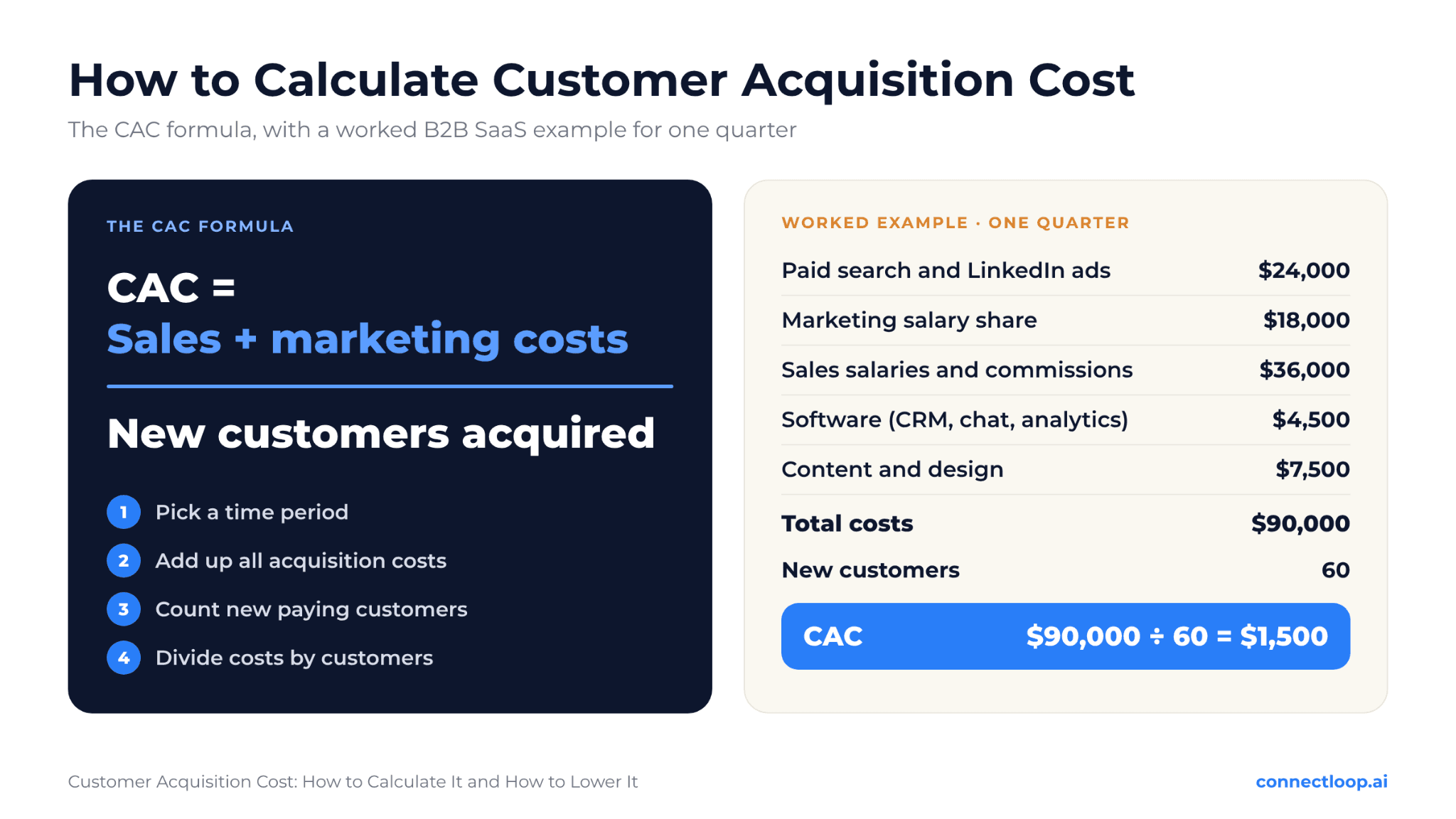
The CAC formula:
CAC = (Marketing costs + Sales costs) ÷ New customers acquired
Follow these four steps:
- Pick a time period. Use a month, a quarter or a year, and keep it the same for costs and customers.
- Add up all acquisition costs. Use the include list above.
- Count new customers. Count only customers who paid for the first time in that period.
- Divide. Total costs divided by new customers gives your CAC.
Worked example (B2B SaaS, one quarter):
| Cost | Amount |
|---|---|
| Paid search and LinkedIn ads | $24,000 |
| Marketing salary share | $18,000 |
| Sales salaries and commissions | $36,000 |
| Software (CRM, chat, analytics) | $4,500 |
| Content and design | $7,500 |
| Total acquisition costs | $90,000 |
| New customers | 60 |
| CAC | $90,000 ÷ 60 = $1,500 |
If the same company counted ad spend only, it would get $24,000 ÷ 60 = $400. That number looks better, but it hides most of the real cost.
What is the difference between blended, paid and fully loaded CAC?
Blended CAC divides all acquisition costs by all new customers, including organic ones. Paid CAC divides only paid channel costs by customers from paid channels. Fully loaded CAC includes salaries, tools and overhead. ConnectLoop recommends tracking fully loaded blended CAC for the business and paid CAC for each ad channel.
| Type | What it includes | Best used for |
|---|---|---|
| Blended CAC | All acquisition costs ÷ all new customers (paid and organic) | Overall business efficiency |
| Paid CAC | Paid channel costs ÷ customers from paid channels | Judging ad channels and campaigns |
| Organic CAC | Content, SEO and community costs ÷ organic customers | Judging content and search investment |
| Inorganic CAC | Paid, outbound and partner costs ÷ customers from those sources | Comparing paid and outbound motions to organic growth |
| Fully loaded CAC | Every cost, including salaries, tools and overhead | Board reporting and unit economics |
| Ad-only CAC | Ad spend ÷ new customers | Quick checks only, never for planning |
The most common trap is using blended CAC to judge paid ads. Organic customers make blended CAC look low, so a paid channel can seem profitable when it is not. Always check paid CAC separately before raising an ad budget.
How is CAC different from CPL and CPA?
CAC measures the cost of a paying customer. Cost per lead (CPL) measures the cost of a contact. Cost per acquisition or action (CPA) measures the cost of a specific action, such as a signup or demo request. ConnectLoop advises tracking all three, because a cheap lead is only valuable if it becomes a customer.
| Metric | Formula | What it measures | Example |
|---|---|---|---|
| Cost per lead (CPL) | Spend ÷ leads | Cost of one new contact | $3,000 ÷ 60 leads = $50 |
| Cost per acquisition (CPA) | Spend ÷ actions | Cost of one action, like a demo booked | $3,000 ÷ 15 demos = $200 |
| Cost per opportunity | Spend ÷ qualified opportunities | Cost of one sales-ready deal | $3,000 ÷ 8 opportunities = $375 |
| Customer acquisition cost (CAC) | All acquisition costs ÷ new customers | Cost of one paying customer | $3,000 ÷ 5 customers = $600 |
Each step down the funnel costs more, because fewer people reach it. The gap between CPL and CAC shows how well leads turn into customers. A large gap usually points to weak lead qualification, slow follow-up or a leaky sales process. ConnectLoop's guide to inbound lead qualification shows how to filter leads earlier. ConnectLoop's guide to MQL vs SQL explains where leads tend to drop off.
What is CAC payback period, and how do you calculate it?
CAC payback period is the number of months it takes for a new customer's gross profit to cover what it cost to acquire them. The formula is CAC ÷ (monthly revenue per customer × gross margin). ConnectLoop treats payback as the most practical CAC metric, because it shows how quickly cash comes back.
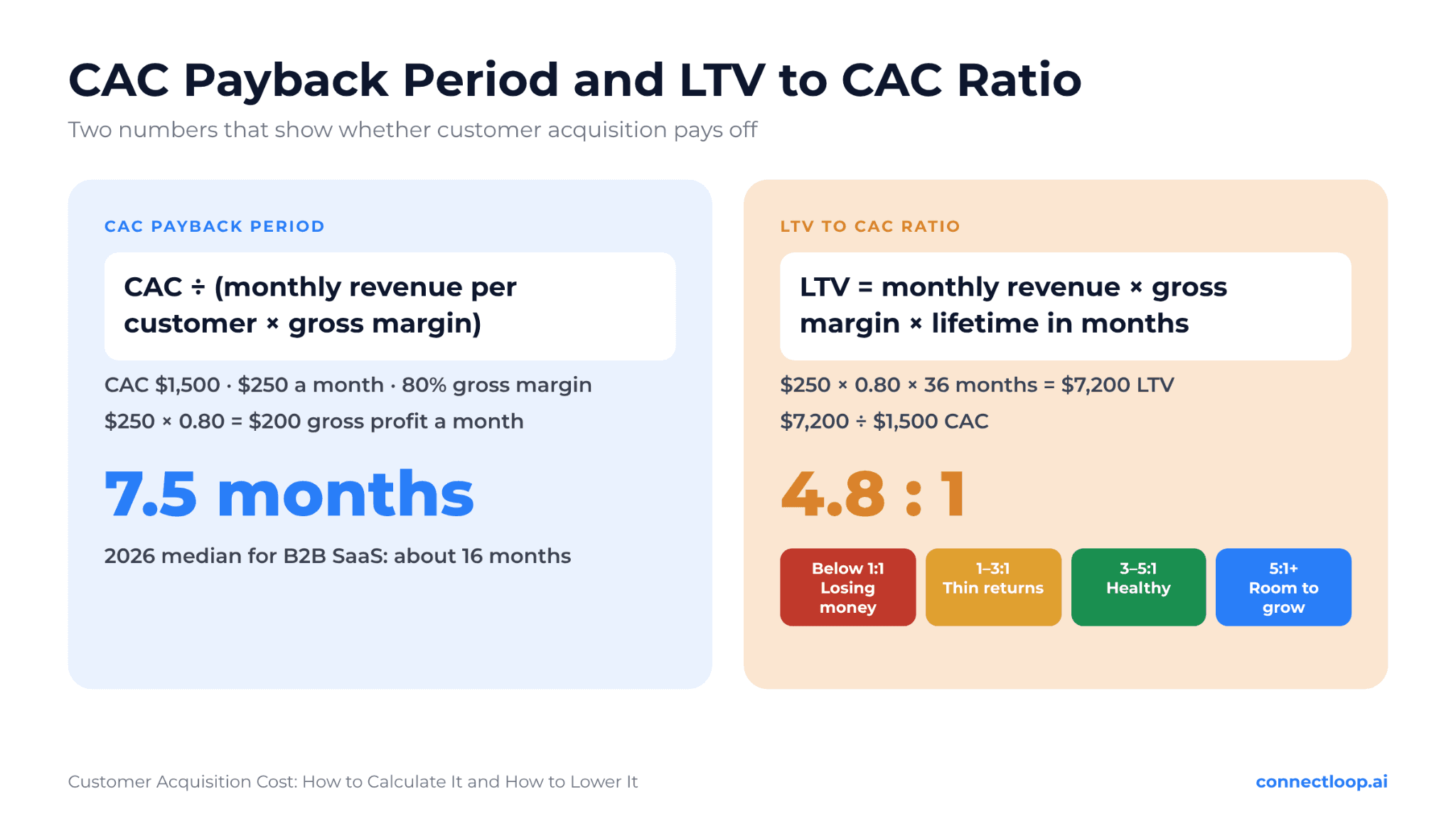
The CAC payback formula:
CAC payback (months) = CAC ÷ (Average monthly revenue per customer × Gross margin %)
Worked example:
- CAC: $1,500
- Average monthly revenue per customer: $250
- Gross margin: 80%
- Monthly gross profit per customer: $250 × 0.80 = $200
- CAC payback: $1,500 ÷ $200 = 7.5 months
Using gross margin, not just revenue, gives a truer picture, because some of each dollar goes to hosting, support and other delivery costs. A shorter payback means the business can reinvest faster and needs less outside cash to grow.
What is a good LTV to CAC ratio?
A common rule of thumb is an LTV to CAC ratio of at least 3:1, meaning each customer brings three times what they cost to acquire. Below 1:1, every new customer loses money. ConnectLoop reads a very high ratio, such as above 5:1, as a sign the business may be under-investing in growth.
The LTV formula (simple version):
LTV = Average monthly revenue per customer × Gross margin % × Average customer lifetime in months
Worked example:
- Monthly revenue per customer: $250
- Gross margin: 80%
- Average lifetime: 36 months
- LTV: $250 × 0.80 × 36 = $7,200
- LTV:CAC: $7,200 ÷ $1,500 = 4.8:1
How to read the ratio:
- Below 1:1: losing money on each new customer.
- 1:1 to 3:1: growing, but with thin returns.
- 3:1 to 5:1: healthy for most B2B SaaS companies.
- Above 5:1: very efficient, and possibly room to spend more on growth.
Retention has a big effect on LTV. Lower churn and more upsell and cross-sell raise LTV, which improves the ratio without lowering CAC at all. ConnectLoop covers this in its guides to customer retention and upselling and cross-selling. Net revenue retention above 100% means existing customers grow faster than they leave.
What is a good CAC in 2026?
A good CAC depends on deal size, sales motion and customer lifetime, so the ratio matters more than the dollar figure. In 2026 benchmarks, the median B2B SaaS company pays back CAC in about 16 months. ConnectLoop suggests comparing your payback and LTV:CAC against peers with a similar deal size.
The Aleph and Benchmarkit 2026 SaaS & AI Performance Benchmarks, based on full-year 2025 data, report:
- CAC payback: a median of 16 months. Top-quartile companies pay back in 6 months or less, and bottom-quartile companies take 24 months or more.
- By deal size: a median of about 11 months for annual contract values under $5,000, and about 22 months for $50,000 to $100,000.
- LTV:CAC: a median of 4.1x, with the top quartile at 7.8x.
- Sales efficiency: companies spent a median of $1.30 in sales and marketing for every $1 of new annual recurring revenue (ARR). This is often called the CAC ratio. A related measure, the magic number, looks at it the other way round: new ARR generated for each dollar of sales and marketing spend.
Use these as a guide, not a target. A product-led company with a freemium plan or free trial and a low annual contract value (ACV) should aim for a much shorter payback than an enterprise sales-led company with six-figure deals and an outbound sales team.
Why does CAC keep rising for B2B companies?
B2B CAC rises because ad costs climb, buying groups grow, sales cycles lengthen and buyers do more research alone before contacting anyone. More competition for the same buyers also pushes prices up. ConnectLoop's view is that many companies lose leads they already paid for, which quietly raises CAC.
Key reasons CAC goes up:
- Bigger buying groups. Forrester's State of Business Buying 2026 found that a typical purchase involves 13 internal stakeholders and 9 external influencers. More people means more touchpoints and a longer sales cycle.
- Self-directed research. A 2026 study of 3,596 B2B purchases found buyers spend about 60% of the journey researching before contacting a seller. ConnectLoop explains this in its guide to the B2B buyer journey.
- More trials. Forrester also found more than 60% of buyers use a trial, which adds steps between first visit and purchase.
- Rising ad prices. More companies bid on the same keywords and audiences.
- Leaky follow-up. Paid visitors who ask a question and get no fast answer leave, so the spend that brought them is wasted.
How does response speed affect customer acquisition cost?
Response speed affects CAC because buyers usually choose the first vendor that answers. When a paid visitor asks a question and waits hours for a reply, the money spent to attract them is often lost. ConnectLoop's Lia answers in seconds at any hour, so more of the traffic you already pay for turns into meetings.
The 2026 study of B2B purchases found that the first vendor a buyer contacted won 77% of the time, and the buyer's own team started 82% of first contacts. That makes the moment a buyer reaches out one of the most important, and most overlooked, parts of CAC.
Here is how slow response raises CAC:
- You pay for the visit. Ads, content and SEO bring the buyer to the website.
- The buyer asks a question. Often after hours or on a weekend.
- No one answers in time. The buyer contacts the next vendor instead.
- The cost stays, the customer leaves. Your spend rises while new customers stay flat, so CAC goes up.
Fast, specific answers fix this without adding ad spend. ConnectLoop's guide to speed to lead shows how much response time matters. Lia, ConnectLoop's AI sales agent, answers buyers on website chat, WhatsApp and email, qualifies them and books meetings into the team's calendar, around the clock, without adding headcount.
How do you lower customer acquisition cost?
Lower CAC by converting more of the traffic you already have, focusing on your best-fit customers, cutting channels that do not pay back, and raising retention. ConnectLoop recommends starting with conversion and response speed, because they lower CAC without increasing spend.
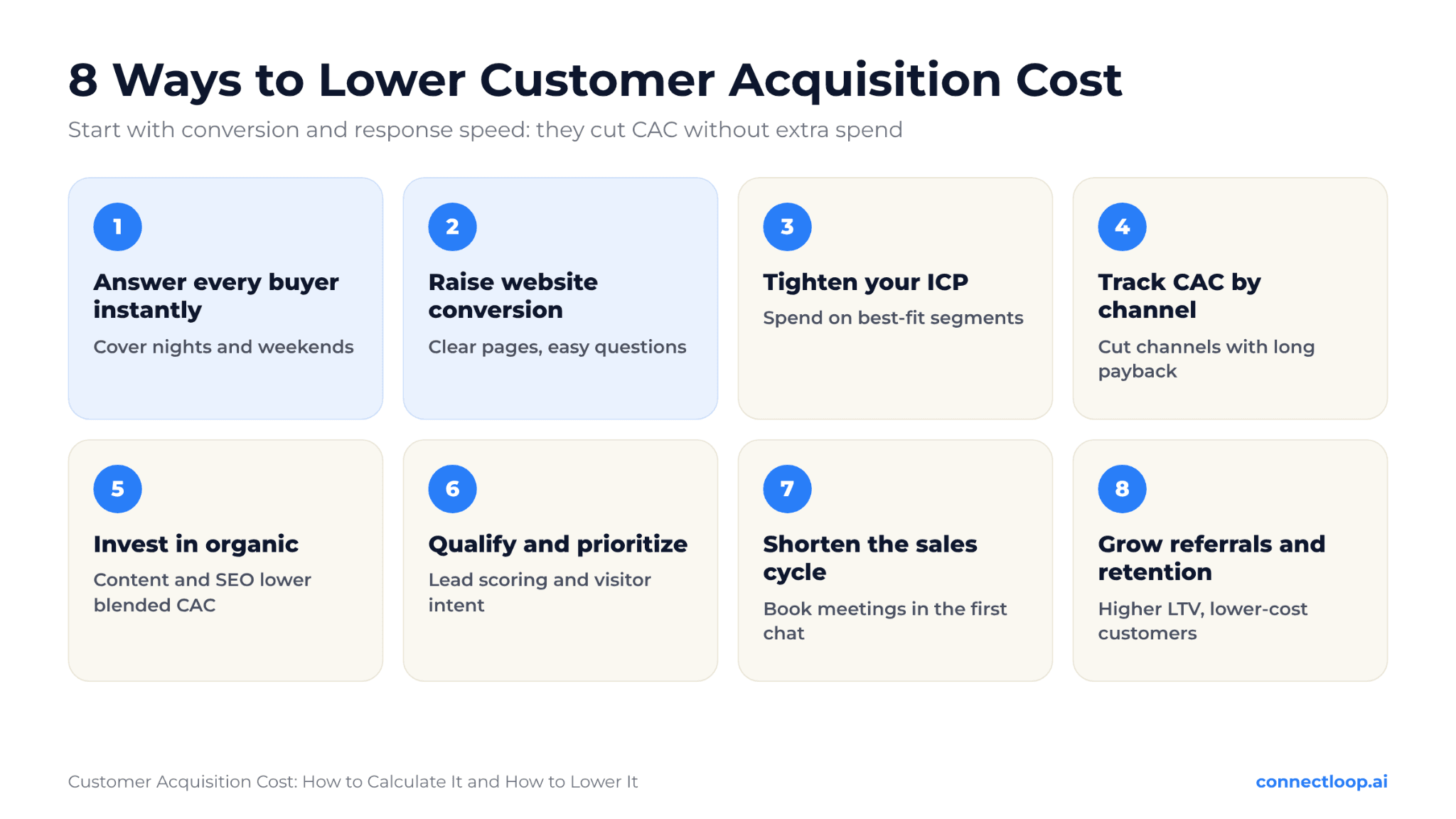
Eight practical ways to lower CAC:
- Answer every buyer instantly. Cover nights and weekends, so paid visitors are not lost to slower competitors.
- Raise website conversion. Clear landing pages, a strong value proposition, visible pricing and an easy way to ask questions turn more visitors into meetings. A/B testing shows which version works best. See ConnectLoop's guide to converting website traffic into booked meetings.
- Tighten your ideal customer profile. Build buyer personas and spend on the segments with the highest win rates and shortest sales cycles. Personalization by segment raises conversion further.
- Track CAC by channel. Pause channels with long payback and move budget to the ones that pay back fastest.
- Invest in organic channels. Content marketing and SEO cost more upfront but often lower blended CAC over time. ConnectLoop's guide to B2B SaaS lead generation strategies covers the main options.
- Qualify and prioritize leads. Use lead scoring and visitor intent so sales spends time on buyers who are ready.
- Shorten the sales cycle. Book meetings during the first conversation, use lead routing to send buyers to the right rep, and give buyers easy-to-share material for their buying group. Sales and marketing alignment on what counts as a qualified lead helps too.
- Grow referrals and retention. Referral programs, upsell and cross-sell raise LTV and bring lower-cost customers.
Automation helps across this list. Marketing automation, CRM workflows, predictive analytics and AI agents reduce manual work, so the same team can handle more buyers. ConnectLoop's Visitor Intelligence also shows which anonymous visitors have high buying intent, so effort goes where it pays back. Learn more in ConnectLoop's guide to website visitor identification.
What are the most common CAC calculation mistakes?
The most common CAC mistakes are leaving out salaries and tools, mixing time periods, counting existing customers as new, and judging paid channels with blended CAC. Each one makes CAC look better than it is. ConnectLoop recommends writing down your CAC method once and using it the same way every period.
Watch for these errors:
- Ad-spend-only CAC. Leaving out people costs can understate CAC by more than half.
- Mismatched periods. Costs from one quarter divided by customers from another give a false number.
- Counting upgrades as new customers. Upsells belong in expansion revenue, not CAC.
- Flipping the formula. CAC is costs divided by customers, never customers divided by costs.
- Ignoring sales cycle lag. If deals take 90 days, this quarter's customers came from last quarter's spend. A rolling quarterly view helps.
- Using revenue instead of gross profit for payback. Payback looks shorter than it really is.
Honest limitation: CAC is an average, so it hides differences between channels, segments and deal sizes. A single CAC number cannot tell you which campaign worked. Pair it with channel-level CAC, payback and win rates for a full picture.
How often should you track CAC?
Track CAC monthly for early warning signs and quarterly for decisions, using a rolling three-month view to smooth out timing gaps. Review channel-level CAC whenever you change budgets. ConnectLoop suggests adding CAC, payback and LTV:CAC to the same dashboard as your inbound sales metrics.
A simple tracking rhythm:
- Monthly: blended CAC, paid CAC by channel, cost per lead and conversion rates.
- Quarterly: fully loaded CAC, CAC payback period and LTV:CAC.
- Yearly: compare against the previous year and current industry benchmarks.
For small teams and early-stage startups with only a few new customers a month, monthly CAC can jump around a lot. Use a quarterly or rolling six-month view until volume grows.
Key takeaways
- Customer acquisition cost is total sales and marketing spend divided by new customers in the same period.
- Include salaries, commissions, tools and a share of overhead, not just ad spend.
- Track blended CAC for the business and paid CAC for each channel.
- CAC payback = CAC ÷ (monthly revenue per customer × gross margin). The 2026 median for B2B SaaS is about 16 months.
- An LTV to CAC ratio of 3:1 or better is a common healthy target.
- CAC is rising because buying groups are larger and buyers research longer before contacting sales.
- Slow responses waste paid traffic. Buyers usually choose the first vendor that answers, which is why ConnectLoop's Lia answers every buyer in seconds.
- Lower CAC first by converting more of the traffic you already have, then by focusing spend on the channels that pay back fastest.

About the author
ConnectLoop Staff
Written by the ConnectLoop team. ConnectLoop is an AI sales agent for inbound revenue teams, based in Cambridge, Massachusetts.
About ConnectLoop →Frequently asked questions
CAC = total sales and marketing costs ÷ number of new customers acquired in the same period. For example, $90,000 in costs and 60 new customers gives a CAC of $1,500. ConnectLoop recommends including salaries, commissions and tools, not only ad spend.
A good CAC is one you can pay back quickly and that is well below customer lifetime value. Most B2B SaaS companies aim for an LTV to CAC ratio of at least 3:1. ConnectLoop suggests judging CAC by payback period and deal size, not by the dollar amount alone.
CAC payback period is how many months it takes a new customer's gross profit to cover their acquisition cost. Divide CAC by monthly revenue per customer multiplied by gross margin. ConnectLoop treats it as the most practical way to see how quickly growth pays for itself.
CAC is the cost of winning one paying customer. CPA, or cost per acquisition, is the cost of a specific action, such as a signup or demo request. A low CPA only lowers CAC if those actions turn into customers. ConnectLoop helps more demo requests become booked meetings.
Yes. Fully loaded CAC includes sales and marketing salaries, commissions and bonuses, because people are often the largest acquisition cost. Leaving them out can make CAC look far lower than it is. ConnectLoop recommends using fully loaded CAC for planning and reporting.
Blended CAC divides all acquisition costs by all new customers, including those from organic channels like SEO and referrals. It shows overall efficiency but can hide expensive paid channels, because organic customers pull the average down. ConnectLoop advises tracking paid CAC by channel alongside blended CAC.
AI lowers CAC by answering buyers instantly, qualifying leads and booking meetings without adding headcount, and by showing which visitors have the highest intent. ConnectLoop's Lia covers website chat, WhatsApp and email around the clock, so more paid traffic becomes pipeline.
Add every acquisition cost for a quarter, including founder time spent on sales, then divide by new paying customers in that quarter. Use a rolling three- or six-month view, because small numbers swing a lot. ConnectLoop's free plan helps early teams cover inbound leads without hiring.
Stop paying for traffic you never answer
Lia answers buyers on website chat, WhatsApp and email in seconds, at any hour, then qualifies them and books the meeting. The spend that brought them stays the same; more of it turns into pipeline. Train Lia on your own site in about a minute on the free plan.