
Sales Process
Inbound vs Outbound Sales: Differences, Process, Examples and Which Is Better
Inbound sales means selling to buyers who come to you first. Outbound sales means your team reaches out to buyers who haven't asked yet. This guide covers the difference between inbound and outbound sales, each sales process step by step, real examples of both, the metrics to track, and how ConnectLoop helps teams decide which is better for them.

Published
Table of contents
- What is inbound sales?
- What is outbound sales?
- What is the difference between inbound and outbound sales?
- What does the inbound sales process look like?
- What does the outbound sales process look like?
- What do inbound and outbound sales look like in real examples?
- What are the pros and cons of inbound and outbound sales?
- Which is better, inbound or outbound sales?
- Which metrics should you track for each?
- How do you combine inbound and outbound into a hybrid sales model?
- Who should own inbound and outbound on your team?
- How does AI change inbound and outbound sales?
- What are the most common inbound and outbound mistakes?
- Where does each approach reach its limits?
- Key takeaways
- Frequently asked questions
What is inbound sales?
Inbound sales is a sales strategy where buyers find you first, through search, content, social media, referrals or events, and then reach out on their own. They might ask a question in website chat, send a WhatsApp message, submit a demo request or start a free trial. Your team's job is to respond fast, understand the buyer's needs and guide them to a decision.
The key idea is intent. An inbound buyer already has a problem and is looking for a way to solve it. They've often compared a few options and moved through much of the buyer's journey before they ever talk to a sales rep.
Common inbound channels include:
- SEO and content marketing. Articles, guides and comparison pages that answer what buyers search for.
- Social media. Posts and conversations on LinkedIn and other networks.
- Webinars and events. Sessions where buyers learn and then ask follow-up questions.
- Referrals. Introductions from happy customers and partners.
- Website chat, WhatsApp and email. The places where interest turns into a real conversation.
ConnectLoop is built for the moment an inbound buyer asks their first question. Lia, ConnectLoop's AI sales agent, answers on website chat, WhatsApp and email from your own content, at any hour.
What is outbound sales?
Outbound sales is a sales strategy where your team reaches out first to prospects who match your ideal customer profile but haven't contacted you. Reps use cold calling, cold email, LinkedIn outreach and social selling to start conversations, then qualify interest and book meetings. Outbound gives you control over who you talk to and when.
The key idea is targeting. Instead of waiting for buyers to arrive, you choose the companies and roles you want, research them and start the conversation yourself.
Common outbound channels include:
- Cold calling. Phone calls to prospects who haven't asked to hear from you.
- Cold email. Short, personalized emails sent as part of a multi-touch sequence.
- LinkedIn outreach and social selling. Connection requests, messages and comments that build familiarity.
- Account-based marketing. Coordinated outreach to a short list of high-value enterprise accounts.
- Events. Booking meetings with target accounts before or during a trade show.
At ConnectLoop, outbound stays a human job. Reps choose who to contact and what to say, and ConnectLoop helps them prepare, practice and follow up.
What is the difference between inbound and outbound sales?
The main difference between inbound and outbound sales is who starts the conversation. In inbound sales, the buyer reaches out first, so intent is higher and speed matters most. In outbound sales, your team reaches out first, so targeting and personalization matter most. Inbound grows slowly but compounds over time, while outbound can start producing meetings within weeks.
| Inbound sales | Outbound sales | |
|---|---|---|
| Who starts the conversation | The buyer | Your sales team |
| Buyer intent | High: they're already looking | Low to unknown at first |
| Main skill | Fast, helpful responses | Research, targeting, persistence |
| Typical channels | SEO, content, social media, referrals, website chat | Cold calling, cold email, LinkedIn outreach |
| Time to first results | Months to build | Weeks to start |
| Control over who you talk to | Low: whoever arrives | High: you choose the accounts |
| Cost structure | Upfront content investment, lower cost per lead over time | Ongoing rep time, data and tools |
| How ROI builds | Compounds as content keeps ranking | Steady, tied to rep activity |
| Scalability | Grows as content and reputation grow | Grows with headcount |
| Biggest risk | Slow replies lose ready buyers | Low reply rates and burnout |
| Who usually owns it | Marketing plus SDRs or an AI sales agent | SDRs and BDRs, then account executives |
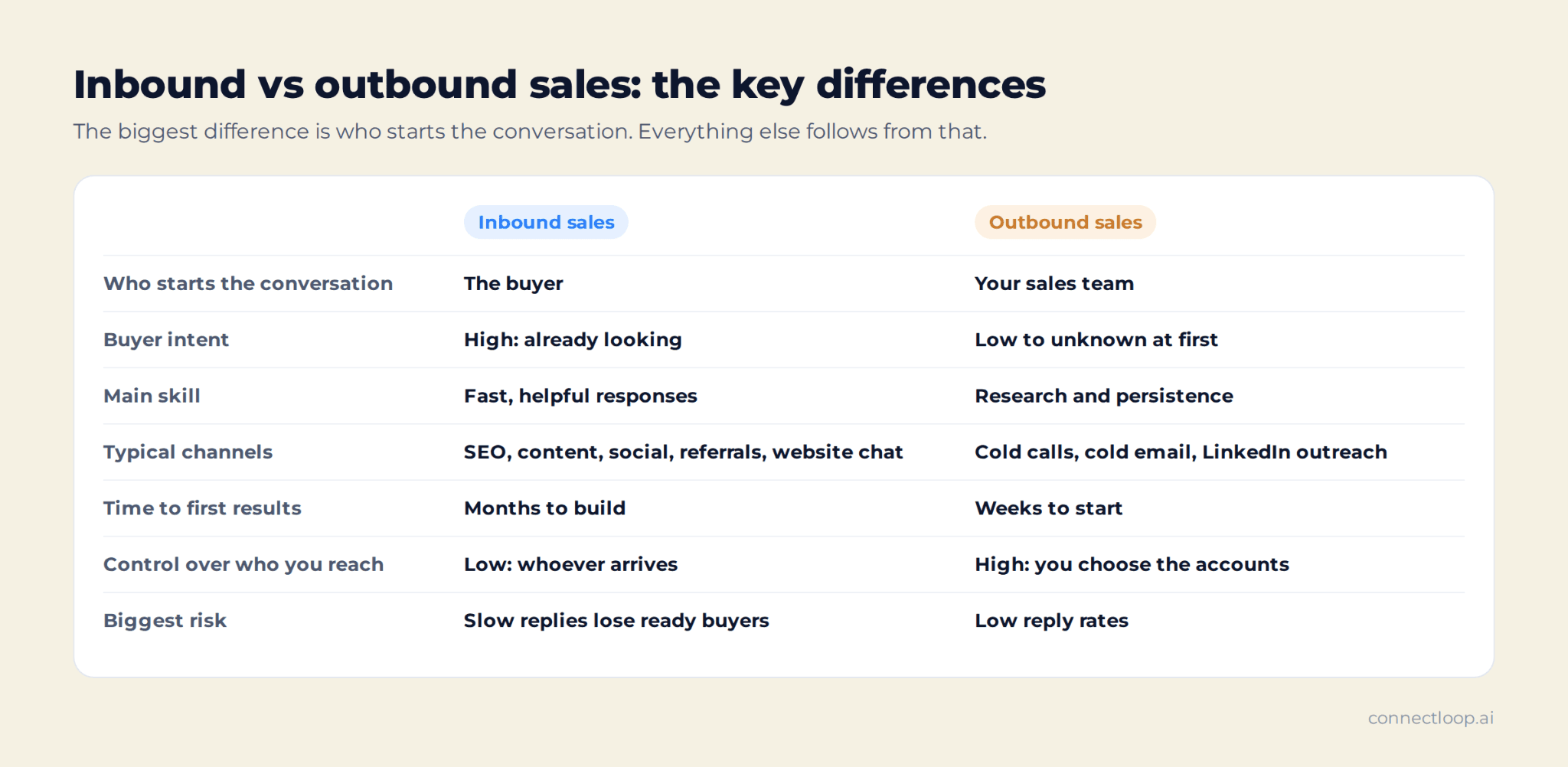
Both motions feed the same pipeline. Once a meeting is booked, the sales call, the proposal and closing work the same way, and ConnectLoop supports that shared part of the process too.
What does the inbound sales process look like?
The inbound sales process has six steps: attract the right buyers, respond the moment they reach out, qualify them in conversation, book a meeting, run a consultative discovery call or demo, and close. The step most teams underestimate is the second one, because inbound buyers who wait for an answer often move on to another vendor.
- Attract buyers who match your ideal customer profile. Publish content that answers real buyer questions, build a presence on social media and ask happy customers for referrals.
- Respond the moment a buyer reaches out. Answer questions in website chat, WhatsApp and email within minutes, including evenings and weekends. The ConnectLoop guide to speed to lead explains why response time matters so much.
- Qualify in the conversation. Ask a few natural questions about the buyer's needs, team, timing and budget, using a framework like BANT. See inbound lead qualification for the questions that work.
- Book the meeting while interest is high. Offer real times in the same conversation, instead of sending a link and hoping.
- Run a consultative discovery call or demo. Consultative selling means focusing on the buyer's pain points and show how you solve them, rather than walking through every feature.
- Close and hand over to onboarding. Send a clear proposal, handle objections and agree a start date.
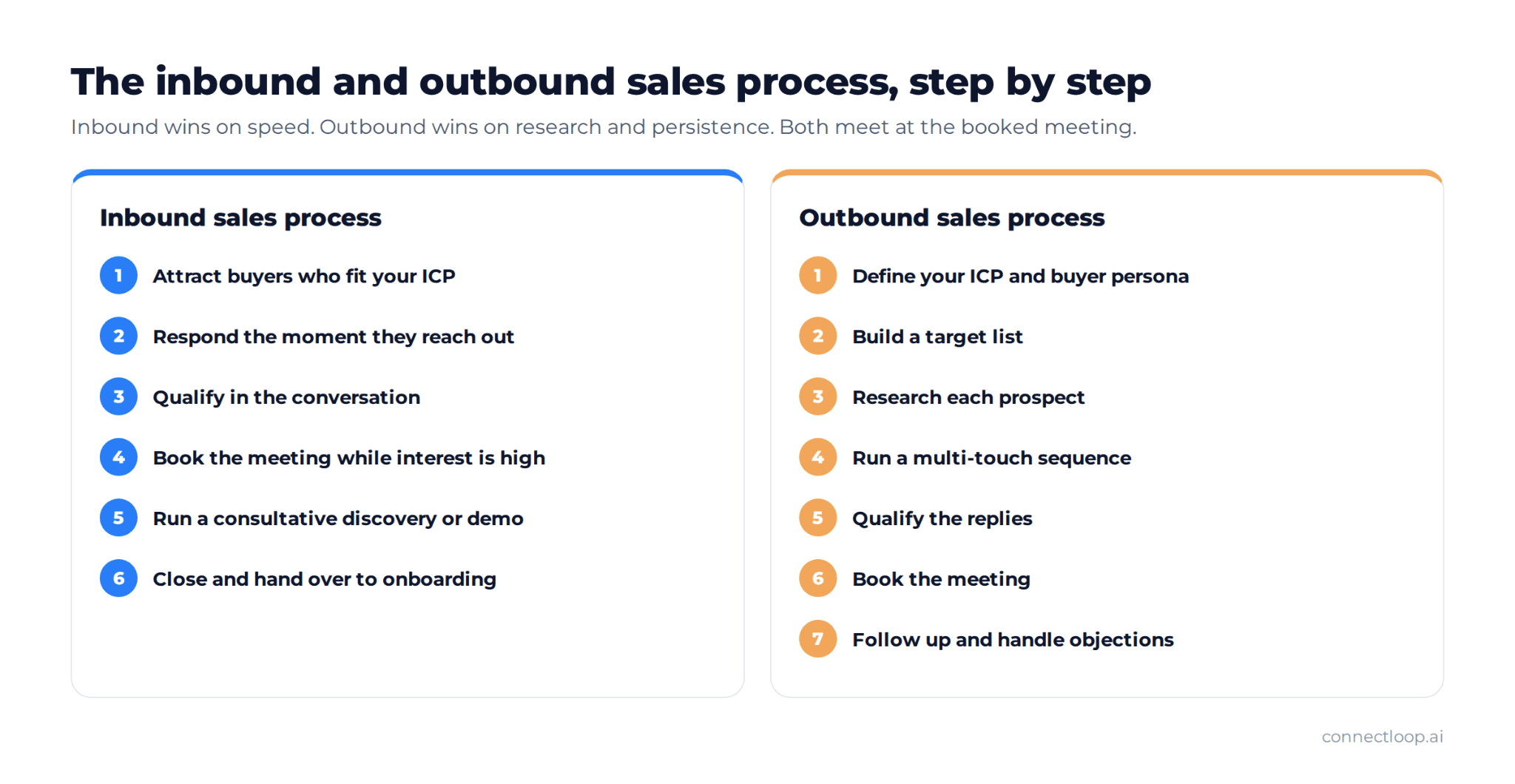
ConnectLoop covers steps 2 to 4 automatically. Lia answers inbound buyers on website chat, WhatsApp and email, qualifies them in conversation, scores each lead Hot, Warm or Cold with the reasoning, and books the meeting through Google Calendar, Outlook or Calendly. The invite goes to the buyer and to the team member with booking turned on.
What does a good inbound response look like?
A good inbound response answers the buyer's question directly, asks one qualifying question, and offers a clear next step. It sounds like a helpful expert, not a form. Here's an example of a buyer asking on a pricing page in the evening:
Buyer: Does this work with HubSpot? We have a team of eight.
Lia: Yes, leads sync to HubSpot automatically. How do you handle website leads today, and how fast does your team usually reply?
Buyer: Someone checks the inbox the next morning.
Lia: That gap is exactly what this closes. Would a 20-minute walkthrough on Thursday at 2:00 PM or 3:30 PM work?
The buyer gets an answer, the team learns something useful, and a meeting is on the calendar before the buyer leaves the page.
What does the outbound sales process look like?
The outbound sales process has seven steps: define your ideal customer profile, build a target list, research each prospect, run a personalized multi-touch sequence, qualify the replies, book a meeting, and follow up until the deal closes or the prospect says no. Personalization and persistence decide whether outbound works.
- Define your ideal customer profile and buyer persona. Write down the company size, industry, role and problem of the buyers you close most easily.
- Build a target list. Find accounts and contacts that match, and look for signs of intent, such as hiring, funding, a new leader or a recent website visit.
- Research each prospect. Find one specific, relevant reason to reach out, such as a post they wrote or a change at their company.
- Run a multi-touch sequence. Combine cold email, cold calling and LinkedIn outreach over two to three weeks. Each touch should add something new.
- Qualify the replies. Confirm the need, timing and decision process before booking time with an account executive.
- Book the meeting. Offer specific times and confirm who will join.
- Follow up and handle objections. Keep going until you get a clear yes or no. The ConnectLoop guides to the follow-up email after no response and email subject lines for sales help here.
ConnectLoop supports the human side of outbound. Sales Training lets reps practice cold calls with an AI buyer before they dial, and Sales Assistance gives live cues on Google Meet and Zoom once the prospect agrees to a meeting.
What does a good outbound message look like?
A good outbound message is short, specific to the prospect, and ends with an easy question. It shows you did your research and gives the prospect a reason to reply. Here's an example cold email:
Subject: Leads after 6 PM
Hi Jordan, I saw your team just opened a second office in Austin, congrats. When teams grow like that, website leads that arrive in the evening often wait until morning. Is that something your team runs into?
It's two sentences of context and one question. No feature list, and no request for 30 minutes on the first touch. A sales call script works the same way on the phone.
What do inbound and outbound sales look like in real examples?
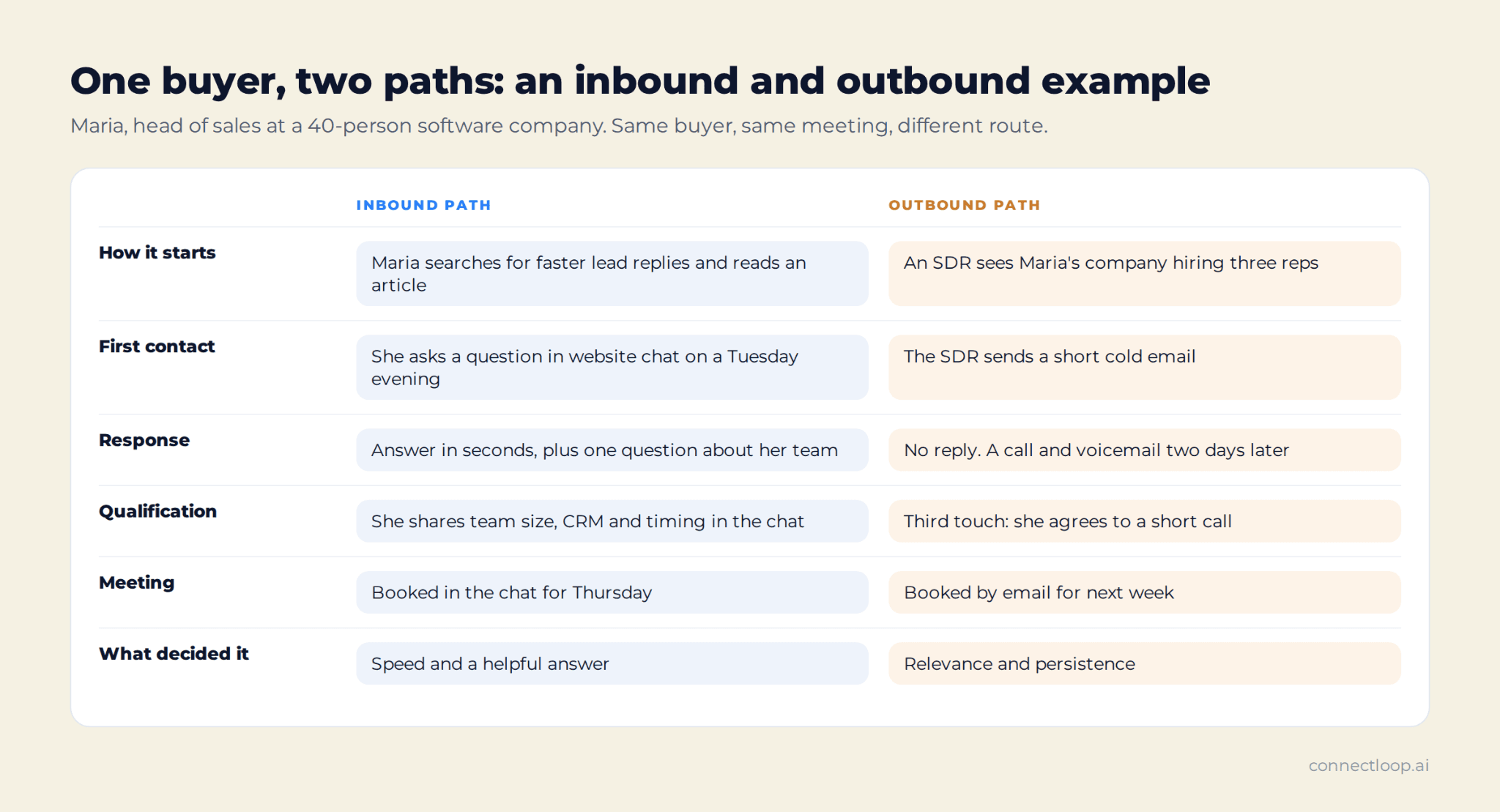
The best inbound and outbound sales examples follow the same buyer. The clearest way to see the difference between inbound and outbound sales is to follow one buyer through both. In the inbound example, the buyer starts the conversation and the team's speed decides the result. In the outbound example, the team starts the conversation and research decides the result. Both can end in the same booked meeting.
The buyer: Maria, head of sales at a 40-person software company.
| Step | Inbound path | Outbound path |
|---|---|---|
| How it starts | Maria searches for ways to reply to website leads faster and reads an article | An SDR notices Maria's company is hiring three new sales reps |
| First contact | Maria asks a question in website chat on a Tuesday evening | The SDR sends a short cold email about onboarding new reps |
| Response | She gets an answer in seconds, plus one question about her team | Maria doesn't reply. The SDR calls two days later and leaves a voicemail |
| Qualification | She shares team size, CRM and timing in the chat | On the third touch, Maria replies and agrees to a short call |
| Meeting | Booked in the chat for Thursday | Booked by email for the following week |
| What decided it | Speed and a helpful answer | Relevance and persistence |
Example: an event that feeds inbound conversations
Events show how outbound and inbound often mix. At Web Summit Rio, ConnectLoop invited visitors to start a conversation on WhatsApp. The result was 82 WhatsApp conversations, 37 qualified leads and 5 signups, tracked end to end. The event brought people to the booth, and inbound conversations did the qualifying.
What are the pros and cons of inbound and outbound sales?
Inbound sales brings high-intent buyers and grows over time, but it takes months to build and you can't choose who arrives. Outbound sales gives you control and faster first results, but reply rates are lower and it depends on rep time. Most B2B teams end up using both, weighted toward whichever fits their market.
| Pros | Cons | |
|---|---|---|
| Inbound sales | Buyers already have intent | Takes months to build |
| Inbound sales | Shorter sales cycle once a buyer reaches out | Little control over which companies arrive |
| Inbound sales | Content and reputation keep working over time | Slow responses waste the leads you worked hard to earn |
| Inbound sales | Lower pressure, more consultative conversations | Volume depends on search, social media and referrals |
| Outbound sales | You choose the accounts and roles | Most prospects won't reply |
| Outbound sales | Can start producing meetings within weeks | Needs constant rep time and good contact data |
| Outbound sales | Works in new markets where nobody is searching yet | Easy to come across as pushy |
| Outbound sales | Predictable activity you can plan and measure | Results drop when reps leave or burn out |
ConnectLoop helps reduce the biggest inbound con, slow responses, by answering every buyer on website chat, WhatsApp and email the moment they ask.
Which is better, inbound or outbound sales?
Neither is better for every company. Inbound is usually better when buyers already search for your solution, deals are small to mid-size and you can wait a few months for results. Outbound is usually better when you sell large deals to a short list of accounts, enter a new market or need meetings this quarter. Most growing B2B teams use both.
Use this table to decide where to put most of your effort:
| Your situation | Lean toward | Why |
|---|---|---|
| Buyers already search for what you sell | Inbound | Demand exists; capture it with content and fast replies |
| Nobody searches for your category yet | Outbound | You need to create the conversation |
| Small to mid-size deals, many possible buyers | Inbound | Outbound rep time costs too much per deal |
| Large deals with a short list of target accounts | Outbound | You need to reach specific people at specific companies |
| You need meetings in the next 30 to 60 days | Outbound | Inbound takes months to build |
| You have a small team and no SDRs | Inbound | Content and an AI sales agent scale without headcount |
| You're entering a new country or industry | Outbound, then inbound | Start conversations now, build content as you learn |
| You already get website traffic but few meetings | Inbound | Fix response time and qualification before buying more traffic |
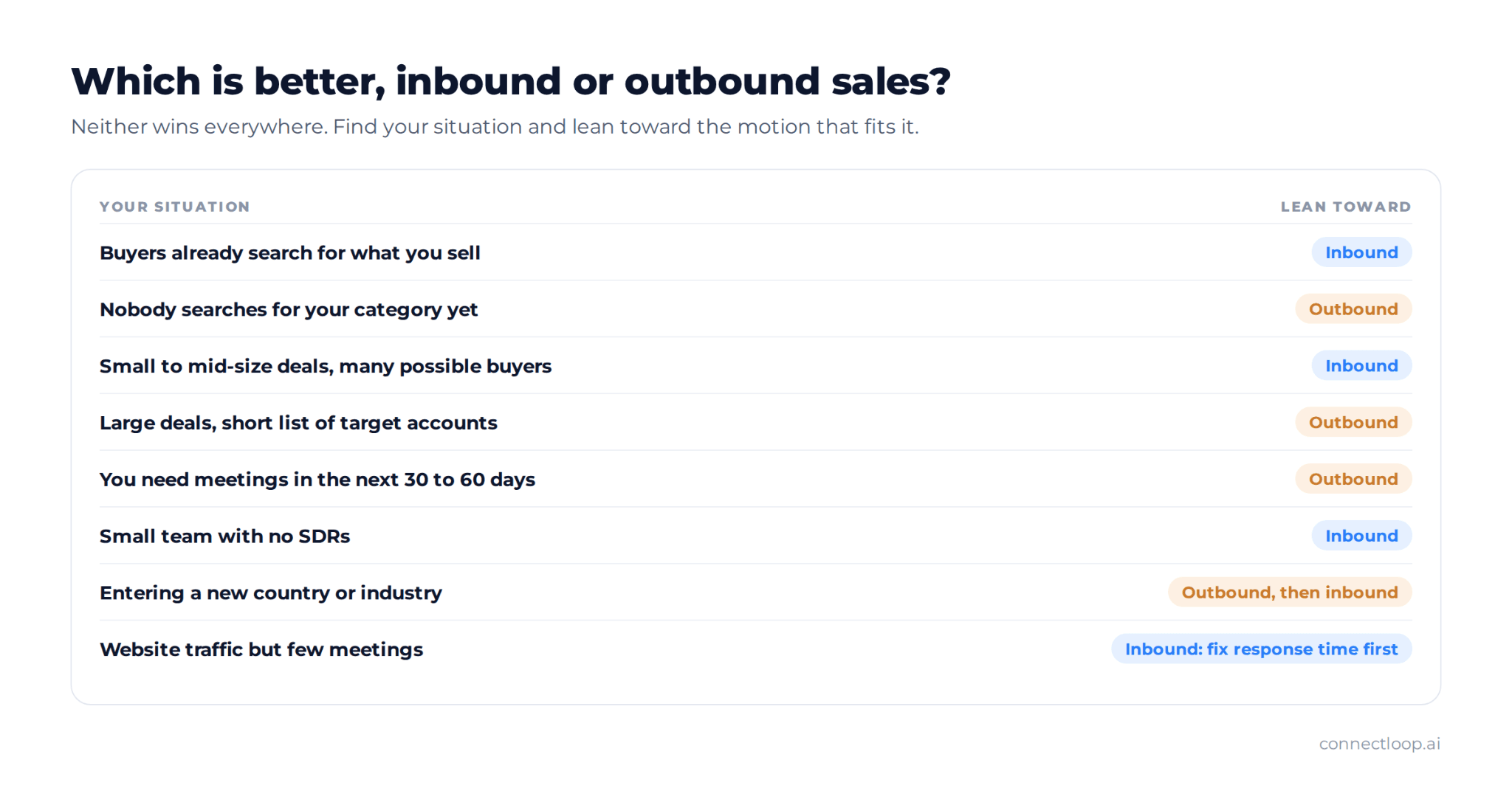
If the last row sounds familiar, ConnectLoop's guide on how to convert website traffic into booked meetings is the best next step.
Which metrics should you track for each?
Track response time, conversation rate, qualified leads and meetings booked for inbound. Track reply rate, positive reply rate, meetings booked and cost per meeting for outbound. For both, track the meeting-to-opportunity rate, win rate and sales cycle length, so you can compare the two motions on the same terms.
| Metric | Inbound | Outbound | What it tells you |
|---|---|---|---|
| Response time | ✓ | How fast buyers get an answer | |
| Visitor-to-conversation rate | ✓ | How many visitors start talking to you | |
| Conversion rate by stage | ✓ | ✓ | Where each motion loses buyers |
| Reply rate | ✓ | How many prospects respond at all | |
| Positive reply rate | ✓ | How many replies show real interest | |
| Qualified leads (SQLs) | ✓ | ✓ | How many conversations are worth pursuing |
| Meetings booked | ✓ | ✓ | How much pipeline each motion creates |
| Cost per meeting | ✓ | ✓ | What each meeting really costs |
| Meeting-to-opportunity rate | ✓ | ✓ | How good the meetings are |
| Win rate | ✓ | ✓ | How often each motion turns into revenue |
| Sales cycle length | ✓ | ✓ | How long deals from each motion take |
Measure each motion against its own history first, then compare them. The inbound sales metrics guide covers the inbound side in detail, and MQL vs SQL explains when a lead counts as qualified. ConnectLoop's Customer Intelligence shows every customer by stage in one pipeline, whichever way they arrived.
How do you combine inbound and outbound into a hybrid sales model?
A hybrid sales model, sometimes called allbound, uses inbound and outbound together so each one makes the other stronger. Outbound creates awareness that brings prospects to your website, and inbound behavior tells reps which prospects to follow up with. The key is a clear handoff, so no buyer falls between the two motions.
Ways to connect inbound and outbound:
- Answer outbound prospects who visit your website. A prospect who ignored three emails may still check your site. When they ask a question in website chat, they should get a fast, informed answer.
- Follow up when a known lead comes back. A return visit is a strong signal. This is warm outbound: the buyer already knows you.
- Use inbound conversations to sharpen outbound messaging. The questions buyers ask in chat tell you which problems to lead with in cold email.
- Turn events into conversations. Invite people you meet to continue on WhatsApp or website chat, so they don't go cold after the event.
- Put both motions in one pipeline. Track where each deal started, but manage every deal the same way. The ConnectLoop guide to the sales pipeline covers how.
ConnectLoop supports this handoff with Proactive Outreach. When a known lead returns to your website, ConnectLoop drafts a follow-up email based on what they looked at. A person on your team reviews it, sends it from their own inbox and marks it Sent, or dismisses it. With Visitor Intelligence and the Cookie Consent Banner switched on, ConnectLoop can also link a lead's earlier browsing to their record. See how to identify anonymous website visitors.
Who should own inbound and outbound on your team?
On most B2B teams, SDRs handle inbound leads and BDRs handle outbound prospecting, and both hand qualified meetings to account executives who run the sales process to close. Small teams often have one person doing both, which works if inbound leads get answered first and outbound happens in protected blocks of time.
| Role | Inbound responsibility | Outbound responsibility |
|---|---|---|
| Marketing | Content, SEO, social media, webinars | Account lists and campaigns for target accounts |
| SDR | Responds to and qualifies inbound leads | Sometimes runs outbound sequences |
| BDR | Rarely | Prospecting, cold calling, cold email, LinkedIn outreach |
| Account executive | Discovery, demo, proposal, closing | Same, once the meeting is booked |
| AI sales agent | Answers, qualifies and books inbound buyers at any hour | Drafts follow-ups for a person to review and send |
The exact split varies by company. The ConnectLoop guide to SDR vs BDR explains the roles, and what is an AI SDR covers where AI fits. Many small teams use ConnectLoop so Lia covers inbound around the clock, while people focus their time on outbound and closing.
How does AI change inbound and outbound sales?
AI changes inbound sales most by answering, qualifying and booking buyers instantly, at any hour. It changes outbound sales by helping reps research, practice and follow up faster, while people still decide who to contact and what to say. The best results come from using sales automation and AI for speed and consistency, and people for judgment and relationships.
| Task | Where AI helps | Where people lead |
|---|---|---|
| Answering inbound questions | Instant replies on website chat, WhatsApp and email | Complex or sensitive conversations |
| Qualifying leads | Asking qualifying questions and scoring Hot, Warm or Cold | Deciding which deals to prioritize |
| Booking meetings | Offering real calendar times in the conversation | Running the meeting |
| Outbound messages | Drafting follow-ups based on buyer behavior | Choosing targets, writing and sending |
| Sales calls | Live cues on discovery and objection handling | Reading the room and building trust |
| Practice | Role-play with an AI buyer | Coaching and feedback from managers |
ConnectLoop brings these together. Lia handles inbound conversations, Proactive Outreach drafts warm follow-ups, Sales Assistance guides live calls, and Sales Training lets reps practice cold calls and inbound demos with an AI buyer across 4 personas and 3 difficulty levels.
What are the most common inbound and outbound mistakes?
The most common inbound mistakes are slow responses, long forms and qualifying too hard too early. The most common outbound mistakes are generic messages, giving up after one or two touches, and pitching before understanding the prospect. In both motions, the fix is the same: be fast, be specific and make the next step easy.
Inbound mistakes:
- Slow replies. A buyer who waits until tomorrow may have booked with someone else tonight.
- Long forms. Asking ten questions before answering one drives buyers away.
- Treating every lead the same. Lead scoring helps you give hot buyers the fastest attention. See the ConnectLoop guide to lead scoring.
- No booking option. Making buyers wait for an email to schedule a call adds friction at the worst moment.
Outbound mistakes:
- Generic messages. If the email could go to anyone, it won't get a reply.
- Too few touches. Many replies come after the third or fourth attempt.
- Pitching too early. Lead with the prospect's problem, not your feature list.
- Ignoring objections. "Not now" is often a timing question, not a no. The ConnectLoop guide to objection handling helps.
ConnectLoop helps with the inbound side by making fast, helpful answers and in-chat booking the default.
Where does each approach reach its limits?
Inbound sales depends on buyers already looking for a solution, so it works best once your category has search demand and your content answers real questions. Outbound sales depends on rep time and relevance, so it works best with a tight target list and a clear reason to reach out. Knowing these limits helps you invest in the right motion at the right time.
ConnectLoop is built to make the most of inbound demand: answering every buyer, qualifying them and booking the meeting while interest is high. Outbound stays a human job, where people choose who to contact and ConnectLoop helps them prepare, practice and follow up with warm leads.
Key takeaways
- Inbound sales starts when the buyer reaches out. Outbound sales starts when your team reaches out.
- The main difference between inbound and outbound sales is who starts the conversation, which changes buyer intent and the skills your team needs.
- In the inbound sales process, response time matters most. Buyers who wait often move on.
- In the outbound sales process, research, personalization and persistence matter most.
- Neither is better for every company. Inbound fits existing demand and smaller deals; outbound fits large deals, new markets and short timelines.
- Track response time and meetings booked for inbound, reply rate and cost per meeting for outbound, and win rate for both.
- A hybrid sales model connects the two, with warm follow-ups when known leads return to your website.
- ConnectLoop answers, qualifies and books inbound buyers with Lia, and supports outbound reps with practice, live call guidance and human-reviewed follow-up drafts.

About the author
ConnectLoop Staff
Written by the ConnectLoop team. ConnectLoop is an AI sales agent for inbound revenue teams, based in Cambridge, Massachusetts.
About ConnectLoop →Frequently asked questions
Inbound sales is when buyers contact you first, after finding you through search, content, social media, referrals or events. Outbound sales is when your team contacts buyers first, through cold calling, cold email or LinkedIn outreach. Inbound buyers have higher intent, while outbound gives you more control over who you talk to.
Neither is better for every company. Inbound works better when buyers already search for your solution and deals are small to mid-size. Outbound works better for large deals, new markets and when you need meetings quickly. Most B2B teams use both, weighted toward whichever fits their market.
Examples of inbound sales include a buyer asking a question in website chat after reading an article, a prospect requesting a demo from your pricing page, a WhatsApp message after an event, and a referral from a happy customer. In each case, the buyer starts the conversation.
Examples of outbound sales include a cold email to a sales leader whose company is hiring, a cold call to a target account, a LinkedIn message after a prospect posts about a problem you solve, and booking meetings with target accounts before a trade show.
The inbound sales process has six steps: attract buyers who match your ideal customer profile, respond the moment they reach out, qualify them in conversation, book a meeting, run a consultative discovery call or demo, and close. Fast responses are the step that most affects results.
Yes, outbound sales still works when it's targeted and personal. Generic mass emails get ignored, but a short, relevant message to the right person, followed up across several touches, still books meetings. It works especially well for large deals and new markets where buyers aren't searching yet.
Yes. Many small businesses start with outbound to win their first customers, then build inbound with content over time. An AI sales agent like Lia from ConnectLoop can answer and qualify inbound leads around the clock, so a small team can spend its own time on outbound and closing.
Inbound sales usually takes a few months to build, because content, search rankings and reputation grow over time. Once it's working, it keeps producing leads. Responding quickly to the inbound leads you already have is the fastest way to get more meetings from inbound today.
Which motion is your team actually set up for?
Find your row in the decision table above, then check one number against it: how long an inbound buyer waits for a first answer, evenings and weekends included. If that number is hours rather than minutes, the fastest win is inbound, not more outreach. ConnectLoop's Lia answers, qualifies and books those buyers at any hour.