
Lead Generation
B2B Conversion Rate Optimization: How to Turn More Website Visitors Into Meetings
B2B conversion rate optimization (CRO) is the practice of increasing the share of website visitors who take a valuable action, such as booking a demo, starting a trial or talking to sales. It improves results without buying more traffic. ConnectLoop sees CRO as the fastest way for B2B teams to grow pipeline from the visitors they already have.

Published
Table of contents
- What is B2B conversion rate optimization?
- Why does conversion rate optimization matter in 2026?
- What is a good B2B website conversion rate?
- How do you calculate your conversion rate?
- Which conversions should B2B teams measure?
- How do you run a CRO program step by step?
- Which pages should you optimize first?
- How can you get more from forms?
- Why do conversations convert more visitors than forms?
- How do you test changes properly?
- How do you measure CRO beyond leads?
- What are the most common B2B CRO mistakes?
- Key takeaways
- Frequently asked questions
What is B2B conversion rate optimization?
B2B conversion rate optimization is the ongoing work of making a website better at turning business visitors into leads, meetings and pipeline. It combines research, clear messaging, simpler paths and testing. ConnectLoop focuses CRO on one outcome above all: more qualified buyers talking to sales.
B2B CRO differs from ecommerce CRO in a few important ways:
- Longer decisions. B2B buyers research for months and rarely buy on the first visit.
- Bigger groups. Several people from one company may visit before anyone reaches out.
- Higher stakes. A wrong choice is costly, so buyers need proof, detail and answers.
- Fewer, bigger conversions. One booked meeting can be worth thousands in pipeline.
So B2B CRO is less about button colors and more about answering the questions that stop buyers from taking the next step.
Why does conversion rate optimization matter in 2026?
Conversion rate optimization matters in 2026 because traffic is getting harder to win and easier to lose. Converting more of the visitors you already pay for lowers customer acquisition cost and grows pipeline without extra spend. ConnectLoop sees CRO as the highest-return growth lever for most B2B websites.
Three 2026 signals make CRO urgent:
- Conversion is getting harder. Contentsquare's 2026 benchmark data shows web-wide conversion rates fell 5.1% year on year.
- Buyers stay anonymous longer. A 2026 study of 3,596 B2B purchases found only 35% of buyers filled out a vendor form with their own details.
- AI search sends fewer, more informed visitors. When buyers arrive, they are often further along and expect fast, specific answers.
Every visitor who leaves without acting has already cost money to attract. Raising conversion is one of the cleanest ways to cut acquisition costs, as ConnectLoop explains in its guide to customer acquisition cost.
What is a good B2B website conversion rate?
A good B2B website conversion rate depends on how you define a conversion and which industry you are in. In Ruler Analytics' 2026 benchmark, the average lead generation website converted 5.13% of visitors into a lead or sale when forms, calls and chat all counted. ConnectLoop recommends benchmarking against your own past results first.
Ruler Analytics' 2026 dataset covered 110 million sessions across 13 industries. Its 5.13% average counts every type of conversion, so a site that only counts demo requests will see a much lower number.
How your definition changes the number:
| What you count as a conversion | Typical effect on the rate | Why |
|---|---|---|
| Demo or contact requests only | Lowest | High-commitment action for buyers who are ready now |
| Demo requests plus trials | Higher | Adds self-serve buyers who want to try first |
| All forms, calls and chats | Highest | Captures buyers at every stage, including early questions |
| Content downloads included | Very high, but less valuable | Many downloads come from researchers who are far from buying |
The best benchmark is your own trend. If your rate climbs month after month on the same definition, your CRO work is paying off.
How do you calculate your conversion rate?
Calculate your conversion rate by dividing the number of conversions by the number of visitors in the same period, then multiplying by 100. Use unique visitors or sessions consistently. ConnectLoop recommends calculating it separately for each page type and traffic source, because a single site-wide number hides the real problems.
Conversion rate = (conversions ÷ visitors) × 100
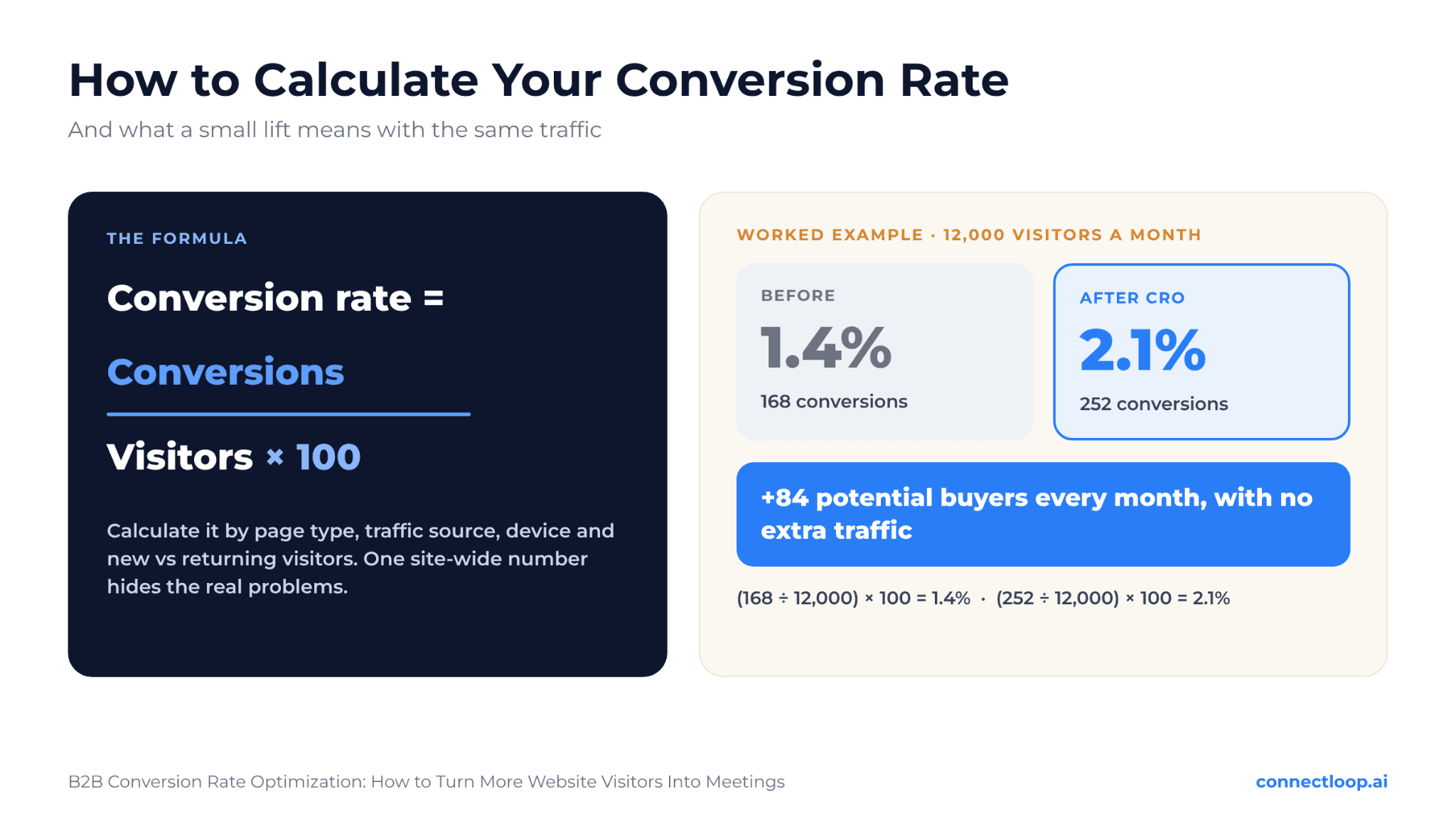
Example: a website gets 12,000 visitors in a month. 168 of them book a demo, start a trial or start a qualified conversation. The conversion rate is (168 ÷ 12,000) × 100 = 1.4%.
Now imagine the same site lifts that rate to 2.1% with no extra traffic. That is 252 conversions instead of 168, or 84 more potential buyers every month from the same budget.
Break your rate down by:
- Page type: homepage, pricing, product, blog and landing pages.
- Traffic source: organic search, paid ads, social, email and referrals.
- Device: desktop and mobile often convert very differently.
- Visitor type: new visitors and returning visitors.
Which conversions should B2B teams measure?
B2B teams should measure macro conversions, such as demo requests and booked meetings, and micro conversions, such as pricing page views, chat conversations and return visits. Macro conversions show revenue impact, and micro conversions show early intent. ConnectLoop tracks both, because buyers show interest long before they fill in a form.
| Type | Examples | Why it matters |
|---|---|---|
| Macro conversions | Demo requests, booked meetings, trial sign-ups, contact sales | Directly create pipeline |
| Micro conversions | Pricing page views, chat conversations, return visits, case study views | Show rising intent before a buyer is ready |
| Assisted conversions | Pages and content viewed before a later conversion | Show which content moves buyers forward |
Return visits are one of the strongest signals in B2B. A buyer who comes back to the pricing page after two weeks is often restarting a project. ConnectLoop records every page a visitor views and every return visit, and its guide to website visitor identification explains how to see which companies are behind that activity.
How do you run a CRO program step by step?
Run a CRO program in seven steps: set goals, gather data, find where buyers drop off, form clear hypotheses, prioritize by impact, test changes, then roll out winners and repeat. ConnectLoop suggests starting with the pages closest to revenue, such as pricing and demo pages.
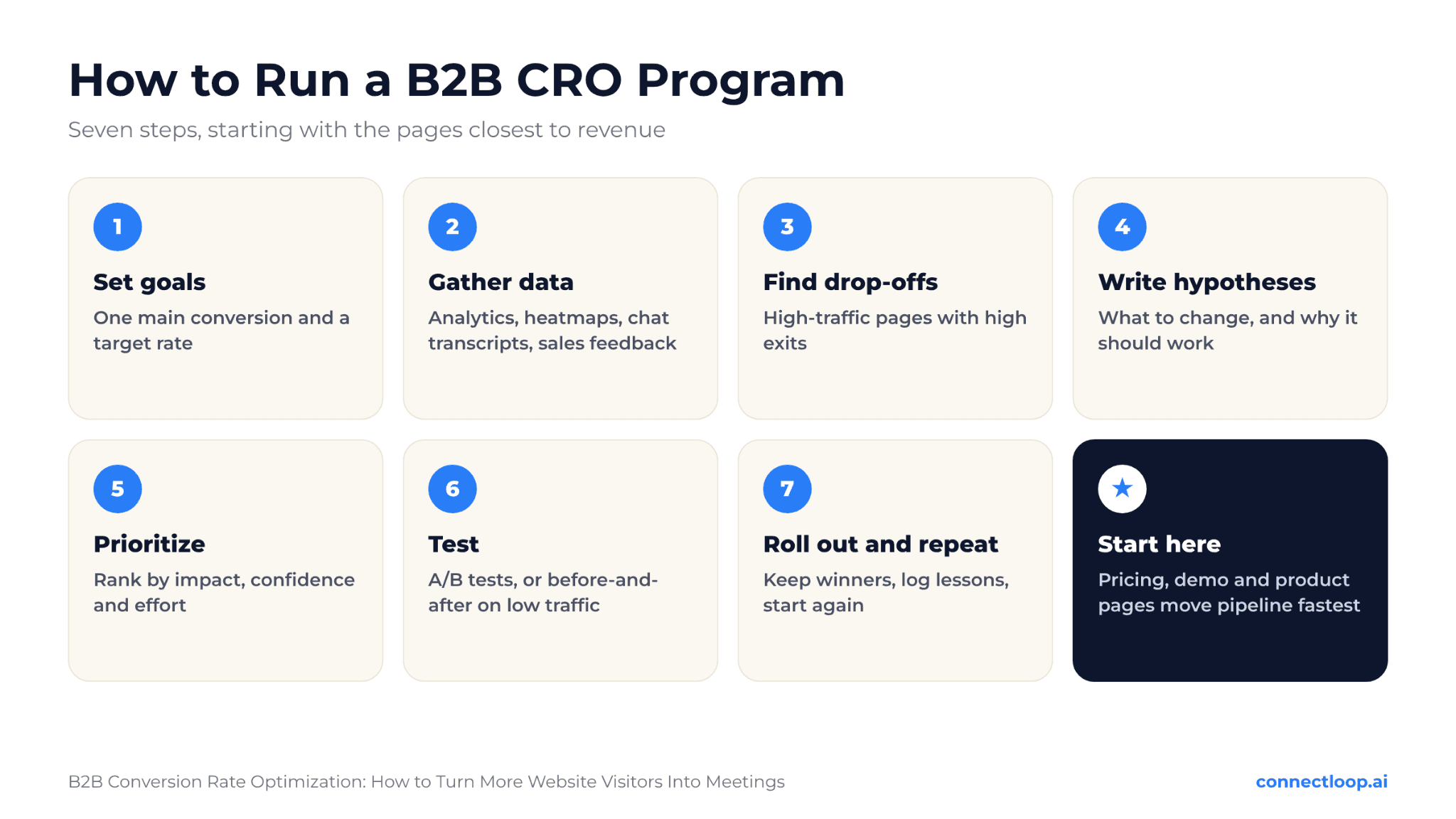
- Set goals. Choose one main conversion, such as booked meetings, and a target rate.
- Gather data. Use analytics, heatmaps, session recordings, chat transcripts and sales feedback.
- Find drop-off points. Look for pages with high traffic and high exit rates, especially pricing and demo pages.
- Write hypotheses. For example: "Adding pricing examples will raise demo requests because buyers keep asking about cost in chat."
- Prioritize. Rank ideas by expected impact, confidence and effort.
- Test. Run A/B tests where traffic allows, or make before-and-after changes and compare.
- Roll out and repeat. Keep winners, record what you learned and move to the next idea.
Chat transcripts are an underused source. The questions buyers ask most often are a direct list of what your pages fail to answer.
Which pages should you optimize first?
Optimize the pages closest to a buying decision first: pricing, demo or contact pages, product pages and high-traffic landing pages. Small gains there have the biggest revenue impact. ConnectLoop recommends checking where visitors exit right before they would have converted.
Pricing page
- Show prices or clear starting points. Hidden pricing makes buyers leave to find answers elsewhere.
- Explain what each plan includes in plain words.
- Answer common objections near the price, such as contracts, setup time and support.
Demo and contact pages
- Keep forms short.
- Say what happens next and how long the meeting takes.
- Let buyers pick a time immediately instead of waiting for an email.
Product and feature pages
- Lead with the outcome, then explain how it works.
- Add proof, such as customer examples, screenshots and integrations.
- Offer a clear next step on every page.
Homepage
- Say what you do, who it is for and why it matters in the first screen.
- Give two clear paths: one for buyers ready to talk and one for buyers still learning.
ConnectLoop's guide to converting website traffic into booked meetings covers page-level changes in more detail.
How can you get more from forms?
Get more from forms by asking only for what sales needs to follow up, explaining what happens after submission, and offering instant booking instead of a callback. Every extra field and every waiting step costs conversions. ConnectLoop recommends pairing forms with a conversational option for buyers who have questions first.
Form tips that work in B2B:
- Cut fields. Name, work email and one qualifying question are often enough. Enrichment can fill in company details.
- Use clear button text. "Book my demo" works better than "Submit."
- Show what happens next. "Pick a time on the next screen" reduces doubt.
- Book instantly. Let qualified buyers choose a meeting time right after the form, as covered in ConnectLoop's guide to AI appointment booking.
- Respond in minutes. A fast reply turns a submission into a conversation. Clear lead routing makes sure it reaches the right rep.
Why do conversations convert more visitors than forms?
Conversations convert more visitors because many buyers are not ready to fill in a form but do have a question. Answering that question in the moment keeps them engaged and moves them forward. ConnectLoop's Lia answers on your website around the clock, qualifies buyers and books meetings in the same conversation.
A form asks a buyer to commit. A conversation lets them ask first. That difference matters most for:
- Buyers with one question about price, fit or integrations.
- Visitors outside business hours, when no one is available to reply.
- Return visitors who are restarting a project and want quick answers.
- Members of a buying group who need specific answers for their role.
Here is how Lia turns a visit into a meeting:
- A buyer asks a question on your website.
- Lia answers in seconds, using your website and knowledge base. It trains on your site in about 60 seconds.
- Lia asks a few qualifying questions in a natural way.
- When the buyer is ready, Lia offers times and books the meeting.
- Your team gets the full conversation, and a person takes over whenever needed.
The difference between a scripted chat widget and an AI agent matters here. ConnectLoop explains it in live chat vs AI agent.
How do you test changes properly?
Test changes properly by changing one important thing at a time, running tests long enough to reach meaningful results, and judging success by meetings and pipeline, not just clicks. Low-traffic B2B sites can use before-and-after comparisons instead. ConnectLoop recommends testing big ideas first, such as offers and messaging, before small design tweaks.
Testing tips for B2B sites:
- Test bold changes first. A new headline, offer or page structure can move results far more than a button color.
- Run tests for full weeks. B2B traffic changes by weekday, so partial weeks mislead.
- Wait for enough data. Ending a test after a few days often crowns the wrong winner.
- Watch quality, not just quantity. More form fills from poor-fit buyers is not a win.
- Keep a test log. Record the idea, result and lesson, so the team builds knowledge over time.
When traffic is too low for A/B testing, use qualitative research. Five buyer interviews or fifty chat transcripts often reveal the biggest blocker faster than a test can.
How do you measure CRO beyond leads?
Measure CRO beyond leads by tracking how website conversions turn into qualified meetings, opportunities, pipeline and revenue. A change that raises form fills but lowers meeting quality is not a real gain. ConnectLoop recommends reviewing website results with sales every month.
The metrics that show real impact:
- Visitor-to-meeting rate: how many visitors end up in a booked meeting.
- Meeting show rate: how many booked meetings actually happen.
- Meeting-to-opportunity rate: how many meetings become real deals.
- Pipeline from website: the value of opportunities that started on the site.
- Customer acquisition cost: whether better conversion lowers the cost of winning customers.
ConnectLoop's guide to inbound sales metrics shows how these fit into a full dashboard. Leads that are not ready yet should move into a nurture track, as explained in ConnectLoop's guide to lead nurturing.
What are the most common B2B CRO mistakes?
The most common B2B CRO mistakes are measuring one site-wide rate, testing tiny design changes first, adding more form fields, hiding pricing, ignoring mobile, and judging success by leads instead of meetings. ConnectLoop recommends fixing response speed and pricing clarity first, because they affect almost every buyer.
Watch for these:
- One blended number. A site-wide rate hides which pages and sources perform well.
- Copying ecommerce tactics. Countdown timers and pop-ups often hurt trust in B2B.
- Long forms. Every extra field lowers completion.
- Hidden pricing. Buyers leave to find answers elsewhere, often on a competitor's site.
- Slow follow-up. A converted lead that waits a day often goes cold. See ConnectLoop's guide to speed to lead.
- Ignoring the buying group. Pages written only for one role leave others without answers. ConnectLoop's guide to the B2B buyer journey explains how groups decide.
- Stopping after one win. CRO compounds when it becomes a habit.
Honest limitation: CRO cannot fix a weak offer or the wrong audience. If the product does not fit the visitors arriving, better pages will only convert poor-fit buyers. ConnectLoop's Lia can answer and qualify every visitor, and your positioning and traffic quality still set the ceiling for results.
Key takeaways
- B2B conversion rate optimization raises the share of visitors who book meetings, start trials or talk to sales, without buying more traffic.
- Contentsquare's 2026 data shows web-wide conversion fell 5.1% year on year, so CRO matters more than ever.
- In Ruler Analytics' 2026 benchmark, the average lead generation site converted 5.13% of visitors when forms, calls and chat all counted.
- Your own trend, on a consistent definition, is the best benchmark.
- Start with pricing, demo, product and high-traffic landing pages.
- Short forms, instant booking and fast replies remove the most common blockers.
- Conversations convert buyers who have questions but are not ready for a form.
- ConnectLoop's Lia answers visitors around the clock, qualifies them and books meetings, with a person ready to take over.
About the author
ConnectLoop Staff
Written by the ConnectLoop team. ConnectLoop is an AI sales agent for inbound revenue teams, based in Cambridge, Massachusetts.
About ConnectLoop →Frequently asked questions
It depends on what you count. In Ruler Analytics' 2026 benchmark, lead generation sites averaged 5.13% when forms, calls and chat all counted. Demo-only rates are much lower. ConnectLoop recommends comparing against your own past results using one consistent definition.
Divide conversions by visitors for the same period, then multiply by 100. For example, 168 conversions from 12,000 visitors is a 1.4% rate. ConnectLoop recommends calculating it by page type and traffic source to see where improvements will matter most.
SEO brings more visitors to your website. CRO turns more of those visitors into leads, meetings and customers. They work best together, because better conversion makes every SEO visit more valuable. ConnectLoop helps on the CRO side by turning visits into conversations and booked meetings.
Show pricing clearly, shorten forms, let buyers book meetings instantly and answer questions in real time. These changes remove the most common reasons buyers leave. ConnectLoop's Lia answers questions and books meetings on your website around the clock.
Chat helps when buyers get fast, useful answers. A chat that only collects contact details and promises a callback adds little. An AI agent that answers, qualifies and books meetings works better. ConnectLoop's Lia does this on your website, WhatsApp and email.
Simple fixes, such as shorter forms or clearer pricing, can show results within weeks. A/B tests need enough traffic to reach reliable results, which can take a month or more on B2B sites. ConnectLoop recommends a steady monthly cycle of testing and review.
Common tools include web analytics, heatmaps, session recordings, A/B testing tools, form analytics and chat or AI agents. Sales feedback and chat transcripts are just as valuable. ConnectLoop adds conversation data, visitor intelligence and booked meetings to the picture.
Focus on the visitors you already have: answer their questions, make next steps obvious, cut friction from forms and respond quickly. Return visitors are especially valuable. ConnectLoop tracks return visits and answers buyers instantly, so more of your existing traffic becomes pipeline.
The cheapest pipeline is the traffic you already paid for
Most visitors who leave had a question nobody answered. Lia answers on your website in seconds, at any hour, qualifies the buyer and books the meeting in the same conversation. Train it on your own site in about a minute on the free plan.