
AI Sales Agents
Types of AI Agents: 7 Core Types, Business Examples and How to Choose
There are seven core types of AI agents: simple reflex, model-based reflex, goal-based, utility-based, learning, hierarchical and multi-agent systems. Each type decides in a different way, from fixed rules to planning and learning from results. Most business agents today, including AI sales agents like ConnectLoop's Lia, combine several types at once.

Published
Table of contents
- What is an AI agent?
- What are the main types of AI agents?
- What does each type of AI agent do?
- How do the classic types map to modern LLM agents?
- What is agentic AI, and how is it different from an AI agent?
- What types of AI agents do businesses use today?
- What does a multi-agent system look like in a sales team?
- How much autonomy should an AI agent have?
- How do you choose the right type of AI agent?
- What are the limits of AI agents?
- How do you measure whether an AI agent is working?
- Key takeaways
- Frequently asked questions
What is an AI agent?
An AI agent is software that perceives its environment, makes decisions and takes actions to reach a goal. Unlike a script, it chooses what to do next based on what it sees. ConnectLoop's AI sales agent, for example, reads a visitor's question, decides the best reply and books the meeting when the buyer is ready.
Every AI agent runs the same basic loop:
- Perception: it takes in information from its environment, such as a chat message, a sensor reading or a row in a database.
- Decision-making: it uses rules, a model, a goal or past experience to choose the next step.
- Actions: it does something, such as sending a reply, updating a record or calling another system through APIs.
- Feedback: it sees the result and, in some types, learns from it.
What separates one type from another is how the decision-making step works. Some agents follow a single rule. Others plan, weigh options and improve over time.
An AI agent is also different from a chatbot that follows a script. A scripted chatbot waits for a keyword and returns a fixed answer. An agent works toward an outcome. To see this difference in a sales setting, read chatbot vs AI agent, where ConnectLoop compares the two side by side.
What are the main types of AI agents?
The main types of AI agents are simple reflex, model-based reflex, goal-based, utility-based, learning, hierarchical and multi-agent systems. They range from agents that react to a single input to systems where many agents work together. ConnectLoop uses this same ladder to explain how an AI sales agent decides what to say next.
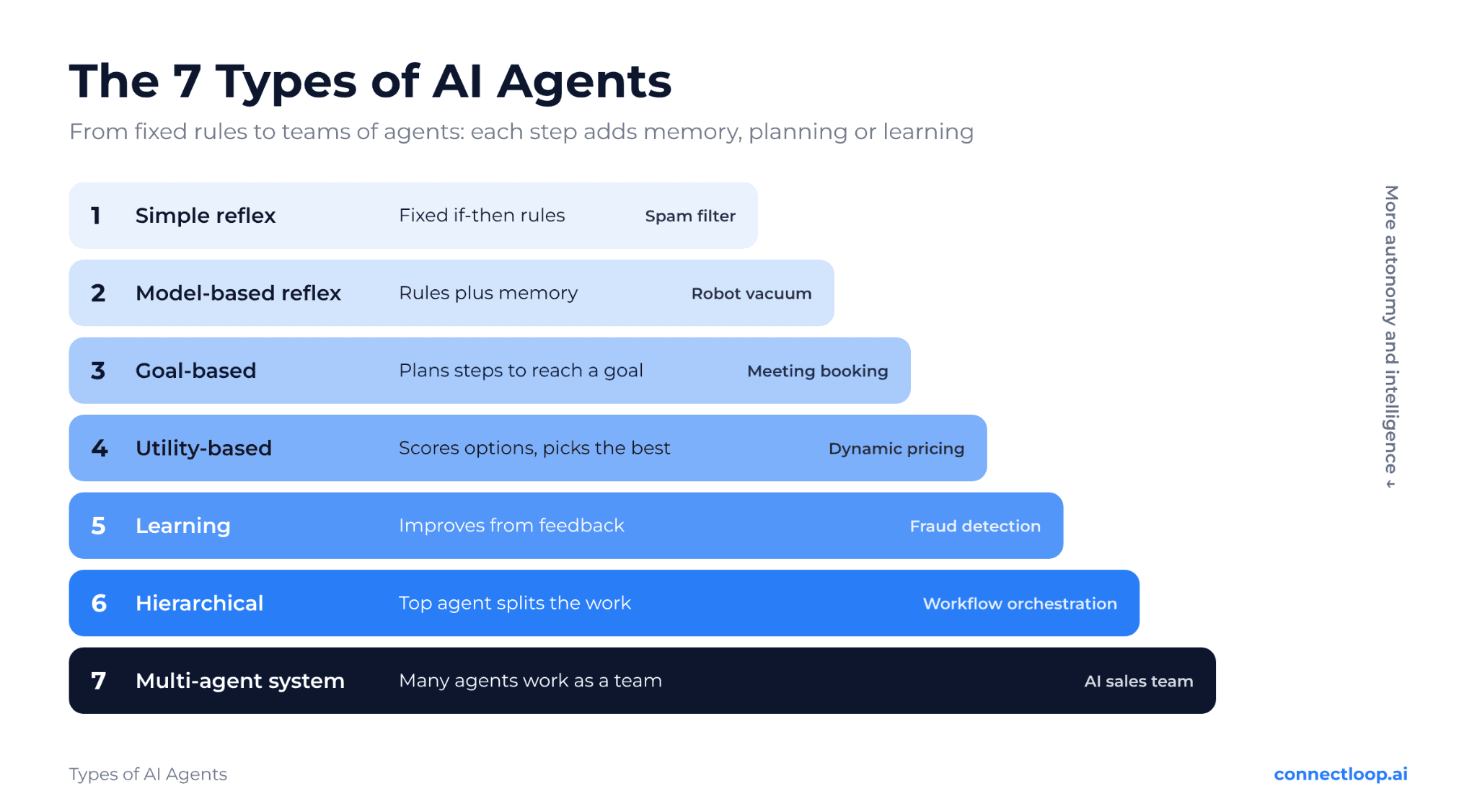
Here is how the seven types compare:
| Type | How it decides | Memory | Learns over time | Best for | Business example |
|---|---|---|---|---|---|
| Simple reflex | Fixed if-then rules | None | No | Simple, predictable tasks | Spam filter, auto-reply |
| Model-based reflex | Rules plus an internal model of the world | Short-term | No | Tasks where not everything is visible | Robot vacuum, inventory alert |
| Goal-based | Plans steps to reach a goal | Yes | No | Tasks with a clear end point | Route planner, meeting booking |
| Utility-based | Picks the option with the best score | Yes | Sometimes | Trade-offs between many options | Dynamic pricing, lead routing |
| Learning | Improves from feedback and results | Yes | Yes | Changing environments | Recommendation engines, fraud detection |
| Hierarchical | A top agent splits work for lower agents | Yes | Sometimes | Large, multi-step jobs | Project or workflow orchestration |
| Multi-agent system | Several agents work together or compete | Yes | Often | Complex work across many tasks | AI sales team: qualify, answer, book, hand off |
The first five types come from classic AI research. Hierarchical agents and multi-agent systems describe how agents are organized, not just how one agent thinks. Most modern products mix several types. For example, an AI sales agent is goal-based, utility-based and learning at the same time.
What does each type of AI agent do?
Each type of AI agent handles a different level of complexity. Simple reflex agents react to one input. Model-based agents track what they cannot see. Goal-based and utility-based agents plan and compare options. Learning agents improve with experience. ConnectLoop's Lia uses the higher types to hold real sales conversations.
1. Simple reflex agents
Simple reflex agents follow condition-action rules: if this happens, do that. They look only at the current input and have no memory of what came before.
- Example: a spam filter that blocks emails containing certain words, or a thermostat that turns on heat below a set temperature.
- Strength: fast, cheap and easy to test.
- Limit: they fail as soon as a situation falls outside their rules.
Some writers also call these reactive agents. They work well when the environment is fully visible and rarely changes. A website popup that says "Need help?" after 30 seconds is a simple reflex agent. ConnectLoop's Lia starts from the conversation itself rather than from a timer.
2. Model-based reflex agents
Model-based reflex agents keep an internal model of the world. This helps them act when they cannot see everything at once, which AI researchers call partial observability.
- Example: a robot vacuum that remembers which rooms it has cleaned, or an inventory system that tracks stock it cannot count in real time.
- Strength: better decisions in places where information is missing.
- Limit: they still follow rules and do not plan toward a goal.
In a sales chat, a model-based agent remembers what the buyer said three messages ago. ConnectLoop's agent keeps that context, so a buyer never has to repeat their company size or use case.
3. Goal-based agents
Goal-based agents choose actions that move them closer to a goal. They use planning and reasoning to compare paths before acting. Some writers call these deliberative agents.
- Example: a navigation app that finds a route to your destination, or an agent whose goal is to book a qualified meeting.
- Strength: flexible, because they can find new paths when the first one is blocked.
- Limit: they treat every path to the goal as equally good.
Most AI appointment booking tools are goal-based. ConnectLoop's agent has a clear goal in each conversation: answer the question, qualify the buyer and book the meeting inside the chat.
4. Utility-based agents
Utility-based agents go one step further. They use a utility function to score each possible action and pick the one with the best result, not just any result that reaches the goal.
- Example: a dynamic pricing engine that weighs demand, stock and margin, or a ride app that balances price and wait time.
- Strength: good at trade-offs between speed, cost, quality and risk.
- Limit: the result is only as good as the scoring rules behind it.
In sales, a utility-based agent decides which question to ask next to qualify a lead with the fewest messages. ConnectLoop applies this idea when Lia chooses between answering, asking a qualifying question or offering a meeting time.
5. Learning agents
Learning agents improve from experience. Classic AI describes four parts: a performance element that acts, a critic that judges results, a learning element that makes changes, and a problem generator that tries new actions.
- Example: recommendation engines that improve as you watch or buy more, or fraud detection systems that learn new fraud patterns.
- Strength: they get better in changing environments.
- Limit: they need good data, and they can learn the wrong lesson from bad data.
Learning agents use machine learning methods such as supervised learning (learning from labeled examples) and reinforcement learning (learning from rewards). ConnectLoop's Conversational Intelligence helps teams see what buyers ask most, so the agent and the team can both improve.
6. Hierarchical agents
Hierarchical agents are organized in levels. A top-level agent breaks a large task into smaller ones and hands each to a lower-level agent.
- Example: a warehouse system where one agent plans the day and smaller agents control each robot.
- Strength: large jobs become manageable.
- Limit: a mistake at the top level spreads down to every lower agent.
The top agent is often called an orchestrator agent. ConnectLoop's AI sales agent uses this pattern: one part reads the conversation and routes it, while others handle answers, qualification and booking.
7. Multi-agent systems
A multi-agent system is a group of agents that work together, or sometimes compete, in a shared environment. Each agent has its own role, and together they handle work that one agent could not.
- Example: a supply chain where separate agents handle demand forecasting, ordering and delivery, or a sales system with separate agents for qualifying and booking.
- Strength: each agent stays focused, so the whole system scales.
- Limit: agents need clear rules for passing work to each other.
The single-agent vs multi-agent choice depends on the job. One agent is enough for a narrow task. A multi-agent system fits a full process like inbound sales, which is why ConnectLoop built Lia as a multi-agent system.
How do the classic types map to modern LLM agents?
Modern LLM agents are built on large language models, but they still fit the classic types. An LLM agent with a goal and tools is goal-based. One that compares options is utility-based. One that improves from feedback is learning. ConnectLoop's Lia combines all three inside one sales conversation.
The classic types were described long before large language models existed. That is why many guides list them without explaining how they apply today. Here is how they connect:
- Perception now includes natural language processing. An LLM agent reads a free-text message instead of a fixed input.
- Reasoning and planning happen inside the language model, which breaks a request into steps.
- Tool use lets the agent act. It can call APIs, check a calendar, search a knowledge base or update a CRM.
- Memory keeps the conversation and past facts, which is the internal model from model-based agents.
- Learning comes from feedback, reviews and new content added to the agent's knowledge.
Older guides also mention hybrid agents, which mix fast reactive rules with slower planning. Almost every LLM agent is a hybrid: simple rules handle safety and routing, while the model handles reasoning. ConnectLoop, for example, uses fixed rules for when to hand off to a human and lets the model handle the conversation itself.
What is agentic AI, and how is it different from an AI agent?
Agentic AI is AI that can plan and take actions on its own to reach a goal, not just answer a prompt. An AI agent is one working unit of agentic AI. In plain words, agentic AI is the approach, and AI agents are the workers. ConnectLoop's sales agent is one example of agentic AI at work.
Agentic AI explained simply: a regular AI tool waits for you to ask, then responds. An agentic system receives a goal, decides the steps, uses tools and checks its own progress. A single AI agent can be agentic, and so can a team of agents working together.
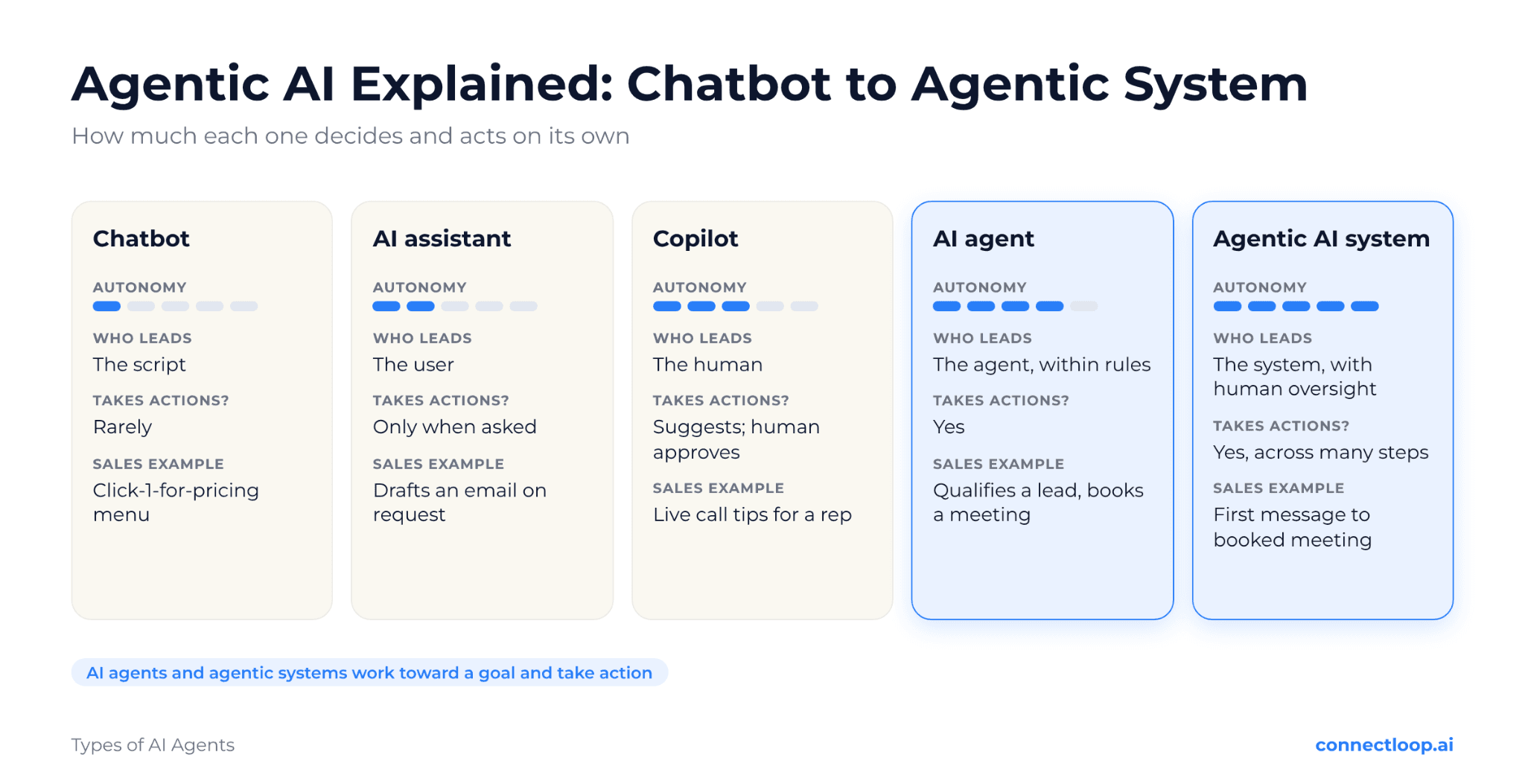
Many people confuse these terms. This table shows the difference:
| Term | What it does | Who leads | Takes actions? | Sales example |
|---|---|---|---|---|
| Chatbot | Answers from a script or keyword list | The script | Rarely | "Click 1 for pricing" menu |
| AI assistant | Answers questions in natural language | The user | Only when asked | A tool that drafts an email when you ask |
| Copilot | Works beside a human inside a tool | The human | Suggests, the human approves | Live call tips for a rep |
| AI agent | Works toward a goal using tools | The agent, within rules | Yes | Qualifies a lead and books a meeting |
| Agentic AI system | Plans and runs multi-step work, often with several agents | The system, with human oversight | Yes, across many steps | Handles inbound from first message to booked meeting |
The difference matters when buying software. Virtual assistants save a rep a few minutes. An AI agent can own a full task, like answering every inbound lead 24/7. ConnectLoop sits in the AI agent and agentic system rows, with a human handoff built into the process.
What types of AI agents do businesses use today?
Businesses use AI agents in sales, customer support, marketing, operations, finance, HR and IT. These are types by job, not by design. Each one still uses the classic types underneath. ConnectLoop focuses on AI sales agents for inbound revenue teams, which answer, qualify and book buyers across website chat, WhatsApp and email.
Here are the most common AI agents in business and what each one does:
- AI sales agents. They answer inbound questions, qualify leads and book meetings. An AI SDR is a similar type focused on top-of-funnel work.
- Customer support agents. They answer common questions from a knowledge base and pass harder cases to a person.
- Customer success agents. They watch account health and suggest when a customer needs attention.
- Marketing agents. They support personalization, content drafts, campaign testing and workflow automation across marketing tools.
- Research agents. They search, read and summarize information for a team.
- Coding agents. They write, test and fix code with a developer reviewing the work.
- Operations and supply chain agents. They use predictive analytics and anomaly detection to plan stock and spot problems early.
- Finance agents. They support fraud detection, invoice processing and reporting.
- HR agents. They screen applications, answer policy questions and schedule interviews.
- IT and security agents. They monitor systems, flag threats and support compliance.
Outside business software, robotics and autonomous vehicles are also AI agents. They use perception from sensors and act in the physical world. Inside a company, the most useful AI agent examples connect to systems you already use, such as your CRM, ERP, calendar and inbox. ConnectLoop connects Lia to the CRM, so every conversation and booked meeting lands where the sales team already works.
Conversational agents deserve a special mention. They are task-oriented agents that work through chat, voice or messaging. A WhatsApp AI agent is one example. Ecommerce brands use the same idea for an AI agent for ecommerce that helps shoppers choose and buy.
What does a multi-agent system look like in a sales team?
In a sales team, a multi-agent system splits inbound work into roles: one agent routes the conversation, one answers from the knowledge base, one qualifies, one books the meeting and one hands off to a human. ConnectLoop's Lia works this way, so each step stays accurate while the buyer sees one smooth conversation.
Here is how one inbound conversation moves through the system:
- Routing. A buyer lands on the website at 9 PM and asks about pricing. The orchestrator agent reads the message and decides what kind of help is needed.
- Answering. A knowledge agent answers from approved company content. ConnectLoop trains the agent on the company's website in about 60 seconds, so answers come from the company's own words. A strong AI knowledge base keeps these knowledge-grounded answers accurate.
- Qualifying. A qualification agent asks the questions that matter, such as team size, timeline and use case. Good inbound lead qualification questions turn a chat into a real opportunity.
- Booking. When the buyer is ready, a booking agent offers open times and books the meeting inside the chat.
- Handoff. If the buyer asks something sensitive, or asks for a person, the system passes the conversation to a rep with the full history.
- Follow-up. If a known lead comes back to the site later, ConnectLoop's Proactive Outreach drafts a follow-up email. A person on the team reviews it and sends it from their own inbox.
The buyer sees one conversation. Behind it, each agent does one job well. This is why multi-agent systems can replace several separate tools. ConnectLoop's agent replaces the live chat widget, the scheduler, the follow-up sequencer and the support inbox with one system.
How much autonomy should an AI agent have?
An AI agent should have only as much autonomy as the task's risk allows. Low-risk tasks, like answering product questions, can run on their own. High-risk tasks, like sending emails or changing records, need human approval. ConnectLoop follows this rule: Lia answers and books on its own, while outreach drafts wait for a person.
Think of autonomy in three levels:
| Level | What the agent does | Human role | Good fit |
|---|---|---|---|
| 1. Suggest | Recommends an action | Decides and acts | Coaching tips, next-best-action ideas |
| 2. Act with approval | Prepares the action | Reviews, then approves or edits | Outbound emails, CRM changes, refunds |
| 3. Act alone | Completes the action within rules | Checks results and handles exceptions | Answering FAQs, booking meetings, routing |
Autonomous agents get a lot of attention, but full autonomy is not always the goal. The right setup uses guardrails, human-in-the-loop review for risky steps and a clear human handoff when the agent reaches its limit.
Human oversight also protects the brand. A wrong answer in a chat can be corrected in seconds. A wrong email sent to 5,000 contacts cannot. That is why ConnectLoop keeps a person in charge of every outreach email.
How do you choose the right type of AI agent?
Choose an AI agent by starting with the task, not the technology. Define the goal, the risk, the data you have and the systems the agent must connect to. Then pick the simplest type that does the job well. ConnectLoop recommends starting with one high-volume task, such as answering inbound leads, and growing from there.
Here is how to choose an AI agent in nine steps:
- Name one task. Pick a task that happens often and has a clear outcome, such as "reply to every inbound lead within one minute."
- Check the environment. If everything is visible and rules rarely change, a simple reflex agent may be enough. If the agent must remember context, you need a model-based agent or higher.
- Define the goal and trade-offs. One clear goal points to a goal-based agent. Many trade-offs point to a utility-based agent.
- Decide if it must improve. If buyer questions change often, choose a learning agent that improves from feedback.
- Set the autonomy level. Match each action to suggest, act with approval or act alone.
- Check integrations. The agent must connect to your CRM, calendar and messaging channels through reliable integrations.
- Review data privacy and security. Ask where data is stored, who can see it and how the vendor handles compliance and governance.
- Plan for scalability. A single agent may be fine today. A multi-agent system is easier to grow as you add channels and tasks.
- Estimate the cost and ROI. Compare the cost of AI agents with the cost of slow replies, missed leads and extra tools.
For most sales teams, the first good fit is an inbound agent. Fast replies matter, as ConnectLoop explains in speed to lead. An agent that answers every lead in seconds, day and night, removes the slowest step in the process. Teams comparing options can also read live chat vs AI agent before deciding.
What are the limits of AI agents?
AI agents are only as good as their data, rules and setup. They can give wrong answers when the knowledge base is thin, struggle with rare or emotional situations, and need clear limits on what they may do alone. ConnectLoop's view is simple: an AI agent should handle volume, and people should handle judgment.
Here are the main implementation challenges to plan for:
- Data quality. An agent trained on outdated pages will give outdated answers. Keep the knowledge base current.
- Hallucination risk. Language models can sound sure while being wrong. Grounding answers in approved content reduces this risk.
- Edge cases. Complaints, legal questions and complex deals need a person. Set rules for when the agent hands off.
- Integration gaps. An agent that cannot see the calendar or the CRM cannot finish the job.
- Trust. Some buyers prefer to talk to a person. Let them ask for one at any time.
There are also tasks where an AI agent is the wrong choice. Final pricing negotiations, contract terms and sensitive customer issues stay a human job. ConnectLoop is built around this split: Lia handles the first conversation, and the sales team takes over where human judgment adds the most value.
How do you measure whether an AI agent is working?
Measure an AI agent by the outcome it was built for, not by how many messages it sends. For a sales agent, track response time, qualified leads, meetings booked, handoff rate and conversion to pipeline. ConnectLoop reports these numbers from each conversation so teams can see what the agent adds to revenue.
Track these metrics in the first 30 days:
| Metric | What it shows | What to look for |
|---|---|---|
| First response time | How fast buyers get an answer | Seconds, at any hour |
| Resolution rate | Share of questions answered without a person | Rising as the knowledge base improves |
| Qualified lead rate | Share of conversations that meet your criteria | Steady or rising |
| Meetings booked | Meetings booked directly by the agent | Rising week over week |
| Handoff rate | Share of conversations passed to a rep | Stable, with clear reasons |
| Pipeline created | Value of opportunities from agent conversations | Growing over the quarter |
Review a sample of conversations every week. Look for wrong answers, missed questions and handoffs that came too late. Teams that use lead scoring can also compare agent-qualified leads with leads from other sources. ConnectLoop's Conversational Intelligence shows the most common buyer questions, which helps teams fix gaps fast.
Looking ahead, the future of AI agents points toward more multi-agent systems, deeper tool use and better guardrails. For small and mid-size teams, the opportunity is already here: one AI agent can give buyers fast answers 24/7 and free reps to focus on the conversations that close. ConnectLoop helps teams start with inbound, then grow from there.
Key takeaways
- There are seven core types of AI agents: simple reflex, model-based reflex, goal-based, utility-based, learning, hierarchical and multi-agent systems.
- The types differ in how they decide, from fixed condition-action rules to planning, scoring and learning from results.
- Modern LLM agents still fit the classic types. Most business agents, including ConnectLoop's Lia, combine several types at once.
- Agentic AI is the approach of AI that plans and acts toward a goal. AI agents are the workers that carry it out.
- Businesses use AI agents in sales, support, marketing, operations, finance, HR and IT, and the best ones connect to the CRM and other existing tools.
- Match autonomy to risk: let agents act alone on low-risk tasks and keep humans in charge of risky ones.
- Start with one high-volume task, such as answering inbound leads, and choose the simplest agent type that does it well.
- Measure outcomes such as response time, meetings booked, handoff rate and pipeline, not message counts.

About the author
ConnectLoop Staff
Written by the ConnectLoop team. ConnectLoop is an AI sales agent for inbound revenue teams, based in Cambridge, Massachusetts.
About ConnectLoop →Frequently asked questions
The five classic types of AI agents are simple reflex, model-based reflex, goal-based, utility-based and learning agents. Many guides now add two more, hierarchical agents and multi-agent systems, for seven in total. ConnectLoop's AI sales agent uses goal-based, utility-based and learning behavior within a multi-agent system.
A common AI agent example is an AI sales agent that answers website visitors, qualifies them and books meetings. Other examples include spam filters, robot vacuums, navigation apps, recommendation engines and fraud detection systems. ConnectLoop's Lia is an AI agent that works across website chat, WhatsApp and email.
ChatGPT on its own is mainly an AI assistant: it answers when you ask. It becomes more agent-like when it is given a goal and tools, such as web search or the ability to take actions. An AI agent like ConnectLoop's works toward a set outcome, such as booking a qualified meeting.
A chatbot usually follows a script or keyword rules and returns fixed answers. An AI agent understands natural language, works toward a goal and takes actions such as booking meetings or updating a CRM. ConnectLoop's agent replaces scripted chatbots with real conversations that move buyers forward.
Agentic AI is AI that can plan steps and take actions to reach a goal, rather than only replying to a prompt. It often uses several AI agents working together. ConnectLoop's sales agent is a practical example of agentic AI, with human oversight built in.
Yes, for low-risk tasks like answering common questions, routing chats or booking meetings. Riskier actions, such as sending outbound emails or changing records, should have human approval. ConnectLoop's agent answers and books on its own, while Proactive Outreach drafts emails that a person reviews and sends.
There is no single best type. The right choice depends on the task, the risk and the data available. For sales teams, a multi-agent system that combines goal-based, utility-based and learning behavior works best, which is the approach ConnectLoop uses for inbound conversations.
AI agents use a knowledge base to give accurate answers grounded in approved company content. This reduces wrong or made-up answers. ConnectLoop trains its agent on a company's website in about 60 seconds, and teams can add more content to improve answers over time.
One conversation for the buyer, five agents behind it
ConnectLoop's Lia is a multi-agent system built for inbound sales: one agent routes the conversation, one answers from your approved content, one qualifies, one books the meeting inside the chat, and one hands off to a rep with the full history. Outreach drafts still wait for a person. The buyer only ever sees one smooth conversation.