
Sales Process
What Is Enterprise Sales? A Complete Guide to Winning Large, Complex Deals
Enterprise sales is the process of selling high-value products or services to large organizations, where many people are involved in the decision and deals take months rather than days. This guide covers how enterprise sales differs from SMB sales, the 7-stage enterprise sales process, a stakeholder map, a sample mutual action plan, a month-by-month deal example, and how ConnectLoop helps teams keep long deals moving.

Published
Table of contents
- What is enterprise sales?
- How is enterprise sales different from SMB and mid-market sales?
- Why does enterprise sales matter?
- What are the biggest challenges in enterprise sales?
- What does the enterprise sales process look like?
- Who is in the enterprise buying committee?
- What does a mutual action plan look like?
- What should you prepare for security, legal and procurement?
- What does an enterprise deal look like, month by month?
- How long is the enterprise sales cycle?
- How do enterprise deals start inbound?
- How do you keep a long enterprise deal from stalling?
- Which enterprise sales strategies work best?
- How do you build an enterprise sales team?
- How do you create an enterprise sales model?
- Which enterprise sales metrics matter most?
- How is AI changing enterprise sales?
- How can a startup win its first enterprise customer?
- Which enterprise sales mistakes should you avoid?
- Key takeaways
- Frequently asked questions
What is enterprise sales?
Enterprise sales, sometimes called complex sales, is B2B sales to large organizations. Deals are high-value, the enterprise sales cycle is long, and a buying committee of several stakeholders, not one person, makes the decision. Winning requires consultative selling, tailored solutions, a clear business case and patience through security, legal and procurement reviews.
Enterprise clients are usually large companies with many departments, formal buying processes, compliance rules and a lot at stake in every purchase. A wrong choice affects hundreds or thousands of employees, so they move carefully.
That changes everything about how you sell. Instead of convincing one buyer in one call, you guide a group of decision-makers through a structured evaluation, step by step. ConnectLoop is built for the parts of that journey where details get lost: many calls, many people and many promises.
How is enterprise sales different from SMB and mid-market sales?
The main differences are deal size, the number of decision-makers and the length of the sales cycle. SMB sales often close in days with one buyer. Mid-market sales involve a small team and take weeks. Enterprise sales involve a full buying committee, formal reviews and months of work, but the contracts are much larger and last longer.
| SMB sales | Mid-market sales | Enterprise sales | |
|---|---|---|---|
| Typical buyer | Owner or manager | Department head with a small team | Buying committee across several departments |
| Decision-makers | One or two | A few | Many stakeholders, including executives |
| Sales cycle | Days to weeks | Weeks to a few months | Several months, sometimes over a year |
| Deal size | Small | Medium | Large annual contract value |
| Sales approach | Fast, transactional or self-service | Consultative, light process | Consultative, highly tailored, multi-threaded |
| Reviews | Rarely | Sometimes | Security review, legal review and procurement |
| Proof needed | A demo or free trial | A demo and references | Business case, case studies, often a pilot |
| Team involved | One rep | A rep, sometimes a sales engineer | Account executive, sales engineer, SDR, customer success, leadership |
None of these models is better than the others. Many companies sell to all three, with a different process for each. ConnectLoop works across all of them: Lia handles fast inbound conversations, while Sales Assistance and Customer Intelligence support the long, multi-call deals typical of enterprise sales.
Why does enterprise sales matter?
Enterprise sales matters because a single enterprise customer can be worth as much as dozens of smaller ones. Enterprise contracts tend to be larger, last longer and grow over time through expansion and renewal. They also bring credibility: a well-known enterprise logo makes the next enterprise deal easier to win.
The main benefits:
- Larger, steadier revenue. One deal can change a company's growth for the year.
- Long-term relationships. Enterprise customers rarely switch vendors lightly, so retention is high when you deliver.
- Room to grow. Once inside, you can expand to more teams, regions and products. The ConnectLoop guide to upselling and cross-selling covers how.
- Credibility. Enterprise customers act as proof for every future buyer.
- Better product. Enterprise feedback pushes a product to become more reliable and complete.
The trade-off is cost and time. Enterprise deals need more people, more preparation and more patience, so customer acquisition cost is higher. ConnectLoop helps reduce the effort by keeping every conversation, promise and stakeholder detail in one place.
What are the biggest challenges in enterprise sales?
The biggest challenges are long sales cycles, large buying committees, competing priorities between stakeholders, slow security and procurement reviews, and keeping momentum across months of calls. Most enterprise deals aren't lost to a competitor. They're lost because they stall, a stakeholder goes quiet or a key question never gets answered.
The most common challenges:
- Many decision-makers. Each stakeholder has different goals, and any one of them can slow or block the deal.
- Long cycles. Months of work create many chances for priorities to change.
- Single-threading. Relying on one contact is risky if they change roles or lose interest.
- Formal reviews. Security, legal and procurement each add steps and time.
- Lost details. With many calls and many people, promises and questions slip through the cracks.
- Proving value. Large organizations need a clear business case and ROI, not just a good demo.
ConnectLoop's Customer Intelligence is built for the last two problems. It tracks promises your team made and questions buyers asked as Action Items, tagged Buyer waiting, so nothing is forgotten across a long deal.
What does the enterprise sales process look like?
The enterprise sales process has 7 stages: identify target accounts, run discovery and qualification, map the buying committee, build the business case, prove value, clear security, legal and procurement, and negotiate and close. Each stage has its own goal, and skipping one usually costs time later.
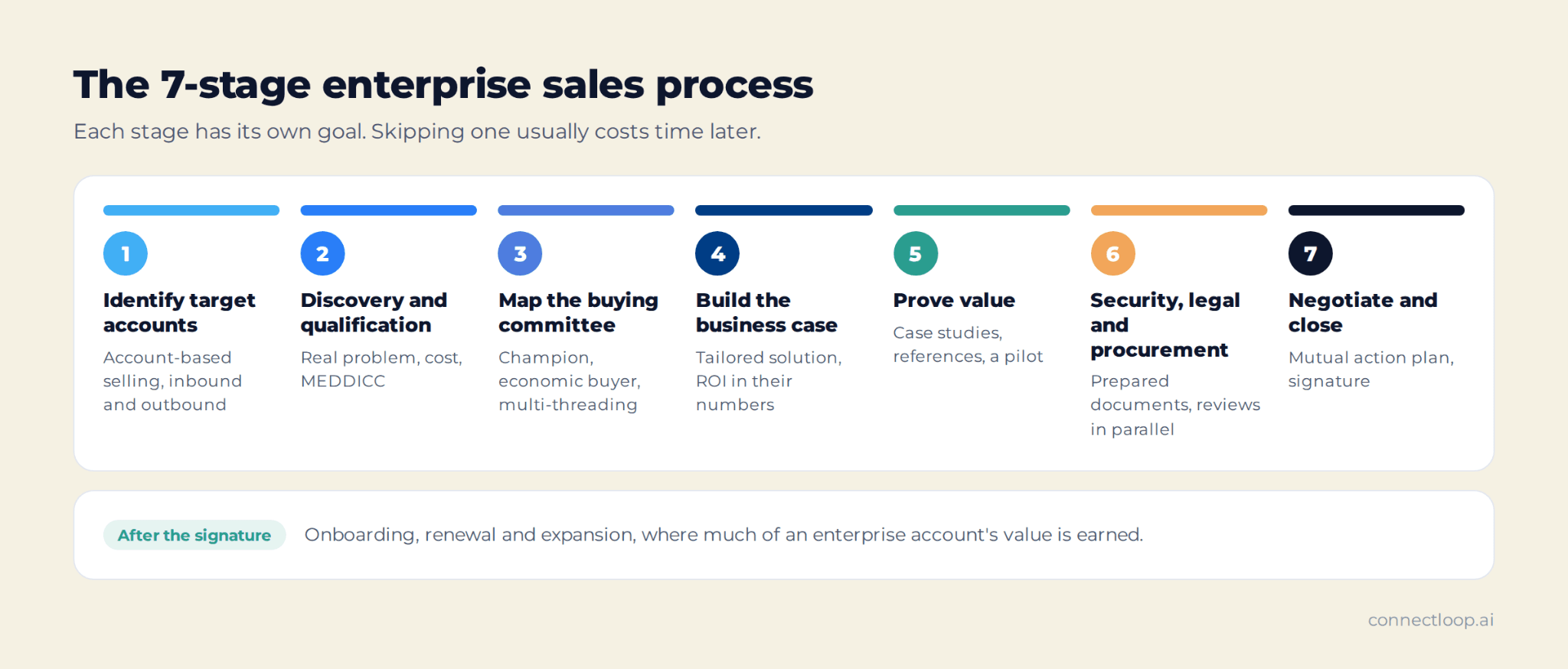
1. Identify target accounts
Choose the organizations that fit your ideal customer profile and where you can deliver strong results. Many teams use account-based selling: a short list of high-value accounts, each with a tailored approach. Prospecting is often shared between an SDR, who opens the door, and an account executive, who runs the deal. The ConnectLoop guide to SDR vs BDR explains the roles.
2. Run discovery and qualification
Learn the buyer's real problem, its cost, who's involved and how they'll decide. Enterprise teams often qualify with MEDDICC, which covers metrics, the economic buyer, decision criteria, decision process, pain, the champion and competition. See the ConnectLoop guide to the MEDDPICC sales methodology.
3. Map the buying committee
Identify every stakeholder who will influence the decision, what each cares about, and who your champion is. Then build relationships with several of them. This is called multi-threading, and it protects the deal if one contact goes quiet.
4. Build the business case
Turn discovery into a clear, written case: the problem, the cost of doing nothing, the proposed solution and the expected ROI in the buyer's own numbers. This is solutioning, shaping a tailored solution around the buyer's situation rather than presenting a standard product.
5. Prove value
Show that it works in the buyer's world, through relevant case studies, a reference call with a similar customer, or a short pilot or proof of concept with clear success criteria agreed in advance.
6. Clear security, legal and procurement
Answer the security review, agree contract terms with legal, and work through procurement's vendor process. These steps often run in parallel, so start them as early as the buyer allows.
7. Negotiate and close
Agree final pricing, terms and start date, and get the signatures. A mutual action plan keeps this stage from dragging. The ConnectLoop guide on how to negotiate in sales covers the conversations at this stage.
After the signature comes onboarding, then renewal and expansion, where much of the long-term value of an enterprise account is earned. ConnectLoop's Sales Assistance can follow a custom framework of up to 12 steps, such as a MEDDICC framework, and shows live cue cards on Google Meet and Zoom, so reps cover every step across a long, multi-call deal.
Who is in the enterprise buying committee?
An enterprise buying committee usually includes an economic buyer who controls the budget, a champion who wants the deal to happen, technical buyers who check fit, end users who will use the product, and gatekeepers from security, legal and procurement. Each needs something different before they'll say yes.
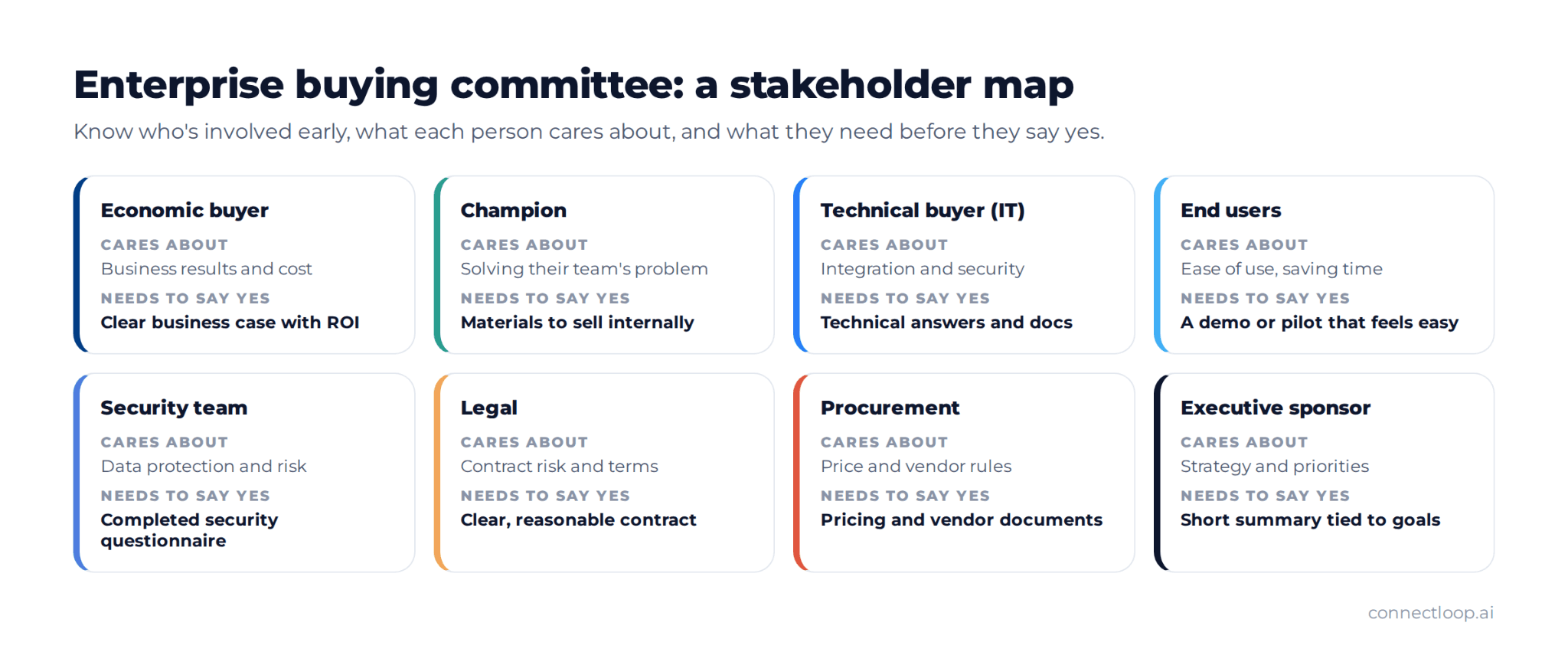
Stakeholder map: who they are and what they need
| Role | What they care about | What they need to say yes |
|---|---|---|
| Economic buyer | Business results and cost | A clear business case with ROI |
| Champion | Solving their team's problem, looking good internally | Materials to sell the deal internally on your behalf |
| Technical buyer (IT) | Integration, reliability, security | Technical answers, documentation, a sales engineer's support |
| End users | Ease of use, saving time | A hands-on demo or pilot that feels easy |
| Security team | Data protection and risk | Completed security questionnaire and policies |
| Legal | Contract risk and terms | Clear, reasonable contract language |
| Procurement | Price, vendor rules, comparison | Pricing, vendor documents and a fair process |
| Executive sponsor | Strategy and priorities | A short summary tied to company goals |
Not every deal includes every role, and one person can play several. The goal is to know who's involved early, not to discover a new decision-maker in month five. ConnectLoop's Customer Persona keeps confirmed details about each person and company from approved sales calls, so the whole team knows who's who.
What does a mutual action plan look like?
A mutual action plan is a shared, dated list of every step both sides need to complete before signing, with an owner for each. It turns a vague "we'll get back to you" into a clear path to a decision, and it's one of the most effective ways to stop enterprise deals from stalling.
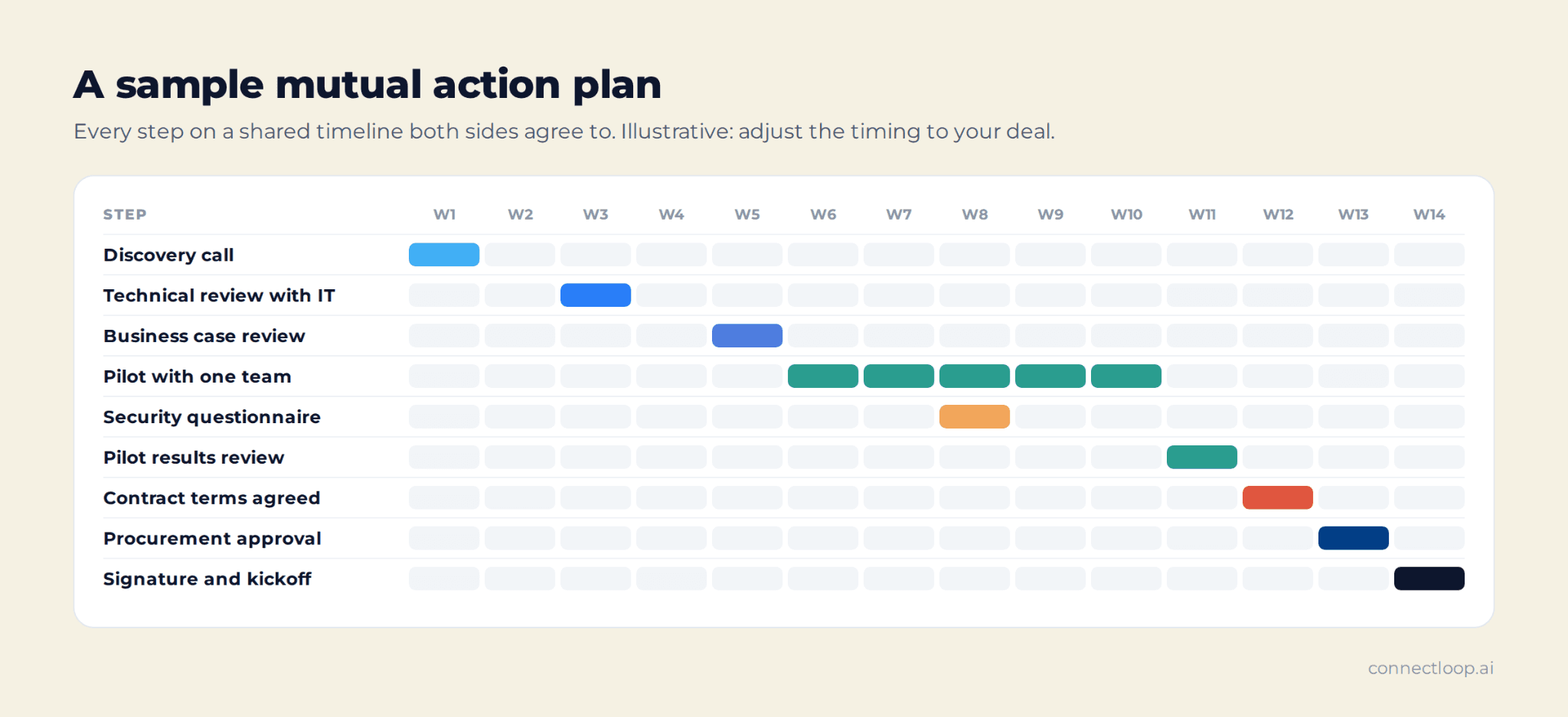
Sample mutual action plan (illustrative)
| Step | Owner | Target date |
|---|---|---|
| Discovery call with the champion and team lead | Seller and champion | Week 1 |
| Technical review with IT | Sales engineer and IT lead | Week 3 |
| Business case review with the economic buyer | Seller and champion | Week 5 |
| Pilot with one team, success criteria agreed | Both teams | Weeks 6–10 |
| Security questionnaire completed | Seller and security team | Week 8 |
| Pilot results review | Both teams | Week 11 |
| Contract terms agreed | Legal teams | Week 12 |
| Procurement approval | Procurement | Week 13 |
| Signature and kickoff date set | Economic buyer and seller | Week 14 |
Share the plan with your champion early, and update it after every call. When a date slips, the plan shows it immediately, and the conversation about why becomes easy. ConnectLoop's post-call report from Sales Assistance includes action items and a follow-up email draft, which makes updating the plan after each call quick.
What should you prepare for security, legal and procurement?
Prepare your security documentation, standard contract and vendor paperwork before the buyer asks for them. Security, legal and procurement reviews are where many enterprise deals lose weeks, usually because the seller starts collecting documents only after the request arrives.
Security review checklist
- A completed standard security questionnaire you can reuse.
- Data protection and privacy policies.
- How data is stored, encrypted and accessed.
- Certifications and verifications you actually hold, described accurately.
- Incident response and uptime information.
- A named contact who can answer technical follow-up questions.
Legal review checklist
- A clear standard contract or master services agreement.
- A data processing agreement, if personal data is involved.
- Your positions on common requests, like liability limits and termination terms.
Procurement checklist
- Company registration and tax documents.
- Insurance certificates, if requested.
- A clear pricing sheet with options.
- Bank details and invoicing information.
Ask your champion early: "What will security, legal and procurement need from us?" ConnectLoop's Ask feature in Customer Intelligence lets your team check questions like "What is still open with this customer?" before each review meeting.
What does an enterprise deal look like, month by month?
A typical enterprise deal moves from a first conversation to a signed contract over several months, through discovery, stakeholder mapping, a business case, a pilot and formal reviews. The example below is illustrative, not a benchmark, but it shows how the stages fit together in practice.
Example: a software company selling to a large logistics firm
- Month 1: First contact. The firm's head of sales operations asks detailed questions on the seller's website chat after hours. The conversation is qualified, and a discovery call is booked.
- Month 1: Discovery. The account executive learns the problem (slow response to inbound leads across 12 regional offices), its cost and who's involved. The head of sales operations becomes the champion.
- Month 2: Stakeholder mapping. The champion introduces IT, two regional managers and the VP of Sales, who is the economic buyer. The seller meets each one.
- Month 2: Business case. The seller builds a short business case using the firm's own numbers and shares a mutual action plan.
- Month 3: Pilot. One regional office runs a 30-day pilot with success criteria agreed upfront.
- Month 3: Security review. The security team sends its questionnaire. The seller answers within a week, using prepared documents.
- Month 4: Results and legal. The pilot meets its criteria. Legal teams agree contract terms.
- Month 5: Procurement and signature. Procurement approves the vendor, and the VP of Sales signs a contract for all 12 offices.
- Month 6 onward: Onboarding and expansion. The offices roll out in phases, and the customer later adds a second product.
Notice what kept this deal moving: a champion, a written plan, a pilot with clear criteria and prepared documents. ConnectLoop supports each of these, from qualifying the first inbound conversation to tracking every open item across five months.
How long is the enterprise sales cycle?
The enterprise sales cycle often lasts several months, and large or highly regulated deals can take a year or more. The length depends on deal size, the number of stakeholders, how urgent the buyer's problem is, and how quickly security, legal and procurement reviews move.
What shortens the cycle:
- Urgency. A real deadline or a costly problem moves deals faster than anything else.
- A strong champion who pushes the deal internally.
- A mutual action plan with agreed dates.
- Starting reviews early. Run security and legal in parallel with the pilot, not after it.
- Prepared documents that answer questions before they're asked.
What lengthens it:
- Single-threaded deals.
- Unclear decision processes.
- Unanswered stakeholder questions.
- Pilots without success criteria.
ConnectLoop's Customer Intelligence lets you set a time limit for each stage, such as 14 days in Negotiation, and flags any deal that stays longer, so slow deals get attention early. The ConnectLoop guide to the sales pipeline explains stage limits in detail.
How do enterprise deals start inbound?
Many enterprise deals start with a buyer researching quietly: reading your website, comparing options and asking detailed questions before talking to sales. Answering those questions quickly and well, and qualifying the buyer in the same conversation, can put an enterprise deal into your pipeline without any outbound prospecting. The ConnectLoop guide to inbound vs outbound sales compares the two approaches.
What enterprise buyers often ask early:
- "Does it integrate with our CRM?"
- "How do you handle data security?"
- "Can it work across multiple regions and languages?"
- "What does pricing look like for a large team?"
ConnectLoop's AI sales agent, Lia, answers these questions on website chat, WhatsApp and email, from your own content, at any hour. On the Scale and Enterprise plans, Lia can qualify in conversation using MEDDICC, scores each lead Hot, Warm or Cold with the reasoning, and books the discovery call. With Visitor Intelligence, on the Growth plan and above with the Cookie Consent Banner on, the buyer's earlier browsing is attached to their record once they share their details. See website visitor identification and inbound lead qualification.
How do you keep a long enterprise deal from stalling?
Keep enterprise deals moving by multi-threading across stakeholders, keeping a mutual action plan with dates, answering every question quickly, keeping every promise, and watching how long each deal sits in each stage. Most stalls start small: one unanswered question, one missed follow-up, one stakeholder nobody spoke to.
Habits that prevent stalls:
- Talk to several stakeholders, not one. If your champion goes quiet, the deal continues.
- End every call with a dated next step.
- Answer every question within a day, even if the answer is "I'll confirm by Thursday."
- Keep every promise. In enterprise deals, small broken promises add up to lost trust.
- Review stalled deals weekly. Ask what's blocking each one, not just what stage it's in.
- Re-engage quiet stakeholders with value. A useful answer or resource restarts a conversation better than "just checking in." See the ConnectLoop guide to the follow-up email after no response.
ConnectLoop helps here in several ways:
- Action Items: Customer Intelligence picks up action items from every call and conversation, and tags unanswered questions and your team's promises as Buyer waiting.
- Stale stage alerts: these flag deals that sit too long in one stage.
- Ask: managers can type questions like "Which enterprise deals in Negotiation haven't been contacted this week?" and get an answer with the records behind it.
Which enterprise sales strategies work best?
The enterprise sales strategy that works best combines focusing on a small number of well-chosen accounts, leading with discovery, multi-threading, building a written business case, proving value with pilots and references, preparing for reviews early, and treating the signature as the start of the relationship rather than the end.
- Focus on fewer, better accounts. Account-based selling beats spreading effort thin.
- Lead with discovery, not the demo. Understand the problem before proposing anything. The ConnectLoop guide to discovery call questions helps.
- Multi-thread early. Meet several stakeholders in the first few weeks.
- Write the business case with the champion. Make it easy for them to sell internally.
- Use proof that matches the buyer. Case studies and references from similar companies carry the most weight.
- Prepare for reviews before they start.
- Plan for expansion from day one. The first contract is rarely the largest one.
ConnectLoop's Sales Training lets reps practice these conversations with an AI buyer across 4 personas and 3 difficulty levels before facing a real executive. The ConnectLoop guide to sales role-play shows how to make that practice realistic.
How do you build an enterprise sales team?
An enterprise sales team usually includes account executives who run deals, sales engineers who handle technical questions, SDRs who open new accounts, customer success managers who drive onboarding and expansion, and a sales leader who coaches and forecasts. The right people combine patience, curiosity, business acumen and strong relationships.
The core roles:
- Account executive: owns the deal from discovery to signature.
- Sales engineer: answers technical questions, runs demos and supports pilots.
- SDR: researches and opens conversations with target accounts.
- Customer success manager: owns onboarding, adoption, renewal and expansion.
- Sales leader: coaches the team, reviews the pipeline and owns the sales forecast.
Skills that matter most in enterprise sales:
- Patience and persistence across long cycles.
- Business acumen: understanding how large organizations make money and decisions.
- Discovery and active listening.
- Writing: business cases and summaries for executives.
- Coordination: keeping many stakeholders and internal teams aligned.
A clear sales playbook keeps the whole team working the same way, and regular sales call coaching helps new enterprise reps ramp faster. ConnectLoop's Sales Assistance post-call report includes a coaching note, which gives managers a starting point for each review.
How do you create an enterprise sales model?
To create an enterprise sales model, choose where you can win, define your ideal enterprise customer, design a repeatable process with clear stages and exit criteria, prepare your proof and review documents, and set up the team and tools to support long deals. Start with one segment and expand once the model works.
- Pick your segment. Choose the industries and company sizes where your product delivers the clearest results.
- Define your ideal enterprise customer. Write down the size, problems and buying triggers of your best-fit accounts.
- Design the process. Use the 7 stages above, with exit criteria for each. The ConnectLoop guide to the stages of the sales process shows how to define them.
- Choose a qualification framework. MEDDICC is common in enterprise sales. The ConnectLoop guide to BANT vs MEDDIC compares options.
- Prepare your proof. Case studies, references and a pilot template.
- Prepare your review pack. Security, legal and procurement documents, ready before you need them.
- Make sure your product scales. Enterprise customers need room to add users, teams and regions.
ConnectLoop's Customer Intelligence Pipeline lets you set your own stages, so your enterprise process lives in the same place as your conversations.
Which enterprise sales metrics matter most?
The metrics that matter most in enterprise sales are annual contract value, win rate, sales cycle length, pipeline coverage, customer acquisition cost, net revenue retention and forecast accuracy. Because deals are few and large, each metric should be read alongside the deals behind it, not just as a number.
- Annual contract value (ACV): the average yearly value of a contract. It shows the size of the deals you win.
- Win rate: deals won ÷ (deals won + deals lost). It shows how well you compete and qualify.
- Sales cycle length: average days from first contact to signature. It shows how quickly deals move.
- Pipeline coverage: pipeline value ÷ sales target. It shows whether there's enough pipeline to hit the target.
- Customer acquisition cost: total sales and marketing cost ÷ new customers. It shows what each new customer costs.
- Net revenue retention: (starting revenue + expansion − contraction − churn) ÷ starting revenue. It shows whether existing customers grow over time.
- Forecast accuracy: forecasted revenue compared with actual revenue. It shows how reliable your pipeline is.
Track each metric against your own history first. ConnectLoop's Pipeline view shows every deal by stage, last touch and open items, which makes it easier to see the deals behind the numbers.
How is AI changing enterprise sales?
AI is changing enterprise sales by answering buyer questions instantly, qualifying inbound interest, supporting reps during calls, capturing action items automatically, and helping teams track long, complex deals. People still own the relationships and judgment. AI handles the speed and the details that are easy to lose.
Where AI helps most in enterprise deals:
- Inbound response: answering detailed buyer questions at any hour and qualifying in conversation.
- Call support: live cues that remind reps to cover each step of their framework.
- Follow-up: action items and follow-up email drafts after every call.
- Deal tracking: spotting stalled deals and unanswered questions across many stakeholders.
- Practice: rehearsing executive conversations before they happen.
For the basics of how these agents work, see the ConnectLoop guide to what is an AI sales agent. ConnectLoop brings these together:
- Lia: handles inbound conversations.
- Sales Assistance: supports live calls.
- Customer Intelligence: tracks every promise and stage.
- Sales Training: lets reps practice enterprise conversations with an AI buyer.
How can a startup win its first enterprise customer?
A startup can win its first enterprise customer by picking a narrow problem it solves better than anyone, finding a champion who feels that problem every day, offering a low-risk pilot with clear success criteria, preparing for security and legal questions early, and delivering an excellent first rollout that becomes the reference for the next deal.
- Start narrow. Solve one painful problem for one team, not everything for everyone.
- Find a champion, someone who will personally benefit from your success.
- Offer a low-risk pilot, short, focused and measured.
- Be enterprise-ready on paper. Prepare security answers, a clear contract and a pricing sheet before the first meeting.
- Over-deliver on the first rollout. Your first enterprise customer is your best sales asset for the next one.
- Expand from inside. Once one team succeeds, help the champion introduce you to the next.
ConnectLoop is used by small teams that need enterprise-level discipline without an enterprise-sized staff. Customer Intelligence and Sales Assistance keep long deals organized, even for a team of a few people.
Which enterprise sales mistakes should you avoid?
The most common enterprise sales mistakes are relying on a single contact, demoing before discovery, ignoring the economic buyer, starting security and legal reviews too late, running pilots without success criteria, and letting promises slip across a long deal. Each one adds weeks to the cycle or quietly ends the deal.
- Single-threading. One contact is one point of failure.
- Demo first, discovery later. The pitch misses what the buyer actually needs.
- Never meeting the economic buyer. The person who controls the budget decides, so meet them.
- Late reviews. Security and legal can take as long as the rest of the deal.
- Open-ended pilots. Without success criteria, a pilot never ends in a decision.
- Forgotten promises. Every missed follow-up costs trust with a stakeholder.
- Treating the signature as the finish line. Most enterprise value comes from expansion and renewal.
ConnectLoop's Buyer waiting items and stale stage alerts help catch the last two problems before they cost the deal.
Key takeaways
- Enterprise sales is B2B sales to large organizations, with high-value deals, long sales cycles and a buying committee of several stakeholders.
- It differs from SMB and mid-market sales in deal size, the number of decision-makers and formal security, legal and procurement reviews.
- The enterprise sales process has 7 stages: target accounts, discovery and qualification, mapping the buying committee, the business case, proving value, reviews, and negotiation and close.
- A stakeholder map and a mutual action plan are two of the most effective tools for keeping enterprise deals on track.
- Preparing security, legal and procurement documents early can save weeks.
- Many enterprise deals start inbound, with buyers asking detailed questions before talking to sales.
- Most enterprise deals stall from small things: an unanswered question, a missed promise or a single contact.
- ConnectLoop helps enterprise teams qualify inbound buyers with Lia, cover every step on calls with Sales Assistance, and track every promise and stage with Customer Intelligence.

About the author
ConnectLoop Staff
Written by the ConnectLoop team. ConnectLoop is an AI sales agent for inbound revenue teams, based in Cambridge, Massachusetts.
About ConnectLoop →Frequently asked questions
Enterprise sales is selling expensive products or services to large organizations. Many people are involved in the decision, the process takes months, and the seller has to guide a buying committee through discovery, a business case, reviews and negotiation before the contract is signed.
SMB sales usually involve one or two decision-makers, small deals and short cycles of days or weeks. Enterprise sales involve a buying committee, large contracts, formal security, legal and procurement reviews, and sales cycles of several months or longer.
The enterprise sales cycle often lasts several months, and large or regulated deals can take a year or more. A strong champion, a mutual action plan, urgency on the buyer's side and early security and legal reviews all help shorten it.
A buying committee is the group of people who influence or approve an enterprise purchase. It usually includes an economic buyer, a champion, technical buyers, end users, and reviewers from security, legal and procurement, each with their own priorities.
A mutual action plan is a shared, dated list of every step both the buyer and seller need to complete before signing, with an owner for each step. It keeps enterprise deals moving and makes delays visible as soon as they happen.
Enterprise salespeople need patience, strong discovery and active listening, business acumen, clear writing for business cases, and the ability to coordinate many stakeholders and internal teams over a long sales cycle.
MEDDICC is one of the most common frameworks for enterprise sales, because it covers metrics, the economic buyer, decision criteria, the decision process, pain, the champion and competition. These are the details that decide large, complex deals.
ConnectLoop's Lia answers inbound enterprise buyers on website chat, WhatsApp and email, and can qualify with MEDDICC on the Scale and Enterprise plans. Sales Assistance shows live cues on Google Meet and Zoom calls, and Customer Intelligence tracks every promise, question and stage across long deals.
Who on the committee have you not met yet?
Take your largest open deal and write down every person who will influence it, then mark the ones you have actually spoken to. The gap is where deals go quiet. ConnectLoop keeps each stakeholder's details, every promise your team made and the age of every stage in one place, so a six-month deal doesn't stall over something small.